
Last reviewed: September 2026
You've spent five years learning a carrier's appetite well enough to bind a risk without asking anyone. You know which contractor classes your company quietly hates, which brokers pad their submissions, and what a clean loss run looks like versus a laundered one. And when you type "remote underwriting jobs" into a job board, LinkedIn tells you there are 6,000-plus of them, and they turn out to be mortgage shops, hybrid seats in Hartford, and a Liberty Mutual page that ranks first for the keyword while showing a single remote underwriting role.
The assumption almost everyone brings to this search is that underwriting is desk work, so it must be the most naturally remote job in insurance. That's technically true and practically misleading. The big carriers went hybrid by default after 2022 and kept the genuinely remote seats for people who already hold underwriting authority. The abundant fully remote "underwriter" jobs belong to a different profession that happens to share the title: mortgage and credit underwriting at lenders, with different pay mechanics and a rate cycle that hires and fires in waves.
Get Remote Job Tips in Your Inbox
Weekly strategies, salary data, and new opportunities
Unsubscribe anytime. No spam.
This guide is built on that distinction. We pulled 389 underwriting postings across five carrier career sites and two global applicant-tracking boards on September 2, 2026, and cross-referenced pay with O*NET's May 2025 BLS wage estimates and Payscale's 640-profile underwriter dataset. Below: the two markets hiding under one keyword, the level that actually gets you a remote seat at a carrier, the posted pay ladder from $60,800 to $293,600, who is hiring remote underwriters right now, and how to get one of those seats without spending a year refreshing listings.
Based on our September 2, 2026 sweep of 389 underwriting postings:
- 7% (n=9 of 125) of underwriting-titled postings on Travelers, The Hartford, CNA, AIG, and Assurant career sites carried a remote signal; 47% (n=59 of 125) mentioned hybrid work
- 0 of 8 entry-level carrier postings (associate, analyst, development program) were remote
- 71% (n=20 of 28) of remote underwriting postings on Workable's global board were mortgage, credit, or title underwriting at lenders, not insurance
- 10% (n=5 of 49) of US underwriting-titled postings on SmartRecruiters were remote-flagged
- 64% (n=80 of 125) of carrier postings published a salary band, running from $60,800 (Travelers development program) to $293,600 (Travelers AVP Underwriting Officer)
- $81,370 median wage for insurance underwriters (O*NET, BLS May 2025; 127,000 employed); $78,878 average for remote underwriters (ZipRecruiter, August 2026)
How We Collected This Data
The figures in this post come from 389 underwriting job postings collected on September 2, 2026. We queried the public Workday career APIs of five carriers (Travelers, The Hartford, CNA, AIG, and Assurant) for "underwriter" and kept the 125 postings with "underwriting" or "underwriter" in the title, 104 of them in the United States. We counted a posting as remote when its location field said Remote, Virtual, or Nationwide, or when the description said the role was fully remote, and as hybrid when the posting used that word. We also checked Liberty Mutual's career-site API, which returned one remote underwriting-adjacent role.
Outside the carriers, we ran 15 underwriting-related queries against Workable's global job board (89 unique postings after de-duplication) and three keyword searches against SmartRecruiters' global board (175 unique postings, 75 in the US, 49 with underwriting in the title). Thirteen additional carrier and lender career sites returned errors to our queries and were excluded rather than estimated.
Salary bands are the ranges employers published in their own postings. We cross-referenced them with O*NET's occupation profile for insurance underwriters, which republishes BLS May 2025 wage data, and with Payscale's insurance underwriter dataset of 640 salary profiles updated July 1, 2026. ZipRecruiter and Glassdoor figures cited below come from their published salary pages as indexed in search; those pages block automated readers, so treat them as one input, not the anchor. Reddit was unreachable to our tools, so no forum sentiment appears here. We refresh this analysis quarterly.
Two Markets Hiding Under One Keyword
The first thing to understand about remote underwriting jobs is that the search term describes two professions. Insurance underwriters price risk for a carrier that keeps the exposure on its own balance sheet. Mortgage and credit underwriters verify that a borrower and a property meet a lender's or investor's guidelines so the loan can be sold or held. Both jobs involve files, guidelines, and a decision, which is why they share a title. Almost nothing else about them matches, and the remote picture is where the difference shows up first.
| Dimension | Insurance underwriting | Mortgage and credit underwriting |
|---|---|---|
| Remote share in our sweep | 7% of carrier postings (n=9 of 125) | 20 of the 28 remote underwriting postings on Workable were lending, credit, or title roles |
| Pay anchor | $81,370 median (O*NET, BLS May 2025) | $97,639 average for remote mortgage underwriters (Glassdoor, 2026); $76,690 loan-officer median (O*NET) |
| What drives hiring | Premium growth, renewals, new lines and territories | Origination volume, which moves with interest rates |
| Credential path | AU designation, then CPCU | NAMU Certified Mortgage Underwriter, then FHA Direct Endorsement and VA SAR approvals |
| What automation eats first | Standard personal lines and small commercial files | Conforming loans already run through automated underwriting systems |
| Who hires remote | Specialty lines, territory sales underwriters, insurtechs | Non-QM, reverse, builder-finance, small-business, and community-development lenders |
The gap in remote share isn't cultural. It's structural, and it comes down to what each employer is protecting.
A carrier's underwriter can bind the company's capital with a signature. Appetite, the sense of which risks the company wants at what price, is not written down anywhere complete; it transfers by proximity, in the referral conversation where a senior underwriter explains why a clean-looking restaurant account is actually a bad one. That's why CNA runs underwriting hubs in Chicago, Warren, and Radnor, and why 28 of its 34 underwriting postings mention hybrid work. The carrier isn't nostalgic for the office. It's running an apprenticeship, and it doesn't hand out remote seats to people it's still training.
A lender's underwriter works to a written guideline, and productivity is counted in files per day. Headcount swings with the rate cycle: when originations spike, lenders staff up fast, and remote hiring is the cheapest way to do it; when rates rise, the same seats disappear. World Business Lenders was advertising senior credit underwriters in six metros on September 2, every one of them remote, and LBC Mortgage had five remote underwriting and originations postings live. Remote is normal in lending because per-file output is measurable and the employer's downside on any single file is capped by the guideline.
Put bluntly, a remote mortgage underwriting seat is a job whose headcount is set by the rate on a 30-year mortgage. That's why the seats are abundant and remote when you're looking and gone when you're not.
In 2026, "remote underwriter" is mostly a mortgage job wearing an insurance keyword. If you're an insurance underwriter, that means the listing counts flatter the market you're in. If you're open to lending, it means the remote seats exist, but you're buying into the rate cycle along with them.
The Authority Ladder: What Actually Gets You a Remote Underwriting Seat
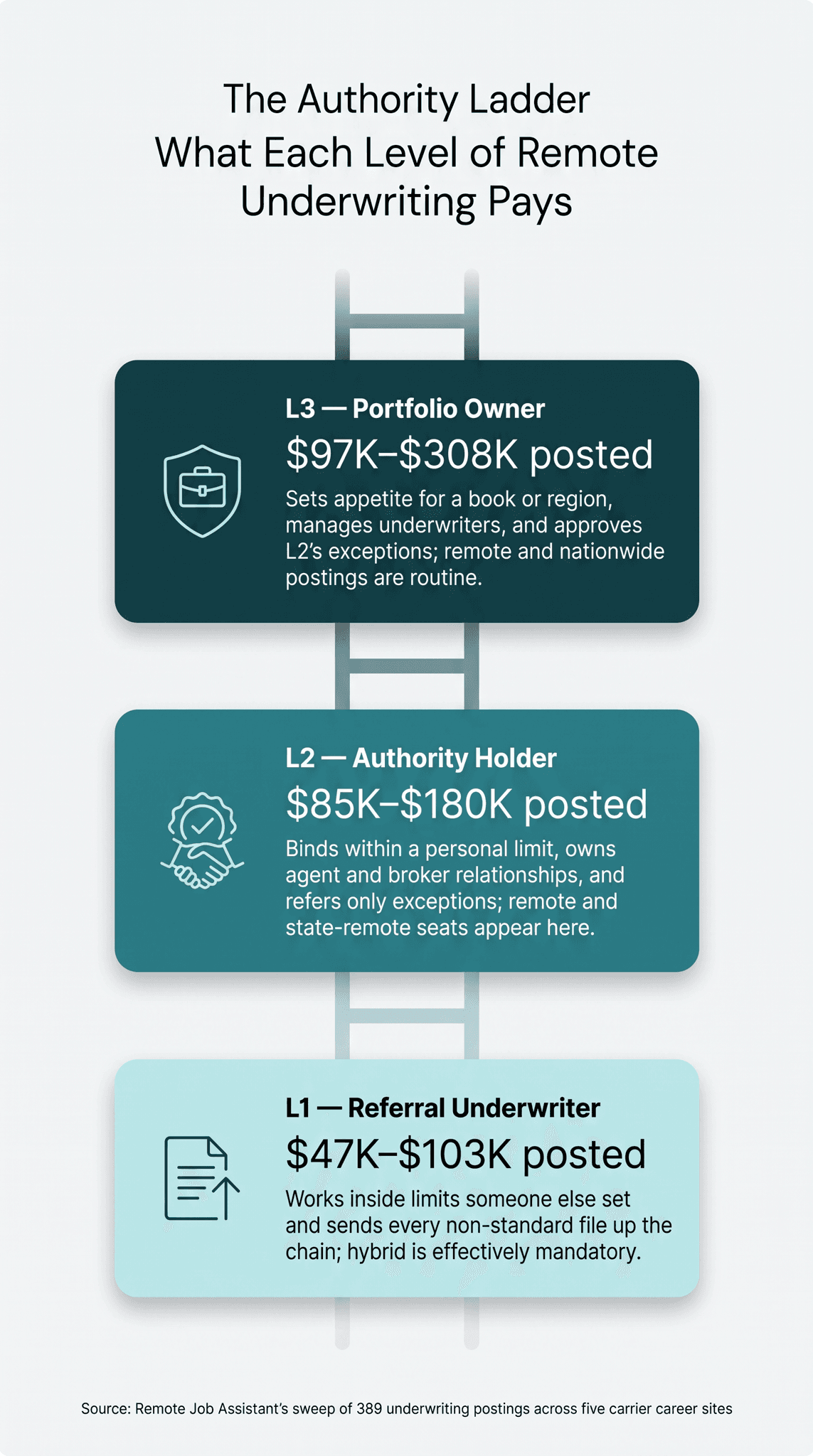
The variable that predicts whether a carrier will let you underwrite from home isn't your specialty or your tenure. It's how much binding authority you hold. We call the resulting rubric the Authority Ladder, and it maps cleanly onto the posted pay bands from the sweep.
The Authority Ladder: a three-level rubric that classifies an underwriting role by how much of the file you can decide without referring it upward, which is the variable that predicts both remote eligibility and pay at a carrier.
- L1 Referral Underwriter ($47K to $103K posted): You work inside authority limits someone else set, and every non-standard file goes up the chain. Titles look like Underwriting Associate ($47,000 to $78,000 at CNA), Underwriting Specialist ($54,000 to $103,000 at CNA), or Underwriting Professional Development Program ($60,800 to $100,300 at Travelers). Hybrid is effectively mandatory: 0 of the 8 entry-level carrier postings in our sweep were remote.
- L2 Authority Holder ($85K to $180K posted): You bind within a personal limit, own the broker or agent relationships on your desk, and refer only exceptions. Titles look like Underwriter / Account Executive ($85,600 to $141,200 at Travelers), Underwriting Consultant ($72,000 to $141,000 at CNA), or Senior Underwriter / Account Executive Officer ($109,300 to $180,200 at Travelers). This is where remote and state-remote seats appear.
- L3 Portfolio Owner ($97K to $308K posted): You set appetite for a book or a region, manage a team, and sign off on L2's exceptions. Titles look like Underwriting Director ($97,000 to $189,000 at CNA), Underwriting Officer ($146,400 to $241,600 at Travelers), AVP Underwriting Officer ($177,900 to $293,600 at Travelers), or VP Regional Underwriting Manager ($194,000 to $308,000 at CNA). Remote and nationwide postings are routine at this level.
How to use it: identify your level from the criteria, not from your title, because carriers name the same job differently. If you're L1, stop filtering job boards for "remote" and target the fastest route to a personal authority limit. If you're L2 or above, filter for specialty lines and territory-based sales underwriter roles, where remote is normal rather than exceptional.
The evidence for the ladder is in the 9 remote-signal postings themselves. Every one was mid-level or above: a Senior Underwriter for agribusiness posted "US - Nationwide" at Travelers ($104,000 to $171,700), a Senior Underwriter for homeowners and condo posted "United States Virtual" at Assurant ($64,900 to $108,200), a Home Office Underwriting Manager for contract surety posted "United States - Remote" at The Hartford ($112,800 to $205,200), Underwriting Directors for ocean cargo and ocean marine at The Hartford ($140,000 to $210,000), and a cluster of P&C Middle Market Center Sales Underwriters at The Hartford posted as "Michigan-Remote" and "New York-Remote" ($68,000 to $145,200). That last pattern matters: it's remote inside a sales territory, not remote anywhere, because the underwriter is also the carrier's face to the agents in that state.
Carriers don't post remote underwriting jobs for people they still have to train. At a carrier, remote is a privilege of authority, not a job type.
The filter at L3 isn't technical skill, which everyone at that level has. It's whether the people above you trust you not to damage the book when nobody is watching, and a remote or nationwide posting is the carrier saying that trust has already been extended to whoever fills it.
Look for the authority language rather than the title. "Within delegated authority" and "refers accounts outside guidelines" describe L1. "Binds within assigned authority," "manages an assigned book," and "develops agency relationships" describe L2. "Sets underwriting appetite," "approves referrals," and "manages a team of underwriters" describe L3. A posting that pairs L2 language with a state name and the word Remote is the one to apply to first.
Stop Applying Manually
Our AI applies to hundreds of matching jobs while you sleep. Wake up to interviews, not more applications.
What Remote Underwriting Jobs Pay in 2026
Eighty of the 125 carrier postings in our sweep published a salary band, and those bands say something the aggregator averages hide: pay tracks authority and specialty, not location. The Hartford's Michigan-Remote sales underwriter sits in the same $68,000 to $145,200 band as its office-based equivalents, and Travelers posts a single nationwide range per title regardless of city.
| Level | Example posting | Posted range | Employer |
|---|---|---|---|
| L1 | Underwriting Associate | $47,000 to $78,000 | CNA |
| L1 | Underwriting Professional Development Program | $60,800 to $100,300 | Travelers |
| L2 | Senior Underwriter, Homeowners & Condo (United States Virtual) | $64,900 to $108,200 | Assurant |
| L2 | P&C Middle Market Center Sales Underwriter (Michigan-Remote) | $68,000 to $145,200 | The Hartford |
| L2 | Underwriter / Account Executive, Small Commercial | $85,600 to $141,200 | Travelers |
| L2 | Senior Underwriter / Account Executive Officer, Agribusiness (US - Nationwide) | $104,000 to $171,700 | Travelers |
| L2 | Senior Underwriter / Account Executive Officer, Technology | $109,300 to $180,200 | Travelers |
| L3 | Underwriting Director | $97,000 to $189,000 | CNA |
| L3 | Home Office Underwriting Manager, Contract Surety (United States - Remote) | $112,800 to $205,200 | The Hartford |
| L3 | Underwriting Officer, Casualty | $146,400 to $241,600 | Travelers |
| L3 | AVP, Underwriting Officer, Construction Casualty | $177,900 to $293,600 | Travelers |
| L3 | VP, Regional Underwriting Manager | $194,000 to $308,000 | CNA |
Salary bands in this table are the ranges the employers published in their own Workday postings on September 2, 2026, filtered to US roles with underwriting in the title. We cross-referenced them against O*NET's BLS May 2025 estimates and Payscale's 640-profile dataset, and excluded Canadian and UK postings. Bands move as carriers reprice; check the linked sources for current figures.
The occupational medians sit well below the carrier bands, and the gap is informative. According to O*NET's May 2025 BLS data, the median insurance underwriter earns $81,370, and Payscale's July 2026 dataset puts the average base at $68,675 with a 10th-to-90th percentile spread of $49,000 to $100,000. Those figures include every personal-lines underwriter at every regional carrier in the country. The commercial and specialty desks that post remote seats start their L2 bands at $85,600 and run their L3 bands past $240,000.
On the lending side, the aggregators tell a different story. Glassdoor reports $97,639 as the average for remote mortgage underwriters in 2026, with a typical range of $77,684 to $123,967, and $125,614 for commercial mortgage underwriters. ZipRecruiter's August 2026 figure for the generic "remote underwriter" title is $78,878, with the 25th percentile at $61,000 and the 90th at $118,000. A remote mortgage underwriter can out-earn a hybrid L1 insurance underwriter by $20,000 or more in a good origination year; the trade is that the seat may not exist in a bad one.
Three things explain the variance inside the carrier bands. Specialty lines pay a premium: surety, ocean marine, cyber, construction casualty, and captives all posted floors above $124,000 at The Hartford or Travelers, because the files are non-standard and the underwriter's judgment is the product. Commercial pays more than personal at the same level: Assurant's virtual homeowners senior underwriter starts at $64,900 while Travelers' small commercial underwriter starts at $85,600. And account ownership pays: Travelers pairs "Account Executive" with the underwriter title precisely because the role carries the broker relationship, which is why its L2 bands run $30,000 above CNA's equivalent.
The pay gap between an underwriter and a senior underwriter at the same carrier is bigger than the gap between a hybrid seat and a remote one. At Travelers, the step from Underwriter / Account Executive to Senior Underwriter / Account Executive Officer moves the band from $85,600 to $141,200 up to $109,300 to $180,200. No remote posting in our sweep paid a premium or a discount for the address. If you're optimizing for income, optimize for the level, and let remote follow. The roles paying into the $100K-plus bracket are almost entirely L2 specialty and L3 seats.
Stop Applying Manually
Our AI applies to hundreds of matching jobs while you sleep. Wake up to interviews, not more applications.
Where the Remote Underwriting Jobs Actually Are
Match the employer type to your level on the Authority Ladder, and the search gets shorter. Three kinds of employers were posting remote underwriting roles on September 2, and they want different people.
Carriers, for L2 and L3 in specialty and territory roles. Travelers hires remote-eligible senior underwriters in lines where the book is national rather than local, such as agribusiness, and posts a single nationwide band for each title. The Hartford is the most remote-friendly of the five carriers we checked, with 6 of its 23 underwriting postings carrying a remote signal, concentrated in state-remote middle-market sales underwriters, a remote contract surety manager, and ocean marine leadership. CNA runs a hybrid hub model, so its postings are worth watching for the hub cities rather than for remote flags. Assurant posts "United States Virtual" senior underwriters in homeowners and condo. Liberty Mutual's underwriting careers page, which ranks first in Google for this keyword, showed exactly one remote underwriting-adjacent role on the day we checked; the search result promises more than the carrier is offering.
Lenders, remote at every level. World Business Lenders hires remote senior credit underwriters across six metros. LBC Mortgage hires remote underwriters and underwriter-originations managers in California. Longbridge Financial hires remote reverse mortgage underwriters, HomeXpress Mortgage hires remote non-QM underwriters, LendingOne hires a remote director of underwriting for builder finance, and Capital Impact Partners hires a remote director of community development underwriting. These are the seats behind LinkedIn's "6,000-plus remote underwriter jobs" headline, and they are real; they're also the seats most exposed to the rate cycle.
Insurtechs, for L2 who can work without a hub. weSure, hiring through its Hourly entity, posted a remote Senior BOP Underwriter to build a small-business commercial book. Measured Insurance posted a fully remote Cyber Underwriter at VP level. Both want people who already carry authority and can price without a referral chain, which is exactly the L2 and L3 profile the carriers keep in hybrid seats.
One more signal worth noting: Workable carried four "Insurance Underwriting AI Expert" contractor postings at $100 to $120 an hour on the same day, for underwriters willing to train models on how they decide files. That's not a career, but it tells you where the carriers think the routine work is going.
Where to look, by level
- L1: carrier development programs and associate roles in hub cities (hybrid), or a mortgage underwriting seat at a lender if you want remote now and can tolerate the cycle.
- L2: territory-based sales underwriter roles at carriers with a state name and "Remote" in the location, specialty desks (surety, marine, cyber, construction, agribusiness), and insurtechs building a book from scratch.
- L3: home-office underwriting manager, director, and officer roles, which carriers now post nationwide as a matter of course.
Adjacent desk-based insurance careers follow the same logic. Remote claims adjuster roles convert to remote faster because output is measurable per file, and remote compliance work sits closer to L3 pay without the apprenticeship. If the lending side appeals, the underwriting and credit skill set overlaps heavily with remote banking roles and remote finance positions. For a broader read on which boards actually surface these seats, our guide to remote job boards ranks them by senior-role density.
The Automation Question: Which Underwriting Jobs Survive
The reason remote L1 seats don't exist is the same reason L1 seats in general are getting scarcer: automation removes the bottom rung first. Understanding why tells you where to stand.
McKinsey's research on commercial P&C underwriting found that anywhere from 30 to 40 percent of underwriting time goes to administrative tasks such as rekeying data and manually executing analyses. That's the work an L1 underwriter does while learning appetite, and it's precisely the work submission-intake and document-extraction tools are built to remove. The occupational forecast reflects it: O*NET projects a decline of 1 percent or more for insurance underwriters from 2024 to 2034, with 8,200 openings a year coming from replacement rather than growth. On the lending side, conforming loans have run through automated underwriting systems for two decades; the human underwriter's job is the file the system can't clear.
The industry knows the pipeline is thinning. In Pacific Life's 2026 Underwriting Outlook Survey of more than 100 life-insurance underwriting executives, released March 25, 2026, 70 percent said they were concerned about the long-term underwriting talent pipeline and 38 percent cited an aging workforce and loss of institutional knowledge. Forty-four percent said AI was already in day-to-day workflows or used as a decision-support tool, and another 38 percent had it in pilot. Read those two numbers together and the conclusion is uncomfortable: the industry says it's worried about the pipeline and is automating its first rung anyway, because a referral-generating L1 seat costs a carrier $47,000 to $103,000 a year plus a senior underwriter's time, and the work it does is the work the tools are best at. That's a market that pays L2 and L3 more, not less, and it's one where waiting for an L1 remote posting is waiting for a job that's being deleted.
The remote entry-level underwriting job you're searching for is being automated out of existence, and the carriers were never going to post it anyway. The realistic entry points are a hybrid carrier associate seat, where you learn appetite in person, or a remote mortgage underwriting seat, where you learn guidelines fast and accept the cycle. Both are routes to L2. Neither is the destination.
The work that survives is the judgment file: the non-standard risk, the large account with a negotiated program, the broker who needs a reason rather than a rate. That work lives at L2 and above, and it's the same work carriers are now willing to let you do from home.
How to Land a Remote Underwriting Role
Because the remote seats are gated by level and specialty rather than by a "remote" checkbox, the job search is a positioning exercise first and a volume exercise second. Start by deciding which seat you're actually chasing.
Which seat to chase, by where you stand
- Under three years, no personal authority: a hybrid carrier associate or development-program seat in a hub city, or a remote mortgage underwriting seat at a lender. The carrier route pays $47,000 to $103,000 posted and teaches appetite; the lender route is remote on day one and teaches guidelines. Pick by whether you want the carrier career or the address more.
- Personal authority, no book: specialty desks (surety, marine, cyber, construction casualty, agribusiness) at carriers, or an insurtech building a book from scratch. These are the seats posted "Nationwide" and "Virtual" in our sweep.
- Authority plus agent or broker relationships you own: territory sales underwriter roles, which carriers post with a state name and "Remote" and which pay $68,000 to $145,200 at The Hartford. Your relationships are the reason the seat is remote.
- Setting appetite or managing underwriters: home-office manager, director, and officer postings, which ran $97,000 to $308,000 in our sweep and are remote or nationwide as a matter of course.
Pick your market before you pick a credential. For insurance, The Institutes' Associate in Commercial Underwriting is the L1-to-L2 signal carriers recognize: five online courses (AU 60, AU 61, AU 62, one CPCU elective, and an ethics module) at four to six weeks each, or roughly 9 to 12 months total. CPCU, with eight courses and a two-year experience requirement, is the L3 credential. No state license is required, which is one advantage underwriting has over adjusting and sales.
For mortgage, the entry credential is the National Association of Mortgage Underwriters' Certified Mortgage Underwriter program: $795, four classes, and a 30-question open-book exam with a 75 percent pass mark. The credentials that move your pay are federal, and they come with rules the job postings don't mention:
- FHA Direct Endorsement (DE). HUD's eligibility rules require three years of experience reviewing credit applications and one- to four-unit property appraisals within the past five years, or two years within the past three plus three more within the past ten. You must be an employee of a single lender, and HUD states that underwriting functions may not be contracted out. Mortgagee Letter 2025-16, issued June 27, 2025, dropped the full-time requirement, so a part-time W-2 DE seat is now allowed. A 1099 DE seat still isn't.
- VA Staff Appraisal Reviewer (SAR). Per the VA's SAR FAQ, you must be a full-time salaried employee of a VA-approved lender with automatic authority and have three years of appraisal or appraisal-review experience; three years as an FHA underwriter counts. The application is $100 to VA Austin, followed by LAPP training and five satisfactory test cases. The approval doesn't travel: change employers and you reapply, and if you haven't issued a Notice of Value in the past year, you repeat the training and the test cases too.
The practical rule: if you're targeting remote lender seats, earn DE and SAR while you're W-2 somewhere stable. Those are the two lines a non-QM or reverse lender will pay for, and neither can be earned on a contract.
Put your authority on paper. Carriers hiring L2 remote want proof you can be trusted alone, and the proof is five numbers: your binding limit, the premium and account count in your book, your hit ratio on quotes, your loss ratio, and your referral rate. "Underwrote commercial package accounts in accordance with company guidelines" describes an L1 doing tasks. "Held $2M single-risk authority on a $14M middle-market book at a 58 percent loss ratio and a 42 percent hit ratio" describes an L2 in one line, and it's a sentence a hiring manager can check against the desk's own numbers. The reasons candidates stop getting interviews at this level almost always come down to a resume that lists tasks instead of authority.
Bring a specimen file. The strongest interview move in underwriting is a written risk evaluation of a real or realistic account in the target line, and it's the only way to prove appetite judgment from a distance. Keep it to two pages with five parts: the account summary (class, operations, revenue, locations); the exposure analysis, with the two or three loss drivers named; the loss-run read, including what the frequency and severity pattern implies; your pricing logic and the terms, sublimits, or exclusions you'd require; and your decision, with the specific facts that would flip it. The last part matters most. The interviewer is testing whether you know where your own authority should stop.
Read the postings for what they're not saying. Four patterns from the sweep deserve a second look before you apply:
- "Remote" plus a state name at a carrier is a territory seat. The Hartford's Michigan-Remote and New York-Remote sales underwriters are remote inside one state because the underwriter is the carrier's face to that state's agents. Expect agency visits and an expectation that you live there.
- A lender posting that pairs "DE underwriter" or "SAR" with 1099 or contract pay. HUD bars contracting out DE underwriting, and the VA requires SARs to be full-time salaried. Either the title is inflated or the authority lives with a salaried underwriter who signs behind you. Either way, you won't be building the credential.
- Lender pay quoted per file or as a production bonus with no salary floor. That's income tied to origination volume, and origination volume is what disappears when rates rise. Ask what the floor was in the last slow quarter.
- Contractor "Insurance Underwriting AI Expert" roles at $100 to $120 an hour. Real money, but the job is teaching a model how you decide files. Take it as a bridge, not a career, and don't let it replace the years that get you to a personal limit.
Ask one question in every interview. At a carrier: "What's the authority limit for this seat, and what did the last person show to get it raised?" A manager who can't answer in numbers doesn't run a desk where authority grows. At a lender: "How many underwriters were on this team at the last origination trough, and what happened to the rest?" The answer tells you whether the remote seat survives the cycle or is the cycle.
Comparing a carrier offer with a lender offer
- A W-2 carrier seat at L2 pays $85,600 to $180,200 posted, hybrid or state-remote, with authority that compounds into L3.
- A remote lender seat averages $97,639 for mortgage underwriters (Glassdoor) and is remote from day one, with headcount that follows rates.
- Count the lender offer at its salary floor, not its bonus target. Count the carrier offer at the band plus the next level's floor, because the authority compounds.
- If the lender offer is 1099, subtract self-employment tax, benefits, and the DE and SAR approvals you won't be able to earn.
- If the two still tie, take the one where the person signing above you is willing to raise your limit.
Then do the volume math honestly. Nine remote seats across 125 carrier postings, five across 49 on SmartRecruiters, and a lending market that reprices monthly means the right job is spread across hundreds of career pages that don't syndicate to the boards. That's a scanning problem, not a qualification problem, and it's the part worth automating so your time goes to the specimen file and the interview. Build searches around state names, specialty lines, and the phrase "account executive" paired with underwriter, and list Excel-level modeling as a stated skill; every L2 posting in the sweep asked for it in some form. The finance and accounting category is where these roles land when they do syndicate, and positions with full benefits at the L2 level are worth prioritizing over 1099 lending contracts if stability matters to you.
Stop Applying Manually
Our AI applies to hundreds of matching jobs while you sleep. Wake up to interviews, not more applications.
Frequently Asked Questions
Can you work remotely as an underwriter?
Yes, but it depends on which underwriting and at what level. In our September 2, 2026 sweep, 9 of 125 underwriting postings on five major carrier career sites carried a remote signal, and every one was mid-level or above; 59 mentioned hybrid. Mortgage and credit underwriting at lenders is remote far more often, accounting for 20 of the 28 remote underwriting postings on Workable's global board.
I'm an underwriting associate at a carrier. Why do all the remote underwriting jobs want five-plus years?
Because carriers grant remote work with authority, not with tenure, and authority usually arrives around the five-year mark. An associate works inside someone else's limits and learns appetite through referrals, which carriers still run in person. Zero of the 8 entry-level carrier postings in our sweep were remote. The fastest route to a remote seat is the fastest route to a personal binding limit, not a better job-board filter.
What does a remote underwriter actually do all day?
The same job as an office underwriter with more written communication. A typical day is a queue of broker submissions to triage, two or three files that need a full exposure and pricing workup, a referral call with a manager about an account outside your limit, a renewal review on a book account whose loss run came in worse than expected, and an agent who wants a reason for a declination by end of day. Territory sales underwriters add agency visits or video meetings to that mix.
Is a remote mortgage underwriter job a good move if I've only done insurance underwriting?
It's a change of profession, not a change of address. Mortgage underwriting is guideline verification for loans that will be sold or held, with output measured in files per day and headcount that follows the rate cycle. The credential is different (NAMU's Certified Mortgage Underwriter runs $795 and four classes), the pay can be higher in a strong origination year (Glassdoor lists $97,639 for remote mortgage underwriters), and the seat can vanish in a weak one. Go in for the money and the remote seat with eyes open on the cycle.
Can I hold FHA DE or VA SAR authority in a remote 1099 underwriting contract?
No. HUD requires a Direct Endorsement underwriter to be an employee of a single lender and states that underwriting functions may not be contracted out; Mortgagee Letter 2025-16, issued June 27, 2025, allows part-time employment but not contract work. The VA requires a Staff Appraisal Reviewer to be a full-time salaried employee of a VA-approved lender, and SAR approval has to be applied for again with each new employer. If a remote contract posting advertises DE or SAR work, the authority sits with a salaried underwriter, not with you.
How do I know which level of the Authority Ladder I'm on?
Ask what you can decide alone. If every non-standard file goes up the chain and your limit was set by someone else, you're L1 regardless of title. If you bind within a personal limit, own agent or broker relationships, and refer only exceptions, you're L2. If you set appetite for a book or region, approve L2's referrals, and manage underwriters, you're L3. Posted pay in our sweep ran $47,000 to $103,000 at L1, $85,000 to $180,000 at L2, and $97,000 to $308,000 at L3.
How much do remote underwriters make compared to office-based underwriters?
The same, because carriers publish one band per title. The Hartford's Michigan-Remote sales underwriter shares the $68,000 to $145,200 band with its office equivalents, and Travelers posts a single nationwide range per role. O*NET's BLS median for insurance underwriters is $81,370, and ZipRecruiter's August 2026 average for the "remote underwriter" title is $78,878. The pay lever is level and specialty, not location.
Which underwriting specialties pay the most and are most likely to be remote?
Specialty lines where the underwriter's judgment is the product. Surety, ocean marine, cyber, construction casualty, captives, and agribusiness all posted floors above $104,000 at The Hartford or Travelers in our sweep, and they're also where the remote-signal postings clustered: a nationwide agribusiness senior underwriter, a remote contract surety manager, remote ocean cargo and ocean marine directors, and a fully remote cyber underwriter at Measured Insurance.
Start Your Remote Underwriting Career
Three decisions, in order. First, which market: insurance, where remote is earned with authority, or lending, where it's granted by the rate cycle. Second, your level on the Authority Ladder, judged by what you can decide alone rather than by your title. Third, the seat that follows from the first two: if you're L1, the hybrid carrier seat or the remote lending seat that gets you to a personal limit fastest; if you're L2 or above, specialty and territory roles, with your authority on paper and a specimen file in hand.
Then let the scanning happen without you. Auto-apply through Remote Job Assistant watches the carrier and lender career pages that never syndicate to the big boards, so the nine-in-125 seats surface the day they post. Our guide to the best remote job boards covers which boards are worth checking manually, and the high-paying remote jobs guide benchmarks underwriting against the other desk-based careers paying into the $100K-plus bracket.
Carriers put their capital behind your signature long before they let you sign from home. Earn the authority, and the address stops mattering.
Ready to Find Your Remote Job?
Browse thousands of curated remote jobs or let AI apply for you.
Browse Remote JobsRelated Job Guides
Remote Tax Jobs: 2026 Salary Guide and Hiring Companies
Remote tax jobs pay $55K to $180K depending on credential and calendar. See the salary ladder, CPA vs EA data, and companies verifiably hiring remote in 2026.
21 min read
Remote Physician Jobs: 2026 Salary and Career Path Guide
Remote physician jobs in 2026: six career paths from telemedicine to medical director, real pay from $150K to $300K+, licensing strategy, and who's hiring.
23 min read

Remote Event Planning Jobs: What Actually Goes Remote
Only 12% of event job postings are fully remote and none were titled Event Planner. See which titles actually go remote, what they pay, and how to pivot.
24 min read