
Last reviewed: August 2026
You have probably seen both of these numbers, and they do not appear to belong in the same market. The Bureau of Labor Statistics projects employment for claims adjusters, appraisers, examiners, and investigators to decline 5% between 2024 and 2034. In July 2026, Glassdoor listed 1,177 open remote claims adjuster roles in the United States. Indeed and LinkedIn each carried over a thousand more.
Both are accurate. The reconciliation is the single most useful thing to understand about this field: BLS also projects 21,600 openings per year, on average, over that same declining decade. That is not growth demand. That is replacement demand — people leaving faster than the shrinking headcount absorbs. A field hiring on turnover is unusually easy to enter and unusually easy to leave, and every recommendation in this guide comes out of that one fact.
Get Remote Job Tips in Your Inbox
Weekly strategies, salary data, and new opportunities
Unsubscribe anytime. No spam.
What most guides get wrong is the conclusion they draw from it. The licensing schools that dominate the informational results for this keyword sell a $200 course, so they lead with catastrophe day rates and bury the part where the work is 1099 and seasonal. The doom takes lead with the -5% and skip the 21,600. Neither tells you the thing that actually decides your outcome, which is not whether you enter claims but which claims you handle.
We analyzed 610 remote claims adjuster and examiner job postings across 190 carriers, third-party administrators, and independent adjusting firms between October 2025 and July 2026. Below: what each line of business pays remotely, why staff and independent adjusting are two different careers being sold as one, what a license actually costs, and which employers hire genuinely remote versus quietly hybrid.
Based on our analysis of 610 remote claims adjuster and examiner postings across 190 employers (October 2025–July 2026):
- 81% (n=494 of 610) were desk or inside adjusting rather than field roles
- 72% (n=439 of 610) required an active adjuster license at the time of application
- 34% (n=207 of 610) excluded at least one US state or restricted hiring to specific time zones despite carrying a "remote" title
- 63% (n=384 of 610) named a specific line of business rather than a generic "claims adjuster" title
- $76,790 median annual wage across the occupation, with the lowest 10% under $47,810 and the top 10% above $112,150 (BLS, May 2024, across 365,300 jobs)
- -5% projected employment change 2024–2034, against 21,600 projected annual openings (BLS)
How We Collected This Data
The figures in this post come from our analysis of 610 remote claims adjuster, examiner, and claims specialist job postings collected between October 2025 and July 2026. Postings were sourced from carrier career pages (Allstate, Progressive, State Farm, American Family, Travelers), third-party administrator career pages (Sedgwick, Crawford, Gallagher Bassett), and from LinkedIn, Indeed, and Glassdoor. We included only US-eligible positions explicitly marked remote or remote-eligible with a disclosed or reliably estimable base compensation range.
We excluded field roles requiring more than 25% travel, staffing-agency reposts of the same requisition, and 1099 catastrophe deployment listings. Those last ones are a genuinely different job with a genuinely different pay model, and averaging them into a salaried dataset is how the numbers on most adjuster salary pages get distorted; they are covered separately below.
Salary data was cross-referenced with the BLS Occupational Outlook Handbook (May 2024 wage data), ZipRecruiter, and Glassdoor for the same period. Ranges reflect base salary; carrier bonus programs typically add 5–15% at the staff level. We update this analysis quarterly. Figures here reflect Q3 2026.
Why a Shrinking Job Keeps Posting 21,600 Openings a Year
The decline is real and it has a specific mechanism. Carriers have spent the last five years pushing straight-through processing — claims that are received, evaluated, and paid without a human opening the file. Industry leaders now report straight-through rates of 30–50% on personal lines claims, and insurers running modern AI platforms reach 50–70% on eligible claim types, according to claims automation research published in 2026.
Carriers did not do this because they dislike adjusters. They did it because the arithmetic on a human touching an $1,800 fender-bender file stopped working. When the cost of the adjudication approaches a meaningful fraction of the claim itself, the file gets automated. That is the whole causal chain, and it explains precisely which work disappears.
Automation doesn't eliminate adjuster jobs. It eliminates adjuster files — and the files it takes first are the ones that pay least.
Meanwhile the openings keep coming, because the remaining work churns. Caseloads are heavy, the metrics are close, and the people who burn out are replaced rather than added. Twenty-one thousand six hundred openings a year against a shrinking base is a turnover number. For someone trying to get in, a turnover market is the friendliest kind there is — the hiring bar is set by how fast seats empty, not by how fast the business grows.
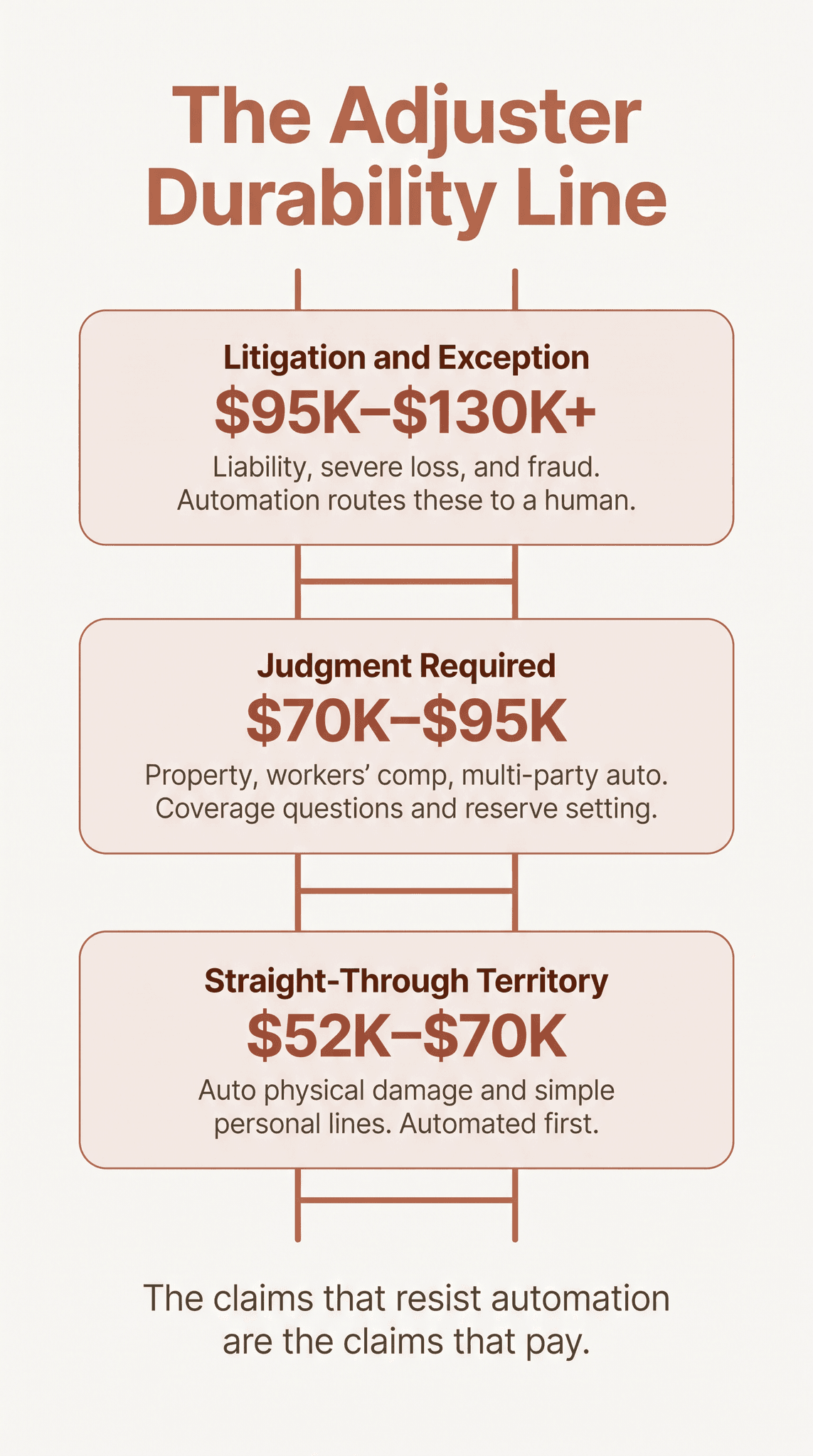
The Adjuster Durability Line
Because automation removes claim types rather than job titles, the useful question about any adjuster opening is not what it is called. It is how much judgment the underlying claim requires.
The Adjuster Durability Line: a 10-point rubric for scoring how automation-resistant a claims seat is, and what that seat pays.
Scoring:
- 0–3 · Straight-Through Territory ($52K–$70K): Auto physical damage, low-complexity personal lines, first-notice-of-loss intake. Decisions are rule-driven, photo estimating software prices the damage, files close in days out of a queue you do not control. This is the volume carriers automate first.
- 4–7 · Judgment Required ($70K–$95K): Property, workers' compensation, multi-party auto, commercial small loss. Coverage questions, recorded statements, reserve setting. A model can price the damage. It cannot decide whether the policy responds.
- 8–10 · Litigation and Exception ($95K–$130K+): Liability lines — commercial general, errors and omissions, directors and officers, cyber — plus severe and large loss and SIU fraud investigation. Every file has counsel, a disputed fact, or an adversary. Automation is designed to route these to a human.
How to use it: score the job description, not the title. Count the decisions in the posting that a rules engine could not make — coverage interpretation, credibility assessment, reserve judgment, negotiation with opposing counsel. Two or fewer and you are in Straight-Through Territory no matter how senior the title reads.
The line moves, which is the part worth internalizing. A hail claim on a fifteen-year-old roof starts as a 2: photos in, Xactimate estimate out, pay the actual cash value. It becomes a 9 the moment the homeowner's contractor disputes the scope, the policy turns out to have a cosmetic damage exclusion nobody read at binding, and a public adjuster enters on the claimant's side. Same claim number, entirely different job. Desks are scored by where their files usually land, but the ones that pay best are the desks where files routinely escalate — because escalation is exactly the thing that cannot be modeled in advance.
Stop Applying Manually
Our AI applies to hundreds of matching jobs while you sleep. Wake up to interviews, not more applications.
What Remote Claims Adjusters Earn by Line of Business
Here is the finding that surprised us least and matters most: the pay bands sort almost perfectly along the Durability Line. The claims that resist automation are the claims that pay, because both properties come from the same source — irreducible human judgment.
| Line of business | Typical remote range | Durability band | Why it pays what it pays |
|---|---|---|---|
| Liability (commercial, E&O, D&O, cyber) | $70K–$100K mid-career; $100K–$130K senior | 8–10 | Litigation exposure and high claim values |
| Workers' compensation | approx. $76K average ($66K–$85.5K interquartile) | 4–7 | Medical, indemnity, and jurisdiction-specific rules |
| Desk adjuster (multi-line, inside) | approx. $75K average (most $67K–$84K) | 4–7 | Remote by design; volume-driven |
| Property (homeowner, commercial) | $55K–$85K mid-career; $95K–$110K senior | 4–7 | Estimating skill and catastrophe surge exposure |
| Auto (personal lines) | approx. $64.5K average ($52.5K–$79.9K interquartile) | 0–3 | Highest automation exposure; the entry door |
Salary ranges derive from our analysis of 610 remote claims postings between October 2025 and July 2026, cross-referenced with BLS May 2024 wage data, ZipRecruiter salary aggregates, and Glassdoor compensation reports for the same period. We excluded outliers and postings without clear remote policies. Ranges shift as markets move — check the linked sources for current figures.
The occupation-wide anchor is worth stating plainly. According to the BLS Occupational Outlook Handbook, the median annual wage for claims adjusters, examiners, and investigators was $76,790 as of May 2024, with the bottom 10% under $47,810 and the top 10% above $112,150. That spread of roughly $64,000 between the tenth and ninetieth percentile is not a seniority gradient. It is mostly a line-of-business gradient with a seniority gradient inside it.
The liability premium in particular is often misread as a reward for tenure. It is not. A commercial liability adjuster is paid more because the file carries litigation risk, the claim values run an order of magnitude higher, and a bad reserve decision on a D&O matter costs the carrier more than the adjuster's salary. You are being paid for exposure, not for years.
Your line of business predicts your remote pay more reliably than your years, your carrier, or your designations.
That has a direct practical consequence. An adjuster with four years in personal auto who moves to commercial liability will typically see a larger jump than an adjuster who stays in personal auto for eight more years. The specialty move is the raise.
One honest caveat on the top of that table, because the pay ladder gets sold as a quality-of-life ladder and it is not one. Litigated liability files are not more pleasant than auto files. They are longer, more adversarial, and they come with depositions, defense counsel budgets, and reserves you will defend in a roundtable in front of people senior to you. What you are buying at $120,000 is durability and intellectual weight, not a calmer desk. Plenty of adjusters take the money and find the file type genuinely worse. Know which one you are optimizing for before you make the move.
Staff Adjuster vs Independent Adjuster: Two Different Jobs
These get discussed as one career. They are not, and the blurring is not accidental — the schools selling pre-licensing courses lead with catastrophe day rates because a $900 number sells a $200 course better than a $75,000 salary does.
| Staff adjuster (carrier or TPA) | Independent / catastrophe adjuster | |
|---|---|---|
| Employment | W-2, salaried | 1099 contractor |
| Pay model | Base plus bonus | Fee schedule per claim, or day rate |
| Typical economics | $52K–$130K by line of business | $150–$500+ per closed property claim; day rates have historically reached $800–$900 in peak storm years |
| What you keep | All of it | 55–70% — the adjusting firm keeps 30–40% |
| Benefits | Medical, 401(k) match, PTO | None |
| Volume risk | Caseload is assigned | No storm, no income |
| Remote reality | Genuinely desk-based | Deployment travel is the job |
The fee split is the part that gets left out of the pitch, and it exists for a reason worth knowing. The independent adjusting firm holds the contract with the carrier and carries the errors-and-omissions coverage that sits behind your work. You are subcontracting off their paper. That is what the 30–40% buys, and it is not unreasonable — it is just rarely mentioned next to the day rate.
The honest summary is that an established independent adjuster earns somewhere between $40,000 and well over $100,000 a year if they are consistently deployed. That conditional carries the entire risk of the career. A quiet hurricane season is a quiet income year, and there is no PTO accrual to soften it. If you want predictability instead, a staff desk seat with full medical and retirement benefits is the trade you are making, and it is a defensible one — the same calculation that runs through remote finance and insurance roles generally.
Stop Applying Manually
Our AI applies to hundreds of matching jobs while you sleep. Wake up to interviews, not more applications.
Who Actually Hires Remote Claims Adjusters
The employers are real and several of them are unusually explicit about remote terms. They are also unusually full of asterisks, and the asterisks are checkable before you spend time applying.
Allstate runs permanent home-based claims roles where the home office does not need to be near an Allstate facility, only inside the United States. According to Allstate's careers postings, the company supplies a technology bundle — laptop, monitors, headset, keyboard, mouse — and reimburses $80 per month for connectivity. The asterisk: these roles are not available to residents of California, Alaska, Hawaii, or Puerto Rico.
Sedgwick, the largest third-party administrator in the space, hires remote adjusters across workers' compensation, liability, and property. Recent postings list starting ranges of $73,000–$75,000 for some jurisdictions, with medical, dental, vision, 401(k) matching, PTO, disability, and life coverage.
Progressive hires remote claims staff with occasional travel for meetings and training. State Farm and Travelers both appear regularly in remote adjuster listings, though with less public specificity on the remote terms.
American Family is the instructive one. Its catastrophe desk adjuster role is described as primarily home-based — roughly 80%, four or more days per week. That is a good job. It is not a remote job, and the posting title will not tell you the difference.
The three asterisks to check before applying
Our posting analysis found that 34% (n=207 of 610) of remote-titled listings carried at least one of these:
- State exclusions. California appears most often, followed by New York, Alaska, and Hawaii. The driver is usually a mix of state-specific licensing and wage-and-hour rules rather than anything about the work.
- License at hire versus license reimbursed. 72% (n=439 of 610) required an active license at application. The remaining 28% either sponsor the license or hire licensed-within-90-days. That distinction determines whether you can apply this week or in three weeks.
- Time zone anchoring. Postings marked "Remote (EST/CST)" are remote in the sense that you choose the room, not the schedule.
Screening for these three before you write anything is the highest-leverage twenty seconds in this job search. When you are working a turnover-driven market where postings move fast, it also makes a strong case for volume — this is exactly the pattern where applying to every matching opening beats hand-crafting six applications a week. You can start from claims adjuster openings or the broader insurance category listings and filter from there.
Stop Applying Manually
Our AI applies to hundreds of matching jobs while you sleep. Wake up to interviews, not more applications.
Getting Licensed Without Moving
Licensing is the barrier most people overestimate, and the reason they overestimate it is that they assume their own state is the relevant one. It usually is not.
Roughly 35 states license adjusters. The rest do not require one at all. If you live in a state with no licensing requirement, you are not locked out — you use a mechanism called a Designated Home State license. You choose a licensing state, qualify there as though you were a resident, and most other states will then grant you a non-resident license by reciprocity. Texas and Florida are the two states nearly everyone designates, because their licenses carry the widest reciprocity. The NAIC State Licensing Handbook sets out the framework the states work from.
The reason the system exists at all is mechanical: reciprocity needs a home license to reciprocate from. Without a designated home state, an adjuster in a non-licensing state has nothing for other states to recognize. The DHS route is the workaround the industry built for exactly that gap.
Texas is the common choice, and the specifics are less painful than the reputation suggests. Texas does not legally require pre-licensing education for adjusters — but completing a Texas Department of Insurance-approved 40-hour course waives the state exam entirely. Approved courses run roughly $174 to $250. If you sit the exam instead, it is 150 scored multiple-choice questions, 150 minutes, 70% to pass, with a $49 Pearson VUE fee.
The coursework costs under $300 and takes about two weeks. The reason most people never start is that nobody tells them their home state doesn't have to be the state they license in.
The coursework is the fast part, and it is worth separating it from the calendar. Where timelines slip is the back end: several states fingerprint applicants and route the prints through a state bureau and the FBI, which the North Carolina Department of Insurance warns can add four to six weeks to issuance on its own. Non-resident applications generally run through NIPR and are faster, but "generally" is carrying weight — reciprocity is granted state by state, and a state that wants a supplemental form or a specific line of authority will simply hold the application until it gets one. Plan the coursework in two weeks and the license in six to eight.
A license is a subscription, not a purchase. Continuing education requirements and renewal fees are set per state and run on their own cycles, and every additional non-resident license you carry adds another one. Adjusters holding five or six states routinely spend more time tracking CE deadlines than they ever spent getting licensed in the first place, and a lapsed license in one state can pull you off files in others.
Practically, the sequence is: designate Texas or Florida, complete the 40-hour course to skip the exam, then add non-resident licenses as specific jobs require them rather than collecting them speculatively. Adjusters who front-load six states before they have an offer end up paying renewal fees on licenses they never used.
What the Job Is Actually Like
The turnover that creates all those openings is not mysterious, and knowing its shape lets you interview against it.
A desk adjuster's day is a queue somebody else built. You open files in the order the system assigns them — usually Guidewire ClaimCenter or a carrier-internal equivalent, which triages and routes by severity before you ever see the claim — and the system is measuring closure rate, cycle time, and how long a file sits untouched. On the property side you will live in Xactimate or Symbility building line-item scopes. If you want a concrete head start before you are hired, Xactimate proficiency is the single most transferable skill in property claims and the one most often listed as "preferred" on postings that then treat it as required.
The rest of the day is the friction. A recorded statement contradicts the photo estimate and now you need a second inspection. A reserve you set at $4,000 in week one has to be moved to $22,000 in week six, and moving it means writing the explanation of why you were wrong the first time. None of that is unreasonable work. The difficulty is that it arrives at a rate you do not set.
That is the honest read on why people leave, and it is worth naming the uncomfortable version. Remote claims is one of the most heavily instrumented remote jobs there is. In Payscale reviews, adjusters describe the volume of internal reporting and the closeness of the monitoring more often than they describe the claims themselves. The autonomy in "remote claims adjuster" is spatial, not operational — you choose the room, and almost nothing else about your day. That suits some people enormously and is intolerable to others, and it is a much better filter for this career than whether you find insurance interesting.
The predictable consequence of measuring people that closely is that some of them optimize for the measurement. Closing thin files early to protect a cycle-time average is a rational response to the incentive, not a character flaw, and if you join a desk where it is happening you will feel the pressure to do it within a month. Ask about it obliquely in the interview by asking what happens when a file needs longer than the target — the answer tells you whether the metric or the claim wins on that team.
People rarely leave claims because the work is hard. They leave because of the caseload number, and the caseload number is almost never in the job posting. Ask for it directly in the final round — pending files per adjuster, not new assignments per week. A hiring manager who cannot answer that quickly is telling you something.
Three questions that surface the reality before you accept:
- What is the current average pending file count per adjuster on this team, and what was it a year ago?
- What percentage of files on this desk close without a coverage question?
- When a file needs more time than the cycle-time target allows, what actually happens?
The second question is the Durability Line in interview form. A desk where most files close clean is a desk automation is coming for. A desk where coverage questions are routine is one that will still exist in five years.
Before you accept anywhere, go read what adjusters say among themselves rather than what carriers say in postings. The CADO forums at catadjuster.org are the long-running independent and catastrophe adjuster community, and r/Insurance carries a steady stream of carrier-specific threads on caseload and metrics. Both will tell you things about a specific desk that no interview will, and adjacent judgment-heavy remote work — remote compliance positions, remote paralegal work on the litigation side, and remote banking roles — follows the same logic.
Frequently Asked Questions
I'm licensed in one state — can I work remote claims for a carrier in another?
Usually yes, through non-resident licensing. Most states grant a non-resident adjuster license by reciprocity to someone holding a resident or designated home state license, though you apply and pay per state. The practical constraint is not the license but the employer: 34% (n=207 of 610) of the remote postings we analyzed excluded at least one state outright for reasons unrelated to licensing, including California and New York.
Do I need an adjuster license before I apply, or will a carrier pay for it?
Both paths exist. In our sample, 72% (n=439 of 610) of remote adjuster postings required an active license at the time of application, and the remaining 28% either sponsored the license or accepted candidates who could be licensed within 90 days. Large carriers and TPAs are the ones most likely to sponsor, because they run internal training cohorts. If you are starting cold, getting a Texas or Florida license first roughly quadruples the number of postings you are eligible for.
Is claims adjusting a bad career to enter if AI is automating it?
Not on the numbers, but the entry point matters more than it used to. BLS projects a 5% employment decline for the occupation between 2024 and 2034 alongside 21,600 openings per year, which means turnover is doing the hiring. Automation is concentrated in low-complexity personal lines, so entering through auto physical damage puts you in the part of the field that is shrinking fastest. Entering through workers' compensation, liability, or complex property does not.
Which claims specialty pays the most remotely?
Liability — commercial general, errors and omissions, directors and officers, and cyber — pays the most, at roughly $70,000 to $100,000 mid-career and $100,000 to $130,000 at senior levels. Workers' compensation and multi-line desk adjusting sit around $75,000 to $76,000 on average. Personal auto is the lowest at roughly $64,500 average. The ordering tracks litigation exposure and claim value, not difficulty of entry.
How do I know where a job sits on the Adjuster Durability Line?
Score the posting, not the title. Count the decisions the role requires that a rules engine could not make: interpreting coverage language, assessing whether a claimant's account is credible, setting a reserve on incomplete information, negotiating with opposing counsel. Two or fewer puts the role in Straight-Through Territory (0–3, $52K–$70K). Routine coverage questions put it in Judgment Required (4–7, $70K–$95K). Regular involvement of attorneys puts it in Litigation and Exception (8–10, $95K–$130K+).
Is independent CAT adjusting actually worth it compared with a staff job?
It depends entirely on whether you can tolerate income that arrives in bursts. Independent adjusters keep 55–70% of the fee schedule, with the adjusting firm retaining 30–40%, and property claims commonly pay $150 to $500 or more each. Established independents earn $40,000 to over $100,000 annually, but only when consistently deployed, and there are no benefits, no PTO, and no floor in a quiet storm season. A staff desk role trades the ceiling for a salary and a 401(k) match.
Why do so many "remote" adjuster postings exclude California?
It is a compliance cost decision, not a comment on California adjusters. Employing someone in California triggers state-specific wage-and-hour rules, meal and rest break requirements, and expense reimbursement obligations that a carrier has to administer separately, and adjuster licensing rules add another layer. For a national remote requisition, some carriers decide the incremental compliance overhead is not worth one more eligible state. Alaska, Hawaii, and New York get excluded for related reasons.
Start Your Remote Claims Career
One decision drives most of the outcome here, and it is not whether to enter claims. It is which claims. Line of business sets your pay band, and because automation removes work by claim type rather than by title, the same choice sets how durable the seat is. Personal auto is the easiest door and the smallest room. Liability, complex property, workers' compensation, and fraud investigation are harder to enter and considerably harder to automate.
If you are already licensed, the move is lateral into a judgment-heavy line rather than upward inside a rule-driven one. If you are not licensed, a designated home state license runs under $300 and about two weeks, and it opens roughly three-quarters of the remote market you are currently invisible to.
From there it is volume, because turnover-driven hiring rewards being early on postings that move fast. Browse remote jobs paying $75K and up, see how six-figure remote roles compare across fields, or let Remote Job Assistant apply to every matching opening while you prepare for the interviews.
The claims nobody can automate are the ones nobody wanted: the disputed, the litigated, the genuinely strange. That is where the money went, and it is not going anywhere.
Ready to Find Your Remote Job?
Browse thousands of curated remote jobs or let AI apply for you.
Browse Remote JobsRelated Job Guides
Remote Ecommerce Jobs: What 1,694 Postings Show (2026)
Remote ecommerce jobs are concentrated: 322 of 1,694 US postings were remote. See which marketplace, brand, agency and SaaS seats pay $100K+ from a home office.
55 min read
Remote Interior Design Jobs: What 1,409 Postings Show (2026)
Remote interior design jobs are rare: 40 of 1,409 US postings were remote. See which designer, planner, and FF&E seats pay $75K+ from home, and where.
46 min read
Remote Journalism Jobs: What 1,438 Postings Show (2026)
Remote journalism jobs are rare: 77 of 1,438 US newsroom postings were remote. See which reporter, editor, and audience seats pay $75K+ from home, and where.
39 min read