
Last reviewed: June 2026
You keep applying to "remote banking" roles, and a strange thing keeps happening. The job that was fully remote in the posting turns into "hybrid, three days" by the second interview. The offer letter says remote, then a Slack message six months later says the team is "coming together for collaboration." You start to wonder if you're doing something wrong.
You're not. You're misreading the market. Banking has the heaviest return-to-office pressure of any white-collar sector — JPMorgan announced a five-day in-office mandate in January 2025 (widely reported by Reuters and CNBC), and Goldman Sachs has required in-office work since 2021, per its own public statements. The mistake isn't your applications. It's that you're treating "remote banking" as one category when it's actually two completely different markets wearing the same job titles.
Get Remote Job Tips in Your Inbox
Weekly strategies, salary data, and new opportunities
Unsubscribe anytime. No spam.
The job title tells you almost nothing about whether a banking role stays remote. The employer type tells you everything. A credit analyst at a fintech is structurally remote. The same title at a money-center bank is a return-to-office mandate waiting to happen.
We analyzed 1,180 remote banking job postings across 190 companies between December 2025 and May 2026. This guide shows you which roles actually stay remote, what they pay, and where the durable jobs really are — so you stop wasting weeks on listings that were never going to last.
Based on our analysis of 1,180 remote banking job postings (Dec 2025–May 2026):
- 64% (n=755/1,180) of genuinely remote postings came from fintechs and digital-first lenders, not traditional banks
- 71% (n=838/1,180) were back-office functions — underwriting, compliance, fraud, or credit analysis — rather than client-facing roles
- $74K–$145K remote base range for Compliance/BSA-AML Analysts (cross-referenced BLS + Glassdoor Q2 2026)
- 38% (n=448/1,180) used "remote-flexible" or "hybrid" language — meaning they were not, in practice, fully remote
- $90,400 BLS median wage for financial examiners (May 2024) — the compliance backbone of remote banking
Why "Remote Banking" Is Different From Remote Tech
When tech went remote, it stayed remote because the work was already digital and the leadership was already distributed. Banking is the opposite case, and the reasons are structural — not a temporary mood that will pass.
First, supervision culture. Banks operate under examiner oversight (the OCC, the Fed, state regulators), and the prevailing management instinct in that world equates physical presence with control. Second, the branch legacy: even digital banks inherited an org chart built around buildings. Third, and most decisive, leadership at the money-center banks has made RTO a public stance. When the CEO of the largest US bank says the office is non-negotiable, every regional bank watching takes that as cover to follow.
Employment analysts and plenty of workers on r/banking have long argued that some RTO mandates function as headcount reduction without severance: make the commute painful enough and a predictable slice of the workforce resigns on its own. When RTO announcements land right as earnings pressure builds, the timing pattern is hard to ignore. If that's the mandate you're under, read it as a layoff you have to fund yourself, and the decision to leave gets a lot clearer.
So the durable remote jobs didn't disappear — they migrated. They concentrated in two places: fintechs and digital-first lenders that were built distributed from day one, and a specific set of back-office functions where the work is documentation and analysis that travels anywhere. Underwriting. Compliance. Fraud investigation. Credit analysis. These functions don't need a building; they need a secure laptop and a VPN.
At a money-center bank, "remote" is a retention perk they can revoke. At a fintech, it's the operating model they can't. That single distinction explains most of the bait-and-switch you've experienced — and it's the basis for how you should target every application from here forward.
Here is the same divide at a glance — the two markets that share job titles but almost nothing else:
| What to check | Fintech / digital lender | Money-center / large bank |
|---|---|---|
| What "remote" means | Operating model, structural | Retention perk, revocable |
| RBDI band | Durable Remote (13–16) | RTO Watch (4–7) |
| Best-fit remote roles | Compliance, fraud, credit, underwriting | Branch-tied and client-facing |
| 12-month durability | High — built distributed from day one | Low — RTO mandate risk |
| Typical posting language | "Fully remote, distributed team" | "Hybrid" or "remote-flexible" |
When two listings carry the same title, this table is the difference between a role that lasts and one that quietly converts to hybrid by your second review cycle.
The Remote Banking Durability Index (RBDI)
Most guides tell you which banking jobs can be done remotely. That's the wrong question. The right question is which jobs stay remote after the next RTO mandate. The Remote Banking Durability Index is a 4-factor, 16-point score for exactly that.
The Remote Banking Durability Index (RBDI): A scoring tool that predicts whether a banking role will still be remote in 12 months, based on employer type, function, regulatory location ties, and posting language.
Score each factor 1–4, then total:
- Employer type: Fintech or digital-first bank (4) → regional bank that "allows" remote (2) → money-center bank or large traditional institution (1)
- Function: Digital-native back office — underwriting, compliance, fraud, credit analysis (4) → client-facing relationship or advisory (2) → branch-, cash-, or vault-tied (1)
- Regulatory/licensing location ties: None or nationally portable (4) → state-licensed but multi-state operation (3) → tied to a single-state charter or physical branch footprint (1)
- Posting language: "Fully remote, distributed team" (4) → "remote-first with occasional travel" (3) → "remote-flexible" or "hybrid, X days" (1)
Scoring bands:
- Durable Remote (13–16): Fintech or digital lender, back-office function, nationally portable. RTO-resistant by design — going back to an office was never the model.
- Conditional Remote (8–12): A regional bank or a client-facing role that works fine distributed until leadership decides proximity matters. Functional today, vulnerable in a downturn.
- RTO Watch (4–7): Money-center bank, hybrid posting language, or a branch-tied function. Treat the word "remote" as temporary and negotiate accordingly.
How to use it: Before you apply, score the posting on all four factors. Anything below 8, assume the remote arrangement has a shelf life. Anything 13 or above, prioritize it — and in the final interview, ask the one question that confirms factor four: "Has your remote policy changed in the last two years, and is there any in-person expectation during audit or close cycles?"
One caveat learned the hard way. A compliance analyst I know took a "fully remote" role at a digital lender — distributed team, RBDI of 14, the works. During the team's first OCC exam, a newly hired head of compliance who'd spent fifteen years at a money-center bank wanted everyone reachable on Slack from 8 to 6 Eastern for three straight weeks while examiners were on-site. No policy change, just an expectation that surfaced under pressure. The two analysts living in Mountain Time quietly started job hunting. The RBDI predicts the structural trajectory of a role; it doesn't immunize you against a manager who imports big-bank instincts the moment regulators are watching. Get the close-cycle and exam-cycle expectations in writing before you accept — and ask specifically whether "remote" still means your own time zone during exam weeks, because "fully remote" and "online 8 to 6 Eastern" are not the same offer.
Stop Applying Manually
Our AI applies to hundreds of matching jobs while you sleep. Wake up to interviews, not more applications.
How We Collected This Data
The figures in this post come from our analysis of 1,180 remote banking job postings collected between December 2025 and May 2026. Postings were sourced from LinkedIn, Indeed, ZipRecruiter, Built In, and direct career pages across fintechs, digital lenders, regional banks, and traditional institutions. We filtered to include only positions explicitly marked remote-eligible in the United States and Canada with a posted base salary or compensation range.
We excluded postings without clear remote policies, roles requiring more than 25% travel, and positions below $70K base (outside our target compensation range, which is why loan processors and customer service roles do not appear in our salary table). Salary data was cross-referenced with the Bureau of Labor Statistics May 2024 Occupational Outlook Handbook and Glassdoor Q2 2026 compensation data for remote roles. Ranges reflect base salary; total compensation including bonus and equity runs higher at later-stage fintechs.
We update this analysis quarterly. Data in this post reflects Q2 2026 figures.
Remote Banking Salaries by Role (2026)
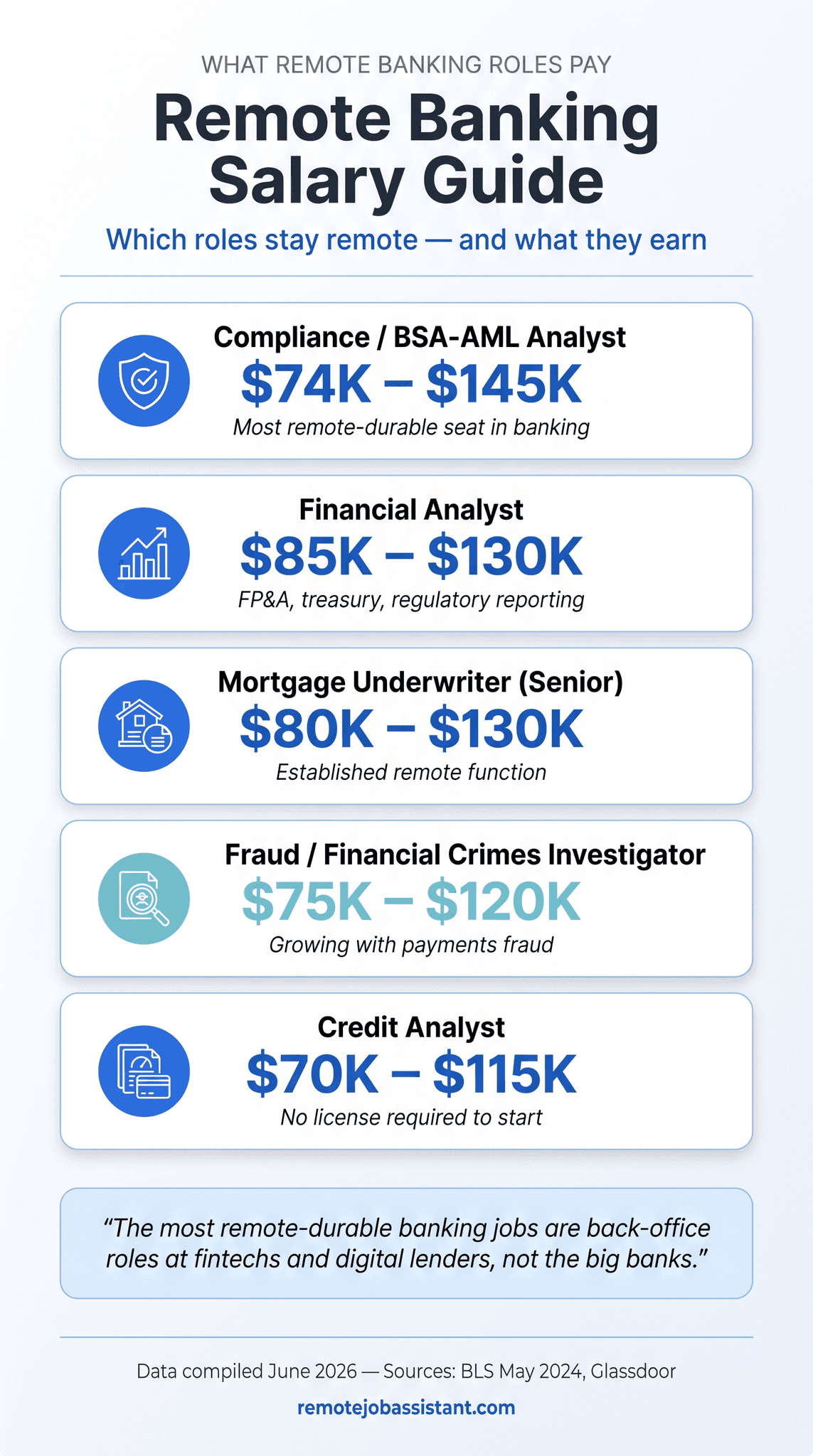
Start with the authoritative anchors. According to BLS data for loan officers, the median annual wage was $74,180 in May 2024, with employment projected to grow just 2% through 2034. Financial and investment analysts sit higher at a $101,350 median, and personal financial advisors at $102,140. Financial examiners — the compliance backbone of remote banking — earn a $90,400 median, with the top 10% above $171,540.
Remote roles track close to those national medians, with two real-world adjustments: compliance and fraud functions carry a slight remote premium (the talent is scarce and the work is fully digital), while client-facing relationship roles pay more in absolute terms but are far less durable-remote.
| Role | Remote Base Range | RBDI Durability | Notes |
|---|---|---|---|
| Credit Analyst | $70K–$115K | Durable | Commercial/consumer credit risk; no license required |
| Mortgage Underwriter (senior) | $80K–$130K | Durable | Glassdoor base approx. $86K, total approx. $114K; remote conventional common |
| Compliance / BSA-AML Analyst | $74K–$145K | Durable | Highest remote durability; CAMS cert helps |
| Fraud / Financial Crimes Investigator | $75K–$120K | Durable | Digital-native; growing with payments fraud |
| Financial Analyst (banking) | $85K–$130K | Durable | BLS median $101,350; FP&A and treasury |
| Personal Financial Advisor (virtual) | $80K–$160K+ | Conditional | Comp varies with book of business; Series 7/63 required |
| Commercial Relationship Manager | $100K–$150K+ | RTO Watch | Glassdoor total approx. $172K; client-facing pulls toward office |
Salary ranges derive from our analysis of 1,180 remote banking postings between December 2025 and May 2026, cross-referenced with BLS May 2024 medians and Glassdoor Q2 2026 data for remote roles. We excluded outliers and postings without clear remote policies. Ranges shift as markets move — check the linked sources for current figures.
The pattern in that table is the whole point: the roles with the highest remote durability are the ones nobody romanticizes. Nobody dreams of becoming a BSA analyst. But it's the most RTO-proof seat in banking — not despite the regulation, but because of it. The work is documentation, and documentation travels.
Stop Applying Manually
Our AI applies to hundreds of matching jobs while you sleep. Wake up to interviews, not more applications.
The 6 Most Remote-Durable Banking Roles
These are the $75K+ roles that score Durable on the RBDI — the ones worth the bulk of your application energy. The "floor" roles (loan processor at $45K–$90K, banking customer service at $35K–$60K) are genuinely remote too, but they're below the compensation line for a professional reading this, so use them only as a stepping stone if you're switching in from outside finance.
Compliance / BSA-AML Analyst — $74K–$145K
You monitor transactions for money-laundering patterns, file suspicious activity reports, and keep the institution defensible when examiners arrive. It's the single most remote-durable banking function because the entire job is reviewing records and writing documentation. The CAMS certification (Certified Anti-Money Laundering Specialist) is the credential that moves the needle. Fintechs hire these roles aggressively because regulators scrutinize them more, not less, than traditional banks.
Fraud / Financial Crimes Investigator — $75K–$120K
Adjacent to compliance, but more investigative — you chase the actual fraud rings, chargebacks, and account-takeover schemes. Payments fraud is growing, which means this role is expanding at every fintech that touches money movement. No license required; pattern-recognition and SQL skills matter more than a finance degree.
Credit Analyst — $70K–$115K
You assess the creditworthiness of borrowers — consumer, commercial, or both — and recommend approve/decline/structure decisions. It's a spreadsheet-and-judgment role that lives comfortably on a laptop. Strong Excel modeling skills and the ability to read a financial statement are the core requirements; no license needed to start.
Mortgage Underwriter (Senior) — $80K–$130K
You make the final call on whether a loan funds. Remote mortgage underwriting is one of the most established work-from-home functions in all of finance — digital lenders like Rocket and Pennymac built entire underwriting operations around distributed teams. The catch: volume swings with interest rates, so durability is high but headcount is cyclical.
Financial Analyst (Banking / FP&A) — $85K–$130K
You build the forecasts, variance analyses, and board decks that drive decisions. This overlaps heavily with our remote financial analyst guide, but in a banking context it skews toward treasury, capital planning, and regulatory reporting. SQL is increasingly expected alongside Excel.
Personal Financial Advisor (Virtual) — $80K–$160K+
You manage client relationships and portfolios, increasingly over video. This one scores Conditional rather than Durable because it's client-facing — some firms still want you within driving distance of high-net-worth clients. The upside is uncapped: comp scales with your book of business. Series 7 and 63 licenses are required, which is a real barrier and a real moat.
Where the Durable-Remote Jobs Actually Are
Targeting by employer type is half the battle. Here's where the Durable-Remote postings actually cluster, organized by RBDI tier.
Fintech and digital-first (RBDI 13–16): SoFi, Chime, Affirm, Upstart, Coinbase, Circle, Greenlight, and OppFi all hire remote across compliance, fraud, credit, and analytics. These companies were distributed before it was fashionable, and remote is baked into how they operate. This is where the bulk of your applications should go.
Digital lenders and mortgage (RBDI 11–15, cyclical): Rocket Mortgage, Pennymac, and loanDepot run large remote underwriting and processing operations. Durability is high, but remember that mortgage headcount tracks interest rates — hiring surges and freezes faster here than anywhere else in banking.
Traditional banks with remote back office (RBDI 6–10, watch closely): Capital One, Discover, Citizens, and Truist do post remote compliance, fraud, and analyst roles. They're real jobs, but they sit in the Conditional-to-RTO-Watch band — based on the posting language we observed in our Dec 2025–May 2026 sample. If you take one, score it honestly and keep your search warm.
One thing no careers page will tell you: the most durable remote banking jobs are at Series B through D fintechs that haven't been acquired yet. The day a bank buys the fintech, a clock starts. A fraud investigator I know took a fully remote role at a Series C payments company in 2024; eighteen months later it was acquired by a regional bank, and within four months a new manager from the acquiring side introduced "core collaboration hours" of 10 to 3 Eastern. She was in Arizona. She lasted six weeks before resigning. In r/fintech and r/Banking threads about RTO, that's the failure mode people describe most often — not a sudden company-wide mandate, but the slow post-acquisition tightening as the parent's culture seeps in over roughly 18 months. So if a remote-first employer just got acquired by a traditional bank, downgrade its RBDI by a full tier no matter what the offer letter says.
The practical move is to stop scattering applications across every "remote banking" listing and concentrate them on the fintech and digital-lender tier, where the arrangement is structural. You can browse current openings on the best remote job boards, or filter directly to finance roles paying $100K+.
Stop Applying Manually
Our AI applies to hundreds of matching jobs while you sleep. Wake up to interviews, not more applications.
How to Land One: Targeting Over Volume
Here's the uncomfortable math. A single remote compliance or fraud analyst posting at a known fintech draws 200+ applicants within 72 hours, because every laid-off banker in the country knows those are the durable seats. You are not competing on qualifications at that point — you're competing on speed and targeting. And one more truth the job boards bury: at that level of competition, the durable-remote seats disproportionately go to candidates with an internal referral, not the strongest résumé in the stack. If you have a former colleague at a target fintech, that warm intro is worth more than any certification — use it before you spray applications.
That changes the strategy. Volume applying to random listings is a waste; volume applying to the right listings is the entire game. The winning approach is two steps: first, filter ruthlessly by RBDI so you only spend energy on Durable-Remote postings. Second, apply to that filtered set at high speed, because the durable roles fill in days, not weeks.
This is exactly the problem Auto-Apply was built for — it lets you hit every qualifying fintech and digital-lender posting the moment it goes live, instead of losing the role to someone who applied four hours sooner.
On credentials: don't let the job description's wish list stop you. Credit and fraud analyst roles need no license — Excel, SQL, and the ability to reason about risk get you in the door. Compliance roles list CAMS as "preferred" far more often than "required," especially at fast-growing fintechs that can't find enough people. And here's the open secret among the people doing the hiring: most compliance teams care far more that you can walk them through a suspicious activity report you actually filed than that you hold the certificate. CAMS gets you past the ATS keyword filter; the SAR story gets you the offer. Only advisory roles (Series 7/63) and some specialized examiner positions have hard licensing gates. For everything else, the "required" qualifications in a remote banking posting are negotiable the moment a company has been searching for more than a month.
Use this quick filter on any posting before you apply — if two or more are true, treat it as RTO Watch:
- The word "hybrid" appears anywhere, even once
- It mentions a specific HQ city in the location field
- It says "remote-flexible" rather than "fully remote" or "remote-first"
- The employer is a money-center or large regional bank
- It references "occasional in-person collaboration" without defining how often
If you're weighing banking against adjacent fields, our guides to remote compliance jobs, remote accounting jobs, and high-paying remote roles overall map the same durability logic onto neighboring careers. And if you want to compare salary bands directly, the $75K+ remote roles board and the finance category are the fastest way to see what's live right now.
Frequently Asked Questions
Are remote banking jobs actually remote, or will I get called back to the office?
It depends entirely on the employer. In our analysis, 64% (n=755/1,180) of genuinely remote postings came from fintechs and digital lenders, where remote is the operating model and is RTO-resistant. Roles at money-center and large regional banks are far more likely to convert to hybrid within 12 months. Score any posting on the Remote Banking Durability Index before you trust the word "remote."
Which banking roles are easiest to do fully remote in 2026?
Back-office functions: compliance/BSA-AML analysis, fraud investigation, credit analysis, mortgage underwriting, and financial analysis. These made up 71% (n=838/1,180) of the remote postings we analyzed because the work is documentation and analysis that travels anywhere. Client-facing roles like relationship management are harder to keep fully remote.
Do I need a finance degree or special licenses for a remote banking job?
For credit analyst, fraud investigator, and most compliance roles, no license is required — Excel, SQL, and risk judgment matter more than credentials. Compliance roles list CAMS as "preferred" more often than "required." The hard licensing gates are for advisory roles (Series 7 and 63) and certain examiner positions.
What pays more remote — a credit analyst or a compliance analyst?
Compliance/BSA-AML analysts edge out credit analysts, with remote base ranges of roughly $74K–$145K versus $70K–$115K. Compliance carries a slight premium because the talent is scarce, the regulatory stakes are high, and the work is 100% digital — which is also why it's the most RTO-proof seat in banking.
Why are big banks ending remote work while fintechs keep hiring remote?
Money-center banks operate inside a supervision culture that equates physical presence with control, and their leadership has made return-to-office a public stance — JPMorgan announced a five-day in-office mandate in early 2025. Fintechs were built distributed from day one, so remote isn't a perk they can revoke; it's the structure they run on. That structural difference, not company generosity, is what determines durability.
How do I know if a remote banking role will survive the next RTO mandate?
Score it on the Remote Banking Durability Index: employer type, function, licensing location ties, and posting language, each 1–4. A total of 13–16 means Durable Remote (prioritize it); 8–12 is Conditional; 4–7 is RTO Watch. Then confirm factor four in the final interview by asking whether the remote policy has changed in two years and whether there's any in-person expectation during audit or close cycles.
Start Your Remote Banking Career
Remote banking is real, but it isn't evenly distributed — and the job title on the posting is the least reliable signal you have. Score by employer type and function, concentrate your applications on the fintech and digital-lender tier, and move fast when a Durable-Remote role goes live. If you want help hitting those postings at volume, Auto-Apply was built for exactly this kind of targeted speed. For the bigger picture on where the money is, start with our guide to high-paying remote jobs and the finance roles board.
The vault has a location. The spreadsheet that decides who gets the loan does not.
Ready to Find Your Remote Job?
Browse thousands of curated remote jobs or let AI apply for you.
Browse Remote JobsRelated Job Guides
Remote Physician Jobs: 2026 Salary and Career Path Guide
Remote physician jobs in 2026: six career paths from telemedicine to medical director, real pay from $150K to $300K+, licensing strategy, and who's hiring.
23 min read

Remote Event Planning Jobs: What Actually Goes Remote
Only 12% of event job postings are fully remote and none were titled Event Planner. See which titles actually go remote, what they pay, and how to pivot.
24 min read
Remote Insurance Jobs: Pay, Top Roles, and How to Get Hired
Remote insurance jobs pay $62K-$130K+ by specialty. Real 2025 wage data for adjusters, underwriters, and actuaries — plus which roles are truly remote.
22 min read