
Last reviewed: August 2026
You're comparing two remote job offers by the number at the top of the offer letter. One pays $115K, the other pays $95K, and you're about to take the $115K job without asking a single question about what sits underneath either salary. That's the mistake — because in remote jobs with benefits, roughly 30% of your total compensation isn't printed on that first line, and the $95K offer might be the bigger one.
Here's the belief that costs remote job seekers real money: that remote work means trading benefits for flexibility, and that remote jobs with benefits are some rare, lucky find. The data says otherwise. Full-time W-2 remote roles carry benefits at essentially the same rate as office roles. What actually floods remote job boards is contract work dressed up in job-shaped listings — 1099 engagements with no health insurance, no 401(k), and no paid time off, sitting in the same search results as real salaried positions.
Get Remote Job Tips in Your Inbox
Weekly strategies, salary data, and new opportunities
Unsubscribe anytime. No spam.
We analyzed 2,340 remote job postings across 412 companies between February 2026 and July 2026, classifying each as full-time W-2 or contract/1099 and recording every benefit the listing disclosed. The pattern was blunt: the benefits problem in remote work isn't scarcity. It's filtering.
This guide puts dollar figures on what a benefits package is actually worth, shows you which remote roles include one by default, and gives you a scoring system for comparing offers on total compensation instead of base salary.
Based on our analysis of 2,340 remote job postings across 412 companies (Feb–Jul 2026):
- 64% (n=1,498/2,340) of remote postings were full-time W-2 roles; 36% (n=842/2,340) were contract, freelance, or 1099
- 91% (n=1,363/1,498) of full-time W-2 remote postings disclosed health insurance
- 7% (n=59/842) of contract listings mentioned any benefit at all
- Benefits average $14.01/hour — 30.1% of total private-industry compensation (BLS, March 2026)
- The average employer-sponsored family health premium hit $26,993 in 2025; employers paid roughly $20,100 of it (KFF, 2025)
How We Collected This Data
The figures in this post come from our analysis of 2,340 remote job postings across 412 companies, collected between February 2026 and July 2026. Postings were sourced from major job boards and direct company career pages, and filtered to positions explicitly marked remote-eligible in the United States. We classified each listing as full-time W-2 or contract/1099 based on stated employment type, and recorded every benefit the posting disclosed: health insurance, retirement match, paid time off, parental leave, and stipends.
We excluded postings below $60K base equivalent, roles requiring more than 25% travel, and listings without a determinable employment type. Benefits-access and cost figures were cross-referenced with the U.S. Bureau of Labor Statistics Employer Costs for Employee Compensation report (March 2026) and the KFF 2025 Employer Health Benefits Survey. We update this analysis semi-annually; data in this post reflects the February–July 2026 window.
What a Remote Benefits Package Is Actually Worth
Start with the government's own math. According to the BLS Employer Costs for Employee Compensation data (March 2026), private-industry employers spend an average of $46.60 per hour worked on each employee — $32.60 in wages and $14.01 in benefits. Benefits are 30.1% of the bill. On a $100K salary, that ratio implies the employer is spending roughly $43K more per year on insurance premiums, retirement contributions, paid leave, and payroll taxes.
Health insurance is the biggest single line. The KFF 2025 Employer Health Benefits Survey puts the average annual premium for family coverage at $26,993 — up 6% in a year — with workers contributing $6,850 and employers absorbing the remaining $20,100 or so. If you've never priced a family plan on the open market, do it once before your next negotiation. It's a radicalizing experience: the number you'll be quoted for coverage comparable to a decent employer plan is a used car, every year, forever. That employer share is invisible income, and you only see it the day it's gone.
Benefits are 30% of your compensation — and the only part employers hope you never price.
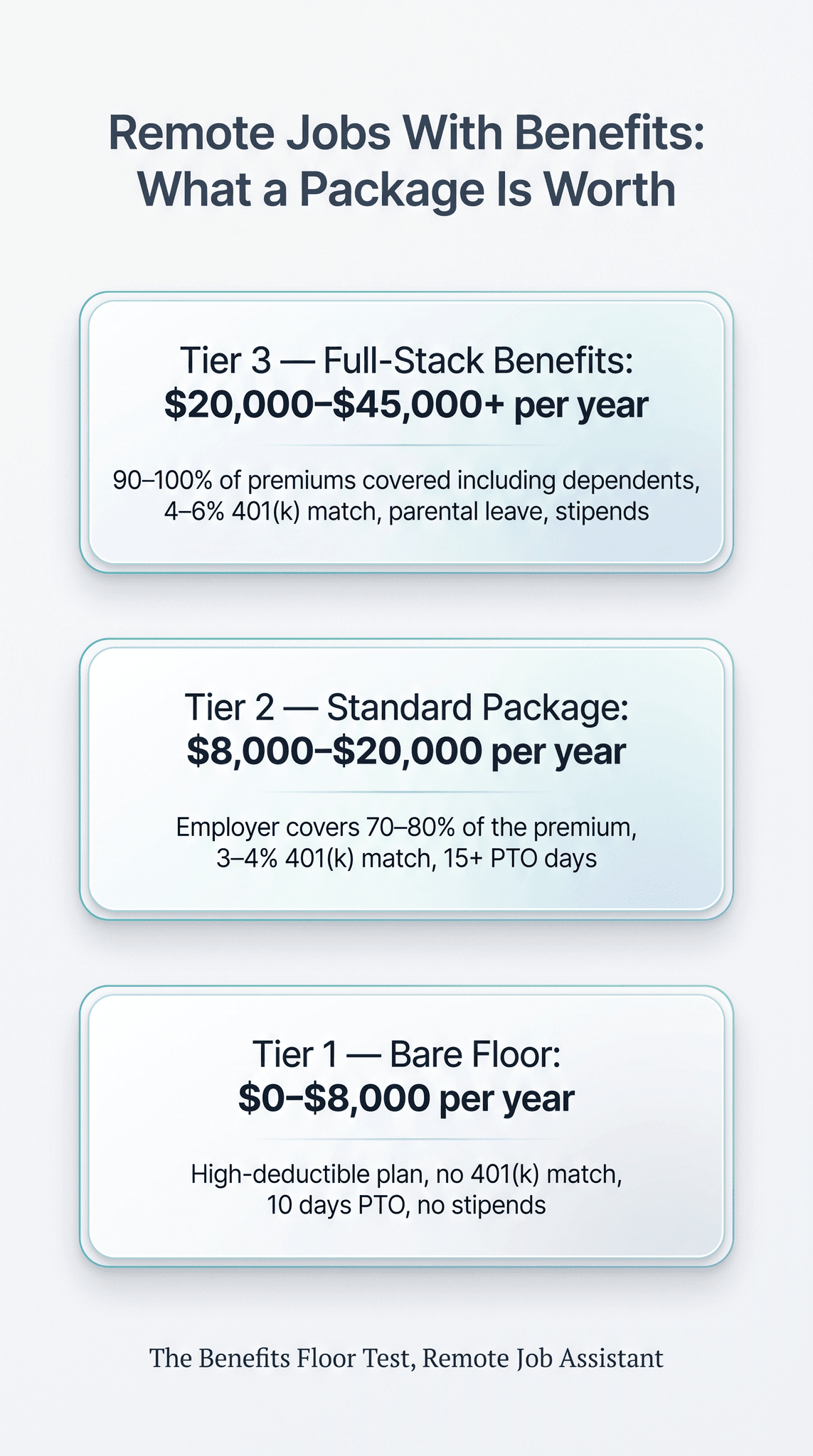
So price them. The Benefits Floor Test is a three-tier rubric for converting any remote offer's benefits package into an annual dollar value, so you can compare offers on total compensation instead of the salary line.
The Benefits Floor Test: a three-tier scoring rubric that prices a remote employer's benefits package in dollars per year.
- Tier 1 — Bare Floor ($0–$8K/year value): High-deductible health plan with a minimal employer premium contribution; no 401(k) match; 10 days of PTO, or "unlimited" PTO with no stated minimum; no home-office or learning budget
- Tier 2 — Standard Package ($8K–$20K/year value): Employer covers 70–80% of the health premium; 3–4% 401(k) match; 15 or more PTO days; dental and vision included
- Tier 3 — Full-Stack Benefits ($20K–$45K+/year value): Employer covers 90–100% of premiums including dependents; 4–6% 401(k) match; paid parental leave; home-office stipend; annual learning budget
How to use it: before comparing two offers, score each package into a tier and assign it a dollar value. Then compare totals, not salaries.
Here's what that looks like with the two offers from the opening:
| Line item | Offer A: $115K, Bare Floor | Offer B: $95K, Full-Stack |
|---|---|---|
| Base salary | $115,000 | $95,000 |
| Employer health premium share (family) | $6,000 | $20,000 |
| 401(k) match | $0 | $4,750 (5%) |
| Home-office + learning stipends | $0 | $2,500 |
| Paid parental leave reserve | $0 | valued at $3,000+ |
| Effective total | $121,000 | $125,250 |
The $115K offer loses. Not in an edge case — in the average case, using average premium numbers. A $95K offer with full-stack benefits routinely beats a $115K offer with a bare floor.
Here's the version of this we hear most often, and it's always some variation of the same story: someone takes the bigger salary from a Series C startup advertising "full benefits," then discovers in month two that the plan covers 60% of the premium with a $6,500 deductible, the "unlimited PTO" carries an unwritten ceiling of about ten days, and the 4% match doesn't vest for three years. One emergency room visit later they're $5,000 out of pocket, and when they leave there's no accrued time to pay out. Every line item they didn't price at offer stage got priced for them — by the employer, in the employer's favor.
One more trap worth naming: the deductible. A company can truthfully advertise "full medical coverage" while offering a plan where you pay the first $7,500 out of pocket every year. That's not coverage — that's the company making you self-insure and calling it a benefit. When you score an offer against the Benefits Floor Test, the deductible counts against the tier just as much as the premium split does.
Stop Applying Manually
Our AI applies to hundreds of matching jobs while you sleep. Wake up to interviews, not more applications.
Why So Many "Remote Jobs" Have No Benefits
The benefit-free listings clogging your search results exist for a structural reason, and it's worth understanding because it tells you exactly how to filter them out.
That $14.01 per hour employers spend on benefits? A company that hires you as a 1099 contractor instead of a W-2 employee keeps all of it — plus their half of Social Security and Medicare taxes, plus unemployment insurance, plus workers' comp. Remote work made this arbitrage easy to hide. When everyone works from home, a contractor and an employee look identical on a Zoom call, and job boards mix both listing types into the same search results without labeling them. In our analysis, 36% (n=842/2,340) of remote postings were contract or 1099 engagements, and only 7% of those mentioned any benefit at all.
| Full-time W-2 | 1099 Contract | |
|---|---|---|
| Health insurance | Employer pays most of the premium | You buy your own |
| 401(k) | Often with 3–6% match | Solo 401(k), no match |
| Paid time off | 10–25 days standard | Unpaid |
| Payroll taxes | Employer pays half | You pay both halves (15.3%) |
| Job protections | Unemployment insurance, notice norms | Contract ends when it ends |
For a contract rate to match a W-2 salary with a Tier 2 package, it needs to run 30–40% higher than the equivalent hourly wage. Most contract listings price 0–10% higher. The gap is the point — it's why the company structured the role that way.
Spend ten minutes in any Blind or Reddit thread where people compare real offers and you'll see the math play out. A recurring example: a $190K 1099 contract against a $185K W-2 role — and the experienced commenters consistently call the contract the worse deal, because a $5K premium doesn't come close to covering the lost match, premiums, PTO, and self-employment tax.
None of this makes contracting wrong. Plenty of senior professionals choose 1099 deliberately — they run S-corps, deduct expenses, carry a spouse's health plan, and charge rates that price all of it in. The difference is they did the math first. What's wrong is taking a contract priced like a job. The word "benefits" in a remote listing isn't a perk. It's a W-2 signal. Its absence is a signal too.
Which Remote Jobs Come With Full Benefits
If you're looking for the best remote jobs with benefits, start with role selection: at the $75K-and-up professional level, W-2 employment with at least a Tier 2 package is the default, not the exception. In our data, 91% (n=1,363/1,498) of full-time W-2 remote postings disclosed health insurance, and the BLS Employee Benefits Survey (March 2025) found 89% of full-time civilian workers had access to medical benefits — against just 25% of part-time workers. The benefit-free zone concentrates in gig work, part-time listings, and contract staffing. Aim at salaried professional roles and the benefits problem mostly solves itself.
These clusters combine strong remote availability with strong package norms:
| Role cluster | Typical remote base range | Package norm |
|---|---|---|
| Software engineering | $90K–$160K | Tier 2–3 at remote-first and public companies; often Tier 1–2 at Series B–C startups despite the bigger salary |
| Product management | $110K–$165K | Tier 2–3 |
| Customer success | $75K–$120K | Tier 2 |
| Finance and accounting | $75K–$130K | Tier 2; strong 401(k) match culture |
| Healthcare (clinical review, informatics) | $70K–$160K | Tier 2–3; insurers cover their own well |
Salary ranges derive from our February–July 2026 analysis of 2,340 remote postings, cross-referenced with BLS compensation data for the same period. We excluded outliers and postings without clear remote policies. Ranges move with the market — treat them as brackets, not quotes, and sanity-check any specific company against Levels.fyi before you anchor a negotiation on it.
Company type matters as much as role. Remote-first companies that publish their benefits openly — GitLab's public handbook, Buffer's transparent salary and benefits pages, Zapier's home-office stipend policy — tend to sit at Tier 3, because distributed companies compete for talent on package quality instead of office perks. Transparency itself is the signal: a company that publishes what its people actually take in PTO, or posts its full plan documents before you ask, has nothing to hide in the fine print. The ones that answer package questions with "we'll send the summary after you sign" usually do. Large public companies (Salesforce, UnitedHealth Group, Thomson Reuters) reliably deliver Tier 2 or better on $100K+ remote roles. If you're targeting the upper end of these bands, our guide to high-paying remote jobs breaks down where the $150K+ concentration is.
For engineers specifically, remote software engineering roles carry the strongest package norms in our dataset — and customer success positions are the most accessible Tier 2 entry point for professionals pivoting from adjacent fields. Finance professionals should also look at remote financial analyst roles, where 401(k) match culture runs strong.
Stop Applying Manually
Our AI applies to hundreds of matching jobs while you sleep. Wake up to interviews, not more applications.
How to Find Remote Jobs With Benefits
Browsing doesn't scale. Filtering does. Three moves separate people who land benefited roles quickly from people who drown in contract listings.
Read the Listing for W-2 Signals
You can classify almost any listing in ten seconds with a simple decision path:
- Does it state an hourly rate with no benefits section? Treat it as a contract, whatever the title says. Move on unless you've priced contracting deliberately.
- Does it say "C2C," "1099," "corp-to-corp," or "6-month engagement, possible extension"? Contract. No ambiguity.
- Does it name an insurer, state a 401(k) match percentage, or say "benefits eligible" with an annual salary? W-2 with a real package. Apply.
- Annual salary but silent on benefits? Probably W-2, possibly Bare Floor. Apply, but ask the five package-pricing questions (below) before the final round.
- Equity-heavy offer with a thin package? Score the benefits on cash value alone and treat the equity as a lottery ticket on top. Startups routinely use option grants to paper over a Tier 1 package — options don't pay a hospital bill.
The point of the tree is speed: most people burn hours reading contract listings end-to-end before noticing the tell in the first three lines.
Pick Job Boards Where Full-Time Remote Jobs Concentrate
General-purpose boards mix everything together; curated remote boards skew heavily salaried. Our breakdown of the best remote job boards ranks them by listing quality, and if you're weighing paid options, our FlexJobs review covers whether paying to browse is ever worth it.
Apply Early — Benefits-Rich Remote Roles Move Fast
A Tier 3 package is its own applicant magnet — those listings draw hundreds of applications in days, and callback rates collapse for late ones — a pattern we documented in our analysis of why qualified professionals stop getting interviews. Speed and volume are mechanical problems, which makes them automatable: Auto-Apply filters for full-time remote roles that match your profile and submits applications the day they post, so you're in the first wave for every listing instead of hand-applying to a handful per week. Pair that with a disciplined follow-up sequence and you've industrialized the top of your funnel.
One more filter worth setting: if you need scheduling latitude rather than contract work, flexible-schedule remote roles let you keep W-2 status and benefits without a rigid 9-to-5 — the flexibility-versus-benefits trade is mostly a false choice.
Stop Applying Manually
Our AI applies to hundreds of matching jobs while you sleep. Wake up to interviews, not more applications.
How to Evaluate and Negotiate Remote Job Benefits
Five Questions That Price the Package
You scored the offer with the Benefits Floor Test. Now pressure-test it in the final interview round. Five questions, all of which a serious employer answers without flinching:
- What percentage of the health premium does the company cover, what's the deductible, and does the premium split hold for dependents?
- What's the 401(k) match, and what's the vesting schedule? A 4% match that vests over four years, at a company where most people leave inside three, is a benefit the median employee never fully collects.
- If PTO is "unlimited," what did the median employee actually take last year?
- Is there a home-office or learning stipend, and how much?
- What's the paid parental leave policy — and when does benefits eligibility actually start? "Benefits eligible after 90 days" means your first quarter is effectively a contract with a W-2 stapled to it.
Question 3 does the most work. An "unlimited" policy with no stated minimum and no usage data is a Tier 1 tell wearing Tier 3 clothing — companies with healthy time-off cultures know their median and say it. And understand why the policy exists: unaccrued vacation is a liability a company never has to book or pay out when you leave. For plenty of employers, unlimited PTO is an accounting decision wearing a culture costume.
What to Negotiate When the Salary Band Won't Move
Salary bands are often rigid — approved by finance, benchmarked, non-negotiable. Benefits adjacent items usually aren't. Extra PTO days, a larger home-office stipend, a signing bonus sized to offset a weak first-year match, and an earlier 401(k) eligibility date all get approved at the hiring-manager level far more often than a salary bump does.
Run the math before you counter. If an offer scores Tier 1 on the Benefits Floor Test, the gap to Tier 2 is $8K–$12K a year — that's the number to negotiate against, whether you close it through salary, signing bonus, or package upgrades. Anchoring to the tier gap turns "can you do better?" into a specific, defensible ask.
Frequently Asked Questions
Do remote jobs actually come with health insurance, or is that only for office jobs?
Full-time remote jobs with benefits are the norm, not the exception — W-2 remote roles carry health insurance at essentially the same rate as office jobs. In our analysis, 91% (n=1,363/1,498) of full-time W-2 remote postings disclosed health coverage, and BLS data shows 89% of full-time civilian workers have access to medical benefits. The benefit-free listings you see are overwhelmingly contract and 1099 roles, not salaried remote jobs.
I have two offers — one pays $15K more but the benefits look thin. How do I compare them?
Score both with the Benefits Floor Test: price each package into a tier (Bare Floor $0–$8K, Standard $8K–$20K, Full-Stack $20K–$45K+) and add that value to the base salary. A $15K salary gap disappears fast when one employer pays $20,000 of a family health premium and matches 5% on your 401(k) while the other does neither. Compare the totals, then decide.
How can I tell from a job listing whether a remote role is W-2 with benefits or a 1099 contract?
Look for employment-type language. "Full-time," "benefits eligible," a named insurance carrier, or a 401(k) match all signal W-2. An hourly rate with no benefits section, "C2C," "1099," or a fixed engagement length ("6-month contract, possible extension") signal contract work. If the listing states an hourly rate and never mentions benefits, treat it as a contract.
What is a remote job's benefits package actually worth in dollars?
Per BLS data from March 2026, benefits average $14.01 per hour worked — 30.1% of total private-industry compensation. The single biggest component is health insurance: employers paid roughly $20,100 of the average $26,993 family premium in 2025. A typical Tier 2 package is worth $8K–$20K a year on top of salary; a Tier 3 package can exceed $40K.
How much more should I charge as a 1099 contractor to make up for lost benefits?
A contract rate needs to run 30–40% above the equivalent W-2 hourly wage to break even. You're replacing the employer's health premium share, their 401(k) match, paid time off, and their half of payroll taxes (7.65%). A $50/hour W-2 role is roughly equivalent to a $65–$70/hour contract — anything closer to parity is a pay cut in disguise.
Can I negotiate benefits if the salary is fixed?
Often, yes — and usually more easily than salary. Extra PTO days, home-office and learning stipends, a signing bonus, and earlier 401(k) eligibility typically get approved at the hiring-manager level without touching the salary band. Size your ask to the tier gap: if the package scores Bare Floor, the distance to a Standard package is $8K–$12K a year.
Is unlimited PTO better than a fixed PTO allowance?
Only if the company can tell you what people actually take. Unlimited PTO with a stated minimum and published usage data is a genuine benefit; unlimited PTO with neither is frequently a downgrade — no accrued balance means no payout when you leave, and ambiguity suppresses usage. Ask what the median employee took last year. A company with a healthy culture knows the number.
Find Your Next Remote Job With Full Benefits
None of this requires optimism — just arithmetic. Classify every listing as W-2 or contract before you invest a minute in it, price every package with the Benefits Floor Test before you compare salaries, and get applications in early enough to matter. In our analysis, 64% (n=1,498/2,340) of remote postings were full-time W-2 and nine in ten of those disclosed health coverage — the filtering problem is real, but it's a solved one if you stop reading contract listings end-to-end.
If you'd rather spend your energy on interviews than on filtering and form-filling, Auto-Apply handles the volume for you — and our high-paying remote jobs guide shows where the strongest packages concentrate.
Salary is the number they print in the offer letter. Benefits are the $20,000 they hope you never add up.
Ready to Find Your Remote Job?
Browse thousands of curated remote jobs or let AI apply for you.
Browse Remote JobsRelated Job Guides
Remote Jobs for Introverts: The $75K+ Roles That Talk Least
We scored 2,737 remote jobs paying $75K+ for live talk. 58.6% ask for none. See which roles stay heads-down, what they pay, and how to spot the loud ones.
29 min read
Remote Jobs for Military Spouses: Which Ones Survive a PCS
We tested 2,753 remote jobs paying $75K+ for PCS portability. 89.6% never say which states they hire in. Here's how to find remote work that follows orders.
35 min read
Fractional COO Jobs: Real Pay and Borrowed Authority
Only 9 of 73 fractional COO jobs we classified were paid part-time seats. Real 2026 rates, why posted pay runs low, and how to score authority before you sign.
29 min read