
Last reviewed: April 2026
You've built a compliance career that can travel. The regulatory frameworks you know cold — BSA, AML, GDPR, HIPAA — apply everywhere. The monitoring software you run lives in the cloud. The audits you prepare happen over email and shared drives. Compliance, more than almost any financial or legal adjacent role, is work that translates to a home office — about 80% of it, anyway. The remaining 20% — regulatory exam prep, regulator site visits, board presentations — is where "remote-first" policies quietly reveal their limits. Understanding which companies have actually solved that 20% problem is the difference between a genuinely remote compliance career and one that keeps pulling you back on-site at the worst possible times.
But here's the tension most compliance professionals hit around the five-year mark: the ceiling that felt far away when you started now feels very close. And that ceiling wasn't set by your performance or your certifications — it was set by an early subspecialty choice you may not have realized you were making. When you said yes to that general corporate compliance analyst role in 2021, you were also saying yes to a salary band that tops out in the mid-$90Ks at most employers. You just didn't know that yet.
Get Remote Job Tips in Your Inbox
Weekly strategies, salary data, and new opportunities
Unsubscribe anytime. No spam.
The $40K–$50K salary gap between a general corporate compliance officer and an AML or fintech compliance specialist isn't about years of experience. It's about subspecialty. We analyzed 520 remote compliance job postings across 148 companies between Q2 2025 and Q1 2026 — real job descriptions filtered to US-eligible, explicitly remote, base salary above $65K — and the data is clear: the specialty you choose determines more about your remote earning potential than the years you log or the employer you work for.
This guide tells you exactly which subspecialties, certifications, and companies open the best remote compliance opportunities in 2026 — and gives you a framework for choosing the path with the right ceiling for where you want to go.
- 62% (n=322 of 520 postings) required at least one compliance certification (CAMS, CCEP, CIPP, CRCM, or equivalent)
- 44% (n=229 of 520) were in financial services or fintech — the largest single vertical
- $87K median base across all mid-level postings vs $118K for AML/KYC specialist roles — a 35% specialization premium
- 28% (n=146 of 520) listed "AI governance" or "emerging technology compliance" as a core responsibility — up from near-zero in 2023. A word of caution: many of these roles are rebranded data privacy jobs with no established regulatory framework yet. "AI governance" in a job description often means "we want someone to figure this out." It can be a career-building opportunity or a sinkhole with no clear mandate — ask specifically what frameworks they're using before accepting.
- Bureau of Labor Statistics projects 33,300 compliance officer openings annually through 2034
How We Collected This Data
Our dataset covers 520 remote compliance job postings sourced from the RemoteJobAssistant.com aggregator, LinkedIn, and direct company career pages between Q2 2025 and Q1 2026. To qualify for inclusion, a posting had to be US-eligible, explicitly designated as remote (not hybrid or flexible), carry a disclosed or estimable base salary of at least $65K, and include clear language about the company's remote work policy.
We excluded hybrid-only roles and any posting that required more than 15% travel. Salary figures were cross-referenced with Glassdoor's 2026 compliance compensation data and BLS May 2024 Occupational Employment and Wage Statistics to validate ranges. Where postings listed salary ranges rather than a single figure, we used the midpoint for averaging. All figures reflect base salary unless otherwise noted.
What Remote Compliance Actually Pays
| Level | Title | Salary Range |
|---|---|---|
| Entry (0–2 yrs) | Compliance Analyst | $65K–$85K |
| Mid (3–5 yrs) | Compliance Specialist / Officer | $85K–$115K |
| Senior (5–10 yrs) | Senior Compliance Manager | $115K–$145K |
| Director | Director of Compliance | $145K–$200K |
| Executive | Chief Compliance Officer | $180K–$350K+ |
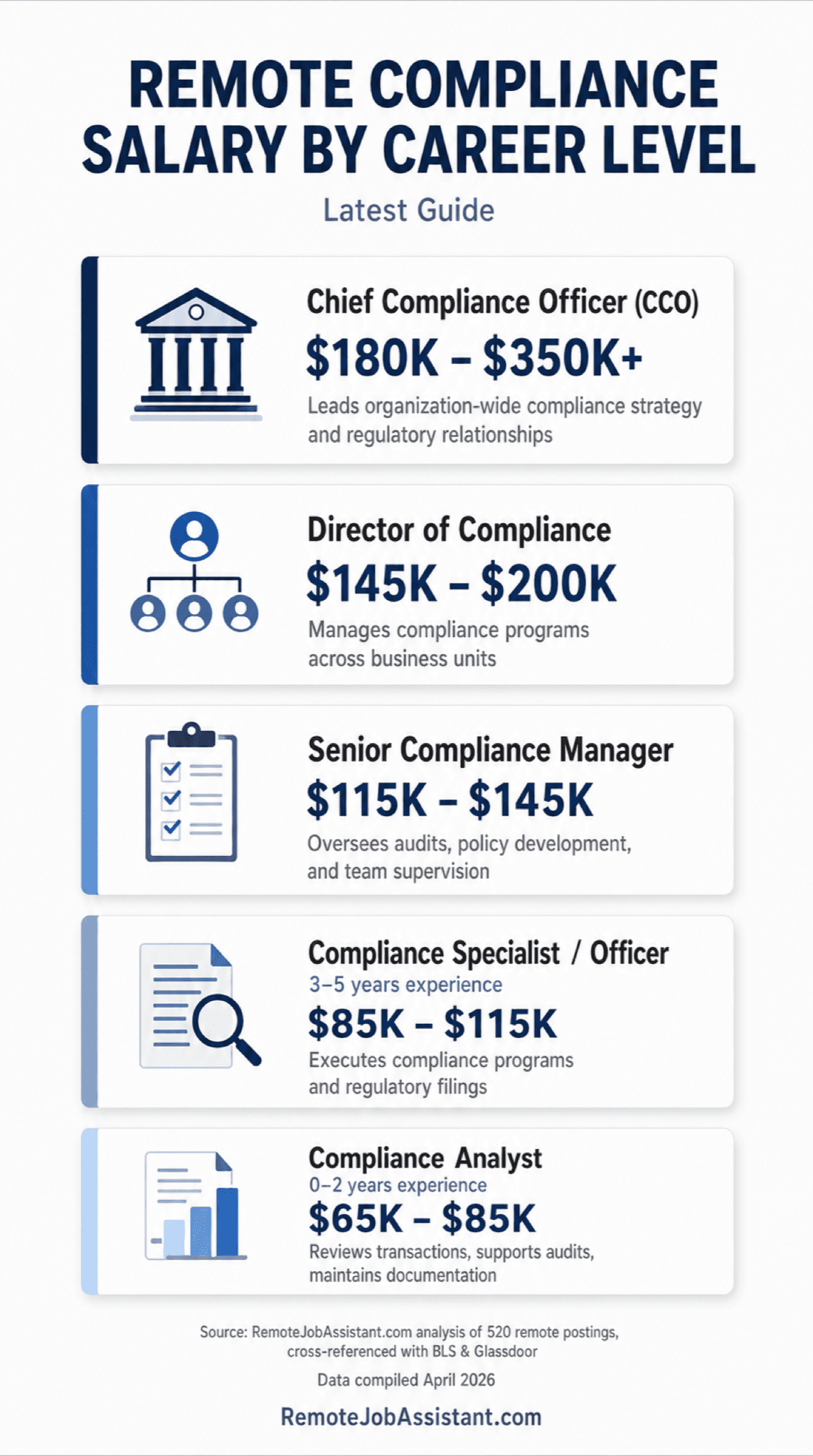
These ranges come from our analysis of 520 remote compliance postings between Q2 2025 and Q1 2026, cross-referenced with Glassdoor's 2026 compliance compensation data. BLS reports a median of $78,420 for all compliance officers (May 2024) — remote-eligible and specialized roles consistently track 15–25% above that median. Ranges reflect base salary; total comp including bonus typically runs 10–20% higher at fintech and public companies.
The BLS median tells you what the average compliance officer earns. It doesn't tell you that an AML specialist at a Series B fintech earns $130K with a CAMS and three years of experience — while a general compliance officer with seven years earns $95K at a regional bank.
The Compliance Subspecialty Stack
Here's the framework that changes how compliance professionals think about their career — and why the decisions you make about specialization matter more than almost anything else in your career trajectory.
The Compliance Subspecialty Stack is a scored rubric that maps six compliance specializations by salary ceiling, remote viability, and demand growth. Most compliance professionals drift into a specialty based on which job was available. This framework lets you choose based on where you want to end up — and gives you a three-step process to act on it.
Step 1: Map your current role to a tier using the table below. Be honest — if your day-to-day is writing policy and running trainings, that's Tier 4 regardless of your title.
Step 2: Identify the adjacent higher tier closest to your existing skills. If you're in Tier 4 corporate compliance and you've done any AML or BSA work, even incidentally, that's your bridge to Tier 3 banking — which is one CRCM cert away from meaningful salary movement, or two steps from Tier 1 with a CAMS.
Step 3: Get the bridge certification before you apply for the higher-tier roles. Trying to land a Tier 1 fintech AML role without CAMS is like applying for a principal engineer role without being able to discuss architecture. The cert doesn't guarantee the job; it gets you past the screener to the conversation where experience actually matters.
| Tier | Specialty | Salary Ceiling | Remote Score (1–10) | Key Cert |
|---|---|---|---|---|
| 1 — Max Ceiling | AML/KYC — Fintech/Crypto | $165K+ | 9 | CAMS |
| 1 — Max Ceiling | Cybersecurity Compliance | $175K+ | 9 | CRISC or CISM |
| 2 — High Ceiling | Data Privacy (GDPR/CCPA) | $155K+ | 9 | CIPP/US or CIPP/E |
| 3 — Solid Base | Banking Regulatory (BSA/CRCM) | $130K | 7 | CRCM |
| 3 — Solid Base | Healthcare Compliance (HIPAA) | $120K | 7 | CHC |
| 4 — General | Corporate Ethics & Compliance | $115K | 6 | CCEP |
The Remote Score runs from 1 (requires permanent on-site presence) to 10 (fully remote is the standard across the industry). Use it as a hard filter: if remote is non-negotiable for you, don't waste time on anything below a 7. For scores of 6 or 7 — primarily banking and healthcare — your interview due diligence question is: "How many times in the last 12 months has this team been required on-site for a regulatory examination?" If the answer is more than once, budget for hybrid creep. The salary may or may not justify it depending on your situation.
Tier 1 scores highest because fintech and crypto companies built remote-by-default infrastructure from day one — their entire compliance operations were designed to satisfy regulators digitally. Healthcare and banking score lower because regulators periodically require on-site examination access, and most of those firms haven't invested in digital examination infrastructure the way fintechs have. A Tier 3 role can be a perfectly good remote job; just don't accept a Tier 3 role on the assumption it will behave like a Tier 1 one.
AML/KYC builds naturally from finance, banking, or legal backgrounds. Data Privacy builds from legal or tech, especially if you have any GDPR or privacy exposure. Cybersecurity Compliance builds from IT or security backgrounds — CRISC is the bridge cert. Healthcare HIPAA compliance builds from health administration or nursing. CAMS and CIPP are the fastest cross-tier certifications — most professionals with 3 or more years in adjacent areas qualify to sit without additional coursework.
Map your current role to a tier. Then look at the Tier 1 or Tier 2 specialty closest to your existing domain. When evaluating job descriptions, use the Stack as a filter: if the title says "compliance officer" but 60–70% of the duties are BSA/AML transaction monitoring — look for phrases like "suspicious activity reports," "transaction monitoring queues," or "NICE Actimize" — you're in Tier 1 territory regardless of what the title says. Search specifically for "AML Analyst" or "BSA Specialist" on job boards rather than just "compliance officer." The narrower search returns higher-ceiling roles.
Our data shows that CAMS-certified compliance professionals receive roughly twice the inbound recruiter contact on LinkedIn as generalist compliance officers at comparable experience levels. Generalists apply. AML specialists get found. The data on this is consistent enough that "get CAMS before you optimize your LinkedIn" is the single highest-ROI action for anyone in Tier 3 or Tier 4 who wants to move up.
If your current work overlaps with financial analysis or tech risk, you may also find it useful to read our guides on remote financial analyst jobs and remote cybersecurity jobs, which cover adjacent subspecialty paths with similar remote viability.
Stop Applying Manually
Our AI applies to hundreds of matching jobs while you sleep. Wake up to interviews, not more applications.
What Skills Remote Compliance Employers Actually Require
The skills gap in remote compliance isn't regulatory knowledge — most candidates applying to mid-level and senior roles have the substantive regulatory background. The real gap is technology fluency and written communication. Remote compliance employers know that a compliance professional who writes clearly and can operate in cloud-based monitoring systems without hand-holding is a fundamentally different hire than someone who relies on the office infrastructure to get work done.
Technical skills that appear most in remote compliance postings:
- AML/BSA regulatory knowledge — required baseline in fintech and banking
- Transaction monitoring systems (NICE Actimize, Fiserv, Oracle Financial Services)
- HIPAA/HITECH frameworks — healthcare compliance roles
- GDPR/CCPA — data privacy roles at tech companies and digital health firms
- SOX compliance — public companies, especially fintech going public
- AI governance and ethics frameworks — fastest-growing requirement (28% of postings, n=146 of 520)
- Data analytics and SQL proficiency — increasingly core, not nice-to-have
- Excel for risk modeling and audit documentation
Beyond the regulatory and technical fundamentals, remote compliance roles carry two additional filters that most candidates aren't prepared for. Fintech and tech companies in particular use these to screen specifically for remote readiness — not just compliance knowledge.
Remote compliance roles get two extra filters that on-site roles don't: a written communication test (often a 500-word case study on a mock regulatory violation) and a self-direction behavioral interview (expect questions like "Describe a compliance issue you caught and resolved with no manager involvement"). One candidate at a $110K fintech role failed the writing screen not because their analysis was wrong — it was solid — but because the sample lacked regulatory citation format. They drafted it the way they'd write an internal memo. The hiring manager wanted to see whether they could write a document that would hold up to a regulator. Prepare the writing sample the same way you'd prepare a technical screen: research the format, find examples, and review it twice before submitting.
Certifications remain the fastest signal of subspecialty commitment. Here's how the major compliance credentials map to remote opportunity:
| Certification | Issuer | Best For | Remote Relevance |
|---|---|---|---|
| CAMS | ACAMS | AML/financial crime | Highest — standard for fintech/crypto |
| CIPP/US or CIPP/E | IAPP | Data privacy | High — tech and healthcare |
| CRCM | ABA | US banking regulations | Medium — banking is more hybrid |
| CCEP | SCCE | Corporate compliance | Medium — corporate roles |
| CRISC | ISACA | IT/cyber risk | High — tech compliance |
| CHC | HCCA | Healthcare | Medium — healthcare systems |
Note: CAMS certification is the single credential that opens the most doors across fintech, banking, and crypto simultaneously. If you're deciding between certifications and your target is Tier 1, start there. One realistic warning: the CAMS exam has a significant failure rate for self-studiers — ACAMS reports that candidates who use only self-study materials pass at a lower rate than those who use structured prep programs or study groups. The r/compliance community on Reddit has threads specifically on CAMS prep strategies worth reading before you register. For data privacy roles, the IAPP's CIPP/US certification is the equivalent entry credential — if your target is tech or digital health, that's where to start.
Which Industries Hire the Most Remote Compliance Roles
Fintech leads on salary and remote flexibility — but burns out analysts faster than any other vertical. Healthcare leads on volume but underpays relative to the documentation load it creates. Tech offers the best comp-to-flexibility ratio, with the caveat that AI governance roles are often poorly defined mandates handed to whoever accepts them first. Those trade-offs don't appear in job descriptions. They matter more than the salary ranges do for long-term career satisfaction.
| Industry | Share of Remote Postings | Avg Salary Range | Remote Maturity |
|---|---|---|---|
| Fintech / Crypto | approx. 25% | $110K–$165K | Remote-first standard |
| Healthcare / Insurance | approx. 22% | $80K–$120K | Increasingly remote |
| Traditional Banking | approx. 19% | $90K–$130K | Mostly hybrid |
| Technology / SaaS | approx. 18% | $105K–$155K | Remote-first standard |
| Government / Regulatory | approx. 8% | $75K–$110K | Hybrid-heavy |
| Other (pharma, telecom) | approx. 8% | $80K–$130K | Varies by firm |
Financial services as a combined vertical — fintech plus traditional banking — accounts for approximately 44% of remote compliance postings in our dataset, making it the dominant hiring category by a wide margin. That concentration reflects both the volume of regulatory requirements in financial services and the fact that fintech companies in particular have invested heavily in cloud-based compliance infrastructure that makes remote operations genuinely viable, not just tolerated.
Technology and SaaS companies deserve attention that most compliance candidates don't give them. The comp-to-remote-flexibility ratio in tech is the best of any vertical: data privacy and AI governance compliance roles at SaaS companies routinely offer $105K–$155K with fully remote structures, often without the on-site examination pressure that traditional banking creates. If your background includes any GDPR, CCPA, or SOX exposure, tech is a lateral move worth running in parallel with your fintech search.
One caution on healthcare: remote healthcare compliance roles — HIPAA-focused positions at large systems like UnitedHealth or Centene — tend to have higher documentation loads than equivalent fintech roles because the on-site team isn't there to absorb the coordination overhead. Compliance professionals in remote healthcare roles consistently report longer hours relative to compensation compared to fintech peers at the same salary level. If you're targeting healthcare compliance specifically, negotiate scope limits and escalation protocols before accepting. The volume of audit prep that falls entirely on the remote compliance analyst is rarely visible in the job description.
For context on how compliance compensation fits into the broader high-earning remote landscape, see our high-paying remote jobs guide and our directory of jobs paying $100K+.
Stop Applying Manually
Our AI applies to hundreds of matching jobs while you sleep. Wake up to interviews, not more applications.
Companies with Verified Remote Compliance Roles
The best remote compliance employers didn't just decide to allow remote work — they built documentation, audit-trail, and regulatory response systems designed from the ground up to satisfy regulators without requiring permanent on-site staff. That infrastructure distinction is what separates genuinely remote employers from remote-flexible ones, and it matters for your day-to-day experience as much as it matters for your job security.
Remote-First Compliance Employers
- Coinbase — AML/KYC, SOX, regulatory compliance. Fully remote US roles. Built crypto-native compliance infrastructure designed to satisfy FinCEN and state regulators via secure digital examination portals.
- Paxos — BSA/AML, state licensing, federal regulatory compliance. Remote-first. Requires CAMS for senior roles; AML Analyst positions are common entry points.
- Stripe — Financial regulatory, AML, payments compliance. Remote roles available across the US and select international locations.
- Wealthsimple — Securities, AML, KYC. Remote-first with Canadian and US operations; strong fit for candidates with cross-border regulatory experience.
- Capital One — AML, financial crime, BSA. Remote roles available across compliance functions; some hybrid requirements apply to senior leadership positions.
Large Employers with Remote Compliance Programs
- State Street — AML, regulatory compliance, global operations. Remote roles available for compliance analysts and specialists; program scope includes international regulatory coordination.
- UnitedHealth Group — HIPAA, healthcare compliance, CMS regulations. One of the largest remote compliance workforces in healthcare; roles span analytics, policy, and audit functions.
- Centene Corporation — Medicaid/Medicare compliance, HIPAA. Multiple remote compliance analyst and officer positions across state-level regulatory programs.
What separates genuinely remote compliance employers from remote-flexible ones comes down to one question: how do regulators interact with your compliance team? At Coinbase and Paxos, regulatory examinations happen via secure portals and digital evidence packages — the team is never required to physically assemble. At traditional banks, "we support remote" often means "until the OCC shows up." Even at some fintechs, a major FinCEN inquiry or state licensing audit can pull a remote team on-site for weeks — and the offer letter won't mention that.
Ask any potential employer directly: "What does a regulatory examination look like for this team, and has anyone on the team had to come in for one in the last two years?" If the recruiter hesitates or redirects to "it's case by case," that's your answer. Companies that have truly solved the remote examination problem will tell you exactly how they do it — because they're proud of the infrastructure investment.
For a broader list of companies across compliance and adjacent roles, see our guides on best remote job boards and remote cybersecurity jobs.
How to Break Into Remote Compliance (or Move Up)
The path to high-earning remote compliance is more accessible than most candidates assume. The bottleneck isn't years — it's subspecialty positioning. That's the part you can actually control, and the part most compliance professionals underinvest in.
Most $100K+ remote roles want five or more years of experience on paper. But three years in a Tier 1 specialty — specifically AML/KYC — with a CAMS certification often outperforms seven years of general compliance experience without it. Employers hiring for fintech AML roles aren't looking for the candidate with the longest resume. They're looking for the candidate with the most relevant regulatory depth and the certification that signals it.
The fastest lateral move in compliance right now is healthcare compliance into healthcare data privacy. If you have HIPAA experience, adding CIPP/US opens the door to tech companies and digital health firms at $105K–$145K — a meaningful step up from where most healthcare compliance roles cap. You're not starting over; you're extending what you already know into a higher-ceiling domain.
The CAMS certification earns its reputation because it opens three doors simultaneously: fintech, banking, and crypto. No other compliance credential has that cross-vertical reach. For candidates targeting Tier 1, it's the single most efficient use of study time and certification budget. Budget 3–6 months of serious study at roughly 8–10 hours a week — this is not a certification you pass on vibes. But CAMS-certified candidates coming from banking, legal, or general compliance backgrounds regularly cross into $100K+ fintech AML roles within 12–18 months of passing. The clock starts when you register, not when you pass.
One more thing nobody says plainly: the first year of a Tier 1 compliance role at a fintech is harder than the interview suggests. Fintech transaction monitoring queues can run 400–600 alerts per analyst per day — roughly triple the volume at a regional bank. The regulatory landscape shifts faster, and you're expected to document in real time without the institutional memory that comes from working in the same building as your senior team.
An AML analyst who transitioned from a Midwest bank BSA team to a fintech AML role put it this way: "The first six months, I was drowning. I flagged a transaction as low-risk and it turned out to be a $1.8M structuring pattern I didn't have the context to recognize. My manager spent 48 hours working with legal to determine whether we needed to retroactively file a SAR. We didn't, but it was close. What I learned is that in fintech, you're expected to build the pattern-recognition context that a traditional bank spends years teaching — and you're expected to build it fast, remotely, largely on your own."
The professionals who make the transition successfully are the ones who over-communicate with managers in the first 90 days, ask every question before acting rather than after, and document their alert logic in writing even when no one requires it. In a remote AML role, your written audit trail is the only record that you made a good-faith judgment call. Treat it that way from day one. Also: bookmark the FinCEN SAR filing guidance before your first week — knowing what a properly documented SAR looks like will save you from the most common first-year mistake.
The fastest path to six figures in remote compliance is CAMS plus a targeted subspecialty pivot — not more years doing the same thing. The compliance professionals who get recruited out of six-figure fintech roles don't have the longest resumes. They have the sharpest regulatory depth in a domain that's actually in demand.
If you're considering adjacent paths with similar remote viability, remote financial analyst jobs offer a natural overlap with compliance work, particularly in financial crime and risk functions. And to run targeted applications efficiently across 20+ compliance employers at once, Remote Job Assistant's auto-apply tool handles the volume while you focus on positioning.
Stop Applying Manually
Our AI applies to hundreds of matching jobs while you sleep. Wake up to interviews, not more applications.
Frequently Asked Questions
What do remote compliance officers do every day?
Day-to-day remote compliance work is almost entirely documentation-driven: transaction monitoring queue reviews, drafting regulatory correspondence and policy updates, cross-functional reviews with legal and product teams, coordinating training rollouts, and preparing audit documentation. All of that work travels cleanly to a home office. The one place remote compliance differs from on-site is documentation quality — when your manager can't look over your shoulder, your written work product becomes the primary signal of how rigorous you are. Remote compliance officers who write clearly and maintain organized audit trails advance faster than those who don't.
I have 4 years of general compliance experience. How do I move into AML or fintech?
CAMS is the entry point — most candidates with three or more years of compliance experience qualify to sit for the exam without additional coursework. Once you've passed, target entry-level to mid-level "AML Analyst" or "BSA Analyst" titles at fintech companies rather than compliance officer titles. The title often resets when you make a lateral subspecialty move; the salary ceiling doesn't. Many AML Analyst roles at Series B or C fintech companies pay $90K–$110K with a CAMS and four years of adjacent experience — well above where a general compliance officer role would sit after the same tenure.
Which compliance certification has the best ROI for remote jobs?
CAMS for anyone targeting financial services or fintech — 44% (n=229 of 520 postings analyzed) of remote compliance postings were in this vertical, and CAMS is a baseline expectation at most fintech and crypto employers. CIPP/US or CIPP/E for tech and healthcare data privacy roles. CCEP for corporate compliance. The common mistake is stacking certifications before establishing subspecialty clarity — pick the one that matches your Tier 1 or Tier 2 target and get it. One well-chosen cert moves the needle more than two unfocused ones.
Is remote compliance actually fully remote, or do you have to come in for regulatory exams?
This is the most important question to ask in any compliance interview. Companies with cloud-based compliance infrastructure — Coinbase, Paxos, most fintech — run regulatory examinations via secure digital portals and electronic evidence packages; the team is never required to physically assemble. Traditional banks and some insurance companies operate differently: FDIC, OCC, or state regulator visits may require on-site presence, and "we support remote" can quietly mean "except then." Ask any interviewer directly: "What does a regulatory examination look like for this team?" The answer is more informative than any policy document.
How do I use The Compliance Subspecialty Stack to choose my specialization?
Map your current role's primary regulatory domain to the Stack table. AML/BSA work puts you in Tier 1 territory. General ethics and code-of-conduct work puts you in Tier 4. The goal is to move toward Tier 1 or Tier 2. If your background is healthcare (Tier 3), adding CIPP/US moves you into Tier 2 Data Privacy, which unlocks tech and digital health companies at $105K–$155K. The strategy is to pick the adjacent tier, not the highest tier — the transition is the lever. Most professionals who try to jump directly from Tier 4 to Tier 1 get stuck because they lack the technical regulatory depth employers expect. Moving one tier at a time with the right certification is faster in practice.
What's the realistic salary for a compliance manager vs analyst in remote roles?
Our analysis of 520 remote postings showed compliance analysts averaging $65K–$85K and compliance managers (senior officer level) averaging $115K–$145K. The gap isn't purely a function of time served. A compliance analyst who moves into AML specialization at a fintech company often reaches $100K or more without the "manager" title, while a generalist compliance manager at a traditional firm may plateau around $95K. Title is a lagging indicator; subspecialty is the leading one. If you're evaluating whether to pursue a manager title at your current employer versus making a subspecialty lateral move, the data suggests the latter often pays more in the shorter term.
Which companies hire the most remote compliance professionals?
Coinbase, Paxos, and Stripe lead for fintech and AML remote roles. UnitedHealth Group and Centene lead for healthcare compliance volume. Capital One and State Street have the most posting volume for general financial compliance. For current openings across all of these employers, check RemoteJobAssistant.com's compliance roles directory — listings are updated daily and filtered to explicitly remote, US-eligible positions.
Start Your Remote Compliance Career
The Compliance Subspecialty Stack is the framework that makes the rest of this actionable. Every table, every salary range, and every company profile in this guide maps back to one decision: which tier are you in, and which adjacent tier are you moving toward? That's the decision that sets your remote earning ceiling, not your next performance review.
Use Remote Job Assistant's auto-apply tool to run targeted applications across 20 or more compliance employers simultaneously — filtered by subspecialty, salary range, and remote policy. While most compliance professionals are sending five applications a month and waiting, the ones getting offers are running volume against the right subspecialty target.
For a broader view of the remote job market, see our best remote job boards guide and our high-paying remote jobs guide.
Compliance has a reputation for being the function that slows everything down. The best remote compliance professionals use that reputation to their advantage — they know the rules well enough that they're never the bottleneck, always the answer. That skill is worth exactly as much from a home office as from an open-plan floor. The ceiling is set by your subspecialty. Everything else is volume.
Ready to Find Your Remote Job?
Browse thousands of curated remote jobs or let AI apply for you.
Browse Remote JobsRelated Job Guides
Remote Benefits Specialist Jobs: 131 of 1,523 Are Remote
We read 1,523 benefits specialist postings. 131 are fully remote. See which employers hire remote, which seats pay $75K+, and how to spot look-alike listings.
25 min read
Remote Auditor Jobs: 554 of 3,422 Postings Are Fully Remote
We read 3,422 auditor job postings. 554 are fully remote, and 244 of those are healthcare audits. See which audit seats hire remotely and what each pays.
27 min read
Remote Loan Processor Jobs: 49 of 490 Are Fully Remote
We read 490 loan processor postings. 49 are fully remote, most at non-bank lenders. See who pays hourly, who pays per file, and where $75K processor pay starts.
24 min read