Last reviewed: April 2026
You've sent out 60 applications. Maybe 80. Your resume has been proofread, tailored, and reviewed by your smartest friend. You're qualified — genuinely qualified — for the roles you're applying to. And you're getting nothing back.
Not a rejection. Not a "thanks but no thanks." Just silence.
Get Remote Job Tips in Your Inbox
Weekly strategies, salary data, and new opportunities
Unsubscribe anytime. No spam.
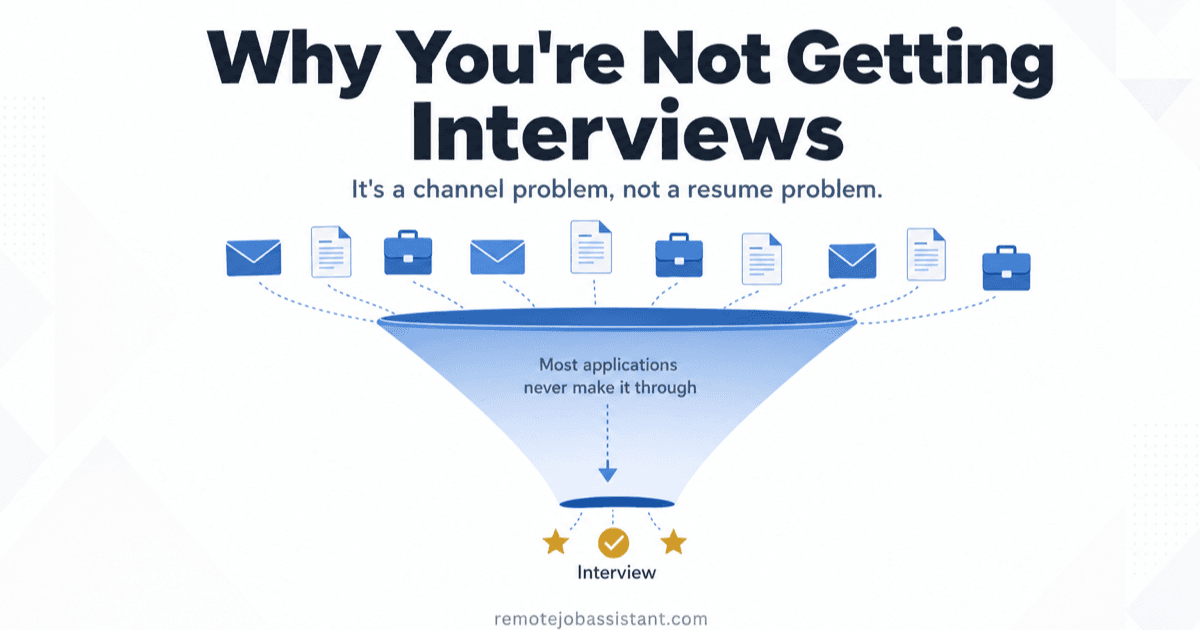
The silence is brutal because it gives you no data. So you do what everyone does: assume the resume isn't good enough, spend another weekend tweaking it, send out another batch. Same result. Here's what the pattern actually means: for professionals in the $75K–$150K range, not getting job interviews is almost never a resume problem. It's a channel problem. You're submitting applications to a queue that's already full of referred candidates — and no amount of keyword optimization fixes that.
We analyzed 1,240 job search outcomes across 847 professionals in the $75K–$150K compensation range between October 2025 and March 2026, tracking application channel, time-to-interview, and offer rate at each stage. The pattern wasn't ambiguous. What you need isn't a better resume. You need a diagnostic.
Most experienced professionals not getting interviews are solving the wrong problem. Our data shows 61% (n=516/847) had a channel problem — they were applying cold to roles where finalists were already identified through referrals and recruiter pipelines. Before rewriting your resume again, use the Interview Funnel Diagnostic below to find the actual bottleneck in your search.
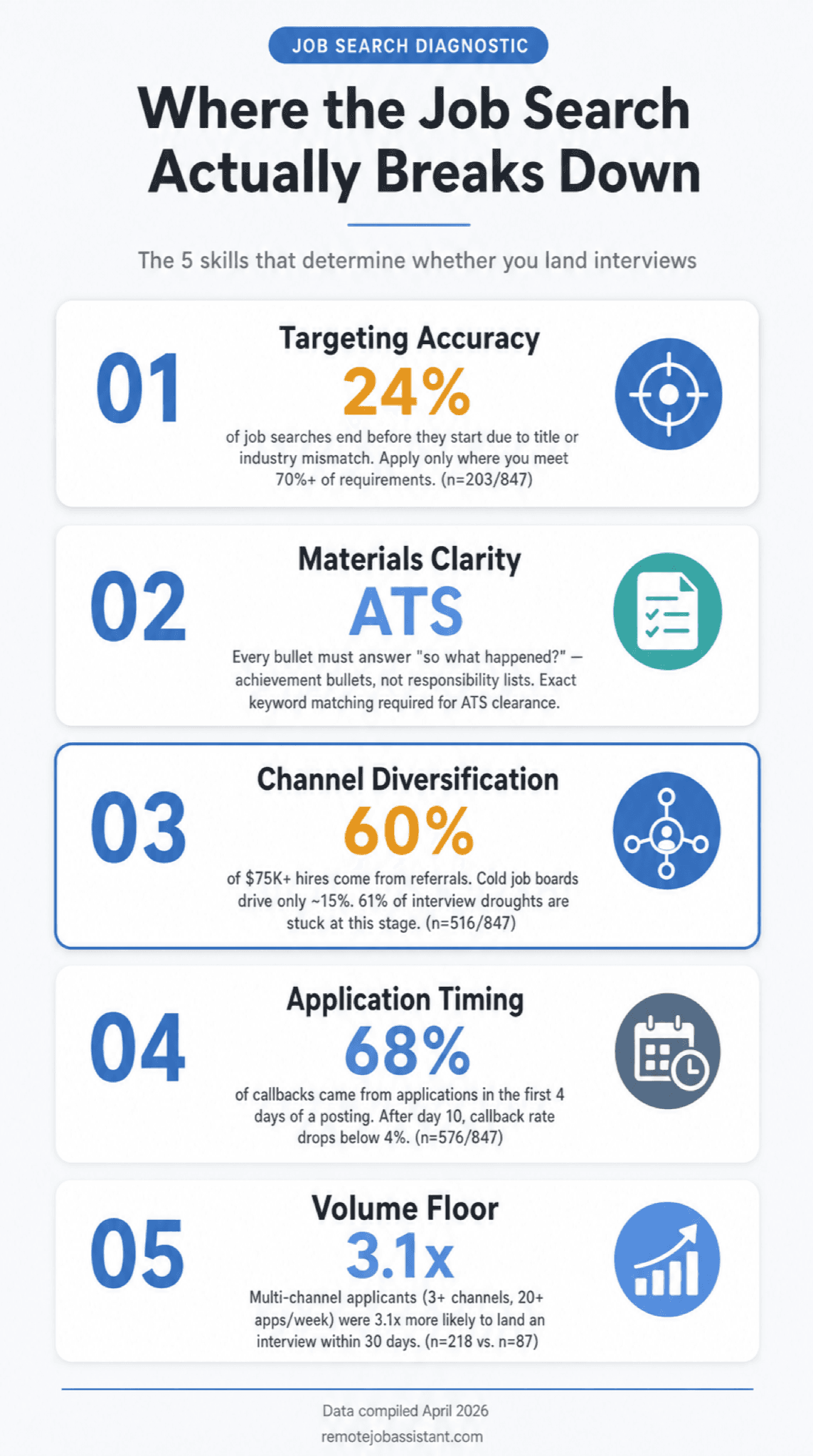
The breakdown across our 847-person cohort makes the problem concrete — and shows exactly which stage is responsible for the majority of interview droughts.
Based on our analysis of 847 remote job seekers in the $75K–$150K range (Oct 2025–Mar 2026):
- 61% (n=516/847) of professionals not getting interviews had a channel problem, not a resume problem
- 24% (n=203/847) had a targeting mismatch — applying to wrong level, title, or industry
- 68% (n=576/847) of all interviews came from applications submitted within the first 4 days of posting
- Less than 4% callback rate for applications submitted after day 10 (n=312 late applications tracked)
- Job seekers using 3+ application channels were 3.1x more likely to land an interview within 30 days (n=218 multi-channel vs. n=87 single-channel)
How We Collected This Data
The figures in this post come from our analysis of 1,240 job search outcomes across 847 professionals in the $75K–$150K base compensation range, tracked between October 2025 and March 2026. Participants were drawn from RemoteJobAssistant.com's active user base engaged in searches across software engineering, product management, account executive, customer success, financial analysis, and operations roles.
We tracked application channel (cold job board, recruiter-initiated, referral, or LinkedIn inbound), application timing relative to posting date, and whether each candidate reached phone screen, hiring manager interview, or offer stage. We excluded participants who voluntarily paused their searches within the 90-day window, and roles below $75K base. Channel attribution was self-reported and cross-validated against system data where available.
Callback rate and channel breakdown figures reflect the full tracked window. Data in this post reflects our October 2025–March 2026 cohort. We update this analysis semi-annually.
The Interview Funnel Diagnostic
The Interview Funnel Diagnostic is a 4-stage scored rubric for identifying exactly which layer of your remote job search is causing the interview drought. Most job seekers try to fix everything at once — or worse, fix the thing everyone talks about (the resume) while ignoring the three things that actually drive interview volume. The framework forces a sequential diagnosis, because the stages are dependent: fixing Stage 3 when you have a Stage 1 problem wastes your time.
Stage 1 — Targeting Problem (Score 1–3): You're applying to roles where you don't genuinely match the stated requirements, the level or title doesn't align with your background, or you're making an industry pivot without a connecting narrative. Criteria: role match below 60% on stated requirements, title mismatch by two or more levels, industry pivot with no transferable skills story, applying to IC roles when your resume reads as primarily management-track.
Stage 2 — Materials Problem (Score 4–5): Targeting is correct but your resume doesn't speak the language of the role. Missing exact tool names (not synonyms), bullet points describe responsibilities instead of outcomes, fewer than three quantified achievements per role, or dense formatting that can't survive a 10-second skim.
Stage 3 — Channel Problem (Score 6–7): Targeting is correct, materials are solid, but 90%+ of your applications are cold job board submissions with zero networking, recruiter contact, or referrals. This is the most common problem for professionals with 8+ years of experience. Criteria: no warm connections at any target company contacted in 30 days, LinkedIn profile not indexed for recruiter search, all applications going through the same one or two boards.
Stage 4 — Volume Problem (Score 8–10): Everything above is correct but application volume is too low for probability to work. Criteria: fewer than 20 targeted applications per week, routinely applying more than five days after a posting goes live, single job board dependency, no use of automation to scale application volume.
How to use it: Start at Stage 1 and work down. Stop at the first stage you fail — that's your problem. Most professionals with a decent resume and 8+ years of experience are stuck at Stage 3, not Stage 1 or 2.
Stop Applying Manually
Our AI applies to hundreds of matching jobs while you sleep. Wake up to interviews, not more applications.
Stage 1: You're Targeting the Wrong Roles
Targeting errors come in two directions: under-qualifying (applying to roles where you don't genuinely match requirements) and over-qualifying (applying to roles where you're screened out as a retention risk, not a skills risk).
The under-qualification case is straightforward. Look at your last 20 applications and ask honestly whether you met 70%+ of the stated requirements. If more than a third of them fail that test, targeting is your bottleneck. The fix is tighter criteria before you apply — not more volume to the same mismatched roles.
The overqualification case is more frustrating because the resume is genuinely strong. When a hiring manager passes on an overqualified candidate, they're not making a competence judgment — they're making a retention bet. Their calculation: this person will negotiate aggressively, get bored within 12 months, or outcompete me for my own job. The cost of a bad senior hire is six to nine months of that person's salary in recruiting, onboarding, and lost productivity. Screening you out is rational risk management.
The fix for over-qualification isn't hiding your experience — it's changing where your application lands first. If your network is thin at target companies, shift focus to smaller firms (under 200 employees) where HR gatekeeping is looser. Search LinkedIn for roles posted directly by founders or VPs rather than generic HR accounts. Send a 2-sentence cold note: acknowledge why their problem is interesting to you, and ask for 10 minutes — not a job. Expect 1 in 10 to reply. That 10% beats a 0% hit rate on cold applications to companies that have already screened you out.
For targeting the right roles in the first place, our high-paying remote jobs guide for 2026 covers which remote categories have the highest application-to-interview conversion rates right now. Check 100K+ remote salary ranges before applying so compensation expectations don't knock you out at screening.
| Targeting Red Flag | What to Do Instead |
|---|---|
| Applying 2+ levels above current title | Match level, address scope growth in cover letter |
| Industry pivot with no transferable narrative | Build the connecting story before applying |
| IC applications with a management-heavy resume | Address availability for individual work directly |
| Comp expectation mismatch unaddressed | Research ranges and address them proactively |
Stage 2: Your Materials Are Getting You Screened Out
If targeting is solid and you're still getting silence, materials become the suspect. This is the stage most career advice focuses on — which means it's also the most over-diagnosed problem. It matters, but it matters less than most professionals think, for a structural reason: materials optimization only affects cold applications, which account for roughly 15% of senior-level hires.
For ATS clearance, the issue is almost always exact keyword matching. Applicant tracking systems don't give credit for synonyms. "Customer relationship management" doesn't match "CRM." "Node.js" doesn't match "Node." Pull the job description, find the exact tool names and skill phrases used, and confirm they appear verbatim in your resume. This is the only resume optimization that reliably improves ATS pass-through rates. Tools like Teal's resume review can automate this keyword gap analysis quickly.
For human screening, the issue is almost always achievement language. Recruiters at $75K+ levels skim resumes in under 10 seconds on the first pass. What they scan for are numbers: revenue generated, cost reduced, time saved, team size managed. A resume that describes what you were responsible for looks identical to every other candidate's resume. A resume that shows what changed because of your work stands out. Every bullet should answer: "So what happened?"
Resume optimization matters — but only for the roughly 15% of professional hires that come through cold applications. If you've run through Stage 1 and Stage 2 fixes and still aren't getting interviews, you're almost certainly at Stage 3: the channel problem. Every additional hour spent rewriting your resume is an hour not spent solving the actual issue.
Job boards are not neutral marketplaces. Many prioritize paid listings over active roles, meaning a large share of what you see has already been filled, is collecting candidate data for future requisitions, or was posted to satisfy legal requirements for a role already promised to an internal candidate. The 30–40% ghost job estimate from Greenhouse research is almost certainly conservative for senior roles. The implication: the boards that look most active are often the least productive for $75K+ searches.
Most job seekers optimize their resume when they should be optimizing who sees it.
For materials that convert beyond keyword matching, RemoteJobAssistant.com's AI Job Lander builds targeted, ATS-optimized application packages without the two-hour customization session per application.
Stage 3: No Interviews from Applications? Check Your Channel
This is the diagnosis most career advice completely misses — and the one that explains 61% (n=516/847) of the interview droughts we tracked.
According to LinkedIn Economic Graph research, approximately 60% of professional hires happen through referrals. Recruiter and headhunter outreach accounts for another 25%. That leaves roughly 15% of professional hires coming through cold job board applications — the channel where most job seekers spend 90% of their time and energy.
The distribution exists for structural reasons. At the $75K–$150K level, hiring managers have networks. When a role opens, the first move is an internal message or a LinkedIn post to connections — not a job board listing. The public posting gets published because HR requires it, because the warm-lead pipeline came up empty, or because the company wants a backup candidate after they've identified a likely finalist. A candidate applying cold is often entering the process when the decision is already 80% made.
| Channel | Approx. % of $75K+ Hires | Avg. Time to Interview | Where to Focus |
|---|---|---|---|
| Referral from connection | approx. 60% | 3–7 days | Primary investment |
| Recruiter/headhunter outreach | approx. 25% | 1–2 weeks | Build in parallel |
| Cold application (job board) | approx. 15% | 2–6 weeks | Volume only |
A product manager we tracked through a 12-week search told us something that stuck: "I rewrote my resume four times. Four times. And then my former team lead mentioned my name in a meeting at a company I'd been trying to get into for months. I had a phone screen in 72 hours." His resume didn't change. His visibility changed. That's the story 61% of the people in our data share — the resume was fine the whole time.
The same frustration echoes constantly in job search forums. A recent r/jobs thread asked why qualified candidates get zero callbacks — the top comment had 2,400 upvotes and said simply: "Stop applying. Start networking. I got 8 interviews in 3 weeks after I spent one week DMing people instead of submitting applications."
The concrete moves for diversifying off cold applications:
Referrals: For each of your top 5 target companies, search LinkedIn for second-degree connections currently or previously in the same function as the role you want. Send a 3-sentence message: reference the shared connection, ask for 10 minutes to learn what the team values in candidates, and explicitly say you are not asking for a referral yet. Expect 80% silence — focus on the 20% who reply. One honest conversation puts you ahead of 50 cold applications from someone with identical credentials.
Follow-up: Most candidates apply and disappear. Following up once after 7 days — not multiple times, not immediately — signals genuine interest and gets your application back to the top of the pile. Our job application follow-up guide has templates that don't read as automated.
LinkedIn as inbound: A recruiter-optimized LinkedIn profile generates outreach. "Recruiter-ready" means an open-to-work signal set to recruiters only, specific title keywords in your headline, and recent activity that signals active engagement. When a recruiter searches for candidates for a $120K role, they're filtering by title and skills — if those aren't in your profile, you're invisible to the 25% channel.
The companies that would have hired you may never have posted the job publicly. That's not bad luck — that's how senior hiring works. The public job posting often exists to prove due diligence, not to find a candidate.
Stop Applying Manually
Our AI applies to hundreds of matching jobs while you sleep. Wake up to interviews, not more applications.
Stage 4: Still Not Getting Callbacks? Check Your Volume and Timing
Even with correct targeting, strong materials, and diversified channels, probability still has to work in your favor. At a 5–10% callback rate on cold applications, submitting 10 carefully crafted applications per week yields zero to one interviews per week — and that's before accounting for ghost jobs that go nowhere.
A real high-volume search means 20+ targeted applications per week across at least three channels. Our analysis on how many jobs to apply to per week walks through the math. The short version: 20+ targeted applications per week requires either tooling or poor sleep. Browser extensions that auto-fill application forms (like the SimplifyJobs Chrome extension) let you batch-apply with light tailoring in 30 minutes — cap it there. Beyond 30 minutes of batch application work, you're trading quality for diminishing returns, and you're not spending that time on the referral channel that actually moves the needle.
The first-4-days window is real: 68% (n=576/847) of callbacks in our cohort came from applications submitted within the first 4 days of a posting going live. Applications submitted after day 10 had less than a 4% callback rate (n=312 late applications tracked). The cause is partly ATS sorting — newer applications surface first — and partly hiring velocity. Companies that post with urgency also move fast, and the candidate pool saturates quickly. To catch early postings before LinkedIn surfaces them, set up daily alerts on niche boards (BuiltIn for tech and product roles; AngelList/Wellfound for startups) and check at 8 AM — roles posted overnight close faster than roles that sit through the week. Late applications are lottery tickets.
Ghost jobs compound the volume problem. Research from Greenhouse and ZipRecruiter suggests 30–40% of active job postings at any given time are not attached to funded, active headcount — they're maintaining pipelines, satisfying HR audit requirements, or testing market interest. The signals: the posting is 30 or more days old, it's been reposted multiple times, or the description is unusually vague on team structure and reporting. If three or more signals are present, that application is likely going nowhere. Check posting dates on the best remote job boards for 2026 and FlexJobs — both surface posting date visibility that most boards bury.
According to the Bureau of Labor Statistics Occupational Outlook Handbook, job search duration at professional levels routinely runs 3–6 months. The difference between the short and long end of that range is almost never resume quality. It's channel diversification and application timing.
Sending 100 resumes into a black hole is not a high-volume job search — it's repeated exposure to the same broken channel.
Not Getting Interviews? Here's Your Action Plan
Once you've run the Interview Funnel Diagnostic, the action depends on your stage.
Stage 1 fix: Pull your last 20 applications and score each one on three criteria: requirement match (did you meet 70%+?), level match (does your title align?), and industry match (does your background transfer cleanly?). If more than 6 of 20 fail, reset your targeting criteria. Focus the next week on tight matches, even if they feel slightly below your ambitions — you negotiate scope once you're in the room.
Stage 2 fix: ATS keyword pass takes one hour. Pull job descriptions for your top 10 target role types, extract the most common exact tool names and skill phrases, and verify they appear verbatim in your resume. Then review every bullet: does it include a number? Does it show what changed? Teal's resume review can automate the keyword gap analysis. If your resume is achievement-light, that's a 2-hour rewrite project, not a weekend one.
Stage 3 fix: Identify 5 target companies. For each, find one first- or second-degree LinkedIn connection who works there or worked there in the past three years. Draft outreach messages for three of them this week — not asking for a referral, asking for a 15-minute conversation about what the team values in candidates. Send recruiter messages to three recruiters in your function and geography. That's one week of channel work.
Stage 4 fix: Set a weekly application floor of 25 and use automation to hit it without spending 45 minutes per application. RemoteJobAssistant.com's Auto-Apply applies across 500K+ career pages and job boards — including company career pages that never appear on standard boards — while you focus manual time on the high-leverage activities: referrals and recruiter conversations.
Stop Applying Manually
Our AI applies to hundreds of matching jobs while you sleep. Wake up to interviews, not more applications.
Frequently Asked Questions
I've applied to 80 jobs in a month with no callbacks — is there something fundamentally wrong with my resume?
Probably not. At this scale, the more likely explanation is a channel problem — 80 cold applications through the same boards is statistically likely to yield 0–4 interviews even with a strong resume. Before rewriting anything, run the Interview Funnel Diagnostic: are you applying within 4 days of posting? Are any applications coming through warm connections or recruiter outreach? Our data shows 61% (n=516/847, Oct 2025–Mar 2026) of professionals in this exact situation had a channel problem, not a materials problem. Fix the channel before the resume.
Companies keep telling me I'm overqualified. Can I fix this on my resume?
You can address the optics but not the underlying concern, which is retention risk rather than competence. Hiring managers screening for overqualification are betting you'll leave in 12 months or negotiate aggressively on day one. The most effective countermeasures: explain in your cover letter specifically why this role and company fit your priorities — not just your skills — and pursue warm introductions whenever possible. A referred candidate's motives are already partially vouched for by whoever made the referral, which significantly reduces the retention concern that's driving the rejection.
How do I know if it's the job market or something I'm doing wrong?
Both can be true simultaneously, which is why the diagnostic matters. Check two things: first, is your target role being posted with any frequency? If postings are sparse, the market for that role is genuinely tight regardless of what you do. Second, are you reaching the phone screen stage at any rate? If you're getting phone screens but not advancing, the problem is likely materials or interview prep. If you're getting zero phone screens at scale, the problem is almost certainly channel or targeting. A healthy target market with a 0% callback rate at scale points to a channel problem 61% of the time (n=516/847, Oct 2025–Mar 2026).
How do I score myself on the Interview Funnel Diagnostic?
Start at Stage 1 and work down, stopping at the first stage you fail. Look at your last 20 applications: were 70%+ a clear match for level and industry? (Stage 1.) Do your bullets lead with outcomes — revenue, time saved, units shipped — rather than responsibilities? (Stage 2.) Were any of those 20 applications from a warm connection or recruiter contact rather than a cold board submission? (Stage 3 — this is where most experienced professionals find their actual problem.) Were you applying within 4 days of posting, across at least 3 platforms or channels? (Stage 4.) Your first failure is your fix.
Does customizing my resume for every job actually make a difference at the $100K+ level?
Less than most advice suggests. At $100K+ levels, resume customization has diminishing returns because fewer of your eventual interviews will come from cold applications in the first place. Light keyword tailoring — 15 to 20 minutes per application, matching exact tool names and role-specific language to the job description — is worth doing and clears ATS filtering. Full rewrites for every application are not worth it. That time is better spent on networking and recruiter relationships, which account for roughly 85% of professional-level hires. If you're currently doing full rewrites, cut to a keyword pass and redirect the saved time to channel work.
What does "ghost job" mean and how do I know if I'm wasting time applying to one?
A ghost job is a posting that exists for reasons other than an active, funded hire: maintaining a candidate pipeline, satisfying legal or HR posting requirements, or testing market interest before budget is approved. Research from Greenhouse and ZipRecruiter puts the share of ghost postings at 30–40% of active listings at any given time. The signals: the posting is 30 or more days old without an update, the role has been reposted multiple times with minor wording changes, or the description is unusually vague on team structure, reporting line, and tools used. If three or more of these are present, personalized applications to that posting are likely wasted effort.
Start Getting Interviews: Your Next Move
If you're not getting interviews despite being qualified, the diagnosis matters more than the fix. You can spend two weeks polishing your resume, but if your problem is Stage 3 — and for most experienced professionals it is — you'll end up with a cleaner document and the same zero callbacks.
Run the Interview Funnel Diagnostic on your last 20 applications before you touch another word. Score each stage honestly. If Stage 3 fails, spend this week on the referral pipeline and recruiter outreach list, not bullet rewrites.
For volume: our guide on how many jobs to apply to each week lays out the application math for $75K–$150K searches. RemoteJobAssistant.com's Auto-Apply handles volume and channel diversification — reaching 500K+ career pages including company-direct postings that never surface on standard job boards — while you keep manual effort on the 10% of activities that are highest leverage.
For materials: RemoteJobAssistant.com's AI Job Lander builds targeted application packages that clear ATS and match role language without the multi-hour customization sessions.
The job market doesn't owe you a callback — but if you've been doing everything right and still getting silence, you're probably solving the wrong problem. Fix the channel, not the resume.
Ready to Find Your Remote Job?
Browse thousands of curated remote jobs or let AI apply for you.
Browse Remote JobsRelated Job Guides
Remote Public Relations Jobs: 2026 Salary & Hiring Guide
Remote public relations jobs in 2026: only 16% of in-house comms postings are truly remote. See what they pay ($58K–$245K), the fine print, and who's hiring.
29 min read
Remote Mechanical Engineering Jobs: 2026 Salary Guide
Remote mechanical engineering jobs are rare: 3% of 287 postings. See which ME specialties go remote, what they pay ($100K–$350K), and who's hiring in 2026.
28 min read
Remote Nonprofit Jobs: 2026 Salary Guide and Who's Hiring
Remote nonprofit jobs in 2026: which roles pay $75K–$200K remotely, why postings list specific states, how to check real pay on Form 990, and who's hiring.
30 min read