
Last reviewed: August 2026
Most of the 74,823 "remote insurance" listings on Glassdoor are one of three things: a hybrid role wearing a remote costume, a $70K field adjuster job that expects you to climb hail-damaged roofs in three states with a laptop in the truck, or a desk job in a state you can't legally work from. LinkedIn's 63,000 are no different. The raw count is the least useful thing you will read about this market.
Here's what the listing counts don't tell you: remote insurance hiring is concentrated, not distributed. The genuinely remote roles cluster at large carriers — Progressive, USAA, Liberty Mutual — that post on their own career portals, while the startup job boards where most remote-work advice sends you have almost no insurance roles at all. And the two specialties people search for most, claims adjusting and underwriting, are shrinking occupations. The openings are real, but they come from retirements and remote conversions, not growth.
Get Remote Job Tips in Your Inbox
Weekly strategies, salary data, and new opportunities
Unsubscribe anytime. No spam.
We pulled 12,372 live insurance postings across SmartRecruiters' and Workable's public global job boards on August 30, 2026 — eleven role-level queries spanning adjusting, underwriting, sales, and actuarial work — and cross-referenced every wage figure in this guide with O*NET's May 2025 BLS estimates. This post covers what each remote insurance specialty actually pays, which ones can truly be done from your house, the licensing gate nobody explains properly, and a 90-day plan to get hired.
Based on O*NET's May 2025 wage estimates and our August 30, 2026 sweep of 12,372 postings:
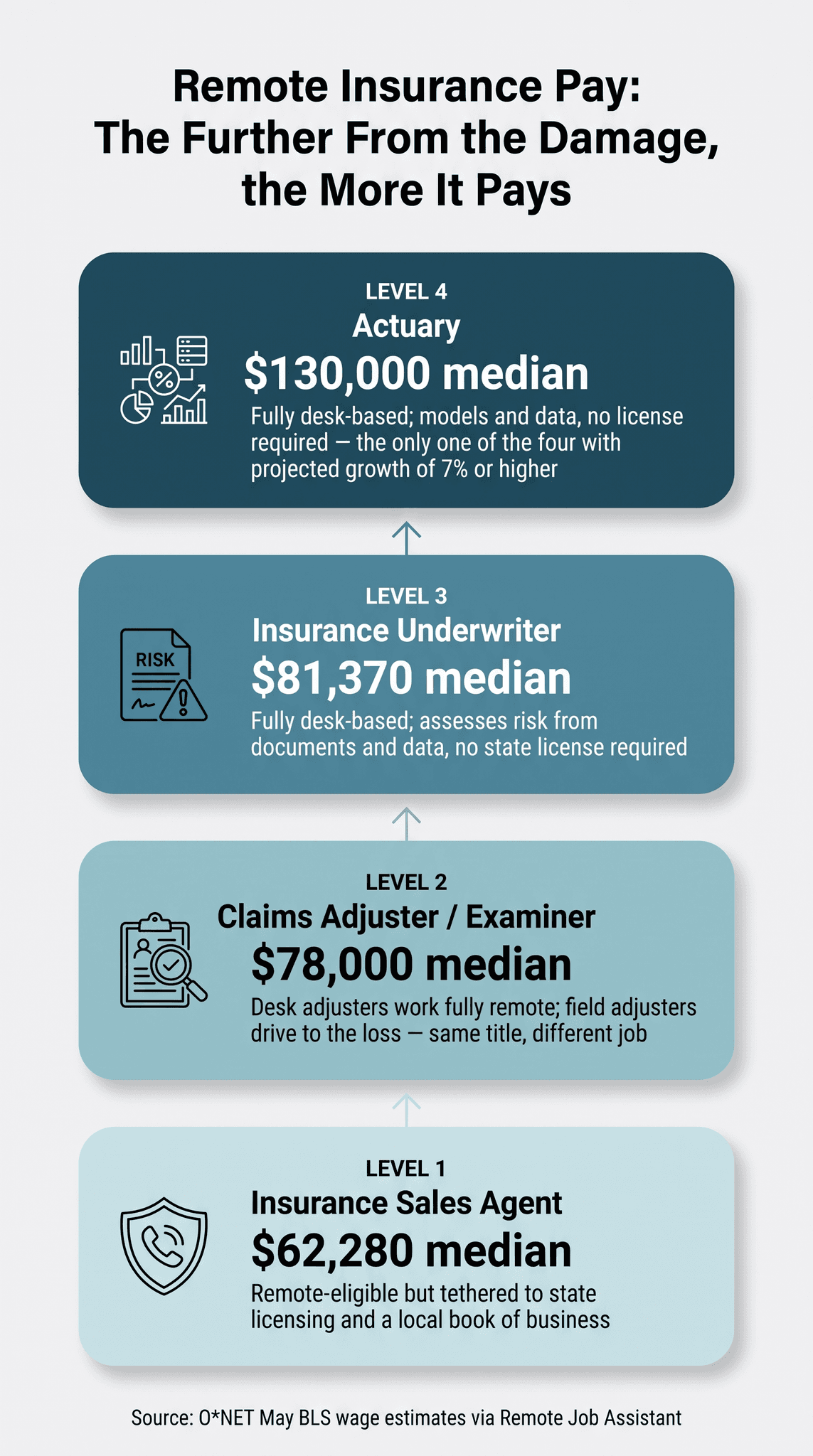
- $78,000 — median wage for claims adjusters, examiners, and investigators (356,100 employed, 2024)
- $81,370 — median for insurance underwriters (127,000 employed)
- $62,280 — median for insurance sales agents (568,800 employed)
- $130,000 — median for actuaries (33,600 employed) — the only one of the four with projected growth of 7% or higher through 2034
- 0 of the first 100 "insurance underwriter" postings on SmartRecruiters' global board (n=2,503 total) carried a remote flag — remote insurance hiring lives on major-carrier portals, not startup job boards
- Roughly 6,500 / 63,000+ / 74,800 — remote insurance listings on Indeed, LinkedIn, and Glassdoor respectively (August 2026), a scale that includes heavy hybrid noise
The Desk Distance Test: Which Insurance Jobs Are Actually Remote
Insurance runs on a simple physical fact: somewhere, there is a wrecked car, a flooded basement, or a signature that needs witnessing. How far your role sits from that physical event determines whether it can be done remotely — not how progressive your employer's HR policy sounds.
That's worth formalizing, because it's the single best predictor of both remote viability and pay.
The Desk Distance Test: A 10-point rubric for judging whether an insurance role can be done fully remote, based on how far the daily work sits from physical losses and in-person sales.
Scoring:
- 0-3 Field-Bound ($55K-$75K): Catastrophe adjusters, field property inspectors, auto damage appraisers. The work is the site visit. When these listings say "remote," they mean "no office" — you're still driving to losses four days a week.
- 4-7 Remote-Eligible ($60K-$85K): Insurance sales agents, claims examiners on complex files, licensed service reps. The work is desk-based, but state licensing, local books of business, or occasional inspections tether it to geography.
- 8-10 Fully Desk-Based ($78K-$130K+): Desk adjusters, underwriters, actuaries, risk and compliance analysts. The entire workflow is documents, data, models, and phone calls. These convert cleanly to remote — and they're the best-paid tiers.
How to use it: Score a specialty before you invest in a license or a certification. In interviews, one question resolves the tier: "What percentage of this role is field work?" Anything above 20% and you're holding a 0-3 role with remote branding.
Notice the correlation: the further the role sits from the damage, the more it pays. In insurance, the distance between your desk and the damage determines whether your job can be remote — and how much it pays.
Why did carriers embrace remote for tier-8 roles specifically? Two structural reasons. First, real estate: a desk adjuster processing claims from home costs the carrier nothing in office space, and claims volume is elastic — remote staffing lets carriers surge capacity after storm seasons without leasing floors. Second, licensing math: an underwriter or actuary can serve any state from anywhere, so remote hiring widens the talent pool at zero regulatory cost. Field roles get neither benefit, which is why no amount of corporate remote-friendliness will ever move them.
Two things carriers won't put in the headline. First, "remote" at a large carrier almost always means "remote from an approved list of states" — the states where the company already runs payroll and holds the licenses — so read the eligibility line before the salary line, or you'll interview for a job you can't legally accept from your kitchen. Second, the tier-8 roles are the ones career changers get filtered out of hardest. A desk adjuster listing that says "remote" is usually looking for someone who already holds licenses and has handled files; the genuinely open door for a newcomer is the licensed sales or service seat at tier 4-7, which pays less and tethers you to geography. That's not a reason to give up on the desk tiers — it's the reason the 90-day plan below front-loads the credential before the applications.
Stop Applying Manually
Our AI applies to hundreds of matching jobs while you sleep. Wake up to interviews, not more applications.
How We Collected This Data
The figures in this guide come from two sources, both checkable. Wage medians, employment counts, and 2024-2034 projections come from O*NET OnLine's occupation profiles for claims adjusters (13-1031), insurance underwriters (13-2053), insurance sales agents (41-3021), and actuaries (15-2011), which republish BLS May 2025 wage estimates.
Posting-market data comes from our August 30, 2026 sweep of SmartRecruiters' and Workable's public global job-search APIs: eleven queries across the four specialties surfaced 12,372 postings, and we sampled the first 100 results per SmartRecruiters query for remote flags, verifying flags against the description text rather than trusting the checkbox. Job-board listing counts (Indeed, LinkedIn, Glassdoor) were recorded from their public search pages in August 2026 and include hybrid-tagged roles — treat them as ceiling numbers, not counts of fully remote openings. We update this analysis when we materially revise the post; figures reflect August 2026.
Remote Insurance Salaries by Specialty
Here's how the four core specialties compare, with each one's Desk Distance tier attached. All medians are national, all-settings figures. Remote status by itself carries no premium — a remote desk adjuster at a large carrier is paid inside the same national band as an office one. The premium sits in the line of business: commercial lines, specialty risk, and litigation-adjacent files pay above the median, personal auto and homeowners pay below it.
| Specialty | 2025 median (O*NET) | Employed (2024) | 2024-34 outlook | Projected openings | Desk Distance tier |
|---|---|---|---|---|---|
| Insurance sales agent | $62,280 | 568,800 | Growth, 3-4% | 47,000 | 4-7 |
| Claims adjuster / examiner | $78,000 | 356,100 | Decline, -1% or lower | 21,100 | 2 (field) to 9 (desk) |
| Insurance underwriter | $81,370 | 127,000 | Decline, -1% or lower | 8,200 | 9 |
| Actuary | $130,000 | 33,600 | Growth, 7%+ | 2,400 | 10 |
Salary figures derive from O*NET's May 2025 BLS-based estimates linked above, cross-checked against the posting sweep described in our methodology section. We've rounded where sources give false precision — nobody negotiates against $81,370.
Two of those outlook cells deserve an explanation, because they're the part everyone glosses over. Claims adjusting and underwriting are both projected to shrink through 2034, and the reason is structural, not cyclical: straight-through processing now settles simple auto and property claims from photos with no human touch, and predictive models have absorbed the routine end of personal-lines underwriting. Carriers aren't cutting these roles because demand fell — they're cutting them because software eats the easy files first. The damage doesn't stop at the entry level. Fewer routine files means fewer junior adjusters and underwriters, and a thinner junior bench today is a thinner senior bench in ten years. It also changes the job for the people who stay: when software settles the clean claims, the desk adjuster's queue is whatever the software rejected — the disputed, the litigated, the angry. The work gets harder as it gets rarer, and it gets measured harder too. Desk claims runs on dashboards — cycle time, files closed, customer scores — and if being measured daily grinds on you, underwriting is the better tier-9 seat.
So why do 21,100 adjuster openings and 8,200 underwriter openings still appear over the decade? Replacement demand. Insurance has an aging workforce, and every retirement in a desk-based role is an opening that increasingly gets posted as remote. Claims adjusting is a shrinking occupation with 21,100 projected openings — replacement demand, not growth, is the door in. The practical read: these are still viable remote careers, but you want to position toward the complex work software can't touch — commercial claims, specialty lines, litigation-adjacent files — not the routine processing it eats.
The actuary row points the other way entirely. Growth of 7% or higher, a $130,000 median, and a fully desk-based workflow make it the strongest long-term remote play in the industry. The catch is the credential: the Society of Actuaries (life, health, pensions) and the Casualty Actuarial Society (property and casualty) each run a multi-exam sequence, and the first exams are where most people who say they want to be an actuary quietly stop. The $130,000 median is the pay of the people who finished, not the people who started — read it as survivor bias, not a promise. The path works for people who can study for years while working, ideally at an employer with an exam-support program — paid study hours and a raise for each exam passed are the standard arrangement at carriers, and a listing that doesn't mention one is telling you something. If you're comparing against adjacent analytical paths, our guides to remote financial analyst roles and remote finance careers map the same $75K-$130K territory with lower entry barriers.
For a deeper cut on the adjusting path specifically — desk versus field, licensing by state, carrier versus independent — see our full guide to remote claims adjuster jobs.
Stop Applying Manually
Our AI applies to hundreds of matching jobs while you sleep. Wake up to interviews, not more applications.
Where the Remote Jobs Actually Are: Carriers, Not Job Boards
Our posting sweep produced a finding that should change where you spend your application hours: of the first 100 "insurance underwriter" results on SmartRecruiters' global board — a platform hosting 2,503 postings matching that query — exactly zero carried a remote flag. Workable's board showed 59 underwriting postings total, six of them remote, and most of those were mortgage underwriting at small lenders, not insurance. The startup and mid-market ATS ecosystem, where most remote-job advice points, is functionally empty of insurance work.
The remote insurance jobs live somewhere else: on the career portals of large carriers, which aggregators index late, partially, or never.
Where to start, by specialty:
- Desk claims or customer care: Start with Progressive (advertises fully remote positions across claims, customer care, and analytics, alongside hybrid and field roles) and USAA (remote-eligible roles across its insurance careers portal, concentrated in claims and member service).
- Underwriting support or insurance technology: Start with Liberty Mutual — a remote query on its careers site returns openings across claims, underwriting support, and technology.
- Case management, utilization review, or claims operations: Skip the P&C carriers and go to the large health and life carriers — the UnitedHealth, CVS/Aetna, Cigna tier — which run comparable remote programs for case management and clinical review.
- Actuarial: Search each carrier's portal for "actuarial analyst" rather than "remote" — the role is desk-based by definition, and filtering on the remote tag hides the roles that are remote-eligible but not tagged.
The workflow that follows from this: identify 15-20 carriers whose remote programs match your target specialty, and check their portals directly. On each portal, search the specialty term — "claims adjuster," "underwriting assistant," "actuarial analyst" — rather than the word "remote," then filter by work location; searching "remote" surfaces the customer-service volume roles and buries the specialty ones. Then let volume tools cover the aggregator long tail. This is exactly the split where auto-applying across the broader market earns its keep: you spend your manual effort on the concentrated carrier portals where quality lives, while automation covers the wide, noisy remainder. The best remote insurance jobs aren't on job boards. They're on carrier career portals that aggregators index late or never.
Licensing: The Gate Nobody Explains Properly
Licensing is the reason insurance careers are simultaneously easier and harder to enter than they look — and almost no job listing explains how it actually works.
The structure splits cleanly by specialty. Sales agents need a state-issued license for every state where their clients sit — a Property & Casualty or Life & Health license per line, earned through a state exam. Adjusters need an adjuster license in many states, but not all: some states, Colorado among them, don't license adjusters at all, which is why the industry invented the Designated Home State arrangement — an adjuster in a non-licensing state earns a DHS license from a state like Texas or Florida to satisfy other states' requirements. Underwriters and actuaries need no license whatsoever. Underwriting's gate is a degree rather than a license — O*NET's occupation profile puts a bachelor's requirement on about 70% of underwriter positions — and beyond that it runs on employer trust and file experience. Actuarial careers run on the SOA and CAS exam sequences: professional credentials, not state permission.
Remote work makes licensing harder, not easier. An office agent serves one state; a remote agent covering a national book may need licenses in a dozen. Carriers know this — which is why many remote claims and sales listings quietly say "multi-state licensing required within 90 days of hire." Read that line before you apply, not after.
Carrier listings are written by recruiters who know exactly what each phrase means. Sort them into two piles before you apply.
Hard dealbreakers — close the tab:
- "Must reside in [list of states]" and your state isn't on it. The carrier runs payroll and holds licenses in those states only. There is no negotiating this, and don't plan to move to an unlisted state later and hope nobody notices — approved-state residency is a condition of employment, and payroll systems catch address changes faster than managers do.
- "CAT deployment as needed" when you want a desk. Catastrophe deployment means weeks on the road after a storm, with no say in the timing. It's a tier 0-3 job wearing a remote badge.
- "Territory" or "book of business" when you want location freedom. The geography is the job. Fine for a sales career you intend to stay in, wrong for anyone planning to move.
Trade-offs — acceptable if the answer to one question is right:
- "Multi-state licensing required within 90 days of hire." Acceptable if the carrier pays the exam fees and renewals and the 90 days is a target, not a termination trigger. Ask both in the first interview; a recruiter who won't answer has answered.
- "License reimbursement upon completion." Acceptable if "completion" means passing the exam and the reimbursement window is short. You're fronting the money either way, so price it against the offer.
- "Occasional field work." Acceptable under 5% — a rare site visit on a complex file. Over 20% is a driving job, and the listing is using "occasional" the way a landlord uses "cozy."
- "Licensing provided" or "trainee." The one phrase that genuinely opens the door for career changers, and it is almost always a sales or service seat at tier 4-7 paid partly on commission. The economics favor the carrier — a low base plus commission means a rep who doesn't produce costs almost nothing, which is why those seats are always open. Acceptable as a two-year bridge into desk claims or underwriting support. Not acceptable as the destination.
If you're self-funding a license, the exam-prep market is mature — providers like AdjusterPro and Kaplan sell state-specific adjuster and P&C prep — and the practitioner conversation about which states to license in first lives in communities like r/Insurance and r/adjusters, where you'll get a more candid read on individual carriers than any listing offers.
The strategic read favors patience over spray-and-pray. If you're targeting tier-8 desk roles, licensing is either irrelevant (underwriting, actuarial, compliance) or employer-sponsored — large carriers routinely pay for adjuster licensing and continuing education, because a multi-state licensed desk adjuster is more valuable to them than to you. If you're targeting sales, budget for the exams yourself: each state license is a moat that makes you harder to replace, which is precisely why the roles paying into the $75K-plus bracket expect you to hold several.
Stop Applying Manually
Our AI applies to hundreds of matching jobs while you sleep. Wake up to interviews, not more applications.
How to Land a Remote Insurance Job in 90 Days
The sequence matters more than the effort. Here's the plan we'd give a professional pivoting into — or up within — remote insurance work.
Days 1-14: Pick your tier before you pick your job. Run the Desk Distance Test against your background, then follow the branch that matches — and only that branch:
- Finance, credit, analytics, or lending background: Underwriting or risk. No license gate, $81K median, and your specimen work translates directly. If you also have customer-ops experience and can't decide, choose underwriting — the higher median with no exam to fund settles it. Compliance work is the sideways alternative.
- Call center, customer operations, or claims-adjacent experience: Desk claims. One adjuster license stands between you and a tier-9 role at a $78K median.
- Field adjuster already licensed: Desk claims conversion. Your licenses transfer; what you're selling is file volume and written communication.
- Math, statistics, or economics degree and a tolerance for years of exams: Actuarial. Take the first SOA or CAS exam before you apply anywhere — a passed exam is the application.
- Sales background, or no insurance-adjacent experience at all: Licensed sales or service at tier 4-7, ideally through a "licensing provided" listing. Treat it as a two-year bridge into desk claims or underwriting support, not the destination.
Choose one branch and stop browsing generic listings — "insurance" is not a job target, "remote commercial lines underwriter" is.
Days 15-45: Clear the credential gate for your tier. Desk claims: start your home state's adjuster license (or a Texas/Florida DHS license if your state doesn't issue one) — most candidates pass within three to four weeks of evening study. Underwriting: skip licensing and spend the time building a specimen risk write-up you can discuss in interviews. Sales: schedule the P&C exam for your home state first; add states when an employer's book demands it.
Days 30-90: Run the two-track application strategy. Track one is manual and narrow — your 15-20 target carrier portals, checked twice a week, with applications tailored to the specialty. Track two is wide — the aggregator market, where an auto-apply setup keeps continuous coverage on new listings across six-figure remote postings while you study. Expect friction: carrier portals will make you rebuild your resume field by field, at least one licensing exam date will slip, and your first two weeks of wide-track applications will surface exactly the hybrid-in-disguise listings this guide warned you about. That's the process working — filtering is the job before the job.
In interviews, use the framework in reverse: ask what percentage of the role is field work, how claims volume is distributed across desk and field teams, and whether licensing costs are sponsored. Those three questions signal industry fluency better than any cover letter — and their answers tell you whether you're accepting a tier-9 desk career or a tier-2 driving job with a laptop.
For the wider view of what desk-based remote careers pay across industries, our high-paying remote jobs guide benchmarks insurance against tech, finance, and healthcare — and if banking-side operations appeal more than carriers, remote banking roles overlap heavily with the underwriting and risk skill set.
Frequently Asked Questions
I'm a licensed field adjuster with five years of experience — can I move to a fully remote desk adjuster role?
Yes, and you're moving with the market's grain: field adjusting sits at tiers 0-3 on the Desk Distance Test while desk adjusting sits at tier 9, and carriers convert desk claims headcount to remote far faster than field. Your licenses transfer directly; what you'll need to demonstrate is file-handling volume and written communication, since desk work replaces windshield time with documentation. Target carrier portals directly — Progressive, USAA, and Liberty Mutual all post remote claims roles.
Do I need an insurance license for a remote underwriting job?
No. Underwriting requires no state license — carriers hire on analytical ability and experience, and O*NET's occupation data shows roughly 70% of underwriter positions ask for a bachelor's degree instead. The practical entry path is an underwriting assistant or support role at a carrier, then movement into a line of business. Certifications like the CPCU help mid-career but are not gates.
Which remote insurance jobs pay over $100K?
Actuarial work clears it at the median — $130,000 across 33,600 employed actuaries per O*NET's May 2025 estimates — and it's the only major insurance occupation projected to grow 7% or more through 2034. Senior underwriters in commercial and specialty lines, complex-claims examiners, and risk management leads also cross $100K, typically a level or two above the $81,370 underwriter median. Adjacent analytical roles reach it too; our remote financial analyst guide maps that path.
Are remote claims adjuster jobs disappearing because of AI?
The routine end is. Straight-through processing settles simple photo-documented claims without an adjuster, which is why the occupation projects a decline of 1% or more through 2034 despite 356,100 people currently doing it. But 21,100 openings are still projected over the decade from retirements and turnover, and they concentrate in complex, commercial, and litigation-adjacent files — the work software can't score. Position toward complexity and the decline is happening to someone else's job description.
How do I score a role on the Desk Distance Test before applying?
Read the listing for physical-world verbs — inspect, visit, appraise, territory — which signal tiers 0-3 regardless of a remote tag. Then confirm in the interview with one question: "What percentage of this role is field work?" Above 20% means field-bound; under 5% with no licensing tether means you're looking at a genuine tier 8-10 desk role. The tier predicts both remote durability and pay, so score before you invest in applications or licenses.
Can a career changer with no insurance experience get a remote insurance job?
Yes, but rarely at the tier you're aiming for on day one. Remote desk adjuster and underwriter listings at large carriers are written for people who already hold licenses or have handled files, so newcomers get filtered out early. The realistic entry is a "licensing provided" sales or service seat at a carrier, or an underwriting assistant role if you have a finance or analytics degree — then a move into desk claims or a line of business inside two years. The exception is actuarial: pass the first SOA or CAS exam and carriers will hire you with no industry experience at all.
Can I work remotely for an insurance company licensed in another state?
For unlicensed roles — underwriting, actuarial, analytics — yes, with no regulatory friction at all. For licensed roles it depends on where the customers sit, not the company: an agent or adjuster generally needs licensing for the states in their book, which is why remote listings often require multi-state licensing within 90 days of hire. If your home state doesn't issue an adjuster license, the Designated Home State route through Texas or Florida solves it.
Start Your Remote Insurance Career
The scale is real — tens of thousands of remote-tagged insurance listings — and almost all of it is noise you can't work from. Ignore the raw counts and target structurally: a tier-8 specialty, the credential that gate demands, fifteen carrier portals searched by specialty term, and automated coverage of everything else. Whether that's desk claims at $78K, underwriting at $81K, or the long actuarial road to $130K, the path runs through the same sequence — and the $75K-plus remote listings it leads to are posted right now.
The damage gets photographed in a driveway. Everything that happens after that is a desk job, and carriers have already decided the desk doesn't need to be in their building. The only question left is whether you're licensed and positioned for the file that lands on it.
Ready to Find Your Remote Job?
Browse thousands of curated remote jobs or let AI apply for you.
Browse Remote JobsRelated Job Guides
Remote Medical Director Jobs: 305 of 1,860 Are Remote
We read 1,860 medical director job postings: 305 are fully remote, mostly health plan and pharma seats. See which go home, what they pay, and the license rules.
31 min read
Remote Mortgage Underwriter Jobs: 55 of 165 Are Remote
We read 165 mortgage underwriter postings: 55 are fully remote, mostly at lenders that sell their loans. See pay by employer, the DE premium and contract rules.
28 min read
Remote Clinical Pharmacist Jobs: 74 of 1,587 Are Remote
We read 1,587 clinical pharmacist postings. 74 are fully remote, mostly payer and PBM claim review. See which seats go home, their pay and the license catch.
29 min read