
Last reviewed: October 2026
You've run a $3 million nonprofit for six years. You've closed two capital campaigns, rebuilt a finance function after an audit finding, and outlasted three board chairs. So you search "remote executive director jobs," and LinkedIn's results page promises 11,000+. Then you open them. A drug maker's Executive Director of regulatory labeling at $255,000 to $347,500. A senior living community that needs its Executive Director in the building every day. A JPMorganChase Executive Director in card risk strategy.
None of those is the job you do. The ones that are your job split in two. The Association of Infant Mental Health in Tennessee posted its Executive Director as "Remote in Tennessee with statewide travel" at $120,000 to $135,000. Reclaim Philadelphia posted the same title at $85,000 to $100,000 with "Applicants must live in Philadelphia, or be willing to relocate here." Both report to a board. Only one lets you stay where you live.
Get Remote Job Tips in Your Inbox
Weekly strategies, salary data, and new opportunities
Unsubscribe anytime. No spam.
The job boards count four different jobs under one title, and only one of them is probably yours. For the job you actually want, the one where you answer to a board, the posting tells you whether it can be remote before anyone says the word: it's in what the organization does and where it does it.
We analyzed 1,521 US executive director job postings across 1,063 employers, listed between May and October 2026 (1,453 of them after July 28). This guide separates the four jobs, shows where the remote board seats are and what they pay, and gives you a four-check test for any posting.
Only 126 of the 603 executive director postings that state a work model are fully remote (20.9%), and 81 of those 126 aren't the nonprofit chief executive job at all. They're rank titles inside drug makers, banks, insurers and health systems, where "Executive Director" is a step on a corporate ladder and the median posted pay is about $238,000. For the chief executive who answers to a board, it's 35 remote of 198 (17.7%), and the remote seats pay what the office seats pay: about $124,000 against $126,000. Senior living and other site EDs almost never offer remote; 202 of 244 don't mention a work model at all.
Here are the counts behind that answer, from the same 1,521 postings.
Based on 1,521 US executive director postings at 1,063 employers (May-October 2026):
- 20.9% (n=126 of 603 postings that state a work model) are fully remote; 233 are hybrid, 232 are on-site or tied to a named office, and 880 don't say
- 18.9% (n=41 of 217) are remote on listings the employer posted itself (Workday, ATS boards, Idealist, Chronicle of Philanthropy)
- 17.7% (n=35 of 198) of board-facing chief executive seats are remote; posted median about $128K (n=208)
- 23.4% (n=81 of 346) of corporate and institutional rank titles are remote; posted median about $238K (n=556), and about $308K at drug and biotech companies (n=197)
- 9.5% (n=4 of 42) of site seats that state a model are remote, and 202 of 244 site postings never state one; median about $115K (n=118)
- 4.8% vs 30.9%: remote share of board seats scoring 0-1 (n=2 of 42) vs 3-4 (n=21 of 68) on The Building Test
- $100K / $145K / $220K: board pay when the posting states a budget under $1.5M (n=7), $1.5M-$5M (n=20) and over $5M (n=5)
How We Collected This Data
Start with what we can't see. Indeed, Glassdoor and ZipRecruiter return 403 errors to our fetcher, Reddit blocks automated access, and ASAE's association career board answered with a bot check. Board searches that a retained firm runs quietly, without a public posting, aren't here either, and a lot of nonprofit chief executive searches run that way.
What we could read: 1,521 unique requisitions at 1,063 employers, collapsed from 1,767 copies. They came from LinkedIn's public job search (64 keyword searches, 3,354 cards, 1,056 job descriptions read in full), SimplyHired, which carries Indeed's feed (34 searches, 349 job pages), 481 Workday career sites, 1,137 live Greenhouse, Lever, Ashby and SmartRecruiters boards, Idealist's own search index (80 Executive Director listings), and the Chronicle of Philanthropy job board (22). Himalayas contributed 63 listings, but it only lists remote jobs, so those are left out of every remote share in this post. We merged copies of the same job across sources and merged reposts (BioSpace and Lifelancer republish drug-company postings).
In: any title containing Executive Director. Out: deputy, associate and assistant EDs; "Account Executive Director" sales titles; assistant-to-the-ED jobs; AI-training gigs; non-US listings; and 32 stale listings dated before May 2026.
Each posting got a seat kind from the employer and the text: the reporting line, "chief executive" and board language, facility and licence words, and the form of the title. We checked 45 remote labels by hand and fixed 5 (one was a university's "may be required to work remotely or be on-call" emergency clause; another was "eligible for up to 20% of routine remote work each week," which is a hybrid job), checked 30 postings the classifier couldn't place, and re-read 82 seat labels. That review is where the fourth kind, chapter EDs at national charities, came from.
Pay figures are midpoints of posted ranges from 895 salaried postings; hourly and part-time postings are left out of the medians. Cross-references: the BLS Occupational Outlook for top executives, the BLS May 2025 wage estimates for religious, grantmaking, civic and professional organizations, O*NET's Chief Executives profile, and Candid's 2025 nonprofit compensation report. Figures reflect October 2026. We refresh them quarterly.
"Executive Director" Is Four Jobs
The title was built for one job, the top staff person at a nonprofit, and it now covers four. O*NET lists "Executive Director" as a reported title for Chief Executives. Meanwhile pharmaceutical companies use it as a grade, banks use it as a corporate rank, and senior living operators use it for the person who runs one community. Here's how the 1,521 postings split, with plain definitions.
| Seat | Postings | Who you answer to | Remote, of those stating | Posted median (n) |
|---|---|---|---|---|
| Board seat: the organization's chief executive | 313 | A board of directors | 35 of 198 (17.7%) | $127,500 (208) |
| Chapter seat: runs one market of a national charity | 19 | A regional vice president | 6 of 17 | $126,000 (13) |
| Rank title: a grade inside a company or institution | 945 | A VP, SVP, dean or C-level executive | 81 of 346 (23.4%) | $238,000 (556) |
| Site seat: runs one building for an operator | 244 | A regional operations director | 4 of 42 (202 don't say) | $115,000 (118) |
The title form gives most of it away. A bare "Executive Director" is a board seat 217 times out of 313 and a site seat 179 times out of 244. Rank titles almost always name a function: 785 of 945 read like "Executive Director, Regulatory Strategy" or "Executive Director - Software Engineering."
Board seats are the job the word was built for: you're the organization, and you answer for budget, staff, fundraising and mission to volunteers who hired you. 186 of the 313 say outright that you report to the board, and 258 list fundraising.
Chapter seats look like board seats from the outside, but you answer to a regional VP at a national charity and carry a revenue goal: the American Red Cross (4 postings), Blood Cancer United (2), MADD, March of Dimes, the National MS Society and the Cystic Fibrosis Foundation all post them.
Rank titles are a step on a corporate ladder. Thirteen postings pair the title with the next rung up or down ("Executive Director/Vice President, Companion Diagnostics (CDx)," "Senior Director/Executive Director, Global Regulatory Lead"), and JPMorganChase alone posted 50.
Site seats run a licensed building: 131 are at senior living operators and 79 name the administrator licence.
Now look at where the remote listings come from. Of the 126 fully remote requisitions, 81 are rank titles, 35 are board seats, 6 are chapter seats and 4 are site seats.
Most remote "executive director" jobs aren't executive director jobs. They're rank titles at drug makers and insurers that want ten years in one function.
The federal government adds a few more of the rank kind. USAJOBS returned 871 results for "executive director," but only 16 carried the title, and 11 of those were Senior Executive Service positions.
The Building Test
The Building Test is four yes-or-no checks you can run on any board-seat posting in two minutes, one point each. The higher the score, the more likely the seat can be done from where you live.
1. There's no place to run. The posting names no facility, shelter, campus, residents, housing, youth programs, museum, students, clinic, or county or neighborhood service area.
2. The people you serve are members or policymakers. It talks about membership, a conference or annual meeting, policy, advocacy or legislative work, or accreditation and standards.
3. There's a travel line. It budgets travel to board meetings, members or conferences.
4. There's no residency clause. It doesn't ask you to live in or relocate to a city or county, to stay within a set number of miles, or to keep a "presence in the local community."
The logic is about where the work happens. If the organization has a shelter, a campus or a gallery floor, the executive director is the person who opens it, walks donors through it and answers for it to a state licenser, so the board writes the job around the building. Organizations whose people are spread out (members across a state, chapters in several states, legislators in a capitol) already run on calls, travel and an annual meeting, and the ED does too. The travel line counts in your favor for the same reason. A board that budgets your travel to come to them isn't expecting you in an office every morning.
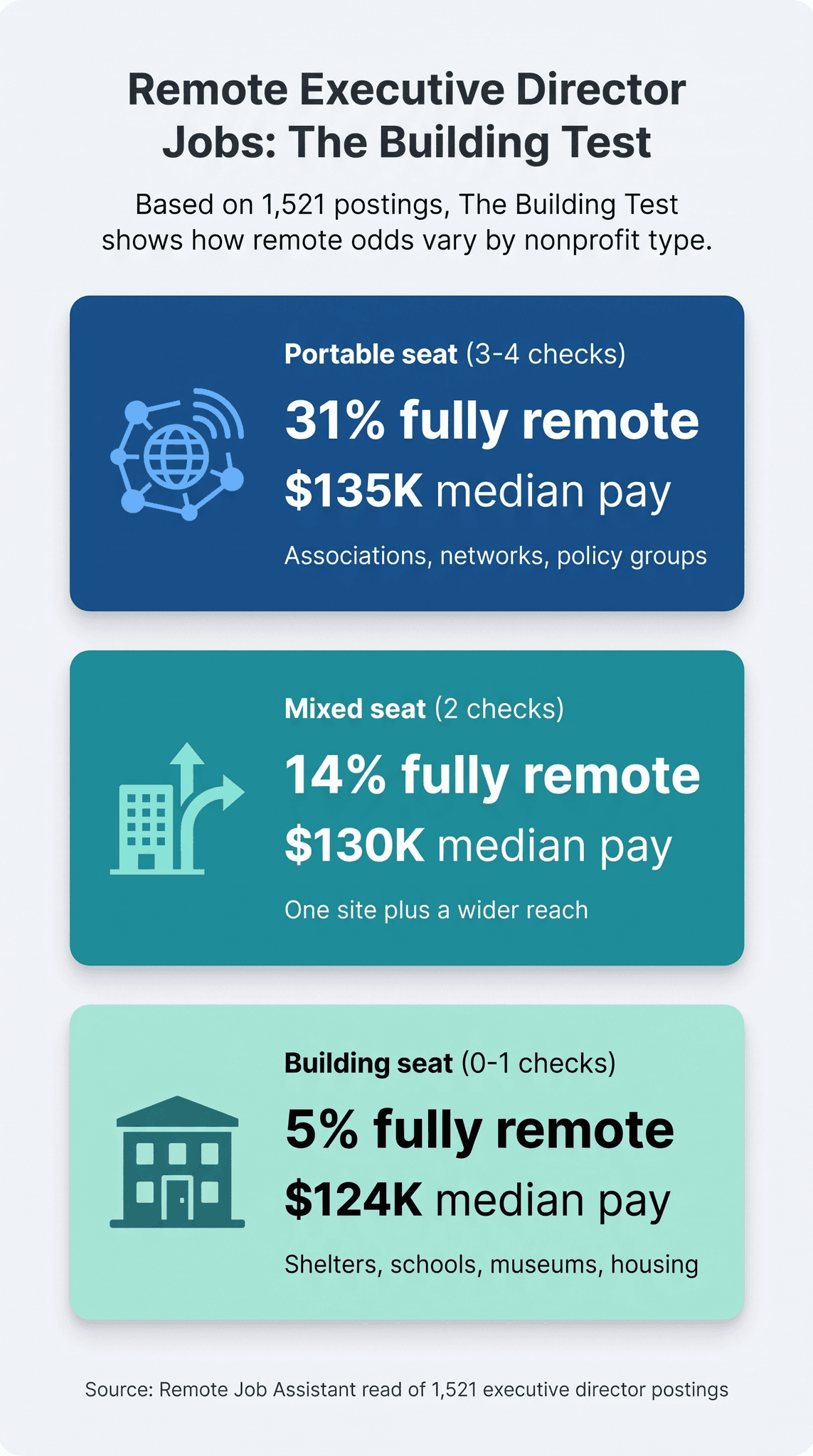
Here's the scored rubric. Pay is the middle half of posted ranges (25th to 75th percentile).
- Building seat (0-1 checks): $100K-$150K, median about $124K (n=46); remote 2 of 42 (4.8%). Direct service in a place: a zoo's support society, a Montessori school, a housing program, a neighborhood organizing group. Often a line about living locally or being visible in the community.
- Mixed seat (2 checks): $92.5K-$187.5K, median about $130K (n=81); remote 12 of 88 (13.6%). A place plus a wider reach: a regional coalition with one program site, a statewide group with a county office, a community foundation that wants you "in-person and community-facing."
- Portable seat (3-4 checks): $100K-$160K, median about $135K (n=81); remote 21 of 68 (30.9%). Associations, statewide and national networks, policy and research groups, fiscally sponsored projects; a travel line and no residency clause.
The gradient holds score by score, and each check pulls in the same direction:
| Building Test score | Board postings | Remote, of those stating |
|---|---|---|
| 0 | 7 | 0 of 6 |
| 1 | 57 | 2 of 36 (5.6%) |
| 2 | 138 | 12 of 88 (13.6%) |
| 3 | 88 | 13 of 51 (25.5%) |
| 4 | 23 | 8 of 17 (47.1%) |
| Check | Remote when yes | Remote when no |
|---|---|---|
| No place to run | 23 of 67 (34.3%) | 12 of 131 (9.2%) |
| Members or policymakers | 31 of 160 (19.4%) | 4 of 38 (10.5%) |
| Travel line | 15 of 52 (28.8%) | 20 of 146 (13.7%) |
| No residency clause | 28 of 154 (18.2%) | 7 of 44 (15.9%) |
Two caveats. We picked the four checks on this same set of postings, so treat the exact percentages as a first read rather than a law; inside Idealist's listings alone, the same steps show up (0 of 23 Building seats remote, 4 of 29 Mixed, 9 of 19 Portable). And the residency clause is the weakest check, because some remote boards still pin you to a state.
Compare two postings from the same month. The Association of Infant Mental Health in Tennessee scores 4: no building, a statewide membership, a travel line and no address requirement beyond the state. It's "Remote in Tennessee with statewide travel" at $120,000 to $135,000. Reclaim Philadelphia, a Philadelphia organizing group, scores 1. Its posting says "Applicants must live in Philadelphia, or be willing to relocate here" next to "in-office work, frequent public events and appearances." It's hybrid. Then there's LandWatch Monterey County, which shows what a residency clause does to a remote line: the ED "must be based in or willing to relocate to the Monterey County area and may work remotely from home."
If the organization has a building, the executive director job is the building.
How to use it: score the posting before you write to the search consultant. A 3 or 4 listed as on-site is worth one direct question, because the board may not have thought about it. A 0 or 1 listed as remote deserves a slow read of the travel and residency lines before you get attached.
The portable seats are scarce, and they're spread across Idealist, the Chronicle, search firms and LinkedIn with no single place to find them. If you're applying to every 3-or-4 seat you can find, that's a volume problem:
Stop Applying Manually
Our AI applies to hundreds of matching jobs while you sleep. Wake up to interviews, not more applications.
Where the Remote Board Seats Are
The 35 remote board seats aren't random. They cluster in four kinds of organization, and once you've seen the list, you know what to search for.
Statewide associations and commissions. The Tennessee infant mental health association above. The League of Women Voters of Florida, "Remote-friendly; Florida residency preferred" at $85,000 to $100,000, with "Regular in-person presence required for key organizational events and meetings." The Tennessee Holocaust Commission: "This is a remote position in Tennessee, with a strong preference for candidates based in Nashville," at $115,000 to $125,000. Remote here means remote inside the state.
National networks, research and policy groups. The Alliance for Innovation in Global Health posted $205,000 to $240,000: "The ED reports to the Board of Directors and leads a small, high-performing remote team." SEAL, an education nonprofit, described itself as "currently a remote organization based in California" and posted $300,000 to $340,000. The Institute for Humane Education posted $85,000 to $100,000 for "a remote position that will involve occasional travel." Code for Science & Society posted its Executive Director/President at $225,000 to $250,000.
Associations run by management firms. Association management companies such as Momentum Association Management and Stringfellow Management Group hire the executive director for client associations, and both posted remote seats, at $80,000 to $100,000 and $140,000 to $150,000. It's a real board seat with a professional services employer between you and the board.
Corporate and affinity foundations. The Fire Family Foundation, posted by Firefighters First Credit Union at $129,074 to $143,415: "This is a remote position. Candidates must live or work on Pacific Time zone hours."
The small print is consistent. Of 41 remote board and chapter postings, 19 carry a travel line, 17 pin you to a state, region or time zone, and 18 mention in-person board meetings or in-person presence. A remote ED job is a travel job.
Chapter seats deserve their own warning. At the national charities you answer to a regional vice president and a revenue goal, often built from walks, galas and corporate sponsors, and you're judged on that number. Six of the 17 stating postings were remote, March of Dimes' "Executive Director, Market Impact (Remote in Washington/Oregon)" among them, at about $126,000 median. Blue Star Families put it plainly in its Maryland chapter posting: "As a fully remote organization, we rely on scheduled in-person gatherings."
The rest of a board posting tells you what kind of week you're signing up for. These lines showed up often enough to count:
| What the posting says | Board postings | What it tells you |
|---|---|---|
| "Evenings and weekends" | 63 of 313 | A community-facing seat: remote 6 of 47, median about $108K (n=40) |
| Grant writing in the ED's own duties | 57 of 313 | No development staff behind you: median about $96K (n=33) |
| "Hands-on" | 47 of 313 | A small shop: remote 5 of 36, median about $114K (n=30) |
| Major gifts or major donors | 78 of 313 | A fundraising program worth running: median about $140K (n=56) |
The Mattapan Food and Fitness Coalition said it directly: "The ED is expected to be visible in the local community, which includes periodic evening and weekend commitments such as community meetings, events, and programs." That's a Building seat, whatever the remote line says.
Our read: chase the constituency, not the cause. If you want a remote chief executive seat, aim at associations, statewide networks and policy groups before the direct-service mission you love. Postings with a member or policy constituency were remote 31 of 160 times (19.4%), against 4 of 38 (10.5%) without one. Postings with no place to run were remote 23 of 67 times (34.3%), against 12 of 131 (9.2%) for those that name one.
Remote usually means remote inside one state, with the board still in a room. Of 41 remote board and chapter postings, 17 pin you to a state, region or time zone and 18 name in-person board meetings or in-person presence. The League of Women Voters of Florida wants "Regular in-person presence required for key organizational events and meetings"; price your travel calendar before you price your move.
What Remote Executive Directors Get Paid
For board seats, remote doesn't move the price. The board-seat median is $127,500 (n=208), with the middle half between $96,000 and $165,000. Remote, hybrid and on-site seats land within about $9,000 of each other. Rank titles are a different market entirely.
| Seat | Remote median (n) | Hybrid median (n) | On-site median (n) |
|---|---|---|---|
| Board seat | $124,500 (31) | $117,500 (47) | $126,000 (62) |
| Rank title | $289,000 (77) | $273,000 (109) | $205,000 (43) |
These are midpoints of posted ranges from 895 salaried postings listed May to October 2026, checked against BLS figures and Candid's 990-based report. The 585 postings that print no range at all aren't in the medians.
What does move board pay is the budget. Only 36 of the 313 board postings state one, and the steps are steep: under $1.5 million, about $100,000 (n=7); $1.5 million to $5 million, about $145,000 (n=20); over $5 million, about $220,000 (n=5).
There's a reason boards price it that way. Under the IRS's rebuttable presumption rules, a board protects itself on executive pay by having people without a conflict approve it in advance, relying on comparability data and documenting the decision. The National Council of Nonprofits tells boards to compare "similarly-sized peer organizations in the same geographic location." So the comparison set is built from the organization's budget and the organization's region. Your home ZIP code isn't in it, and neither is whether you'll commute.
A board doesn't pay you less for working from home. It pays for the budget you'll run.
That cuts both ways. A Tennessee board pricing against Tennessee peers won't discount you for living in a cheaper county, and it won't add a San Francisco premium because you live in San Francisco either. If you're in an expensive metro, the remote board seats worth chasing are the ones whose own region or budget already pays like yours.
The outside benchmarks line up once you know which job they count. BLS puts the median chief executive at $213,990 across all industries (May 2025), but in religious, grantmaking, civic and professional organizations it's $182,340, and general and operations managers in those same organizations earn $108,920. Employers code a nonprofit ED under either title, and the general-manager figure sits closer to our board-seat median. Candid's 2025 report, built from the 2023 Form 990s of more than 130,000 organizations, puts median nonprofit CEO pay at $110,000, up from $97,000 in 2019, and finds women CEOs paid 73 cents per dollar.
Before you negotiate, read the organization's 990. Part VII lists officers, key employees and the five highest-paid employees, per the IRS filing tips, so your predecessor's pay is usually public. Our guide to remote nonprofit jobs walks through reading one line by line.
Rank-title pay depends on the employer:
| Employer type (rank titles) | Postings | Posted median (n) | Remote, of those stating |
|---|---|---|---|
| Drug, biotech and research companies | 246 | $308,000 (197) | 36 of 133 (27.1%) |
| Health insurers and benefit managers | 30 | $255,000 (17) | 3 of 7 |
| Banks and financial firms | 104 | $233,000 (73) | 2 of 28 (7.1%) |
| Hospitals and health systems | 125 | $185,000 (45) | 10 of 48 (20.8%) |
| Universities | 181 | $162,500 (80) | 4 of 47 (8.5%) |
| Government agencies | 59 | $150,000 (31) | 3 of 10 |
Remote rank titles pay more than on-site ones ($289,000 against $205,000) because the remote ones are mostly at drug companies. That's the employer mix, not a remote premium. If those numbers are in your range, our roundup of high-paying remote jobs and the remote roles over $200K are the next stop.
If your search lives between $100K and $150K, you're competing for a few dozen portable board seats a quarter, and the ones posted with a range move fast:
Stop Applying Manually
Our AI applies to hundreds of matching jobs while you sleep. Wake up to interviews, not more applications.
The Rank Title: Executive Director at Drug Makers, Banks and Universities
If you're a senior director in regulatory, clinical operations, market access, risk or product, these are your listings, and they're the bulk of what "remote executive director" returns. The median rank posting asks for 10 years of experience (n=592), and 118 ask for 15 or more.
Who is higher, a VP or an executive director? It depends on who's using the title. Inside a drug or biotech company it's usually the grade between senior director and vice president, which is why postings like "Senior Director/Executive Director, Global Regulatory Lead" and "Executive Director/Vice President, Companion Diagnostics (CDx)" exist. At banks it's a corporate rank attached to the role: JPMorganChase posted 50 of them ("Card Portfolio Risk Management - Consumer & Community Banking - Executive Director") and Morgan Stanley 8, one titled "Executive Director/Vice President, FXEM Distribution COO." At a nonprofit, it's the top staff job.
Remote varies by industry for structural reasons. Drug and biotech companies posted 36 remote rank titles out of 133 that state a model. Regulatory, safety, market access and medical affairs work is done with the FDA, partners and payers by video and documents. Insmed's regulatory labeling ED says "This is a fully remote role" at $255,000 to $347,500. Bristol Myers Squibb assigns every role one of four models, "site-essential, site-by-design, field-based and remote-by-design." Banks barely post remote at this rank: 2 of 28. Wells Fargo's ED posting asks for "Willingness to work on-site in accordance with current office requirements." Insurers sit in between. UnitedHealthcare's Medicare & Retirement Texas ED says "If you are located in Texas, you will have the flexibility to work remotely," at $159,300 to $273,200.
If you're coming from a nonprofit ED seat, the realistic bridge is the institution side: health system and university rank titles in development, operations, community programs and foundation work, median $168,000 (n=184), remote 20 of 115. Corporate functional seats rarely hire a nonprofit generalist. For the pharma lanes in depth, see our guides to remote regulatory affairs jobs and remote medical director jobs.
Site Seats: Senior Living, Hospice and Home Health
The 244 site seats are the steadiest jobs carrying the title and the least remote. 131 are at senior living operators, 79 name the administrator licence (LNHA, NHA or RCFE), and 41 run a home health or hospice agency. Only 42 state a work model at all. Thirty-one say on-site and 7 tie you to the location. Of the 4 remote ones, two are hospice EDs and one is a floating "Mobile - PRN" senior living ED. The other 202 say nothing, because the job is the building. Median posted pay is about $115,000 (n=118).
The cause is the licence. These operators hire a licensed administrator to be accountable for the building, its census and its state inspections, so they need that person on the floor when the surveyor arrives. If you're a site ED who wants remote work, the path runs up (regional director or VP of operations, where travel replaces the building) or across to a board seat. Our guide to remote operations jobs covers the regional side.
How to Find a Remote Board Seat
Sort the posting before you score it. Most of the wasted applications in this search come from treating all four jobs as one, so work down this tree:
- The title names a function ("Executive Director, Market Access") and a VP sits above you → it's a rank title. Do you have about ten years in that exact function (the median ask, n=592)? → apply as a senior director, and look hardest at drug and biotech companies, which posted 36 remote of 133. No → skip it; a nonprofit generalist resume doesn't map onto a functional grade.
- A national charity, a market or chapter name, a regional VP and a revenue number → it's a chapter seat. Comfortable carrying a fundraising goal? → 6 of 17 were remote, about $126K. No → skip.
- A licence (LNHA, RCFE) or a community's name in the title → it's a site seat. 4 of 42 stating postings were remote → skip unless you'd move.
- It reports to a board → it's a board seat. Score The Building Test:
- 3-4 → apply, and ask in the first call how often the board meets in person and where.
- 2 → ask where the staff sits. Mixed seats came out hybrid 28 times of 88 and remote 12.
- 0-1 → apply only if you'd live there; 2 of 42 were remote.
Then search for the constituency, not the word "remote." Terms like "statewide," "association," "coalition," "network," "alliance," "society" and "foundation for" surface Portable seats. Idealist's executive director listings carry their own remote field, which is more reliable than keywords: of its 80 Executive Director listings, 12 were remote, 25 hybrid and 43 on-site. The Chronicle of Philanthropy job board carries fewer listings (22 Executive Director titles in our pull, including SEAL's $300,000 to $340,000 remote seat).
Know who's running the search. Only 23 of 313 board postings in our data came through a search firm or a reposting service, so most boards post directly on Idealist, the Chronicle, state nonprofit association boards and LinkedIn. If you're only watching search-firm sites, you're missing most of the market.
Read the 990 next to the posting. Part VII shows what your predecessor was paid. If the posted range starts below that figure, ask the board chair why before the second interview.
Watch for interim and part-time seats. We counted 7 interim and 42 part-time ED postings; 22 of the part-time ones are board seats, and 4 of the 20 part-time postings that state a model are remote. They're a way into the title, not a shortcut to remote.
If you're widening the search beyond the chief executive title, nonprofit operations manager roles, program manager roles and the broader operations and project management category are where deputy-level and COO-track seats get posted. Our guides to remote program manager jobs and fractional COO work cover those paths.
Portable board seats were 111 of the 1,521 postings in our data, spread across Idealist, the Chronicle, LinkedIn and search firms. If you're checking all of them every morning, let the applications run while you prepare for the board conversations:
Stop Applying Manually
Our AI applies to hundreds of matching jobs while you sleep. Wake up to interviews, not more applications.
Frequently Asked Questions
I've run a small nonprofit for eight years. Can I realistically find a fully remote executive director job?
Yes, but there are fewer than the search counts suggest: 35 of the 198 board-seat postings that state a work model were fully remote (17.7%, May-October 2026). Your odds depend on the organization. Seats that pass three or four Building Test checks (no building to run, a member or policy constituency, a travel line, no residency clause) were remote 21 of 68 times (30.9%), against 2 of 42 for seats that pass one or none.
Who is higher, a VP or an executive director?
It depends on the employer. At drug and biotech companies an executive director usually sits between senior director and vice president, and 13 postings in our data pair it with the rank above or below ("Executive Director/Vice President Market Access and Business Development"). At banks like JPMorganChase and Morgan Stanley it's a corporate rank attached to the job. At a nonprofit the executive director is the top staff job and reports to the board.
How much does a remote nonprofit executive director make?
Remote board-seat postings had a median posted midpoint of about $124,500 (n=31), close to on-site seats at about $126,000 (n=62). Budget matters more than location: postings that stated a budget under $1.5 million paid about $100,000 (n=7), and those over $5 million about $220,000 (n=5). Candid puts median nonprofit CEO pay at $110,000 across 2023 Form 990 filings.
What does a Building Test score of 2 mean?
A 2 is a Mixed seat: the organization has a place or a local footprint, but also a wider reach, such as a regional coalition with one program site. In our data, 12 of 88 Mixed seats that stated a work model were fully remote (13.6%), and many more were hybrid. Ask early how often the board and staff meet in person, because that answer usually decides it.
Why are so many remote executive director listings at pharma companies?
Because at drug and biotech companies "Executive Director" is a rank, not the top job, and their regulatory, market access and medical affairs work runs across sites by video. Of 126 fully remote ED postings, 81 were rank titles, and drug and biotech companies posted 36 remote of the 133 that stated a model. Their median posted pay was about $308,000 (n=197), with 10 or more years in the function expected.
Will a nonprofit board pay me less if I live somewhere cheaper?
Usually not. IRS rules push boards to set executive pay from comparability data, and the National Council of Nonprofits tells them to compare similarly sized organizations in the same region. That's the organization's region, not yours. In our postings, remote board seats paid about the same as on-site seats (median midpoints of about $124,500 and $126,000).
Are senior living executive director jobs ever remote?
Almost never. Of 244 site-seat postings (senior living, hospice, home health), only 42 stated a work model and 4 were remote, all field or floating roles. The licensed administrator is accountable for the building and its state survey results, so the operator wants that person on site; 79 of the 244 postings named the administrator licence.
Start Your Remote Executive Director Search
Sort every listing before you open the cover-letter file: a function in the title means a rank title, a licence or a community's name means a site seat, a regional VP and a revenue goal mean a chapter, and a board means it's yours to score. On a board seat, check for the building, the constituency, the travel line and the residency clause, and pull the 990 before the first call. Use Auto-Apply to cover the scattered postings while you prepare for the board interviews. For the wider nonprofit market, start with our guide to remote nonprofit jobs. For leadership roles priced above six figures, browse remote jobs paying $150K and up and remote jobs over $100K.
A board can hire a chief executive from anywhere. It can't move the building.
Ready to Find Your Remote Job?
Browse thousands of curated remote jobs or let AI apply for you.
Browse Remote JobsRelated Job Guides

Remote Marketing Director Jobs: What 2,566 Postings Pay
We read 2,566 marketing director postings. 420 of 1,328 that state a work model are remote, and pay runs $109K to $198K by employer type. Spot the remote ones.
27 min read

Remote Art Director Jobs: What 428 Postings Pay (2026)
We read 428 art director postings. 46 of 243 are remote, and the same title pays $81K at an agency and $159K at a tech company. How to price any seat.
28 min read

Remote Benefits Specialist Jobs: 131 of 1,523 Are Remote
We read 1,523 benefits specialist postings. 131 are fully remote. See which employers hire remote, which seats pay $75K+, and how to spot look-alike listings.
25 min read