
Last reviewed: October 2026
You have cut over two plants on a Sunday night and you know which IDoc fails first. Your title says SAP Consultant, your rate card says $70 an hour, and your laptop was your office long before it was fashionable. So you search "remote sap jobs." Google's first result is an Indeed page that no crawler can load. LinkedIn's remote SAP page claims 11,000 or more openings, shows a city on 30 of its first 30 cards and pay on none of its first 60. Dice's "sap abap remote" page is contract or third-party on 17 of 20 cards, and 7 of its 12 city cards say on site in the text, one of them "100% ONSITE ROLE." Flip the words to "sap remote jobs" and SAP's own careers site takes the second and third results, because that search is half brand traffic: Ahrefs files it under the parent topic "sap careers," and 6 of the 7 "People also ask" boxes we pulled ask whether SAP itself hires remotely.
The government doesn't have an SAP job either. The Bureau of Labor Statistics files most SAP consultants as computer systems analysts, $105,850 median pay in May 2025 across 519,530 workers, next to software developers at $135,980 and computer and information systems managers at $175,140, and it says nothing about remote work for any of them. O*NET's hot-technology data finds "SAP software" in 534,138 US job postings in 2025, the tenth most-requested technology of 176, inside 20% of logistics-analyst postings and 13% of computer-systems-analyst postings. SAP's mainstream maintenance for ECC ends in 2027. And the job boards file a $60-an-hour support-queue contract and a $250,000 transformation lead under the same keyword.
Get Remote Job Tips in Your Inbox
Weekly strategies, salary data, and new opportunities
Unsubscribe anytime. No spam.
So we read the postings. Two things predict an SAP posting's pay better than the module in its title: what the SAP work is, and who posts the seat. The module medians we measured sit inside a $15,000 band, $131,950 to $146,500; the work type alone spreads $27,750. And remote SAP work has a shape most guides miss: it is sold mostly through consultancies, staffing firms and federal contractors, and the seats that are easiest to get remotely are, on average, the ones that pay least.
Remote Job Assistant read 2,031 US postings whose title names SAP or an SAP-only product (ABAP, S/4HANA, SuccessFactors, Ariba, Fiori, BW/4HANA, SAP Basis) from 892 employers in full, pulled October 11, 2026, with posting dates from October 2025 to October 2026 (1,796 of the 2,001 dated ones listed since July 1). They came from LinkedIn (1,334, from 64 keyword searches plus LinkedIn's own three SAP pages), the Indeed network via SimplyHired (372), Himalayas (178), 567 Workday career sites (101), amazon.jobs (27) and 944 Greenhouse, Lever, Ashby and SmartRecruiters boards (19). We read 113 Oracle, Workday, NetSuite and Dynamics postings and 41 ERP and business-systems postings that require SAP without naming it in the title the same way, and report them separately. We set aside end-user titles that merely use SAP (an AP specialist "- SAP," a buyer), federal postings where "SAP" means a Special Access Program or Simplified Acquisition Procedures, recruiters and sales titles, trainers, interns, 49 offshore listings posted under a US flag and 16 titles in other languages.
Based on our analysis of 2,031 US SAP-titled postings at 892 employers (posted October 2025–October 2026):
- 45.3% (n=398 of 879) of postings that state a work model are fully remote, once Himalayas, a remote-only board, is set aside; 974 of the 2,031 say nothing about it
- 53.5% (n=1,086 of 2,031) were posted by consultancies, systems integrators and staffing firms; consultancies post a $149,800 median range midpoint (n=353) and staffing firms $125,000 (n=63), against $177,410 at software companies (n=85), $162,650 at pharma, medtech and health companies (n=58) and $130,175 at manufacturers running SAP in-house (n=152)
- 71.4% of federal-contractor SAP postings that state a model are remote (60 of 84), and 61.4% of staffing-firm postings (70 of 114), against 37.8% at software companies (42 of 111), 25.2% at manufacturers (41 of 163) and 18.2% at pharma, medtech and health companies (8 of 44)
- $150,000 median midpoint for postings that name S/4HANA and not ECC (n=525) against $129,500 for postings that name only ECC (n=17); the ECC-only postings that state a model are remote 17.6% of the time (3 of 17)
- $146,500 for finance seats (n=98), $145,000 for logistics (n=232), $145,573 for data and analytics (n=40), $138,725 for Basis (n=48), $135,000 for ABAP and integration developers (n=135), $131,950 for SuccessFactors and HCM (n=53) and $170,050 for SAP leads and architects (n=98)
- 43.0% (n=873 of 2,031) post an annual range: median $115,000–$170,000; 616 start at $100,000 or more and 147 at $150,000 or more (22 remote); 96 more post only an hourly rate, a $70–$80 median
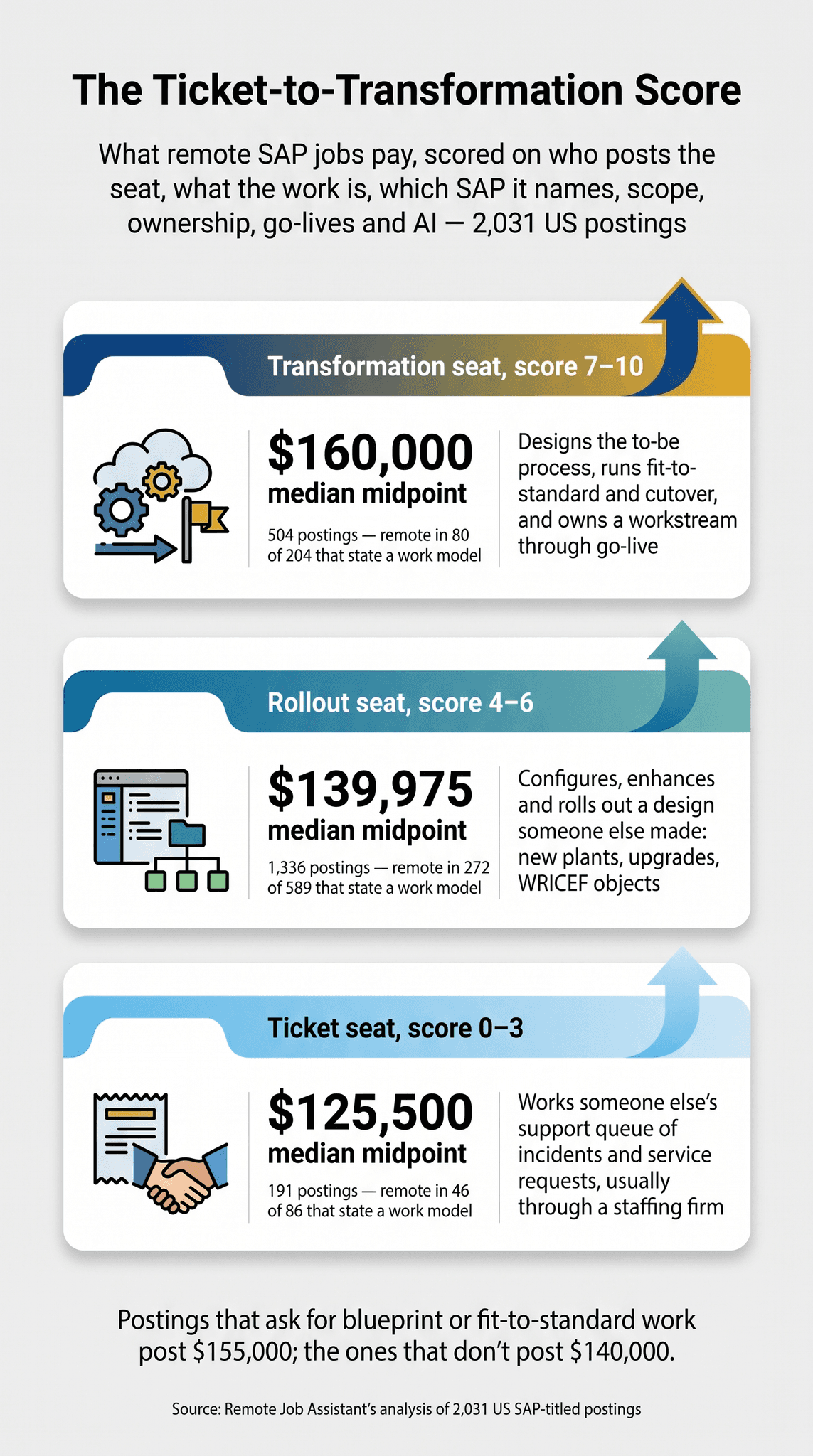
- 9.4% (n=191 of 2,031) score as Ticket seats at a $125,500 midpoint (n=60), 65.8% (n=1,336) as Rollout seats at $139,975 (n=564) and 24.8% (n=504) as Transformation seats at $160,000 (n=249)
- Of the 572 remote postings, 94 name US citizenship, 86 a security clearance, 80 a travel percentage, 48 W-2 only and 18 a time zone
Three seats, then. A Ticket seat (191 postings) posts a $125,500 midpoint and is remote 53.5% of the time it states a model outside Himalayas (46 of 86); a Rollout seat (1,336) posts $139,975 and 46.2% (272 of 589); a Transformation seat (504) posts $160,000 and 39.2% (80 of 204). Pay climbs with the score and the remote share falls with it, because the seats that are easiest to staff from anywhere are the ones a vendor can bill by the hour, and the seats that own the design sit closest to the people who own the business.
Of the 200 remote SAP-titled postings with a posted range, 22 start at $150,000 or more, and 16 of those 22 carry lead, architect, director, manager or principal in the title. The top of the list: Ramp's Technical Consultant, S/4HANA at $191,000–$291,000; Cepheid's Director, Enterprise Applications – SAP Platform at $190,000–$215,000; K2 Partnering Solutions' SAP Finance Architect Director at $190,000–$230,000; SAP NS2's AIS Developer at $176,300–$374,300 and three more SAP NS2 seats at $151,900–$340,900 (SAP's federal subsidiary); Nguyen Tech Consulting's Senior SAP GRC and Application Security Analyst at $175,000–$220,000; Amgen's Global ERP Operations Lead, SAP Platform at $167,720–$226,915; Stott and May's SAP EWM (Techno Functional) Solution Architect at $165,000–$200,000; NTT's SAP Business AI Lead Architect at $160,377–$229,337; and Accenture Federal Services' SAP Integration Lead at $157,900–$310,700. RTX posts six remote SAP lead, manager and analyst seats at $132,400–$251,600, which start below the line but top out above $250,000.
How We Collected This Data
Three biases shape every number below. Pay is posted on 43.0% of SAP-titled postings (873 of 2,031: 86 of 101 Workday rows, 565 of 1,334 LinkedIn rows, 128 of 372 SimplyHired rows, 61 of 178 Himalayas rows), so medians lean toward employers with pay-transparency blocks and away from the small vendors that never print a range. 974 of the 2,031 postings (48.0%) say nothing about work model, so every "remote" share in this guide is a share of postings that state one. And Himalayas lists only remote jobs: 174 of its 178 SAP-titled rows are remote by construction, so every remote share in this guide sets Himalayas aside unless we say otherwise, while pay figures keep it. What we could not read: Indeed, Glassdoor and ZipRecruiter return 403 errors to every route we tried, including the Internet Archive; jobs.sap.com and sap.com block crawlers, so SAP's own pages come from archived copies; and the Dice, Remote Rocketship, Jobgether, Working Nomads and DailyRemote pages were read by hand and not counted.
A posting counted if its title named SAP, ABAP, S/4HANA, HANA, SuccessFactors, Ariba, Concur, Fieldglass, Fiori or UI5, BW/4HANA, BusinessObjects, Hybris or SAP Basis next to a professional role word. We sorted those titles by module family: finance (FI, CO, FICO, S/4HANA Finance, Treasury, BPC), logistics (MM, SD, PP, QM, PM, EWM, TM, IBP, Ariba, GTS), HCM and SuccessFactors, development and integration (ABAP, Fiori, BTP, CPI, PI/PO), Basis and HANA administration, data and analytics (BW, Analytics Cloud, Datasphere, MDG, data migration), security and GRC, leads and architects, analysts with no module named, and plain "SAP Consultant." We dropped titles where SAP is the tool, not the job (an AP clerk or buyer "- SAP," 4 of them), recruiters and SAP sales titles, trainers, interns, non-English titles, and the acronyms that are not the ERP: a DoD "SAP" security officer works on Special Access Programs, a federal procurement "SAP" is Simplified Acquisition Procedures, and a DOT "SAP" is a Substance Abuse Professional. We found all three in our pull.
Dedupe started from 3,583 rows, 2,920 of them in the US and dated after October 2025. After the title and body tests, we removed 116 exact copies, 175 per-city clones of one requisition and 139 copies under sibling employer names, then collapsed 163 duplicates found on two sources, leaving 2,264 unique postings across the SAP-titled and comparison sets. Per-city clones are the big one in SAP: on LinkedIn, the 2,483 SAP-titled cards our searches returned were 1,583 unique title-and-employer pairs, and Deloitte's 417 cards were 22 titles posted in 49 cities. LinkedIn served 1,727 of the 1,736 job pages we requested, which covered every one of those SAP-titled pairs plus samples of the comparison titles. We read work model from the posting text, not the board's flag, and we sorted employers by kind from curated name lists (SAP partners and systems integrators, SAP-market staffing firms, federal contractors), then the employer's own LinkedIn industry label, then the employer's own Workday career site (an end customer by definition).
The Ticket-to-Transformation Score is computed by code from duty language, and the audit changed one component. The interim version scored consultancies one point and companies running SAP in-house two; on the interim pass both posted a $145,000 midpoint, so that point did nothing. The split that moves pay is different in SAP than in most of tech: manufacturers' in-house SAP teams post $130,175 (n=152), federal contractors $139,950 (n=79), consultancies $149,800 (n=353), pharma, medtech and health companies $162,650 (n=58) and software companies, SAP included, $177,410 (n=85). The employer point now follows that order, and every scored component raises the posted midpoint on its own.
Salary cross-references: BLS Occupational Employment and Wage Statistics for May 2025 (Computer Systems Analysts, median $105,850, 25th percentile $82,860, 75th $134,110, 90th $167,710; Software Developers, median $135,980; Computer and Information Systems Managers, median $175,140; Management Analysts, median $101,860), the BLS Occupational Outlook Handbook (computer systems analysts, 8% growth from 2025 to 2035 and about 32,900 openings a year; "Some systems analysts work as consultants"), Robert Half's 2027 salary guide (ERP systems analyst, $110,000–$158,000), Levels.fyi (SAP SE's own US employees, total compensation: management consultant $183K, software engineer $190K) and Remote Rocketship's published US average for remote SAP consultants ($147,387 across 713 openings). Glassdoor's, Indeed's and ZipRecruiter's figures appear only in search-result titles and are labelled that way.
The Ticket-to-Transformation Score: Why Two Remote SAP Integration Jobs Pay $52,100 Apart
The usual advice is to add a module. Learn EWM, add Ariba, get the S/4HANA Finance certificate, and the offers follow. The postings disagree. Outside leads and analysts, the module medians in our set sit between $131,950 and $146,500. What moves an SAP posting's pay is what the work is (a support queue, a rollout of someone else's design, or the design itself) and who sells or buys it.
The Ticket-to-Transformation Score is a 0–10 rubric that scores any SAP posting, or your current job, on how far it sits from "working a support-ticket queue on someone else's ECC system" toward "leading an S/4HANA transformation end to end," using only what the posting says.
The two-minute check. Answer four questions from the posting:
- Who posts it: a staffing firm, a manufacturer or federal contractor running its own SAP, or a consultancy, software company, pharma company or bank?
- What is the work: incidents and service requests, configuration and rollouts of an existing design, or blueprint, fit-to-standard and cutover?
- Which SAP does it name: ECC only, both, or S/4HANA and BTP only?
- Does it ask for a delivery record (full-cycle implementations, go-lives), cross-module scope, design ownership or AI work?
Scoring, with the median posted midpoint for each value across the 2,031 postings:
- Employer (0–2), who posts the seat: a staffing firm or C2C vendor = 0 ($125,000, n=63); an in-house team at a manufacturer, consumer-goods or distribution company, or a federal contractor = 1 ($135,000, n=290); a consultancy or systems integrator, a software company (SAP included), a pharma or medtech company or a bank = 2 ($153,775, n=520).
- Work (0–2), what the SAP work is: a support queue (tickets, incidents, application management services, break/fix, service requests) = 0 ($126,750, n=35); enhancements, rollouts, upgrades and configuration changes, or nothing decisive = 1 ($137,350, n=426); implementation and transformation (blueprint, fit-to-standard, solution design, S/4HANA conversion or greenfield, cutover, full-cycle delivery) = 2 ($154,500, n=391).
- Era (0–2), which SAP the posting names: ECC, R/3, PI/PO or BW 7.x only = 0 ($132,592, n=18); both, or neither = 1 ($142,200 with migration language, n=371); S/4HANA, BTP, Fiori, RISE, Datasphere or Analytics Cloud only = 2 ($147,000, n=380).
- Scope (0–1): cross-module or end-to-end process scope, such as order-to-cash or procure-to-pay "integration with SD and MM" ($150,000 vs $140,000).
- Ownership (0–1): solution architecture, design authority, a workstream or team to lead, mentoring ($149,275 vs $135,550).
- Go-live record (0–1): asks for completed full-cycle implementations or go-lives ($153,178 vs $141,000; n=127).
- AI (0–1): SAP Business AI, Joule, generative AI or Copilot expected in the work ($165,000 vs $140,469; n=91).
Bands:
- Ticket seat (0–3): $125,500 midpoint (n=60); remote in 53.5% of the 86 postings outside Himalayas that state a model. You work someone else's queue (incidents, service requests, month-end fixes), usually through a staffing firm or a consultancy's support contract. 191 postings.
- Rollout seat (4–6): $139,975 midpoint (n=564); remote 46.2% of 589. You configure, enhance and roll out a design someone else made: new plants and company codes, upgrades, WRICEF objects, a module on a program you joined after blueprint. 1,336 postings.
- Transformation seat (7–10): $160,000 midpoint (n=249); remote 39.2% of 204. You design the to-be process, run fit-to-standard workshops and cutover, and own a workstream through go-live, at consultancies, software companies and the end customers paying for the move. 504 postings.
| Seat | Score | Postings | Remote (of stated, ex-Himalayas) | Median midpoint (n) | Hourly median (n) | Contract | Typical posters |
|---|---|---|---|---|---|---|---|
| Ticket | 0–3 | 191 | 53.5% (46 of 86) | $125,500 (60) | $60–$70 (17) | 55 | Staffing firms, support contracts |
| Rollout | 4–6 | 1,336 | 46.2% (272 of 589) | $139,975 (564) | $65–$74 (62) | 220 | Consultancies, manufacturers, federal contractors |
| Transformation | 7–10 | 504 | 39.2% (80 of 204) | $160,000 (249) | $80–$85 (18) | 53 | Consultancies, software, pharma, end customers mid-migration |
The single score is honest about its noise: $132,500 at 2 (n=14), $125,000 at 3, $127,250 at 4, then $139,975 at 5, $149,800 at 6, $155,000 at 7, $159,600 at 8, $177,550 at 9 (n=23) and $202,264 at 10 (n=2). The dip at 3 is small samples; the climb from 4 to 9 is $50,300.
How to use it. Score your current job, then every posting you consider, in two minutes. The biggest single point is who posts it: $125,000 at a staffing firm, $153,775 at a consultancy, software company or pharma company. The cheapest point is the work you can truthfully claim: a fit-to-standard workshop you ran, a cutover plan you owned, a go-live you were on the bridge for. If you score 0–3 and want $150,000, change what the work is and who posts it before you add a module. And decide up front which trade you are making: the remote vendor seat, or the transformation seat that asks for a week a month on site.
Here is the score on two postings for nearly the same skill. Bright Vision Technologies posts an SAP CPI Developer as "100% Remote (U.S.)," "Full-time, Direct W2," "Salary Range: $89,000–$111,000," with "6+ years" required, to "design, build, and operate enterprise integration scenarios that connect SAP S/4HANA and other SAP applications." It scores 3: zero for a staffing-and-consulting vendor, one for build-and-run work, one for an era that spans PI/PO and S/4HANA, one for ownership language ("own the full integration lifecycle"). Cardinal Health posts a Senior Engineer, SAP BTP, from Ohio as work-from-home at $125,300–$178,900, to "architect, govern, and optimize our enterprise SAP cloud landscape" and run "AI/Joule Security" on BTP. It scores 7: two for a health company buying the work, one for the work, two for an S/4HANA-and-BTP-only stack, one for ownership and one for AI. Both are remote, both are W-2, and their midpoints are $100,000 and $152,100. The integration skills overlap almost completely. The $52,100 is the employer and the era.
Why does the employer move SAP pay so much? Because in SAP the vendor's margin shows up in the range. A staffing firm bills an SAP CPI developer to a client at a rate and pays a salary or an hourly W-2 rate under it, and its ranges are templates: of the 63 staffing postings with an annual range, 19 use exactly $100,000–$150,000, and Bright Vision alone posts 19 different SAP titles at that range. Consultancies post more ($149,800), because Big Four and SI rate cards for S/4HANA programs are high and their postings are senior and program-shaped: a Deloitte SAP SD/OTC posting asks for experience on an "implementation, transformation, or migration program" and adds "Ability to travel up to 50%, based on the work you do and the clients and industries/sectors you serve." Manufacturers running SAP themselves post less ($130,175), because their SAP team is a cost center sized for run-and-maintain between migrations. Pharma, medtech and software companies post the most, because the system they run is regulated (59 of our postings name GxP, GMP or validated-system rules) or because SAP is part of what they sell.
Why does the work type move it? A support queue is priced on volume; a design seat is priced on risk. "Experience supporting system enhancements, incident management, and application support activities," from a Conagra Brands SAP Systems Analyst posting, is a different job from one that "plays a key role in Agilent's enterprise transformation from SAP ECC to S/4HANA Private Cloud," even when both name the same module. The best-paid word in an SAP job description isn't a module. It's "blueprint": postings that ask for blueprint or fit-to-standard work post $155,000; the ones that don't post $140,000.
Two honest exceptions. Federal contractors break the remote-pay pattern: their SAP postings are remote 71.4% of the time they state a model (60 of 84) at a $139,950 midpoint, because Navy ERP, GFEBS and other defense SAP programs run on cleared, distributed contractor teams, and 191 of our postings name a clearance. And a staffing firm's "Solution Architect" title can post $175,000–$200,000 (Bright Vision's SAP HANA Solutions Architect does), so the score is a starting point for a posting, not a verdict on it.
Stop Applying Manually
Our AI applies to hundreds of matching jobs while you sleep. Wake up to interviews, not more applications.
The vendor reposts and round-number ranges are the part that wears people down: the same requisition under three agency names, each with a different rate. Filtering to the Rollout and Transformation postings with a real employer and a real range is the job. Auto-Apply handles the application volume once you've decided which ones those are.
Remote SAP Salary by Module: FICO, Logistics, ABAP, Basis and the Rest
The module tells you less about pay than the seat does, but it still matters, and it is where most searches start. Here is what each module family posts.
| Module family (title) | Postings | Remote (of stated, ex-Himalayas) | Median posted range (n) | Median midpoint | Hourly median (n) |
|---|---|---|---|---|---|
| Leads and architects (program, solution, enterprise) | 205 | 41.6% (37 of 89) | $140,000–$202,100 (98) | $170,050 | n/a |
| Finance (FI, CO, FICO, Treasury, BPC) | 225 | 36.8% (39 of 106) | $117,800–$170,000 (98) | $146,500 | $80–$85 (4) |
| Data and analytics (BW, Analytics Cloud, Datasphere, MDG) | 99 | 68.4% (26 of 38) | $112,500–$160,000 (40) | $145,573 | $65–$72 (9) |
| Logistics (MM, SD, PP, QM, EWM, TM, IBP, Ariba) | 572 | 40.7% (98 of 241) | $116,115–$173,400 (232) | $145,000 | $70–$80 (31) |
| "SAP Consultant," no module named | 185 | 58.8% (50 of 85) | $100,800–$176,350 (86) | $140,900 | $75–$87.50 (10) |
| Security and GRC | 65 | 35.7% (10 of 28) | $100,000–$188,750 (32) | $139,462 | $65–$80 (4) |
| Basis and HANA administration | 145 | 52.9% (36 of 68) | $120,000–$159,900 (48) | $138,725 | $60–$65 (9) |
| Development and integration (ABAP, Fiori, BTP, CPI) | 297 | 50.0% (66 of 132) | $107,500–$160,000 (135) | $135,000 | $75–$80 (17) |
| HCM and SuccessFactors | 126 | 61.1% (33 of 54) | $110,000–$155,000 (53) | $131,950 | n/a |
| SAP analyst, no module named | 102 | 2.9% (1 of 34) | $101,400–$150,000 (49) | $128,500 | $56–$62 (6) |
Salary ranges derive from our analysis of 2,031 US SAP-titled postings dated October 2025 to October 2026, 873 of them with a posted annual range, cross-referenced with BLS May 2025 wages for computer systems analysts ($105,850) and software developers ($135,980) and with Robert Half's 2027 ERP systems analyst band ($110,000–$158,000). Remote shares exclude Himalayas, whose listings are remote by construction. Ranges move with the market, so check the linked sources for current figures.
Three things in that table are worth reading twice. First, the spread inside each family is wider than the spread between them: logistics runs from $116,115 at the bottom of the median range to $173,400 at the top, and finance from $117,800 to $170,000. Second, the newer tools and the harder modules carry the premium inside a family: postings naming Datasphere post $151,175 (n=38) and SAP Analytics Cloud $145,200 (n=67), against $140,000 for postings naming classic BW (n=72); PP/QM postings post $155,000 (n=99) and Project Systems $156,000 (n=45). Third, the plain "SAP Analyst" title is the weakest remote seat in the set, remote in 1 of 34 postings that state a model, because it is usually an in-house business-systems job at a manufacturer, closer to the remote business analyst jobs we covered separately than to an SAP consultant's seat.
The module families also overlap with neighbouring markets, which is where a lot of SAP people move next. Basis seats increasingly run SAP on Azure or AWS and compete with remote cloud engineer jobs; BW and Datasphere people sit next to remote SQL jobs and data engineering; SuccessFactors consultants are bought by the same HR leaders our remote HR jobs guide describes; and Ariba and MM consultants share buyers with remote procurement jobs.
Level matters more than module. Mid-level SAP titles post $129,800 (n=340), senior titles $139,975 (n=188) and lead, manager, architect and principal titles $167,225 (n=329). Entry-level SAP titles are rare (24 of 2,031) and post $89,600. Years of experience track the same curve: postings asking for 0–4 years post $138,788, 5–7 years $144,200 and 8–10 years $158,760; the median ask is 6 years.
The BLS figure sits $37,650 under our overall median ($143,500) because it counts every computer systems analyst, including the government and hospital analysts who never touch SAP; the SAP-specific premium shows up at the BLS 75th percentile ($134,110), about where our Rollout seats start. Robert Half's ERP systems analyst band ($110,000–$158,000) brackets our in-house manufacturer seats, and Remote Rocketship's $147,387 US average for remote SAP consultants sits close to our consultancy median ($149,800).
If you are on a contract, do the math on the hourly number. The 96 hourly-only SAP postings post a $70–$80 median, which is $145,600–$166,400 at 2,080 hours with no paid leave, no health plan and no bench pay between projects. A talent marketplace that ranks for "sap abap remote jobs" spells it out: "Contractor assignment (no medical/paid leave)," "Duration of Contract: 3 months." A full-time Rollout seat at $139,975 with benefits beats a $70 contract for most people who don't already have a pipeline of clients.
Who Actually Posts Remote SAP Jobs
More than half of all SAP-titled postings come from someone selling SAP work to someone else: 850 from consultancies and systems integrators and 236 from staffing firms, 1,086 of 2,031 (53.5%). Here is who posts, what they pay and how often they say remote.
| Employer kind | Postings | Remote (of stated, ex-Himalayas) | Median midpoint (n) | Contract postings | What the seat usually is |
|---|---|---|---|---|---|
| Software and internet companies (SAP included) | 189 | 37.8% (42 of 111) | $177,410 (85) | 28 | SAP teams at Amazon, Ramp, Databricks; SAP NS2 |
| Pharma, medtech and health | 86 | 18.2% (8 of 44) | $162,650 (58) | 4 | In-house S/4HANA programs, GxP systems |
| Consultancies and systems integrators | 850 | 52.0% (158 of 304) | $149,800 (353) | 164 | Big Four, global SIs, SAP partners |
| Consumer goods and retail | 89 | 17.9% (5 of 28) | $140,000 (53) | 3 | In-house SAP teams |
| Federal contractors | 118 | 71.4% (60 of 84) | $139,950 (79) | 7 | Navy ERP and other defense SAP programs, cleared |
| Manufacturers and distributors | 382 | 25.2% (41 of 163) | $130,175 (152) | 16 | In-house SAP analysts and leads |
| Staffing firms and C2C vendors | 236 | 61.4% (70 of 114) | $125,000 (63) | 94 | Contract and W-2 seats at end clients |
Banks, insurers and a handful of other employers (81 postings) make up the rest.
In SAP, the easiest seat to get remotely is usually the cheapest one: staffing firms state remote 61.4% of the time at a $125,000 midpoint; software companies 37.8% of the time at $177,410.
The consultancy lane is where most SAP work lives and where the posting language is most honest about travel. Accenture's SAP postings carry "The amount of travel will vary from 0 to 100% depending on business need and client requirements" (25 postings); C5MI's say a consultant "Travels up to 50% to support project activities, testing, and go-live events." Clarkston Consulting's EWM posting puts the trade in one line: "When not traveling to client sites, consultants work from their home office." Consultancies post on LinkedIn in bulk, in many cities at once: Deloitte's 417 SAP cards in our searches were 22 titles, EY's 159 were 14 and PwC's 157 were 14.
The staffing lane is the most remote and the most opaque. 125 of our postings say W-2 only (remote 68.2% of the time they state a model, 60 of 88, at a $125,000 midpoint), 53 name C2C, and the vendor postings carry their own small print: "MUST WORK ON DIRECT W2 WITH NTTD, NO C2C AVAILABLE," "Must be able to work on a W2 basis only (no C2C or 1099)." When the same end client's requisition reaches you through three vendors, the rate you see depends on whose margin it passed through first.
The federal lane is remote and cleared. CACI, RTX, Lockheed Martin, Accenture Federal Services and SAP's own federal subsidiary, SAP NS2, post SAP seats for defense ERP programs, many of them fully remote within the US, with lines like "Percentage of Travel Required: Up to 10%" and a clearance requirement. Lockheed Martin's SAP analyst seats post ranges as wide as $98,700–$254,700.
The end-customer lane pays according to the business. Manufacturers' in-house SAP postings post $130,175 and are remote 25.2% of the time; pharma, medtech and health companies post $162,650 and are remote 18.2% of the time. These are the seats with a real design voice during a migration ("GE Aerospace's Edison Works business is embarking on an exciting ERP journey to implement a greenfield SAP S/4HANA instance"), and the ones most likely to ask for hybrid days.
One more thing about end customers: some of their SAP seats are not in the US at all. On the 64 employers' own Workday career sites where we found SAP-titled postings (PwC's global site set aside), 122 of 289 were located in India and 116 in the US. Amgen listed 25 SAP seats in Hyderabad and 1 in the US. That is the competition a US remote SAP candidate is priced against, and it is why "remote" from a US company usually means "remote within the US," written into the posting.
Stop Applying Manually
Our AI applies to hundreds of matching jobs while you sleep. Wake up to interviews, not more applications.
The vendor lane and the end-customer lane need different applications: one wants a rate and an availability date, the other wants a migration story. Auto-Apply sends the volume to whichever lanes you choose, so the time you save goes into the two or three end-customer interviews that matter.
S/4HANA, ECC and the 2027 Deadline: What It Does to Pay
SAP set the clock itself. Its maintenance strategy page says mainstream maintenance for the core SAP Business Suite 7 applications, SAP ERP 6.0 among them, runs "until end of 2027," followed by optional extended maintenance "until end of 2030" at "a premium of two percent points on the maintenance basis." S/4HANA is maintained until the end of 2040. In February 2025 SAP added a paid bridge, the SAP ERP, private edition, transition option, usable from 2031 to 2033 for systems moved to SAP's private cloud on HANA before December 31, 2030, and said in the announcement that "this is not a maintenance prolongation of SAP ERP."
The customers are moving, slowly and at great expense. In ASUG research covered by diginomica on October 6, 2026, 68% of 194 member companies were live on S/4HANA or moving from ECC, 62% had been on S/4HANA for under three years, and partners and systems integrators were the biggest line in a migration budget at 37%, ahead of licensing at 28%. Nearly half (47%) chose a brownfield conversion and 30% greenfield. The German-speaking user group DSAG's 2026 survey of 198 member companies found S/4HANA on-premise in use at 56% against 54% still on ECC, and 63% named the end of maintenance as a challenge. Gartner's count, reported by The Register in March 2025, was that about 39% of 35,000 ECC customers had licensed S/4HANA by the end of 2024: licensed, not live.
Here is what that does to the postings.
| Era named in the title, else the body | Postings | Remote (of stated, ex-Himalayas) | Median midpoint (n) |
|---|---|---|---|
| S/4HANA (or BTP, Fiori, RISE) and not ECC | 1,172 | 43.0% (221 of 514) | $150,000 (525) |
| Both ECC and S/4HANA | 451 | 49.5% (96 of 194) | $135,450 (192) |
| Neither named | 356 | 50.6% (78 of 154) | $137,500 (139) |
| ECC only | 52 | 17.6% (3 of 17) | $129,500 (17) |
The 2027 deadline pays the people who move companies off ECC, not the people who keep it running: postings that name only ECC post $129,500 and are remote 3 times in 17; postings that name S/4HANA and not ECC post $150,000. The ECC-only cell is small (17 postings with pay), and the direction holds in the framework's stricter era read ($132,592 for ECC-only language against $147,000 for S/4HANA-only).
Inside the S/4HANA era, the design words pay. Postings that ask for blueprint or fit-to-standard work post $155,000 against $140,000 without; SAP Activate methodology $155,000 (n=84) against $141,800; a full-cycle implementation record $158,984 (n=179) against $140,000; and SAP Business AI, Joule or generative-AI language $164,045 (n=72) against $141,800. Integration has moved to the cloud too: CPI and Integration Suite postings post $145,500 against $135,185 for PI/PO. The ECC-only postings are mostly run-and-maintain work ("Experience supporting system enhancements, incident management"); the S/4HANA ones are mostly conversion and design ("Experience upgrading SAP ECC to S/4 HANA," from an RTX ABAP posting; "develop and implement clean core strategies," from Medtronic).
So is SAP still in demand? The O*NET count says yes (534,138 postings in 2025, tenth of 176 technologies), the customer surveys say the migration wave is at its middle, and our dates agree: 1,796 of the 2,001 dated postings were listed since July 1. But the demand is for S/4HANA-era work. If your resume says ECC and nothing after it, the deadline is a reason to add the conversion experience, not a guarantee of the next contract.
Does SAP Hire Remote? Working at SAP vs Working in SAP
A large share of the people who search "sap remote jobs" want a job at SAP, not a job in SAP: Ahrefs puts that search under the parent topic "sap careers," SAP's careers pages hold its second and third results, and 6 of its 7 "People also ask" boxes are about SAP the employer. The short answer is: less than it used to. In January 2024 SAP issued guidance requiring employees globally "to work in an office or on site with a customer three days a week from April," Fortune reported from Bloomberg's coverage, and more than 5,000 employees signed an internal letter against it within two weeks. SAP's careers site, archived in April 2026, showed "Results 1 – 25 of 32" on its "Virtual Jobs at SAP" page worldwide, and 7 of the 25 rows shown were in the US.
SAP itself was a small poster in our set: 26 of the 4,815 LinkedIn cards our 64 searches returned were SAP's own, and 24 of our 2,031 SAP-titled postings, most of them at SAP NS2, its national-security subsidiary, with lines like "Top Secret, CI Polygraph required" and "TS/SCI + CI Poly" in the titles. Those 24 post the highest midpoint of any employer group in our set, $240,475 (n=18), and 7 of the 8 that state a work model are remote. SAP pays its own people well: Levels.fyi's October 2026 data puts the US median total package for a management consultant at SAP at $183K (57 submissions) and for a software engineer at $190K (2,144 submissions).
But those are a few dozen seats a month in the US, many of them cleared or hybrid. The remote SAP market this guide measures is built at SAP's partners and SAP's customers.
What Nobody Tells You About Remote SAP Jobs
"Remote" in an SAP posting comes with conditions. Of the 572 remote SAP-titled postings in our set:
| Small print in remote SAP postings | Postings | Share of 572 remote |
|---|---|---|
| US citizenship named | 94 | 16.4% |
| Security clearance | 86 | 15.0% |
| A travel percentage | 80 | 14.0% |
| W-2 only | 48 | 8.4% |
| C2C named | 18 | 3.1% |
| A time zone or core hours | 18 | 3.1% |
| Go-live weekends or after-hours work | 15 | 2.6% |
Travel is the default in consulting, and "remote" doesn't remove it. 281 of 2,031 postings name a travel percentage. The most common values are 10% (71 postings), 25% (50), 50% (42) and 100% (39, almost all Accenture's "0 to 100%" line). RTX's remote S/4HANA seats ask for "Ability to travel up to 25% or as needed"; LeverX's remote MM consultant, "Ability to travel up to 30% of the time to client sites within the US." Ask for the travel percentage, the months it falls in and whether it is billable before the final round.
The delivery record is the real filter. 236 postings name a number of full-cycle implementations: 65 ask for one, 84 for two, 59 for three and 28 for four or more. The ones asking for one post $136,700 (n=30); two, $160,000 (n=39); three, $158,500 (n=32). "Prior experience with at least 3 full lifecycle SAP implementation projects," Dow writes. "At least two full-lifecycle SAP SOM implementations in a solution architect or lead design role, from blueprint through HyperCare," HPE writes. If you have done two go-lives, put them at the top of the resume with dates, scope and your role.
Certification is named often and required almost never. 317 postings (15.6%) mention SAP certification, at a $145,000 midpoint against $142,200 without; 66 call it preferred and 5 call it required. SAP's own rules changed: without an SAP Learning Hub subscription, you have to "retake the certification exam(s) every year," per SAP's certification FAQ. Treat a certificate as a tiebreaker for a module switch, not as the way into a $150,000 seat; our guide to the certifications that show up in remote postings runs the same test across other fields.
"Early career" remote SAP ads are often training-to-placement offers. Built In carries remote "SAP Consultant for Project Implementation" ads that require candidates to be "trained in their respective domain" and promise "gainful employment after completion of the project." That is a training funnel, not a $75,000 job.
FICO on a job board is not always SAP FICO. Dice's "sap fico" results include "FICO Xpress" optimization and "FICO Rules Developer" roles at Fair Isaac, the credit-score company. Search "SAP FI/CO" or "S/4HANA Finance" instead.
The board counts are noise. Our best remote job boards guide covers which boards are worth paying for; for SAP, the counts they print tell you little. LinkedIn's FICO page moved from "192 Open Roles" in September to "3,000+" in October; its ABAP page from 322 to "1,000+." Robert Half's Q2 2026 count of all technology postings was 85% fully on-site, 11% hybrid and 4% fully remote. SAP is more remote than tech overall, because so much of it is a consulting business, but a remote SAP job is still the exception you search for, not the default.
Stop Applying Manually
Our AI applies to hundreds of matching jobs while you sleep. Wake up to interviews, not more applications.
Reading the small print on every posting is the slow part of an SAP search, and it's the part you can't skip. Auto-Apply covers the volume, so your time goes to the travel, W-2 and clearance lines on the postings that pass.
How to Move From a Ticket Seat to a Transformation Seat in 90 Days
Days 1–30: score and rewrite. Score your current job and your last three projects with the Ticket-to-Transformation Score. Rewrite the top third of your resume around design work you did and can prove, with numbers: the fit-to-standard workshops you ran, the cutover plan you owned, the WRICEF list you cut, the go-live you were on the bridge for, the month-end close you shortened.
Days 31–60: build one S/4HANA-era artifact that is true. An Integration Suite flow in a BTP trial account, a Datasphere or Analytics Cloud model over a sample data set, a readiness-check walkthrough of a conversion. Learn the clean-core vocabulary (key-user extensibility, side-by-side extensions on BTP) well enough to argue it in an interview.
Days 61–90: search employers, not the keyword. Search titles and employers: end customers mid-migration (their postings say "S/4HANA" and "greenfield" or "brownfield"), consultancies that will put you on a transformation rather than a support contract, and the software and pharma companies at the top of the pay table. Filter vendor reposts and travel strings before you apply.
Ask these before the final round; the answers move the score as much as the posting does.
- What share of the time is travel, and which months?
- Which states can I work from, and in which time zone?
- W-2, C2C or salaried, and who is the end client?
- Is this a support contract or a transformation, and who owns the design?
- How many go-live weekends a year, and what is the utilization target?
Frequently Asked Questions
Does SAP hire remote workers?
Less than it used to. In January 2024 SAP told employees worldwide to work in an office or at a customer three days a week from April 2024, and its archived "Virtual Jobs at SAP" page listed 32 roles worldwide in April 2026, 7 of the first 25 in the US. SAP's own postings were 24 of the 2,031 SAP-titled postings we read, mostly cleared roles at SAP NS2. Most remote SAP work is at SAP's partners and customers: 1,086 of the 2,031 came from consultancies and staffing firms.
Is SAP still in demand in 2026, or will the jobs dry up after the ECC deadline?
Demand is high and shifting to S/4HANA. O*NET counted SAP software in 534,138 US postings in 2025, tenth of 176 technologies, and 1,796 of the 2,001 dated postings in our set were listed since July 2026. ECC mainstream maintenance ends in 2027 and extended maintenance in 2030, and 68% of 194 ASUG member companies were live on S/4HANA or moving in 2026. Postings that name only ECC post $129,500 against $150,000 for S/4HANA postings, so the demand is for conversion and design, not for keeping ECC running.
Is SAP FICO or ABAP still a high-paying skill?
Yes, at a mid-tier rate: finance seats post a $146,500 median midpoint (n=98) and ABAP and integration developers $135,000 (n=135), against $170,050 for SAP leads and architects. Finance seats are remote 36.8% of the time they state a model outside Himalayas (39 of 106); developers 50.0% (66 of 132). What raises either is the work: blueprint and fit-to-standard language adds $15,000 to the median, and S/4HANA-only postings outpay ECC-only ones by $20,500.
I'm an SAP consultant on a W-2 or C2C contract at $70 an hour. How do I get a direct remote job?
Change who posts the seat before you change the module. Staffing firms post a $125,000 midpoint and consultancies $149,800; software companies post $177,410. Your $70 an hour is $145,600 at 2,080 hours with no paid leave or benefits, against a $139,975 midpoint for a salaried Rollout seat and $160,000 for a Transformation seat. Lead with two go-lives and an S/4HANA conversion story with numbers, target consultancies and end customers mid-migration, and let Auto-Apply carry the application volume.
Should I get SAP certified to land a remote SAP job?
Only as a tiebreaker. 317 of 2,031 postings (15.6%) mention SAP certification, 66 call it preferred and 5 call it required, and postings that mention it post $145,000 against $142,200 for those that don't. SAP now requires an SAP Learning Hub subscription to keep a certification current; without one you retake the exam every year. A documented go-live does more for a remote application than a certificate does.
How much travel do "remote" SAP consulting jobs really require?
Usually some. 281 of 2,031 SAP postings name a travel percentage, and 80 of the 572 remote postings do. The common values are 10%, 25% and 50%, and Accenture's SAP postings say travel "will vary from 0 to 100%." Federal and in-house remote seats usually ask for 10% to 25%; consultancy seats on a transformation ask for more. Ask for the percentage, the months and the client locations before the final round.
What's my Ticket-to-Transformation Score if I support ECC finance for a manufacturer?
One for the employer (a manufacturer running SAP in-house), zero or one for the work (zero if your week is incidents and service requests, one if it is enhancements and rollouts), zero for an ECC-only era, and nothing for scope, ownership, go-lives or AI unless your job names them. That is a 1 or 2, a Ticket seat, in a band that posts a $125,500 midpoint; manufacturers' in-house SAP postings post $130,175. The fastest moves are the work point and the era point: take a role in your company's S/4HANA conversion and the same job scores 4 or 5.
Start Your Remote SAP Search
Search for the employer first and the title second: a consultancy, software company, pharma company or end customer mid-migration, posting a Rollout or Transformation seat with the remote line, the states, the travel percentage and the employment type written down. Start with the remote jobs paying $150,000 or more and the $100,000-plus remote listings, scan the finance and accounting category for FICO seats, the operations and project management category for logistics and SAP program roles and the engineering and technical category for ABAP, BTP and Basis seats, and look at remote business analyst roles and remote project manager roles for the titles SAP work hides under. If you are moving from finance or supply chain into SAP, our guides to remote financial analyst jobs and remote supply chain jobs cover the business side, and Auto-Apply sends the applications to the postings that pass the score.
ECC runs the same from any desk until 2027. The people who get paid most for working remotely are the ones who decide what replaces it.
Ready to Find Your Remote Job?
Browse thousands of curated remote jobs or let AI apply for you.
Browse Remote JobsRelated Job Guides
Remote AWS Jobs: What 759 Postings Actually Pay (2026)
Remote AWS jobs: we read 759 US postings. Amazon's AWS org listed 16 of 5,370 jobs as virtual, so the remote seats sit elsewhere. Pay by role and employer.
43 min read
Remote SQL Jobs: What 449 Postings Actually Pay (2026)
Remote SQL jobs: we read 449 US postings. SQL Server seats post $116K, cloud-warehouse seats $186K, and the best-paid SQL jobs drop SQL from the title.
45 min read
Remote Java Developer Jobs: What 1,384 Postings Pay (2026)
Remote Java developer jobs: we read 1,384 US postings. 32% of those stating a model are remote, 57% come from consultancies, and the best-paid don't say Java.
48 min read