
Last reviewed: March 2026
You're good at asking the right questions. You can sit in a meeting where engineers and executives are talking past each other — one group speaking in tickets, the other in quarterly targets — and figure out exactly where the gap is.
That's not a soft skill. That's a remote business analyst job. It pays six figures, and it doesn't require you to write a single line of code.
Get Remote Job Tips in Your Inbox
Weekly strategies, salary data, and new opportunities
Unsubscribe anytime. No spam.
The business analyst role is one of the most undersold paths in tech-adjacent work. Most people searching for it either underestimate their existing transferable skills or look in the wrong places. Operations managers, project coordinators, finance analysts, and even customer success leads often have 80% of what the job actually requires — they just haven't seen it framed that way.
We analyzed 312 remote business analyst job postings across 47 companies between October 2025 and March 2026. Here's what employers are actually paying, which skills appear in hiring decisions versus which ones just fill out the job description, and which companies have built genuine remote BA cultures — not just checkbox policies.
This guide covers salary by experience and industry, the skills that actually get you interviews, a day-in-the-life that includes the friction, and a practical path for career changers breaking in without a BA title on their resume and into their first remote BA role.
Based on our analysis of 312 remote BA postings (October 2025–March 2026):
- 78% (n=244/312) required Agile/Scrum methodology experience
- 61% (n=191/312) listed SQL as a required or preferred skill
- 54% (n=169/312) specified Jira and Confluence as tool requirements
- Median base salary for remote BA roles: $95,000–$105,000 (cross-referenced with Built In and Dice Q1 2026 data)
- CBAP certification appears in 23% (n=72/312) of senior-level postings as a preferred qualification
What Does a Remote Business Analyst Do?
The core business analyst responsibilities center on translation. A BA sits between the people who define what the business needs and the people who build the technical solution. You gather requirements, write them down clearly enough that a developer can act on them without calling you, and then make sure what gets built is what was actually requested.
The deliverables look like this: Business Requirements Documents (BRDs), user stories with acceptance criteria, process flow diagrams, UAT test plans, and sign-off documentation. Not code. Not designs. Documentation that drives decisions and reduces the cost of misunderstanding.
Here's what changes when you do this remotely: the documentation is no longer a nice-to-have. In an office, a vague requirement can be clarified with a five-minute hallway conversation. Remote, that clarification costs 24 hours and a Zoom meeting nobody wanted to schedule. The BAs who succeed in distributed environments are the ones who anticipate that gap and write requirements precise enough that the follow-up meeting never needs to happen.
The Remote BA Readiness Score
The Remote BA Readiness Score is a 10-point rubric for evaluating whether your current documentation habits will hold up in a genuinely distributed team — before you get three months into a role and realize they won't.
Scoring:
- Office BA (1–3): Relies on hallway conversations and whiteboard sessions; requirements drift because decisions aren't written down; effective in-person but loses accuracy in async communication. Documentation exists but is treated as a backup, not the source of truth.
- Hybrid BA (4–6): Documents the important things; uses Confluence or Notion for decisions; can manage async but still defaults to "let's jump on a call" when things get complicated. Gets by in hybrid environments; shows strain in fully distributed teams.
- Remote-Native BA (7–10): Everything is written; decisions are documented before meetings, not during them; stakeholders trust the documentation as the source of truth and don't need to ask the BA to explain what they meant. Async is the default, not the fallback.
How to use it: Score yourself now. Write a mock user story — can a developer act on it without asking a single clarifying question? If not, you're below a 7. Remote-first companies often probe documentation habits directly in interviews: "Walk me through how you handle an async disagreement with a stakeholder." Practice that answer before you apply.
BA vs. Data Analyst vs. Product Manager
This comparison resolves the most common confusion. All three roles work at the intersection of business and technology, but the outputs, tools, and org placement are materially different.
| Business Analyst | Data Analyst | Product Manager | |
|---|---|---|---|
| Primary output | BRDs, user stories, process maps | Dashboards, reports, statistical models | Product roadmap, PRDs, strategy |
| Core tools | Jira, Confluence, Visio/Lucidchart | SQL, Python/R, Power BI, Tableau | Jira, Figma, analytics platforms |
| Required coding | SQL (preferred, not always required) | SQL required; Python/R common | Rarely required |
| Typical org home | IT, operations, transformation | Data/analytics team | Product organization |
| Remote friendliness | Very high — documentation-native | High | High |
| Salary range (remote) | $65K–$150K+ | $70K–$145K+ | $95K–$185K+ |
Not sure which path fits you? Our deep dives on business analyst vs. data analyst and product manager vs. project manager break down the differences with specific career path guidance.
How We Collected This Data
The figures in this post come from our analysis of 312 remote business analyst job postings collected between October 2025 and March 2026. Postings were sourced from LinkedIn, Indeed, and direct company career pages, filtered to include only positions explicitly marked remote-eligible in the United States with a posted base salary of $55,000 or higher.
We excluded hybrid-only roles, contract positions without a disclosed end client, and staffing agency listings without salary data. "Remote" postings that listed a single HQ city without multi-state eligibility were treated as location-flexible rather than fully remote and were excluded from primary analysis.
Salary figures were cross-referenced with Built In, Dice, ZipRecruiter, and Talent.com compensation data for the same period. Ranges reflect base salary; total compensation including bonus typically runs 10–20% higher at larger employers. We update this analysis quarterly — data here reflects Q1 2026 figures.
Remote Business Analyst Salary: What to Expect at Each Level
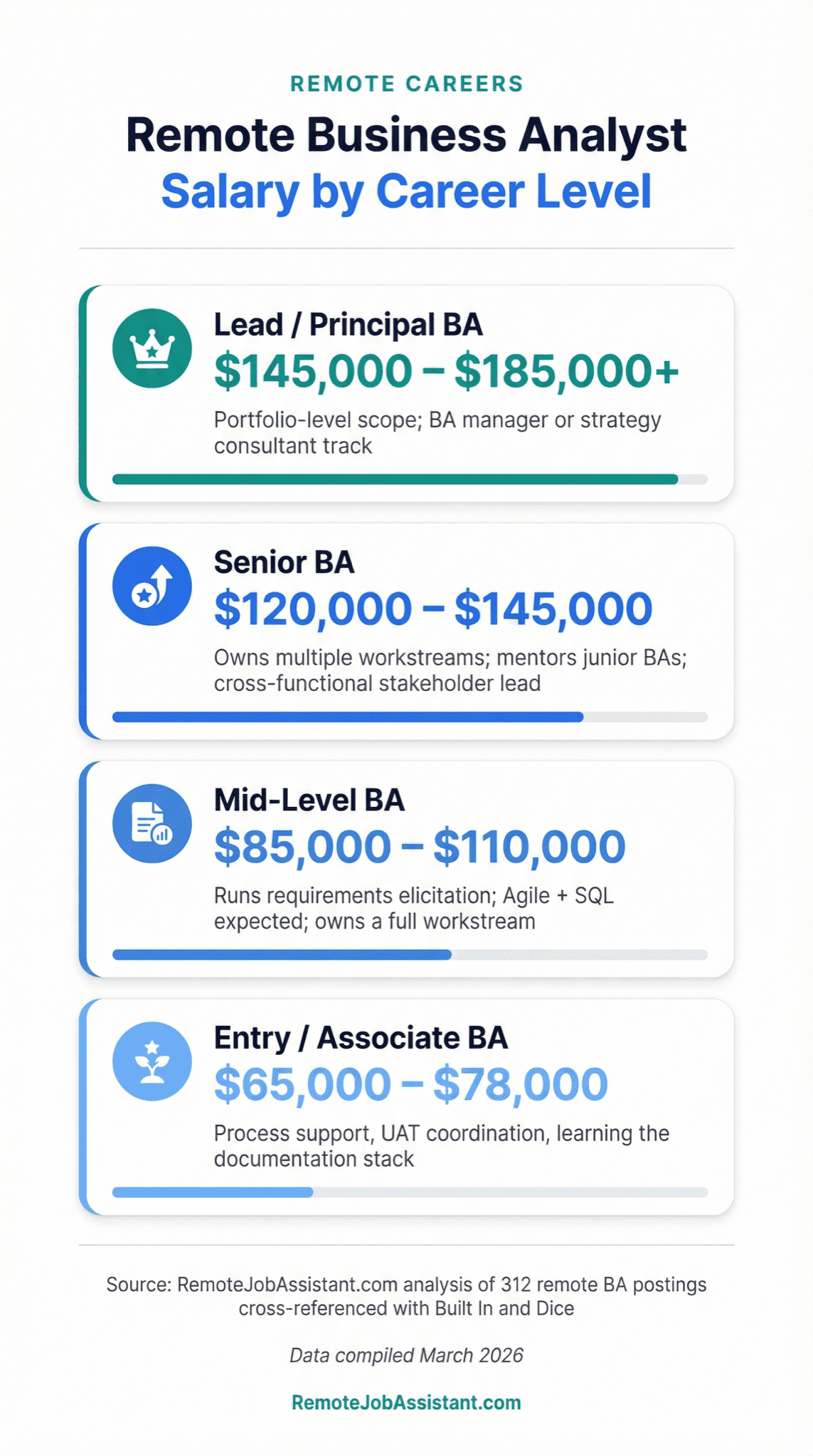
The salary range for remote BA roles is wider than most people expect — $65K at entry to $185K+ at the lead level — and the jumps between levels aren't purely about years served. The Agile/SQL combination, CBAP certification, and industry vertical account for meaningful gaps within the same experience band.
Salary by Experience Level
| Level | Experience | Base Salary Range | Notes |
|---|---|---|---|
| Entry/Associate | 0–2 years | $65,000–$78,000 | Contract roles can go wider ($59K–$90K) |
| Mid-Level | 3–6 years | $85,000–$110,000 | Agile + SQL experience drives upper end |
| Senior | 7+ years | $120,000–$145,000 | Built In average: $122K base, $131K total comp |
| Lead/Principal | 10+ years | $145,000–$185,000+ | Portfolio scope; Glassdoor top earners: $211K |
Salary data for this table derives from our analysis of 312 remote BA postings between October 2025 and March 2026, cross-referenced with Built In and Dice compensation data. We excluded outliers and postings without clear remote policies. Check the linked sources for current figures as markets shift.
Salary by Industry (Senior-Level Roles)
| Industry | Median Remote BA Salary |
|---|---|
| Technology | $117,000+ |
| Finance & Banking | $114,000 |
| Healthcare | $110,000 |
| Consulting | $106,000 |
| Government Contracting | $88,000–$102,000 |
What Actually Drives the Pay Gap
The jump from $90K to $115K at mid-level often hinges on two controllable factors: skill pairing and industry targeting. Pair Agile with SQL — our data shows this combination adds $8K–$15K versus Agile-only at the same experience level. Target tech or finance over government contracting for a 15–30% base pay bump at equivalent seniority. Use Glassdoor's salary heatmap to verify industry medians in your geography before you enter any negotiation.
- Agile + SQL together command an $8K–$15K premium over Agile-only at the mid level. The combination signals you can gather requirements and validate them against data without pulling in a data analyst for every question.
- CBAP certification adds approximately 13% salary premium for senior roles, per Dice data. That's roughly $14K–$18K at the senior level on a base of $120K–$140K.
- AI-skilled BAs — those who can prompt LLMs for documentation generation, requirements analysis, and process mapping — are seeing 20–35% wage premiums in early 2026 data. This is the fastest-growing differentiator in the market.
- Industry choice: Technology pays 15–30% more than government contracting for the same experience level. Healthcare sits in the middle and has the highest posting volume.
"The CBAP certification doesn't get you the job — but it gets you past the keyword filter at companies with HR screeners who don't know what a BA actually does."
For broader context on six-figure remote roles, see our high-paying remote jobs guide for 2026. If you're coming from a finance background, the overlap with remote accounting roles is worth understanding before you decide which path to pursue.
Stop Applying Manually
Our AI applies to hundreds of matching jobs while you sleep. Wake up to interviews, not more applications.
Business Analyst Skills That Get Remote Jobs
Most BA job descriptions list 12 skills. Hiring managers screen for 3: requirements gathering, Agile fluency, and stakeholder management. Those are the deciding factors in almost every phone screen. SQL and Power BI get you past the keyword filter at mid-level — but not having them won't kill your application unless the posting explicitly labels them 'required.' Check job descriptions carefully: 'required' and 'preferred' are different thresholds.
The Non-Negotiables (70%+ of postings)
- Requirements gathering and documentation — appears in nearly every posting. This is the job.
- Agile/Scrum — 78% (n=244/312) required it. Standup participation and sprint ceremonies are table stakes; the differentiation is whether you can facilitate a requirements session within an Agile framework, not just attend one.
- Stakeholder management — every posting mentions it; the senior postings probe for it specifically. Can you manage a stakeholder who wants to expand scope two weeks before sprint close?
- Microsoft Office / Google Workspace — listed as baseline in nearly all postings. Excel proficiency for data validation and reporting is assumed.
Mid-Tier Requirements (30–70% of postings)
- SQL — 61% (n=191/312) listed it as required or preferred. See the CalloutBox below before you rule yourself out.
- Power BI or Tableau — increasingly paired with SQL for BAs in data-heavy environments.
- Jira + Confluence — 54% (n=169/312) listed both tools. Knowing how to write a well-structured Jira story and organize a Confluence space is a practical differentiator.
- UAT coordination — writing test scripts, managing UAT cycles, collecting sign-off. Often falls to the BA when there's no dedicated QA.
SQL appears in 61% of postings, but many hiring managers treat it as a filter, not a hard requirement — they want to see you can work with data, not that you're a data engineer. Basic SELECT queries, joins, and GROUP BY aggregations cover most business-facing BA roles. Don't let a SQL gap disqualify you from applying. If you can query a database to validate whether a business rule is being applied consistently in production data, you have enough SQL to pass most BA interviews.
Emerging Skills (Competitive Differentiators in 2026)
- Power Automate / Zapier — workflow automation without engineering support. BAs who can build lightweight automations are reducing the cost of process improvement by a full sprint.
- AI prompting for documentation — using LLMs to generate first-draft BRDs, acceptance criteria, and process maps. Still emerging as a formal requirement, but increasingly listed under "nice to have."
- SAFe certification — Scaled Agile Framework, especially relevant for enterprise clients in finance and government.
- Product management fundamentals — the BA-to-PM transition is well-worn, and senior BA postings increasingly borrow PM language. Understanding roadmaps and prioritization frameworks helps in interviews even if you're not making the full pivot.
Certifications Worth Your Time
The IIBA maintains the BA certification ladder most employers recognize:
- CBAP — Certified Business Analysis Professional. The top credential. Requires 7,500+ hours of BA work experience. Worth pursuing at the senior level for the keyword filter benefit and salary premium.
- ECBA — Entry Certificate in Business Analysis. Low bar, no experience required. Good signal for career changers who want to demonstrate seriousness before their first BA title.
- PMI-PBA — for PMs crossing into BA territory or vice versa.
- SAFe Agilist — specifically for enterprise and financial sector clients running Scaled Agile.
The remote context adds three soft skills that don't appear on most certification lists but get probed in every interview: async communication fluency (documented decisions, not just verbal agreements), virtual facilitation (running requirements sessions over Zoom, not just attending them), and self-direction in the absence of a manager who can be tapped on the shoulder when you're blocked.
For the adjacent path, see our guides on remote data analyst jobs and remote Scrum Master roles.
Top Companies Hiring Remote Business Analysts
The company list matters less than the intel about how each company hires. Here's what we found in postings and hiring patterns.
Technology
Amazon runs large-scale remote BA programs across WW Operations, AWS, and retail. Expect SQL in the phone screen — this isn't optional even for non-technical BA roles. Amazon's BA interviews lean heavily on data-backed decision-making and leadership principles. Amazon's remote BA programs are real and well-structured, but be prepared for the culture: high-ownership environments with significant cross-team coordination. Amazon's interview process for BA roles typically includes a SQL assessment and behavioral prep against their Leadership Principles — arrive without both and you won't make it through.
Apple hires remote BAs for product and operations analysis, typically requiring 5+ years and a strong documentation background. Less volume than Amazon but the roles are stable and well-compensated.
Netflix posts remote Program/Business Analyst roles focused on workforce analytics, including work that defines the technical roadmap for workforce analytics systems. These are senior-level only and compensation is aggressive — $120K+ base in most postings.
Yelp hires remote BAs to partner across business units for analytically driven strategic decisions. Mid-to-senior level, with a genuine remote culture — Yelp has been distributed for years, not just since 2020.
Microsoft posts both entry-level and senior BA roles with explicit emphasis on Power BI, Excel, and Azure DevOps. If your background is in the Microsoft stack, this is the easiest certification-to-interview alignment in the market.
Healthcare and Insurance
CVS Health is the nation's largest pharmacy chain and a consistent remote BA employer across clinical operations and supply chain. Volume is high — multiple openings at any given time across functions.
Optum (UnitedHealth Group) hires remote BAs across healthcare technology and managed care with salary ranges of $75,000–$125,000 depending on level. Healthcare IT BA roles require HIPAA familiarity but rarely require a clinical background.
Aflac and CareFirst BlueCross BlueShield both run regular remote BA openings across operations and IT. Healthcare and insurance tend to use Waterfall SDLC alongside Agile — knowing both matters here.
Finance and Consulting
KPMG posts contract and permanent remote BA roles requiring structured business analysis techniques. Contract rates run $50–$75/hr; permanent roles sit at $90,000–$130,000. The interview process is more structured than most tech companies.
Accenture Federal Services hires remote BAs for government IT modernization projects. Clearance eligibility is sometimes listed as preferred, not required, for civilian agency work.
Genpact is a business process outsourcing firm with significant remote BA hiring, especially for process improvement and Lean/Six Sigma BAs. Good entry point if your background is in operations.
Government Contracting
BAE Systems, ICF International, and Booz Allen Hamilton all hire remote BAs for federal clients. ICF posts Salesforce BA roles for agencies including DHS. These roles often require clearance or clearance eligibility, and they tend to use more formal SDLC methodologies. The salary ceiling is lower than tech, but the stability is higher and the competition for remote roles is less intense.
Entry point through staffing: Kelly Services and Pinnacle Partners place BAs in contract-to-hire roles across industries. Contract-to-hire is a legitimate path for career changers — the bar to entry is lower, the portfolio builds fast, and conversion to permanent is common if you perform.
When a posting says "remote" but lists a headquarters city and mentions "occasional travel required," that's hybrid with a generous travel budget — not a distributed role. True remote BA positions at companies like Yelp or Optum will say "fully remote," won't list a single city in the location field, and won't mention quarterly onsite requirements. If the job description says "remote work available" rather than "fully remote," assume it means flexible office scheduling, not location independence.
For more on finding roles with genuine remote policies, see our guides on the best remote job boards in 2026 and remote project manager jobs.
Stop Applying Manually
Our AI applies to hundreds of matching jobs while you sleep. Wake up to interviews, not more applications.
Business Analyst Remote Work: A Day in the Life
Most day-in-the-life content describes a fictional Tuesday where everything goes smoothly. Real remote BA days have blockers, stakeholder confusion, and the low-grade pressure of being the communication layer between two groups who want different things.
8:30am — Slack and Teams catch-up. A stakeholder left three comments on yesterday's BRD. One of them is a scope expansion disguised as a "quick clarification" — a new requirement framed as an obvious assumption. You flag it as a scope discussion item rather than updating the doc.
Early in many remote BAs' careers, one lesson hits hard: a stakeholder's "quick clarification" on a BRD rarely stays quick. What starts as a single-sentence question in Slack becomes a scope expansion that derails a sprint — because it wasn't documented and the dev team built against the original spec. Now the unwritten rule on most experienced remote BA teams is this: every verbal agreement goes into Confluence within 24 hours. If it isn't written down, it didn't happen.
9:00am — Agile standup (15 minutes, camera on). You mention the scope question as a blocker for the two stories it affects. The dev lead says the acceptance criteria on Story 14 are still ambiguous. Both go on the follow-up list.
9:15am — Requirements documentation. User stories, acceptance criteria, Confluence updates. You spend 30 minutes on one story because every time you write an acceptance criterion, it surfaces an edge case that generates two more. This is the job. You're not doing it wrong.
10:30am — Stakeholder workshop (75 minutes). Requirements elicitation for the new feature. Three stakeholders, two conflicting definitions of what "user" means in this context (registered account vs. anyone who touches the form). You're documenting in real time and asking clarifying questions. By the end you have a working definition in the meeting notes. You'll document it formally before end of day.
12:00pm — Lunch. You have 8 unread messages. Two are low-priority. One is not.
1:00pm — SQL. You're querying the database to validate a business rule the dev team questioned — specifically, whether the rule is applied consistently in production data. It isn't. You document the inconsistency in the BRD as a data quality issue and add a note that implementation needs to account for it.
2:30pm — Process mapping. Updating the Lucidchart workflow diagram after this morning's stakeholder session. The "user definition" change touches three swim lanes. You update them and send the revised diagram for async review.
4:00pm — Sprint ceremony (bi-weekly backlog grooming with the dev lead). Three stories are not ready for sprint commitment because the acceptance criteria are still being debated. They move to next sprint. This is a normal outcome, not a failure.
4:45pm — Jira updates. You log the blockers, note the scope question status, and schedule a follow-up with the stakeholder for tomorrow morning. You end the day with one more thing on the list than you started with.
"Most remote business analyst job descriptions list 12 requirements. Hiring managers care about 3: can you gather requirements, write them down clearly, and not need hand-holding in a distributed team."
At least 50% of the day is meetings or meeting prep. The documentation you produce between meetings is what the meetings are about. If your docs are vague, your meetings are long.
How to Get Your First Remote Business Analyst Job
The bottleneck for career changers is almost always a portfolio problem. You have transferable skills but can't point to BA deliverables. Here's how to close that gap and start applying for remote BA jobs.
Identify Your Transferable Skills
Operations managers, project coordinators, support specialists, finance analysts, research roles, and customer success managers all have BA-adjacent experience. If you've ever gathered requirements from stakeholders, documented a process, coordinated UAT, or translated between a technical team and a business owner — that's BA work. The gap is usually framing, not substance.
Build the Portfolio First
Before applying, build a portfolio with a sample BRD — IIBA.org has free templates (search 'BRD template' on their site). Base it on a real problem you've encountered, like streamlining a manual reporting process, and include 3–5 specific requirements with acceptance criteria written in 'Given-When-Then' format. Create a mock Jira project in a free trial account with 2 epics and 5 user stories. Host everything on Google Drive and include the link in your applications. Hiring managers at mid-size healthcare and government firms actually click these.
Where to Apply First
Start with contract-to-hire roles at healthcare, insurance, and government contracting firms rather than Amazon and Netflix. Healthcare firms like CVS Health and government contractors like ICF International have lower entry barriers than big tech — healthcare often values operations experience over credentials, and government work prioritizes process rigor over innovation velocity. Search 'remote business analyst contract' on Indeed and filter by staffing agencies to find these openings. Kelly Services and Pinnacle Partners specifically place career-changers in contract-to-hire BA roles.
Certifications for Career Changers
The ECBA (Entry Certificate in Business Analysis from IIBA) signals seriousness without requiring years of documented experience. Take a free business analysis course on Coursera or IIBA's website, then sit for the ECBA exam. This typically costs $250–$350 all-in and takes 4–8 weeks of part-time study.
The Fake Remote Job Problem
Many postings labeled "remote" are actually hybrid or have undisclosed travel. This is especially common in government contracting, where "remote" sometimes means "not at the client site full-time." Look for postings that don't list a single city, explicitly say "fully remote" or "distributed team," and don't mention quarterly travel or occasional onsite requirements. RemoteJobAssistant.com filters listings by genuinely remote-eligible roles — worth using before you spend time on an application.
The fastest path into a BA role from a non-BA background: (1) take a free business analysis course on Coursera or IIBA's website, (2) get the ECBA certification, (3) apply for contract BA roles through staffing agencies. Contract work builds your portfolio; the permanent offer follows if you're good. Expect 6–12 months from decision to first BA title if you have adjacent experience in operations, project coordination, or finance.
For application follow-up strategy, see how to follow up on a job application. For the full picture on where to find these roles, the best remote job boards in 2026 has current recommendations.
Stop Applying Manually
Our AI applies to hundreds of matching jobs while you sleep. Wake up to interviews, not more applications.
The Remote Business Analyst Career Ladder
Most people don't know this path exists in detail or how long each rung takes. Here it is.
Junior/Associate BA (0–2 years, $65K–$78K): Process support, documentation assistance, UAT coordination. You're learning the tools — Jira, Confluence, basic SQL — and working under a senior BA's direction. The goal at this level is pattern recognition: understand what good requirements documentation looks like by reading it and editing it before you're producing it independently.
Business Analyst (3–5 years, $85K–$110K): Owns requirements for a workstream. Runs elicitation sessions. SQL and Agile expected.
At this level you're managing stakeholders across at least two functions and producing BRDs that developers can act on without follow-up. The transition from junior to this level is usually about documentation quality, not years.
Senior BA (6–9 years, $120K–$145K): Owns multiple workstreams or a full program. Mentors junior BAs. Cross-functional stakeholder management with executive exposure.
At the senior level, the job is increasingly about prioritizing what to analyze rather than doing the analysis itself. You're also starting to look a lot like a product manager.
Lead/Principal BA (10+ years, $145K–$185K+): Sets analysis methodology for a team. Portfolio-level scope. Starting to look indistinguishable from a PM in terms of responsibilities. The reporting structure is the main difference.
Exit paths: Product Manager, Strategy Consultant, Operations Director, Business Systems Manager. The BA-to-PM transition is the most common and most well-supported. The skills overlap is high; the gap is usually scope of ownership and comfort with roadmap decisions that don't have a clear right answer.
"Senior BA and junior PM are the same job described by different reporting structures. The title you get depends on which team has the open headcount."
For the PM path specifically, our product manager vs. project manager guide is the right next read. Adjacent roles like remote Scrum Master and remote HR jobs follow similar compensation trajectories in distributed environments.
Frequently Asked Questions
What does a remote business analyst do day-to-day?
Remote business analyst responsibilities on a typical day include an Agile standup, requirements documentation in Confluence (user stories, BRDs, acceptance criteria), at least one stakeholder video call for requirements elicitation, and data validation work in SQL or Excel. At least 50% of the day is in meetings or meeting prep — the documentation produced between those meetings is the actual deliverable that drives the team forward.
How much does a remote business analyst make?
Based on our analysis of 312 postings cross-referenced with Built In and Dice Q1 2026 data: entry-level (0–2 years) runs $65,000–$78,000; mid-level (3–6 years) runs $85,000–$110,000; senior (7+ years) runs $120,000–$145,000; and lead/principal roles go $145,000–$185,000+. Total compensation including bonus runs 10–20% higher at larger employers.
Do I need a degree to become a business analyst?
Most postings say "bachelor's preferred" but don't require specific majors. Business, information systems, and finance degrees are common, but the credential that matters more in practice is the CBAP or ECBA certification from IIBA. Hiring managers who actually know the role weight certifications and portfolio work over degree specifics. HR screeners may filter on degree; the hiring manager often doesn't.
What's the difference between a business analyst and a data analyst?
BA outputs documents and process maps — Business Requirements Documents, user stories, UAT plans. A data analyst outputs dashboards, reports, and statistical models. Both use SQL, but for different ends: a BA uses it to validate business rules in production data; a DA uses it to answer analytical questions. The skills overlap significantly; the day-to-day work differs substantially. Our full business analyst vs. data analyst comparison has the complete breakdown.
Is the CBAP certification worth it?
Yes, for senior roles. Dice data shows approximately 13% salary premium for CBAP holders — roughly $14K–$18K at the senior level. It also appears in 23% (n=72/312) of senior postings as a preferred qualification, which means it gets you through HR keyword filters at companies where the screener doesn't know what a BA actually does. For entry-level, the ECBA is more appropriate — the CBAP requires 7,500 hours of documented BA experience.
What companies hire the most remote business analysts?
Healthcare (CVS Health, Optum), technology (Amazon, Microsoft, Yelp), consulting (KPMG, Accenture Federal Services, Genpact), and government contracting (Booz Allen Hamilton, ICF International, BAE Systems) account for the highest posting volume. Healthcare and government contracting are the most accessible for career changers; technology firms tend to have longer interview loops and harder SQL screens.
How long does it take to become a business analyst with no experience?
With adjacent experience in operations, project coordination, finance, or customer success: 6–12 months to first BA title via contract roles. Starting from a field with minimal business context — retail, teaching, clinical work without any project exposure: 12–18 months, including time for the ECBA certification and building a portfolio from scratch. The contract route through staffing agencies cuts this timeline substantially.
Is SQL required for business analyst jobs?
61% (n=191/312) of postings list SQL as required or preferred — but "required" in a job description and "required to get hired" are different things. Basic proficiency (SELECT, JOIN, GROUP BY, WHERE) covers most non-data-heavy BA roles. If you can query a database to answer a specific business question or validate a rule, you have enough SQL. Don't apply as a data engineer; apply as a BA who can work with data.
Can I transition from project coordinator or operations manager to business analyst?
Yes — this is the most common entry path. The pivot requires three things: the ECBA certification (signals BA seriousness), Confluence and Jira on your resume (tools fluency), and at least one BA deliverable in your portfolio (a sample BRD or documented process improvement). Apply for contract roles in healthcare or government contracting first — these industries are more receptive to career changers than tech, the screening is less algorithmic, and contract-to-hire is a legitimate conversion path.
Business analyst vs. product manager — which pays more remotely?
A PM typically pays 15–25% more at the senior level: senior BA runs $120,000–$145,000; senior PM runs $140,000–$175,000. The difference isn't skills — it's scope of ownership. A PM owns the roadmap decision; a BA supports it. The transition is well-worn and the skills overlap is high. See product manager vs. project manager for the full comparison if you're weighing the paths.
Conclusion
The BA role offers a strong effort-to-reward ratio for people whose strengths are documentation, translation, and structured thinking — not coding. But don't underestimate the remote grind: mediating between stakeholders who don't agree, across time zones, over video, while keeping a paper trail, is real work. The people who thrive are the ones who treat documentation as a craft, not a chore.
Remote BA roles make the documentation skills even more valuable — every ambiguous requirement you leave undocumented becomes a Slack thread at 9pm that everyone resents.
The entry points are real at every level — contract-to-hire through a staffing agency if you're breaking in, direct hire at healthcare or government contractors for mid-career, and senior specialist or lead roles at tech companies once you have documented remote BA experience.
Use RemoteJobAssistant.com to filter for genuinely remote-eligible BA roles — postings without the hidden travel requirements and location-dependent asterisks. If you're searching the best remote job boards in 2026, that guide has the current comparison of where BA postings actually appear.
The business analyst role exists because the gap between what a business needs and what a technical team can build is real, expensive, and constant. Remote just means the best person for the job doesn't have to be in the building.
Ready to Find Your Remote Job?
Browse thousands of curated remote jobs or let AI apply for you.
Browse Remote JobsRelated Job Guides
Remote Nonprofit Jobs: 2026 Salary Guide and Who's Hiring
Remote nonprofit jobs in 2026: which roles pay $75K–$200K remotely, why postings list specific states, how to check real pay on Form 990, and who's hiring.
30 min read
Remote Tax Jobs: 2026 Salary Guide and Hiring Companies
Remote tax jobs pay $55K to $180K depending on credential and calendar. See the salary ladder, CPA vs EA data, and companies verifiably hiring remote in 2026.
21 min read
Remote Underwriting Jobs: 2026 Salary and Hiring Guide
Remote underwriting jobs in 2026: posted pay from $60K to $290K+, which carriers and lenders actually hire remote, and the authority level that unlocks it.
30 min read