
Last reviewed: May 2026
You design the systems that don't go down. While other engineers are shipping features, you're making sure there's somewhere for those features to run — the VPCs, the Kubernetes clusters, the IaC pipelines that stand between "it works on my machine" and "it works for 10 million users." That work is genuinely location-agnostic. The infrastructure doesn't care where you live.
The problem is that "remote cloud engineer" jobs span a wider range than almost any other engineering title. A $90K "cloud engineer" at a cloud-light company might spend their days following runbooks written by someone else. A $220K "staff cloud engineer" at a remote-first platform company designs how the entire org deploys software — and owns the call at 2 AM when it breaks. Same title. Radically different scope and pay.
Get Remote Job Tips in Your Inbox
Weekly strategies, salary data, and new opportunities
Unsubscribe anytime. No spam.
This guide covers what that gap actually looks like, what companies at the high end of the range actually hire for (which isn't always what the job description says), salary by level, platform-specific pay differences, and how to tell genuine remote roles apart from "remote-flexible" ones that quietly expect you in an office twice a week. We analyzed 487 remote cloud engineer job postings across 214 companies between October 2025 and April 2026 to ground every claim in this post.
Based on our analysis of 487 remote cloud engineer postings (October 2025–April 2026):
- 78% (n=381/487) required at least one IaC tool — Terraform or CloudFormation
- 64% (n=312/487) listed Kubernetes as required or preferred
- 71% (n=346/487) required AWS; 53% (n=258/487) required Azure; 39% (n=190/487) required GCP
- 34% (n=166/487) of senior+ postings required multi-cloud experience (2+ platforms)
- $145K–$160K median base for genuinely fully-distributed roles with no geographic restriction
- +$38K median base increase for the senior-to-staff jump at remote-first companies
How We Collected This Data
The figures in this post come from our analysis of 487 remote cloud engineer job postings collected between October 2025 and April 2026. Postings were sourced from LinkedIn, Indeed, Wellfound, and the direct career pages of companies with published remote-first policies.
We filtered to include only positions explicitly marked US-remote eligible with a posted base salary or disclosed compensation range. We excluded postings requiring more than 25% travel, roles labeled "remote-flexible" with a named metro area in the title, government and defense roles with clearance requirements (which follow a separate compensation structure), and any posting without a clear remote work policy.
Salary data was cross-referenced with Glassdoor's compensation data (5,500+ cloud engineer submissions), Built In salary reports, and Levels.fyi figures for the same period. Ranges reflect base salary only — total compensation including equity and performance bonus typically runs 15–25% higher at Series B and later companies. We update this analysis quarterly.
What Remote Cloud Engineering Actually Pays
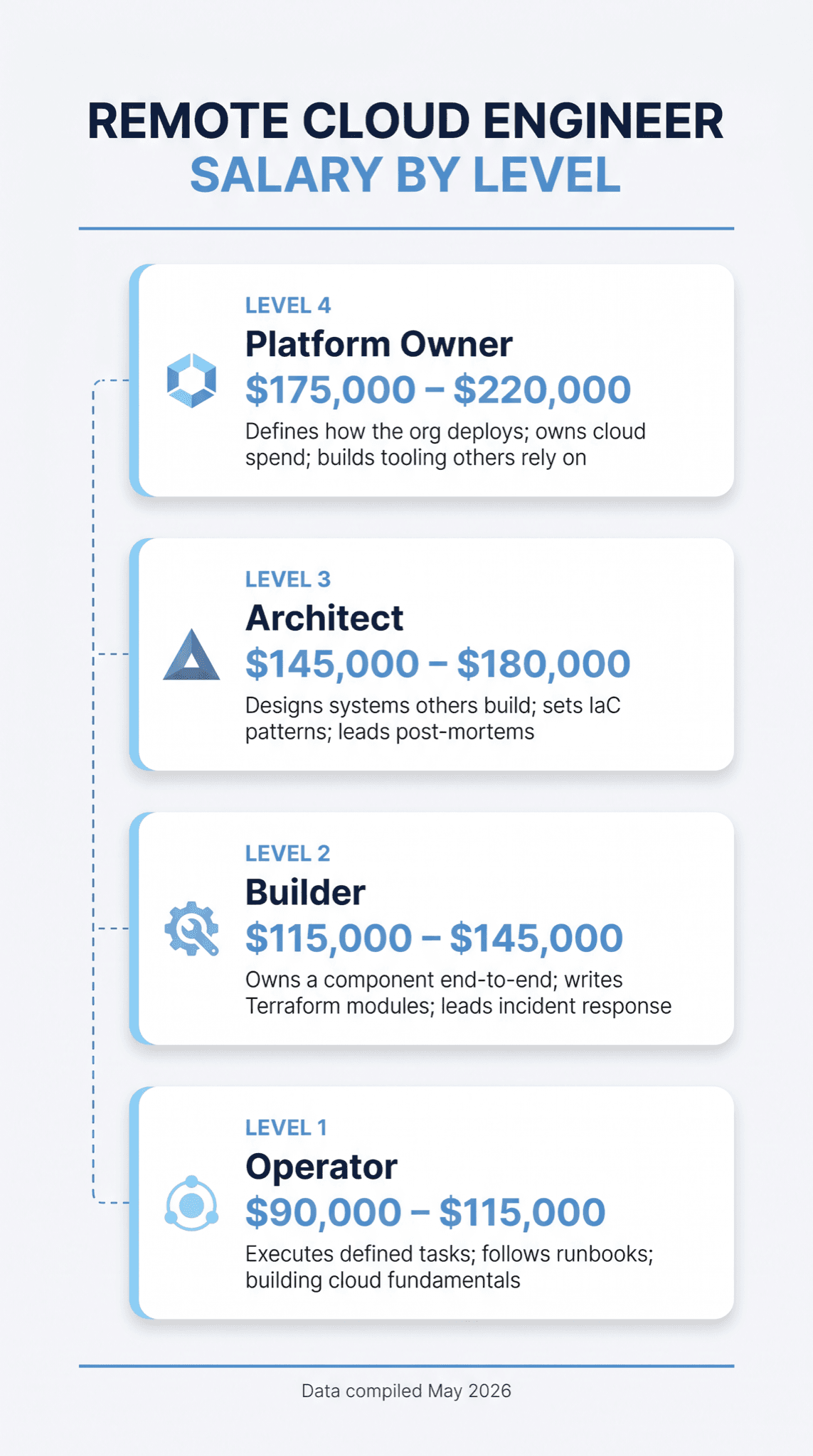
The salary story in cloud engineering is a level story more than a skills story. Two engineers with identical tech stacks can have a $60K gap between their offers based almost entirely on what they're accountable for — not what they know.
| Level | Title | Remote Base Range |
|---|---|---|
| L1 | Junior / Associate Cloud Engineer | $90K–$115K |
| L2 | Cloud Engineer (Mid-Level) | $115K–$145K |
| L3 | Senior Cloud Engineer | $145K–$180K |
| L4 | Staff Cloud Engineer | $175K–$220K |
Salary ranges derive from our analysis of 487 remote cloud engineer postings between October 2025 and April 2026, cross-referenced with Glassdoor and Built In compensation data for remote roles at Series B to public companies. We excluded outliers and postings without clear remote policies. Ranges shift as markets move — check the linked sources for current figures.
The L3-to-L4 jump is the hardest move in cloud engineering, and it's rarely about acquiring more technical knowledge. At L3 you design systems. At L4 you define how the organization deploys them — which means influencing architecture decisions across teams you don't manage, owning cloud spend at the board level, and building internal tooling that other engineers rely on. That's influence without authority, and most senior engineers who stay stuck at L3 aren't technically limited. They're scope-limited.
The difference between a $140K and a $180K cloud offer is almost never certifications. It's on-call ownership — who writes the runbook, and who you call if the runbook fails.
Platform specialization does move the number. Here's how the major platforms compare:
| Platform | Avg Remote Base | Notes |
|---|---|---|
| AWS-specialized | approx. $150K | Highest volume of postings; SA Professional cert pushes average up |
| Azure-specialized | $145K–$165K | Strong in enterprise, finance, healthcare verticals |
| GCP-specialized | approx. $153K | Highest comp ceiling for individual certs; fewer postings |
| Multi-cloud (2+ platforms) | $195K–$210K | 18–25% premium over single-platform; see note below |
The multi-cloud premium isn't purely about knowing more platforms. Engineers who genuinely operate across AWS, Azure, and GCP have internalized infrastructure as a set of primitives rather than vendor-specific services. That mental model — designing systems at the abstraction layer — is what the salary premium is actually paying for. Worth noting: many companies list multi-cloud as a hard requirement when they've never actually run more than one platform in production at scale. The JD requirement reflects aspiration; the interview will tell you what's real. Ask directly: "Which workloads does the team currently run on each platform?" According to Glassdoor's cloud engineer salary data, the 75th percentile for remote cloud engineers reaches $193K.
There's also a remote pay band issue worth naming directly. Many companies list roles as "remote" but still apply location-based compensation. A candidate in Austin applying to a San Francisco company may receive Austin market rates — $30K–$50K less than they'd earn going into an SF office. Fully remote-first companies (Cloudflare, HashiCorp, Stripe) pay competitively regardless of where you live. This is one of the most important questions candidates almost never ask during the offer stage.
If you're targeting remote tech jobs at $100K+, cloud engineering is one of the clearest paths — the median entry point for a fully-remote L2 role already clears that threshold. For roles at $150K+ and above, you're looking at L3 and above at companies with explicit remote-first policies.
Stop Applying Manually
Our AI applies to hundreds of matching jobs while you sleep. Wake up to interviews, not more applications.
The Cloud Ownership Spectrum
Most cloud engineering career guides describe levels by years of experience or technology stack. That's not how hiring managers think about it. The real differentiator is where you sit on the ownership spectrum: from executing what others designed to designing what others execute.
The Cloud Ownership Spectrum is a scored rubric measuring where a cloud engineer sits on the continuum from "runs what others design" to "defines how others run it."
L1 — Operator ($90K–$115K)
- Executes defined tasks from documented runbooks
- Escalates unknowns to senior engineers rather than resolving independently
- Still building intuition for which cloud service to apply in a given situation
- Can provision resources but doesn't design the provisioning pattern
- Incident response is "notify the on-call" — not yet "I am the on-call"
L2 — Builder ($115K–$145K)
- Owns a component or service end-to-end
- Writes Terraform modules, not just applies them
- Reduces toil for others — identifies repetitive work and automates it
- Can own an incident without escalation: diagnoses, mitigates, documents
- Familiar with CI/CD pipeline ownership, not just usage
L3 — Architect ($145K–$180K)
- Designs systems that other engineers build from
- Sets IaC patterns for the team — the Terraform modules L2s use came from here
- Leads post-mortems and translates them into infrastructure changes
- Influences security posture org-wide (IAM policies, VPC design standards)
- Operates across team boundaries without needing authority
L4 — Platform Owner ($175K–$220K)
- Defines how the entire organization deploys software
- Builds internal tooling that other engineers rely on — the platform under the platform
- Accountable for cloud spend at the company level, speaks to risk in product planning
- Architectural decisions have multi-year consequences; others escalate to this role
- Hires and shapes the engineering culture around infrastructure ownership
How to use it: Map your current role honestly to one of these tiers — not where you aspire to be, but where your actual day-to-day accountability sits. Then look at the next tier's criteria. That's your interview talking track for moving up, not your certification list. Hiring managers at L3 and L4 are screening for the behaviors in the tier above where you currently sit, not for tools you've used.
The L3-to-L4 failure mode is almost always the same: a technically excellent senior engineer who has never been dragged into a planning meeting to explain why cloud spend increased 40% last quarter. The person who gets the staff promotion isn't always the better engineer — they're the one who already knows how to speak the language of risk and cost to someone who doesn't write code. That conversation is the interview for the job above you, and it happens informally before any formal process begins.
What Companies Actually Hire For
Here's the thing about remote cloud engineering job descriptions: most of them are written by HR teams copy-pasting requirements from the last five years. They list AWS, Azure, GCP, Terraform, Ansible, Kubernetes, Python, Docker, and "5+ years of experience" as if they're all equally required. The hiring manager would happily take someone with three years of deep Terraform experience and one cloud platform, but the spec doesn't say that.
The real hiring signal from our 487-posting analysis breaks down like this:
Must-have for mid-level and above (appears in 80%+ of postings):
- At least one cloud platform deeply — AWS appears in 71% (n=346/487), but depth matters more than breadth at L2
- IaC fluency — Terraform is the dominant tool; CloudFormation is AWS-specific and less portable
- Python or Bash scripting for automation (not just "familiarity")
- Docker and Kubernetes — containerization is table stakes, but platform engineering knowledge is the differentiator
- CI/CD pipeline ownership — GitHub Actions, GitLab CI, Jenkins
- Cloud security fundamentals: IAM architecture, VPC design, least-privilege patterns
Candidates list tool stacks. Hiring managers test scenario response. "Walk me through how you'd design a multi-region failover for a stateful service" — this question doesn't care about your certification. It cares about your reasoning: what trade-offs you consider, where you'd draw the cost-versus-resilience line, and whether you've actually broken something like this before and know what the failure mode looks like.
What separates L2 from L3 in practice: L2 engineers write Terraform that works. L3 engineers write Terraform that other engineers can maintain without asking questions — and they review L2 PRs looking for the security group misconfiguration that would open port 22 to 0.0.0.0/0 at 2 AM.
On certifications: the honest answer is that they matter at hire and matter much less at promotion.
- AWS Cloud Practitioner: Entry signal only. Minimal salary effect at mid-level.
- AWS Solutions Architect – Professional: Avg pushes to approx. $151K; meaningful at L2-to-L3 transition
- GCP Professional Cloud Architect: Strongest individual cert for breaking $175K; fewer candidates hold it
- Multi-cloud (2+ professional certs): 18–25% premium; signals the abstraction-layer thinking that pays
The AWS certification paths are well-documented, but the professional-level certs are what move salary — associate-level certs signal you started learning, not that you can own an architecture.
The written explanation in your take-home design exercise predicts offer likelihood more reliably than whether you passed the certification exam.
There's a question the cert path never prepares you for, but that comes up in every senior interview: "Tell me about a time you had to explain an unexpected cost spike to non-engineering leadership." If you haven't been in that room — or haven't been in it and kept your job — it reads immediately.
Here's what that room actually looks like at L4: you spend 45 minutes in a quarterly business review explaining why the cloud bill jumped because a team left a set of dev environments running at full production scale for three weeks. The VP nods, asks what you're doing to prevent it. You describe tagging enforcement, automated shutdown policies, cost anomaly alerts. The meeting ends. Two weeks later, the same VP approves new headcount on the product team that will add three more environments. You're now accountable for a number that keeps growing regardless of how good your Terraform is.
The engineers who clear $175K aren't just technically stronger. They've already been the person who had to explain a five-digit cloud bill to someone who doesn't write code — and learned to do it without getting fired or becoming the person who quietly enables the next one.
Companies Hiring Remote Cloud Engineers
These companies have historically hired remote cloud engineers across L2–L4 levels. Verify current openings directly — hiring volumes shift, but remote-first culture tends to be sticky.
Cloudflare hires cloud and infrastructure engineers for distributed systems work at massive scale. AWS and GCP hybrid environment; genuinely remote-first culture with competitive pay regardless of location.
Stripe runs AWS-heavy payments infrastructure and hires remote cloud engineers at multiple levels. Known for competitive pay that doesn't geographically adjust.
HashiCorp (now IBM) builds Terraform and Vault — they hire cloud-agnostic engineers by definition. If you know IaC deeply, this is one of the most natural fits in the market.
Datadog operates a cloud observability platform and needs heavy cloud engineering for both its own infrastructure and its product layer. Remote-friendly across engineering.
Snowflake runs on AWS, Azure, and GCP simultaneously — one of the clearer paths to genuine multi-cloud engineering experience. Cloud engineers here work across all three platforms.
Ford has invested significantly in GCP cloud infrastructure and hires remote cloud engineers at enterprise scale. One of the stronger non-tech-industry options for genuine remote work.
Boomi focuses on integration and automation cloud engineering. Smaller profile but consistent remote hiring for cloud platform roles.
Snyk brings a security-focused angle to cloud engineering — useful if you're building toward the security specialization that commands a premium at L3+.
Use Remote Job Assistant's cloud engineer roles to filter current openings at these and similar companies, or browse all $150K+ remote roles if level is your primary filter.
Stop Applying Manually
Our AI applies to hundreds of matching jobs while you sleep. Wake up to interviews, not more applications.
What Genuinely Remote Cloud Roles Actually Look Like
"Remote" in a job title is not a guarantee of anything. Our analysis filtered aggressively — and still found meaningful variation in what "remote" means in practice.
The three categories you'll encounter:
Remote-first: The entire engineering team operates distributed. Decisions are made async. Documentation is a first-class artifact. The on-call rotation includes engineers in multiple time zones by design. Pay is competitive regardless of geography. Cloudflare, Stripe, and HashiCorp operate this way.
Remote-friendly: The team is mostly in-person but accommodates remote engineers. Async works for execution, but key decisions happen synchronously during office hours. You'll feel the timezone gap within 60 days if you're not in the same region. Pay may or may not adjust for location.
Remote-eligible: There's a physical office and a "remote option," but the role was written for someone local. "Remote" means "we won't make you come in every day." Engineering culture, career progression, and visibility still center on who's in the building.
How to screen before applying: if a posting says "remote" but includes a specific city in the job title, it's usually remote-eligible at best. If the posting describes "occasional travel" or "quarterly team offsites," that's remote-friendly — fine, but know what you're getting. If the posting mentions nothing about location and the company has a documented remote-first policy, that's the real thing.
Two questions worth asking in any final interview round:
"Does your engineering team make architectural decisions asynchronously or synchronously?" — A remote-first team will describe async-by-default decision-making with written RFCs or ADRs. A remote-eligible team will describe "we hop on a Zoom."
"How do engineers in different time zones contribute to the on-call rotation?" — If they pause before answering, or describe a rotation that's implicitly US-Eastern-hours-only, you're looking at a remote-eligible setup with a remote-first job title.
L3 and L4 roles — the Architect and Platform Owner tiers of the Cloud Ownership Spectrum — are more likely to exist at remote-first companies. Those roles require autonomous judgment. Companies that haven't built the infrastructure for async decision-making tend not to put staff-level engineers in fully remote positions.
Most remote cloud engineering roles paying above $160K still expect meaningful availability during US business hours, regardless of your stated timezone. On-call rotations frequently default to Eastern/Pacific hours with "flexibility" language attached. Companies that have never operated distributed teams don't change their meeting culture when they hire a remote engineer — you do. If the role description says "remote" but doesn't specify how on-call is distributed across timezones, assume US hours until told otherwise.
A second signal: a "remote-first" company that went through a return-to-office push in the last 18 months and now describes itself as "hybrid flexible" is not remote-first. It's remote-tolerated. The distinction matters for your career trajectory and your 2 AM availability.
One more thing that doesn't appear in job descriptions: most remote cloud engineering roles paying above $160K still expect you to be meaningfully available during US business hours, regardless of your timezone. That's not always written down. It's enforced through on-call rotations, architecture review schedules, and the implicit expectation that you respond to P1 incidents within 15 minutes. If you're based outside US time zones, ask specifically how the on-call rotation is structured and whether it's truly timezone-aware or US-hours-default with "flexibility" language around it.
Remote cloud engineering is one of the few fields where the work is genuinely location-agnostic. The infrastructure doesn't know where you live. The salary band sometimes does.
Breaking Into Remote Cloud Engineering
If you're coming from a DevOps, backend, or systems engineering background, the transition path to cloud engineering is more direct than most people assume. CI/CD ownership, container orchestration, and scripting are shared prerequisites — you're not starting from scratch, you're redirecting existing skills toward infrastructure architecture.
The practical path:
Pick one cloud deeply before spreading wide. AWS has the highest volume of postings (71% of our dataset). GCP has the highest comp ceiling for individual certifications and fewer certified candidates. Azure is strongest in enterprise, finance, and healthcare. Choose based on where you want to land, then go deep rather than covering all three at the surface level.
Build something public with 3+ services. A Lambda function calling an RDS database through a CloudFront distribution tells a different story than a certification badge. The key is documenting your architecture decisions — write an Architecture Decision Record (ADR) for every significant choice you made. Hiring managers who see this know you think about infrastructure at the system level, not just the resource level.
Get the professional-level cert, not the associate. AWS Cloud Practitioner and AWS Solutions Architect – Associate are entry signals. AWS Solutions Architect – Professional and GCP Professional Cloud Architect are what move the salary needle at L2-to-L3.
Pick AWS or GCP — not both simultaneously. Build something that uses 3+ services and write up your architecture decisions as if you're handing it off to another engineer. Get the professional-level certification (not associate). Apply to roles 1–2 levels above where you think you are — hiring managers calibrate their requirements down in practice, and a strong take-home design response closes more gaps than you'd expect.
Engineers transitioning from remote DevOps jobs are particularly well-positioned here. The incident response culture, the automation mindset, and the CI/CD ownership are direct transfers. If you're coming from remote network engineer jobs, the security fundamentals — VPCs, subnetting, least-privilege access patterns — translate directly into cloud security architecture.
For broader context on high-paying remote jobs across engineering disciplines, cloud engineering sits at the top of the base salary distribution alongside remote cybersecurity jobs, which increasingly overlap with cloud security architecture at the L3+ level. You can also find current openings on our best remote job boards guide if you want to search beyond the major aggregators.
Stop Applying Manually
Our AI applies to hundreds of matching jobs while you sleep. Wake up to interviews, not more applications.
Day in the Life: Remote Cloud Engineer (L3)
This is a realistic sketch of a Wednesday at L3 — Architect level — at a remote-first SaaS company. Not a perfect day.
9:00 AM — Async stand-up in Slack. Three teammates have posted updates; you read them over coffee. There's one overnight CloudWatch alert flagged: a Lambda function timeout that's been intermittent for three days. You look at the logs. False positive 80% of the time, but the 20% is real — there's a connection pool leak in the cold start path. You file it as a P2 and assign it to yourself. This will take longer than a morning.
10:00 AM — Terraform PR review for the payments team. It looks clean until you get to the security group definition: port 22 open to 0.0.0.0/0. Nobody did this maliciously — it's the kind of thing that gets copy-pasted from a Stack Overflow example and makes it through code review because reviewers are checking functionality, not blast radius. You flag it, explain why, and suggest the correct pattern. This is 40% of your job at L3.
12:00 PM — Architecture review call for a new data pipeline. The proposal uses a single-AZ RDS instance because it's cheaper. You recommend against it. The engineering lead pushes back — the cost difference is real. You explain what a failover event looks like at 3 PM on a Tuesday when the primary AZ goes down, and that the cost of the outage exceeds the savings within 18 months. Your recommendation holds, but someone had to say it and have the numbers ready.
2:00 PM — Actual design work. There's an IaC module that's been copy-pasted into seven different repos with slight variations in each one. Classic toil. You spend two hours refactoring it into a shared module with sensible defaults and escape hatches. This is the work that makes L2 engineers' lives better for the next year.
4:00 PM — Deploy a staging environment using the new module. It fails on the first attempt because someone hardcoded an account ID into a variable that should be parameterized. The fix takes eight minutes. Documenting it in the runbook so the next person doesn't lose those eight minutes takes twenty. The post-mortem note will take thirty.
The engineers who keep cloud infrastructure from quietly failing are rarely in the spotlight. Remote just means you can do that work without being in the building.
Frequently Asked Questions
I'm a mid-level DevOps engineer — can I transition to cloud engineering, and what would my salary bump look like?
Yes, and the transition is more direct than most guides suggest. DevOps engineers already own CI/CD, containers, and automation — the three hardest prerequisites for cloud engineering. What the transition adds is infrastructure architecture ownership: designing VPCs, writing IaC from scratch rather than running it, and leading incident response rather than escalating it. In terms of salary, a mid-level DevOps engineer at $100K–$120K who transitions to cloud engineering at an L2 role is looking at $115K–$145K, with L3 available in 18–36 months if you move into architecture ownership. The fastest path is picking one cloud deeply (AWS for volume, GCP for pay ceiling), building a public project with an ADR, and getting the professional-level cert.
Is it better to specialize in AWS, Azure, or GCP for remote jobs in 2026?
It depends on the kind of work and the kind of company you want. AWS has the highest volume of remote postings — 71% (n=346/487) of the roles in our dataset listed AWS. If you want the most options, AWS gives you the widest market. GCP has the highest compensation ceiling for individual certifications and a smaller pool of certified candidates, which means less competition at the senior level. Azure is dominant in enterprise, finance, and healthcare sectors — if you want to work at a company like Ford or a major financial institution remotely, Azure experience is often the requirement. Multi-cloud (knowing two or more) pays 18–25% more on average, but it's a longer path. Start with one and go deep before spreading.
Do I need all three cloud certifications to get hired for senior roles?
No. One professional-level certification in a single platform plus demonstrated IaC ownership is more valuable than three associate-level certifications across all three clouds. Hiring managers at L3 and above are screening for depth and judgment — not breadth. The Cloud Ownership Spectrum is useful here: the criteria for L3 and L4 don't mention certification counts. They describe design patterns you set for others, post-mortems you lead, and security posture you influence. A GCP Professional Cloud Architect who can design a multi-region stateful failover and explain every trade-off will clear $175K. A candidate with AWS, Azure, and GCP associate certs who can't own an incident won't.
How do I know if a remote cloud engineering role is truly distributed or just remote-flexible?
Look for three things in the job description: whether a specific city or metro appears in the posting (remote-eligible signal), whether "occasional travel" or "quarterly offsites" are mentioned (remote-friendly signal), and whether the company has a documented remote-first policy on their careers page (the real thing). In interviews, ask two questions: "Does your engineering team make architectural decisions asynchronously or synchronously?" and "How do engineers in different time zones participate in the on-call rotation?" Remote-first companies answer both questions with specific async practices. Remote-eligible companies will describe synchronous decision-making with a Zoom link.
What's the salary jump from senior to staff cloud engineer, and how do I position for it?
The median base increase from senior (L3) to staff (L4) is +$38K at remote-first companies, based on our analysis of 487 postings (October 2025–April 2026). But the positioning work is almost entirely about demonstrating influence beyond your immediate team. The Cloud Ownership Spectrum's L4 criteria are the roadmap: if you're at L3, start documenting how you're already doing L4 work. That means writing the IaC module others use (not just reviewing theirs), owning cloud spend visibility and optimization at the team level, and leading post-mortems that produce org-wide changes rather than team-level fixes. The salary jump follows demonstrated accountability, not tenure.
What does a cloud engineer actually do day-to-day at a remote company?
At L2, the day is heavily operational: reviewing Terraform PRs, responding to CloudWatch alerts, building automation for repetitive tasks, and owning incidents when they happen. At L3, the work shifts toward architecture: designing systems for other teams, reviewing proposals for cost and resilience trade-offs, writing IaC patterns that others apply, and influencing security decisions org-wide. At L4, the scope expands to the organization itself — defining deployment standards, building internal tooling, and participating in product planning to surface infrastructure risk early. The realistic version of all three levels includes interruptions, deployments that fail on the first attempt, documentation that never feels finished, and the satisfaction of watching an alert that used to page someone at 3 AM quietly stop firing because you fixed the root cause.
Find Your Next Remote Cloud Engineering Role
The $110K–$175K range for remote cloud engineering is real, and the ceiling above it is accessible — but the path there isn't paved with certifications. It's paved with demonstrated ownership: the infrastructure you've designed, the incidents you've led, the IaC patterns other engineers use without thinking about who wrote them.
Start with the Cloud Ownership Spectrum to identify which tier you're in and what the next tier's criteria actually look like. If you're transitioning from remote DevOps jobs or remote network engineer jobs, map your existing skills to L2 behaviors and identify the ownership gaps.
For job search, Remote Job Assistant's auto-apply tool filters to genuinely remote roles at companies with documented remote-first policies — the distinction that separates $145K from $115K at the same experience level. Browse cloud engineer roles filtered by level, or go directly to $150K+ remote engineering positions if you're targeting the L3+ market.
According to the BLS occupational outlook for computer and information technology, this sector is projected to grow 15% through 2031 — faster than almost any other occupational category. The demand side of this market is not the problem.
The systems that power e-commerce, fintech, and healthcare don't know where their engineers sit. Increasingly, neither do the companies that build them.
Ready to Find Your Remote Job?
Browse thousands of curated remote jobs or let AI apply for you.
Browse Remote JobsRelated Job Guides
Best Certifications for Remote Jobs: What 2026 Postings Say
We read 4,476 remote jobs paying $75K+ in 2026. Only 2.1% require a certification. See which credentials lock doors, which break ties, and which to skip.
32 min read
Easiest Jobs That Pay $100K: What 3,702 Remote Postings Ask
We read 3,702 remote jobs paying $100K+ in 2026. Only 30% hard-require a degree; years are the real gate. See the easiest $100K roles and their hidden catch.
32 min read
Remote Jobs for Introverts: The $75K+ Roles That Talk Least
We scored 2,737 remote jobs paying $75K+ for live talk. 58.6% ask for none. See which roles stay heads-down, what they pay, and how to spot the loud ones.
29 min read