
Last reviewed: July 2026
You approved a $2M purchase order from your kitchen table this morning. You rebalanced inventory across three distribution centers before lunch, argued with a freight forwarder over email, and adjusted the demand plan for a product launch — all without touching a single pallet. Then you opened a job board and found that half the "supply chain" listings still assume you'll relocate to sit in an office park attached to a warehouse you would never actually visit.
Here's the correction nobody in your LinkedIn feed will make: supply chain quietly split into two careers around 2020. The physical layer — warehouse supervision, production floors, receiving docks — will never go remote, and pretending otherwise wastes your time. But the decision layer — planning, procurement, analytics, sourcing — moved into cloud ERPs and control-tower dashboards, and it never moved back. That layer is where the remote jobs live, and it pays $65K to $190K+ depending on how far your role sits from the dock.
Get Remote Job Tips in Your Inbox
Weekly strategies, salary data, and new opportunities
Unsubscribe anytime. No spam.
Search results for remote supply chain jobs are a wall of job-board listing pages with zero career guidance. So we built the guide that doesn't exist: which roles actually go remote, what each one pays, which skills and certifications move the number, and how to land one. We analyzed 1,384 remote supply chain job postings across 236 companies between September 2025 and June 2026 — here's what the data shows.
Based on our analysis of 1,384 remote supply chain postings across 236 companies (September 2025–June 2026):
- 64% (n=886 of 1,384) required experience in at least one major ERP — SAP, Oracle, or NetSuite
- 47% (n=651 of 1,384) required SQL or a BI tool (Power BI or Tableau) — up from what was a niche requirement five years ago
- 58% (n=803 of 1,384) were fully remote; the remaining 42% were hybrid with 2–3 office days
- 31% (n=429 of 1,384) listed S&OP process ownership as a core responsibility — the strongest single predictor of a $110K+ base
- $80,880 BLS median wage for logisticians (May 2024); ASCM's 2026 salary report puts the median supply chain base at $98,500
- 22% median salary premium for postings requiring both SQL and a planning platform (Kinaxis, Blue Yonder, or o9) versus ERP-only roles
How We Collected This Data
The figures in this post come from our analysis of 1,384 remote supply chain job postings collected between September 2025 and June 2026. Postings were sourced from LinkedIn, Indeed, Glassdoor, and direct company career pages, then filtered to include only positions explicitly marked remote-eligible in the United States and Canada.
We excluded postings without clear remote policies, roles requiring more than 25% travel or site presence, and warehouse-floor positions below $50K base (outside our target compensation range). Salary data was cross-referenced with the U.S. Bureau of Labor Statistics Occupational Outlook Handbook, Glassdoor's remote supply chain manager compensation data, and the Association for Supply Chain Management's 2026 Supply Chain Salary and Career Report. Ranges reflect base salary; total comp at large CPG, pharma, and tech companies typically runs 10–20% higher with bonus.
We update this analysis quarterly. Data in this post reflects Q2 2026 figures.
Which Supply Chain Jobs Actually Go Remote
Most guides list every supply chain title as if they're equally remote-eligible. They're not, and the reason is physical: some roles need hands near goods, and some need judgment near data. That distinction is worth naming, because it predicts both your remote odds and your salary.
The Dock-to-Desk Distance: A 4-tier rubric measuring how far a supply chain role sits from physical goods — the further from the dock, the more remote-eligible and better paid the role.
Scoring:
- T1 — Floor-Bound ($45K–$70K, 0% remote): Warehouse supervisors, receiving leads, on-site production schedulers. The work is the building: cycle counts, dock scheduling, line supervision. No amount of software makes these remote, and postings that claim otherwise are misclassified.
- T2 — Site-Adjacent ($55K–$80K, hybrid at best): Transportation coordinators, expediters, logistics specialists tied to a specific facility's daily flow. Escalations — a stuck truck, a short shipment — often still pull you on-site. In our dataset, only 23% (n=74 of 322) of coordinator-level postings were fully remote.
- T3 — Data-Distance ($65K–$95K, widely remote): Supply chain analysts, demand and supply planners, procurement specialists. The entire job happens inside the ERP, the planning system, and the BI dashboard. This is the tier that went remote in 2020 and stayed — 71% (n=513 of 723) of T3 postings in our analysis were fully remote.
- T4 — Strategy-Distance ($95K–$190K+, remote at the HQ level): Sourcing managers, supply chain managers, S&OP leads, directors. The deliverable is a decision — a supplier contract, a network design, a demand call — not presence. Remote availability here depends on company type more than role: supply chain SaaS firms hire T4 remote by default; traditional manufacturers still anchor some seats to headquarters.
How to use it: Score your current role. If you're T1 or T2 and want remote work, the bridge is T3 skills — SQL, a planning platform, BI tools — not more site experience. If you're already T3, the jump to T4 money runs through S&OP ownership, which we'll get to below.
One hiring pattern worth internalizing: a demand planner we know interviewed for a remote Kinaxis-heavy role at a food manufacturer and got rejected — not for tool gaps, but because when asked about her worst forecast miss, she didn't have one. The hiring manager's explanation, relayed afterward: they'd been burned by planners who could run the software but froze the first time the number was badly wrong. She prepped three specific miss-and-recovery stories, told one in her next final round, and took that offer. Remote supply chain interviews select for owned failure, because nobody can look over your shoulder while you fix it.
Why did the split happen? Cloud ERP and control-tower software did to supply chain what the CRM did to sales. When Kinaxis, Blue Yonder, Coupa, and project44 moved planning and visibility off local servers and clipboards into browsers, the decision layer stopped having a geography. COVID forced the experiment; the software made it permanent. Companies didn't go remote out of generosity — they discovered the demand plan doesn't improve because the planner sits above the warehouse.
| Tier | Example Titles | Remote Availability | Base Salary |
|---|---|---|---|
| T1 Floor-Bound | Warehouse supervisor, receiving lead | Effectively zero | $45K–$70K |
| T2 Site-Adjacent | Logistics coordinator, expediter | 23% fully remote (n=74/322) | $55K–$80K |
| T3 Data-Distance | Analyst, demand planner, procurement specialist | 71% fully remote (n=513/723) | $65K–$95K |
| T4 Strategy-Distance | Supply chain manager, sourcing manager, director | High at SaaS/CPG HQ roles | $95K–$190K+ |
A meaningful share of remote-flagged supply chain roles quietly expect you to live within driving distance of headquarters or a major distribution center — the tell is "occasional site visits" with no stated cadence, or a posting that names a specific facility. And a chunk of the genuinely remote listings are 6–12 month contract seats through staffing firms, with no benefits and no path to conversion. Ask two questions before investing in any application: "How many site visits did the last person in this role make last year?" and "Is this a W-2 role on your payroll?" The answers reclassify a surprising number of postings.
None of this is a reason to avoid the market — it's a reason to filter it faster than the applicants who take every "remote" flag at face value.
Stop Applying Manually
Our AI applies to hundreds of matching jobs while you sleep. Wake up to interviews, not more applications.
Remote Supply Chain Salary Breakdown
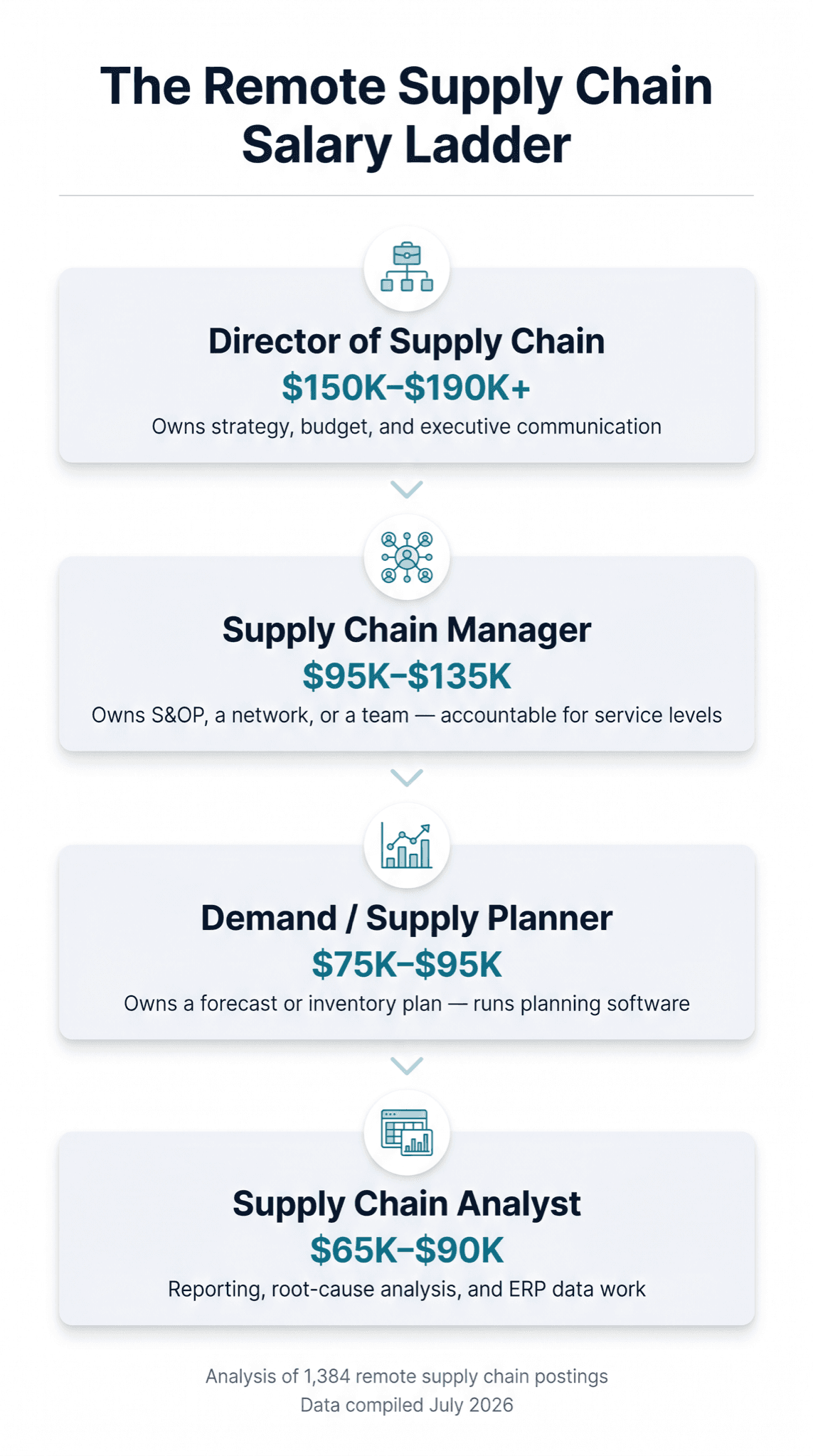
Experience moves supply chain salaries less than most professionals assume. What moves them is decision ownership: whether you build the spreadsheet or make the call it supports. That's visible in the jump between analyst and manager comp — and in why some planners out-earn managers.
| Level | Typical Title | Base Salary | What Differentiates |
|---|---|---|---|
| Entry/Mid | Supply Chain Analyst | $65K–$90K | Reporting, root-cause analysis, ERP hygiene |
| Mid | Demand / Supply Planner | $75K–$95K | Owns a forecast or inventory plan; runs planning software |
| Mid | Procurement / Sourcing Specialist | $70K–$100K | Owns a spend category; negotiates supplier terms |
| Senior | Supply Chain Manager | $95K–$135K | Owns S&OP, a network, or a team; accountable for service levels |
| Leadership | Director of Supply Chain | $150K–$190K+ | Owns strategy, budget, and executive communication |
Salary ranges derive from our analysis of 1,384 remote supply chain postings between September 2025 and June 2026, cross-referenced with Glassdoor compensation data and ASCM's 2026 salary report. We excluded outliers and postings without clear remote policies. Ranges shift as markets move — check the linked sources for current figures.
Three external benchmarks frame the ladder. According to the Bureau of Labor Statistics, the median logistician earned $80,880 in May 2024, with the top 10% above $132,110 — and the field is projected to grow 17% through 2034, much faster than average. ASCM's 2026 Supply Chain Salary and Career Report puts the median base at $98,500 and median total compensation at $103,500, with 77% of surveyed professionals reporting a raise in the past year. And remote-listed analyst roles specifically average around $74K, with most falling between $59K and $83.5K per ZipRecruiter's mid-2026 data.
Why the variance within each band? Three factors, in order of impact. Industry: CPG, pharma, and semiconductor supply chains pay 15–25% above 3PLs and distributors for the same title, because a stockout costs them more. Scope: a planner who owns a global product line out-earns one who owns a regional warehouse's replenishment. And tech stack: the 22% premium for SQL-plus-planning-platform roles in our data isn't a skills bonus — it's a different job. Companies pay it because that person closes the gap between what the ERP says and what's actually true.
The gap between a $75K supply chain analyst and a $130K supply chain manager isn't years of experience — it's whether you own the decision or the spreadsheet that supports it.
If you're mapping career moves beyond supply chain, the same decision-ownership logic drives comp in remote project manager roles and remote business analyst positions — adjacent paths that supply chain professionals move into more often than any other.
The Skills That Move the Number
The supply chain skills market has an oversupply problem and an undersupply problem at the same time. Oversupply: people who can run a report in SAP. Undersupply: people who can pull the underlying data themselves and explain what it means. That asymmetry is the single biggest salary lever available to you this year.
ERP systems — the entry ticket: SAP (including IBP), Oracle, NetSuite. Required in 64% (n=886 of 1,384) of postings. This gets you considered; it no longer gets you paid a premium.
Planning platforms — the T3-to-T4 bridge: Kinaxis, Blue Yonder, o9, SAP IBP. Scarcer than ERP experience and disproportionately requested in $100K+ postings.
Analytics — the premium: SQL, Power BI, Tableau, and increasingly Python for forecasting. Required in 47% (n=651 of 1,384) of postings, and the core of the 22% pay premium in our data.
Procurement suites: Coupa, Ariba, GEP — the fastest-growing requirement cluster in sourcing roles.
The unglamorous constant: advanced Excel. Still named in a majority of postings at every tier, because every supply chain eventually falls back to a spreadsheet at 5 PM on a Friday.
The causal logic matters here. Companies spent the last decade instrumenting their supply chains — every PO, shipment, and forecast now lands in a database. What they didn't build is the analyst bench that can query it. So demand planning teams sit on mountains of ERP data and a shortage of people who can join two tables without filing an IT ticket. That's why Excel proficiency is table stakes while SQL is a raise: one reads the export, the other writes the question. If you want a sense of how deep the analytics path goes, our guide to remote data analyst jobs covers the adjacent career track — and plenty of supply chain analysts make that lateral move for the comp bump.
An unpopular observation from inside these teams: planning-platform experience is somewhat overrated as a credential. Planners in r/supplychain routinely describe working around badly configured planning-platform implementations in Excel — ask anyone there how their company's "AI-powered forecasting" actually gets overridden every month. A sharp Excel-plus-SQL analyst who understands the business routinely outperforms a certified tool operator who doesn't. Postings still filter on the tool names, so learn them — but in the interview, the story that wins is "here's the bad forecast the system produced and here's how I caught it," not "here's my certification."
SQL fluency now moves a supply chain salary more than a decade of site experience.
Stop Applying Manually
Our AI applies to hundreds of matching jobs while you sleep. Wake up to interviews, not more applications.
Certifications: What Actually Moves Salary
Supply chain is one of the few fields where certifications genuinely change offers — largely because the people screening your resume are ASCM members themselves and treat the credentials as a shared language. But the premiums differ by credential, and the sequencing matters.
| Certification | Reported Premium | Best For |
|---|---|---|
| CSCP (Certified Supply Chain Professional) | 14–27% per ASCM | End-to-end supply chain roles; managers and aspiring managers |
| CPIM (Planning and Inventory Management) | 15–25% per ASCM | Demand/supply planners; the T3 workhorse credential |
| CLTD (Logistics, Transportation and Distribution) | Up to 30% per ASCM | Logistics and distribution-heavy roles |
| Lean Six Sigma (Green/Black Belt) | Varies widely | Process-improvement and operations-facing roles |
According to the Association for Supply Chain Management's certification data, professionals holding three or more credentials report premiums up to 32% over non-certified peers — at the manager level, the CSCP alone translates to roughly $12K–$18K in additional base.
The honest read: certifications multiply experience; they don't replace it. A CPIM on top of three years of real planning ownership is a raise. A CPIM with no planning experience is a line item. If you're choosing one, match it to the tier you're targeting — CPIM for planning roles, CSCP for the manager jump, CLTD only if you're staying in transportation. Budget roughly $1,500–$2,500 and three to six months of evening study per credential.
Who's Hiring Remote Supply Chain Talent
Remote supply chain hiring splits into two buckets, and they behave differently.
Supply chain tech companies hire remote by default because their product is the dashboard, not the dock. Flexport (freight and global trade), Coupa and GEP (procurement and spend management), project44 (shipment visibility), Keelvar (sourcing automation), and consultancies like enVista all hire supply chain professionals into remote roles — solutions consulting, implementation, product operations — where practitioner experience is the qualification. These roles often pay tech-company comp for supply chain knowledge, which is the best arbitrage in the field right now.
Brand-side companies — CPG, retail, pharma, industrial — post remote T3 and T4 roles in planning, sourcing, and analytics, though policies vary more. The pattern from our postings data: the more digital the company's supply chain stack, the more remote its decision-layer roles. Glassdoor listed roughly 1,200–1,700 remote supply chain openings at any point in mid-2026, and planner and analyst titles turn over constantly as companies chase the same skills.
A practical note on filtering: "remote" in a supply chain posting deserves scrutiny. Check whether the role references a specific distribution center, plant, or "occasional site visits" beyond quarterly — that's a T2 job wearing a T3 costume. Genuinely remote postings describe systems and stakeholders, not facilities. Before applying anywhere, spend ten minutes searching the company's name in r/supplychain — planners are blunt about which employers treat "remote" as real and which treat it as bait, and that thread beats any review site for ground truth. You can browse current operations management openings and business analyst listings on our board — both categories overlap heavily with supply chain hiring, and recent openings there frequently include planning and procurement titles at $100K+ compensation levels.
Stop Applying Manually
Our AI applies to hundreds of matching jobs while you sleep. Wake up to interviews, not more applications.
How to Land a Remote Supply Chain Job
The competition for remote T3/T4 roles is national, not local — you're no longer the best planner in your metro; you're one of 300 applicants who can all run Kinaxis. Four moves separate the offers from the rejections.
Rewrite your resume from activities to decisions. "Processed purchase orders in SAP" is a T1 sentence. "Owned a $40M packaging spend category; renegotiated three supplier contracts to cut material costs 8%" is a T4 sentence describing the same general work. The test to run on every bullet: did I own the outcome, or did I execute someone else's process? If it's execution, either find the decision hiding inside it (you flagged the shortage, you proposed the substitution) or cut it. Quantify in dollars and service levels — the two units supply chain executives think in.
Lead with the stack. Because 64% of postings filter on ERP and nearly half on analytics tools, your systems belong in your resume's top third, not buried under "Skills." Name the modules — "SAP IBP demand planning," not "SAP." ATS screens are literal, and so are hiring managers skimming at 11 PM.
Prepare trade-off stories, not process descriptions. Remote supply chain interviews at the $100K+ level are scenario-driven: the forecast says one thing, sales swears another, and there's one container slot left — what do you do? Interviewers are testing judgment under incomplete information, because that's the entire T4 job. Have three stories where you made a call, were partially wrong, and corrected — those out-perform stories where everything went smoothly. And if you're interviewing for an S&OP role, here's a take worth saying out loud in the room: at most companies, the S&OP meeting is theater — the consensus number was negotiated in hallway conversations days earlier. Candidates who acknowledge that reality, and can describe how they run the pre-meeting alignment that actually decides the number, read as operators. Candidates who describe the textbook five-step process read as students.
Solve the volume problem with automation. Here's the math nobody says out loud: T3/T4 supply chain roles draw hundreds of applicants within days, response rates for qualified candidates run in the single digits, and you already have a demanding full-time job. Applying to 5 roles a week won't produce offers on any reasonable timeline. This is exactly the situation Remote Job Assistant's Auto-Apply was built for — it applies to matching remote roles on your behalf, at volume, while you spend your limited evening hours on the interviews rather than the forms. Pair it with a curated shortlist from our breakdown of the best remote job boards for the targeted, manual layer of your search.
Companies stopped paying for presence at the dock in 2020. They pay for judgment about what moves through it.
Frequently Asked Questions
Can supply chain management really be done fully remote?
The decision layer can; the physical layer can't. In our analysis of 1,384 remote supply chain postings (September 2025–June 2026), 71% of analyst and planner roles were fully remote, versus 23% of logistics coordinator roles tied to daily facility flow. If the deliverable is a plan, a contract, or an analysis, the work is remote-viable. If the deliverable involves anything on a pallet, it isn't.
I'm a warehouse operations supervisor — how do I move into a remote supply chain role?
Bridge through the data, not the tenure. The remote tiers run on ERP, planning systems, and analytics — so the fastest path is taking ownership of your site's inventory analysis or replenishment planning, learning SQL and Power BI, and applying to supply chain analyst roles that value floor credibility. Your operational context is a genuine advantage once the tooling gap is closed; supervisors who make this jump typically land in the $65K–$85K analyst band and reach planner roles within two years.
What's the highest-paying remote supply chain job?
Director-level roles top the remote ladder at $150K–$190K+, with VP roles above that where they're offered remote. Below director, the best-paid remote work clusters around S&OP ownership — supply chain managers running the S&OP process ($95K–$135K) and senior planners at large CPG or pharma companies. Sourcing managers who own major spend categories reach similar bands because their negotiation outcomes are directly measurable.
Is the CSCP certification worth it for remote jobs?
If you have real experience to multiply, yes. ASCM's data puts the CSCP premium at 14–27% — roughly $12K–$18K at the manager level — and it's the credential hiring managers most associate with end-to-end thinking rather than a single function. For planning-specific roles, CPIM is the better first credential. Neither substitutes for decision ownership on your resume.
Do remote supply chain jobs pay less than on-site ones?
The averages mislead here. Remote-listed supply chain salaries skew lower because the remote job mix is analyst-heavy, while plant and site leadership roles inflate on-site averages. Compare title-to-title and the gap mostly disappears: a remote demand planner and an on-site one at the same company sit in the same band. What does differ is geography arbitrage — remote roles let you earn CPG-headquarters money outside CPG-headquarters cities.
Should I learn SAP or SQL first for remote supply chain work?
SQL, unless you have zero ERP exposure at all. ERP experience appeared in 64% of the postings we analyzed, but it functions as a pass/fail filter — while SQL plus a planning platform carried a 22% median salary premium. You can learn enough SAP navigation on the job in months; analytical fluency is what postings pay extra for. Ideal answer: SQL now, and a planning platform (Kinaxis, Blue Yonder, o9) as soon as your employer will put you on one.
What tier of the Dock-to-Desk Distance is my role, and how do I move up one?
Score it by your deliverable. If your output requires a building, you're T1–T2; if it's analysis or a plan produced entirely in software, you're T3; if it's a decision others execute — a supplier contract, a demand call, a network design — you're T4. Moving up one tier means changing your deliverable, not your effort: T2 to T3 runs through analytics tooling, and T3 to T4 runs through S&OP or category ownership, which appeared in 31% of postings as the marker of $110K+ roles.
Start Your Remote Supply Chain Career
The remote supply chain market rewards a specific profile: decision ownership, analytical tooling, and the judgment to act on incomplete data. If that's you — or six months of deliberate skill-building from now, it could be — the $65K–$190K ladder above is the map.
Start by scoring your current role on the Dock-to-Desk Distance, then close the one gap between you and the next tier. Browse high-paying remote roles across every function to calibrate your target, sharpen the project management skills that S&OP roles quietly demand, and let Auto-Apply handle application volume while you prepare for the conversations that actually decide offers.
The goods will always need a warehouse. The decisions about them stopped needing one in 2020.
Ready to Find Your Remote Job?
Browse thousands of curated remote jobs or let AI apply for you.
Browse Remote JobsRelated Job Guides
Remote Physician Jobs: 2026 Salary and Career Path Guide
Remote physician jobs in 2026: six career paths from telemedicine to medical director, real pay from $150K to $300K+, licensing strategy, and who's hiring.
23 min read
Remote Event Planning Jobs: What Actually Goes Remote
Only 12% of event job postings are fully remote and none were titled Event Planner. See which titles actually go remote, what they pay, and how to pivot.
24 min read
Remote Insurance Jobs: Pay, Top Roles, and How to Get Hired
Remote insurance jobs pay $62K-$130K+ by specialty. Real 2025 wage data for adjusters, underwriters, and actuaries — plus which roles are truly remote.
22 min read