
Last reviewed: September 2026
You've got a tab open with the exam page. $749 for CISSP, or $675 for PMP if you skip the PMI membership, plus the renewal fees nobody mentions until after you pass. It started with one remote posting that listed the credential, and now you're wondering whether it's the reason you aren't hearing back.
Every list of the best certifications for remote jobs will tell you it is. Those lists rank credentials by salary claims and course affiliate links. None of them checks what employers actually write into their postings, or whether the line says required or preferred. That's the only thing that decides whether a credential is filtering you out.
Get Remote Job Tips in Your Inbox
Weekly strategies, salary data, and new opportunities
Unsubscribe anytime. No spam.
So we checked. The short version: licenses gate, certifications break ties. Across 4,476 remote postings paying $75,000 or more, 95 require a certification. That's 2.1%. Only 59 require one without an "or equivalent" escape hatch. The credentials that actually keep people out are state licenses, bar admission, FINRA registrations, and a handful of exam gates.
This guide covers which credentials employers name in each role family, how often they're required, what those postings pay, and what each credential costs to keep. It also gives you a 10-point Credential Gate Score to run before you pay for any exam.
On September 26, 2026 we read 54,334 postings on 689 employer job boards (Greenhouse, Lever, Ashby and SmartRecruiters), plus 6,772 remote-tagged postings from 126 large employers on Workday: insurers, health plans, banks, pharma companies and defense contractors. After removing hybrid, field-territory and non-U.S. roles, we had 4,476 fully remote U.S. postings from 340 employers, each with a posted base salary of $75,000 or more. We read every one for 55 credential groups (47 certification families and 8 license types) and tagged each mention as required, required-or-equivalent, earn-after-hire, or preferred.
Based on 4,476 remote U.S. postings paying $75K+ base, from 340 employers, read September 26, 2026:
- 11.9% (n=532 of 4,476) name any certification or license at all
- 2.1% (n=95 of 4,476) require a certification; 1.3% (n=59) require one with no "or equivalent"
- 78% (n=454 of 579) of certification mentions are "preferred"; 58% (n=116 of 200) of license mentions are required
- 49% (n=282 of 579) of certification mentions sit inside a menu such as "CISSP, CISM, or similar"
- PMP is named in 79 postings at 37 employers and required in 3 (4%), never as the only option
- 12 of 12 postings that required CompTIA Security+ were government-contract seats
- 0 of 4,476 named a Google Career Certificate or a "remote work" certificate
If you only read one paragraph of this guide, make it the next one.
For most remote roles paying $75K+, no certification is required: 88.1% of the 4,476 postings we read name none. Get a credential before you apply only if a law or a contract requires it for your seat (a state license, bar admission, FINRA registration, or Security+ on a Defense Department cyber contract), or if your field uses it as an exam gate (actuarial exams, medical coding). Everything else is a tiebreaker. Buy it only when it's cheap next to the roles it touches, or when an employer will pay for it after the offer.
How We Collected This Data
Start with what this method can't see. A posting tells you what an employer writes down, not how a hiring manager breaks a tie between two finalists. A "preferred" certification can still decide a close call, and we can't measure that. Reddit, Glassdoor and the Bureau of Labor Statistics block automated reads, so there's no forum sentiment or survey pay here. Employers on iCIMS, Taleo and SuccessFactors publish no open data feed, so companies like Liberty Mutual and State Farm are missing. So are the Big Four accounting firms and most large banks beyond Capital One and Citi.
The postings came from two places. The first was a same-day sweep of 689 startup and growth-stage boards on Greenhouse, Lever, Ashby and SmartRecruiters: 54,334 postings. The second was the Workday career sites of 126 large employers, including Humana, Cigna, CVS Health, Nationwide, Travelers, Capital One, CACI, Leidos, Amgen and Salesforce. From those we took up to 120 remote-tagged postings per employer, for 6,772 in total.
We kept U.S.-eligible, fully remote roles. That meant dropping hybrid day-count rules, "not a remote position," and office-proximity clauses. We also removed 461 field and territory roles (a city or territory in the title, or field sales, clinical and service work) and deduplicated by employer, title and pay. A posted base floor of $75,000 or more left 4,476 postings from 340 employers: 2,727 from startup boards and 1,749 from Workday. Every posting was live on September 26, 2026, and the median Workday posting went up on September 16.
Each credential group has a pattern plus context guards. CPA as cost-per-acquisition doesn't count, CISA as the federal cyber agency doesn't count, and PMP as programmatic ads' "private marketplace" doesn't count. Strength comes from the nearest cue word, the line, and the section heading ("Preferred qualifications"). In a hand check of 100 random mentions, 96 were labeled correctly. The one error type we didn't fix slightly undercounts required mentions.
Postings also can't show requirements that only surface in conversation: a referral-only req, or a hiring manager who says "we really need someone who already holds X" on the first call. Pay figures are posted base floors (the bottom of the range), not total comp. Fees and renewal rules come from the issuers' own pages, read the same week. We re-run this analysis quarterly.
Licenses Lock Doors. Certifications Break Ties.
Split every mention by credential type and the requirement rate flips.
| How the posting words it | Certification mentions (n=579) | License mentions (n=200) |
|---|---|---|
| Required, no alternative | 64 (11%) | 87 (44%) |
| Required, "or equivalent" allowed | 55 (9%) | 29 (14%) |
| Earn it after you're hired | 6 (1%) | 8 (4%) |
| Preferred, a plus, nice to have | 454 (78%) | 76 (38%) |
The reason is legal, not cultural. A state bar, a board of nursing, a medical board or FINRA decides who may do the work, so the employer has no choice. A posting that left out the license would be hiring someone who can't legally do the job. The Nurse Licensure Compact says a nurse must be licensed where the patient is located at the time of care, telehealth included. FINRA won't let you sit the Series 7 unless a member firm sponsors you.
A certification is the employer's own choice. Requiring it shrinks the candidate pool to buy a signal that experience already provides. So employers write "preferred," "or equivalent," or a menu of five acronyms. You can read the reasoning in their own words. Eight Sleep writes: "CIPP/US or CIPP/E is a plus, not a requirement; we weight experience over credentials." Drata lists CISSP, CISM, CRISC and CCSP, then adds: "(though real, tenured experience carries more weight)." Dropbox is blunter still: "Relevant industry certifications are valued but are not required."
Four certification families behave like licenses, and each has a mechanism behind it:
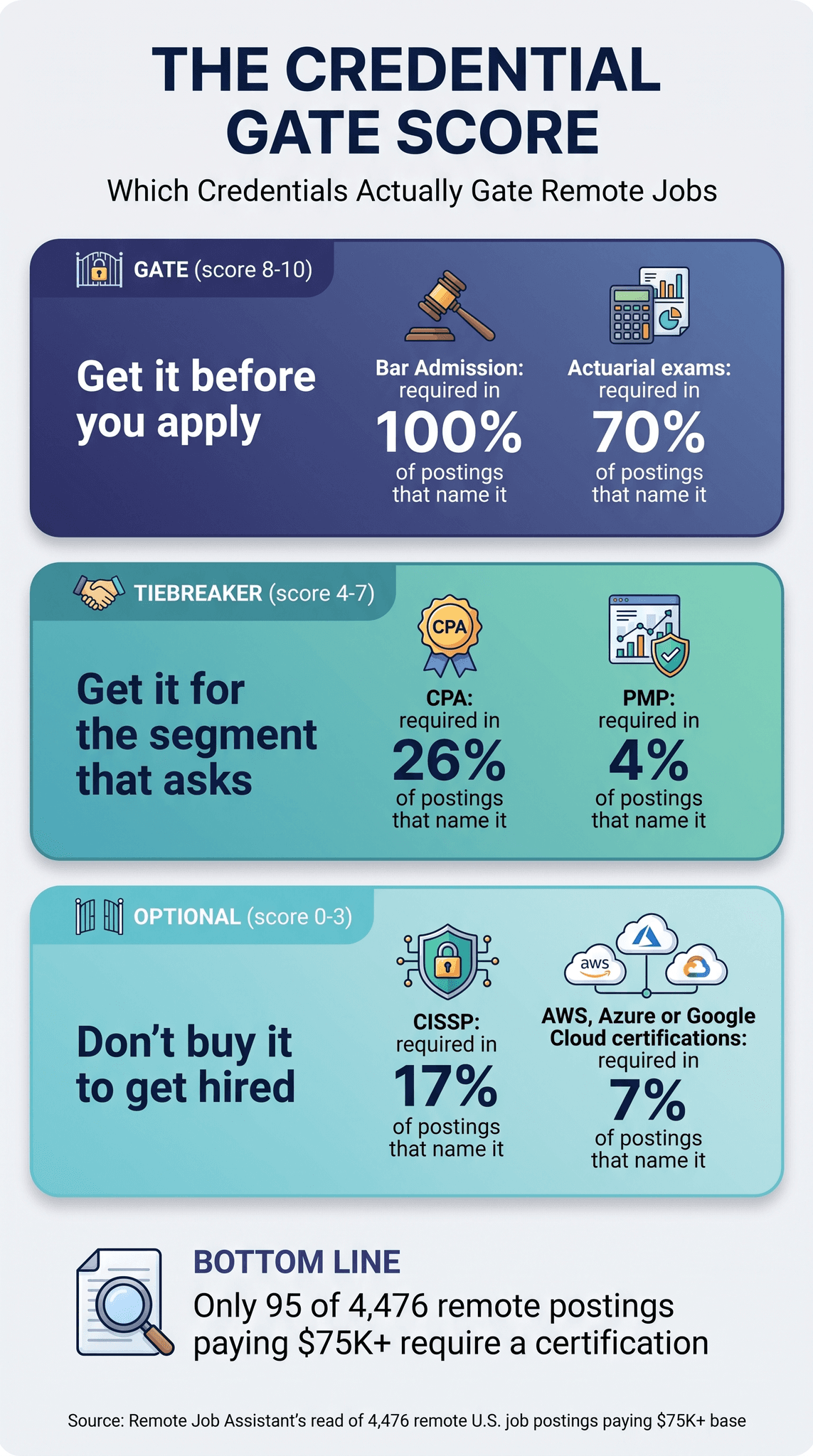
- Actuarial exams. 23 of 33 naming postings (70%) require them. Nationwide writes "FSA designation required," and CareSource "Associate of the Society of Actuaries (ASA) is required." The exams are the profession's credentialing system, and some roles sign regulatory filings.
- Medical coding. 9 of 11 postings require them. Headway: "A Certified Professional Coder (CPC) certification is required." These postings sit in payment-integrity, audit and clinical documentation work, where the credential is the standard proof that you code to the rulebook.
- CompTIA Security+ on defense contracts. 12 of the 22 naming postings require it, and all 12 are government-contract seats at CACI, Leidos, RTX and a Siemens Healthineers federal team. DoD Manual 8140.03 says contracted personnel "must meet foundational qualification requirements upon commencement of cyberspace work." Government civilians and service members get 9 months. A certification is one of three ways to qualify, but only incumbent federal civilians can substitute experience. Contractors can't.
- Bar admission and clinical licensure. Bar admission was required in 9 of 9 naming postings. Physician, NP and therapist licensure was required in 66 of 74 (89%).
In remote postings paying $75K+, the credentials that keep you out are licenses. Certifications mostly break ties.
The Credential Gate Score: Should You Get It Before You Apply?
A requirement rate on its own doesn't tell you whether to buy an exam. PMP is named in more postings than any other credential and required in almost none. Security+ is rare overall but mandatory in the seats that ask for it. The Credential Gate Score combines both kinds of evidence.
The Credential Gate Score is a 0–10 rating of how hard a credential gates remote jobs paying $75K+. It's built from what postings in the credential's own role cluster actually write down.
Score five factors from 0 to 2 each:
- Mandate (0–2): 2 = a law or regulator requires it to do the work (state license, bar admission, FINRA registration, DEA registration). 1 = a contract or program rule requires it for some seats (Defense Department cyber seats, actuarial sign-off roles). 0 = voluntary.
- Pull (0–2): the share of $75K+ remote postings in the role cluster that name it. 2 = 20% or more, 1 = 5% to 19.9%, 0 = under 5%.
- Hard rate (0–2): of the postings that name it, the share that require it (including "or equivalent"). 2 = 50% or more, 1 = 20% to 49%, 0 = under 20%.
- Floor (0–2): the median posted base floor of naming postings, compared with the whole cluster. 2 = 10% or more higher, 1 = within 10%, 0 = 10% or more lower.
- Stand-alone (0–2): the share of mentions not buried in a "such as X, Y, or similar" menu. 2 = 60% or more, 1 = 30% to 59%, 0 = under 30%.
Bands:
- Gate (8–10): get it before you apply, because postings filter on it. Any credential scores as a Gate for your seat when the law requires it there (Mandate = 2), whatever its total.
- Tiebreaker (4–7): worth it when you're targeting the segment that names it and the cost is small next to those roles, or when the employer pays after the offer.
- Optional (0–3): don't buy it to get hired. Earn it for the job you already have, or for one specific employer that asks.
How to use it: Score the credential against the 20 to 30 postings you'd actually apply to, not against the whole market. Then check readiness against the issuer's prerequisites before you pay. A Gate you're qualified for gets scheduled now. A Tiebreaker gets raised on the first recruiter call: "Do you sponsor this, and by when?"
Here's how the most-named credentials score when each one is measured against the job titles that use it:
| Credential | Gate Score | Band | Named in its role cluster | Required when named | Median floor, naming vs cluster |
|---|---|---|---|---|---|
| RN license | 10 | Gate | 8 of 36 (22%) | 67% | $116K vs $92K |
| Bar admission | 9 | Gate | 9 of 76 (12%) | 100% | $190K vs $157K |
| Physician, NP, therapist licensure | 9 | Gate | 60 of 126 (48%) | 89% | $206K vs $191K |
| Actuarial exams (ASA, FSA, ACAS, FCAS) | 8 | Gate | 27 of 41 (66%) | 70% | $118K vs $123K |
| FINRA registrations | 7 | Gate for registered seats | 12 of 67 (18%) | 59% | $115K vs $131K |
| CPA | 7 | Tiebreaker | 54 of 82 (66%) | 26% | $140K vs $134K |
| CompTIA Security+ | 5 | Tiebreaker | 9 of 239 (4%) | 55% | $99K vs $156K |
| Six Sigma or Lean belt | 5 | Tiebreaker | 16 of 288 (6%) | 22% | $115K vs $125K |
| PMP | 4 | Tiebreaker | 49 of 262 (19%) | 4% | $123K vs $123K |
| CFA | 4 | Tiebreaker | 9 of 82 (11%) | 11% | $149K vs $159K |
| GIAC | 2 | Optional | 23 of 183 (13%) | 22% | $135K vs $165K |
| CISM | 2 | Optional | 15 of 265 (6%) | 12% | $143K vs $156K |
| CISA | 2 | Optional | 13 of 134 (10%) | 16% | $145K vs $136K |
| CISSP | 1 | Optional | 35 of 259 (14%) | 17% | $140K vs $161K |
| AWS, Azure or Google Cloud | 1 | Optional | 10 of 493 (2%) | 7% | $126K vs $164K |
A role cluster is the set of $75K+ remote postings whose titles do the work the credential covers. For PMP that's 262 project, program and delivery titles. For CPA it's 82 accounting, tax, audit and controller titles.
Two scores will surprise people. PMP lands at 4 because it's everywhere and required almost nowhere. CISSP lands at 1, for reasons the security section below spells out. Neither score says the credential is worthless. They say it won't be the thing standing between you and an offer.
Keep the other side of the ledger in view. The 88.1% of postings that name no credential are still the majority, and for most people the binding constraint is how many well-targeted applications go out, not a missing certificate. That's the job Auto-Apply does.
Stop Applying Manually
Our AI applies to hundreds of matching jobs while you sleep. Wake up to interviews, not more applications.
Best Certifications for Remote Jobs by Role Family
"Best" depends on the work. The share of postings that name any credential runs from 39.9% in clinical roles to 0.9% in marketing, a spread of more than 40 times.
| Role family | $75K+ remote postings | Name any credential | Most-named credentials | Median posted floor |
|---|---|---|---|---|
| Clinical and care | 228 | 91 (39.9%) | Physician/NP/therapist licenses 68, RN 14 | $150K |
| Finance and accounting | 302 | 116 (38.4%) | CPA 62, actuarial exams 29, CFA 11 | $129K |
| Security | 180 | 45 (25.0%) | CISSP 28, GIAC 23, OffSec 12, CISM 11 | $167K |
| Legal and compliance | 155 | 27 (17.4%) | Bar admission 7, IAPP privacy 6 | $140K |
| Operations and program management | 597 | 89 (14.9%) | PMP 45, Six Sigma or Lean 16 | $130K |
| Recruiting and people | 67 | 9 (13.4%) | PHR/SPHR 5, SHRM 3 | $131K |
| Customer-facing technical | 409 | 39 (9.5%) | PMP 13, Salesforce 7 | $136K |
| Software engineering | 918 | 57 (6.2%) | Salesforce 11, Security+ 7, Microsoft 7 | $162K |
| Sales | 525 | 21 (4.0%) | Salesforce 8 | $139K |
| Product management | 197 | 5 (2.5%) | Scrum 2 | $171K |
| Data and machine learning | 393 | 9 (2.3%) | PMP 3 | $160K |
| Design and research | 76 | 1 (1.3%) | none repeated | $155K |
| Marketing and content | 221 | 2 (0.9%) | none repeated | $140K |
Floors are the bottom of each posting's base range from our September 26, 2026 read of 4,476 remote postings. They exclude bonus, equity and commission. Families are assigned by job title, and cells under 10 postings show direction, not precision. Browse remote jobs starting at $75K to see the current mix.
Read the table as a triage rule. If your family names a credential in a quarter or more of its postings (clinical, finance, security), run the Gate Score on your target credential before you apply anywhere. Between 5% and 25% (legal, operations, HR, customer-facing technical, software), check only the specific employers you're targeting. Under 5% (sales, product, data, design, marketing), drop certifications from this search entirely and put the hours into portfolio evidence: shipped launches, closed quota, models in production.
Security: Security+ for contract seats, not CISSP for commercial ones
Security names credentials more than any tech family: 45 of 180 postings (25.0%). The two halves of the market want different things, though. Government contractors are most of the reason security certifications ever appear as requirements: 19 of the 23 postings that require any security certification are at contractors, and every hard Security+ requirement sits on a government contract, for the DoD 8140 reason above. Commercial security teams list CISSP, GIAC and OffSec certifications in menus. Those menus read like "OSCP, OSEP/OSCE, GPEN, GXPN, or equivalent," and 93% of OffSec mentions sit in one.
Two gotchas before you book anything. First, Security+ V8 is expected on or around November 17, 2026, and the current V7 exam retires June 11, 2027, so check which version your prep covers. Second, ISC2's experience rule requires five years in two of CISSP's eight domains. Pass the exam without them and you become an Associate of ISC2, with six years to earn the experience. For the roles themselves, see our guide to remote cybersecurity jobs.
CISSP is the credential most security lists put first, and it scores 1 of 10 on the Credential Gate Score. It appears in 35 of 259 security-titled $75K+ remote postings. It's required in 9 of the 52 postings that name it, and 79% of its mentions sit inside a "CISSP, CISM, or similar" menu. Naming postings post a lower median floor ($140K) than the security cluster as a whole ($161K). It's still useful for security leadership and GRC seats you'd get anyway. It's rarely the gate.
The survey data points the other way, so weigh the source. ISC2's 2025 hiring study of 929 hiring managers across six countries found they expect about a third of entry-level (34%) and junior (33%) candidates to hold a CISSP. ISC2 issues the CISSP. Postings are what employers commit to in writing, and in the postings we read, CISSP shows up as a preference.
Finance and accounting: CPA and actuarial exams are the real gates
Finance names credentials in 116 of 302 postings (38.4%), second only to clinical roles. CPA is named in 54 of 82 accounting, tax, audit and controller postings (65.9%). It's required in only 19 of the 72 postings that name it, though, and 13 of those allow no alternative. The contrast shows up in the wording. Oura writes "An active CPA license — this is a requirement for the role." Smartsheet writes "CPA strongly preferred." If you're weighing the license, NASBA's pathway list, updated September 21, 2026, shows a new bachelor's-plus-two-years route with effective dates in 44 jurisdictions. California, Colorado, Illinois and Indiana start January 1, 2027. The AICPA says that route isn't yet recognized everywhere for practicing across state lines.
Actuarial exams are a true gate: 70% required. CFA never appeared as a strict requirement. Two postings accepted it as one option among several. Our guides to remote accounting jobs and remote actuary jobs cover those roles, and the current remote finance and accounting openings show the live mix.
Project and program management: PMP is the most-named credential and the least required
PMP appears in 79 postings at 37 employers, more than any other credential, and in 49 of 262 project and program postings (18.7%). It's required in 3, and none of the 3 accepts PMP alone. Parsons, for example, writes "An active PE or PMP." Naming postings post a $123,000 median floor, the same as the cluster's $123,100. PMP moves no money on its own in this data. It's also an enterprise signal: 65 of the 79 PMP postings came from large employers on Workday (JLL, Parsons, SOLV Energy, BeiGene), and only 14 from the 2,727 startup and growth-stage postings. Don't buy it to land a remote PM job at a software company. If you're aiming at construction, energy or pharma program offices, or an employer will pay, time it. PMI's PMP page says that from December 1, 2026, live instructor-led training counts toward the 35 required hours only if an Authorized Training Partner or accredited program delivers it. The exam costs $425 for members or $675 otherwise, and you pay only after PMI accepts your application. With a bachelor's degree you need 36 months of experience leading projects. Scrum and SAFe show up in just 8 of 323 postings in their cluster. See remote project manager jobs, remote project manager roles on our board, our project management skills page, and the scrum master vs project manager breakdown.
Cloud and software engineering: certifications barely register
Software engineering names a credential in 57 of 918 postings (6.2%). AWS, Azure and Google Cloud certifications appear in 10 of 493 cloud, platform, infrastructure and architect postings at 124 employers. Salesforce looks like an exception until you check who's asking: 23 of the 30 postings naming a Salesforce certification are at Salesforce itself. That's product fluency for the vendor, not a market-wide gate (our Salesforce skill listings show where else it matters).
If you hold cloud certifications, know their clocks. Microsoft role-based certifications expire every 12 months, and renewal is a free open-book assessment. AWS certifications last three years. Google Cloud Professional certifications last two years, or one if you renew through Google Skills. Our remote cloud engineer jobs guide covers what those roles screen on instead.
Legal, privacy and compliance: bar admission yes, privacy certifications optional
Bar admission was required in all 9 naming postings, at a $190,000 median floor. IAPP privacy certifications appeared in 8 postings and were required in none. The CIPP/US costs $550, plus $250 per two-year term unless you hold an IAPP membership. Browse legal and compliance roles for current openings.
Clinical and health: licensure is the job
Clinical roles name a credential in 91 of 228 postings (39.9%). Physician, NP and therapist licensure is required in 89% of naming postings. The Nurse Licensure Compact covers 43 jurisdictions, but you can hold a multistate license only if you live in a compact state. You still need a single-state license anywhere else your patients are. Our remote nursing jobs guide walks through which remote roles need what.
HR, sales, marketing, product and data: skip the certificate aisle
HR names a credential in 9 of 67 postings, and none of the 5 postings naming a SHRM or HRCI credential required it. Sales names one in 21 of 525 postings, product in 5 of 197, data and machine learning in 9 of 393, and marketing in 2 of 221. In these families the posting is asking about shipped work, quota, pipeline or portfolio.
If a posting lists your certification inside "such as X, Y, or similar," it's describing a kind of candidate, not a checkpoint.
If the credential isn't what's filtering you out, it's worth looking at how many of the right postings you're reaching.
Stop Applying Manually
Our AI applies to hundreds of matching jobs while you sleep. Wake up to interviews, not more applications.
The Pay Signal Runs Backwards in Tech
In tech families, postings that name a credential pay less at the median. In regulated families they pay more.
| Role family | Median floor, postings naming a credential | Median floor, postings naming none |
|---|---|---|
| Software engineering | $112K (n=57) | $165K (n=861) |
| Security | $140K (n=45) | $169K (n=135) |
| Customer-facing technical | $123K (n=39) | $140K (n=370) |
| Operations and program management | $119K (n=89) | $131K (n=508) |
| Finance and accounting | $135K (n=116) | $123K (n=186) |
| Legal and compliance | $150K (n=27) | $138K (n=128) |
| Clinical and care | $189K (n=91) | $147K (n=137) |
Credentials don't lower pay. The gap comes from where they get written in. The 15 government contractors in our data posted 356 of the 4,476 postings (8%), but they account for 32 of the 95 certification requirements (34%). They name a certification in 20.5% of their postings, against 7.2% everywhere else. Contract seats and enterprise IT operations roles post lower floors than product engineering at commercial software companies. In security alone, the 17 government-contract postings have a $105,100 median floor, against $168,000 for the 163 commercial ones.
In software and security postings, a named certification more often marks a compliance seat than a premium one.
The decision rule: if you work in tech and a certification is your plan to move up-market, this data says it points you toward compliance seats. The premium seats are hiring on shipped work. Pearson VUE's 2025 survey of about 24,000 IT professionals found 32% got a raise after certifying, but Pearson VUE delivers certification exams, and a raise at your current employer isn't the same as a door opening at a new one.
What Each Certification Costs to Keep
The exam fee is usually the smallest number. The experience gate decides when you can hold the credential, and the renewal decides what it costs you every year after.
| Credential | Exam fee | Experience gate | Renewal | Ongoing cost |
|---|---|---|---|---|
| CISSP | $749 | 5 years in 2 of 8 domains | 120 CPE per 3 years | $135 a year |
| CISM or CISA | $575 member, $760 otherwise | 5 years within the prior 10 | 120 CPE per 3 years | $45 or $85 a year |
| PMP | $425 member, $675 otherwise | 36 months leading projects (with a bachelor's) + 35 training hours | 60 PDUs per 3 years | Renewal fee |
| CompTIA Security+ | Not listed here | None required | 50 CEUs per 3 years | $150 per 3-year cycle |
| AWS Associate or Professional | $150 or $300 | None | Every 3 years | Recertification exam |
| Microsoft role-based | Typically $165 | None | Every 12 months | Free online assessment |
| Google Cloud Professional | $200 | None (3 years recommended) | Every 2 years | $100 renewal exam |
| CKA (Kubernetes) | $445, one retake included | None | Every 2 years | Retake |
| CIPP/US | $550 | None | 20 CPE per 2 years | $250 per term, or IAPP membership |
| GIAC | $999 | None | 36 CPE per 4 years | $499 per renewal |
| OSCP | $1,699 exam | None | OSCP never expires; OSCP+ every 3 years | $145 a year for OSCP+ |
| PSM I (Scrum.org) | $200 | None | Lifetime | None |
| CFA charter | $3,520 to $4,570 for all three levels | 4,000 hours over at least 36 months | Annual membership | $299 a year |
Five fine-print rules that change the math:
- CISSP can come before the experience. Pass it early and you're an Associate of ISC2 with six years to earn the five. You pay a $50-a-year associate fee in the meantime.
- OSCP and OSCP+ are the same exam with different clocks. Passing earns both. OSCP never expires, but OSCP+ lapses after three years unless you log 120 CPE and pay $145 a year, or pass the $799 recertification exam. Check which one a posting means.
- The two scrum master credentials are priced differently for life. Scrum.org's PSM I is $200 per attempt with no renewal. Scrum Alliance's CSM requires a course and renews every two years with 20 learning units and $100.
- A FINRA registration can't be self-studied. Only the SIE ($100, valid four years) is open to anyone. The Series 7 requires a member firm to sponsor you.
- Epic certification runs through Epic's UserWeb. Access is limited to employees of Epic customers, consultants working with them, and people already Epic-certified.
Certifications to Skip for $75K+ Remote Roles
The credentials the top-ranking lists push hardest barely appear at this pay level. Google Career Certificates appeared in 0 of 4,476 postings. So did "remote work" certificates, the kind sold as proof you can work from home. CompTIA A+ appeared twice, CAPM twice, and HubSpot, Google Ads or Meta marketing certificates once.
Some credentials appear but were never required anywhere in the set: IAPP privacy certifications (0 of 8), CEH (0 of 8), PHR/SPHR and SHRM (0 of 5 postings), Google Cloud (0 of 5), CMA (0 of 5) and CFE (0 of 5). CFA was never a strict requirement either.
The reason is structural. Entry-level certificates prove you finished a course. Postings at $75K+ screen on years of scoped work, which a course can't supply. When an employer does want the course, it often pays: Stripe, Affirm, Kin, KnowBe4 and BeiGene advertise certification budgets or reimbursement, across 20 postings.
Don't pause a job search to study for an Optional-band credential. At 78% "preferred," applying without it is the normal case, and the months you spend studying are months of postings you didn't apply to. If you're getting no callbacks, the cause is more likely the résumé or the targeting. Our guide to why you're not getting interviews walks through the usual culprits.
If you're mid-search, apply now and study on weekends, not the other way round.
Stop Applying Manually
Our AI applies to hundreds of matching jobs while you sleep. Wake up to interviews, not more applications.
How to Read a Certification Line in a Job Posting
The wording tells you whether to apply now, apply and negotiate, or skip. Here's how to decode it, with the mechanism behind each phrase:
- "Such as X, Y, or similar" or "one or more of." This is a menu, and it covers 49% of the certification mentions we read. Any close credential, or strong experience, usually satisfies it. Apply.
- "Or equivalent experience." The employer will trade the certificate for proof. Ten postings say so outright, and more imply it. Lead your résumé with the equivalent work.
- "Within 6 months of hire" or "willingness to obtain." The employer has a path, so don't pay first. Leidos writes "PMP Certification or willingness to obtain within two years." CACI writes "be able to obtain it within 60 days of hire."
- "DoD 8570," "DoD 8140," or "IAT Level II." This is a contract gate, and you must hold it on day one. Leidos: "Active Security+ certification or equivalent IAT Level II certification."
- "Active license in [state]" or "compact license." Licensure follows the patient or client, not you. Check your state before you apply.
- "Series 7, 63 required" at a financial firm. If you don't hold it, the firm would have to sponsor you. Ask whether they do before you invest in the process.
- A vendor asking for its own certification. This is product fluency, not a market-wide gate. Salesforce accounts for 23 of the 30 Salesforce-certification postings.
The apply, earn or skip rule:
- Law or contract requires it for the seat, and you don't hold it: skip the posting until you do, or find the sponsoring employer.
- Required, but "or equivalent" is allowed: apply, and put the equivalent in your résumé's first third.
- Earn it after hire: apply, and ask them to cover the exam and renewals in the offer.
- Preferred or menu: apply. Never let a preferred certificate stop an application.
- Not mentioned: don't spend money on it for this search.
One interview question fills in whatever the posting leaves out: "If I don't hold this certification on day one, what's the path? Do you sponsor it, and by when?" You'll learn whether it's a gate or a tiebreaker for that team, and you'll learn it before you pay for anything.
Putting a Credential to Work in Your Search
If you hold a credential that postings in your family name, make it easy to find. Write both the acronym and the full name once, as in "Project Management Professional (PMP)," because postings use both forms and applicant tracking systems match on the exact string. List a credential "in progress" only if the exam is on the calendar, with the date. Eighteen postings explicitly accept in-progress wording, like Sprout Social's "CPA license or actively working towards obtaining license."
Negotiate the cost into the offer. Use the renewal table above to name the full carrying cost, not just the exam, and ask for both. A $499 GIAC renewal every four years, or a $135 ISC2 fee every year, is an easy line item for an employer and a real one for you. If your current employer pays your renewals, don't assume the next one will; ask before you accept.
Most of all, don't let a missing "preferred" credential shrink your search. The lever for the 88.1% of postings that name no credential is getting in front of more of the right ones. That's what Remote Job Assistant's Auto-Apply is built for: it applies to remote roles paying $100K+ and other roles that fit your target while you spend your evenings on the credential that actually gates your field. If you're still choosing a field, our high-paying remote jobs guide maps where the six-figure remote roles are.
Frequently Asked Questions
Which certification is most worth getting for a remote job that pays over $100K?
It depends on your family, and for most families the honest answer is none. Only 2.1% of 4,476 remote postings paying $75K+ (n=95) require a certification. The credentials that gate jobs are licenses and a few exam gates: bar admission, clinical licensure, FINRA registrations, actuarial exams, medical coding, and Security+ on defense contracts. If yours isn't on that list, spend on evidence of shipped work first.
Is the PMP worth it for remote project manager jobs?
PMP is the most-named credential in our data, appearing in 79 postings at 37 employers, but it's required in only 3, and never as the only option. Naming postings post the same median floor as other project and program postings ($123K). It's a tiebreaker (Gate Score 4). If you want it, note that from December 1, 2026, PMI only counts live training toward the 35 hours when it comes from an Authorized Training Partner or accredited program.
Should I get CISSP or Security+ for remote cybersecurity work?
Get Security+ if you're targeting government-contract seats. All 12 postings that required it were contract roles, because Defense Department rules require contractors to be qualified on day one. For commercial security roles, CISSP is usually a preference (required in 9 of 52 naming postings), and it needs five years of experience in two of eight domains to hold in full.
Do AWS or Azure certifications help you get a remote cloud job?
Rarely as a screen. Cloud certifications appeared in 10 of 493 remote cloud, platform and infrastructure postings paying $75K+, and naming postings posted lower floors than the cluster. They can help you learn a platform, but budget for the clock: Microsoft role-based certifications renew every 12 months, and AWS every three years.
Will a Google Career Certificate get me a remote job?
Not at $75K+. None of the 4,476 remote postings we read at that pay level named a Google Career Certificate. Those certificates are built for entry-level career changers, and $75K+ postings screen on years of scoped work.
Do I need a CPA for remote accounting and finance roles?
For accounting, tax and controller roles, CPA is the credential employers name most (54 of 82 postings, 65.9%), but it's required in only 26% of the postings that name it. Roles that sign SEC filings or technical accounting memos are the ones that insist. NASBA's September 2026 list shows a new bachelor's-plus-two-years CPA pathway in 44 jurisdictions.
How do I use the Credential Gate Score before I pay for an exam?
Score the credential against the 20 to 30 postings you'd actually apply to: Mandate, Pull, Hard rate, Floor and Stand-alone, 0 to 2 each. At 8 to 10 (or when the law requires it for your seat), get it before applying. At 4 to 7, get it only if your target segment names it or an employer will pay. At 0 to 3, keep applying without it.
Pick the Credential That Opens a Door
If you came here for a ranked list of the best certifications for remote jobs, here's the ranking the postings support. First come the credentials your seat legally or contractually requires. Next come the tiebreakers your target employers actually name. After that, nothing.
So start by checking whether your target seat carries a legal or contract gate: a state license, bar admission, FINRA registration, actuarial exams, medical coding, or Security+ on defense contracts. If it does, that credential comes before the applications. For anything else, run the Credential Gate Score against the postings you'd actually apply to before you pay, and make Tiebreakers part of the offer conversation. Skip entry-level certificates at this level; they didn't appear in a single posting we read.
Then get back to volume. You can find current remote roles paying $100K+, remote finance and accounting openings and legal and compliance roles on our board, or let Auto-Apply work through them for you.
A license decides whether you're allowed to do the work. For most remote jobs paying $75K+, the posting never asks for the certificate. It asks what you've done.
Ready to Find Your Remote Job?
Browse thousands of curated remote jobs or let AI apply for you.
Browse Remote JobsRelated Job Guides
Remote Jobs for Introverts: The $75K+ Roles That Talk Least
We scored 2,737 remote jobs paying $75K+ for live talk. 58.6% ask for none. See which roles stay heads-down, what they pay, and how to spot the loud ones.
29 min read
Remote Jobs for Military Spouses: Which Ones Survive a PCS
We tested 2,753 remote jobs paying $75K+ for PCS portability. 89.6% never say which states they hire in. Here's how to find remote work that follows orders.
35 min read
Fractional COO Jobs: Real Pay and Borrowed Authority
Only 9 of 73 fractional COO jobs we classified were paid part-time seats. Real 2026 rates, why posted pay runs low, and how to score authority before you sign.
29 min read