
Last reviewed: July 2026
You negotiated seven figures of supplier spend last year, and your company still thinks procurement is the department that orders laptops. That gap — between what procurement actually does and what people assume it does — is also the gap most job seekers fall into when they search for remote procurement jobs. They find 6,000+ listings on LinkedIn and no explanation of which ones are real remote roles, what they pay, or why a "Procurement Specialist" posting can mean anything from $50K of PO processing to $95K of strategic sourcing.
Here's the reframe that changes how you search: remote procurement pay doesn't track your years of experience — it tracks the spend you own. A buyer processing purchase orders and a category manager both "do procurement," but one touches $200K of transactions and the other owns a $40M category. Job boards price those identically under one keyword. Hiring managers don't.
Get Remote Job Tips in Your Inbox
Weekly strategies, salary data, and new opportunities
Unsubscribe anytime. No spam.
To map what the remote procurement market actually pays, we reviewed the 781 remote procurement postings listed on Glassdoor as of June 2026 — alongside Indeed's approx. 740 remote procurement listings and ZipRecruiter's remote salary data — and cross-referenced compensation against Salary.com, PayScale, and ZipRecruiter benchmarks from February through July 2026. This guide covers the salary bands by level, the titles hiding behind the "procurement" keyword, the certifications that actually move pay, and the honest path to landing a remote seat.
Counted from live job-board listings and published salary benchmarks (February–July 2026), not modeled estimates:
- 781 remote procurement jobs listed on Glassdoor US (June 2026); LinkedIn showed 6,000+ under the same search
- 33% (n=259 of 781 Glassdoor remote procurement postings, July 2026) were manager-level or above — this is a mid-career-heavy remote field
- approx. 7% (n=53 of approx. 740 Indeed remote procurement listings, May 2026) were marked entry-level — remote seats at the bottom rung are scarce
- $50K–$76K was the 25th–75th percentile band for work-from-home procurement specialists, with 90th percentile at $95K (ZipRecruiter, 2026)
- $130K–$212K was the 25th–75th percentile band for senior category managers (Salary.com, 2026)
- 10–20% salary premium for CPSM-certified professionals versus non-certified peers at equivalent seniority (industry certification studies)
Why Procurement Went Remote (And Which Half Didn't)
Procurement split in two over the last decade, and only one half went remote.
The transactional half — plant purchasing, receiving, inventory-adjacent buying — still lives near loading docks and ERP terminals that companies keep on-site. If a role involves physically verifying what showed up, it will say "hybrid" and mean it.
The strategic half moved into the browser. Sourcing events run in Coupa, SAP Ariba, or Jaggaer. Contract redlines happen in a CLM system. Supplier negotiations that used to justify a flight now happen over video — a shift that stuck after 2020 because CFOs noticed the travel line item shrank while savings targets still got hit. When the entire workflow is software, the work stops caring where you sit. That's the structural reason remote procurement listings skew senior: the strategic work that goes remote is the work you only get after a few years of owning transactions.
That progression has a shape. We call it the Spend Ownership Ladder.
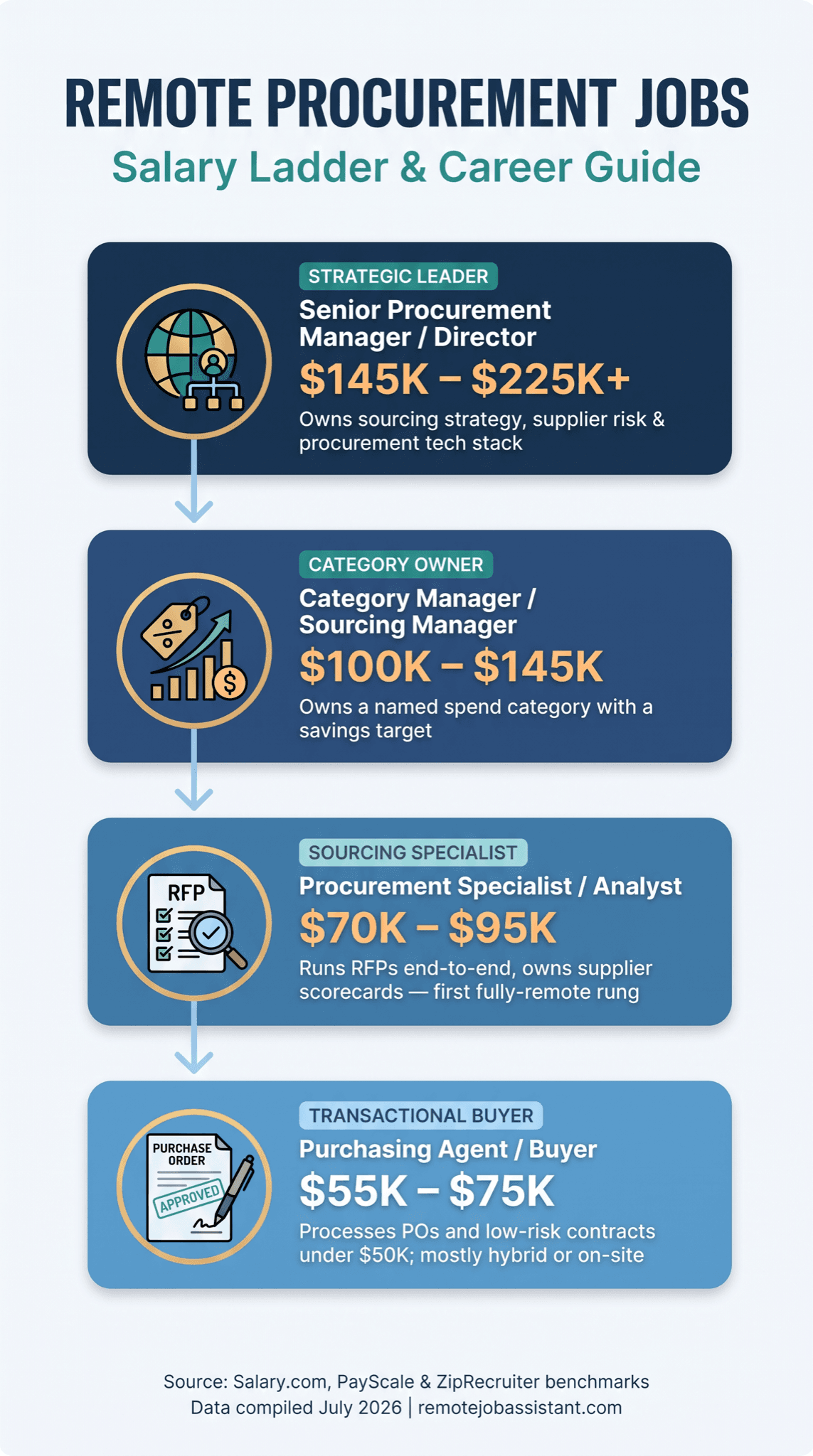
The Spend Ownership Ladder: a four-level rubric that maps procurement compensation to the spend you own, not the title you hold.
- L1 — Transactional Buyer ($55K–$75K): Processes purchase orders, resolves invoice mismatches, onboards suppliers, negotiates low-risk contracts under $50K. Owns transactions, not strategy. Mostly hybrid or on-site.
- L2 — Sourcing Specialist ($70K–$95K): Runs RFPs end-to-end, owns supplier scorecards, negotiates mid-size renewals without sign-off at every step. The first fully-remote-viable rung.
- L3 — Category Owner ($100K–$145K): Owns a named spend category — IT, logistics, marketing, MRO — with a savings target attached to their name. Presents to finance leadership quarterly.
- L4 — Strategic Leader ($145K–$225K+): Senior manager or director. Owns sourcing strategy across categories, supplier risk, and the procurement tech stack itself.
How to use it: Identify your level by what spend you own today, then build your resume and interview stories around the next level's criteria. The candidates who jump bands fastest describe outcomes one rung above their title.
Stop Applying Manually
Our AI applies to hundreds of matching jobs while you sleep. Wake up to interviews, not more applications.
How We Collected This Data
The figures in this post come from our review of remote procurement job listings and compensation data collected between February 2026 and July 2026. Posting counts were pulled from Glassdoor (781 remote procurement jobs, of which 259 were manager-level, June–July 2026), Indeed (approx. 740 remote procurement listings, including 53 marked entry-level, May 2026), and LinkedIn (6,000+ US remote procurement results, May 2026). We counted only positions explicitly marked remote in the United States.
Salary bands were cross-referenced across Salary.com, ZipRecruiter's work-from-home procurement data, and PayScale for the same period. Where platforms disagreed — and on procurement titles they disagree by $20K or more — we report the range and explain the variance rather than averaging it away. Ranges reflect base salary; bonus typically adds 10–20% at manager level and above. We update this analysis as new quarterly data lands; figures here reflect mid-2026.
Remote Procurement Salaries by Level
The four rungs of the Spend Ownership Ladder produce four distinct pay bands. Titles vary by company; the spend ownership behind them doesn't.
| Level | Typical titles | Base range (2026) | What you actually own |
|---|---|---|---|
| L1 Transactional Buyer | Purchasing Agent, Buyer, Procurement Coordinator | $55K–$75K | POs, invoice resolution, contracts under $50K |
| L2 Sourcing Specialist | Procurement Specialist, Procurement Analyst, Strategic Sourcing Specialist | $70K–$95K | RFPs, supplier scorecards, mid-size renewals |
| L3 Category Owner | Category Manager, Sourcing Manager, Senior Procurement Specialist | $100K–$145K | A named category with a savings target |
| L4 Strategic Leader | Senior Procurement Manager, Director of Procurement | $145K–$225K+ | Multi-category strategy, supplier risk, the tech stack |
Salary ranges derive from our February–July 2026 review of remote procurement listings, cross-referenced with Salary.com, PayScale, and ZipRecruiter compensation data. We excluded postings without posted pay or clear remote policies. Treat the board counts as point-in-time snapshots, not a census — they move weekly; the band structure doesn't.
The platform spread is worth understanding before you anchor a negotiation. PayScale puts the average procurement specialist at roughly $70K, while Salary.com reports about $92K for the same title. That's not a data error — it's title inflation. Companies post "Procurement Specialist" for both L1 and L2 work, and the platforms average across both. ZipRecruiter's remote-specific data shows the honest mid-band: $50K–$76K for the middle 50% of work-from-home specialists, with 90th-percentile earners at $95K.
Above specialist level, the numbers separate fast. Mid-level category managers average around $113K nationally. According to Salary.com's 2026 compensation data, senior procurement managers earn $145K–$225K, averaging about $174K. Senior category managers land in a similar band: $130K–$212K for the middle 50%.
Three variables move you within a band: industry (tech, pharma, and financial services pay the top; government and education pay the bottom), category type (IT and logistics sourcing out-earn office supplies and facilities), and company stage (a Series C scaling its vendor stack pays L3 money for L2 titles — a mispricing worth hunting for). Most L3 and L4 roles clear the bar for remote jobs paying $100K or more.
In procurement, your salary is a lagging indicator of the spend you own.
The Titles Behind "Procurement"
Six different jobs get posted under the procurement keyword. Applying to all of them with one resume is how you get 40 rejections and no signal.
| Title | Core focus | Remote availability | Typical base |
|---|---|---|---|
| Purchasing Agent / Buyer | Transaction execution, PO management | Low — often hybrid | $50K–$70K |
| Procurement Analyst | Spend analysis, reporting, supplier data | Medium | $60K–$90K |
| Procurement Specialist | RFPs, supplier management, mid-size contracts | High | $70K–$95K |
| Strategic Sourcing Manager | Sourcing events, negotiation strategy | High | $95K–$135K |
| Category Manager | Owns a spend category end-to-end | High | $100K–$145K |
| Procurement Manager / Director | Team + multi-category strategy | High | $120K–$225K |
Notice the pattern: remote availability rises with the ladder. The transactional titles sit near physical operations; the strategic titles live in software. Of Glassdoor's 781 remote procurement listings in July 2026, 259 — a full third — were manager-level or above. Compare that to most job families, where remote listings skew junior, and you see what kind of field this is.
One warning before you apply upward: a meaningful share of remote "Procurement Manager" postings are contract administration wearing a strategy title — you'll route approvals and chase signatures with no authority to pick suppliers or walk away from a deal. Companies do this deliberately: inflating the title is cheaper than paying market rate for the authority the role actually carries, and outside tech, plenty of "remote procurement" seats are still PO processing with a Zoom background. The screen is one interview question: "What's the largest contract this role can negotiate without a VP's sign-off?" If the answer is a number under $100K — or a pause — you're looking at an L1 job with L3 branding, and the comp will eventually match the work, not the title.
One more boundary worth drawing: procurement is not supply chain, even though job boards mash them together. Procurement decides what to buy and from whom; supply chain moves it once bought. The roles share systems and salary bands but diverge in skills — if logistics, planning, and inventory sound more like your work, you want our guide to remote supply chain jobs instead.
Stop Applying Manually
Our AI applies to hundreds of matching jobs while you sleep. Wake up to interviews, not more applications.
Skills That Move You Up the Ladder
Three skill clusters separate the rungs, and they're not the ten bullets in the job description.
Systems fluency. Coupa, SAP Ariba, Jaggaer, Oracle Procurement Cloud — name the exact platforms you've run sourcing events in, because ATS filters match on tool names, not "e-procurement experience." Here's what the tool lists won't tell you: plenty of enterprises run aging Ariba configurations that veteran users learn to work around — a constant theme in r/procurement threads — so the candidate who can say "I know where our setup breaks and how to route around it" beats the one who took the newest platform's certification course. Underneath the suites, advanced Excel still decides who owns the spend cube. Pivot-table-level fluency is assumed; the differentiator is building a spend analysis a CFO will trust.
Analysis. Spend analysis, should-cost modeling, and total-cost-of-ownership math are what turn a buyer into a sourcing strategist. If you can show a hiring manager how you found $800K of duplicate SaaS spend across three business units, you're interviewing at L3 regardless of your current title. The analytical toolkit overlaps heavily with what we cover in our remote business analyst guide.
Negotiation and stakeholder management. The negotiation everyone imagines is with suppliers. The negotiation that actually determines your success is internal — getting engineering to stop buying tools on credit cards and legal to turn contract reviews in under two weeks. L4 leaders spend more time managing stakeholders than suppliers.
Every veteran category manager carries a version of the same scar: four months building a should-cost model on a $9M services category, a clean case for switching suppliers — and then the CMO renews with the incumbent anyway because "we've always used them," while the savings target stays on the category manager's scorecard. The lesson buried in that story is the one the job descriptions never state: the model only matters if the person who owns the P&L wants the number to change. Told well in an interview, that scar is worth more than any tool certification, because it proves you understand the actual job — influence without authority. Threads on r/procurement are full of these (search "shadow spend" or "stakeholder went around me" and read the comment sections); spend an evening there before your next interview loop, both for the pattern-matching and the vocabulary.
Related uncomfortable arithmetic: the biggest savings wins in indirect procurement rarely come from clever negotiation. They come from someone finally saying no to a renewal — killing the SaaS tool with 12 licenses and 2 active users, consolidating three overlapping vendors into one. Negotiation theater gets the LinkedIn posts; renewal discipline gets the numbers. Candidates who talk about demand management, not just rate reduction, read as L3 immediately.
On certifications, the market splits cleanly by geography. The CPSM (Certified Professional in Supply Management, from the Institute for Supply Management) is the North American standard, covering strategic sourcing, supplier relationship management, and contract economics. CIPS is its UK, European, and Commonwealth equivalent. Industry certification studies consistently show a 10–20% salary premium for certified professionals versus non-certified peers at equivalent seniority — and many employers reimburse the exam and prep costs, which makes the ROI math simple.
But sequence matters, and so does honesty about what the letters prove. Plenty of CPSM holders have never run a real should-cost model — the exam tests vocabulary, not judgment, and hiring managers who've sat across from both know the difference in the first ten minutes. It's the standard failure pattern in L3 loops: strong exam credential, no category story, polite rejection after the case round. The CPSM doesn't get you the interview — the category on your resume does. The CPSM gets you the extra 10–20% once you're in the room. Certify to raise your band, not to enter the field. (Ask r/procurement "is the CPSM worth it" and you'll get the same sequencing answer with more profanity.)
Who Hires Remote Procurement Professionals
Four employer archetypes account for most remote procurement hiring, and they pay differently.
Tech and SaaS companies hire remote procurement teams to manage indirect spend — software, cloud, contractors — and pay the top of every band. Hitachi Digital, for example, hires remote procurement sourcing managers, and indirect procurement at a software company is fully digital work — the most remote-friendly lane in the field. Part of why the pay runs high: the tech sector tends to price the function the way it prices engineering, rather than benchmarking against industrial peers.
Healthcare and pharma run large, regulated supplier networks and hire remote category managers for everything from clinical supplies to IT. The trade: more process, slower decisions, but real category ownership — and they value compliance instincts, which pairs well with skills from remote compliance work.
Government contractors hire remote procurement and subcontract administrators, typically US-only with citizenship requirements. Pay runs mid-band, but the federal acquisition experience compounds — FAR fluency is a scarce skill.
Consulting and managed-procurement firms staff remote sourcing consultants who run categories for multiple clients. Post-2020, most of these roles dropped the four-days-on-site travel model. The pace is higher; so is the learning curve compression.
Openings across all four archetypes show up daily in remote procurement listings on our job board — worth a scan to calibrate what your target level actually posts for.
How to Land a Remote Procurement Job
The playbook has four moves, and the first one does most of the work.
Rewrite your resume around spend owned, not duties performed. If a bullet doesn't contain at least one of these four numbers — total spend owned, savings delivered, supplier count, or cycle time cut — delete it; hiring managers skip everything else. "Managed supplier relationships" is invisible. "Owned $12M in IT category spend across 40 suppliers; delivered $1.4M in negotiated savings" gets a callback. And expect your savings numbers to get pressure-tested, because interviewers know half the savings figures on procurement resumes are inflated or belong to someone else's negotiation — the candidates who survive that scrutiny can walk through exactly how the number was calculated and what the baseline was.
Name your systems explicitly. Coupa, Ariba, Jaggaer, Ironclad, NetSuite — exact names, because that's what the ATS matches. If your experience is on an obscure ERP, list it and the nearest mainstream equivalent you've touched.
Target the rung your ownership supports — not your title. The decision rule is simple. If you've never owned a savings target, apply L2 even if your title says manager: you'll clear those loops and start owning spend. If you've run RFPs but never held a category, apply L3 only where the posting names the category — generalist L3 loops will expose the gap. If you own a category today, apply one rung up and let the interview stories carry you. This is where the honest math matters.
Remote entry-level procurement barely exists: roughly 7% (n=53 of approx. 740) of Indeed's remote procurement listings in May 2026 were marked entry-level. Companies keep junior buyers close to operations because that's where you learn what a receiving discrepancy actually looks like. The realistic path is two years of hybrid transactional work, then a remote L2 move — not a remote start.
Remote procurement isn't an entry-level field — it's where experienced buyers go after they've done a couple of years of dock-visible work. If you're mid-career, that's not a barrier; it's your moat.
And know what you're walking into. Remote sourcing work has its own friction: RFP cycles that die when a sponsor changes roles, stakeholders who route around you to buy SaaS on a corporate card and create the shadow spend you'll be asked to clean up next quarter, suppliers who ghost mid-negotiation. The job is managed conflict over spend. Interviewers light up when candidates describe that reality instead of a process diagram.
The volume problem is real too. Procurement roles draw applicants from purchasing, supply chain, finance, and operations simultaneously, so posted roles fill fast. Applying to twenty roles a week manually while employed is the bottleneck that kills most searches — it's exactly the problem our Auto-Apply service was built to remove, and pairing volume with a disciplined follow-up sequence is what converts applications into screens.
Stop Applying Manually
Our AI applies to hundreds of matching jobs while you sleep. Wake up to interviews, not more applications.
Career Paths From Procurement
Procurement compounds into adjacent careers unusually well, because spend touches everything.
The classic vertical move runs category manager → procurement director → VP of supply chain or CPO. But here's the take nobody puts in the job description: some of the best category managers eventually leave procurement, because outside a handful of companies the function caps out below where equivalent finance and operations talent lands. That's not a tragedy — it's the plan. Spend analysis skills transfer directly into remote finance roles, and category managers who enjoy the modeling more than the negotiating often move toward financial analyst work. Supplier risk and contract governance experience feeds vendor risk management and third-party compliance — growing fields with strong remote availability. And operators who'd rather run the whole engine than the buying side of it graduate into broader operations leadership, where the $75K+ remote market is deep.
For a wider view of where procurement sits among high-paying distributed careers, our high-paying remote jobs guide maps the landscape.
Frequently Asked Questions
Are remote procurement jobs actually remote, or will I end up doing site visits?
Strategic sourcing and category management roles are genuinely remote — the work lives in e-procurement platforms and video negotiations. Roles tied to plants, receiving, or inventory usually say "hybrid" and mean it. A reliable screen: ask what percentage of the team's sourcing events ran fully virtual last year. If the answer is "nearly all," the role is real remote.
I have five years in purchasing at a manufacturer — can I go remote?
Yes, and you're the exact profile remote employers want, but reposition first. Translate your plant purchasing into spend language — total spend managed, savings negotiated, supplier count — and target L2 sourcing specialist or L3 category roles rather than remote "buyer" postings, which are scarce and underpaid. Your ERP experience is an asset; name the system explicitly.
Is the CPSM worth it for remote procurement roles?
If you already own spend, yes: certification studies consistently show a 10–20% salary premium at equivalent seniority, and many employers reimburse the cost. If you're trying to break in, no — the CPSM raises your band but doesn't substitute for sourcing experience. Get a category on your resume first, then certify.
How do I know which level of the Spend Ownership Ladder I'm on?
Look at what spend carries your name, not your title. If you process transactions others negotiated, you're L1. If you run RFPs end-to-end, L2. If a spend category and its savings target belong to you, L3. If you set strategy across categories and own the procurement tech stack, L4. Interview one rung above where you sit today.
What's the difference between procurement and supply chain jobs?
Procurement decides what to buy and from whom — sourcing, negotiation, contracts. Supply chain moves what was bought — planning, logistics, inventory. Pay bands overlap, and both went remote in their strategic tiers, but the day-to-day skills differ. If planning and logistics sound more like you, see our guide to remote supply chain jobs.
Can I get an entry-level remote procurement job with no experience?
It's rare enough to plan around: only about 7% (n=53 of approx. 740) of Indeed's remote procurement listings in May 2026 were entry-level. The dependable path is 18–24 months in a hybrid buyer or procurement coordinator seat learning transactional reality, then a remote sourcing specialist move. Trying to skip that step usually means a year of silent rejections.
Which industries pay the most for remote procurement professionals?
Tech and SaaS pay the top of every band because indirect procurement — software, cloud, contractors — is high-spend and fully digital. Pharma and financial services follow. Government and education pay the bottom of each range but offer stability and, on the federal side, FAR experience that compounds in value.
Start Your Remote Procurement Career
The remote procurement market rewards the same thing the field always has — ownership. Figure out your rung on the Spend Ownership Ladder, rewrite your resume in dollars, and target the strategic roles where remote is standard rather than negotiated. Calibrate your board strategy with our breakdown of the best remote job boards, and let Auto-Apply handle application volume while you prep the negotiation stories that win offers.
Companies stopped caring where their buyers sit the day the purchase order moved into the browser. What they still pay for is whose name is on the category.
Ready to Find Your Remote Job?
Browse thousands of curated remote jobs or let AI apply for you.
Browse Remote JobsRelated Job Guides

Remote Physician Jobs: 2026 Salary and Career Path Guide
Remote physician jobs in 2026: six career paths from telemedicine to medical director, real pay from $150K to $300K+, licensing strategy, and who's hiring.
23 min read
Remote Event Planning Jobs: What Actually Goes Remote
Only 12% of event job postings are fully remote and none were titled Event Planner. See which titles actually go remote, what they pay, and how to pivot.
24 min read

Remote Insurance Jobs: Pay, Top Roles, and How to Get Hired
Remote insurance jobs pay $62K-$130K+ by specialty. Real 2025 wage data for adjusters, underwriters, and actuaries — plus which roles are truly remote.
22 min read