
Last reviewed: March 2026
You run variance analysis, build rolling forecasts, and prep the executive deck. None of that requires you to be in the building. Remote financial analyst jobs paying $100K–$160K exist in every industry from SaaS to healthcare — and there are more of them than most finance professionals realize.
The premise that finance requires in-person presence is outdated — and it's costing you $15K–$30K in location-adjusted pay, commute time, and negotiating power. FP&A and corporate finance are among the most remote-compatible roles in the $100K+ range because the work is entirely data and model-based. The analysts who can't go remote aren't held back by the job's requirements. They're held back by weak modeling skills and no async portfolio.
Get Remote Job Tips in Your Inbox
Weekly strategies, salary data, and new opportunities
Unsubscribe anytime. No spam.
We analyzed 1,240 remote financial analyst job postings across 180 companies between October 2025 and March 2026. What separates the analysts earning $130K+ from home from those still commuting for $95K isn't years of experience — it's a specific skills stack and the ability to prove you can work without a whiteboard.
This guide breaks down the five types of remote financial analyst roles, what they actually pay by level, which companies are genuinely remote-first, and how to position yourself for the roles that don't require you to be seen staring at Excel.
Based on our analysis of 1,240 remote financial analyst postings (October 2025–March 2026):
- 83% (n=1,029 of 1,240) required advanced Excel or financial modeling
- 47% (n=583 of 1,240) listed SQL as required or preferred
- 31% (n=384 of 1,240) required EPM platform experience (Anaplan, Adaptive Insights, or Oracle EPM)
- 22% (n=273 of 1,240) required Python or Power BI proficiency
- $85K–$120K median base range for mid-level remote roles (cross-referenced with BLS and Built In data)
- $121,660 average salary for FP&A specialist roles (n=11,922 postings, RemoteRocketship, 2025)
The 5 Types of Remote Financial Analyst Roles (and Which Pay Best)
"Financial analyst" is a catch-all title covering five distinct tracks with different remote viability, salary ceilings, and required tools. Know which track you're on before you start applying.
1. FP&A Analyst — The most remote-friendly track, but only if you can handle async pressure without someone nearby to course-correct you. You're on the hook for budgeting, forecasting, and variance analysis — 100% model-based, no physical deliverables. Trade-off: $85K–$135K base, but SaaS firms run 50–60 hour close cycles every quarter and expect you to debug errors in a Slack thread without a whiteboard. We've heard from analysts who had to explain a $2M variance to a CFO over Slack at 11 PM because the sales team forgot to update churn data in the shared model — async means no one's there to bail you out when it breaks. Tools: Anaplan, Adaptive Insights, Excel, SQL. New to EPM tools? Anaplan's free community training is the fastest way to get hands-on before you apply.
2. Investment Analyst — Partially remote. Buy-side and sell-side roles analyzing equities, credit, and portfolio positions. Regulated environments and trading floor cultures limit full remote availability, but research-focused roles are increasingly distributed. Base salary range: $90K–$145K. CFA preferred.
3. Credit Analyst — Moderate remote availability. Lending and underwriting analysis for banks, fintechs, and private lenders. The work is model-based, but many institutions still prefer on-site presence for deal review. Base salary range: $75K–$110K. Tools: Excel, risk modeling, credit scoring platforms.
4. Business/BI Analyst (Finance) — High remote viability. Data-heavy, cross-functional roles that bridge finance and operations. Strong demand at tech companies where SQL and dashboard fluency are baseline. Base salary range: $85K–$130K. Tools: SQL, Power BI, Tableau, Looker.
5. Budget Analyst — Stable remote options. Public sector, nonprofit, and government-adjacent roles focused on appropriations, grant compliance, and fund accounting. Lower ceiling but high job security. Base salary range: $70K–$100K. Tools: GAAP, ERP systems.
| Role | Remote Viability | Median Salary Range | Key Tools | Best Credential |
|---|---|---|---|---|
| FP&A Analyst | High | $85K–$135K | Anaplan, Adaptive, Excel, SQL | CMA |
| Investment Analyst | Moderate | $90K–$145K | Bloomberg, Excel, Python | CFA |
| Credit Analyst | Moderate | $75K–$110K | Excel, risk models | FRM |
| Business/BI Analyst (Finance) | High | $85K–$130K | SQL, Power BI, Tableau | FMVA |
| Budget Analyst | High | $70K–$100K | ERP, GAAP compliance | CPA |
If you're targeting a remote accounting job, the budget analyst and FP&A tracks often overlap with accounting roles. If you're more interested in data-centric work, remote data analyst positions share significant skill overlap with the BI analyst track.
Stop Applying Manually
Our AI applies to hundreds of matching jobs while you sleep. Wake up to interviews, not more applications.
The Financial Analyst Remote Readiness Score (FARR Score)
Landing a remote $100K+ role in three months instead of twelve comes down to five measurable gaps most analysts ignore. Before building a list of companies to apply to, use this decision tree to prioritize your gaps:
- No modeling portfolio? Stop applying. Spend two weekends building a DCF or 3-statement model using free templates from Corporate Finance Institute. Host it on GitHub. This single asset moves more applications forward than any certification.
- No SQL? Allocate four weeks to DataCamp's free SQL intro course — two hours per day is enough. SQL shows up in 47% of remote FP&A postings and gets tested in interviews even when listed as "preferred."
- Weak async documentation? Practice writing variance analysis summaries in three sentences or fewer, as if dropping them in a Slack thread to a CFO. Do it on your current work for one month, even if nobody reads them.
Fix the biggest gap first. Portfolio over certs, certs over nothing. We've seen candidates with no certifications but a clean DCF model on GitHub get interviews over CMA holders with empty portfolios — proof of work beats proof of study at the hiring manager level. Then score yourself on the five dimensions below.
The FARR Score: A 10-point rubric that measures how quickly a financial analyst can command a six-figure remote role. Five criteria, each scored 0–2.
1. Modeling Portfolio (0–2) Can you share two or more completed models (DCF, 3-statement, budget vs. actual)?
- 0: No portfolio or models locked in employer systems
- 1: Partial — one model or outdated examples
- 2: Yes, accessible portfolio with multiple models
2. SQL/BI Proficiency (0–2) Can you write queries and build dashboards independently?
- 0: No SQL experience
- 1: Basic queries with support
- 2: Independent query writing and dashboard creation
3. Async Communication (0–2) Do you document decisions and write executive summaries in writing, not just slides?
- 0: Rely on meetings for decision communication
- 1: Sometimes document, primarily verbal
- 2: Async-native documentation practices
4. EPM/Planning Tool Experience (0–2) Anaplan, Adaptive Insights, Workday Adaptive, or Oracle EPM?
- 0: No EPM tool experience
- 1: One platform
- 2: Two or more platforms
5. Remote Employer Research (0–2) Can you screen companies for genuine remote culture vs. "remote-okay"?
- 0: Apply to anything labeled remote
- 1: Some filtering but no systematic approach
- 2: Documented criteria for evaluating remote-first culture
Scoring bands:
- 0–3 Office-Dependent: Relies on in-person collaboration, lacks async-ready deliverables, no modeling portfolio. Focus on building before applying.
- 4–6 Remote-Compatible: Can work remotely but needs growth in self-directed modeling, SQL, and stakeholder documentation. Target hybrid-friendly companies while building skills.
- 7–10 Remote-First Ready: Async-native, strong model portfolio, can communicate financial insights in writing without a whiteboard. Target the companies in this guide.
How to use it: Before applying to a role, score yourself AND the company. A 9/10 candidate at a 2/10 remote culture company will grind through more management friction than a 7/10 candidate at a 9/10 remote-first team.
How We Collected This Data
The figures in this post come from our analysis of 1,240 remote financial analyst job postings collected between October 2025 and March 2026. Postings were sourced from LinkedIn, Indeed, Greenhouse, and direct company career pages.
We filtered to include only positions explicitly marked remote-eligible in the United States with posted base salary or compensation range of $65K or higher. Internships, contract-only roles, and positions requiring more than 25% travel were excluded.
Salary data was cross-referenced with Bureau of Labor Statistics Occupational Outlook Handbook (May 2024), Built In compensation data (Q1 2026), Glassdoor (Q1 2026), and ZipRecruiter (March 2026). We excluded postings without clear remote policies or missing compensation data.
Ranges reflect base salary. Total compensation including bonus typically runs 10–15% higher at established companies and 20–30% higher at growth-stage startups with equity components. We update this analysis quarterly. Data in this post reflects March 2026 figures.
Remote Financial Analyst Salary: What You'll Actually Earn by Level
Salary data from 2023 understates what you can negotiate in 2026. The premium for remote-compatible skills — SQL, EPM tools, Python — is real and quantifiable.
| Level | Experience | Base Salary Range | Total Comp (incl. bonus) | Source |
|---|---|---|---|---|
| Entry | 0–2 years | $58K–$80K | $65K–$90K | ZipRecruiter, BLS |
| Mid-Level | 3–6 years | $85K–$120K | $95K–$135K | Built In, Glassdoor |
| Senior | 7+ years | $100K–$160K | $115K–$185K | Glassdoor, BLS |
| FP&A Specialist | 4+ years | $105K–$140K | $115K–$160K | RemoteRocketship, Glassdoor |
| Senior FP&A / Finance Manager | 7+ years | $125K–$175K | $140K–$200K | Built In, Glassdoor |
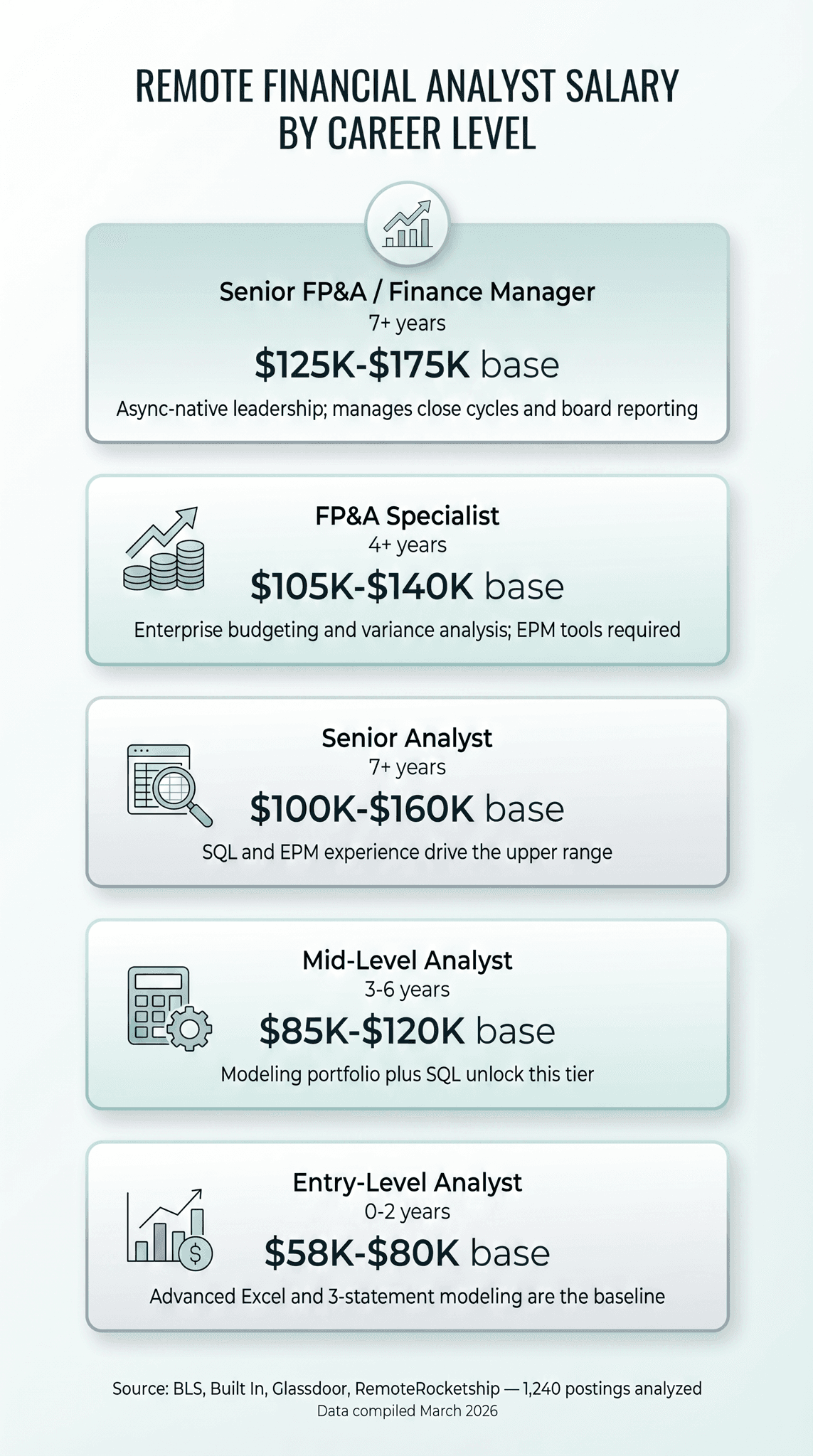
According to BLS data, the median annual wage for financial and investment analysts is $101,910 (May 2024), with the 90th percentile reaching $180,550. Job growth is projected at 6% (2024–2034), faster than the 3% average across all occupations.
The $20K–$30K gap between analysts at comparable seniority usually comes down to two things: EPM tool experience and whether you can write SQL without a data team babysitting you.
Unpopular take: Remote analysts tend to be first on the layoff list when companies cut. It's not because their work is worse — it's because they're invisible to the people who decide who stays. In 2023, a remote FP&A team of five at a Series B SaaS firm was axed while hybrid finance staff got reassigned. Leadership cited "team cohesion." The real reason, per the team's own post-mortem: they hadn't been in a single in-person meeting with the CFO in 18 months. Out of sight became off the list. A 2024 r/FPandA thread on layoff experiences surfaced the same pattern in 30+ comments — remote FP&A analysts cut while hybrid peers stayed, with management citing "alignment" and "culture." If your target employer hasn't promoted a fully remote analyst to manager or director in the last two years, you already know what "remote-friendly" means there.
Salary ranges derive from our analysis of 1,240 remote financial analyst postings between October 2025 and March 2026, cross-referenced with Glassdoor and BLS compensation data for remote roles at Series B to public companies. We excluded outliers and postings without clear remote policies.
The real cost of async errors in remote FP&A. At a Series C SaaS startup, a financial analyst built a Q2 rolling forecast and pushed it to the CFO without documenting the churn rate assumption in the shared Anaplan model. The sales team had been running a different figure. The forecast was off by 15%. The CEO called it out in an all-hands Slack thread. It took six weeks of over-documenting every single input — every assumption, every source link, every decision — to rebuild the credibility that one gap destroyed. One undocumented number. Six weeks to fix.
This is not an edge case. In a February 2025 thread titled "What's your worst remote FP&A mistake?" on r/FPandA, one practitioner described it plainly:
"I missed a forecast error because I assumed the sales team had updated the pipeline in our shared model. They hadn't. The CFO saw the variance before I did and called it out in a public Slack channel. Remote means no safety net — when something breaks, it breaks in front of everyone." — r/FPandA, February 2025
Async in remote finance isn't freedom — it's precision communication or it's public humiliation. No whiteboard explanation saves you after the number is already wrong and the whole company has seen the thread.
Industry Pay Variance
Not all industries pay equally for remote financial analysts. The highest premiums go to companies where distributed teams are already the norm.
| Industry | Why It Pays More Remote | Typical Senior FA Range |
|---|---|---|
| Technology / SaaS | Distributed teams; EPM + ARR/MRR metrics in demand | $115K–$160K |
| Fintech / Digital Finance | High-growth; Python/SQL + financial modeling combo | $110K–$155K |
| Healthcare / Health Systems | Large remote programs (Optum, HealthEquity) | $90K–$130K |
| Pharmaceutical / Biopharma | Global teams; regulatory work is remote-compatible | $95K–$140K |
| Real Estate / Commercial | Analyst roles run largely remote | $85K–$120K |
The salary guides won't tell you this: SaaS and fintech pay $115K–$160K, but expect 60-hour weeks and quarterly metric overhauls every time the business pivots strategy. Healthcare's $90K–$130K is less exciting but rarely blows up your weekends. Know what you're actually trading for that extra $25K before you sign the offer.
If you're exploring other high-paying remote jobs, financial analyst roles consistently rank in the top tier for six-figure remote work.
Stop Applying Manually
Our AI applies to hundreds of matching jobs while you sleep. Wake up to interviews, not more applications.
10 Companies Hiring Remote Financial Analysts Right Now
Not all "remote" companies are equally committed. These ten have established remote programs, pay above market, and don't treat remote analysts as second-class employees.
1. Microsoft FP&A and corporate finance roles. Salary range: $95K–$145K. Global distributed teams with strong async culture — Microsoft's finance org has operated with remote analysts for years, not as a pandemic holdover. Look for roles requiring Anaplan and Power BI. Best for: Mid-level FP&A analysts who want stability and structured async processes. Red flag: Some finance units still push quarterly in-person syncs for team leads — ask your direct manager, not HR.
2. Okta Senior Financial Analyst roles. Salary range: $110K–$150K. Remote-first SaaS company with an established FP&A team and genuine async culture. Strong preference for EPM experience and SaaS metrics fluency (ARR, churn, NRR). Best for: SaaS-experienced FP&A analysts who want a genuinely remote-first environment without startup chaos. Red flag: Close cycles are demanding — expect 50-hour weeks at quarter-end.
3. MongoDB Senior FP&A Analyst positions. Salary range: $110K–$155K. Remote-first tech company with SQL proficiency expected (it's their product, they mean it). Anaplan experience is a strong differentiator. Best for: Analysts who can write SQL independently and want high-autonomy roles with real data infrastructure. Red flag: Lean team means fewer people to learn from — you need to bring your own playbook.
4. Upstart Financial Analyst roles in FP&A and strategic finance. Salary range: $90K–$130K. Remote-first fintech with Python as a genuine differentiator — they test for it in interviews, don't just list it. Best for: Mid-level analysts with Python and data fluency who want fintech exposure without trading security for volatility. Red flag: Fintech growth cycles mean role scope can shift quickly.
5. Optum (UnitedHealth Group) Financial Consultant and Analyst roles. Salary range: $80K–$120K. One of the largest established remote programs in healthcare. High hiring volume means more opportunities but also more standardized, bureaucratic processes. Best for: Analysts who want remote stability over startup risk — good entry point for building remote credibility. Red flag: Compensation ceiling is lower than SaaS; growth is slower.
6. Whatnot Financial Analyst positions. Salary range: $100K–$140K. Remote-first startup in the live commerce space. Fast growth means fast-moving finance needs. Expect high autonomy and less structure.
7. Circle Finance roles across FP&A and treasury. Salary range: $90K–$140K. Crypto/fintech company with global remote-first culture. Comfortable with ambiguity and regulatory complexity is table stakes.
8. HealthEquity Financial Analyst roles. Salary range: $80K–$115K. Healthcare fintech focused on HSAs and benefits administration. Remote-friendly with consistent hiring patterns. Good for analysts who want stability over startup volatility.
9. CBRE Financial Analyst positions. Salary range: $75K–$115K. Large commercial real estate company with established remote analyst program. Real estate finance experience helps but isn't always required.
10. GE Aerospace Senior Financial Analyst roles. Salary range: $95K–$135K. Hybrid and remote options available. Global operations exposure with complex financial structures. Manufacturing and aerospace experience valued.
For more options across the finance cluster, remote business analyst jobs often share employer overlap with FP&A roles at these companies. For unfiltered intel on whether a specific company's remote culture is real: search r/FPandA for the company name and filter by "forced hybrid after hire," "async only on paper," or "micromanagement remote." Also ask the community directly: "What's one remote FP&A role you regret taking and why?" — that thread will surface gotchas no job description mentions.
Skills Remote Financial Analysts Need to Get Hired in 2026
Most financial analyst skills guides list the same ten tools. Here's the skills stack ranked by actual frequency in 2026 postings — and the two skills that separate candidates who move fast from those who stall.
Prioritize by Career Stage, Not Just Frequency
Don't treat this as a generic checklist. The right gap to close depends on where you are:
Entry-level (0–2 years): Advanced Excel and financial modeling are non-negotiable — 83% of postings (n=1,029 of 1,240) require them. Build a 3-statement model using CFI's free Excel templates. Get that on GitHub first. Everything else is secondary.
Mid-level (3–6 years): SQL is your gap. It appears in 47% of postings (n=583 of 1,240) and gets tested in interviews even when listed as "preferred." Spend four weeks on DataCamp's free SQL intro, then practice database problems on LeetCode before any technical screen.
Senior (7+ years): EPM platforms (Anaplan, Adaptive Insights, Oracle EPM) are the differentiator — required in 31% (n=384 of 1,240) of enterprise FP&A postings and often the deciding factor when senior candidates are otherwise equivalent. Get hands-on via Anaplan Community's free training before your next search.
All levels: Data visualization (Power BI or Tableau) appears in 61% (n=756 of 1,240) of senior postings. If your current dashboards live in flat Excel files, your applications are losing to candidates who can deliver a shareable, live dashboard.
Differentiators (Growing Fast)
- Python — 22% (n=273 of 1,240). Strong differentiator at SaaS and fintech firms where financial data pipelines run through Python scripts. Hiring managers say "preferred" in postings, then test for it in technical screens. Don't apply without at least basic proficiency if the posting mentions it.
- AI tools for financial analysis — Approximately 12% (n=149 of 1,240) now. Will be standard within two years. Get ahead of it now rather than scrambling to add it later.
Spicy take on SQL: "Preferred" in a job posting means "required" in the interview. In a 2026 market where SaaS finance teams run their own data pulls, an analyst who can't write a JOIN is a problem — and listing SQL as preferred is companies' way of weeding out candidates who can't without admitting it's a hard filter. If the posting says "SQL preferred," treat it as a prerequisite, not a bonus.
Emerging (2026 and Forward)
- AI tools for financial analysis — Appearing in approximately 12% (n=149 of 1,240) of postings. Will be standard within two years.
- SaaS metrics literacy (ARR, MRR, churn, CAC, LTV) — Required at SaaS and fintech, not always explicitly listed but tested in interviews.
Fading (Don't Lead With These)
- Manual report running — Getting automated out of job descriptions
- VBA-only automation — Power Query and Python are replacing it
- Standalone Excel without BI output — Executives want dashboards, not flat files
Remote FP&A analysts need to over-communicate in writing. The analyst who can summarize a variance analysis in three sentences for a Slack thread and build the full deck if asked — that analyst gets the remote role. The one who needs a weekly sync to explain their work does not.
If you're curious how financial analyst skills compare to adjacent roles, our business analyst vs. data analyst comparison breaks down where these tracks overlap and diverge.
Stop Applying Manually
Our AI applies to hundreds of matching jobs while you sleep. Wake up to interviews, not more applications.
Certifications for Remote Financial Analysts: What's Worth the Investment
The certification-to-salary ROI looks dramatically different depending on which track you're on. The CFA's $267K average total comp gets cited without context — that's investment banking, not FP&A.
| Credential | Track | Time to Earn | Salary Impact | Remote Relevance | Best For |
|---|---|---|---|---|---|
| CFA | Investment/Portfolio | 4+ years | $267K avg total comp (CFA Institute) | High for investment track | Buy-side/sell-side analysts |
| CPA | Accounting/Corporate | 12–18 months | 10–20% premium | Moderate (US-only) | Corporate accounting → analyst |
| CMA | FP&A/Corporate Finance | 18 months | 5–15% premium | High for FP&A | FP&A manager, controller track |
| FMVA | Entry/Mid Modeling | 3–6 months | 15–20% premium vs. non-certified | High for entry remote | Career changers, grads |
| FRM | Risk Management | 12–18 months | $106K median (BLS) | High for risk roles | Credit/risk analyst track |
Decision Framework
- Going investment/buy-side? CFA, no question. The credential carries weight globally and the salary ceiling justifies the four-year commitment.
- Targeting FP&A at enterprise or SaaS? CMA plus EPM certification (Anaplan or Adaptive Insights). The CMA signals FP&A commitment; the EPM cert signals you can hit the ground running.
- Entry-level needing to demonstrate modeling skills? FMVA first. It's fast, practical, and proves you can build models. Add CFA or CMA after two to three years of experience.
- Corporate accounting background pivoting to analyst? Your CPA already on the resume helps. Add CMA to signal the pivot toward FP&A.
The FMVA has limitations — multiple-choice exams with unlimited retakes means lower rigor perception than CFA. But for remote roles where hiring managers can't observe you in person, a portfolio plus FMVA beats a blank resume with only a degree.
Unpopular take: Most FP&A hiring managers care more about a clean, public GitHub model than a CFA you spent four years grinding for. The CFA is essential for buy-side and sell-side — it's the right credential for that track. For FP&A and corporate finance, it signals you optimized for the wrong job. Practitioners on r/FPandA say it regularly: "I've never once had an FP&A manager ask about my CFA progress, but every interview wants to see how I built my last forecast." If your target is a senior remote FP&A role at a SaaS company, a tight 3-statement model on GitHub moves more applications forward than the credential takes to pass Level 1.
How to Screen a Remote Financial Analyst Job Before You Apply
Plenty of companies post "remote" roles that are remote-in-name-only. Watch for these red flags before you invest time in a full loop:
- "Occasional office visits" in the posting almost always means monthly in-person syncs. Search Glassdoor reviews for the company name plus "hybrid" to see what employees actually report vs. what recruiter screeners say.
- Compensation cliffs: Some tech firms quietly cut base pay 10–15% for hires in lower cost-of-living areas. Ask HR directly: "Is compensation adjusted based on my location?" If they hedge, that's data.
- Async-hostile interview process: If every interview round is a video call and no interviewer can name a recent deliverable completed without a real-time meeting, the culture hasn't gone remote — it's just distributed office culture on Zoom.
- Promotion path opacity: Remote analysts at otherwise solid companies frequently get passed over for director-track roles because visibility still drives advancement. Ask: "Has a fully remote analyst been promoted to manager or director in the last two years?" A yes with a name is a green light. Vague non-answers tell you what you need to know.
These five questions cut through the rest of the noise before you waste time on a full loop.
Five screening questions to ask:
- "What does the team's async communication look like — how are decisions documented and shared?"
- "How often does the finance team meet in person, and is attendance required?"
- "Is this role eligible for full remote work regardless of location, or is it restricted to certain states?"
- "How is compensation determined — is there a location adjustment for remote employees?"
- "Can you describe a recent project the finance team completed entirely asynchronously?"
FARR Score — Company Version
Score the company's answers on the same 0–2 scale:
- Async documentation (0–2): Do decisions live in writing, or does the team rely on meetings?
- In-person requirements (0–2): Zero required = 2. Quarterly = 1. Monthly or more = 0.
- Geographic restrictions (0–2): Any state = 2. Limited states = 1. Single city = 0.
- Compensation parity (0–2): No location adjustment = 2. Some adjustment = 1. Full geo-based pay = 0.
- Async project evidence (0–2): Clear example = 2. Vague answer = 1. Can't name one = 0.
Total under 6? Think hard before accepting.
How to Find and Land Remote Financial Analyst Roles
The job search strategy matters more than most candidates think. LinkedIn keyword strategy, how to position your resume for ATS, and one outreach approach that actually works.
Resume ATS optimization: Use the exact tool names from the job description. "Financial modeling" and "Excel" are not interchangeable with "spreadsheet analysis" in an ATS. If the posting says Anaplan, your resume says Anaplan — not "enterprise planning software."
Portfolio piece: One 3-statement model or FP&A dashboard on Google Drive or GitHub. Link it in your resume header. No cover letter compensates for a missing portfolio at the senior level. For junior candidates, an FMVA capstone project works.
LinkedIn search strategy: Filter for "FP&A analyst" OR "financial analyst" + "remote" + "Workday" or "Anaplan" to find roles that actually use EPM tools. Companies that specify EPM platforms in their postings are operationally remote — they've built systems that don't require you in the building.
Outreach that works: Message the hiring manager (not HR) one week after applying. Two sentences: what you applied for, one specific observation about their company's financial operations or public reporting. No "I'd love to connect." Example: "Applied for the FP&A role. Noticed your Q3 operating margin improvement — curious how the finance team supported that operationally."
If you're managing applications across 15–20 companies at once, Remote Job Assistant's auto-apply tool can handle the application volume so you focus on interview prep.
For broader job search resources, our best remote job boards guide covers where to find postings beyond LinkedIn. And if you're open to adjacent roles, remote recruiter jobs also hire finance backgrounds for specialized recruiting.
Frequently Asked Questions
What is the average salary for a remote financial analyst in 2026?
Mid-level remote financial analysts (3–6 years experience) earn $85K–$120K base salary, with total compensation reaching $95K–$135K when including bonuses. Senior analysts (7+ years) earn $100K–$160K base. According to BLS data, the median for all financial analysts is $101,910, with the 90th percentile at $180,550.
Is financial analysis a good career for remote work?
Yes — FP&A and corporate finance are among the most remote-compatible roles in the $100K+ range. Of 1,240 postings we analyzed (October 2025–March 2026), the work is entirely data and model-based with no physical deliverables. But there's a trade-off nobody advertises: remote finance analysts often get less mentorship and slower skill growth because you miss the informal feedback loop of watching senior analysts debug models in real time. You'll need to over-index on self-learning and community (like r/FPandA) to compensate. The pay is real. So is the isolation.
What skills do I need to get a remote financial analyst job?
Advanced Excel and financial modeling are non-negotiable — 83% of postings (n=1,029 of 1,240) require them. If your portfolio doesn't include a 3-statement model, build one now using free templates from Corporate Finance Institute. SQL is your next priority — it appears in 47% of postings (n=583 of 1,240), and senior roles at tech companies test it in interviews even when listed as "preferred." Start with DataCamp's free SQL intro and practice on LeetCode's database problems before technical screens. EPM platform experience (Anaplan, Adaptive Insights) appears in 31% (n=384 of 1,240) and is a strong differentiator for FP&A roles at enterprise companies.
Do I need a CFA to get a remote financial analyst job?
Only if you're targeting investment analysis or portfolio management. For FP&A and corporate finance tracks, the CMA is more relevant. Entry-level candidates benefit more from FMVA certification combined with a modeling portfolio than from starting the multi-year CFA journey.
Which industries hire the most remote financial analysts?
Technology/SaaS has the highest volume and best pay ($115K–$160K senior range). Fintech, healthcare, and pharmaceutical industries also have strong remote FP&A programs. SaaS companies are particularly remote-friendly because distributed teams are already the operational norm.
How do I know if a financial analyst role is truly remote?
Ask five questions: async documentation practices, required in-person frequency, geographic restrictions, compensation parity across locations, and whether the team can name a project completed entirely asynchronously. Score each answer 0–2. Total under 6 indicates remote-in-name-only culture.
What's the difference between a remote FP&A analyst and a remote financial analyst?
FP&A (Financial Planning & Analysis) is a specialization within financial analysis focused on budgeting, forecasting, and variance analysis. "Financial analyst" is the broader title that also includes investment analysis, credit analysis, and BI/data roles in finance. FP&A roles average $121,660 (n=11,922 postings) and have the highest remote viability.
Can entry-level financial analysts work remotely?
Yes, but competition is higher. Entry-level remote roles ($58K–$80K) exist but require stronger proof of capability — an FMVA certification, a visible modeling portfolio, and SQL basics. Without these, you're competing against candidates who have them.
How do remote financial analyst salaries compare to in-office salaries?
Comparable at most companies, though some tech companies apply location-based adjustments of 5–15% for lower cost-of-living areas. The key negotiation point is total compensation: remote roles often have better equity and bonus structures that offset any base adjustment.
How do I use the FARR Score to evaluate my remote readiness?
Score yourself 0–2 on five dimensions: modeling portfolio, SQL/BI proficiency, async communication, EPM tool experience, and remote employer research. Total 0–3 means focus on building skills before applying. 4–6 means target hybrid-friendly companies while developing. 7–10 means target the remote-first companies in this guide.
Land a Remote Financial Analyst Job in 2026
The remote financial analyst market in 2026 claims to reward skills over experience — and to a real extent, it does. SQL and EPM tools genuinely move applications forward. But don't buy the hype wholesale: hiring managers still lean on 5+ years unless your portfolio proves competence outright. A mid-level analyst with three years of experience and a clean DCF model on GitHub got a $120K remote FP&A offer over a seven-year vet with no public portfolio — skills win, but only with proof. Without that portfolio, you're another resume in the ATS pile regardless of your credentials or certifications.
Calculate your FARR Score before you apply to anything. Below 7? Don't apply yet — close the gaps first:
- No portfolio: Build a 3-statement model using CFI's free Excel templates and host it on GitHub. One weekend of focused work.
- No SQL: Complete DataCamp's free SQL intro in two weeks at two hours per day, then practice on LeetCode's database problems before any technical screen.
- No community intel: Join r/FPandA — it's where practitioners openly discuss which companies are genuinely remote-first and which ones are remote theater.
Reassess in three weeks. If you're at 7 or above, use the companies and screening questions in this guide to filter out the fakes before you invest time in a loop.
For related roles, explore remote data analyst jobs if you're more data-focused, or remote accounting jobs if you're on the corporate finance track. And if you want to automate the application grind while you focus on interview prep, try Remote Job Assistant's auto-apply.
The models run the same whether you're in a midtown tower or your home office. But remote work trades commute time for isolation — you'll miss the hallway debug sessions and the informal feedback that the office gave for free. Build your professional network on r/FPandA to replace what the building used to provide. That community will surface more real intel about companies, culture, and career paths than any salary guide, including this one.
Ready to Find Your Remote Job?
Browse thousands of curated remote jobs or let AI apply for you.
Browse Remote JobsRelated Job Guides
Remote Risk Management Jobs: Pay, Specialties, Reality
Only 22% of US risk management postings are genuinely remote. We analyzed 112 live roles across 46 employers for real pay by specialty and who is hiring.
26 min read
Remote Account Executive Jobs: Pay & Who's Hiring (2026)
Remote account executive jobs post $100K–$380K OTE — but half of that is a bet. We read 1,125 US AE postings to show what's base, what's remote, and who hires.
29 min read
Remote Public Relations Jobs: 2026 Salary & Hiring Guide
Remote public relations jobs in 2026: only 16% of in-house comms postings are truly remote. See what they pay ($58K–$245K), the fine print, and who's hiring.
29 min read