
Last reviewed: October 2026
You know which index the month-end close needs before anyone files the ticket. You have read more execution plans than most people have read emails, and your title still says SQL Developer, on a contract through a firm whose name isn't on the database. So you search "remote sql jobs." Google's first result is an Indeed page that no crawler can load. The second is a Dice page where 14 of 20 cards are contract or third-party and 7 of the 20 are the same Virginia toll-road database job, reposted by 7 staffing vendors, with lines like "Must be VA Resident only" and "Local candidate only In person interview only" inside cards filed as remote. LinkedIn's remote SQL page claims 10,000 or more openings, shows pay on none of its 60 cards and a city on 29 of the first 30. The fourth result is a Reddit thread from January 2020, and its most useful answer is "I don't have hard numbers."
The government doesn't have a "SQL job" either. The Bureau of Labor Statistics counts 69,990 database administrators at a $104,620 median and 67,140 database architects at $139,500 (May 2025), projects 0% growth for the first group and 9% for the second through 2035, and says nothing about remote work for either. O*NET's hot-technology data finds SQL in 758,250 US job postings in 2025, the seventh most-requested technology of 176, inside 62% of database-administrator postings, 51% of data-scientist postings and 24% of software-developer postings. SQL is the language under at least eight job families whose median pay in our postings runs from $102,500 to $225,625, and the boards file all of them under one keyword.
Get Remote Job Tips in Your Inbox
Weekly strategies, salary data, and new opportunities
Unsubscribe anytime. No spam.
So we read the postings. Two things predict a SQL posting's pay better than any dialect it names: what the SQL produces, and who posts the seat. The title is a tell on its own. If your title says Developer and the posting you want says Engineer, the median posted midpoint in our set moves from $110,000 to $160,000, and the SQL in the two job descriptions is often the same. SQL is the language that runs everything and the title word that pays least for it: the best-paid SQL work is posted as Database Engineer, Data Engineer or Analytics Engineer, with SQL in the requirements and not in the title.
Remote Job Assistant read 449 US postings whose title names SQL (SQL Developer, SQL Server DBA, T-SQL and PL/SQL Developer, PostgreSQL and MySQL DBA, SSIS and SSRS developer, SQL Data Engineer and SQL Analyst titles) from 353 employers in full, pulled October 10, 2026, with posting dates from October 2025 to October 2026 (380 of them listed since July 1). They came from LinkedIn (218, from 62 keyword searches plus LinkedIn's own three SQL pages), the Indeed network via SimplyHired (155), Himalayas (36), 312 Workday career sites (27), 941 Greenhouse, Lever, Ashby and SmartRecruiters boards (7, because startup boards put SQL in the requirements, not the title) and amazon.jobs (6). We read 186 Database Administrator, Database Engineer and Database Developer postings and 191 Data Analyst, BI and Data Engineer postings that require SQL without naming it in the title the same way, and report them separately. We set aside QA and ETL testers, NoSQL-only titles, instructors, 4 offshore listings posted under a US flag and 3 AI-trainer gigs that wanted "SQL" experts.
Based on our analysis of 449 US SQL-titled postings at 353 employers (posted October 2025–October 2026):
- 25.2% (n=113 of 449) were fully remote; among the 272 postings that state a work model, 41.5%; 177 say nothing
- 33.2% (n=149 of 449) were posted by IT consultancies and staffing firms; consultancy postings carry a $104,400 median range midpoint (n=23) and staffing firms $107,500 (n=12), against $148,750 at software companies (n=30), $144,750 at banks and insurers (n=29) and $130,000 at federal contractors (n=29)
- $127,943 median midpoint for SQL-titled postings (n=162) against $142,650 for database titles that require SQL without naming it (n=80) and $178,356 for Data Analyst, BI and Data Engineer titles that require it (n=149); remote in 41.5% (113 of 272), 38.1% (37 of 97) and 43.4% (63 of 145) of those stating a model
- 55.9% (n=251 of 449) are SQL Server seats, named in the title or, for plain "SQL" titles, in the body, at a $115,906 midpoint (n=88); Oracle seats post $125,000 (n=15), PostgreSQL seats $145,000 (n=32) and cloud-warehouse seats $185,875 (n=11)
- $100,000 median midpoint for postings whose only stack words are legacy (SSIS, SSRS, Access, VBA, older SQL Server versions; n=40) against $140,000 for postings that name a cloud warehouse or modern tooling (n=61); SSIS alone marks the gap, $110,000 with it (n=37) and $130,000 without (n=125)
- 36.1% (n=162 of 449) post an annual range: median $107,900–$145,220; 96 start at $100,000 or more (15 remote) and 26 at $150,000 or more (1 remote); 54 more post only an hourly rate, $55–$60 an hour on the 32 contract rows
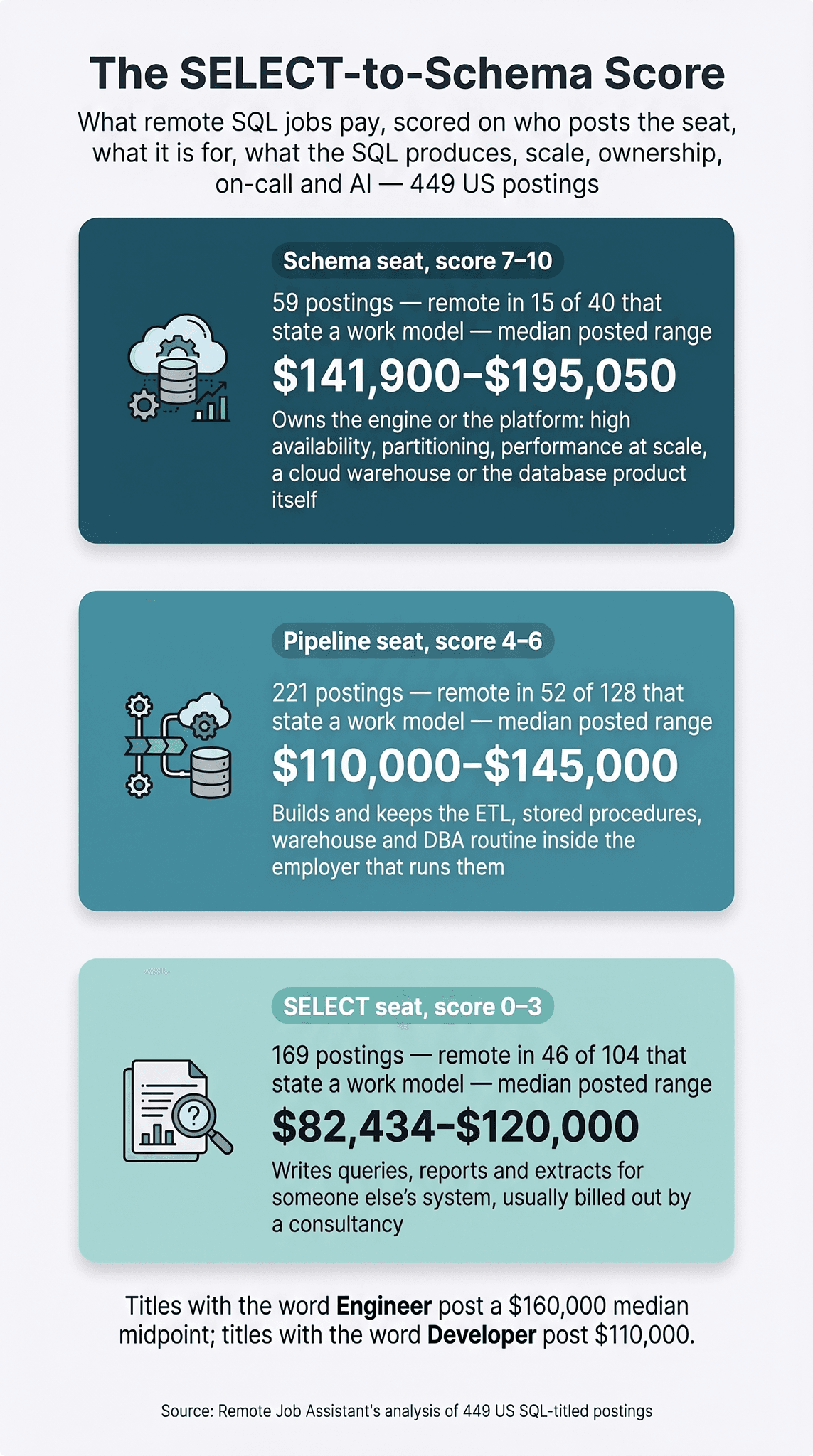
- 37.6% (n=169 of 449) score as SELECT seats at a $100,000 midpoint (n=48), 49.2% (n=221) as Pipeline seats at $130,000 (n=87) and 13.1% (n=59) as Schema seats at $170,650 (n=27)
- Of the 113 remote postings, 23 name on-call, 13 night or weekend windows, 12 US citizenship, 12 a time zone or core hours, 10 a security clearance, 10 travel and 9 W-2 only
Three seats, then. A SELECT seat (169 postings) posts a $100,000 midpoint and is remote 44.2% of the time it states a model (46 of 104); a Pipeline seat (221) posts $130,000 and 40.6% (52 of 128); a Schema seat (59) posts $170,650 and 37.5% (15 of 40). Pay climbs with the score and the remote share falls with it, because the seats that are easiest to hand to someone working from home are the ones a consultancy can bill by the hour.
Among SQL-titled postings, exactly 1 of the 31 remote ones with a posted range starts at $150,000 or more: Beacon Biosignals' Staff Software Engineer, PostgreSQL at $170,000–$190,000. The next rung down is ABC Legal Services' Sr. Database Engineer, Postgre SQL/AWS Aurora at $140,000–$150,000, GSSI Solutions' Senior SQL/Oracle DBA Lead at $138,550–$156,856, Patient Accounting Service Center's Database Administrator, Microsoft SQL Server at $135,000–$155,000 and DrFirst's PostgreSQL DBA at $130,000–$150,000. The two comparison sets have 30 remote starts at $150,000 or more between them: Chainguard's Staff Platform Database Engineer at $205,000–$231,000, Altruist's Staff Database Administrator at $181,000–$265,000, Airbnb's Senior Staff Data Engineer, Foundational Data at $248,000–$310,000, Discord's Senior Data Engineer, Ads at $220,500–$245,000, 1Password's Director, Analytics Engineering at $204,000–$306,000, Mercury's Senior Data Analyst, Reconciliation at $192,300–$235,100 and Vanta's Senior Analytics Engineer at $190,000–$224,000. None of those 30 says SQL in the title.
How We Collected This Data
Two biases shape every number below. Pay is posted on 36.1% of SQL-titled postings (162 of 449: 25 of 27 Workday rows, 70 of 218 LinkedIn rows, 54 of 155 SimplyHired rows, 7 of 36 Himalayas rows; 29 of 51 at banks and insurers and 29 of 49 at federal contractors, against 23 of 110 at consultancies and 12 of 39 at staffing firms), so medians lean toward employers with pay-transparency blocks and away from the small consultancies that never print a range. And 177 of the 449 postings (39.4%) say nothing about work model, so every "remote" share in this guide is a share of postings that state one. A third bias applies to the comparison sets: 173 of the 186 database-title postings came from LinkedIn, while 150 of the 191 analyst and data-engineering postings came from Greenhouse, Lever, Ashby and SmartRecruiters boards, which skews that set toward product companies with posted pay. So wherever we compare them with the SQL-titled set we also compare within one source (on LinkedIn, SQL-titled $121,334, n=70, against database titles $138,742, n=72) and within one employer kind (at software companies, $148,750, n=30, against $184,222, n=119). What we could not read: Indeed, Glassdoor and ZipRecruiter return 403 errors to every route we tried, including the Internet Archive, Reddit is behind a login wall, and the Dice, FlexJobs, Robert Half, Remote Rocketship, Turing and Working Nomads pages were read by hand and not counted.
A posting counted if its title named SQL, T-SQL, PL/SQL, MS SQL, SQL Server, MySQL, PostgreSQL, SSIS, SSRS or SSAS next to a role word. We sorted those titles by the other words in them: DBA and database administration, database-product engineering (Postgres control planes, Aurora and RDS engineering, distributed-SQL engines), data engineering and ETL, BI and reporting, analyst, an application language next to SQL (.NET, C#, Java), support, and plain SQL Developer. We dropped QA and ETL-tester titles, NoSQL-only titles (a MongoDB DBA is not a SQL job), security, instructors and tutors, interns, recruiters, data entry and non-English titles. Database, analyst, BI and data-engineering titles without the word SQL were kept only from the same SQL keyword searches and only when the body requires SQL: a SQL-craft term named alongside it (stored procedures, execution plans, window functions, CTEs, SSIS, dbt, Snowflake), primary-skill phrasing ("advanced SQL," "writing complex queries"), or two mentions. A posting that names SQL once in a list of tools is not a SQL job, and we did not count it (3 did that).
Dedupe started from 1,387 rows, 1,071 of them in the US, removed 43 exact copies, 76 per-city clones of one requisition and 20 copies under sibling employer names, then collapsed 82 duplicates found on two sources, leaving 836 unique postings across the SQL-titled and comparison sets. One sampling choice needs saying: LinkedIn rate-limited job pages after our 62 keyword searches, so the LinkedIn core is a fixed-seed random sample, 256 of the 316 unique SQL-titled cards those searches returned, with the cards on LinkedIn's own three SQL pages read first. A random sample does not bias the shares; it only lowers the counts. We read work model from the posting text, not the board's flag: LinkedIn's "remote" keyword searches returned 62 kept SQL-titled rows, of which 34 are remote in the body, 12 hybrid and 16 silent, and the 12 postings with "Remote" in the title are remote in 11 bodies and on-site in 1. Employer kind comes from curated name lists (the IT-services firms named by hand), then the employer's own LinkedIn industry label ("IT Services and IT Consulting" is the consultancy label), then body rules for "our client," C2C and W-2 language.
The SELECT-to-Schema Score is computed by code from duty language, and the audit settled one design question. The stack era moves SQL pay more than the Python era moved Python pay: postings whose only stack words are legacy post $100,000 (n=40), postings with migration language $130,000 (n=36), postings that name neither $137,500 (n=25) and postings that name a cloud warehouse or modern tooling $140,000 (n=61). But Snowflake, Databricks and partitioning are also the engine words the output point counts, so scoring the stack too would count the same sentence twice. The stack is reported beside the score, not inside it. Every scored component raises the posted midpoint on its own, including on-call, which lowered Python pay and raises SQL pay.
Salary cross-references: BLS Occupational Employment and Wage Statistics for May 2025 (Database Administrators, median $104,620, 25th percentile $79,610, 75th $135,460, 90th $163,320; Database Architects, median $139,500, 75th $169,290, 90th $204,000; database administrators in computer systems design, $124,130), the BLS Occupational Outlook Handbook (database administrators and architects combined, $126,760 median in 2025, 4% growth to 2035, about 7,300 openings a year), Levels.fyi's October 10, 2026 total-compensation medians (database administrator $126,480, data engineer $157,300, business intelligence engineer $166,000, data analyst $110,000, equity and bonus included) and the Stack Overflow 2025 survey's US medians (data engineer $150,000, data or business analyst $100,956). Glassdoor's, Indeed's and ZipRecruiter's figures appear only in search-result titles and are labelled that way below.
The SELECT-to-Schema Score: Why Two Remote SQL DBA Jobs Pay $56,500 Apart
The advice on most career sites is to stack more tools: SSIS, SSRS, Power BI, another certification. Our postings say the tool list barely matters and sometimes points the wrong way. SSIS appears in 101 of the 449 and carries a $110,000 midpoint (n=37) against $130,000 without it (n=125); SSRS appears in 78 at $110,000; Excel or VBA in 54 at $110,276; stored procedures, the core of every SQL developer resume, in 204 at $121,200 against $136,500 without (n=73 and 89). Certifications are named in 185 postings, at $129,083 against $127,500 without, which is no difference at all. The reason is who writes the tool lists. Consultancies and staffing firms copy every product the client's request named; the banks and software companies write a short duty list and a pay-transparency block. What changes the number is who posts the seat, what the seat is for, what the SQL produces, and whether scale, ownership, on-call and AI tools are written into the work.
The SELECT-to-Schema Score is a 0 to 10 rubric that scores any SQL posting, or your current job, on how far it sits from "writing SELECT statements that feed someone else's reports" toward "owning the schema, the pipelines and the engine the company runs on." It uses only what the posting says. Every component below stays in the score because posted pay rises with it on its own, and the stack era sits beside the score because it overlaps the output point.
Score a posting in four questions.
- Who posts it? A consultancy, a staffing firm, a gig platform or "our client": 0. An in-house team at a hospital, a retailer, a manufacturer, a university, a public body or a federal contractor: 1. A software company, a bank, an insurer, a payments or trading firm: 2.
- What is the seat for? A client's project or a contract: 0. Keeping existing systems running (production support, tickets, maintenance), or nothing decisive: 1. The employer's own product or platform: 2.
- What does the SQL produce? Reports, dashboards, ad hoc pulls, extracts, Excel, SSRS or Crystal: 0. Pipelines, stored procedures, ETL or ELT, data models, a warehouse, integrations, or nothing decisive: 1. The engine itself: performance tuning, execution plans, indexing strategy, high availability and disaster recovery, replication, partitioning, schema design at scale, a cloud-warehouse platform: 2.
- Does it name scale (millions or billions of rows, terabytes, high volume), ownership (architecture, technical leadership, owning the data model or the platform), on-call (a rotation, incident response, 24/7, after-hours support) and AI tools expected in the work (Copilot, Claude, AI-assisted query writing)? One point each.
0 to 3 is a SELECT seat, 4 to 6 a Pipeline seat, 7 to 10 a Schema seat.
What each point is worth, in posted midpoints across the 449 SQL-titled postings:
- Employer (0–2): $103,450 at a consultancy, staffing firm or gig platform (n=44); $128,953 at an in-house team at a hospital, retailer, manufacturer or federal contractor (n=59); $145,000 at a software company, bank, insurer or payments firm (n=59).
- Seat (0–2): $100,000 for a client's project (n=31); $110,000 for keeping existing systems running (n=31); $166,100 for the employer's own product or platform (n=17). Postings that say nothing decisive post $135,000 (n=83), because the terse ones are the banks'.
- Output (0–2): $95,980 when the SQL produces reports and extracts (n=15), $120,000 when it builds pipelines, procedures and models (n=59), $137,126 when it owns the engine (n=86).
- Scale (0–1): $150,000 with it against $120,000 without. Ownership (0–1): $130,000 against $119,525. On-call (0–1): $142,300 against $120,000. AI tools (0–1): $142,300 against $120,000, on 49 postings, 36 of them dated September or October 2026.
Bands:
- SELECT seat (0–3), $82,434–$120,000 median posted range (n=48), midpoint $100,000: you write queries, reports and extracts for someone else's system, usually billed out by a consultancy (81 of the 169) or a staffing firm (23). 169 postings at 144 employers; hourly rows post $50–$55 an hour (n=24); 44.2% of the 104 that state a model are remote; 51 are contract.
- Pipeline seat (4–6), $110,000–$145,000 (n=87), midpoint $130,000: you build and keep the ETL, the stored procedures, the warehouse and the DBA routine (backups, patching, tuning tickets) inside the employer that runs them, at a software company (60), a federal contractor (36), a bank or insurer (30) or a consultancy's better-written seat (29). 221 postings at 188 employers; 40.6% of 128 are remote; 37 are contract.
- Schema seat (7–10), $141,900–$195,050 (n=27), midpoint $170,650: you own the engine or the platform, high availability and disaster recovery, partitioning, performance at scale, a cloud warehouse or the database product itself, at a software company (34) or a bank or insurer (20). 59 postings at 52 employers; 37.5% of 40 are remote; 4 are contract.
How to use it. Score your current job first, then every posting before you apply; four questions take two minutes. Move one component at a time. The biggest single point is the employer: leaving a consultancy bench for a software company, a bank or an insurer is the $41,550 gap between employer 0 and employer 2. The cheapest points are the engine, ownership and AI-tool words you can put on a resume this week if they are true. If you score 0 to 3 and want $150,000 or more, change what your SQL produces and who posts the seat before you learn another dialect; no SELECT seat in our set starts at $150,000. And stop searching for "SQL Developer." Search "Database Engineer," "Data Engineer" and "Analytics Engineer" with SQL in the requirements: those postings post $142,650 to $194,825 and are remote about as often as the SQL-titled ones.
Here is the check run on two real postings that share a work model and a job. Cognizant's MS SQL Database administrator ("Location: Remote," "We are offering between $75,000 – $92,000") is posted by a consultancy (employer: 0) whose practice "delivers key results for our customers" (seat: 0), asks for "Expert: SQL replication and High availability AlwaysON Skills, Troubleshooting Skills, SQL server tuning, performance optimization Skills" (output: 2, engine work), and names ownership ("Strong knowledge on SQL server architecture, design and administration activities": 1) and nothing about scale, on-call or AI tools. Score 3, a SELECT seat. DrFirst's PostgreSQL DBA, also remote ($130,000–$150,000; "DrFirst is committed to being a Remote-First company"), is posted by a health-software company (2) for its own platform ("how data enters our platform from prescribers, pharmacies, EHRs, and patient channels": 2), runs "PostgreSQL on AWS Aurora" as "one critical layer inside a broader, event driven persistence architecture" (output: 2), names scale ("how applications read it back reliably at scale": 1), ownership (1), "Participate in on call rotation for production support" (1) and "Active, daily use of AI tools such as Claude, Copilot, ChatGPT, or Cursor for scripting, troubleshooting, and documentation" (1). Score 10, a Schema seat. Both are remote DBA seats, and both ask for engine skills. The dialect differs, but that is not what separates them: $56,500 of range midpoint does, $83,500 against $140,000, and the first two points of the gap are about who signs the paycheck.
The table shows how the three seats compare on remote share and pay.
| Seat (score) | Postings | Remote, of those stating a model | Median posted range (n) | Hourly rate where posted (n) | Contract | Typical titles and employers |
|---|---|---|---|---|---|---|
| SELECT (0–3) | 169 | 44.2% (46 of 104) | $82,434–$120,000 (48) | $50–$55/hr (24) | 51 | SQL Developer, Oracle PL/SQL Developer, SQL DBA at Intone Networks, Gainwell Technologies, NTT DATA, Capgemini, Kforce, Ampcus and about 135 other employers, mostly consultancies |
| Pipeline (4–6) | 221 | 40.6% (52 of 128) | $110,000–$145,000 (87) | $60–$70/hr (23) | 37 | SQL Developer, SQL Database Administrator, SQL Server DBA, Data Engineer (SQL) at GDIT, Citi, JPMorganChase, CACI, Leidos, Guidehouse, Amazon |
| Schema (7–10) | 59 | 37.5% (15 of 40) | $141,900–$195,050 (27) | $60–$65/hr (7) | 4 | Database Engineer, SQL Server; Microsoft SQL Sr DBA; PostgreSQL Database Administrator at Amazon, Capital One, Supabase, Mastercard, Disney, Cisco, Leidos |
The gap holds inside each seniority level where the samples are large enough to read. Mid-level postings run $81,000–$120,000 in a SELECT seat (n=39) and $100,000–$129,000 in a Pipeline seat (n=44). Senior postings run $110,000–$150,000, $125,000–$169,000 and $167,700–$190,300 across the three bands (n=7, 28 and 15). Lead postings run $113,840–$156,856 in a Pipeline seat (n=11) and $144,000–$220,000 in a Schema seat (n=8). The single-score ladder is not a perfect staircase: it runs $96,250 at 2 (n=20), $110,000 at 3 and $110,990 at 4, where consultancy seats and in-house maintenance seats overlap, then $130,000 at 5, $143,650 at 6, $151,475 at 7, $168,375 at 8 and $192,050 at 9 (n=5). The 3 priced postings at a score of 1 and the single one at 10 are too few to read. Read the bands, not the single digits.
Why who-posts-it moves pay so much comes down to what the seat is priced against. In a SELECT seat, the seat is a billable hour, and the posting says so. Kavaliro's SQL Database Developer: "Pay: $35 - 40 per hour," to "Develop and optimize reports using Crystal Reports and SQL Server Reporting Services (SSRS)." NTT DATA's PL/SQL Developer: "The starting pay range for this role is $38-$48/hour." Allied Resources Technical Consultants' SQL Developer/Power BI Developer: "Pay: $50–$62/hr + 1.5x OT." Gainwell Technologies' remote TSQL Developer posts $58,200–$83,200. The client is the real employer, the firm takes its margin, and the posting carries the client's office rules without the client's pay band.
In a Pipeline seat, the SQL keeps a business running, and the posting reads like an operations manual. Citi's Oracle Database PL/SQL Developer, Assistant Vice President ($96,960–$145,440) lists "support continuous delivery of quality database changes" and "Use AI-powered development tools, including GitHub Copilot" among its duties. Fuze Health's Senior DBA Engineer ($125,600–$157,000) is there to "Lead the planning and execution of the SQL Server modernization on EC2: migration to AWS RDS (SQL Server) and/or in-place version upgrade off SQL Server 2016 ahead of end of support." West 4th Strategy's remote Senior SQL Database Administrator ($125,000–$135,000) sets the working day: "8 hours per day between core hours of 7:30am-6:00pm EST."
In a Schema seat, the database is the product's spine, and the posting prices it that way. Three examples from the database-title set, which the score reads the same way: Crunchyroll's Senior Database Engineer ($203,400–$254,200): "Own the identification, debugging, and elimination of query execution bottlenecks, optimizing raw SQL, missing indexes, execution plans, and data models to maximize throughput and minimize latency." TRM Labs' Senior Software Engineer, Database Engineer ($200,000–$220,000): "Keep customer-facing APIs fast and available at five-nines by owning query tuning, index design, and schema optimization on petabyte-scale Postgres/Citus." Altruist's remote Staff Database Administrator ($181,000–$265,000): "You will lead our multi-region disaster recovery program for data stores, break critical domains out of shared clusters into dedicated ones, and re-architect our replication and data movement layer so it keeps up as volumes multiply."
Two places where the score and the pay disagree, with the numbers. Cognizant's posting above asks for engine work and scores 2 on output, and the employer and seat points still hold it to $75,000–$92,000; read the output point as necessary, not sufficient. And security clearances do not lift SQL pay the way they lift cleared Python seats: the 66 SQL-titled postings that name a clearance post $127,260 (n=36) against $128,559 without, and only 10 of the 38 that state a model are remote, because a cleared database usually sits inside a facility.
Engine skills don't pay when the seat is billed out: a consultancy DBA posting that asks for AlwaysOn, replication and tuning posts $75,000–$92,000, and a product company's DBA posting with the same skills and an on-call rotation posts $130,000–$150,000, both remote.
If you score your current job and land in the SELECT band, you don't need a new credential to move. You need direct-employer postings in front of you, and a lot of them, because the 280 Pipeline and Schema seats are spread across 229 employers, and the best-paid version of the same work usually drops SQL from the title altogether.
Stop Applying Manually
Our AI applies to hundreds of matching jobs while you sleep. Wake up to interviews, not more applications.
Remote SQL Developer Salary: What 162 Posted Ranges Show
Salary ranges in this section come from the 162 SQL-titled postings that print an annual range, collected October 2025 to October 2026 and cross-referenced with BLS's May 2025 wage data and Levels.fyi's October 2026 medians; hourly-only rows are reported separately because they are almost all contracts. Across all 162, the median posted range is $107,900–$145,220 and the median midpoint $127,943 (25th percentile $101,880, 75th $150,369). 147 of the 162 (90.7%) start at $75,000 or more, 96 (59.3%) at $100,000 or more and 26 (16.0%) at $150,000 or more. Only 1 of those 26 is remote.
| Title family | Postings | Median posted range (n) | Midpoint | Remote, of those stating a model | Hourly where posted (n) |
|---|---|---|---|---|---|
| Database-product engineer (Postgres, Aurora, distributed SQL) | 17 | $190,000–$261,250 (5) | $225,625 | 8 of 13 | n/a |
| Application developer with SQL (.NET, C#, Java plus SQL) | 38 | $113,840–$163,000 (15) | $141,067 | 6 of 21 | $40–$52/hr (5) |
| DBA (SQL Server, PostgreSQL, Oracle, MySQL) | 176 | $110,500–$150,000 (65) | $136,753 | 44 of 101 | $54–$60/hr (21) |
| SQL data engineer, ETL and SSIS developer | 56 | $115,000–$140,000 (22) | $131,250 | 15 of 38 | $60–$70/hr (5) |
| SQL developer (T-SQL, PL/SQL, SQL Server) | 128 | $98,480–$125,000 (42) | $110,000 | 30 of 77 | $52–$58/hr (20) |
| SQL analyst, BI and support | 34 | $88,000–$120,000 (13) | $102,500 | 10 of 22 | $50–$69/hr (3) |
Plain SQL developer seats sit at the bottom of the technical families because they are where consultancies post: 72 of the 128 developer postings score as SELECT seats, and 38 of them are contracts. DBA seats sit higher because a DBA posting has to name the engine work, and the database-product engineers sit far above both because they build the database rather than run one.
The title word is the cheapest tell in the set. Titles with the word Engineer post a $160,000 midpoint (n=39); titles with Developer or Programmer post $110,000 (n=65); titles with Administrator or DBA post $135,876 (n=54). Developer titles are 29.5% contract (57 of 193), Engineer titles 14.8% (13 of 88). The gap holds where the employer is the same kind: Engineer $205,000 against Developer $127,500 at software companies (n=9 each), $177,500 against $121,200 at banks and insurers (n=13 and 9), $130,000 against $104,400 at consultancies (n=6 and 9).
The government numbers sit lower than ours for a structural reason. BLS's $104,620 median for database administrators covers every DBA in the country, including the on-site ones at schools and public bodies (educational services pay a $86,330 median) and the ones whose title is "Systems Administrator" with a database on the side; our postings are for named SQL seats at employers that hire through job boards. BLS's own industry lines point the same way: database administrators in computer systems design earn a $124,130 median and in finance and insurance $123,280. Levels.fyi's medians run higher again, $126,480 for database administrators and $157,300 for data engineers, because they include bonus and equity and skew toward large tech employers.
The contract math is where most remote SQL work is decided. The 32 contract rows that post an hourly rate sit at $55–$60 an hour, which is $114,400–$124,800 a year at 2,080 hours, with no paid leave, no employer health plan and no 401(k) match, against a $130,000 midpoint for a full-time Pipeline seat. The best contract rates go to migrations: Mitchell Martin's remote Cloud Databases Engineer (GCP, Oracle to Postgres) posts "Pay Range:$100.00-$140.00 Per Hr." The worst go to reports: Kavaliro's $35–$40 for Crystal and SSRS work.
Where Remote SQL Jobs Actually Exist
The remote SQL market is a barbell. At one end, consultancies and staffing firms post a third of all SQL-titled roles and state remote often; at the other, software companies post fewer and pay $44,350 more at the median. Banks sit between them and write hybrid into policy.
| Who posts it | Postings | Remote, of those stating a model | Median midpoint (n) | Pay posted | Contract |
|---|---|---|---|---|---|
| IT consultancy | 110 | 43.1% (28 of 65) | $104,400 (23) | 23 of 110 | 31 |
| Staffing firm | 39 | 33.3% (9 of 27) | $107,500 (12) | 12 of 39 | 19 |
| Software or internet company | 96 | 42.3% (30 of 71) | $148,750 (30) | 30 of 96 | 12 |
| Bank, insurer or payments firm | 51 | 33.3% (8 of 24) | $144,750 (29) | 29 of 51 | 5 |
| Federal contractor | 49 | 40.7% (11 of 27) | $130,000 (29) | 29 of 49 | 6 |
| Health system or health IT | 13 | 57.1% (4 of 7) | $133,575 (8) | 8 of 13 | 1 |
| Employer we could not classify | 50 | 51.5% (17 of 33) | $116,250 (12) | 12 of 50 | 12 |
The other 41 postings sit at agencies, manufacturers, retailers, media companies, universities and public bodies, none of them in large enough numbers to read on their own.
Consultancies state remote as often as software companies do (43.1% against 42.3%), and that is the trap. A consultancy's remote SQL seat is usually a slice of a client's project, priced as a margin on an hourly rate, and the remote line can disappear when the client's office policy changes: 31 of the 110 consultancy postings are contracts, and their median midpoint is $44,350 below the software companies'. Banks are the opposite: they pay $144,750 and state remote on 8 of 24, because their technology groups have written hybrid days into policy. Federal contractors post pay on 29 of 49 (59.2%) and pair it with clearance and citizenship lines, which is why they are remote less often than their pay transparency suggests. If you are reading remote data analyst jobs or remote data engineer jobs alongside this guide, the same pattern repeats with the titles changed.
In remote SQL work, the seats that are easiest to get from home are the ones that pay least: SELECT seats state remote 44.2% of the time at a $100,000 midpoint, and Schema seats 37.5% of the time at $170,650.
That is the trade most SQL job seekers make without seeing it. The remote filter on a job board selects for the billable seat. The fix is not to drop the remote filter; it is to add a second one, the employer, and to search the titles that software companies and banks actually use. Our data and analytics job category and the engineering and technical category both carry those titles, and the remote jobs paying $100,000 or more cut out most of the bench work.
Stop Applying Manually
Our AI applies to hundreds of matching jobs while you sleep. Wake up to interviews, not more applications.
SQL Server, Oracle, PostgreSQL or Snowflake: Which Dialect Pays
SQL Server is the market, and it is the cheapest dialect in it. 251 of the 449 SQL-titled postings (55.9%) are SQL Server seats, named in the title or, for titles that just say "SQL," in the body.
| Dialect (title, else body) | Postings | Median posted range (n) | Midpoint | Remote, of those stating a model | Contract |
|---|---|---|---|---|---|
| SQL Server (T-SQL, SSIS, SSRS) | 251 | $100,000–$135,000 (88) | $115,906 | 35.5% (54 of 152) | 54 |
| Oracle (PL/SQL) | 73 | $100,000–$150,000 (15) | $125,000 | 51.2% (21 of 41) | 25 |
| PostgreSQL | 63 | $130,000–$160,000 (32) | $145,000 | 41.0% (16 of 39) | 8 |
| Cloud warehouse (Snowflake, Databricks, Redshift, BigQuery, Synapse) | 20 | $156,750–$204,700 (11) | $185,875 | 57.1% (8 of 14) | 3 |
| Plain "SQL," no dialect named | 33 | $80,674–$111,730 (12) | $96,750 | 61.1% (11 of 18) | 2 |
Six more name MySQL (3 with pay, $150,000–$170,000) and 3 name nothing we could read.
The order is not about the languages. T-SQL, PL/SQL and PostgreSQL's dialect differ in syntax you can learn in a month. The order is about who runs them. SQL Server is the database of mid-market in-house IT and of the consultancy requests that serve it, so its postings carry the SSIS packages, SSRS reports and stored procedures that the tool-list analysis above priced at a discount. Oracle seats are a third contract (25 of 73), most of them PL/SQL work on long-lived enterprise systems. PostgreSQL is where software companies build, and it is the only one of the four big relational systems that grew on DB-Engines' October 2026 ranking over the past year (688.75 points, up 45.56, while Oracle, MySQL and SQL Server fell). Stack Overflow's 2025 survey has PostgreSQL in use by 55.6% of respondents against 30.1% for SQL Server, and as the most admired and most desired database since 2023.
The stack era tells the same story more sharply than the dialect does.
| Stack words in the posting | Postings | Median midpoint (n) | Remote, of those stating a model |
|---|---|---|---|
| Legacy only (SSIS, SSRS, Access, VBA, older SQL Server versions) | 105 | $100,000 (40) | 46.9% (30 of 64) |
| Both, or migration language | 98 | $130,000 (36) | 33.3% (20 of 60) |
| Neither named | 106 | $137,500 (25) | 53.1% (26 of 49) |
| Cloud warehouse or modern tooling only (Snowflake, Databricks, dbt, Azure SQL, Aurora, Git) | 140 | $140,000 (61) | 37.4% (37 of 99) |
Snowflake is named in 37 SQL-titled postings at $149,250 (n=12) against $127,500 without; Python, named alongside SQL in 105, carries $140,000 against $122,500. A migration posting is worth reading closely, because it is a legacy seat with a paid way out: Patient Accounting Service Center's remote Database Administrator ($135,000–$155,000) asks for "Experience supporting database migrations to Microsoft Azure," and ICIMS' Lead DBA ($175,000–$215,000) is hired for "a large-scale, multi-phase modernization of the company's database platforms." Our read, which the counts support but cannot prove: Oracle and SQL Server work stays on contract because the employers that run it buy that labor by the hour. Oracle seats are 34.2% contract (25 of 73) and 52.1% consultancy or staffing (38 of 73); SQL Server seats are 21.5% contract (54 of 251) and 31.1% consultancy or staffing (78 of 251); PostgreSQL seats are 12.7% contract (8 of 63). If you are on SQL Server today, the move with the shortest path is not a new dialect; it is a migration project on your own stack, SQL Server to Azure SQL, RDS or Snowflake, that you can describe with numbers. For a deeper read on where that path leads, see our guides to remote cloud engineer jobs and remote Python jobs.
In SQL, the stack era sets the pay band more than the dialect does: a posting whose only stack words are SSIS, SSRS, Access or VBA posts $100,000, and one that names a cloud warehouse or modern tooling posts $140,000.
Remote SQL DBA Jobs: On-Call, Night Windows and the Engine
The DBA seat is the biggest single family in the set and the one with the most search demand around "remote SQL Server DBA." 176 SQL-titled postings are DBA seats, at a $136,753 midpoint (n=65), remote in 44 of the 101 that state a model (43.6%), with hourly rows at $54–$60 (n=21). The 186 database postings that leave SQL out of the title (Database Administrator, Database Engineer, Database Architect) post $142,650 (n=80) and are remote in 37 of 97 (38.1%).
Three things move DBA pay, and two of them are about the hours. High availability and disaster recovery are named in 180 of the 449 SQL-titled postings (40.1%), at $137,500 against $120,600 without, and those postings are remote in 55 of 112 that state a model (49.1%). On-call is named in 96 (21.4%), at $141,150 against $123,834; Gannett's Sr. Database Engineer asks you to "Participate in a scheduled 24x7 on-call rotation shared with other team members," and Okta's Senior Database Reliability Engineer wants "Experience supporting 24/7 production environments with on-call rotation." Night and weekend windows are named in 45 (10.0%), at $128,226, no premium at all, but remote in 13 of 22 (59.1%): the maintenance window is the part of DBA work that employers are happiest to have done from home. If you want remote and the pay that comes with on-call, the posting to look for names both, and names the rotation's size.
Certifications are the move that doesn't pay. 185 SQL-titled postings mention a certification (41.2%), at $129,083 against $127,500 without. The DP-300 or the OCP can get a resume past a staffing firm's keyword filter; the posted pay never moves for it.
On the question every DBA search eventually asks, whether AI will replace the job: 49 of the 449 SQL-titled postings (10.9%) expect AI tools in the work, 36 of them dated September or October 2026, at $142,300 (n=25) against $120,000 without. Leidos' PostgreSQL Database Administrator ($107,900–$195,050) asks for "Experience using Generative AI to tune SQL statements," and Altruist's Staff Database Administrator is hired to "Build automation and AI-assisted tooling that makes routine database work self-serve for product engineers." Our read on the AI lines: some of them are cheap to write. 12 of the 49 postings that ask for AI tools come from consultancies, whose seats score lowest, and a sentence about Copilot costs a consultancy nothing to add; the ones worth weight name the task, the way Leidos names query tuning. The government projection says the same thing in a different way: BLS projects 0% growth for database administrators and 9% for database architects through 2035. The routine work is being automated, and the people who automate it and design what it runs on are the ones being hired. Chainguard's remote Staff Platform Database Engineer ($205,000–$231,000) says it in one line: "This is not a traditional DBA role focused primarily on query tuning or operating a single database."
The SQL in the Body: What Data Analyst, BI and Data Engineer Postings Pay
Every SQL search returns two kinds of posting: the ones with SQL in the title and the ones where SQL is a requirement under another title. The second kind pays more, at every level we can read.
| Title | Postings | Median midpoint (n) | Mid-level | Senior | Remote, of those stating a model |
|---|---|---|---|---|---|
| SQL in the title | 449 | $127,943 (162) | $110,000 (87) | $146,750 (50) | 41.5% (113 of 272) |
| Database title, SQL in the body | 186 | $142,650 (80) | $139,984 (33) | $150,000 (33) | 38.1% (37 of 97) |
| Data Analyst, BI or Data Engineer title, SQL in the body | 191 | $178,356 (149) | $140,000 (45) | $190,050 (82) | 43.4% (63 of 145) |
The comparison is fair where it can be made fair. Inside LinkedIn alone, SQL-titled postings post $121,334 (n=70) and database titles $138,742 (n=72). Inside software companies, SQL-titled postings post $148,750 (n=30), database titles $173,500 (n=19) and analyst and data-engineering titles $184,222 (n=119); inside banks and insurers, $144,750, $147,000 and $181,225 (n=29, 8 and 10); inside consultancies, $104,400 against $117,500 for database titles (n=23 and 15). One cell reverses: at lead level, SQL-titled postings post $164,500 (n=19) against $147,500 for database titles (n=13), because the SQL-titled lead seats include Citi's Vice President ladder and the database-product engineers. By family, SQL-titled data-engineering postings post $131,250 (n=22) against $194,825 for Data Engineer, ETL and Analytics Engineer titles (n=103), and SQL-titled analyst postings $110,000 (n=9) against $138,341 for analyst titles (n=38).
The reason is who writes the title. A staffing firm or a consultancy titles the seat after the skill it is matching, "SQL Developer," "PL/SQL Developer," "MS SQL DBA," because the title is the search term its recruiters use; 81 of the 169 SELECT seats came from consultancies. A software company titles the seat after the job, "Data Engineer," "Analytics Engineer," "Database Engineer," and puts SQL in the requirements because everyone it hires is assumed to write it. The work overlaps far more than the titles suggest. If the distinction between those titles is new to you, our comparisons of data engineer vs data analyst and business analyst vs data analyst lay out the duties, and the remote data analyst role board lists current openings under the analyst title.
The best-paid SQL jobs don't say SQL in the title: Data Engineer and Analytics Engineer postings that require SQL post a $194,825 midpoint, database titles $142,650, and postings with SQL in the title $127,943.
Stop Applying Manually
Our AI applies to hundreds of matching jobs while you sleep. Wake up to interviews, not more applications.
What Nobody Tells You About Remote SQL Jobs
One requisition shows up under many names. The Virginia toll-road database job that fills 7 of Dice's first 20 "remote sql" cards turned up in our own pull too: 16 surviving postings mention VDOT or tolling, and 6 vendors put "Tolling" or "VDOT" in the title (Novalink Solutions, V-Soft Consulting, TALENT Software Services, INFO ORIGIN, Derex Technologies and BranCore Technologies). The same seat posts $55–$60 an hour through TALENT Software Services and $69–$79 an hour through INFO ORIGIN. Apply through one vendor, ask which client it is before you send a resume, and compare the rate with the others before you sign.
"Remote" carries small print. Of the 113 remote SQL-titled postings, 23 name on-call, 13 night or weekend windows, 12 US citizenship, 12 a time zone or core hours, 10 a security clearance, 10 travel and 9 W-2 only; 14 carry a residency or "local candidates" line. Think Tank's remote SQL Database Administrator ($120,000–$150,000) adds "occasional travel to onsite location in Brooklyn, NY"; KORE1's remote Senior Data Engineer (Snowflake, dbt, SQL, Python) requires "biweekly onsite travel to Columbia, Missouri." Okta's hybrid Senior Database Reliability Engineer "Requires in-person onboarding and travel to our San Francisco, CA HQ office or our Chicago office during the first week of employment." Read the last third of a remote posting before the first.
Five red flags, counted. Across the 449 SQL-titled postings, 22 ask for local candidates or commuting distance, 10 require an in-person interview, 24 mention contract-to-hire, right-to-hire or conversion, 9 mention C2C and 27 W-2, and 66 require a security clearance (only 10 of the 38 cleared postings that state a model are remote). On-call is the quiet one: of the 105 postings that score the on-call point, 50 mention a rotation and 5 say how big it is or how often it comes round. Ask for the rotation size, and for the conversion salary in writing, before the final round.
The board numbers are not job counts. Remote Rocketship shows 3,464 jobs tagged SQL and 20 titled SQL Developer worldwide (14 in the US), and its "$115,653" average is computed over the tagged set. LinkedIn's remote SQL page claimed "10,000+" the day we read it; search-result titles for the same page said 25,000+ (captured September 18) and 37,000+. FlexJobs' archived "6,491 Remote SQL Jobs" page had 33 of its 50 cards labelled "Hybrid Remote Work." Turing's SQL developer page quotes "$20,000 - $40,000 per annum" and "$79,000 and $88,000 per annum" a few paragraphs apart, and Built In's remote SQL developer salary widget reads "$0." The only count that means anything is the one you make yourself, with the remote line read from the body.
The office came back, and SQL went with it less than most. Robert Half's analysis of Q2 2026 job postings found technology postings 85% fully on-site, 11% hybrid and 4% fully remote. Our SQL-titled set is fully remote on 25.2% of all postings (113 of 449), six times that rate, and on 41.5% of the postings that state a model, because SQL work that runs against a cloud database or a client's VPN was never tied to a desk. That is the good news, and it is why the remote filter alone is not a strategy: when only a quarter of a profession's postings are remote, the remote ones get the applications.
AI trainers want SQL people too. Three postings in our pull were AI-training gigs ("Coding Expert - SQL" and two others from AuraOne Human Data and Alignerr), set aside because they are contract evaluation work, not SQL seats. They are not scams, but they are not the job you are looking for either.
How to Move From a SELECT Seat to a Schema Seat in 90 Days
The SELECT-to-Schema Score gives you a plan as well as a filter: find the component that is holding your score down, and move it with evidence, not keywords.
Find your move in three questions.
- Is your employer a consultancy or a staffing firm (employer 0)? Move the employer first. The same SQL posts $103,450 at a consultancy or staffing firm, $128,953 at an in-house team and $145,000 at a software company, bank or insurer. Search the titles in question 3 at direct employers only, and drop any posting that is the second vendor on the same requisition.
- Are you direct, but your SQL produces reports (output 0)? Take one engine job inside your current employer before you leave: a slow query fixed with before-and-after timings, an index redesign, an availability group or a failover test, a move off SSIS or onto a managed service. Report seats post $95,980; engine seats post $137,126.
- Are you already on the engine (output 2) at a direct employer? Add the points that Schema postings write in: on-call ($142,300 with it, $120,000 without), scale ($150,000 against $120,000) and AI tools in the work ($142,300 against $120,000). Then retitle the search: Database Engineer, Data Engineer, Analytics Engineer, with SQL in the requirements.
Work the questions in that order because the employer point is worth as much as the output point and moves faster: $41,550 between a consultancy and a software company or bank, against $41,146 between a report seat and an engine seat, and a job search changes the first in weeks while the second takes a project.
The minimum migration story. A migration line on a resume is strong enough when it carries four numbers: how big (database size or row count), how long it was down (or that it wasn't), what got faster (a query or job time before and after), and what it cost or saved. "Migrated SQL Server to Azure SQL" carries none of them, and the postings that pay for migrations ask for exactly that kind of detail: Fuze Health's Senior DBA Engineer is hired to move SQL Server on EC2 to RDS "ahead of end of support," and Leidos' PostgreSQL Database Administrator to run "PostgreSQL with over 70TB migrating from Oracle to Aurora."
Build the artifact with the free tools working DBAs use: Brent Ozar's open-source First Responder Kit for SQL Server health and plan-cache checks, SQL Server's Query Store for before-and-after plan comparisons, PostgreSQL's EXPLAIN documentation for reading plans, and Markus Winand's Use The Index, Luke for index design in every major dialect. Give the first 30 days to scoring your job and rewriting the resume around what your SQL produces, the next 30 to searching titles rather than the keyword and scoring every posting before you apply (5 and above get your applications), and the last 30 to three interview stories with numbers: a slow query you fixed, a failure you recovered from or rehearsed, and a schema or migration you changed under load.
Questions to ask before you accept a remote SQL offer. Is the seat direct, or am I billed to a client? Which states can you employ me in? What are the core hours and the on-call rotation size? Is there a maintenance window at night or on weekends, and is it rotated? Is the stack being migrated, and will I be on the migration? If this is a contract, what is the conversion rate and when?
If your applications go out and nothing comes back, the score is the first thing to check and why you're not getting interviews is the second.
Frequently Asked Questions
Can you get a remote job just knowing SQL?
Yes, but SQL alone usually buys a SELECT seat: 169 of the 449 SQL-titled postings we read (37.6%) score in that band, at an $82,434–$120,000 median range, mostly through consultancies and staffing firms. The postings that pay more pair SQL with engine work (tuning, high availability, partitioning), a cloud warehouse or Python, and the best-paid ones are titled Data Engineer, Analytics Engineer or Database Engineer, at $142,650 to $194,825 midpoints. Entry-level remote SQL seats are rare: 8 of 449 postings were entry-level titles, and 1 of the 5 that stated a work model was remote.
Is SQL still in demand in 2026?
Yes. O*NET's posting data has SQL in 758,250 US job postings in 2025, the seventh most-requested technology of 176, and Dice's September 2026 report ranks it the twelfth most-requested tech skill. Stack Overflow's 2025 survey has 58.6% of developers using it. Our own count is 449 SQL-titled and 377 SQL-requiring US postings in a year, 380 of the SQL-titled ones since July 1. What is shrinking is the title that only operates a database: BLS projects 0% growth for database administrators and 9% for database architects through 2035.
Will AI replace SQL developers and DBAs?
Not in the postings so far. 49 of the 449 SQL-titled postings (10.9%) expect AI tools in the work, 36 of them dated September or October 2026, at a $142,300 midpoint (n=25) against $120,000 without. Employers are asking DBAs to use generative AI to tune queries and build self-serve tooling, which shrinks the routine work and raises the value of the person who designs and automates it. The seats most exposed are the report-and-extract SELECT seats, which already post the lowest pay.
How much does a remote SQL Server DBA make?
The 176 DBA seats in our set post a $110,500–$150,000 median range and a $136,753 midpoint (n=65); SQL Server seats overall post $115,906 (n=88), lower than PostgreSQL ($145,000) or cloud-warehouse seats ($185,875). Remote SQL-titled postings with pay sit at a $115,162 midpoint (n=31), and hourly DBA rows at $54–$60. BLS puts all database administrators at a $104,620 median for May 2025, and Levels.fyi's total-compensation median is $126,480.
I'm a SQL Server developer on a W-2 contract through a staffing firm. How do I get a direct remote job?
Change the employer and the title you search before the skills you list. Consultancy and staffing postings post $104,400 and $107,500 midpoints and are 33.2% of all SQL titles; software companies post $148,750 and banks $144,750. Your $55-an-hour contract is $114,400 at 2,080 hours with no benefits, against a $130,000 midpoint for a full-time Pipeline seat. Search Database Engineer and Data Engineer titles at direct employers, lead with a migration or performance story that has numbers in it, and let Auto-Apply carry the application volume.
Should I learn Snowflake, Databricks or PostgreSQL to raise my pay?
Learn one, and use it on something real. Postings that name a cloud warehouse post $142,375 (n=26) against $123,834 without, PostgreSQL seats post $145,000 against $115,906 for SQL Server seats, and legacy-only stacks post $100,000. The dialect itself is not what pays; the stack signals a software company or a bank and engine-level work. A SQL Server person who leads a move to Azure SQL, RDS or Snowflake gets the same signal without starting over.
What's my SELECT-to-Schema Score if I write SSRS reports and stored procedures for a hospital?
One for the employer (an in-house health team), one for the seat (keeping systems running), and zero or one for the output, depending on whether reports or procedures dominate your week; nothing for scale, ownership, on-call or AI unless your job names them. That is a 2 or 3, a SELECT seat, in a band that posts $82,434–$120,000; health-system SQL postings in our set post a $133,575 midpoint (n=8). The cheapest move is the output point: take on the tuning, the high-availability setup or the cloud migration, and the same job scores 4 or 5.
Start Your Remote SQL Search
Search for the employer first and the title second: a software company, bank or insurer posting a Database Engineer, Data Engineer or Analytics Engineer seat whose SQL owns the engine or the pipeline, with the remote line, the states, the hours and the rotation written down. Start with the remote jobs paying $100,000 or more and the $150,000-plus remote listings, scan the data and analytics category and the engineering and technical category, and read our best remote job boards guide before paying for a board. Auto-Apply sends the applications to the postings that pass the score.
The SQL is the same at $83,500 and at $140,000; what the bigger number buys is the person who gets paged when it breaks.
Ready to Find Your Remote Job?
Browse thousands of curated remote jobs or let AI apply for you.
Browse Remote JobsRelated Job Guides
Remote Java Developer Jobs: What 1,384 Postings Pay (2026)
Remote Java developer jobs: we read 1,384 US postings. 32% of those stating a model are remote, 57% come from consultancies, and the best-paid don't say Java.
48 min read
Remote Python Jobs: What 580 Postings Actually Pay (2026)
580 US Python-titled postings read in full: who posts them, the $126K–$180K median range, which are remote, and the four-question score behind the pay gap.
65 min read
Remote Web Developer Jobs: What 3,937 Postings Pay (2026)
Remote web developer jobs: we read 3,937 US postings. 47% of those stating a model are remote, and the word "Engineer" in the title tracks $50K of pay.
46 min read