
Last reviewed: October 2026
You've kept a bank's Spring estate alive through two modernization programs, you know which WebLogic domain falls over at month-end close, and your title still says Java Developer, on a W-2 through a firm whose name isn't the bank's. So you search "remote java developer jobs." Google's first result is a ZipRecruiter page titled "$49–$71/hr" that no crawler has ever been able to load. The second is an Indeed page for Philadelphia. The sixth is a page of remote Java jobs in Brazil. LinkedIn's "Java Remote" page promises 10,000 or more open roles, shows a city on 53 of its 60 cards, pay on none of them, and 38 of the 60 aren't Java titles at all. Dice's "remote java developer" page shows 20 cards from 20 staffing firms, nine of them priced by the hour.
The Bureau of Labor Statistics puts software developers at a $135,980 median (May 2025) with 10% growth to 2035, and computer programmers, the occupation whose sample titles include "Java Developer," at $100,390 and a 7% decline. The same Spring Boot service work sits under both labels, and the boards list both under one keyword without telling you which one you're applying to.
Get Remote Job Tips in Your Inbox
Weekly strategies, salary data, and new opportunities
Unsubscribe anytime. No spam.
So we read the postings, all of them, and stopped reading the stack lists after the first few hundred, because the stack list is the one thing every Java posting has and the one thing that barely moves its pay. Two things do: who posts the seat, and whether the title says Developer, Engineer, or nothing about Java at all.
Remote Job Assistant read 1,384 US postings whose title names Java (Java Developer, Java Engineer, Software Engineer (Java), Java Full Stack, Java Backend, Java Architect, Spring Boot) from 760 employers in full, pulled October 9, 2026, with posting dates from October 2025 to October 2026 (1,269 of them listed since July 1). They came from LinkedIn (1,061, from 163 keyword searches plus LinkedIn's own three Java pages), the Indeed network via SimplyHired (179), 309 Workday career sites (96), Himalayas (42) and 926 Greenhouse, Lever, Ashby and SmartRecruiters boards (6, because startup boards put Java in the body, not the title). We read 717 generic "Software Engineer" postings that require Java the same way and report them separately. This guide leaves generic engineering titles to our remote software engineer guide, and it sets aside Kotlin and Scala titles, Android, Selenium test seats, offshore listings posted under a US flag, and AI-trainer gigs.
Based on our analysis of 1,384 US Java-titled postings at 760 employers (posted October 2025–October 2026):
- 15.8% (n=218 of 1,384) were fully remote; among the 684 postings that state a work model, 31.9%; 700 say nothing
- 57.2% (n=791 of 1,384) were posted by IT-services consultancies and staffing firms; consultancy postings carry a $120,000 median range midpoint (n=197) against $160,000 at banks and insurers (n=131), $143,732 at software companies (n=63) and $145,000 at government contractors (n=60)
- $155,000 median midpoint for titles with the word Engineer (n=249) against $120,000 for titles with the word Developer (n=229); Developer titles are 31% contract (n=227 of 731), Engineer titles 11% (n=56 of 493)
- $168,300 median midpoint for the 717 generic Software Engineer postings that require Java in the body (n=451 with pay), remote in 49.9% (n=180 of 361) of those stating a model
- 38.4% (n=531 of 1,384) post an annual range: median $114,000–$150,000, midpoint $133,900; 376 start at $100,000 or more (56 remote) and 105 at $150,000 or more (16 remote); 114 more post only an hourly rate, median $58–$65 an hour
- 64.2% (n=889 of 1,384) name Spring Boot, with a $110,000–$147,114 median posted range (n=318) against $120,000–$171,000 when it is absent (n=213); 7.4% (n=102) name Java 17 or newer, 12.6% (n=174) name Java 8 or 11, and 22.5% (n=311) name J2EE-era words
- 24.8% (n=343 of 1,384) expect AI coding tools in the work, at $152,000 against $130,000 without; 2 of 24 postings dated January–March 2026 did, against 160 of 564 dated October
- Of the 218 remote postings, 36 require US citizenship, 26 a security clearance, 31 name contract terms, 20 say no sponsorship, and only 2 list eligible states
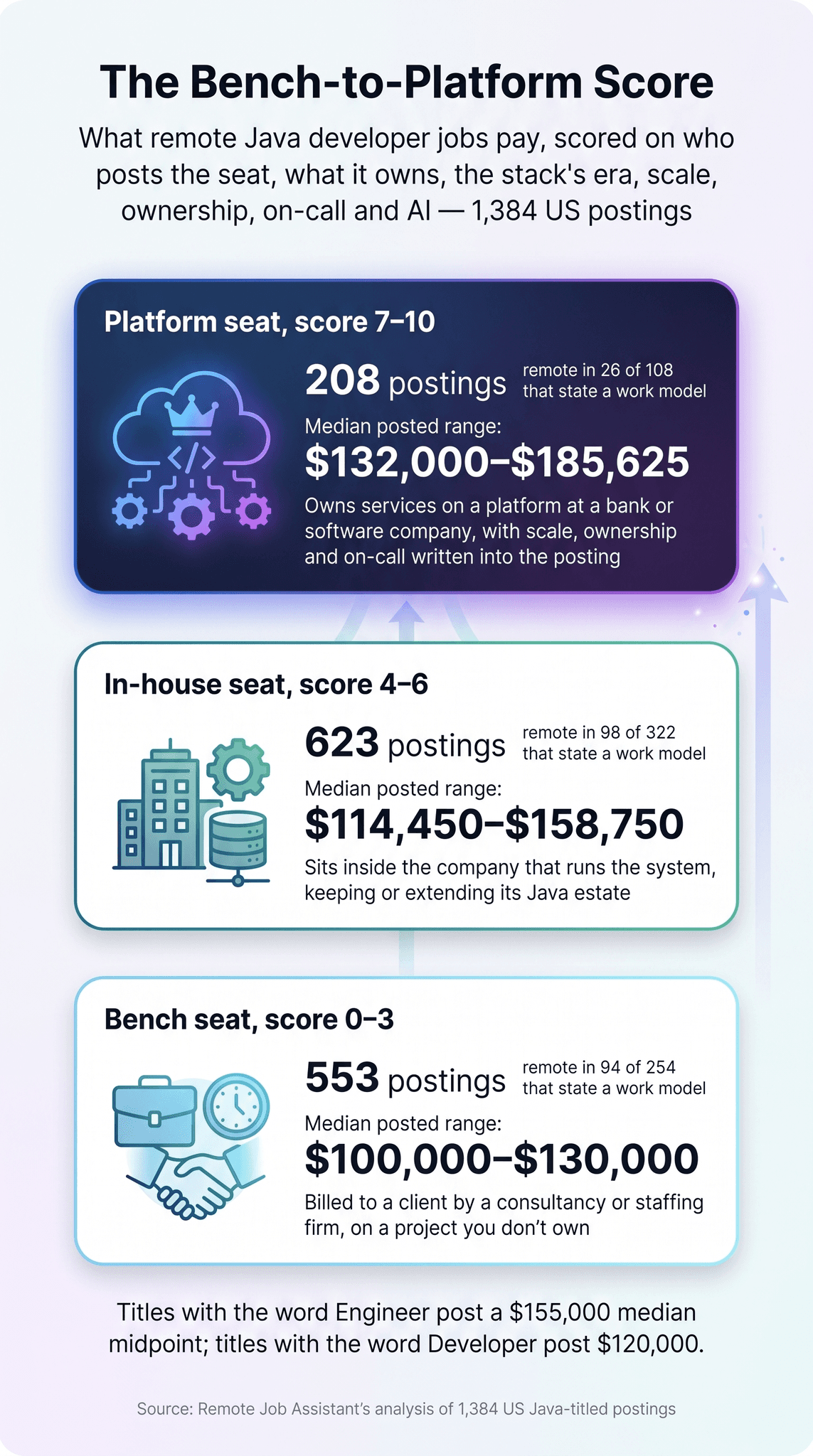
Those numbers sort every posting into one of three seats, and you'll see them throughout this guide. A Bench seat is billed to a client by a consultancy or staffing firm. An In-house seat sits inside the company that runs the system, keeping or extending it. A Platform seat owns services on a platform at a bank or software company, with scale, ownership and on-call written into the posting.
Among Java-titled postings, 16 of the 73 remote ones with a posted range start at $150,000 or more: Capital One's Full-stack Engineer 4 (Java, TypeScript, AWS) at $179,400–$204,700, Tradeweb's Senior Java Algo Developer at $175,000–$250,000, Tivly's Principal Software Engineer – Java at $170,000–$190,000, NinjaOne's Senior Software Engineer, Java at $160,000–$200,000, SentinelOne's Staff Backend Software Engineer – Agent Platform (Java) at $156,000–$215,000 and First Citizens Bank's Java Tech Lead – Digital Banking at $150,000–$180,000. The generic-titled set has 41 remote starts at $150,000 or more, led by Airbnb's Senior Staff Engineer at $248,000–$310,000, Marqeta's Principal Software Engineer at $242,400–$303,000, Bestow's Staff Backend Engineer at $202,000–$237,500 and GoDaddy's Staff Software Engineer – Backend at $182,000–$273,000. None of those 41 says Java in the title.
How We Collected This Data
Two biases shape every number below. Pay is posted on 38.4% of postings (81% of Workday postings, 35% of LinkedIn, 36% of SimplyHired), so medians lean toward banks and contractors with pay-transparency blocks and away from the small consultancies that never print a range. And 700 of the 1,384 postings (50.6%) say nothing about work model, so every "remote" share in this guide is a share of postings that state one. What we could not read: Indeed, Glassdoor and ZipRecruiter return 403 errors (the Indeed network came through SimplyHired), Reddit is blocked, and Dice's and Randstad's search pages were read by hand (20 and 30 cards) and not counted.
A posting counted if its title named Java (Java Developer, Engineer, Programmer or Architect; Software Engineer with Java in the title; Java Full Stack; Java Backend) or Spring Boot. Because "java" also matches JavaScript, we neutralised JavaScript, JS, Node, TypeScript, React and Angular tokens before testing for Java. We dropped Kotlin- and Scala-only titles (23, reported separately), Android, QA and SDET seats (Selenium is written in Java, which is not the same job), DevOps, data and Spark, Salesforce, SAP, Pega, MuleSoft, AEM and ServiceNow platform seats, security, game, Web3, instructors, interns and recruiters. Generic Software Engineer titles were kept only from the same Java keyword searches and only when the body requires Java as the primary language: a Java-ecosystem tool named alongside it, primary-language phrasing, or two mentions with at least one outside a language list. A looser test that accepted any single mention would have added 577 postings that merely list Java among "Go, C++, Rust, Java, Python." Those are not Java jobs, so they are reported separately and not counted.
Dedupe removed 173 exact copies, 278 per-city clones of one requisition (Citi posts a single requisition in up to five cities), 107 copies under sibling employer names and 433 duplicates found on two sources. We read work model from the posting text, not the board's flag: Workday's structured hybrid label was checked against sentences like "3 days in the office and 2 days working remotely," a "Remote" word in a LinkedIn title was right 32 of 33 times, and LinkedIn's "remote java" keyword searches returned 182 kept postings of which 99 are remote, 26 hybrid, 2 on-site and 55 silent. Employer kind comes from curated name lists (about 90 Java body shops named by hand), then the employer's own LinkedIn industry label ("IT Services and IT Consulting" is the consultancy label), then body rules for "our client," C2C and W-2 language, and we hand-checked the labels on the employers that post most often.
The Bench-to-Platform Score is computed by code from duty language. A first version weighted the stack's era and engineering-rigor words; the audit of all 1,384 postings showed that body-shop postings list every modern tool and that rigor words do not move pay, so the score was rebuilt around what does. We set aside 38 offshore listings posted under a "United States" flag (PradeepIT, goPro Consultancy Group, Human Power BG, Valce Talent Solutions, B3 Consulting Poland, Hivex), 12 AI-training contracts (AuraOne's "Java Developer" at $50–$120 an hour, Alignerr at $90–$120), three non-English roles and two production-support titles.
Salary cross-references: BLS Occupational Employment and Wage Statistics for May 2025 (Software Developers, median $135,980, 25th percentile $105,210, 75th $171,980, 90th $214,670; Computer Programmers, median $100,390, 25th $75,850, 75th $130,680), the Motion Recruitment 2026 Tech Salary Guide (mid-level Java $91,000–$161,000, senior $112,000–$203,000, remote senior $144,000–$174,000) and Levels.fyi's backend software engineer median of $195,000 total compensation, which includes equity. Glassdoor's and Indeed's figures appear only in search snippets and are labelled that way below.
The Bench-to-Platform Score: Why Two Spring Boot Jobs Pay $45K Apart
The common advice for Java developers who want more money is to add Spring Boot, Kafka and Kubernetes to the resume. Our postings point somewhere else. Spring Boot appears in 64.2% of them and it doesn't hold pay together: a posting that names Spring Boot carries a $110,000–$147,114 median range (n=318), midpoint $127,500, and a posting that doesn't carries $120,000–$171,000 (n=213). The reason is who writes them. The consultancies list every framework the client's RFP mentioned; the banks write four terse lines and a pay-transparency block. What changes the number is who posts the seat, what the seat is for, and whether the posting talks about scale, ownership, on-call and AI tools.
The Bench-to-Platform Score: a 0–10 rubric that scores any Java posting, or your current job, on how far it sits from "billed out from a consultancy bench to someone else's project" toward "owning a platform at the company that runs it," using what the posting itself says.
Scoring:
- Employer (0–2), who posts the seat: a staffing firm, IT-services consultancy, agency, offshore shop, gig or AI-training platform, university or nonprofit = 0; an in-house team at a health system, retailer, telecom, manufacturer, publisher or federal contractor = 1; a software or internet product company, bank, insurer, payments or capital-markets firm = 2.
- Seat (0–2), what the seat is for: delivery to a client or on a contract ("our client," deliverables, SOW, engagement, implementation) = 0; keeping existing applications running (production support, L2/L3, maintenance, enhancements, tickets), or nothing decisive = 1; the employer's own product or platform ("our platform," user-facing, features, ship, transactions) = 2.
- Era (0–2), the stack's era: legacy-era words only (J2EE, EJB, Struts, JSP or JSF, servlets, WebLogic, WebSphere, JBoss, SOAP, mainframe, Java 8 or older) = 0; both eras or neither = 1; platform-era words only (Spring Boot, microservices, Kafka, Kubernetes, cloud-native AWS, Azure or GCP, Java 17 or newer, reactive, gRPC, Kotlin), two or more with no legacy words = 2.
- Scale (0–1): +1 when the posting names distributed systems, concurrency or multithreading, low latency, high throughput, millions or billions of transactions, or working at scale.
- Ownership (0–1): +1 for architecture, technical leadership, mentoring, design decisions, or owning services or a domain.
- On-call (0–1): +1 for on-call, incident response, a pager, a production-support rotation or 24/7 coverage.
- AI (0–1): +1 when AI coding tools are expected in the work.
Bands:
- Bench seat (0–3), $100,000–$130,000 median posted range (n=164), midpoint $118,584: you are billed to a client by a consultancy (419 of the 553) or a staffing firm (83), on a project you don't own. 553 postings at 331 employers; hourly-only rows post $57–$65 an hour (n=61); 37.0% of the 254 that state a model are remote; 166 are contract.
- In-house seat (4–6), $114,450–$158,750 (n=244), midpoint $135,975: you sit inside the company that runs the system, keeping or extending its Java estate, at a bank (138), a government contractor (71), a software company (66), or on the larger consultancies' better-written seats (230). 623 postings at 407 employers; 30.4% of 322 are remote; 134 are contract.
- Platform seat (7–10), $132,000–$185,625 (n=123), midpoint $161,375: you own services on a platform at a bank (112), a software company (65) or a consumer company (9), with scale, ownership, on-call and AI expectations written into the posting. 208 postings at 138 employers; 24.1% of 108 are remote; 19 are contract.
How to use it: score your current job, then score every posting before you apply. The four questions below take two minutes. Change one component at a time. The biggest point is the employer: leaving the bench for a bank or a product company is worth two points, and it is the whole Engineer-versus-Developer gap. The cheapest points are the scale, ownership and on-call words, which belong on your resume this week if they are true of what you've shipped. If you score 0–3 and want $150,000 or more, change who posts the seat before you learn another framework, because the Bench band tops out at a $130,000 median. And stop searching for "Java Developer." Search for "Software Engineer" with Java in the requirements. That set posts a $168,300 midpoint and is remote half the time it states a model.
The four-question score check. (1) Who posts it? A consultancy, a staffing firm or "our client" scores 0; an in-house team at a retailer, hospital, manufacturer or contractor 1; a software company or bank 2. (2) What is the seat for? A client's project scores 0; keeping existing applications running, or nothing said, 1; the employer's own platform or product 2. (3) Which era does it name? J2EE, WebLogic or Java 8 with nothing newer scores 0; a mix, or no stack words at all, 1; Spring Boot, Kafka, Kubernetes or Java 17 and newer only, 2. (4) Does it mention distributed systems or low latency? Ownership or architecture? On-call? AI coding tools? Score +1 for each. Add it up: 0–3 is a Bench seat, 4–6 an In-house seat, 7–10 a Platform seat.
Here is the check run on two real remote postings that both name Spring Boot. Conduent's Senior Java Developer ($96,250–$125,000) is posted by a consultancy (employer: 0) for a client program (seat: 0), lists twelve platform-era terms and no legacy ones (era: 2), mentions "operating FHIR at scale in production environments" (scale: 1) and architecture (ownership: 1), and says nothing about on-call or AI tools. Score 4, the bottom of the In-house band. Capital One's Full-stack Engineer 4 (Java, TypeScript, AWS) ($179,400–$204,700) is posted by a bank (2), describes "deep experience in distributed microservices, and full stack systems" (scale: 1) for its own systems (seat: 1), names eight platform-era terms (2), ownership (1) and "Experience leveraging modern AI-based coding tools and IDE copilots" (1). Score 8, a Platform seat. Both postings are remote. Both name Spring Boot and AWS. Four points on the score separate about $81,000 of range midpoint, and the first two of those points are about who signs the paycheck.
The table shows how the three seats compare on remote share and pay.
| Seat (score) | Postings | Remote, of those stating a model | Median posted range (n) | Hourly-only rows (n) | Contract | Typical titles and employers |
|---|---|---|---|---|---|---|
| Bench (0–3) | 553 | 37.0% (94 of 254) | $100,000–$130,000 (164) | $57–$65/hr (61) | 166 | Java Developer, Senior Java Developer, Java Full Stack Developer at TCS, Synechron, Infosys, Cognizant, Capgemini and about 300 smaller consultancies and staffing firms |
| In-house (4–6) | 623 | 30.4% (98 of 322) | $114,450–$158,750 (244) | $60–$65/hr (47) | 134 | Senior Java Developer – Assistant Vice President, Senior Java Software Engineer, Lead Java Developer at Citi, JPMorganChase, Leidos, Allstate, First Citizens and the larger consultancies' client seats |
| Platform (7–10) | 208 | 24.1% (26 of 108) | $132,000–$185,625 (123) | $60–$75/hr (7) | 19 | Software Engineer (Java), Backend Engineer (Java), Low Latency Java Engineer, Staff Java Software Engineer at Citi, Capital One, GEICO, Early Warning, NinjaOne, SentinelOne, Walmart |
The gap holds inside every seniority level. Senior postings run $100,000–$135,000 in a Bench seat, $113,600–$160,000 in an In-house seat and $132,000–$185,625 in a Platform seat. Lead and manager postings run $120,000–$145,000, $128,600–$180,500 and $149,750–$213,480. Mid-level postings run $100,000–$130,000 on the bench and $109,000–$147,487 in-house, then flatten: the 22 mid-level Platform seats with pay post $100,781–$144,906, a small sample, and a sign that the Platform premium is paid for seniority and ownership rather than for the seat alone. The single-score ladder climbs from $105,900 at a score of 1 to $171,850 at 9, with one dip at 3 ($115,200 against $123,500 at 2, where the Bench seats of the big consultancies cluster) and four postings at 10.
Why who-posts-it moves pay so much comes down to what the seat is priced against. In a Bench seat, the seat is a billable hour, and the posting says so. Matlen Silver's Java Developer in Newark, Delaware: "Required Pay Scale: $60-65/hour W2; Not available C2C or 1099." Rapinno Tech's remote Senior Java Backend Developer: "Duration: 06+ Months Contract." Vytwo Technologies' Java Backend Lead Developer: "100% written confirmation on working from the client office – no remote working (not negotiable)." Ascendion's Java API developer: "Job Title: Java Developer Client Domain: Banking Location: Manhattan, NY or Jersey City, NJ (100% onsite)." Global Business Ser. 4u's Java Backend Developer: "Job Type: 12-24 Month Project ,Contract(C2C/W2/1099)." The client's bank is the real employer, the firm takes its margin, and the posting carries the client's office rules without the client's pay band.
In an In-house seat, the seat keeps an estate running, and the posting reads like a maintenance contract. BlackRock's Full Stack Java Engineer for Aladdin Engineering: "the development and enhancement of existing suite of tools." S&P Global's Lead, Java Software Engineer ($120,000–$150,000): "Should have experience working in Java 8 features especially Streams API." Allstate's remote Product Engineer (Java): "Provide production support for software products in user environments."
In a Platform seat, the code moves money, and the posting prices it that way. Citi's Senior Java Platform Engineer, Senior Vice President ($141,440–$212,160): "Own the engineering roadmap for modernising the check payment platform, migrating mainframe and monolithic legacy components." Citi's Senior Java Engineering Lead for Payments Technology ($113,840–$170,760): "Design and build high-throughput, low-latency microservices using Java 8+, Spring Boot." Citi's Low Latency Java Engineer posts $142,320–$213,480; Early Warning's Staff Software Engineer – Java/AWS posts $174,000–$223,000; GEICO's Senior Staff Engineer – Java posts $130,000–$260,000.
Two places where the score and the pay disagree, with the numbers. Postings that name no stack words at all carry a $142,500 midpoint (n=71), more than postings that list a platform-era stack ($136,900, n=257), because the terse postings come from banks and the buzzword lists come from body shops; the era component still scores the stack, not the author, so read it as a tiebreaker rather than a verdict. And a few consultancy postings price like banks because the end client is a trading firm: Haystack's remote Senior Java Backend Engineer posts a flat $180,000, and BIP US's trading-systems seats post $140,000–$180,000. The employer point still scores them 0, and most of their siblings on the same boards post $100,000–$130,000.
Listing Spring Boot does not raise a Java posting's pay; it lowers it, because the postings that list every framework are written by the firms that bill you out, and the postings that list almost nothing are written by the banks that pay the most.
If you score your current job and land on the bench, you don't need a new credential to move. You need direct-employer postings in front of you, and a lot of them, because the 831 In-house and Platform seats are spread across more than 500 employers, and the best-paid version of the same seat usually drops Java from the title altogether.
Stop Applying Manually
Our AI applies to hundreds of matching jobs while you sleep. Wake up to interviews, not more applications.
Remote Java Developer Salary: What 531 Posted Ranges Show
The federal statistics explain the spread before the postings do. The same Java seat is filed under two occupations. Software Developers earn a $135,980 median (May 2025), are projected to grow 10% from 2025 to 2035 with about 106,100 openings a year, and carry ONET's Bright Outlook badge. Computer Programmers, the occupation whose ONET sample titles include "Java Developer", earn $100,390, are projected to decline 7%, and get 4,400 openings a year. O*NET lists Java, Spring Boot, Apache Maven and J2EE as technology skills under both. Employers title the same Spring Boot service work either way, and the title they choose tracks which occupation's pay band you land in. Industry medians for software developers, where Java postings cluster: software publishers $164,550, insurance carriers $130,840, computer systems design $132,050, finance and insurance $135,460.
Salary ranges below derive from our analysis of 1,384 Java-titled postings dated October 2025 to October 2026, cross-referenced with BLS May 2025 wage data and the Motion Recruitment and Levels.fyi figures above. Posted ranges are base salary; 531 postings carry one, 114 more carry only an hourly rate, and we never convert hourly rates into the annual medians. Ranges shift as markets move; check the linked sources for current figures.
The first table is the title-word tell. Every row is the median posted range and its midpoint for a title family, with the share that is a contract.
| Title | Postings | Median posted range (n) | Midpoint | Contract | Hourly-only rows |
|---|---|---|---|---|---|
| Java Developer | 412 | $110,000–$140,000 (115) | $123,094 | 136 | $60–$65/hr (58) |
| Senior Java Developer | 123 | $110,000–$141,000 (34) | $126,250 | 44 | $60–$72/hr (17) |
| Java Full Stack Developer | 176 | $105,000–$132,500 (55) | $120,000 | 54 | $52.50–$65/hr (20) |
| Java Backend Developer | 81 | $100,000–$130,000 (19) | $112,500 | 34 | $60–$65/hr (10) |
| Java Engineer | 72 | $130,000–$170,000 (31) | $155,000 | 6 | (1) |
| Java Software Engineer | 120 | $120,000–$166,000 (51) | $145,000 | 25 | $60–$65/hr (9) |
| Software Engineer (Java) | 177 | $122,500–$183,700 (107) | $158,100 | 10 | (1) |
| Backend Engineer (Java) | 54 | $121,500–$179,440 (28) | $158,750 | 12 | (3) |
| Full Stack Engineer (Java) | 90 | $110,500–$148,406 (40) | $127,500 | 5 | (3) |
| Lead Java Developer / Java Tech Lead | 176 | $133,202–$180,000 (75) | $155,200 | 35 | $65–$75/hr (8) |
| Java Architect | 71 | $130,000–$167,842 (20) | $142,940 | 20 | $75–$80/hr (3) |
| Staff / Principal (Java) | 47 | $131,650–$215,500 (32) | $178,450 | 5 | (1) |
Across every title, Engineer beats Developer at the same level: mid-level Engineer titles post a $125,000 midpoint (n=69) against $118,584 for Developer (n=127), senior $160,000 (n=105) against $122,625 (n=66), lead $177,150 (n=70) against $145,440 (n=24). The gap survives the employer too: at software companies $154,550 against $117,500, at consultancies $125,000 against $110,625, at government contractors $165,000 against $136,250, at staffing firms $155,000 against $125,000, and at banks $160,000 against $151,500. Developer is the word the bench uses. Consultancies and staffing firms wrote Developer on 505 of their 791 titles and Engineer on 176; direct employers wrote Engineer on 317 of 589 and Developer on 222.
The second table is the level ladder, with the years the postings ask for.
| Level | Postings | Median posted range (n) | Midpoint | Remote, of stated | Years asked (median) |
|---|---|---|---|---|---|
| Entry | 34 | $67,500–$109,150 (18) | $88,375 | 22.2% (4 of 18) | 3 |
| Mid | 610 | $100,000–$136,350 (200) | $119,875 | 31.5% (85 of 270) | 5 |
| Senior | 437 | $117,000–$165,749 (176) | $145,000 | 37.3% (88 of 236) | 6 |
| Lead / Staff / Architect | 303 | $130,000–$188,400 (137) | $157,200 | 25.6% (41 of 160) | 8 |
Of the 501 postings that state a years figure, the median is 6, and 105 ask for 10 or more. Bench seats ask for a median of 7 years against 5 in Platform seats, which is the consultancy reselling your seniority to the client at the client's rate card.
The third table is who posts the seat, which is the tell that nobody prints.
| Who posts it | Postings | Median posted range (n) | Hourly-only rows (n) | Remote, of stated | Contract | Examples |
|---|---|---|---|---|---|---|
| IT-services consultancies | 654 | $100,000–$130,000 (197) | $55–$65/hr (52) | 36.4% (107 of 294) | 175 | TCS $100,000–$121,000 (n=25), Synechron $105,000–$115,000 (n=19), Infosys $90,751–$131,600 (n=7), Cognizant $69,211–$121,000 (n=10), Capgemini $86,129–$127,189 (n=5) |
| Staffing firms | 137 | $130,000–$150,000 (28) | $58–$65/hr (43) | 33.8% (26 of 77) | 75 | Kforce, BCforward, Motion Recruitment, TEKsystems, Tandym, Apex Systems |
| Banks, insurers, payments | 251 | $130,000–$188,100 (131) | $68–$76/hr (6) | 20.0% (24 of 120) | 28 | Citi $141,440–$212,160 (n=29), JPMorganChase $156,750–$215,000 (n=17), Charles Schwab $155,000–$175,000 (n=5), Early Warning $190,000–$249,000 (n=4) |
| Software and internet companies | 131 | $117,000–$167,000 (63) | $60–$68/hr (10) | 31.0% (22 of 71) | 25 | NinjaOne, SentinelOne, Garmin, Comcast, New Relic, Salesforce |
| Government contractors | 102 | $115,000–$165,600 (60) | (1) | 34.5% (20 of 58) | 3 | Leidos $119,600–$216,200 (n=6), GDIT $158,855–$207,000 (n=5), Integral Federal $115,000–$150,000 (n=6) |
| Retail and consumer | 28 | $113,500–$197,300 (18) | none | 31.2% (5 of 16) | 2 | Walmart $113,500–$227,000 (n=6), Uline, Fanatics, GameStop |
| Health systems and health IT | 23 | $114,000–$152,000 (15) | (1) | 50.0% (7 of 14) | 6 | Kaiser Permanente $114,900–$148,610 (n=5), CVS Health, Optum |
| Industrial | 25 | $128,300–$160,676 (8) | none | 6.7% (1 of 15) | 2 | Lennox, United Airlines, Siemens Digital Industries Software |
The hourly rows are the contract market, and the math is worth doing once. Contract postings are 319 of 1,384 (23.0%), and the hourly medians run $58–$65 across the hourly rows, $58–$65 at staffing firms (n=43), $55–$65 at consultancies (n=52) and $55–$65 on remote rows (n=24). At 2,080 hours, $60 an hour is $124,800 before benefits, paid time off, a 401(k) match, and the weeks between contracts. The top remote rates in our data were Apex Systems' Java Backend Services Developer V at $102–$111 an hour, Beechwood Computing's migration seat at $84–$90 corp-to-corp and GlobalPoint's Java/DB2 seat at $75–$80; the floor was Kforce's remote Java Developer at $30–$40 an hour.
Three outside figures bracket ours. Motion Recruitment's 2026 guide puts mid-level Java at $91,000–$161,000, senior at $112,000–$203,000 and remote senior at $144,000–$174,000. Levels.fyi's backend software engineer median is $195,000 in total compensation on October 9, 2026, with equity included. Glassdoor's search snippet says "$120,299 … $94K–$155K" for Java Developer and Indeed's says "$57.31 per hour"; the only ZipRecruiter page a crawler can reach is a November 2022 snapshot that says $110,062. Our $133,900 midpoint sits between the hourly-heavy board figures and the equity-inclusive one, which is what you'd expect from a universe that is 57% consultancies.
Remote pays about the same as hybrid here, $140,000 against $141,150 at the midpoint, and more than on-site at $128,725, because the remote rows are a mix of consultancy seats at mid pay and bank seats at the top, while the on-site rows are the body shops' "100% onsite" client seats. Inside the banks, remote seats post a $152,500 midpoint (n=12) against $165,000 for hybrid and on-site (n=55); inside the consultancies the two are level, $125,000 against $123,094.
Where Remote Java Developer Jobs Actually Exist
Remote Java work is a barbell, and the heavy end is the cheap end. Of postings that state a model, consultancies are 36.4% remote (107 of 294) at $100,000–$130,000, government contractors 34.5% (20 of 58), staffing firms 33.8% (26 of 77), software companies 31.0% (22 of 71), health systems 50.0% (7 of 14, a small sample), banks and insurers 20.0% (24 of 120, with 90 hybrid) and industrial employers 6.7% (1 of 15).
The banks are where the top of the range lives and where remote mostly isn't. Citi's 34 unique Java postings are hybrid in 28 of the 28 that state a model, with the same line in most of them: "Work in a hybrid model with three days in the office and two days working remotely each week." JPMorganChase's 31 postings say nothing about location in 30 of them, and the bank moved to five days a week in March 2025. SAIC: "This position will be 4 days per week on-site in Ashburn, VA for the first year of employment." PayPal: "For the majority of employees, PayPal's balanced hybrid work model offers 3 days in the office." Bank of America: "committed to an in-office culture that supports collaboration, engagement, and career development." Capital One's own FAQ says three days a week, which is why its remote Java seat at $179,400–$204,700 is posted from Plano and labelled remote in the title rather than the policy. The exceptions are real and worth naming: Allstate posts its Java seats as "USA - IL (Remote)" and 6 of 6 that state a model are remote; First Citizens Bank's 6 are all remote, posting $130,000–$180,000 on the three with a range; Mutual of Omaha's Lead Full Stack Engineer III ($135,000–$155,000) and Solutions Lead ($115,000–$155,000) are remote; Genworth's Software Engineer – Java Development is remote at $77,800–$117,000.
The small print on the 218 remote postings is mostly about who you are rather than where you sit. A US-citizenship line appears on 36 of them (16.5%): Global Payments, "This position is not eligible for visa sponsorship, now or in the future. Candidates must be a US Citizen or Green Card Holder"; Rapinno Tech, "Note: Need Only US Citizen, Green Card, EAD-GC, J2 EAD, H4 EAD, L2 EAD, and TN Visa." A clearance appears on 26 (11.9%): 3M Consultancy, "IRS MBI Clearance is required." Contract terms appear on 31 (14.2%): Tier One Technologies, "PLEASE NOTE: No corp-to-corp candidates will be accepted"; Raag Solutions, "OPT Should be fine - Only W2." A no-sponsorship line appears on 20 (9.2%), including Capital One ("will not sponsor a new applicant for employment authorization") and New Relic. A US-only residence line appears on 18, a near-an-office clause on 6 (SAIC, Ford, Genworth), a time zone on 4, travel on 2, on-call on 10, and a conditional clause on 8. The conditional ones are the ones to read twice. Fidelity's Principal Software Engineer (Java/SpringBoot) is posted remote and says "Fidelity is transitioning to a full-time onsite working model through a phased rollout across regions and roles." Only two of the 218 list the states you may live in: NinjaOne names 19 and Tivly 11.
A note on the boards. LinkedIn holds 1,061 of our postings and states a work model on 436 of them; 25.0% of those are remote. The 73 postings located just "United States" with no city are remote in 41 cases and silent in 30; the 891 city-located postings are remote in 55 and silent in 532. The "Java Remote" page that ranks first on Google says 10,000 or more; the all-Java page says 11,000 or more, so the "remote" page is a keyword page, not a filter. Himalayas' Java listings are 26 of 37 non-US, and the offshore shops that post "United States" there without naming a country are the ones we set aside; if a posting quotes a monthly USD figure, mentions "freshers," or names a team in Poland, Argentina or India, it is not a US seat.
The best-paid remote Java jobs don't say Java in the title. Software Engineer postings that require Java post a $168,300 midpoint and are remote half the time they state a model; Java-titled postings post $133,900 and are remote a third of the time. Once you see that, typing "java developer" into a search box starts to look like self-sabotage.
Which is why the search string matters more than the stack, and why a tool that applies to fifty direct-employer postings a week beats a week spent on one.
Stop Applying Manually
Our AI applies to hundreds of matching jobs while you sleep. Wake up to interviews, not more applications.
The Java in the Body: What the $168K Postings Ask For
The 717 generic postings are the Java market the keyword hides. 142 of them are titled plain "Software Engineer," the rest are Backend Engineer, Software Developer, Staff Engineer, Principal Engineer and a few Software Architects; all of them require Java as the primary language in the body. They post a $139,100–$197,500 median range (n=451), midpoint $168,300. At senior level the midpoint is $182,250 (n=228) against $145,000 for Java-titled senior postings; at lead $190,000 (n=81) against $157,200; at software companies $190,000 (n=175) against $143,732. They are remote in 49.9% of the 361 that state a model, and contract in 46 of 717 (6.4%). Of the 104 remote ones with a range, 94 start at $100,000 or more and 41 at $150,000 or more; the Java-titled equivalents are 56 and 16.
The requirement lines read differently too. Airbnb's remote Senior Staff Engineer, Guest & Host ($248,000–$310,000): "Deep backend expertise in distributed systems, data modeling, and API design for large-scale, business-critical platforms, using Java, Kotlin, or similar languages." Stripe's Senior Software Engineer, Backend ($206,086–$285,600): "5 years of experience programming in Java, Scala, or Python." Elastic's Principal Software Engineer – Performance Tuning ($159,800–$252,800): "You have deep knowledge of Java internals and JVM memory management." Coinbase's Senior Staff Software Engineer, Institutional Exchange ($262,650–$309,000): "Deep expertise in low-latency distributed systems and a backend language such as Java, C++, or Go, with fluency in JVM/Linux performance tuning." MongoDB's Software Engineer 3, Atlas Search Systems ($122,000–$209,000): "Experience with at least one modern statically typed programming language, and interest in working with Java." Amazon's SDE II in Privacy Engineering: "The tech stack is Java on native AWS, and the startup ethos is real: small team, greenfield architecture." Kotlin appears alongside Java in 82 of the 717, Python in 283.
The remote list, every row confirmed remote in its own text: Airbnb's Senior Staff Engineer, Guest & Host and Senior Staff Software Engineer, Trust, both $248,000–$310,000; Marqeta's Principal Software Engineer, $242,400–$303,000; RevenueCat's Senior SDK Engineer, $230,000; Bestow's Staff Backend Engineer, $202,000–$237,500, and Senior Backend Engineer II, $170,000–$200,000; Gravie's Staff Platform Engineer, $193,875–$258,500; OpenSea's Staff Software Engineer – Platform, $190,000–$345,000; Fundrise's Lead Software Engineer, $190,000–$250,000; Twilio's Principal Engineer, $188,240–$235,300; Starburst's Senior Software Engineer, Control Plane, $185,000–$215,000; Imply's Staff Software Engineer, $185,000–$225,000; GoDaddy's Staff Software Engineer – Backend, $182,000–$273,000; Trumid's Senior Software Engineer (Trading Systems), $175,000–$250,000. Amazon's 15 generic Java postings are on-site in all 15, which is what a five-day policy looks like in a dataset.
The federal lane is its own In-house market, and the clearance is the pay. Government contractors post 102 Java-titled and 97 generic Java postings, with a clearance named in 79 of the Java-titled ones. Leidos' Java Developer (SME) posts $154,050–$278,475 and requires "an active TS/SCI with polygraph security clearance"; Amentum's Full Java Stack Developer at Annapolis Junction posts $215,000–$238,000 for "TS/SCI w Poly"; Boeing's Lead Java Software Engineer in Herndon posts $211,650–$286,350 with an "Active Top Secret Security Clearance"; GDIT's Core Java Software Engineer with TS/SCI and polygraph sits in a $158,855–$207,000 band. The Java-titled contractor seats are 34.5% remote of stated and the generic ones 66.0%; the civil-service version of the same seat sits in the 2210 series at GS-12 $89,508, GS-13 $106,437 and GS-14 $125,776 in OPM's 2026 Rest-of-US table.
The cheapest jump for a Bench-seat Java developer is not a bigger consultancy. It is any direct employer that writes "Software Engineer": consultancy Java-titled postings carry a $120,000 midpoint (n=197) and consultancy generic ones $138,750 (n=44), while banks post $160,000 (n=131) and software companies' generic postings $190,000 (n=175). The move is two employer points and a title word, and it is worth more than every framework on the list.
Is AI Replacing Java Developers? What the Postings Say
The postings say the job is changing shape, not disappearing. AI is named in 554 of 1,384 postings (40.0%). AI coding tools are expected in the work in 343 (24.8%), and the share rose through the year: 2 of the 24 postings dated January to March 2026, 142 of 543 dated September (26.2%), 160 of 564 dated October (28.4%). Those postings pay more, a $152,000 midpoint (n=152) against $130,000 without (n=379), and the gap holds at senior level ($157,500 against $139,250), because the seats that expect AI tools are the Platform seats at banks: 106 of the 251 bank postings expect them, against 9 of 102 at government contractors and 115 of 654 at consultancies.
The duty language is ownership, not replacement. Citi's Senior Java Engineering Lead for Payments Technology: "Integrate AI-powered developer tooling — such as GitHub Copilot and LLM-based code generation." Citi's Senior Java Platform Engineer: "Embed AI-powered engineering practices across the team by leveraging tools such as GitHub Copilot and LLMs." CVS Health's remote Senior Manager, Application Development (Java, APIs, Microservices, AWS, AI): "Drive adoption of AI-assisted software development tools such as Claude Code, GitHub Copilot, Cursor AI, Amazon Q, and similar technologies." BlackRock's Vice President, Senior Backend Engineer (Java): "Experience with agentic development and applying AI tooling to the product development life cycle." Jain Global's Senior Low Latency OEMS Engineer (Java) ($150,000–$200,000): "Work AI-first: use coding agents daily for implementation, review and investigation, and evolve the shared agent configuration (rules, skills, hooks, automated checks) that keeps AI-generated code within our low-latency standards." McKesson's Senior Full Stack AI Software Engineer (Java) ($126,000–$210,000): "Evaluate AI-generated code for security, performance, scalability, maintainability, and functional accuracy." SMBC's Senior Java Developer ($158,000–$205,000): "Strong understanding of validating AI-generated code and applying engineering best practices." And Kforce's remote Java Developer at $30–$40 an hour: "Evaluate, review, and improve AI-generated code to ensure quality, maintainability, and security." The same sentence sits at both ends of the pay scale; what differs is who wrote the code review into the job.
The market context cuts the same way. Indeed Hiring Lab shows software development postings up about 15% since late February 2025 but still 27.5% below February 2020, with 69.3% of them senior-level and 4.5% entry-level in the first quarter of 2026. Dice's 2026 Tech Sentiment Report shows Java Developer posting volume down 4%. Stack Overflow's 2025 survey has Java used by 29.4% of developers, seventh among languages, with 45% of its users saying they admire it; Spring Boot sits at 14.7%. JetBrains' State of Java 2025 has Java 21 in use at 40% of respondents and Java 8 still at 31%; our postings name Java 17 or newer in 7.4% and Java 8 or 11 in 12.6%, and Oracle shipped Java 25 as a long-term-support release on September 16, 2025. TIOBE ranks Java fourth (7.54% in September 2026), and GitHub's Octoverse 2025 ranks it fourth by contributors, up 20.7% year over year. Put the BLS projections next to that: the occupation called computer programmer is projected to shrink 7% and the one called software developer to grow 10%, and Java sits under both labels. The thing that is shrinking is the title "Java Developer," and the body shops that post it.
One more set-aside, because it ranks. Jobgether's Brazil page, Google's sixth result for the US keyword, lists "Java Coding Specialist - Freelance AI Trainer" gigs, and AuraOne posts a "Java Developer" at $50–$120 an hour, Alignerr a backend engineer at $90–$120. Those are model-training contracts, not engineering seats, and we set 12 of them aside.
Stop Applying Manually
Our AI applies to hundreds of matching jobs while you sleep. Wake up to interviews, not more applications.
What Nobody Tells You About Remote Java Developer Jobs
The posting prices the seat before you negotiate, and the Java market has its own red flags. Each one below is counted, and each has a mechanism.
| Red flag in the posting | What it means | How often | Green flag instead |
|---|---|---|---|
| An hourly rate with no benefits line | Bench economics: $60 an hour is $124,800 at 2,080 hours with no paid time off, no 401(k) match and no pay between contracts | 114 of 1,384 postings are hourly-only; median $58–$65 | A posted annual range with a named employer of record |
| "W2 only," "No C2C," "OPT should be fine" | The firm is pricing your visa status, not your work; the client will never see your name on the rate card | 108 postings say W-2 only; 48 mention corp-to-corp terms | "Visa sponsorship is available with this position" (Caterpillar) or silence from a direct employer |
| "Local candidates only," "F2F interview required" on a card labelled remote | The client's office is the real location | 41 postings ask for locals, 36 require an in-person interview | A written remote policy with states, as NinjaOne and Tivly print |
| "Duration: 06+ months," "Contract: 12 months" | A project, not a seat; the bench begins when it ends | 73 postings name a duration | Full-time with a pay-transparency block |
| Java 8 or J2EE named with nothing newer | A maintenance estate: $120,000 midpoint for Java 8/11 seats (n=62), $118,790 for legacy-era-only stacks (n=25) | 174 name Java 8 or 11; 66 name legacy-era words and nothing newer | Java 17 or newer, Kafka, Kubernetes and a named platform |
| "10+ years" for a $110,000–$130,000 range | The consultancy is reselling your seniority at the client's rate card | 105 of 501 postings that state years ask for 10 or more; Bench seats ask a median 7 | Five to six years and a range that starts at $130,000 |
| "Remote" with a phased-RTO or "subject to change" paragraph | Remote until it isn't | 8 of 218 remote postings | A remote clause in the duty section, not the benefits section |
| The client described as "a leading financial services firm" | You can't check the client's return-to-office policy or its pay band | 224 of 791 consultancy and staffing postings mention a client; 46 describe it only as a leading or Fortune-ranked firm | The client named, or a direct employer |
| "Visa Sponsorship is not available for this Role" | Read it before the recruiter call, not after | 85 postings; Citi, Capital One, Uline ("does not participate in the H-1B lottery") | Nothing to read into; 20 of 218 remote postings carry the line |
What actually happens after the flag, from the postings that admit it. Dice's "remote java developer" page carries a "100% onsite" Wilmington job and a "4 day onsite" Charlotte job. inSync Staffing's Java Application Developer reads "One day a week onsite in Denver on Tuesdays, remote Monday and Wednesday through Friday … You need to be living in the Denver metro area — this is not a remote role." Haystack's Senior Java Backend Developer is "A 6+ month W2 contract at $70.00 - $80.00 per hour," which is $145,600 for the months it runs and nothing for the months it doesn't. Capital One's remote Full-stack Engineer 4 is posted by a company whose careers FAQ says hybrid associates work three days a week in the office, and Fidelity's remote Principal Software Engineer says the company is "transitioning to a full-time onsite working model." Read the company's policy, not just the card.
Our opinion, with the counts behind it: most consultancy Java postings are body shopping with a Spring Boot keyword list on top. 439 of the 654 consultancy postings score as client seats, 295 list a platform-era stack, and the median range is $100,000–$130,000 either way. And the Engineer title is a status game, which is exactly why it works: inside the same banks, Engineer titles post a $160,000 midpoint against $151,500 for Developer, and recruiters search by title.
The interview-stage version of the same list is three questions. If the recruiter can't name the end client, you are reading a Bench seat, and the rate you are quoted is the bill rate minus a margin you will not be told. If the posting says "our client" and "W2 only," ask who the employer of record is and whether the client converts contractors; 319 of our 1,384 postings are contract, and the conversion is the raise. If the title says Developer at a bank, ask whether the same team posts an Engineer ladder, because Citi lists "Java Developer – Assistant Vice President" at $107,120–$160,680 and "Low Latency Java Engineer" at $142,320–$213,480 on the same careers site, both hybrid.
A $65-an-hour remote W-2 contract is $135,200 at 2,080 hours with no benefits; a $120,000 hybrid seat at a bank is less cash and a two-point jump on the score that converts into the $160,000 band. Take the bank seat if you can commute three days, and keep the contract only when it names the end client and the client's domain is trading or payments, where the midpoints are $162,000 and $142,782. That is our reading of the numbers, not a rule the postings state.
One sanity check before you spend money on a credential: a computer science degree is named in 32.1% of postings and required with no equivalence clause in 13.8% (191 of 1,384), so the 86% without that line is still most of the market.
How to Move From the Bench to a Platform Seat in 90 Days
The move is a seat change, not a skills change, and ninety days is enough to make the postings read you differently.
Weeks 1–4: score and rewrite. Score your current job with the four questions. Then rewrite the resume around what the seat owned, not what it used. The template, not a claim: "Java developer on the client's claims platform (Spring Boot, Kafka, AWS)" becomes "Owned the claims-adjudication services for a 40-state carrier: Spring Boot on Kubernetes, Kafka at N events a day, on-call one week in six, reviewed AI-generated code before merge." Scale, ownership, on-call and AI review are the four points you can add this month if they are true, and they are the words the $150,000 postings use.
Weeks 5–8: retitle the search. Stop typing "java developer." The searches that found our Platform seats were title searches for engineers with Java in the body: "software engineer java spring" and "backend software engineer java" on LinkedIn with the location set to United States and no city (41 of the 73 nationally located postings were remote), the career sites of Allstate, First Citizens, Capital One, Mutual of Omaha and CVS Health with the remote filter on, and the Greenhouse, Lever and Ashby boards of software companies, where 105 of the 111 Java postings carry a generic title. Where one employer lists both a Developer and an Engineer posting, apply to the Engineer one. Before you name a number, check Levels.fyi's backend software engineer page ($195,000 median total compensation, equity included) against the posted base range, and read Himalayas' Java tag with the offshore test above, because a third of its "United States" cards are not US seats.
Weeks 9–12: volume and screening. Apply to every direct-employer posting that scores 4 or higher, which is a volume problem Auto-Apply solves, and screen each call with four questions: Who is the employer of record? What does this seat build, your platform or a client's project? Is remote in writing, with states, on-call and the sponsorship line? Which Java version and which era words does the team actually run?
What the answers mean, with the counts behind them. Hybrid postings state a day count in only 24 of 300, so if the interviewer says hybrid, ask for the number; where it is stated, the answers run from S&P Global's two days to SAIC's and CGI's four. A citizenship line sits on 36 of the 218 remote postings and a clearance on 26, so if the posting is a contractor's, ask which clearance and whether they sponsor it. On-call appears in only 10 of 218 remote postings but in 114 of all 1,384, so ask anyway; silence on a Platform seat is usually an omission. And if the posting is remote and the company's own policy says three days, as Capital One's does, ask whether the seat is remote-designated or remote by exception.
The decision tree, before the calendar.
- Billed to a client today (Bench)? If you hold a clearance, take the federal lane: contractors pay In-house seats like Platform ones ($154,050–$278,475 at Leidos with a polygraph) and are 34.5% remote of stated. If not, target a direct In-house seat at a bank or insurer, where the midpoint moves from $120,000 to $160,000, and Allstate and First Citizens post those seats remote.
- In-house, keeping an estate alive? Move to the same employer's payments or trading platform team (Citi posts its Senior Java Platform Engineer at $141,440–$212,160 and its Low Latency Java Engineer at $142,320–$213,480, against $107,120–$160,680 for its Java Developer – Assistant Vice President rung), or to a software company's generic Software Engineer title, which posts a $190,000 midpoint and is 41.7% remote of stated.
- Already in a Platform seat? The next step is the title, not the seat: Staff and Principal Java titles post a $178,450 midpoint (n=32) and generic lead titles $190,000 (n=81).
- Mid-level with Spring Boot and no scale words? Put the distributed, low-latency and on-call evidence on the resume first. Without it the scale, ownership and on-call points stay at zero and the posting reads you as a maintenance seat.
Tie-breakers when two offers look equal: direct beats bench at the same pay; an Engineer title beats a Developer title at the same range, because it sets the next range; a named end client beats "a leading bank"; a written remote policy with states beats a card that says Remote; and full-time W-2 beats an hourly contract under $75. If you cannot commute three days a week, the bank seats that state remote in our data are Allstate (6 of 6), First Citizens (6 of 6), Mutual of Omaha and Genworth, and the federal lane is 34.5% remote of stated. If you hold a clearance and can commute, Amentum's Annapolis Junction seat at $215,000–$238,000 and Boeing's Herndon seat at $211,650–$286,350 start higher than any remote Java-titled posting we found. If you are not getting interviews from the direct-employer postings, the problem is usually the seat words on the resume, not the stack; our guide on why you're not getting interviews walks through the fixes.
Where the score sends you next. If the generic "Software Engineer" title is the one you'll be applying under, the remote software engineer guide covers that market and the remote coding jobs guide ranks the languages inside it. If the full-stack title is the one you keep seeing, the remote full stack developer guide has the 60/40 answer, and the remote web developer guide shows why Java was the least remote stack in the browser market. If the on-call line is the part you want to own, remote DevOps jobs and remote cloud engineer jobs pay for exactly that, and the Spark and Scala branch sits in remote data engineer jobs. The remote engineering guide shows which disciplines go remote and which don't.
Frequently Asked Questions
Can Java developers work remotely?
Yes, less often than the boards suggest. 218 of the 684 US Java-titled postings that state a work model are fully remote (31.9%), and the share swings by who posts the seat: consultancies 36.4%, government contractors 34.5%, software companies 31.0%, banks and insurers 20.0% with 90 hybrid. The generic Software Engineer postings that require Java are remote 49.9% of the time. LinkedIn's "Java Remote" page shows a city on 53 of its 60 cards, so read the body, not the board.
How much do remote Java developers make?
Remote Java-titled postings with a range post $120,000–$158,000 (n=73), a $140,000 midpoint, and remote hourly rows post $55–$65 an hour (n=24). The title changes the answer: remote postings titled Java Developer post a $118,750 midpoint (n=14), and remote postings with Engineer in the title post $130,000–$170,000 (n=38), a $158,750 midpoint. BLS puts software developers at $135,980 and computer programmers at $100,390.
Is Java still in demand in 2026?
The language is; the title is not. We found 1,384 Java-titled and 717 Java-requiring generic postings in a year, 1,269 of the first group listed since July 2026, and Citi alone had 162 Java requisitions on its careers site on October 9. Stack Overflow 2025 has Java at 29.4% of developers and TIOBE ranks it fourth. Dice's 2026 report shows Java Developer posting volume down 4%, and BLS projects computer programmers down 7% while software developers grow 10%. The same Spring Boot work is being re-filed under Software Engineer, at about $34,000 more.
Is AI replacing Java developers?
The postings say the opposite: AI coding tools are expected in 343 of 1,384 postings (24.8%), up from 2 of 24 dated January–March 2026 to 160 of 564 dated October, and those postings carry a $152,000 midpoint against $130,000 without. The duty is to own the output: McKesson asks you to "Evaluate AI-generated code for security, performance, scalability, maintainability, and functional accuracy," and Jain Global to "use coding agents daily" within its low-latency standards. The seats most exposed are the Bench seats, whose postings are 115 of 654 on AI tools and whose work is the client's to automate.
I'm a Java developer on a W-2 contract through a consultancy at $65 an hour. How do I get a direct remote job?
Change who posts the seat before you change the stack. $65 an hour is $135,200 at 2,080 hours with no benefits; the direct-employer seats post a $160,000 midpoint at banks and $190,000 at software companies for generic titles. Search "software engineer java" rather than "java developer," apply to the Engineer posting where an employer lists both, and put scale, on-call and AI-review language on the resume. Of the 104 remote generic postings with a range, 94 start at $100,000 or more and 41 at $150,000 or more.
What's my Bench-to-Platform Score if I maintain J2EE applications at a consultancy for a bank client?
Probably 0 to 2, a Bench seat: the consultancy scores 0 on employer, client delivery 0 on seat, and J2EE with nothing newer 0 on era, so only ownership or on-call language can add a point. The fastest change is the employer: the same work in-house at the bank scores 2 on employer and 1 on seat, which moves the median range from $100,000–$130,000 toward $114,450–$158,750, and a payments or trading platform seat at that bank reaches the $132,000–$185,625 band.
How can I make $1,000 a week remotely as a Java developer?
$1,000 a week is $25 an hour at 40 hours, and no remote Java posting in our data paid that little: the lowest was Kforce's remote Java Developer at $30–$40 an hour, and the median remote hourly row was $55–$65, which is $2,200–$2,600 a week before taxes. On salaried seats, 56 of the 73 remote Java-titled ranges start at $100,000 or more, which is about $1,923 a week. The realistic risk is not the rate but the bench time between contracts, which is why the full-time seats score higher.
Start Your Remote Java Developer Search
Remote Java jobs that pay $150,000 or more are real, but they sit in a narrower slice of the market than the boards suggest, and their postings read differently. Look for a direct employer rather than a consultancy, a title that says Engineer or just Software Engineer with Java in the requirements, a seat that owns a platform, a posting that names scale, on-call and AI tools, and remote terms in writing with the citizenship and sponsorship lines read before the call.
Browse remote jobs paying $100K+ and the $150K+ remote listings, see what's open on the remote software engineer board and in the engineering and technical category, and compare the boards in our best remote job boards guide and our FlexJobs review. Then let Auto-Apply send the applications while you prepare for the interviews that matter.
The posting prices your seat before anyone reads your resume. A consultancy's name on it costs about $32,000 a year at the midpoint, the word Developer about $35,000 against Engineer, and the word Java in the title about $34,000 against a plain Software Engineer title. Score the seat first. Apply second.
Ready to Find Your Remote Job?
Browse thousands of curated remote jobs or let AI apply for you.
Browse Remote JobsRelated Job Guides
Remote Web Developer Jobs: What 3,937 Postings Pay (2026)
Remote web developer jobs: we read 3,937 US postings. 47% of those stating a model are remote, and the word "Engineer" in the title tracks $50K of pay.
46 min read
Remote Ecommerce Jobs: What 1,694 Postings Show (2026)
Remote ecommerce jobs are concentrated: 322 of 1,694 US postings were remote. See which marketplace, brand, agency and SaaS seats pay $100K+ from a home office.
55 min read

Remote Interior Design Jobs: What 1,409 Postings Show (2026)
Remote interior design jobs are rare: 40 of 1,409 US postings were remote. See which designer, planner, and FF&E seats pay $75K+ from home, and where.
46 min read