
Last reviewed: October 2026
You've written the Terraform for a three-account VPC and you know which CloudWatch alarm cries wolf at 2 a.m. So you search "remote aws jobs." The first two results are Amazon's own careers pages, and neither one mentions remote work. LinkedIn's page for the search promises "11,000+ Remote Aws Jobs jobs in United States," then shows a city on 54 of its first 60 cards, AWS in 22 of their titles and a salary on none. Dice's remote search for AWS cloud engineers returned one card labelled Remote out of the first 20 when we checked, and FlexJobs' AWS page labelled 23 of 49 jobs hybrid.
The reason is in Amazon's own policy. Its corporate employees have been expected in the office five days a week since January 2, 2025, and on October 11, 2026, 16 of the 5,370 US postings in its AWS business carried a "Virtual Location," seven of them sales or solutions-architect seats with a state territory. The government has no AWS job either. The closest Bureau of Labor Statistics occupations are computer network architects ($134,050 median pay in May 2025), software developers ($135,980), information security analysts ($129,180) and network and computer systems administrators ($99,130), and BLS says nothing about remote work for any of them. O*NET's hot-technology list counts "Amazon Web Services AWS software" in 537,989 US job postings in 2025, ninth of 176 technologies and two places ahead of Microsoft Azure.
Get Remote Job Tips in Your Inbox
Weekly strategies, salary data, and new opportunities
Unsubscribe anytime. No spam.
So the remote AWS jobs exist. They're at the companies that pay the AWS bill, not the company that sends it. We read the postings to find out which companies, what they pay and what they actually ask for. Two things predict a remote AWS posting's pay better than the list of services in it: what the AWS work is, and who posts the seat. And the best-paid seats are the least remote. Banks, insurers and fintechs post the highest AWS-titled midpoint in our set, $168,750, and say remote in 2 of the 30 postings that state a work model.
Remote Job Assistant read 759 US postings whose title names AWS or Amazon Web Services from 426 employers in full, pulled October 11, 2026, with posting dates from late October 2025 to October 2026 (715 of them listed since July 1). They came from LinkedIn (451, from 83 keyword and state searches plus LinkedIn's own AWS job pages), the Indeed network via SimplyHired (148), Himalayas (102), 567 Workday career sites (55) and 969 Greenhouse, Lever, Ashby and SmartRecruiters boards (2, plus 1 from Jobicy). For comparison we read 386 cloud-engineering postings with no AWS in the title whose bodies require AWS, 89 Azure-, Google Cloud- and Oracle Cloud-titled postings, and every US posting in Amazon's AWS business, 5,370 of them.
Based on our analysis of 759 US AWS-titled postings at 426 employers (posted October 2025–October 2026), plus all 5,370 US postings in Amazon's AWS business:
- 0.3% (n=16 of 5,370) of US postings in Amazon's own AWS business carried a Virtual Location on October 11, 2026; outside its 2,177 operations and data-center postings it was 16 of 3,193
- 39.4% (n=134 of 340) of AWS-titled postings that state a work model are fully remote, once Himalayas, a remote-only board, is set aside; 317 of the 759 say nothing about it
- 53.5% (n=406 of 759) were posted by consultancies, AWS partners and staffing firms, at a $132,133 median range midpoint for consultancies (n=122) and $132,500 for staffing firms (n=43); federal contractors posted 113 at $151,475 (n=84) and banks, insurers and fintechs 87 at $168,750 (n=53)
- 6.7% of bank, insurer and fintech postings that state a model are remote (2 of 30), against 36.0% at federal contractors (18 of 50), 40.8% at software companies (20 of 49) and 46.2% at consultancies (54 of 117)
- 47.7% (n=362 of 759) post an annual range: median $120,000–$165,000; 264 start at $100,000 or more and 86 at $150,000 or more (18 remote); 44 more post only an hourly rate, a $61–$75 median
- 36.9% (n=280 of 759) name an AWS certification, but 1.8% (n=14) require one; Terraform is named in 52.4% (n=398)
- 53.0% (n=402 of 759) score as Console seats at a $130,000 midpoint (n=168), 34.4% (n=261) as Pipeline seats at $151,750 (n=141) and 12.6% (n=96) as Platform seats at $160,000 (n=53)
- Of the 234 remote postings, 48 name a security clearance, 33 US citizenship, 18 AWS GovCloud and 54 an on-call rotation
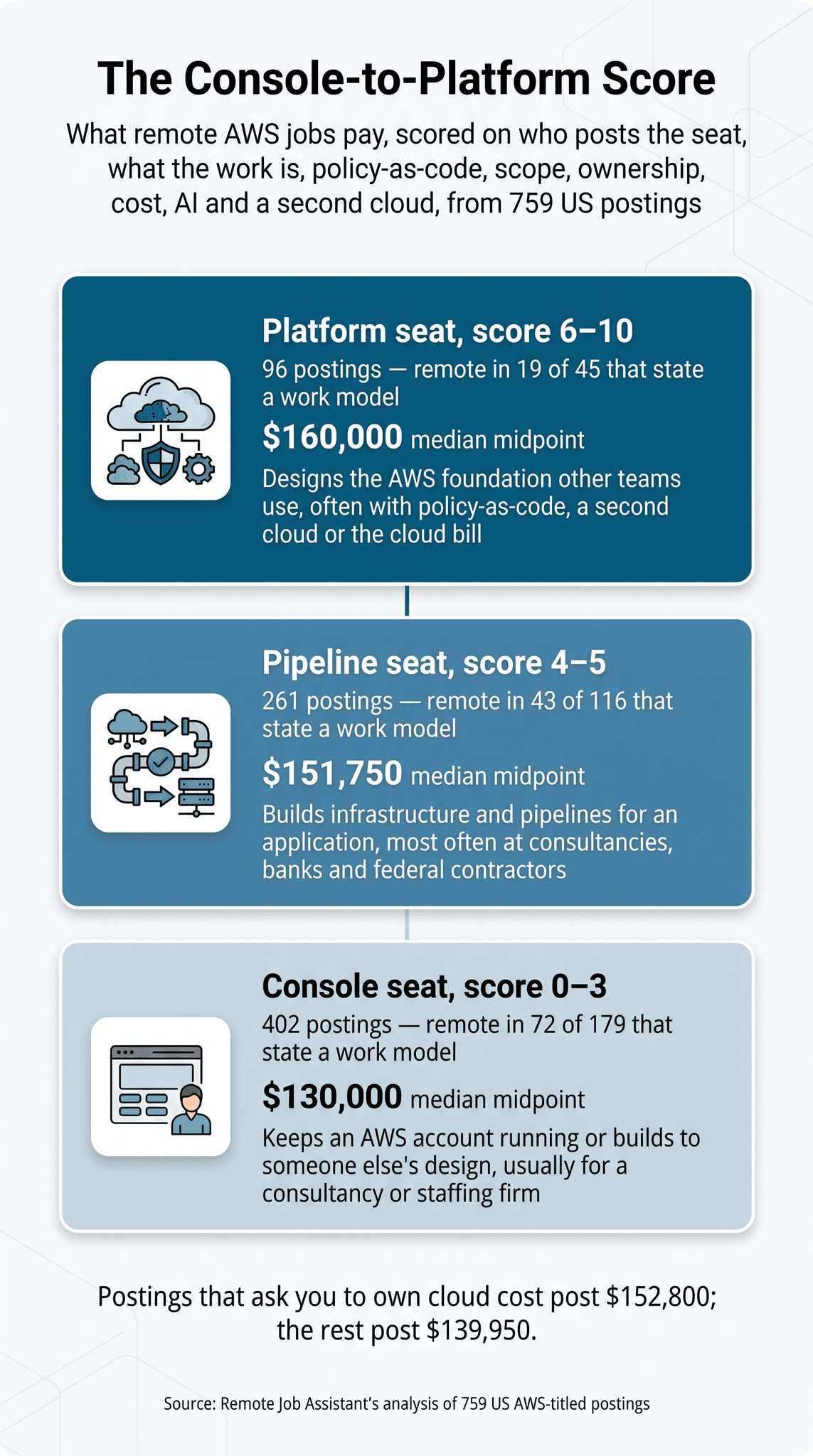
Three seats, then. A Console seat (402 postings) posts a $130,000 midpoint and is remote 40.2% of the time it states a model outside Himalayas (72 of 179); a Pipeline seat (261) posts $151,750 and 37.1% (43 of 116); a Platform seat (96) posts $160,000 and 42.2% (19 of 45). Pay climbs $30,000 with the score while the remote share barely moves, which means you don't have to trade remote work for the better seat. You have to trade the employer.
Of the 98 remote AWS-titled postings with a posted range, 18 start at $150,000 or more, 11 of the 18 carry architect, lead, director or principal in the title, and 7 come from federal contractors. The top of the list: ICF's Director, Secure Cloud Hosting (AWS/Azure) at $191,339–$325,277; Koniag Government Services' Senior AWS DevOps Engineer at $190,000–$270,000; Databricks' Specialist Solutions Architect, AWS Infrastructure and AI Platform at $180,000–$247,500; an AWS Cloud Architect seat listed under Tyto Athene at $180,000–$215,000; GDIT's AWS Technical Lead at $165,750–$224,250; Easy Dynamics' AWS Technical Lead at $160,000–$190,000; TEKsystems' Lead Java Practice Architect (AWS) at $160,000–$225,000; and Ledgebrook's Sr Platform Engineer (AWS) at $150,000–$200,000.
Can You Work Remotely at AWS? What Amazon's Own Postings Say
Short answer: rarely, and mostly if you sell to a state government. In September 2024, Amazon CEO Andy Jassy told employees the company would "return to being in the office the way we were before the onset of COVID," and made "this new expectation active on January 2, 2025." The memo names two ways out: "extenuating circumstances" (a sick child, a house emergency, days on the road with customers) or "a Remote Work Exception approved through your s-team leader." It names no exception for AWS. A month later, AWS CEO Matt Garman told staff who disliked the policy that "there are other companies around," according to a transcript CNBC reported.
The postings agree with the memo. On October 11, 2026, Amazon's job site listed 5,370 US postings in its AWS business, and 16 of them (0.3%) carried a Virtual Location. Take out the 2,177 postings in its operations, IT and support engineering category, mostly data-center, install and engineering-operations technicians whom nobody expects to be remote, and it is still 16 of 3,193 (0.5%). The sixteen are not a hidden remote engineering track:
- 4 are solutions architects with a territory, such as "Solutions Architect (SLG/EDU), State and Local Government, Higher Education - Great Lakes" ("This is a virtual position with primary focus in Indiana") and two Energy & Utilities seats in Florida and Texas.
- 3 are sales seats tied to a state or an account: "Sales - State of Iowa, Midwest SLG," "AWS Account Executive - State of Indiana, SLG/EDU" and a Global Account Manager for energy.
- 1 is a ProServe delivery consultant in Georgia whose posting "requires that the candidate selected be a US Citizen and must currently possess and maintain an active TS/SCI security clearance with polygraph."
- 1 is a software development engineer (Amazon MQ). The other 7 are hardware, Just Walk Out retail-technology and product-management seats.
Of the 890 AWS software-development postings, one was virtual. Of the 430 solutions-architect postings, four were.
AWS pays well for the commute. 3,788 of the 5,370 postings print a range, and their median midpoint is $173,650: $194,400 for software development (n=888), $180,700 for solutions architects (n=430) and $148,100 for the operations and data-center category (n=707). Most of those seats sit in Seattle (1,171 postings), Herndon and Arlington, Virginia (753 together), Austin (205) and New York (200). And the page that ranks for "aws jobs remote," amazon.jobs' remote-jobs page, covers all of Amazon; 88 of the 388 remote-location values in its search filter are virtual contact-center locations.
Apply to AWS for the pay, the brand and the depth of the platform, not for remote. The remote AWS jobs are at the companies that pay the AWS bill, and the rest of this guide is about them.
How We Collected This Data
Start with what we couldn't read. Indeed, Glassdoor and ZipRecruiter block automated reading, so Indeed's listings appear here only through SimplyHired, which carries its feed. Reddit is unreadable to our crawler, so this guide quotes no Reddit sentiment. Referral-only and staffing-pipeline roles never reach a public board at all. Those gaps lean toward employers that post publicly and print ranges, which makes our pay figures, if anything, a little high for vendor seats and our remote share a little low for small firms.
Three more biases shape every number. Pay is posted on 47.7% of AWS-titled postings (362 of 759: 46 of 55 Workday rows, 205 of 451 LinkedIn rows, 62 of 148 SimplyHired rows, 47 of 102 Himalayas rows), so medians lean toward employers with pay-transparency blocks. 317 of the 759 (41.8%) say nothing about work model, so every "remote" share in this guide is a share of postings that state one. And Himalayas lists only remote jobs: 100 of its 102 AWS-titled rows are remote by construction, so remote shares set Himalayas aside unless we say otherwise, while pay figures keep it.
A posting counted if its title named AWS or Amazon Web Services (or an AWS-only product such as Amazon Connect, Redshift or SageMaker) next to a professional role word. We sorted titles into role families: cloud, DevOps and platform engineers; developers and software engineers; architects; data engineers; security; machine learning and generative AI; administrators and support; consultants; and managers. We dropped sales, partner, alliance and marketplace titles, instructors, interns, non-English postings and the "AWS" that isn't Amazon (American Welding Society inspector jobs, federal "AWS days" alternative work schedules). Amazon's own postings are counted separately, because ", AWS Config" in an Amazon title names a team, not a skill.
Dedupe started from 7,928 rows, 5,493 of them Amazon's own postings. We removed 2,122 exact copies, 1,161 per-city clones of one requisition and 144 copies under sibling employer names, then collapsed 1,331 duplicates found on two sources, leaving 1,314 unique non-Amazon postings across the AWS-titled and comparison sets. Per-city clones matter in AWS hiring: on LinkedIn, the 1,667 AWS-titled cards our searches returned were 895 unique title-and-employer pairs, and PwC's 130 cards were 5 titles posted in 52 locations. We fetched the full posting for 880 of those 895 pairs. Work model comes from the posting text, not the board's remote flag, and employer type from curated names (including AWS partners and AWS-market staffing firms), LinkedIn's industry label, and employers' own career sites.
The Console-to-Platform Score is computed by code from duty language, and the audit changed three things. The interim version gave a point for on-call; on-call postings posted $134,438 against $144,000 without it, so on-call is reported, not scored, and that point went to owning cloud cost. Naming Terraform, CloudFormation or CDK earned nothing on its own ($141,575 against $139,950 with no tool named), so the provisioning point now requires IaC plus GitOps or policy-as-code. And the employer point follows posted pay: staffing firms and consultancies post level with each other, companies running their own AWS estates post more, and banks post most.
Salary cross-references: the BLS Occupational Outlook Handbook for computer network architects (median $134,050 in May 2025; lowest 10% under $79,900, highest 10% above $202,680; 8% growth from 2025 to 2035; "5 years or more" of related work experience), BLS OEWS May 2025 (software developers $135,980; information security analysts $129,180; database architects $139,500; network and computer systems administrators $99,130; computer and information systems managers $175,140), O*NET's hot-technology counts, and the Stack Overflow 2025 Developer Survey, where 43.3% of 24,473 respondents to its cloud and infrastructure question reported extensive AWS work (45.9% of 20,070 professional developers), against 26.3% for Azure and 24.6% for Google Cloud. Figures reflect postings pulled on October 11, 2026; we refresh this analysis quarterly.
The Console-to-Platform Score: Why Two Remote "AWS Cloud Architect" Jobs Pay $27,500 Apart
The usual advice is to add a service or a badge: learn EKS, get the Solutions Architect certificate, put Lambda on the résumé, and the offers follow. The postings disagree. Postings that name Lambda post $136,948 against $151,817 for the ones that don't, Terraform alone moves nothing, and the role-family midpoints for engineers, developers, data engineers and security sit inside a $5,000 band ($137,000 to $141,575). What moves an AWS posting's pay is what the work is (keeping an account running, building on it, or designing the platform everyone else builds on) and who sells or buys the seat.
The Console-to-Platform Score is a 0–10 rubric that scores any AWS posting, or your current job, on how far it sits from "keeping someone else's AWS account running from the console and the ticket queue" toward "designing the AWS platform other teams build on," using only what the posting says.
The two-minute check. Answer four questions from the posting:
- Who posts it: a staffing firm or consultancy that bills your hours to a client, a company running its own AWS estate, or a bank, insurer or fintech?
- What is the work: tickets, patching, backups and access requests; pipelines and infrastructure for one application; or account structure, guardrails and modules other teams use?
- Does it pair infrastructure-as-code with GitOps or policy-as-code (Argo CD, Flux, OPA, Sentinel)?
- Does it ask for multi-account or large-scale scope, ownership, the cloud bill, AI work, or a second cloud?
Scoring, with the median posted midpoint for each value across the 759 postings:
- Employer (0–2), who posts the seat: a staffing firm, C2C shop or consultancy that bills the seat to a client = 0 ($132,500, n=165); a company running its own AWS estate, including software companies, federal contractors, healthcare and manufacturers = 1 ($150,988, n=144); a bank, insurer or fintech = 2 ($168,750, n=53).
- Work (0–2), what the AWS work is: operate (tickets, patching, backups, monitoring, access requests, console administration) = 0 ($123,750, n=24); build (pipelines, infrastructure for an application, CI/CD, migrations, automation) or nothing decisive = 1 ($140,000, n=234); platform (multi-account strategy, landing zone, Control Tower, guardrails, internal developer platform, reusable modules, reference architecture) = 2 ($155,000, n=93).
- Provisioning (0–1): infrastructure-as-code plus GitOps or policy-as-code ($155,000, n=29). Naming Terraform, CloudFormation or CDK alone scores nothing, because it posts $141,575 against $139,950 with no tool named.
- Scope (0–1): multi-account, multi-region or large-scale production ($151,600 vs $137,880).
- Ownership (0–1): architecture, technical lead, mentoring, owning a platform or service ($145,000 vs $136,000).
- Cost (0–1): owns cloud spend, such as cost optimization, FinOps, Savings Plans or rightsizing ($152,800 vs $139,950; 146 postings).
- AI (0–1): Bedrock, SageMaker or generative-AI work expected ($150,000 vs $140,000; 182 postings).
- Breadth (0–1): a second cloud named alongside AWS, such as Azure, Google Cloud or OCI ($160,000 vs $139,500; 124 postings).
Bands:
- Console seat (0–3): $130,000 midpoint (n=168); remote in 40.2% of the 179 postings outside Himalayas that state a model. You keep an account running or build to someone else's design, usually for a consultancy (193 of these postings) or a staffing firm (84). 402 postings.
- Pipeline seat (4–5): $151,750 midpoint (n=141); remote 37.1% of 116. You build infrastructure and pipelines for an application, most often at consultancies (82), banks (60) and federal contractors (46). 261 postings.
- Platform seat (6–10): $160,000 midpoint (n=53); remote 42.2% of 45. You design the AWS foundation other teams use, often with policy-as-code, a second cloud or the bill, at federal contractors (22), banks (22), consultancies (19) and software companies (13). 96 postings.
| Seat | Score | Postings | Remote (of stated, ex-Himalayas) | Median midpoint (n) | Hourly median (n) | Contract | Typical posters |
|---|---|---|---|---|---|---|---|
| Console | 0–3 | 402 | 40.2% (72 of 179) | $130,000 (168) | $60–$75 (32) | 65 | Consultancies, staffing firms |
| Pipeline | 4–5 | 261 | 37.1% (43 of 116) | $151,750 (141) | $65–$75 (10) | 29 | Consultancies, banks, federal contractors |
| Platform | 6–10 | 96 | 42.2% (19 of 45) | $160,000 (53) | $78–$81 (2) | 5 | Federal contractors, banks, consultancies, software |
The single score is honest about its noise: $103,750 at 0 (n=4), $128,538 at 1, $132,500 at 2, $131,766 at 3, $143,750 at 4, $160,000 at 5, $155,445 at 6, $163,125 at 7 and $177,312 at 8 (n=4). The flat spot at 2 to 3 and the dip at 6 are small samples; the climb from 3 to 8 is $45,500.
How to use it. Score your current job, then every posting you consider, in two minutes. The biggest single point is who posts it: $132,500 at a staffing firm or consultancy, $150,988 at a company running its own AWS estate, $168,750 at a bank. The cheapest points are the ones you can truthfully claim this month: a cost report with your name on it, a reusable module another team adopted, a policy check you added to the pipeline. If you score 0–3 and want $150,000, change what the work is and who posts it before you buy another certificate. And decide which trade you're making, because the best-paid employer type is also the least remote.
Here is the score on two postings with the same title, the same work model and the same kind of employer. Goldschmitt and Associates, a federal IT contractor, posts an AWS Cloud Architect as remote "with preference given to candidates who live within a commutable distance to the DMV area," at $160,000–$180,000, to "Design, develop, implement, and maintain AWS cloud environments supporting enterprise/SaaS applications," "Implement and maintain AWS Infrastructure as Code (IaC)" and "Implement and manage AWS identity, access controls, roles, policies, and permissions following least-privilege principles." It scores 3: one for an in-house federal employer, one for build work, one for architecture ownership, and nothing for scope, policy-as-code, cost or breadth. A second AWS Cloud Architect posting, listed under Tyto Athene on Himalayas with a body that names its Quantum Sky team, is also remote, at $180,000–$215,000, "to lead the expansion of our existing Google Cloud (GCP) platform into AWS," translating "its existing architecture, landing zone, and security controls into equivalent AWS services and design patterns" and refactoring "the platform's Terraform modules and CI/CD pipelines to support AWS deployments alongside the existing GCP implementation." It scores 7: platform work (+2), policy-as-code alongside Terraform (+1), multi-account scope (+1), a technical-lead and mentoring line (+1), a second cloud (+1), plus the same employer point. Same title, same remote status, same employer type: $170,000 against $197,500 at the midpoint.
Why does the work move AWS pay so much? Because an operate seat is priced per account and a platform seat is priced per blast radius. A managed-services contract bills a client a monthly fee to keep its AWS estate patched, backed up and answering tickets, and the engineer behind it is a cost line the vendor competes on. A platform seat writes the account structure, the guardrails and the modules that every product team inherits. When it's wrong, every team is wrong at once, which is why those postings ask for ownership, design reviews and the cloud bill, and why they post more. One consultancy put the line bluntly in its own posting: "GUI/console-based Lambda creation is not acceptable." A staffing firm asked for "Significant experience automating infrastructure rather than simply administering AWS through the console."
Platform language is cheap to write, so check it before you score it.
Adjectives aren't artifacts: 570 of the 759 postings call the work scalable, highly available, secure or resilient, and 314 of those name no platform artifact (no landing zone, account vending, SCPs, guardrails or reusable modules); they post $135,000 (n=149), against $155,000 (n=127) when the adjectives come with an artifact. A named consumer is the strongest tell: the 49 postings that say who uses the platform (product teams, self-service, golden paths, an internal developer platform) post $168,750 (n=27). And ownership lines are worth reading literally: "own," "define standards" and "technical lead" postings post $145,000 against $136,000.
Why does the employer move it? Because a vendor's margin sits inside the range. A staffing firm or consultancy bills an AWS engineer to a client at a rate and pays a salary or hourly rate under it, and its postings are templates: System One posted 24 AWS-titled roles in our set, Bright Vision Technologies posted 5 with ranges such as $100,000–$150,000 on two different titles. Banks pay most because their AWS estates are regulated, large and owned in-house, and they pay it in the office: 2 of the 30 bank, insurer and fintech postings that state a work model are remote. The best-paid line in an AWS job description isn't a service name. It's the one that hands you the bill: postings that ask you to own cloud cost post $152,800; the rest post $139,950.
Two kinds of posting break the pattern. Federal contractors pay like in-house teams ($151,475, n=84) and still post remote 36.0% of the time they state a model (18 of 50), but 94 of their 113 AWS postings name a clearance, so that remote seat is open only to people who hold one or can get one. And a staffing firm can attach platform language to a vendor seat: Bright Vision's AWS Solutions Architect asks you to "Design multi-account AWS organizations, including landing zones, SCPs, centralized logging, and shared services." The score reads the posting, so treat it as a starting point for a conversation, not a verdict.
Stop Applying Manually
Our AI applies to hundreds of matching jobs while you sleep. Wake up to interviews, not more applications.
The vendor reposts are the part that wears people down: the same AWS requisition under three agency names, each with a different rate, and a "remote" headline over a body that says Reston. Filtering to the Pipeline and Platform postings with a real employer and a real range is the job. Auto-Apply handles the application volume once you've decided which ones those are.
Remote AWS Salary by Role: Cloud Engineer, DevOps, Architect, Data and Security
Role family matters less than seat and employer, with two exceptions: architects post more, and administrators post much less.
| Role family (title) | Postings | Remote (of stated, ex-Himalayas) | Median range | Median midpoint (n) | Hourly median (n) |
|---|---|---|---|---|---|
| Architect (solutions, cloud, enterprise) | 115 | 50.0% (27 of 54) | $129,300–$175,400 | $155,125 (51) | $79–$83.50 (4) |
| ML and generative AI | 32 | 80.0% (12 of 15) | $121,450–$190,000 | $147,988 (12) | $60–$100 (2) |
| Consultant or specialist | 20 | 50.0% (3 of 6) | $120,000–$160,000 | $142,500 (11) | $85.50–$92.50 (2) |
| Cloud, DevOps and platform engineer | 230 | 29.5% (28 of 95) | $119,105–$162,900 | $141,575 (126) | $67.50–$82.50 (12) |
| Data engineer or data architect | 87 | 36.8% (14 of 38) | $120,000–$156,700 | $139,950 (35) | $60–$70 (6) |
| Developer or software engineer | 196 | 37.8% (37 of 98) | $120,000–$160,000 | $139,000 (89) | $61–$74.50 (14) |
| Security | 46 | 36.4% (8 of 22) | $107,900–$160,000 | $137,000 (25) | $77–$87 (2) |
| Administrator or support | 27 | 30.0% (3 of 10) | $95,000–$136,700 | $108,000 (9) | $30–$35.50 (2) |
Salary ranges come from our analysis of 759 US AWS-titled postings pulled October 11, 2026, 362 of which print an annual range; medians are of each posting's range midpoint, and remote shares exclude Himalayas because it lists only remote jobs. BLS cross-references are May 2025 medians: computer network architects $134,050, software developers $135,980, information security analysts $129,180, network and computer systems administrators $99,130. Ranges shift as markets move, so check the linked sources for current figures.
The middle half of posted midpoints runs from $120,000 to $170,000, and the top tenth starts near $200,000. The BLS medians sit a little below ours because they cover every worker in the occupation, including people who never touch a cloud console, while AWS-titled postings skew senior: 223 of the 759 carry lead, principal, architect or manager in the title, at a $160,000 midpoint (n=117), against $126,500 for mid-level titles (n=148) and $151,475 for senior ones (n=89). Years asked climb the same way: postings asking 0–4 years post $136,875 (n=42), 5–7 years $142,400 (n=54), 8–10 years $152,950 (n=39) and 11 or more $167,500 (n=11). The median ask is five years.
The AWS solutions architect salary question has two answers. AWS-titled architect postings at other employers post a $155,125 midpoint and are remote half the time they state a model (27 of 54). Amazon's own solutions-architect postings print $180,700, and 4 of its 430 were virtual. Our remote cloud engineer guide covers the cloud-engineering ladder more broadly, and the remote DevOps guide covers the on-call side of the same work.
Contract rates need a conversion before you compare them. The 44 postings that print only an hourly rate post a $61–$75 median, which is $126,880–$156,000 at 2,080 hours, before you pay for your own benefits and the weeks between contracts. Contract seats also skew to the Console band: 65 of the 99 contract postings in our set score 0–3. If an offer comes as an hourly rate, multiply by 2,080, subtract what your health insurance and unpaid gaps cost, and compare that to a direct range, not the headline rate.
Who Actually Posts Remote AWS Jobs (and What "AWS" in the Title Tells You)
Most AWS-titled postings are sold, not owned. Consultancies, AWS partners and staffing firms posted 406 of the 759 (53.5%), federal contractors 113 (14.9%), and the companies that run their own AWS estates (banks, software companies, healthcare, manufacturers) the rest.
| Employer type | Postings | Remote (of stated, ex-Himalayas) | Median range | Median midpoint (n) | Contract |
|---|---|---|---|---|---|
| Banks, insurers and fintechs | 87 | 6.7% (2 of 30) | $137,750–$208,700 | $168,750 (53) | 6 |
| Federal contractors | 113 | 36.0% (18 of 50) | $111,563–$180,000 | $151,475 (84) | 0 |
| Manufacturers, retail, media and other in-house | 41 | 30.0% (6 of 20) | $131,600–$170,000 | $150,000 (15) | 3 |
| Software and internet companies | 94 | 40.8% (20 of 49) | $127,000–$170,000 | $144,500 (35) | 15 |
| Healthcare | 18 | 63.6% (7 of 11) | $111,350–$158,951 | $139,234 (10) | 2 |
| Staffing firms | 104 | 42.9% (27 of 63) | $115,000–$150,000 | $132,500 (43) | 41 |
| Consultancies and AWS partners | 302 | 46.2% (54 of 117) | $110,400–$151,518 | $132,133 (122) | 32 |
Read the table as a trade. The two vendor rows are the easiest remote seats to find and the cheapest ones. Banks are the opposite: JPMorganChase, Travelers, Capital One and State Street post high ranges, and 26 of the 30 bank, insurer and fintech postings that state a model are hybrid. Built In's remote AWS page shows the same pattern from the other side: 8 of its 25 cards were JPMorganChase roles labelled "Remote or Hybrid." Federal contractors sit in between, at near-bank pay with a clearance gate.
The title tells you which of those you're looking at. Postings with AWS in the title post a $142,400 midpoint (n=362). The 386 cloud-engineering postings with no AWS in the title but AWS in the requirements (Platform Engineer, Site Reliability Engineer, Cloud Infrastructure Engineer) post $175,250 (n=264) and are remote 45.9% of the time they state a model (111 of 242). That gap is mostly about who posts each: 187 of the 386 come from software companies (Esri, Snowflake and Databricks among the most frequent), while AWS-titled postings come mostly from vendors.
| Title type | Postings | Remote (of stated) | Median midpoint (n) | Mid level | Senior | Lead |
|---|---|---|---|---|---|---|
| AWS in the title | 759 | 39.4% (134 of 340) | $142,400 (362) | $126,500 | $151,475 | $160,000 |
| Cloud title, AWS required in the body | 386 | 45.9% (111 of 242) | $175,250 (264) | $148,025 | $187,750 | $188,600 |
| Azure, Google Cloud or OCI in the title | 89 | 81.0% (47 of 58) | $145,000 (47) | $132,750 | $157,500 | $162,875 |
Within the same employer type the gap mostly closes: $131,033 against $145,000 at consultancies, $151,475 against $146,950 at federal contractors, $168,750 against $181,250 at banks. Software companies are the exception ($144,500 against $194,950), because the ones that post Platform Engineer at $195,000 rarely put a cloud vendor in a title. Within LinkedIn alone, AWS-titled and cloud-titled postings post $148,580 and $150,000. So the AWS word isn't a pay penalty by itself; it's a flag for a vendor seat. If you deploy to AWS every day, apply under the platform or infrastructure title, not the AWS one. Our remote software engineer guide and the software engineer job listings are where those titles live.
Two things the postings say that the vendors won't. At consultancies, "AWS Architect" is a sales title as much as a job title: 32 of the 62 consultancy architect postings describe platform work, and they still post $140,000 (n=30) against $170,000 (n=21) for architects everywhere else. And clearance is the closest thing to a remote pay premium, but it's small: remote postings that name a clearance post $139,950 (n=35) against $135,000 (n=63) without one, and 7 of the 18 remote postings that start at $150,000 or more are federal. What the postings don't support is the common warning that federal remote seats vanish when a contract changes: only 3 of the 113 federal postings carry a contract-contingent line, such as GDIT's "This position is contingent upon contract award."
Three more lanes are worth naming. Clearance work is nearly a quarter of the market: 181 of the 759 postings name a clearance, and Leidos, CACI, Booz Allen Hamilton, GDIT, Peraton and Northrop Grumman post lines like "Minimum Clearance Required to Start: TS/SCI with Polygraph" (CACI). Azure- and Google Cloud-titled postings are remote far more often (81.0%, 47 of 58) at similar pay ($145,000), which says more about who posts them (47 of the 89 come from consultancies and staffing firms) than about the clouds. And a second cloud in the requirements pays: postings that name Azure or Google Cloud next to AWS post $156,800 (n=87) against $137,379 without. For the data side of the same stack, our remote data engineer guide breaks down Redshift, Glue and Databricks seats, and data and analytics listings carry the current openings.
Stop Applying Manually
Our AI applies to hundreds of matching jobs while you sleep. Wake up to interviews, not more applications.
The "remote" cards that say hybrid three paragraphs down cost the most time: 146 of the AWS-titled postings outside Himalayas that state a model are hybrid, against 134 remote. Auto-Apply reads the work-location line before it applies, so the hybrid-in-disguise ones don't eat your evenings.
AWS Certifications vs Terraform: What Remote Postings Actually Ask For
Is an AWS certification worth it? For the remote seats in our set, it's a tiebreaker and rarely a gate. 280 of the 759 AWS-titled postings (36.9%) name an AWS certification. 14 (1.8%) require one, and 34 call one preferred; the rest list it among nice-to-haves or as an example. Among the 386 higher-paying cloud-engineering postings that require AWS, 55 (14.2%) name an AWS certification and 2 require one. Terraform is named in 398 AWS-titled postings (52.4%) and in 288 of the 386 cloud-engineering ones (74.6%).
| What the posting names | Postings | Share of 759 | Median midpoint, named (n) | Median midpoint, not named |
|---|---|---|---|---|
| Any AWS certification | 280 | 36.9% | $149,500 (137) | $139,500 |
| A Professional-level AWS certification | 108 | 14.2% | $160,000 (57) | $139,375 |
| An Associate-level AWS certification | 88 | 11.6% | $145,000 (39) | $142,400 |
| AWS Cloud Practitioner | 39 | 5.1% | $132,500 (19) | $142,400 |
| AWS certification required | 14 | 1.8% | $174,175 (8) | $141,575 |
| Terraform | 398 | 52.4% | $142,400 (199) | $144,500 |
| GitOps (Argo CD, Flux) | 41 | 5.4% | $165,000 (17) | $140,000 |
| Kubernetes or EKS | 303 | 39.9% | $146,250 (152) | $139,950 |
The certificate level tracks the seat, not the other way round. Postings that name a Professional-level certificate post $160,000 because they're architect and lead seats; postings that name Cloud Practitioner post $132,500 because they're junior and vendor seats. At consultancies the split is stark: $156,800 when a Professional certificate is named (n=21), $118,750 when only an Associate is (n=12). Federal contractors name certificates most (65 of their 113 postings, 57.5%), because contract staffing plans and partner tiers count certified headcount; banks name them least (16 of 87, 18.4%).
AWS's own rules, from its certification policies (checked October 11, 2026): Foundational exams cost $100, Associate $150, Professional and Specialty $300 per attempt. A certification lasts three years. If you fail, "you must wait 14 calendar days before you are eligible to retake the exam," and once you pass you "will not be able to retake the same exam for two years." AWS retired the Data Analytics, Database and SAP on AWS Specialty exams in April 2024 and the Machine Learning Specialty on March 31, 2026, and the Advanced Networking Specialty retires December 31, 2026. It added a Data Engineer Associate (March 12, 2024) and replaced SysOps Administrator with CloudOps Engineer Associate on September 30, 2025. The Solutions Architect Professional exam changes on November 17, 2026 (SAP-C03; registration opens October 27). AWS says there were "more than 1.42 million active AWS Certifications and 1.05 million unique AWS Certified individuals" as of January 2025, which is part of why a certificate alone doesn't separate you.
Sit for it or skip it: a rule from the postings.
- Sit for a Professional exam ($300) if you're targeting federal contractors or consultancies and already do architect-level work; those employers name certificates in 57.5% and 36.4% of their postings, and a named Professional certificate tracks $173,750 at federal contractors (n=18).
- Skip the Associate-for-its-own-sake if you're targeting banks or software companies; they name certificates in 18.4% and 28.7% of postings and require one in 1 of 181. Spend the time on a GitOps or policy-as-code project instead ($165,000 and $150,000 midpoints when named).
- Skip Cloud Practitioner entirely if you already work in AWS. It appears in 39 postings at a $132,500 midpoint, mostly junior and vendor seats.
Our certifications guide compares AWS certificates with the other credentials remote postings name, if you're deciding between AWS and something like Kubernetes (CKA, CKAD or CKS appear in 24 AWS-titled postings at a $165,900 midpoint).
The Remote Small Print: Clearance, GovCloud, Travel and On-Call
A posting that says remote can still decide who may apply and where you sit. Among the 234 remote AWS-titled postings, here's what the small print said.
| Small print in remote postings | Remote postings | Share of 234 | Example line from a posting |
|---|---|---|---|
| On-call rotation | 54 | 23.1% | "Participate in on-call rotations to support 24/7 production systems and incident response" (Peraton) |
| Security clearance | 48 | 20.5% | "Ability to obtain and maintain a Public Trust security clearance" (Leidos) |
| FedRAMP or DoD impact levels | 41 | 17.5% | "Demonstrated experience working in AWS IL6, AWS GovCloud, or comparable high-security government cloud environments" (North South Consulting Group) |
| US citizenship | 33 | 14.1% | "As required by our governmental client, this position requires U.S. Citizenship" (Cherokee Federal) |
| Any travel | 27 | 11.5% | "This role is a Remote/Telecommute position with the ability to travel up to 20%" (TruSummit Solutions) |
| AWS GovCloud | 18 | 7.7% | "Support both AWS Commercial and AWS GovCloud environments" (Goldschmitt and Associates) |
| Time zone or core hours | 8 | 3.4% | |
| W-2 only | 7 | 3.0% |
Add them up and 61 of the 234 remote postings (26.1%) carry a clearance, citizenship or GovCloud line. AWS explains the GovCloud part itself: GovCloud (US) is "operated by U.S. citizens on U.S. soil," and its root account holders "must pass a screening process validating U.S. persons status." The regions support FedRAMP High and Defense Department Impact Levels 2, 4 and 5. That's why federal AWS postings stack a citizenship line on top of a clearance line, and why a green-card holder can use GovCloud as a customer but still be screened out of a cleared contractor seat. The citizenship line comes from the contract, not from AWS. Our remote cybersecurity guide covers the clearance ladder in more depth.
What to do with each line, in order of how often it blocks people:
- If it names a clearance you don't hold (48 of the 234 remote postings), skip it unless the line says "ability to obtain" a Public Trust; that's the one level a non-cleared US citizen can realistically start in.
- If it names US citizenship or GovCloud (33 and 18), treat it as a hard gate; the employer can't waive what the contract requires.
- If it says remote "with preference" for a metro, ask how often people in that metro go in, and get the answer for your own address in writing.
- If it says remote arrangements are "subject to change based on client requirements" (NTT DATA's wording, one of 9 contract-contingent lines in the set), ask which client and what changed for the last person in the seat.
- If it asks for travel of 25% or more, price the trips before you price the salary; those are client-site consulting seats.
Travel is the consulting tax. Accenture's AWS Technical Architect says "The amount of travel will vary from 0 to 100% depending on business need and client requirements"; Deloitte's Amazon Connect consultant says "Ability to travel up to 50% on average, based on the work you do and the clients and industries/sectors you serve"; a resident-architect seat says "Typical travel expectations range from 25-100%, with occasional higher travel during key architecture or program milestones." Postings that mention travel post $153,825 (n=34), more than those that don't, because they're senior client-facing seats.
After you're hired, the postings tell you what the week looks like. On-call shows up as "Participation in a global on-call rotation" (Securitas) and "take direct accountability for production operations, including on-call" (Praxis Precision Medicines); the operational side as "Run scheduled DR tests and game days, and write runbooks that make recovery repeatable by anyone on call" (Reflex Media). The conditional-remote lines matter too: "remote with preference given to candidates who live within a commutable distance to the DMV area" is a remote seat you may be asked to drive to.
| Flag in the posting | What it usually means | What to ask | Green flag instead |
|---|---|---|---|
| "AWS Cloud Engineer" from a vendor you've never heard of, with a round range | A staffing template reused across titles and clients | "Who is the end client, and is this W-2 with them or with you?" | The employer's own career site lists the same req |
| Remote in the title, a city or office days in the body | The board flag is wrong or the req changed | "Is this remote from anywhere in the US, in writing?" | A structured remote work-location field and no office-days line |
| A clearance line plus "AWS GovCloud" | A federal program seat; citizenship is required and some work may sit in a secure facility | "What share of the work is unclassified and remote?" | A Public Trust line and a remote-eligibility statement |
| "24/7 on-call" with no team size | A thin operations team carrying the pager | "How many people share the rotation, and how often are you paged?" | A rotation of six or more and SLO-based alerting |
| "Travel up to 50%" or "0 to 100%" | A consulting seat that bills on site at client offices | "What was the actual travel for this team last quarter?" | A stated cap of 10% or less |
| "AWS certification required" on a support seat | A vendor counting certified headcount for a client or partner tier | "Will you pay for the exam and the renewal?" | A posting that names the work (landing zone, cost, platform) instead of a badge |
How to spot a real remote AWS job in 60 seconds:
- Find the work-location line, not the title. "Remote (US)" or a remote work-location field beats "remote" in a headline.
- Look for the employer's own name on its own career site. A staffing firm's copy of the same req costs you a margin.
- Search the body for clearance, citizenship and GovCloud. Any one of them narrows who can apply and sometimes where you sit.
- Read the duties for the work: tickets and patching (operate), pipelines and modules (build), or account structure, guardrails and the bill (platform).
- Check for a range. 362 of the 759 postings print one; the rest leave you to negotiate blind.
On-call deserves its own note, because it runs against intuition. Postings that mention on-call post $134,438 (n=86) against $144,000 without it. The pager in an AWS posting usually belongs to an operations seat, not a senior platform seat, so on-call is a production marker we report, not a point we score.
Stop Applying Manually
Our AI applies to hundreds of matching jobs while you sleep. Wake up to interviews, not more applications.
Clearance-gated requisitions are a dead end for most applicants, and they hide inside remote searches: 61 of the 234 remote AWS-titled postings carry a clearance, citizenship or GovCloud line. If you can't hold one, filter them out before you apply; if you can, they're some of the best-paid remote seats in the set.
How to Move From a Console Seat to a Platform Seat in 90 Days
You don't need a new employer to change your score, but you usually need one to get paid for it. Start with what you can change at work this quarter, then change who posts the seat.
Which move first? A four-branch rule from the postings:
- If you're at a staffing firm or consultancy (employer point 0): the fastest raise is a direct employer, not a new certificate. Staffing and consultancy postings post $132,500 and $132,133; federal contractors post $151,475 and companies running their own AWS estates $150,988. Apply direct to the end clients whose accounts you already run.
- If you run an in-house AWS estate (operate work, work point 0): turn one operating duty into a platform artifact. Write the account-vending or tagging standard, the reusable module or the guardrail, and put your name on the cost report. Platform work posts $155,000 against $123,750 for operate work.
- If you're a developer who deploys to AWS: apply under the platform or infrastructure title, not "AWS Developer." Developer-titled AWS postings post $139,000; cloud-engineering titles that require AWS post $175,250.
- If you're at AWS and the office rule is the problem: the 16 virtual postings are mostly territory sales and solutions-architect seats. Your AWS résumé is worth most at a bank ($168,750, rarely remote) or a federal contractor ($151,475, remote 36.0% of the time it's stated, usually behind a clearance), so decide which of the two you're optimizing for before you apply.
Three illustrative résumé rewrites (examples of the shape, not quotes from postings):
- Before: "Managed AWS infrastructure for multiple clients." After: "Owned 40 AWS accounts for 12 clients; moved them to an Organizations structure with SCP guardrails and cut monthly spend 18% with Savings Plans."
- Before: "Wrote Terraform for application deployments." After: "Built the Terraform module library (VPC, EKS, RDS) that six product teams deploy from; policy checks in CI block untagged resources."
- Before: "AWS Certified Solutions Architect – Associate" as the first line. After: keep the badge in the certifications line, and lead with the system you designed.
Five questions for the first recruiter call, in this order:
- "Who owns the AWS bill for this team, and does this role?"
- "How many AWS accounts and environments does the team run, and is there a landing zone?"
- "Is the infrastructure in Terraform or CDK, and are changes reviewed through pull requests and policy checks?"
- "How many people share on-call, and how often were you paged last month?"
- "Is the role remote from anywhere in the US, and can you put that in the offer letter?"
One sanity check against what employers actually pay for. A degree requirement doesn't move AWS pay at all ($142,400 with a bachelor's line, $142,500 without), and "degree or equivalent experience" postings post more ($157,500, n=61). Go appears in 39 postings at $158,500 and Java in 179 at $152,212, against $140,000 for postings that name Python; if you write Python, our remote Python guide covers where that pays, and the remote Java developer guide covers the bank-heavy Java side. The remote network engineer guide is the path if your AWS work is mostly VPCs, Transit Gateway and Direct Connect.
Frequently Asked Questions
Does AWS allow remote work in 2026, or do I have to be in an office?
Mostly the office. Amazon's five-day expectation took effect January 2, 2025, with exceptions only for extenuating circumstances or an existing Remote Work Exception, and on October 11, 2026, 16 of the 5,370 US postings in its AWS business (0.3%) carried a Virtual Location. Most of those were state-territory sales and solutions-architect seats.
Is an AWS certification worth it for getting a remote cloud job?
As a tiebreaker, yes; as a ticket, rarely. 36.9% (n=280 of 759) of AWS-titled postings name an AWS certification but 1.8% (n=14) require one, and 2 of the 386 higher-paying cloud-engineering postings that require AWS make a certification mandatory. A Professional-level certificate named in a posting tracks a $160,000 midpoint because it appears in architect and lead seats; Cloud Practitioner tracks $132,500.
I'm a solutions architect at AWS. Would leaving for a remote architect job mean a pay cut?
Usually, unless you go to a bank or a federal contractor. Amazon's own solutions-architect postings print a $180,700 median midpoint (n=430), and 4 of those 430 carried a Virtual Location; AWS-titled architect postings at other employers post $155,125 (n=51) and are remote 50.0% of the time they state a work model (27 of 54), while consultancy architect seats post $140,000.
I'm an AWS engineer at a staffing firm making $70 an hour. What would a direct remote role pay?
$70 an hour is $145,600 at 2,080 hours, before you pay for your own benefits and the gaps between contracts. Staffing-firm AWS postings with an annual range post $132,500; federal contractors post $151,475 and banks $168,750. The bigger gain usually comes from changing the work, not the rate: platform postings post $155,000 against $123,750 for operate-only seats.
What does a Console-to-Platform Score of 4 mean, and what moves it to 7?
A 4 is the entry to the Pipeline band: typically build work at a company running its own AWS estate, plus two more points such as ownership and multi-account scope. To reach 7 you add platform work (account structure, guardrails, reusable modules) and two of cost ownership, GitOps or policy-as-code, AI work, or a second cloud. Pipeline seats post $151,750; Platform seats $160,000.
I know CloudFormation but not Terraform. Will that cost me remote AWS offers?
It narrows them. Terraform appears in 52.4% (n=398 of 759) of AWS-titled postings and 74.6% of the higher-paying cloud-engineering ones, against 36.4% for CloudFormation and 17.3% for CDK. Learning Terraform opens doors without raising pay on its own; pairing infrastructure-as-code with GitOps or policy-as-code is what posts more ($155,000).
Are remote AWS jobs still in demand, or is AI replacing cloud engineers?
Demand is still broad: O*NET counts AWS in 537,989 US postings in 2025, ninth of 176 technologies, and Synergy Research put AWS at 28% of worldwide cloud infrastructure spending in Q2 2026. AI is showing up as work, not as a replacement: 182 of the 759 AWS-titled postings expect Bedrock, SageMaker or generative-AI work, at a $150,000 midpoint against $140,000 without it.
Start Your Remote AWS Search
If you remember one number from this guide, make it 16 of 5,370: the remote AWS job is almost never at AWS. Look at the companies that pay the bill, score each posting before you apply, and spend your effort on the moves that change the score (the work, the employer, the cost line) rather than on another badge.
- Browse remote engineering and technical jobs and filter for platform and infrastructure titles, not just AWS ones.
- Check remote jobs paying $150K+ and $100K+ for the Pipeline and Platform seats.
- Compare where to search in our guide to the best remote job boards, and see which other fields pay at this level in high-paying remote jobs.
- Before you accept a consultancy offer, look the firm up on AWS's partner tier page, which explains what Select, Advanced and Premier mean; and if your employer won't pay for training, AWS Skill Builder costs $29 a month on AWS's training page.
- When you're ready to apply at volume, Auto-Apply sends tailored applications to the postings you've already decided are worth it.
AWS will run your workload from any region on earth. It just won't let most of its own engineers work from one. The remote AWS job you want is at the company that pays the AWS bill.
Ready to Find Your Remote Job?
Browse thousands of curated remote jobs or let AI apply for you.
Browse Remote JobsRelated Job Guides
Remote SAP Jobs: What 2,031 Postings Actually Pay (2026)
Remote SAP jobs: we read 2,031 US postings. Ticket-queue seats post $126K, S/4HANA design seats $160K, and the most remote SAP seats pay the least of all.
38 min read
Remote SQL Jobs: What 449 Postings Actually Pay (2026)
Remote SQL jobs: we read 449 US postings. SQL Server seats post $116K, cloud-warehouse seats $186K, and the best-paid SQL jobs drop SQL from the title.
45 min read
Remote Java Developer Jobs: What 1,384 Postings Pay (2026)
Remote Java developer jobs: we read 1,384 US postings. 32% of those stating a model are remote, 57% come from consultancies, and the best-paid don't say Java.
48 min read