
Last reviewed: August 2026
You search "remote real estate jobs," get four hundred results, and every one of them wants the same three things: get licensed, join our brokerage, and buy your own leads. The pay line says "unlimited earning potential," which is the phrase people use when there is no salary.
You have a compensation history. You have a title. You are not looking for a business opportunity — you are looking for a job, and the search engine keeps handing you a franchise pitch with a "Remote" badge on it.
Get Remote Job Tips in Your Inbox
Weekly strategies, salary data, and new opportunities
Unsubscribe anytime. No spam.
Here is the part nobody says out loud: that is not an accident, and it is not a search algorithm failure. Indeed's own employer-facing guide tells brokerages to tag agent recruitment with the keyword "Remote work from home." The listings are behaving exactly as designed. Meanwhile the actual salaried remote jobs in this industry — the ones paying $75K to $175K — sit in underwriting, title, capital markets, and asset management, and almost none of them have the words "real estate agent" anywhere in the posting.
To sort the real from the recruiting, we pulled JLL's entire public careers board (3,410 postings) on August 28, 2026, queried public applicant-tracking feeds at nine named proptech and title employers, and cross-referenced pay against BLS 2025 wage data, Salary.com, Payscale, and the Robert Half 2026 Salary Guide.
- 6.5% (n=220 of 3,410 postings, pulled August 28, 2026) of openings at JLL, the largest commercial real estate services firm, are tagged remote — and not one of them is a brokerage role
- 86% of REALTORS® are independent contractors at their firm, not employees (NAR 2026 Member Profile)
- 62% of agents with two years or less of experience earn under $10,000 a year; the median for that group is $8,100 (NAR)
- $59,200 median REALTOR® gross income against the $91,543 "common salary" Indeed advertises for the same title — a 55% gap
- 0 of 30 open roles at Roofstock, a proptech company, are remote (Greenhouse board, August 28, 2026)
- 422,234 active California real estate licensees as of July 2026, down 2.4% year over year (California DRE)
That last number matters more than it looks. People are leaving this industry faster than they are joining it, and the recruiting spend has to go somewhere.
The JLL number is worth sitting with too. Of the 220 remote roles on that board, the titles were things like lead application security architect, regional finance analyst, senior GIS engineer, and pricing manager. Corporate functions, every one. The brokerage side — the part of the business most people picture when they think "real estate job" — was zero.
How We Collected This Data
The employer figures come from public applicant-tracking feeds rather than job-board aggregators, because aggregators are where the commission-only ads live. We pulled JLL's full careers board through its Workday feed and counted the remote workplace-type facet against total postings. We then queried public Greenhouse boards for Knock, Hometap, Orchard, Qualia, Ownwell, Pacaso, Doma, Roofstock, and Homeward, recording role titles, stated locations, posted pay, and any credential requirement.
Salary figures are cross-referenced across four source types because they disagree systematically: posting-scrapers (Indeed, Talent.com) skew high because advertised bands show their ceiling, and self-report sites (Payscale) skew low. Where sources diverge by more than $20K on the same title, both figures appear below rather than an average. Occupational medians come from BLS 2025 wage data, accessed through O*NET OnLine, which republishes the BLS OEWS series.
Licensing rules are read from primary regulators, not summaries: the Texas Real Estate Commission, the California Department of Real Estate, Fannie Mae's Selling Guide, 12 CFR Part 1008, and the NAIC State Licensing Handbook.
Three limitations worth stating plainly. Several major employers — CoStar, Compass, CBRE, and Cushman & Wakefield among them — block automated access to their careers pages, so this post makes no claim about their current openings, only about their publicly stated policies. Reddit was inaccessible during research, so there is no community sentiment here, only regulator and employer sources.
And the count undercounts in one specific direction: public boards miss internal mobility postings, which is where a meaningful share of remote conversions actually happen, and they miss roles tagged "hybrid" that are functionally remote with a quarterly on-site. The true remote share is almost certainly higher than 6.5%. It is not higher by enough to change the conclusion. Figures reflect August 2026.
Why This Search Returns Mostly Agent Ads
The mechanism is documented, and it comes from the platform itself.
Indeed publishes an employer guide called How to Hire a Real Estate Agent. Its recommended keyword list for brokerages posting agent roles includes "Real estate," "Realtor," "Sales" — and "Remote work from home." The same guide states that agents "are generally considered independent contractors, even when they work exclusively for a particular broker."
So the platform instructs brokerages to attach a remote-work keyword to a role it simultaneously defines as non-employment. Indeed's own employer policy, meanwhile, prohibits "misleading commission-only structures" and bars listings that "require candidates to invest money or create their own job." Both things are true at once, which is why your results look the way they do.
The financial structure underneath is not ambiguous either. Under the IRS statutory nonemployee rule, licensed real estate agents are self-employed for all federal tax purposes when their pay is tied to output rather than hours and a written contract says they are not employees. That means no minimum wage floor, no overtime, no unemployment insurance eligibility, no employer benefits, and the full 15.3% self-employment tax on you.
There is a second layer. Cloud brokerages like eXp and Real genuinely have no offices — which is precisely why their recruiting ranks so well for remote searches. The remote part is real. The job part is the problem: you pay startup fees, monthly fees, per-transaction fees, errors-and-omissions coverage, and MLS dues before you earn anything.
According to NAR's own agent income data, agents with two years or less of experience earn a median of $8,100, and 62% of them earn under $10,000 for the year. Indeed's employer guide advertises a "common salary" of $91,543 for the same job title. Neither number is fabricated — one is what the work pays, and the other is what the recruiting says it pays.
A commission-only posting is not a remote job offer. It's an invitation to fund your own unpaid trial.
The Property Tether: How Remote a Real Estate Job Really Is
Every real estate role sits somewhere on one axis, and it is not seniority or salary. It is how tightly the work is bound to a physical address.
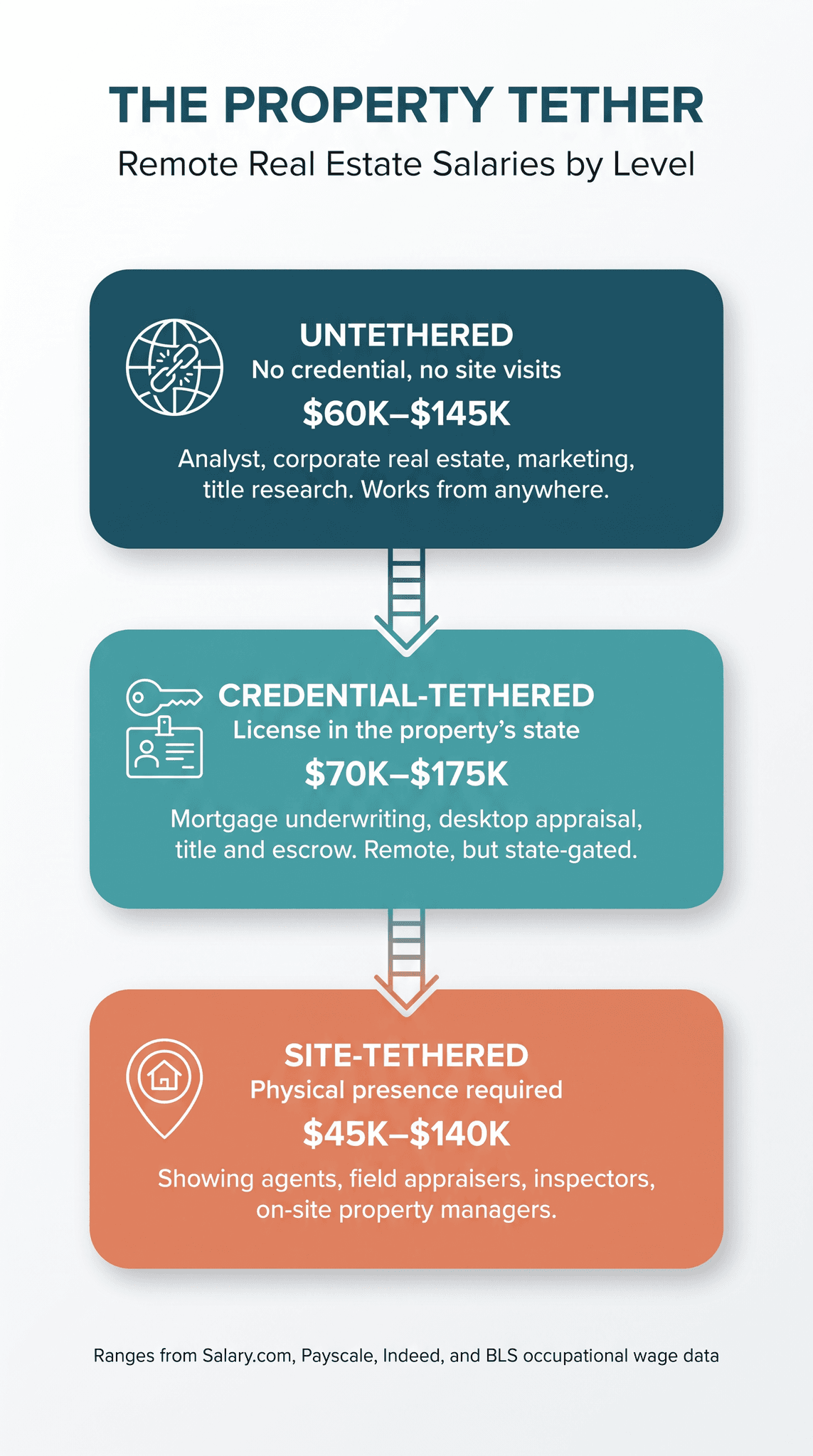
The Property Tether: a 10-point score for how strongly a real estate role is anchored to a specific location — the single variable that determines whether the job can actually be done remotely.
Scoring:
- 0–3 Untethered ($60K–$145K): No credential required and no site visits. The work runs on records, models, and databases. Real estate analyst, corporate real estate manager, property tax consultant, research analyst, marketing manager, title searcher. State lines are irrelevant; you could do this job from a different country if payroll allowed it.
- 4–7 Credential-Tethered ($70K–$175K): Desk work in practice, but a license or certification must exist in the property's state. Mortgage underwriter, desktop and hybrid appraiser, title producer, escrow officer. Fully remote day to day, geographically gated on paper.
- 8–10 Site-Tethered ($45K–$140K): Requires a body at the property. Showing agent, field review appraiser, property inspector, on-site property manager, facilities engineering. No software makes these remote, and a "remote" tag on one of them is marketing.
How to use it: before you apply, find the credential line and the travel clause in the posting. No credential named and no travel percentage means Untethered — apply from anywhere. A named state means Credential-Tethered, and your first interview question is whether the employer sponsors licensure. Any mention of site visits or "occasional travel to properties" means Site-Tethered, and you should read the remote claim as flexible scheduling rather than location independence.
In real estate, "remote" is decided by one question: does the credential follow the property, or does it follow you?
Stop Applying Manually
Our AI applies to hundreds of matching jobs while you sleep. Wake up to interviews, not more applications.
Untethered: The Roles With No Zip Code
These are the jobs to search for by title, because searching by industry is what got you the agent ads.
Real estate analyst and acquisitions analyst. You underwrite deals in Excel and Argus, build cash-flow models, and write investment memos. You do not tour buildings. Payscale puts the base range at $52,000–$91,000 with an average of $70,063 (n=287), while Salary.com puts acquisitions analysts at an average of $100,337 with a 90th percentile of $118,295. The gap between those two figures is roughly the gap between analyst and senior analyst. If you already work in remote finance roles, this is the shortest lateral move on the list.
Corporate real estate manager. This is the highest-paying unlicensed role in the set — Salary.com puts the average at $143,073, with the 90th percentile at $172,083. You manage the lease portfolio for a company that is not a real estate company: which offices to keep, which to exit, what to renegotiate. It reads much closer to remote operations jobs than to anything a brokerage does.
Asset manager and portfolio manager. Salary.com averages $119,338 and $127,310 respectively. Honest caveat: these score a 4 rather than a 0 on the Property Tether, because periodic site visits are typical even when the posting says remote. Read the travel percentage before you get attached.
Property tax consultant and real estate research analyst. Ownwell hires remote commercial property tax consultants nationally. Research and data roles at the large data providers are effectively remote data analyst jobs pointed at real estate. Be careful with published salary data here — Salary.com and Talent.com disagree by 48% on the research analyst title, which is wide enough that no point estimate is trustworthy.
Real estate marketing manager. Salary.com averages $118,953. Verified remote postings run lower than that: Greystar at $75,000–$85,000, AZX at $80,000–$120,000. The same title-versus-posting gap shows up across remote marketing roles paying six figures.
Title searcher, examiner, and post-closer. The most remote-native work in the entire industry — it is records research on digital deed and lien databases, and it never required an office. BLS 2025 data puts the median for title examiners and abstractors at $58,650, which sits below this post's target band. It earns a mention anyway because it is the cleanest entry point into title operations, and title operations is where the credential-tethered $100K roles live.
The highest-paid remote jobs in real estate never touch a listing.
Credential-Tethered: Remote, With a State Attached
This is the tier that job seekers get wrong most often, because the rules are real but they are not what people assume.
Mortgage underwriting and processing is the clearest remote win in the sector. Under 12 CFR §1008.103, the license follows the property, not your chair. Washington states it most plainly of any regulator: you may originate Washington loans from your residence, inside or outside Washington, as long as your sponsoring company is licensed there. Florida, Texas, Washington, California, Montana, and Illinois all made remote mortgage work permanent after the emergency-order era rather than letting it lapse.
The distinction that actually affects your paycheck: a W-2 processor or underwriter working under a licensed originator's supervision does not need an MLO license. A 1099 independent-contractor processor doing the same work does. If a "remote underwriter" listing offers contractor terms, that is not a technicality — it moves the licensing burden onto you.
Verified remote pay in this lane: Knock posts a mortgage processor/underwriter role at $70,000 base with $97,000 OTE; Enterprise Community Partners posts an underwriter at $120,000–$130,000; Mutual of Omaha Mortgage at $80,000–$100,000. If you are coming from remote banking jobs, your existing credit training transfers almost intact.
One live administrative detail worth knowing before an interview: NMLS added a work-remote data field with three statuses — office-centric, hybrid, and fully remote. It deployed in September 2025, and existing employment relationships had to be updated by August 31, 2026. An employer that has classified its roles is an employer that has thought about this.
Appraisal is more remote than its reputation. Fannie Mae's Selling Guide B4-1.2-02, last updated December 10, 2025, keeps desktop appraisals live: eligible for one-unit principal residences on purchase transactions at 90% LTV or below, and the minimum scope of work explicitly excludes an inspection by the appraiser. Hybrid appraisals go further, letting a third party collect the property data while the appraiser values it remotely. The constraint is the credential — it must be issued by the state where the property sits, and PAREA, the virtual pathway that replaces field experience hours, is not recognized in every jurisdiction. Field review appraisal is never remote; it requires the appraiser to inspect the subject and the comparables in person.
Title and escrow carry the strangest rules in the industry, and they trip people up because the licensing does not sit where you would look for it. Title agents are licensed by state insurance departments, not real estate commissions. Title is not a uniform major line of insurance, so reciprocity is unusually poor — Maryland alone publishes a list treating 22 states as non-reciprocal, meaning an exam and duplicate continuing education. Texas licenses individual escrow officers and restricts the license to residents of Texas, Louisiana, New Mexico, Arkansas, or Oklahoma. Utah requires a staffed physical office in state. If you are eyeing this lane, check the specific state before the specific employer. Adjacent remote compliance roles carry fewer geographic strings.
Transaction coordination deserves a myth correction. The Texas Real Estate Commission states that transaction coordinators "are not defined nor mentioned in TREC rules and statutes" and are not required to hold a license. California has no transaction coordinator license either — the widely repeated claim that it does is simply wrong. When a posting demands a license, as Redfin's remote licensed transaction coordinator role does at $22.80–$35.50 an hour, that is employer risk policy, not law. Worth noting what that particular posting also does: it reimburses state license fees, MLS dues, and REALTOR association dues — which is exactly the arrangement to ask for when an employer imposes a credential the law does not. It is also a six-month temporary role, which is the kind of detail that sits below the salary line rather than next to it. Pay in this lane runs $44,000–$58,000, below this post's target band, so treat it as a stepping stone rather than a destination.
The inside sales agent role is the trap in this tier. ISA listings look like ordinary remote phone work with a base salary. Whether they are legal depends on the state: California permits narrow unlicensed canvassing with hard limits, while Texas prohibits it outright. Asked directly whether an unlicensed person may call to determine buying interest and set an appointment, TREC's published answer is one word: no.
The Part the Regulations Don't Cover
Everything above is what the law says. What the employer says is a separate question, and the gap between them is where remote real estate offers actually go wrong.
The transaction coordinator case is the clean illustration: Texas says no license needed, California has no such license to need, and Redfin requires one anyway. Neither position is wrong. The company is managing its own errors-and-omissions exposure, and its risk tolerance is not published anywhere you can read before applying. Expect the same pattern in title, where a multi-state agency may decline to sponsor a non-resident's licensure simply because the paperwork is not worth it for one hire, and in mortgage, where "we're licensed in 40 states" describes the company's footprint rather than a commitment to add yours.
Three questions worth asking in a first call, because none of them are answerable from the posting:
- Who pays for licensure and continuing education in additional states, and does that survive a change in the company's risk policy?
- Is this role W-2 or 1099? In mortgage processing and underwriting, that single answer moves the licensing obligation from the employer to you.
- Is the remote designation recorded in NMLS, or is it a manager's arrangement? Employers had until August 31, 2026 to classify existing employment relationships in that field. One of those answers survives a reorg.
The choice nobody frames for you is Untethered versus Credential-Tethered. A $95K analyst role you can hold from any state is often worth more over five years than a $125K underwriting role that binds you to one state's license, because the analyst role survives a move, a partner's relocation, and a layoff without you re-credentialing. Take the credential-tethered premium when the employer funds the license and you intend to stay put. Take the untethered role when your life is not settled.
Stop Applying Manually
Our AI applies to hundreds of matching jobs while you sleep. Wake up to interviews, not more applications.
What These Roles Actually Pay
| Role | Typical range | Property Tether | Source |
|---|---|---|---|
| Corporate real estate manager | $112K–$172K (avg $143K) | 0–3 | Salary.com, Aug 2026 |
| Portfolio manager | $111K–$160K (avg $127K) | 0–4 | Salary.com, Aug 2026 |
| Asset manager | $94K–$146K (avg $119K) | 4 | Salary.com, Aug 2026 |
| Marketing manager | $98K–$140K (avg $119K) | 0–3 | Salary.com, Aug 2026 |
| Acquisitions analyst | $63K–$118K (avg $100K) | 0–3 | Salary.com, Aug 2026 |
| Development manager | $60K–$155K (avg $96K) | 6–9 | Indeed, Aug 2026 |
| Mortgage underwriter | $57K–$93K (avg $75K) | 4–7 | Salary.com, Aug 2026 |
| Real estate analyst | $52K–$91K (avg $70K) | 0–3 | Payscale, Jun 2026 |
| Property accountant | $70K–$94K | 0–3 | Robert Half 2026 Guide |
| Real estate paralegal | $56K–$83K (avg $69K) | 0–3 | Salary.com, Aug 2026 |
| Appraiser (occupational median) | $40K–$123K (median $68K) | 4–10 | BLS 2025 via O*NET |
| Title examiner | $42K–$89K (avg $61K) | 0–3 | Indeed, Aug 2026 |
Salary ranges derive from Salary.com's August 2026 benchmarks, Payscale's June 2026 self-reported data, Indeed's posting aggregates, and BLS 2025 occupational wage data accessed via O*NET. We excluded Glassdoor and ZipRecruiter figures entirely because both blocked verification. Ranges reflect base pay; totals at public companies run higher once bonus is included.
Read that table with one adjustment in mind. The sources disagree by $20K–$40K on the same title, and the disagreement is methodological rather than random: posting-scrapers report the top of advertised bands because that is what employers publish, and self-report sites run low because the people who fill out salary surveys skew junior. When you negotiate, anchor on the posting figure. When you budget, trust the self-report figure.
The variance between employers is larger than the variance between titles. A real estate analyst at a fund underwriting acquisitions clears $110K. The same title at a brokerage running comps for producers posts at $65K. The difference is not years of experience — it is whether the role owns a capital decision or supports someone else's, which is exactly the distinction that separates the top and bottom of the Untethered band. For a wider view of where these ranges sit, our guide to the highest-paying remote jobs covers the same territory across industries.
Which of these numbers are actually negotiable is a different question from which are accurate. The 90th-percentile figures on the corporate and portfolio rows are real but they are not entry points — they represent people who already own a portfolio, and quoting them in a first-round screen reads as unserious. The averages are where the negotiation actually happens, and the reliable lever is not the title but the scope: whether you sign off on a number or prepare it for someone who does. The one row to treat with real suspicion is the appraiser range, because that $40K–$123K spread is an occupational median covering staff appraisers, fee shops, and chief appraisers in a single bucket; it will not predict any individual offer.
And here is the pattern hiding in the whole table: the best-paid remote roles in real estate are mostly at organizations that are not real estate companies. Corporate real estate manager tops the list at $143K, and that job exists inside retailers, banks, and tech companies managing their own footprint. JLL's own remote roles were corporate functions. The further a job sits from commission, the more it pays and the more portable it gets.
Who Actually Hires Remote
The industry has split publicly on this, and both sides are on the record.
| Company | Position | On the record |
|---|---|---|
| Zillow | Remote-first since March 2021 | CEO Jeremy Wacksman, Feb 2025: "it's been fantastic for us" — applicants quadrupled, employees now in all 50 states |
| CoStar | Fully in-office — 0 remote roles of 417 openings (413 onsite, 4 hybrid), August 2026 | CEO Andy Florance, May 2026: "companies that live on Zoom are handicapped and are not as competitive" |
| JLL | 6.5% remote (220 of 3,410 postings) | Remote roles are security architects, finance analysts, GIS engineers — no brokerage |
| Roofstock | 0 of 30 openings remote | All field operations: inspectors, maintenance technicians, on-site asset managers |
Roofstock is the useful lesson there. It is a proptech company with a remote-friendly reputation, and its board today is entirely on-site field work. A technology logo tells you nothing about remote hiring — verify per company, per role, per posting.
Employers with verified remote listings at the time of research include Knock, Hometap, Orchard Title, Qualia, Ownwell, Pacaso, Doma, and First American Title. Notice what that list has in common: they are lenders, title platforms, and software companies that happen to operate in real estate. None of them are brokerages.
For finding these postings, general boards work better than real-estate-specific ones precisely because the real-estate-specific ones are full of brokerage recruiting. Our comparison of the best remote job boards and our breakdown of Indeed versus LinkedIn for job search both apply here.
Stop Applying Manually
Our AI applies to hundreds of matching jobs while you sleep. Wake up to interviews, not more applications.
How to Filter the Listings in Under 30 Seconds
Run every listing through this before you spend a minute on the application. Most postings fail at step one, which is the point.
- Search the posting text for "commission," "1099," "unlimited earning potential," and "licensing assistance." Any hit means agent recruiting. Close the tab.
- No posted base salary range on a role claiming six figures? Close the tab. Real employers post bands; recruiters post ceilings.
- Find the credential line and score the Property Tether. None named means Untethered — apply regardless of where you live. A state named means Credential-Tethered, and your question is who pays for licensure. Site visits mentioned means Site-Tethered, and the remote claim is scheduling flexibility.
- Search by job title, not by industry. "Real estate analyst," "mortgage underwriter," "title examiner," "asset manager," and "corporate real estate" all return salaried W-2 roles. "Remote real estate jobs" returns brokerages.
- Expect a share of the remainder to be inactive. A 2026 Clarify Capital study of more than 175,000 US listings found roughly one in seven active job posts are ghost jobs — postings kept live without an open role behind them.
Four phrases that should end your interest immediately, and what each one actually means:
- "Unlimited earning potential" — there is no base salary. This is the industry's standard substitute for a compensation range.
- "We'll help you get licensed" — you are paying for the course, the exam, the state fee, and probably the brokerage's affiliated school. Licensing assistance in a salaried role is a benefit; in a commission role it is a sales funnel.
- "Must be self-motivated with an entrepreneurial mindset" — in a W-2 posting this is filler. In a real estate posting it is a description of unsupervised 1099 work.
- "Remote / flexible" with a travel percentage buried in the requirements — that is Site-Tethered wearing a remote badge. The travel line is authoritative; the header is marketing.
That fourth step in the screen above is the one that changes outcomes. The industry indexes itself by job function, not by "real estate," and the search you have been running is the only one that surfaces the recruiting layer. Once you are searching correctly, the volume problem flips — there are more qualified postings than you can reasonably apply to by hand, which is where automated applications earn their keep.
Frequently Asked Questions
I have eight years in commercial real estate but I've never worked remote — which roles should I actually target?
Start with analyst, asset management, and corporate real estate, in that order. Those score 0–4 on the Property Tether, meaning no credential gate and minimal site visits, and your existing deal experience transfers directly. Corporate real estate manager is the highest-paying unlicensed target at an average of $143,073 (Salary.com, August 2026). Skip anything with "development" in the title for now — development managers average $96K but score 6–9 on the tether because entitlement and construction oversight pull them on-site.
Can I work remotely as a real estate agent?
Yes, and that is exactly the problem. Cloud brokerages like eXp and Real have no offices at all, so the work is genuinely location-independent. But 86% of REALTORS® are independent contractors rather than employees, and agents with two years or less of experience earn a median of $8,100, with 62% of them making under $10,000 for the year. You would be paying brokerage fees, MLS dues, and 15.3% self-employment tax against that.
Do I need a real estate license for a remote transaction coordinator job?
Legally, almost never. The Texas Real Estate Commission states that transaction coordinators are not mentioned in its rules or statutes and are not required to hold a license, and California has no transaction coordinator license at all — the claim that it does is a persistent myth. Individual employers can and do require one anyway as a risk-management policy, which is why Redfin's remote transaction coordinator posting asks for it.
How do I know if a remote real estate job is really remote?
Score it on the Property Tether using two lines in the posting. If no credential is named and no travel percentage appears, it is Untethered and genuinely portable. If a specific state license is required, it is Credential-Tethered — still remote day to day, but you cannot take the job without that state's credential. If the posting mentions property visits, walkthroughs, or "occasional travel to sites," it is Site-Tethered and the remote label means flexible hours.
Is remote mortgage underwriting actually legal from another state?
Yes. Under 12 CFR §1008.103, mortgage licensing follows the property, not the employee's location — Washington's rule states outright that you may originate Washington loans from a residence inside or outside the state as long as your sponsor is licensed there. The catch is employment structure: a W-2 underwriter supervised by a licensed originator needs no MLO license of their own, while a 1099 contractor doing identical work does.
What's the highest-paying remote real estate job that doesn't require a license?
Corporate real estate manager, averaging $143,073 with a 90th percentile of $172,083 (Salary.com, August 2026). You run the lease and facilities portfolio for a company whose actual business is something else. Portfolio manager ($127,310 average) and asset manager ($119,338) follow, though asset management often carries a site-visit expectation that the job description will not mention.
Can appraisers work from home in 2026?
Partly, and the boundary is precise. Desktop appraisals remain live under Fannie Mae Selling Guide B4-1.2-02, but only for one-unit principal residences on purchase transactions at 90% LTV or below. Hybrid appraisals let a third party collect property data so the appraiser can value remotely. Field review appraisal cannot be done remotely — it requires in-person inspection of the subject and comparables — and your credential must be issued by the state where the property sits.
Where the Remote Jobs Actually Are
The search term is broken, but the market underneath it is not. There is real salaried remote work in this industry — it is just filed under underwriting, title, analysis, and portfolio strategy rather than under "real estate."
Change three things and the results change with them. Search by job title instead of by industry. Read the credential line before the salary line. And treat any posting without a base range as a recruiting ad until it proves otherwise.
If you are moving laterally, the closest adjacent guides are remote finance roles for the analyst path, remote banking jobs for the underwriting path, and remote paralegal positions for the title and closing path. If you want to see what the pay ceiling looks like across every remote sector, start with the highest-paying remote jobs guide.
Real estate is the last industry where "remote" still gets used to mean "unpaid." The jobs that actually pay a salary were never about the house — they were always about the spreadsheet behind it.
Ready to Find Your Remote Job?
Browse thousands of curated remote jobs or let AI apply for you.
Browse Remote JobsRelated Job Guides

Remote UX Researcher Jobs: What 211 Postings Pay (2026)
Remote UX researcher jobs: we read 211 US postings. Remote seats paid $144K vs $176K hybrid; employer type, statistics and AI work set the $190K+ band.
38 min read
Remote Solutions Architect Jobs: Pay by Seat Type (2026)
Remote solutions architect jobs: we read 1,079 US postings. Vendor pre-sales seats post $205,000 and say remote 81% of the time. AWS listed 4 of 269 remote.
42 min read

Remote iOS Developer Jobs: What 370 Postings Pay (2026)
Remote iOS developer jobs: we read 370 US postings. Apple flagged 26 of 4,384 US jobs Home Office, none of them iOS. Where the remote seats are, and the pay.
48 min read