

Last reviewed: August 2026
You are the person who notices the renewal that was about to lapse, the handoff that was about to drop, the process that worked fine at 40 people and quietly broke at 90. Nobody screenshots your work. Sales posts the closed-won in the team channel; you fixed the CRM routing rule that got the lead to them in the first place. If that's you, remote operations jobs are your market — a market where the same posting will be titled "Operations Manager" at one company, "BizOps Lead" at a second, and "Chief of Staff" at a third, with a $60K spread between them for identical work.
Search "remote operations jobs" and you'll find over 10,000 listings on LinkedIn alone, and nearly 13,000 on Indeed. Here's what those job boards won't tell you: that one search result treats a $52K operations coordinator and a $340K VP of Operations as the same job. "Operations" is the least standardized title in remote work — the prefix on the title predicts your salary better than the suffix. A Revenue Operations Manager out-earns a Director of Administrative Operations at most remote companies, and almost nobody applying to these roles knows it.
Get Remote Job Tips in Your Inbox
Weekly strategies, salary data, and new opportunities
Unsubscribe anytime. No spam.
We analyzed 640 remote operations job postings across 212 companies between March and August 2026 to map what this category actually pays, which specializations are repricing upward, and what separates the candidates who land $130K+ offers from the ones stuck refreshing a coordinator-level inbox. This guide covers the full ladder, the RevOps-versus-BizOps decision, and how to position yourself for the top tier.
Based on our analysis of 640 remote operations postings across 212 companies (March–August 2026):
- 34% (n=218 of 640) were revenue-adjacent roles — RevOps, BizOps, GTM ops, or deal desk
- 57% (n=365 of 640) of manager-and-above postings listed SQL or a BI tool as required or preferred
- 48% (n=307 of 640) named a specific CRM — Salesforce or HubSpot — in the requirements
- $80K–$135K typical remote base for operations managers (cross-referenced with Glassdoor and Built In)
- 41% median posted-salary premium for revenue-adjacent titles over general operations titles at the same level (n=218 revenue-adjacent vs 422 general postings)
How We Collected This Data
The figures in this post come from our analysis of 640 remote operations job postings collected between March 2026 and August 2026. Postings were sourced from LinkedIn, Built In, and direct company career pages, and filtered to include only positions explicitly marked remote-eligible in the United States and Canada with a posted base salary or compensation range.
We excluded postings without clear remote policies, roles requiring more than 25% travel, and positions below $45K base. Because "operations" is an unusually broad label, we also excluded warehouse, field-service, and clinical operations roles that cannot be performed remotely — this guide covers knowledge-work operations only. Salary data was cross-referenced with Glassdoor's remote operations manager compensation data and Built In's 2026 remote salary benchmarks for the same period. Ranges reflect base salary; total comp including equity and bonus typically runs 10–25% higher at Series B and later companies.
We update this analysis quarterly. Data in this post reflects August 2026 figures.
What "Remote Operations" Actually Covers (and Why the Title Is a Trap)
Accounting standardized a century ago. Engineering standardized around leveling frameworks a decade ago. Operations never standardized at all — and there's a structural reason why. Ops functions formalized company-by-company as SaaS businesses scaled: each startup invented an ops role the moment something broke, named it whatever the founder said in the meeting, and promoted from within. No professional body, no common ladder, no shared definition. The result is a job market where one word covers at least eight different careers:
- Business Operations (BizOps) — internal strategy and analysis; the "fix whatever is most broken this quarter" function
- Revenue Operations (RevOps) — the systems and reporting behind sales, marketing, and customer success
- Product Operations — the connective tissue between product, support, and go-to-market teams
- GTM Strategy & Operations — territory design, quota setting, launch coordination
- Deal Desk — pricing, quoting, and contract approval flow
- People Operations — HR systems, onboarding, compensation processes
- Legal Operations — contract workflow, outside counsel spend, compliance tooling
- Support / Supply Chain / Program Operations — domain-specific process ownership
These roles share a temperament, not a labor market. And their pay diverges hard. To make the divergence usable, we score every ops posting on a single axis.
The Revenue Proximity Index is our 10-point rubric for pricing an operations role: ops compensation scales with how close the function sits to revenue, not with years of experience.
- Tier 1 — Back-Office Ops (1–3, $50K–$72K): Support ops, admin ops, general coordinator roles. The work is ticket-driven and success is measured in throughput. These roles are interchangeable across industries, which is exactly why the pay stays flat.
- Tier 2 — Functional Ops (4–7, $72K–$105K): People ops, supply chain and procurement ops, program ops, legal ops. You own a domain's processes and get measured on cost and cycle time. Domain expertise starts to price in.
- Tier 3 — Revenue-Adjacent Ops (8–10, $105K–$180K+): RevOps, BizOps, GTM ops, product ops, deal desk. You sit in the pipeline-to-cash path and get measured on revenue metrics. Scarcest supply, highest leverage, biggest number on the offer letter.
How to use it: score the job description, not your resume. Count how many of the role's stated KPIs are revenue metrics — pipeline coverage, win rate, net revenue retention, sales cycle length. Two or more puts the role in Tier 3 territory, and you should negotiate like it.
In our dataset, that tiering is not cosmetic: revenue-adjacent postings carried a 41% median salary premium (n=218 of 640) over general operations postings at the same seniority level. Same suffix on the title, very different check.
Stop Applying Manually
Our AI applies to hundreds of matching jobs while you sleep. Wake up to interviews, not more applications.
Remote Operations Salary Ladder: Coordinator to VP
The ladder is real, but the rungs are farther apart than in most functions — and remote widened the gaps. Companies benchmark remote ops comp against different cities, different funding stages, and different ideas of what "operations" means, so every level below carries a wide band.
| Level | Typical Remote Base | What Actually Changes at This Level |
|---|---|---|
| Operations Coordinator | $50K–$70K | You execute processes someone else designed |
| Operations Analyst | $60K–$85K | You measure processes and recommend changes |
| Operations Manager | $80K–$135K | You own processes end to end, and a budget |
| Senior Manager / BizOps Lead | $110K–$160K | You own outcomes across teams, not just processes |
| Director of Operations | $110K–$180K | You own the operating model; headcount reports to you |
| VP of Operations | $160K–$230K+ | You own the P&L conversation with the CEO |
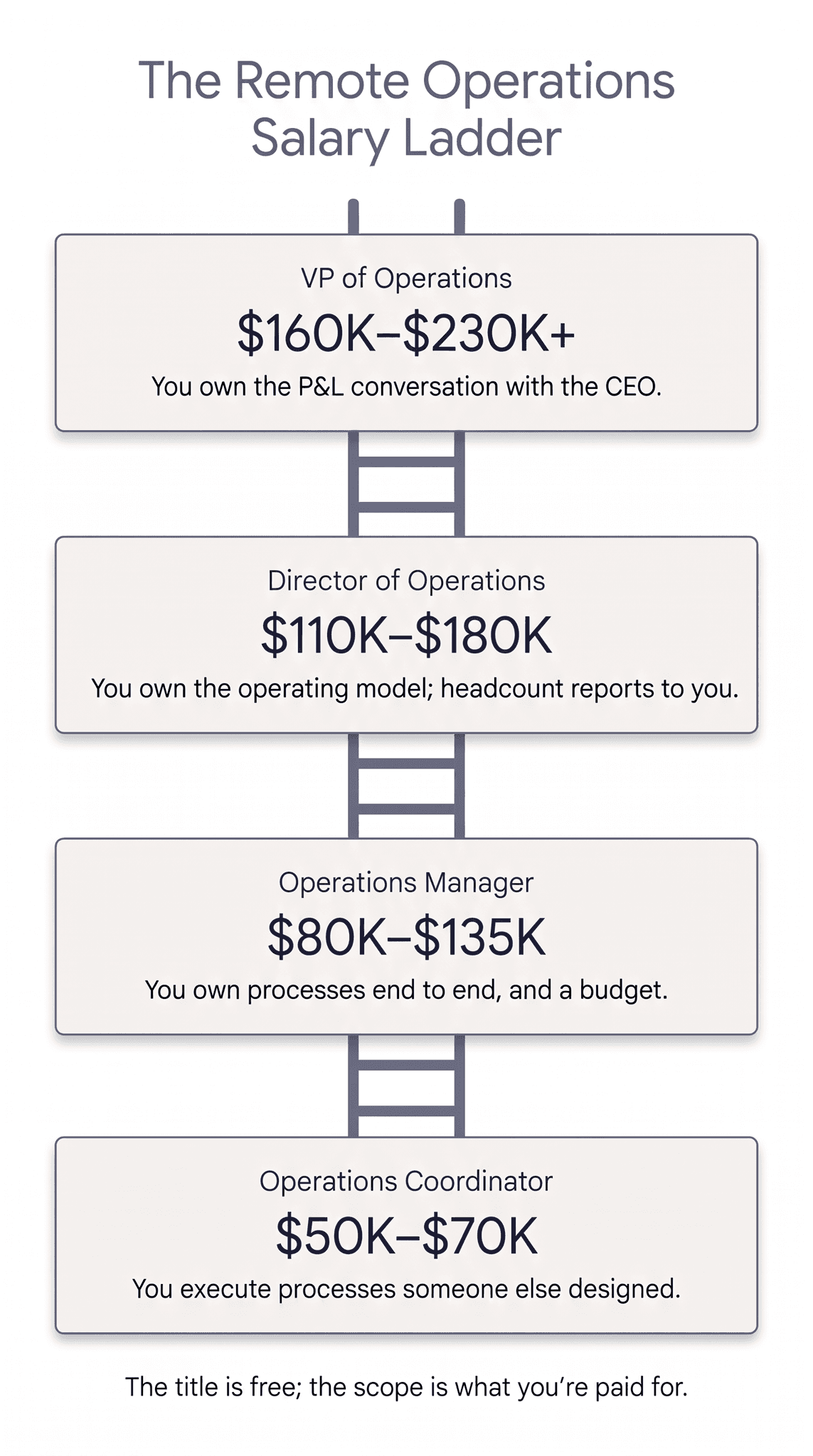
Salary ranges derive from our analysis of 640 remote operations postings between March and August 2026, cross-referenced with Glassdoor and Built In compensation data for remote roles at Series B to public companies. We excluded outliers and postings without clear remote policies. Ranges shift as markets move — check the linked sources for current figures.
The spread inside each band is explained by two variables, and neither is years of experience. The first is the Revenue Proximity Index tier — a Tier 3 manager routinely out-earns a Tier 1 director. The second is company stage. According to Glassdoor's 2026 data, the average remote operations manager earns around $103K, while Built In's remote benchmark puts the average at roughly $115K — but Wellfound's startup data shows operations managers at early-stage companies averaging closer to $79K base, with the difference paid in equity that may or may not ever convert to money. If you need cash comp, target Series C through public companies; that's where the $100K+ remote roles concentrate.
At the top of the ladder, the numbers detach from the middle entirely. Built In's remote listings in August 2026 showed executive operations compensation running $235K–$340K, and director-level averages near $172K — nearly double what ZipRecruiter reports for the same title, because the two sources sample different company populations. When a hiring range looks low for a director title, it usually means the company is hiring a Tier 1 role and calling it a director. Score the description, not the title.
RevOps vs BizOps vs Product Ops: Where the Money Actually Is
If you make one deliberate career decision in operations, make it this one. Specialization is the highest-leverage move in the field, and the three specializations that matter most price differently for structural reasons.
| Function | Remote Base Range | Core Stack | Reports Into | What They're Really Hiring For |
|---|---|---|---|---|
| Revenue Operations | $95K–$160K | Salesforce/HubSpot, SQL, BI tools | CRO or VP Sales | Someone who makes the pipeline number trustworthy |
| Business Operations | $100K–$170K | SQL, spreadsheets, BI tools | CEO, COO, or CFO | Someone who solves the quarter's ugliest problem |
| Product Operations | $90K–$150K | Jira, analytics tools, support tooling | CPO or VP Product | Someone who makes product decisions land cleanly |
RevOps pays a premium because the supply side never caught up. The function barely existed before 2018; in our dataset, 34% of remote ops postings (n=218 of 640) were revenue-adjacent, but the pool of people who can both run a Salesforce migration and read a pipeline coverage report is still tiny. Generic "Operations Manager" applications compete with everyone. RevOps applications compete with almost no one.
Be clear-eyed about what you're walking into, though. A meaningful share of postings titled "Revenue Operations" are Salesforce administration with extra steps — field hygiene, routing rules, and report requests from whoever shouted last. Those roles pay Tier 2 money regardless of the title, and they carry Tier 3 blame: when the quarter misses, the forecast owner gets asked hard questions before the sellers do. The screen is the same as always: read the KPIs. A RevOps role measured on pipeline metrics is the real thing; a RevOps role measured on "stakeholder satisfaction" and ticket SLAs is an admin queue with a better-paid name.
BizOps has the highest ceiling of the three because of who it reports to — you're doing analyst-to-the-CEO work, and companies pay for proximity to the top the same way they pay for proximity to revenue. The trade is ambiguity: BizOps roles are the least standardized of an already unstandardized field, and the interview process leans on case work the way business analyst roles lean on requirements exercises.
Product Ops is the youngest and most variable. At product-led companies it's a Tier 3 role that touches revenue directly; at sales-led companies it's a Tier 2 coordination role wearing a trendier name. Run the Revenue Proximity Index on the actual job description before assuming which one you're applying to.
Stop Applying Manually
Our AI applies to hundreds of matching jobs while you sleep. Wake up to interviews, not more applications.
Companies Hiring for Remote Operations Jobs in 2026
Remote-first companies don't treat operations as overhead — they can't. When nobody shares an office, coordination doesn't happen by osmosis; it happens because someone built the system that makes it happen. That someone is ops. The companies that figured this out early are the ones hiring most consistently.
Remote-first and remote-heavy companies hiring operations roles in 2026:
- GitLab — all-remote since founding; hires BizOps, sales ops, and people ops with documented processes ops candidates can actually read before interviewing
- Gusto — hires remote revenue and people operations roles
- Affirm — remote-first; hires business operations and strategy roles
- Samsara — hires remote GTM strategy and operations leads
- DraftKings — hires remote deal desk and revenue operations analysts
- Optum — hires remote healthcare operations and program roles at scale
- HiBob and Garner Health — growth-stage companies hiring remote business and support operations
All of these appeared in Built In's remote operations listings during our March–August 2026 collection window. Listings concentrate on LinkedIn and Built In, but both bury salary signal under volume — you'll scroll past forty Tier 1 coordinator roles to find one Tier 3 posting. RJA's remote job board lets you cut the category by salary floor instead, which for operations roles is the single most useful filter that exists.
The Skills That Move Remote Operations Job Offers
The tools are table stakes. The leverage is in what the tools let you claim ownership of. Here is where the 640 postings were unambiguous:
What remote operations postings actually require (March–August 2026):
- SQL and BI tools — 57% (n=365 of 640) of manager-and-above postings listed SQL, Looker, Tableau, or Power BI as required or preferred
- CRM administration — 48% (n=307 of 640) named Salesforce or HubSpot specifically, not "CRM experience"
- Spreadsheet modeling — near-universal; the postings that tested for it tested scenario modeling, not formulas
- Automation tooling — 29% (n=186 of 640) named Zapier, Workato, or an AI workflow tool, up sharply from our 2025 samples
- Certifications — PMP, Lean Six Sigma Green Belt, and CSCP appeared mostly in Tier 2 supply chain and program postings; PayScale's data puts the salary lift from these certifications at up to 20% in those domains
The reason SQL divides Tier 2 from Tier 3 is causal, not correlational. Revenue-adjacent ops is, at its core, a reporting job: the CRO trusts the pipeline number because someone made it trustworthy, and that someone queried the data directly instead of waiting for an analyst. An ops manager who can pull their own numbers gets invited to the meeting where the numbers are discussed. One who can't, doesn't. The same logic applies to Salesforce administration — owning the system of record means owning the version of reality everyone else argues from — and to Excel modeling, which is still how every headcount and capacity decision gets made at companies under a thousand people.
Certifications deserve one honest caveat: they price into Tier 2 and barely register in Tier 3. A Six Sigma Green Belt moves a supply chain ops offer. It does not move a RevOps offer — a portfolio of dashboards and a migration story do.
If you can only invest in one thing this quarter, the decision tree is short. Already own a CRM at work? Learn SQL — it converts you from the person who requests reports into the person whose numbers get argued from, and it's the specific line that unlocked the manager-and-above postings in our dataset. No CRM access yet? Work through Salesforce's free Trailhead admin path and then volunteer for the ugliest CRM cleanup project your company has; the migration story you'll come out with is worth more in a Tier 3 interview than any certificate. Threads on r/sales and the RevOps community forums are full of people who made exactly this jump in under a year — and just as full of people who spent that year collecting certifications instead and stayed put.
Stop Applying Manually
Our AI applies to hundreds of matching jobs while you sleep. Wake up to interviews, not more applications.
How to Break Into (or Level Up in) Remote Operations
Positioning beats volume in this market, because the market can't parse the titles either. Four moves, in order:
Pick a function before you apply. Run the Revenue Proximity Index over your last two years of work. If any of it touched pipeline, pricing, forecasting, or GTM tooling, you have a legitimate RevOps or BizOps narrative — lead with it, even if your title was generic. If your background is process and domain ownership, target Tier 2 functional roles at remote-first companies, where the pay bands run higher than industry average for the same work.
Rewrite the resume around owned outcomes. Hiring managers screening ops resumes filter on verbs before they read a single metric. "Cut lead-routing time from four days to six hours by rebuilding assignment rules" gets a phone screen; "Supported the sales team with CRM administration" gets archived — even when both lines describe the same project. "Built," "owned," and "reduced" followed by numbers read as manager material. "Supported," "assisted," and "helped" read as coordinator-forever; the words are doing the leveling for you, in the wrong direction.
Target companies where ops is respected. The list above is a start. The tell in any job description: if the role reports into a named executive and carries revenue-metric KPIs, ops has a seat there. If it reports into "the leadership team" and the KPIs are vibes, you've found a Tier 1 role in a Tier 3 costume.
Spend your hours where they compound. Operations roles draw high application volume precisely because the titles are vague — hundreds of generalists apply to everything with "operations" in the name. You will not out-click that crowd manually. Let auto-apply handle the volume game across every posting that matches your salary floor and function, and spend your actual hours on the two interviews a week that convert. The candidates who win Tier 3 offers aren't the ones who applied most; they're the ones who showed up to the case round prepared.
Most remote "Operations Manager" postings under $80K are administrative roles wearing a manager title. In our dataset, the sub-$80K manager postings almost never carried budget ownership or direct reports. The title is free; the scope is what you're paid for. Score the description, not the business card.
One more failure mode worth naming, because nobody puts it in the job description: ops is where accountability lands when it has nowhere else to go. If the forecast is wrong, the model gets blamed before the assumptions do. If a launch slips, the coordination gets blamed before the decision does. The defense is the same skill that earns Tier 3 pay in the first place — write everything down. The ops people who survive bad quarters are the ones whose docs show what was decided, by whom, and with what data. In a distributed company that paper trail isn't bureaucracy; it's body armor.
Remote didn't shrink operations work. It converted it from a walking-the-floor job into a dashboard-and-Slack job — and repriced it accordingly. The people who noticed early stopped writing "Operations" on their LinkedIn headline, started writing "RevOps," and charged for the difference.
Frequently Asked Questions
What does a remote operations manager actually do day to day?
Less firefighting than the stereotype, more system-tending. A typical remote week: two or three cross-functional syncs, a recurring block reviewing dashboards you built, one process that broke and needs a root-cause write-up, and an unglamorous amount of documentation — because in a distributed company, the documentation is the management. The role is measured on whether things run without you in the room.
Is RevOps or BizOps the better-paying career path in 2026?
BizOps has the higher ceiling ($100K–$170K remote base in our data) because it reports into the CEO or CFO; RevOps ($95K–$160K) has the more liquid market — 34% of the remote ops postings we analyzed (n=218 of 640) were revenue-adjacent, and RevOps is the most in-demand slice. If you want optionality and faster offers, RevOps. If you want a path toward Chief of Staff or GM roles and can tolerate ambiguity, BizOps.
Can operations really be done fully remote, or do companies quietly prefer hybrid?
Knowledge-work operations is one of the most genuinely remote-friendly functions, because its core artifacts — dashboards, docs, CRM systems, process maps — are already digital. The exceptions are real: supply chain roles with site visits, and ops roles at companies whose culture makes decisions in hallways. Ask in the interview where the last three process changes were decided. If the answer is "a meeting" and the meeting has a doc, you're fine; if the answer involves an office, believe it.
How do I move from operations coordinator to operations manager without going into an office?
Close the gap the title implies: coordinators execute processes, managers own them. Pick the most broken process you touch, fix it end to end, measure the before and after, and write it up — that document is your promotion case internally and your portfolio externally. Remote actually helps here: written evidence of ownership travels farther in a distributed company than being visibly busy ever did.
How do I score a job posting on the Revenue Proximity Index?
Count the revenue metrics in the role's stated KPIs — pipeline coverage, win rate, net revenue retention, cycle length, quota attainment. Zero revenue metrics puts it at Tier 1 (1–3, $50K–$72K); process and cost metrics put it at Tier 2 (4–7, $72K–$105K); two or more revenue metrics puts it at Tier 3 (8–10, $105K–$180K+). Price your ask off the tier, not the title — that's the entire point of the index.
Do I need SQL for remote operations jobs?
At coordinator level, rarely. At manager level and above, increasingly yes: 57% of the manager-and-above postings we analyzed (n=365 of 640, March–August 2026) listed SQL or a BI tool as required or preferred. You don't need engineering-grade SQL — you need to join two tables and defend the number you pulled. Two focused weekends gets you there, and it's the single highest-ROI skill investment in the field.
I've been a generalist ops manager for six years — should I specialize now?
Yes, and you're better positioned than you think. Six generalist years almost certainly include revenue-adjacent work you haven't labeled as such — forecasting, CRM cleanup, pricing support, board deck data. Reframe that slice as your specialization and target the corresponding function. The market pays a 41% median premium for the specialized framing of work you may already have done; staying a generalist means donating that premium back.
Start Your Remote Operations Career
Remote operations jobs are a badly labeled category, which is exactly the opportunity: most of your competition is applying to a title, and you now know to apply to a tier. Score the postings, pick your function, and put your hours where they compound — browse remote operations roles by salary floor, let auto-apply run the volume while you prep the interviews that matter, and if you're weighing adjacent paths, our guides to remote project management careers and remote supply chain roles map the neighboring ladders.
The companies got distributed. Someone still has to make them run. That someone no longer needs an office.
Ready to Find Your Remote Job?
Browse thousands of curated remote jobs or let AI apply for you.
Browse Remote JobsRelated Job Guides
Remote Java Developer Jobs: What 1,384 Postings Pay (2026)
Remote Java developer jobs: we read 1,384 US postings. 32% of those stating a model are remote, 57% come from consultancies, and the best-paid don't say Java.
48 min read
Remote Python Jobs: What 580 Postings Actually Pay (2026)
580 US Python-titled postings read in full: who posts them, the $126K–$180K median range, which are remote, and the four-question score behind the pay gap.
65 min read
Remote Web Developer Jobs: What 3,937 Postings Pay (2026)
Remote web developer jobs: we read 3,937 US postings. 47% of those stating a model are remote, and the word "Engineer" in the title tracks $50K of pay.
46 min read