Last reviewed: October 2026
You've shipped through App Review more times than you can count, and you know which Combine pipeline leaks and why the new Foundation Models call needs a fallback. So you search "remote ios developer jobs." Page one is all job lists. LinkedIn's page promises "1,000+ Remote Ios Developer jobs in United States," then shows a city on 30 of its first 60 cards and a salary on none. Dice's remote filter for iOS developers returned 3 cards labelled Remote in the first 34 we read, next to 12 labelled hybrid in a named city. FlexJobs' iOS developer page, in its latest archived copy, tagged 28 of 50 jobs as hybrid. And the "average remote iOS developer salary" figures on the same page run from $83,037 (Arc) to $135,167 (Built In).
The company that makes the platform won't settle it for you either. Apple has expected its corporate staff in the office three days a week since September 5, 2022, and on October 12, 2026, its careers site listed 4,384 US postings, 26 of them flagged Home Office and none of those an iOS seat. The government doesn't count iOS developers as a job. The closest Bureau of Labor Statistics occupation, software developers, paid a $135,980 median in May 2025, and BLS projects 10.2% growth from 2025 to 2035 with 95,300 openings a year. O*NET's hot-technology list counts "Apple iOS" in 88,449 US job postings in 2025, 65th of 176 technologies, and Swift in 25,424.
Get Remote Job Tips in Your Inbox
Weekly strategies, salary data, and new opportunities
Unsubscribe anytime. No spam.
Apple itself is a dead end for remote iOS work: none of the 25 iOS, Swift and Xcode software postings on its careers site was remote. The remote money is at the companies that build on Apple's platform. We read the postings to find out which companies, what they pay and what they actually ask for. Two things predict a remote iOS posting's pay better than the framework list in it: who posts the seat, and whether the work is screens for someone else's app, an app your employer owns, or the SDK and modules other engineers build on. And the best-paid seats are among the least remote. Software and internet companies post the highest iOS-titled midpoint in our set, $205,100, and say remote in 9 of the 55 postings that state a work model.
Remote Job Assistant read 370 US postings whose title names iOS, Swift or Apple's platforms from 293 employers in full, pulled October 12, 2026, with posting dates from late October 2025 to October 2026 (321 of them listed since July 1). They came from LinkedIn (167, from 59 keyword searches plus LinkedIn's own iOS job pages), the Indeed network via SimplyHired (108), Himalayas (33), 953 Greenhouse, Lever, Ashby and SmartRecruiters boards (33) and 567 Workday career sites (29). For comparison we read 57 mobile and software-engineering postings with no iOS in the title whose bodies require it, 42 Android-titled postings, and every iOS, Swift and mobile posting on Apple's own careers site.
Based on our analysis of 370 US iOS-titled postings at 293 employers (posted October 2025–October 2026), plus Apple's own careers site:
- 0.6% (n=26 of 4,384) of Apple's US postings carried its Home Office flag on October 12, 2026; 0 of 25 iOS, Swift and Xcode software postings did
- 21.5% (n=40 of 186) of iOS-titled postings that state a work model are fully remote, once Himalayas, a remote-only board, is set aside; 74 are hybrid, and 151 of the 370 say nothing
- 50.0% (n=185 of 370) post an annual range: median $147,000–$203,000, midpoint $175,000; 89 start at $150,000 or more, 12 of them remote; 37 more print only an hourly rate
- Software and internet companies posted 130 at a $205,100 midpoint (n=77), remote in 16.4% of those that state a model (9 of 55); consumer apps posted 39 at $172,700, remote 40.0% (12 of 30); banks, insurers and fintechs posted 28 at $173,400, remote in 0 of 10
- 28.9% (n=107 of 370) came from consultancies, app agencies and staffing firms; consultancies and agencies post a $114,489 midpoint (n=18)
- Titles with "iOS Engineer" post $195,000 (n=63); titles with "iOS Developer" post $135,000 (n=19), and 48 of those 82 postings came from vendors
- 10.5% (n=39 of 370) put a second platform in the title (Android, React Native or Flutter); they post $117,000 (n=15) against $176,005 for iOS-only titles (n=170)
- 14.9% (n=55 of 370) expect AI features in the app at $200,000 (n=39) against $170,500; 35.7% (n=132) still name Objective-C
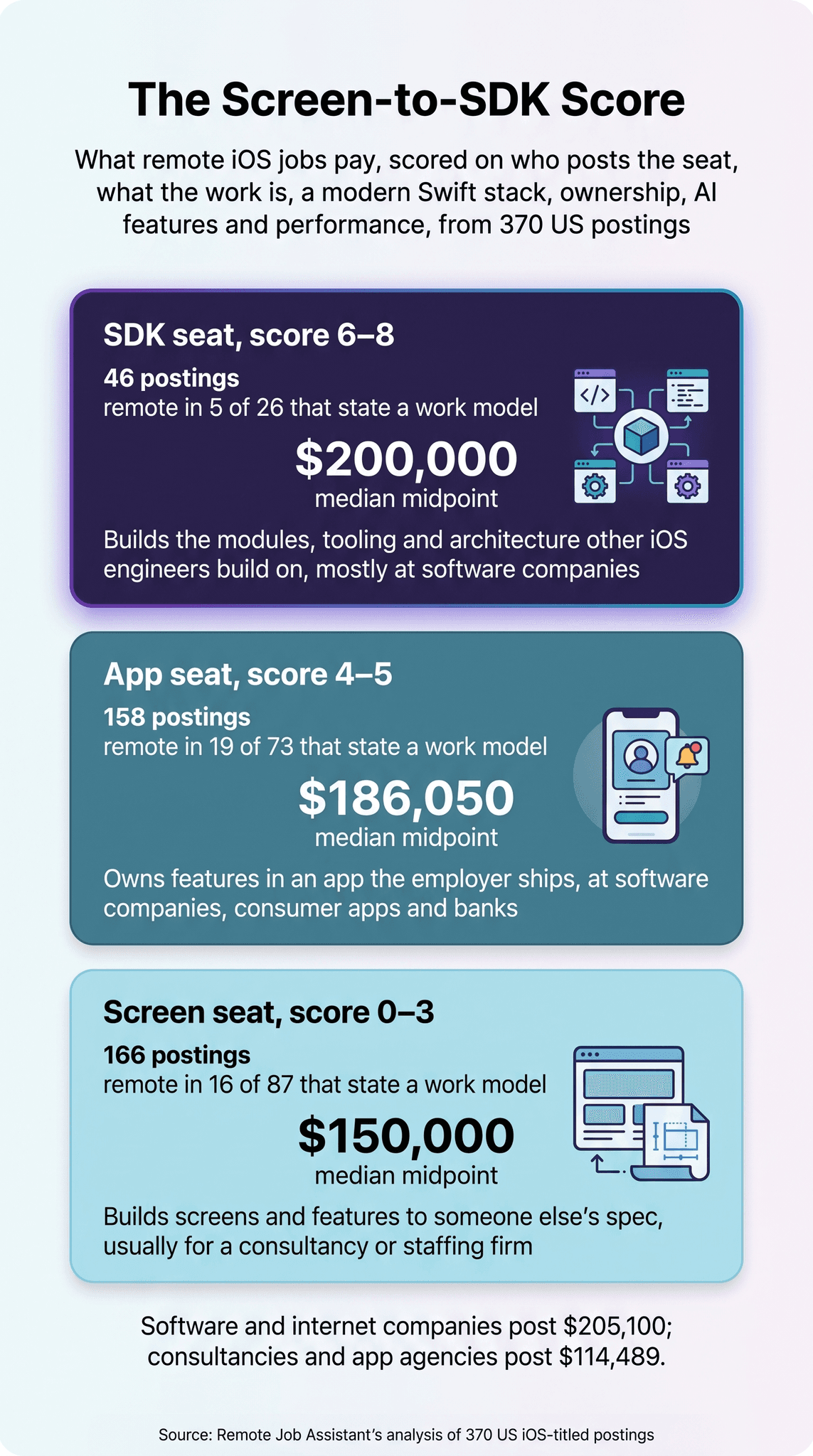
Three seats, then. A Screen seat (166 postings) posts a $150,000 midpoint and is remote 18.4% of the time it states a model outside Himalayas (16 of 87); an App seat (158) posts $186,050 and 26.0% (19 of 73); an SDK seat (46) posts $200,000 and 19.2% (5 of 26). Moving from a Screen seat to an SDK seat adds $50,000 at the median and almost nothing to your odds of remote work (18.4% against 19.2%). The employer type is what gates remote: consumer apps say remote in 12 of 30 postings that state a model, banks in 0 of 10.
Of the 28 remote iOS-titled postings with a posted range, 12 start at $150,000 or more. 11 of the 12 carry senior, staff or a numbered level in the title, and all 12 come from companies that own their app: 6 consumer companies, 5 software companies and one health company. The list: Netflix's Software Engineer 5 - iOS at $388,000–$558,000; Whatnot's Staff iOS Engineer, App Platform at $245,000–$290,000; Reddit's Staff iOS Engineer, Media Foundation at $217,000–$303,000; Airbnb's Staff Software Engineer, iOS Platform at $212,000–$265,000 and Senior Software Engineer, iOS Platform at $196,000–$230,000; Office Hours' Senior iOS Engineer at $180,000–$200,000; Thrive Market's Senior Software Engineer, iOS at $175,000–$190,000; Sony Interactive Entertainment's Senior Graphics Programmer, Mobile at $172,000–$258,100; Fetch's Senior iOS Software Engineer I at $162,198–$190,821; Oura's Senior iOS Engineer at $162,000–$203,000; and iOS seats at NOCD and Eleos at $150,000–$180,000.
Can You Work Remotely at Apple? What Its Own Postings Say
Short answer: not as an iOS engineer. Apple's corporate employees have been expected in the office three days a week since September 5, 2022. 9to5Mac's report of the policy, citing Bloomberg's Mark Gurman, put it this way: "The mandatory days are Tuesdays and Thursdays, plus a third day that can be defined by each team." By March 2023, MacRumors was reporting that Apple "is tracking the attendance of its employees at offices using badge records in order to ensure they are coming in at least three times a week." We searched Apple-focused and business press for a 2025 or 2026 change and found none, so three days is the last verified policy.
Apple's careers site says the same thing in numbers. On October 12, 2026, jobs.apple.com listed 4,384 US postings, and its Home Office filter, the flag Apple uses for remote seats, returned 26 of them (still 26 when we checked again the next day). Fourteen sit in Corporate Functions and eleven in Sales and Business Development: retail employee-relations partners, retail facilities managers, carrier field-engineering managers and K-12 education leads, most of them one requisition copied across several cities. The 26th is an Offensive Security Researcher for kernel and embedded security in New York. None is an iOS or app-engineering seat.
Apple hires plenty of iOS engineers, just not remote ones. Its search returned 436 US postings for "ios" and 428 for "swift," most of them Siri, Safari, wireless, silicon and iPhone hardware seats that mention the platform. 25 carry iOS, Swift or Xcode in the title and sit in Apple's software teams: an iOS Engineer for Apple Sports in New York, a Swift Engineer on Find My, a Senior iOS Frameworks Engineer for HealthKit, an Xcode Intelligence Foundation Engineer. 17 of the 25 are in Cupertino, and all 25 are office seats. Apple prints pay the same way on every one of them; the most common line, on 11 of the 24 that print one, says the "base pay range for this role is between $150,400 and $277,600," and the median midpoint across the 24 is $214,000.
The "apple remote jobs" search that 9,700 people run every month returns At Home Advisor and customer-support pages, because those are the remote jobs Apple is known for. Apply to Apple for the platform, the pay and the chance to build the frameworks every other iOS engineer consumes. Don't apply for remote. The remote iOS jobs are at the companies that ship apps, and the rest of this guide is about them.
How We Collected This Data
Start with what we couldn't read. Indeed, Glassdoor and ZipRecruiter block automated reading, so Indeed's listings appear here only through SimplyHired, which carries its feed. Reddit is unreadable to our crawler except through archived copies, so the only Reddit voice in this guide is one archived r/swift thread. Referral-only and agency-pipeline roles never reach a public board at all. Those gaps lean toward employers that post publicly and print ranges, so our vendor pay figures run a little high and our remote share for small studios runs a little low.
Three more biases shape every number. Pay is posted on 50.0% of iOS-titled postings (185 of 370: all 29 Workday rows, all 33 rows from Greenhouse, Lever, Ashby and SmartRecruiters boards, 69 of 167 LinkedIn rows, 47 of 108 SimplyHired rows and 7 of 33 Himalayas rows), so medians lean toward employers with pay-transparency blocks. 151 of the 370 (40.8%) say nothing about work model, so every remote share in this guide is a share of postings that state one. And Himalayas lists only remote jobs: all 33 of its iOS-titled rows are remote by construction, so remote shares set Himalayas aside unless we say otherwise, while pay figures keep it.
A posting counted if its title named iOS, iPhone, iPad, Swift, SwiftUI, Objective-C, Xcode, watchOS, tvOS or visionOS next to a professional role word. We sorted titles into developers and engineers, platform and SDK engineers, architects, and engineering managers, and set aside QA and test-automation titles, device-support and Mac-administration titles, Cisco IOS network titles (a different IOS), SWIFT payments-messaging titles, designers, product managers, interns and non-English postings. Apple's own postings are counted separately. The comparison sets are Mobile Engineer and Software Engineer titles with no platform word whose bodies require iOS, and Android-titled postings.
Dedupe started from 2,003 rows, including Apple's. 1,744 were US postings dated within the last year; from those we removed 243 exact copies, 217 per-city clones of one requisition and 59 copies under sibling employer names, then collapsed 166 duplicates found on two sources, leaving 1,038 unique postings across the iOS-titled, comparison and Apple sets. Per-city clones are common in iOS hiring: on LinkedIn's own "iOS Developer jobs" page, 11 of the first 60 cards repeated a title and employer in another city. LinkedIn's 2,163 cards from our searches held 307 unique iOS-titled title-and-employer pairs; we fetched 315 full LinkedIn postings across the iOS-titled and comparison sets before our time limit, and 167 survived dedupe as unique iOS-titled postings. Work model comes from the posting text, not the board's remote flag, and employer type from curated names (including app agencies and iOS-market staffing firms), LinkedIn's industry label, and employers' own career sites.
The Screen-to-SDK Score is computed by code from duty language, and the audit at lock changed four things. Banks held the top employer point in the interim version; software and internet companies out-posted them ($205,100 against $173,400), so they took it. The first work rule scored SDK and app work almost exactly level ($175,150 against $175,250) because it counted any Swift package or CI mention as SDK work; the final rule reads the seat first (a client project or maintenance of someone else's app scores 0) and asks for three distinct SDK, module or build-system cues, or an SDK or platform title, before it awards 2. Release duties such as App Store submission, TestFlight and release trains moved nothing ($175,500 against $174,525), and a second platform lowered pay, so both are reported, not scored. And a performance point (profiling, launch time, memory) replaced a scale point, which raised pay overall but turned slightly negative inside software companies ($205,100 with scale language against $207,500 without).
Salary cross-references: BLS OEWS May 2025 (software developers $135,980; software quality assurance analysts and testers $104,300; computer and information systems managers $175,140), the BLS Employment Projections table (software developers +10.2% from 2025 to 2035, 95,300 openings a year, with "Mobile Applications Developer" among its example titles), O*NET's hot-technology counts, the Stack Overflow 2026 Developer Survey, where 34.8% of 24,602 respondents work fully remote and Swift is used by 5.9% of the 14,099 who answered the language question, and the Levels.fyi iOS Engineer page, a self-reported $218,000 median total compensation and $175,000 median base. Figures reflect postings pulled October 12, 2026; we refresh this analysis quarterly.
The Screen-to-SDK Score: Why Two Remote "Senior iOS Engineer" Jobs Pay $37,000 Apart
The usual advice is to keep up with Apple: SwiftUI this year, Swift Concurrency next, Apple Intelligence after that, and the offers follow. The postings mostly disagree. Postings that name SwiftUI post $172,500 against $175,275 for the ones that don't, and naming Combine moves the midpoint $1,510. What moves an iOS posting's pay is who posts the seat (a vendor billing your hours to a client, a company that owns its app, a software company) and what the work is: screens for someone else's app, features in an app your employer owns, or the SDK, modules and tooling other engineers build on.
The Screen-to-SDK Score is a 0–8 rubric that scores any iOS posting, or your current job, on how far it sits from "building screens to someone else's spec and fixing the tickets that come back" toward "building the SDK, modules and tooling the other iOS engineers build on," using only what the posting says.
The two-minute check. Answer four questions from the posting:
- Who posts it: a consultancy, app agency or staffing firm that bills your hours to a client, a company that owns the app, or a software or internet company?
- What is the work: client projects or tickets on an existing app; features in the employer's own app; or SDKs, shared modules, the build system or developer tooling?
- Does it name a modern Swift stack (SwiftUI plus Swift Concurrency, Combine, Swift Package Manager or Swift 6)?
- Does it ask you to own the architecture, ship AI features in the app, or tune performance?
Scoring, with the median posted midpoint for each value across the 370 postings:
- Employer (0–2), who posts the seat: a consultancy, app agency or staffing firm that bills the seat to a client = 0 ($115,228, n=21); a company that owns the app it ships, including consumer apps, banks, healthcare, media, manufacturers and federal contractors = 1 ($166,500, n=87); a software or internet company = 2 ($205,100, n=77).
- Work (0–2), what the iOS work is: screen, meaning a client project or maintenance seat on someone else's app (engagements, deliverables, tickets, enhancements, support of an existing app) = 0 ($124,550, n=24); app, meaning features or a product surface in an app the employer owns, or nothing decisive = 1 ($176,510, n=141); SDK, meaning three or more distinct cues for SDKs, shared modules, build systems, developer tooling, a design system or work other teams build on, or an SDK, platform or core title = 2 ($209,250, n=20).
- Era (0–1): a modern Swift stack named, SwiftUI plus Swift Concurrency, Combine, Swift Package Manager, Swift 6 or TCA ($182,500 vs $171,850; 108 postings).
- Ownership (0–1): architecture, technical lead, mentoring or owning the app ($175,500 vs $155,000).
- AI (0–1): LLM features, on-device ML, Core ML, Apple Intelligence or Foundation Models expected in the app ($182,500 vs $172,700; 55 postings).
- Performance (0–1): profiling, launch time, memory, hangs or frame drops ($182,500 vs $169,075; 157 postings).
Four things are reported, not scored, because they don't raise posted pay: App Store release duties, "millions of users" scale language, a second platform, and on-call.
Bands:
- Screen seat (0–3): $150,000 midpoint (n=61); remote in 18.4% of the 87 postings outside Himalayas that state a model. You build screens and features to someone else's spec, usually for a consultancy (57 of these postings) or a staffing firm (26), and often on contract (45). 166 postings.
- App seat (4–5): $186,050 midpoint (n=91); remote 26.0% of 73. You own features in an app your employer ships, most often at software companies (85), consumer apps (18) and banks (12). 158 postings.
- SDK seat (6–8): $200,000 midpoint (n=33); remote 19.2% of 26. You build the modules, tooling and architecture other iOS engineers build on; 35 of these 46 postings come from software companies.
| Seat | Score | Postings | Remote (of stated, ex-Himalayas) | Median midpoint (n) | Hourly median (n) | Contract | Typical posters |
|---|---|---|---|---|---|---|---|
| Screen | 0–3 | 166 | 18.4% (16 of 87) | $150,000 (61) | $51.80–$63.30 (30) | 45 | Consultancies, staffing firms, consumer apps |
| App | 4–5 | 158 | 26.0% (19 of 73) | $186,050 (91) | $50–$55 (9) | 16 | Software companies, consumer apps, banks |
| SDK | 6–8 | 46 | 19.2% (5 of 26) | $200,000 (33) | n/a | 1 | Software companies |
The single score is honest about its noise: $130,000 at 0 (one posting), $113,000 at 1 (n=7), $125,600 at 2, $160,650 at 3, $177,000 at 4, $198,275 at 5, $200,000 at 6 and $219,250 at 7 (n=6). No posting scored 8. The bottom two points are thin samples; the climb from 2 to 7 is $93,650.
How to use it. Score your current job, then every posting you consider, in two minutes. The biggest single point is who posts it: $115,228 at a consultancy or agency, $166,500 at a company that owns its app, $205,100 at a software company. The next biggest is the work: screens for a client post $124,550, features in an owned app $176,510, SDK and module work $209,250. The cheapest points are the ones you can truthfully claim this quarter: a Swift package another team imports, a launch-time budget you own, an LLM feature you shipped with a fallback. If you score 0–3 and want $150,000, change who posts the seat before you learn another framework. And decide which trade you're making, because the best-paid employer type is one of the least remote.
Here is the score on two postings with the same title and the same remote status. CVS Health posts a Senior iOS Engineer from its work-from-home location at $101,970–$203,940, to work "alongside other engineers and with the product and design teams to consistently deliver new features" and "refactor existing code in order to bring greater stability and scalability for our application," asking for "2+ years of experience with SwiftUI" and "Knowledge of MVC and MVVM architectural patterns." It scores 3: one for an employer that owns its app, one for app work, one for ownership, and nothing for a full modern stack, AI or performance. Office Hours, an expert-network software company, posts a Senior iOS Engineer as remote at $180,000–$200,000, to "Own and shape our iOS app end to end: architecture, state, navigation, offline, and App Store delivery," with "Mobile: Swift, SwiftUI, Swift Concurrency," "Experience integrating AI/LLM-powered features, including streaming responses into the UI" and "Familiarity with modern Swift Concurrency, on-device performance tuning, and mobile CI/CD." It scores 7: two for a software company, one for app work, and one each for the modern stack, ownership, AI and performance. Same title, same remote status: $152,955 against $190,000 at the midpoint.
Why does the work move iOS pay so much? Because a screen seat is priced per sprint and an SDK seat is priced per blast radius. A consultancy or app agency bills a client for features against a statement of work, and the iOS developer behind it is a cost line the vendor competes on. Zazz describes its seat as working "across multiple client engagements, building native iOS and Android applications from the ground up." An SDK seat writes the modules, build setup and shared components every feature team inherits, so when it's wrong, every team ships the mistake. Fox's Staff iOS Engineer is asked to "Drive the technical strategy for the mobile platform, including modularization, build system performance, developer tooling, and long-term platform evolution," and Whatnot's App Platform seat wants "A track record of measurably improving stability or performance, for example crash-free rate, launch time or hang rate."
SDK language is cheap to write, so check it before you score it.
One mention isn't SDK work: 173 of the 370 postings name at least one SDK, module or build-system term, and they post $175,300 (n=93) against $173,050 without one. Three distinct cues are: the 25 postings that name three or more post $194,000 (n=20) against $173,400. And the title is the strongest tell: the 11 postings with SDK, Platform, Foundation or Developer Experience in the title post $248,500 (n=9).
Why does the employer move it? Because a vendor's margin sits inside the range, and because the company that sells software pays engineers like a product cost, not a project cost. Consultancies and agencies post a $114,489 midpoint and staffing firms mostly post hourly rates ($62.50–$70 at the median); companies that own an app post $166,500; software and internet companies post $205,100, and they're remote in 9 of the 55 postings that state a model. The best-paid line in an iOS job description isn't a framework. It's the one that says other engineers build on your code: postings with three or more SDK, module or build-system cues post $194,000; the rest post $173,400.
Two kinds of posting break the pattern. Consumer apps pay like other app owners ($172,700) and post remote far more often than anyone else, 12 of the 30 that state a model, so an App seat at a consumer company is the best remote trade in the set. And the score misses one kind of strong seat: Airbnb's iOS Platform postings score 5 because Airbnb files as a consumer company and the postings carry no ownership line, yet they pay $196,000–$265,000 and are remote. When a posting under-describes the seat, the title and the range break the tie, and "iOS Platform" at $212,000 is not an App seat.
A Staff title doesn't buy you the SDK band either. 35 of the 45 staff and principal postings in the set score below 6, and they post $215,000 in the App band against $261,500 for the 10 that score as SDK seats. Read the duties before you read the level.
Stop Applying Manually
Our AI applies to hundreds of matching jobs while you sleep. Wake up to interviews, not more applications.
Most of the time this search costs you isn't applying. It's sorting: the "remote" card whose body says two days in Dearborn, the agency copy of a requisition you've already seen, the iOS Developer contract with no range. Filtering down to App and SDK seats with a real employer and a real range is the job. Auto-Apply handles the application volume once you've decided which postings those are.
Remote iOS Developer Salary: What 185 Posted Ranges Show
Seniority and the title word move iOS pay more than any framework does.
| Title or level | Postings | Remote (of stated, ex-Himalayas) | Median range | Median midpoint (n) | Hourly median (n) |
|---|---|---|---|---|---|
| Staff, principal or level 5 in the title | 47 | 16.1% (5 of 31) | $186,500–$262,675 | $227,500 (40) | $80–$100 (1) |
| "iOS Engineer" in the title | 104 | 20.8% (11 of 53) | $162,000–$225,000 | $195,000 (63) | $62.80–$70.30 (2) |
| Senior level | 167 | 24.7% (22 of 89) | $158,900–$215,450 | $183,600 (112) | $60.54–$77.50 (8) |
| "Software Engineer, iOS" or similar | 82 | 25.0% (9 of 36) | $150,000–$200,000 | $176,510 (61) | $65–$80 (3) |
| "Mobile" plus iOS in the title | 65 | 18.2% (6 of 33) | $128,000–$177,000 | $157,000 (28) | $30–$40 (10) |
| Mid level | 168 | 21.2% (17 of 80) | $128,000–$170,500 | $153,375 (62) | $51.80–$63.30 (24) |
| "iOS Developer" in the title | 82 | 14.6% (6 of 41) | $111,000–$160,000 | $135,000 (19) | $52.50–$65 (18) |
Salary ranges come from our analysis of 370 US iOS-titled postings pulled October 12, 2026, 185 of which print an annual range; medians are of each posting's range midpoint, and remote shares exclude Himalayas because it lists only remote jobs. BLS cross-references are May 2025 medians: software developers $135,980, software quality assurance analysts and testers $104,300, computer and information systems managers $175,140. Ranges shift as markets move, so check the linked sources for current figures.
The "ios developer salary" question has three common answers, and they measure different things. Our posted midpoint is $175,000; the middle half of midpoints runs from $142,750 to $215,000, and the top tenth starts at $255,500. BLS's $135,980 covers every software developer, including people who never ship an app. Levels.fyi's self-reported iOS Engineer median is $218,000 in total compensation and $175,000 in base pay, which matches our base-range midpoint almost exactly. The five averages on page one of Google (Arc $83,037, Wellfound $85,375, Remote Rocketship $115,626 "based on data from 261 job openings," ZipRecruiter $123,994 and Built In $135,167) disagree by $52,130 because they mix countries, levels and employer types. Split our postings by employer type and the same market runs from $114,489 at consultancies to $205,100 at software companies.
Experience climbs the same way. Postings asking 0–4 years post $151,500 (n=30), 5–7 years $171,025 (n=36) and 8–10 years $220,498 (n=17), and the median ask is five years. Equity is a quieter tell: postings that mention equity post $197,500 (n=99) against $154,450 (n=86) for the rest, because equity lines come from product companies. Lead titles are the odd row out at $172,325 (n=10), because "Lead iOS Developer" is often an agency title for the senior person on a client project.
Contract rates need a conversion before you compare them. The 39 postings that print an hourly rate post a $51.59–$61.59 median, which is $107,307–$128,107 at 2,080 hours, before you pay for your own benefits and the weeks between contracts. Contract seats also sit in the Screen band: 45 of the 62 contract postings in our set score 0–3. Staffing firms printed an annual range on 3 of their 34 postings, too few to report, and an hourly rate on 14, at $62.50–$70. If an offer comes as an hourly rate, multiply by 2,080, subtract what your health insurance and unpaid gaps cost, and compare that to a direct range. For the broader engineering ladder, our remote software engineer guide covers the titles iOS engineers most often move into, and remote jobs paying $150K+ collects the App and SDK seats.
Who Actually Posts Remote iOS Jobs (and What "iOS Developer" in the Title Tells You)
Software and internet companies posted 130 of the 370 iOS-titled postings (35.1%). Consultancies, app agencies and staffing firms posted 107 (28.9%), and the rest came from consumer apps, banks, healthcare, media and manufacturers that own their apps.
| Employer type | Postings | Remote (of stated, ex-Himalayas) | Median range | Median midpoint (n) | Contract |
|---|---|---|---|---|---|
| Software and internet companies | 130 | 16.4% (9 of 55) | $175,000–$240,000 | $205,100 (77) | 9 |
| Manufacturers, telecom and other in-house | 33 | 33.3% (5 of 15) | $160,000–$230,000 | $195,000 (13) | 1 |
| Banks, insurers and fintechs | 28 | 0.0% (0 of 10) | $150,000–$195,000 | $173,400 (13) | 4 |
| Consumer, retail and travel apps | 39 | 40.0% (12 of 30) | $141,900–$198,900 | $172,700 (35) | 1 |
| Healthcare | 17 | 12.5% (1 of 8) | $150,000–$180,000 | $165,000 (15) | 1 |
| Media and publishers | 7 | 33.3% (2 of 6) | $131,500–$160,000 | $152,500 (5) | 0 |
| Consultancies and app agencies | 73 | 13.9% (5 of 36) | $87,000–$139,000 | $114,489 (18) | 26 |
| Staffing firms | 34 | 20.0% (4 of 20) | hourly only, $62.50–$70 (14) | too few annual ranges (3) | 18 |
| Federal contractors | 9 | 33.3% (2 of 6) | $78,500–$146,950 | $112,000 (6) | 2 |
Read the table as a trade. Software companies pay the most and post remote in 9 of 55; Salesforce posts its three iOS seats at a $255,500 midpoint, all on site, Google's five post $213,000 with no remote line, and Netflix's $388,000–$558,000 level-5 posting is the exception that makes the remote list. Banks are the clearest case: none of the 10 bank, insurer and fintech postings that state a model is remote. Consumer apps (Airbnb, Oura, Thrive Market, Whatnot) are where remote and pay meet. And the vendor rows are where most of the "iOS Developer" postings live.
The title tells you which of those you're looking at. 48 of the 82 postings with "iOS Developer" in the title came from consultancies, agencies and staffing firms, and 27 are contracts; 14 of the 104 with "iOS Engineer" did, and 5 are contracts. The pay follows: $135,000 against $195,000. Inside companies that aren't vendors the gap narrows but holds ($139,500 for Developer titles, n=24, against $182,500 for Engineer titles, n=142), because product companies reserve "Developer" for junior and contract seats. If you build iOS apps for a living, search under "iOS Engineer" and "Software Engineer, iOS," not "iOS Developer." The Developer title is mostly a vendor flag.
| Title type | Postings | Remote (of stated, ex-Himalayas) | Median midpoint (n) | Mid level | Senior |
|---|---|---|---|---|---|
| iOS in the title | 370 | 21.5% (40 of 186) | $175,000 (185) | $153,375 | $183,600 |
| Mobile or Software Engineer title, iOS required in the body | 57 | 37.0% (10 of 27) | $183,500 (33) | $145,600 | $194,005 |
| Android in the title | 42 | 15.4% (4 of 26) | $209,500 (38) | $201,525 | $214,000 |
Two more comparisons are worth knowing. Mobile Engineer titles with iOS in the body are the most remote titles in the set (10 of 27), and 50 of the 57 expect Android or a cross-platform framework too, so searching "mobile engineer" widens the remote pool at the price of a second platform. Android-titled postings post more than iOS ones ($209,500 against $175,000), mostly because of who posts them: 28 of the 42 come from software companies and one from a consultancy. Inside software companies the gap is smaller ($218,000 against $205,100).
The vendor lane has its own vocabulary, and it's easy to read once you've seen it. "Compensation: Open to Both C2C and W2 options" (System One). "Type: Full-time (W2 or Contract 1099), 40 hours per week" (Adidev Technologies, which posted 13 iOS-titled roles in our set, all contracts). "Due to client requirements, applicants must be willing and able to work on a w2 basis" (Eliassen Group). "(In-person interview with customer Wells Fargo)" (AppLab Systems). None of these is a bad job by definition, but each one prices the seat as billable hours for someone else's app, which is the Screen band.
Vendor postings are built from a template, and the template shows. 48 of the 107 vendor postings name a client in the body, 44 are contracts, 30 print an hourly rate and 21 print an annual range. The terms often sit in the title itself: "Sr. iOS Engineer - Only w2 (NO H1B & OPT)" (Redolent), "Sr. iOS Developer ( Locals Only) --- Hybrid role" (Zillion Technologies), "iOS Developer | Plano, TX - hybrid | W2 ONLY" (Matlen Silver). And requisitions travel: across the whole set, our dedupe removed 59 copies of a posting under a sibling or partner employer name and collapsed 166 that appeared on two sources. A vendor's iOS posting in a remote search is remote in 9 of the 56 that state a model (16.1%), and 5 of those 9 are contracts. Our remote web developer guide found the same Developer-versus-Engineer split on the web side, and the software engineer listings are where the Engineer titles live.
Stop Applying Manually
Our AI applies to hundreds of matching jobs while you sleep. Wake up to interviews, not more applications.
The "remote" cards that turn out hybrid three paragraphs down cost the most time: outside Himalayas, 74 iOS-titled postings that state a work model are hybrid, against 40 remote. Auto-Apply reads the work-location line before it applies, so the hybrid-in-disguise ones don't eat your evenings.
SwiftUI, Objective-C and the Second Platform: What Remote Postings Actually Ask For
Is iOS development still in demand? The postings say yes, and they say what kind. O*NET counts "Apple iOS" in 88,449 US job postings in 2025, BLS projects 10.2% growth for software developers through 2035, and Apple says its App Store ecosystem facilitated $1.4 trillion in billings and sales in 2025 (Apple Newsroom, June 2026). Cross-platform frameworks haven't replaced native iOS in these postings: 57 of the 370 (15.4%) mention React Native, Flutter or Kotlin Multiplatform, and three of those describe migrations away from React Native, among them Abbott's "transition from React Native to fully native iOS" and a posting that describes "a significant migration from React Native to a fully native codebase."
| What the posting names | Postings | Share of 370 | Median midpoint, named (n) | Median midpoint, not named | Remote (of stated, ex-Himalayas) |
|---|---|---|---|---|---|
| SwiftUI | 198 | 53.5% | $172,500 (105) | $175,275 | 20.8% (22 of 106) |
| UIKit | 122 | 33.0% | $182,500 (53) | $171,000 | 15.0% (9 of 60) |
| Objective-C | 132 | 35.7% | $166,550 (52) | $176,650 | 9.8% (6 of 61) |
| Objective-C as a requirement | 57 | 15.4% | $163,500 (18) | $175,500 | 7.7% (2 of 26) |
| Swift Concurrency (async/await, actors) | 69 | 18.6% | $184,275 (36) | $172,700 | 28.2% (11 of 39) |
| Core Data | 81 | 21.9% | $142,500 (25) | $176,580 | 14.3% (6 of 42) |
| Android or Kotlin mentioned | 117 | 31.6% | $173,400 (61) | $175,275 | 25.5% (14 of 55) |
| Build both platforms | 49 | 13.2% | $147,250 (22) | $175,500 | 16.0% (4 of 25) |
| AI features in the app | 55 | 14.9% | $200,000 (39) | $170,500 | 37.9% (11 of 29) |
| AI coding tools (Copilot, Cursor, Claude Code) | 90 | 24.3% | $190,000 (59) | $170,500 | 29.6% (16 of 54) |
SwiftUI is table stakes now. It's named in more than half the postings and carries no premium. UIKit named in a posting tracks more pay, not less, because large apps with years of UIKit code sit at large companies: Block's Staff iOS Software Engineer, Bitcoin wants "Experience working in large, modular iOS applications, including existing UIKit or Objective-C codebases." Objective-C is the least remote line in the set: postings that require it are remote in 2 of the 26 that state a model. Swift Concurrency is the one stack term with a clear premium ($184,275) and one of the more remote ones (11 of 39). Core Data tracks less ($142,500), because it's a staple of consultancy and agency requirement lists.
A second platform is where the myth breaks. Mentioning Android or Kotlin moves nothing ($173,400 against $175,275), because product companies name the other platform's team, not a second job: Oura writes that "Our engineering organization consists of many talented Android and iOS app developers distributed across the EU and US." Asking you to build both platforms is different ($147,250, n=22), and putting the second platform in the title is a pay cut: the 39 postings titled iOS plus Android, React Native or Flutter post $117,000 (n=15) against $176,005 for iOS-only titles. A second platform in an iOS job title is a pay cut, not a bonus: iOS-and-Android titled postings post $117,000; iOS-only titles post $176,005. The cause is the seat: small teams and agencies hire one person for two apps, and product companies hire each platform separately.
AI is the newer line, and it needs a careful read. Postings that expect AI features in the app (LLM features, on-device ML, Core ML, Apple Intelligence, Foundation Models) post $200,000 against $170,500, and postings that expect AI coding tools post $190,000. But inside software companies, AI-feature postings post $205,000 against $205,300 for the rest. So the AI line marks a funded product team; it isn't a premium you earn by adding Core ML to your résumé. The tools line is already ordinary at large companies: Fox asks for "Experience using AI-assisted development tools (such as Codex, Cursor, Claude Code, OpenCode or similar) to support software development and improve engineering productivity," and Reddit's Media Foundation seat says "Utilize AI-assisted development tools to accelerate prototyping, system design, and coding, while applying rigorous judgement to validate and own the final outputs." Apple's own Xcode 27, released September 14, 2026, advertises "coding agents in Xcode, powered by the model of your choice."
Learn it or skip it: a rule from the postings. Only one stack line is worth chasing for pay.
- Learn Swift Concurrency first if you're still writing completion handlers. It's the only stack term with a premium ($184,275 in 69 postings), and it's remote in 11 of the 39 that state a model.
- Keep your Objective-C, but don't lead with it. Large apps still need it (Snapchat asks for "well-tested Objective-C software which powers experiences in Snapchat's camera"), yet postings that require it are remote in 2 of 26.
- Skip learning Android just to look like a full mobile engineer if you're targeting product companies. Mentioning Android moves nothing; a two-platform title costs $59,005 at the midpoint.
- Ship one AI feature in an app (streaming responses, an on-device fallback) if you're targeting software companies. 55 postings ask for it, remote in 11 of 29, but expect it to get you in the door, not to raise the band.
Apple's own rules are part of the stack question too. Since April 28, 2026, apps uploaded to App Store Connect must be built with Xcode 26 or later using the iOS 26 SDK (Apple's upcoming requirements page), and Swift 6.4 shipped on September 15, 2026. A posting that still describes a CocoaPods-and-storyboards app is describing a codebase that has to move, and that migration is SDK work if you can get it written into the job.
The Remote Small Print: Hybrid Labels, Local-Only Contracts, W-2 Lines and Time Zones
Remote iOS postings carry less small print than most engineering fields, because an app isn't regulated infrastructure. The bigger trap is the label itself. Across the 370 iOS-titled postings and the 73 remote ones, here's what the fine print said.
| Line in the posting | All iOS-titled (370) | Remote (73) | Example line from a posting |
|---|---|---|---|
| W-2 only | 31 | 4 | "Due to client requirements, applicants must be willing and able to work on a w2 basis" (Eliassen Group) |
| On-call rotation | 26 | 2 | "Supports working hours as part of a rotating schedule to provide on call support of Garmin's 24/7 operations" (Garmin) |
| US citizenship or permanent residency | 16 | 4 | "This position is restricted to US citizens or lawful permanent residents" (Robinhood) |
| Security clearance | 15 | 1 | "Must be eligible to obtain a Security Clearance (U.S. Citizenship Required)" (DigitalCM) |
| Local candidates or in-person interview | 12 | 0 | "Location: Plano, TX (local candidates only, in-person interview required)" (Matlen Silver) |
| Time zone or overlap hours | 12 | 5 | "This role can be done remotely as long as you're willing to work on the Americas time zone" (MyTime) |
| No visa sponsorship | 12 | 0 | "We are unable to provide visa sponsorship or support visa transfers" (Beacon AI) |
| Travel | 10 | 4 | "This position requires traveling to our HQ office in Los Angeles, California, twice a year for all-company summits" (Thrive Market) |
| State exclusion list | 1 | 1 | "We are not considering candidates residing in the following states" (Oura, which lists 10) |
The citizenship and clearance lines come almost entirely from federal contractors (9 postings) and Robinhood's government-products team; the W-2 and local-only lines come from staffing firms. None of the 12 local-only postings is remote, which is the point: they're office seats that a remote search surfaced because the word appears somewhere on the page. The time-zone lines are the ones that do sit on remote postings, and they're specific: Blueprint says "We generally require 2–3 hours of overlap with the Los Angeles time zone," and Mindgrub's contract lists "Remote; 9:00am - 5:00pm EST; 40 hrs / wk anticipated."
What to do with each line:
- If the card says remote and the body names office days, believe the body. Cognizant's "Senior iOS Developer - Hybrid" says "this is a hybrid position requiring 2 -3 days a week in a client or Cognizant office in Dearborn MI."
- If it says local candidates or an in-person interview (12 postings), it's an office seat; skip it unless you live there.
- If it's W-2 only through a staffing firm (31), ask who the end client is and what the bill rate is; you're pricing a Screen seat.
- If it names a time zone or overlap window, get the hours in writing; the "Americas time zone" and two to three hours of overlap with Los Angeles are different jobs for someone in Boston.
- If it lists excluded states, check yours before the recruiter call; Oura excludes 10, from Alaska to Wisconsin.
- If it says remote plus HQ travel, price the trips; Thrive Market's is twice a year to Los Angeles.
After you're hired, the postings tell you what the week looks like, and it's mostly about the release. Citizen describes a rotation where "Release Captain is a rotational program: when it is your week, you run the release end to end and land high-priority bug fixes on a severity-based timeline, typically within one to two days." Thrive Market wants you to "Identify and resolve bottlenecks, memory leaks, and crashes to ensure a 99.9% crash-free session rate" while you "help evolve our iOS app from a legacy-heavy foundation into a modern, maintainable, and high-velocity codebase." Fox's Staff seat owns "application performance, reliability, observability, and crash-free rate targets across the iOS and tvOS platforms." And some remote seats come with your colleagues' hours attached: Carv warns that "busy periods may require early calls (around 7am) for UK overlap."
| Flag in the posting | What it usually means | What to ask | Green flag instead |
|---|---|---|---|
| "iOS Developer" from a vendor, no range | A contract seat billed to a client | "Who is the end client, and is this W-2 with them or with you?" | The employer's own career site lists the same requisition |
| iOS plus Android in the title | One engineer for two apps at a small team or agency | "How many mobile engineers are there, and which platform is primary?" | Separate iOS and Android teams named in the posting |
| "Maintain and enhance" the existing app, with tickets | A maintenance seat on someone else's roadmap | "What share of last quarter was new features versus tickets?" | Features or modules you own, with a named product area |
| Remote in the card, office days in the body | The board flag is wrong or the requisition changed | "Is this remote from anywhere in the US, in writing?" | A remote work-location field and no office-days line |
| "24/7" on-call for a mobile app | A thin team carrying the app and its backend | "How many people share the rotation, and how often were you paged?" | A crash-free target and a release-captain rotation |
| Objective-C required, no Swift migration mentioned | A legacy codebase with no plan to move | "Is there a migration plan, and would I own part of it?" | A posting that names the migration as the work |
How to spot a real remote iOS job in 60 seconds:
- Find the work-location line, not the card. "Remote (US)" or a remote work-location field beats "remote" in a search result.
- Check the title word. "iOS Engineer" or "Software Engineer, iOS" from a company that ships the app beats "iOS Developer" from a vendor.
- Search the body for "local," "in-person," "W2" and a time zone. Any one of them narrows who can apply.
- Read the duties for the work: client deliverables and tickets (screen), features in their own app (app), or modules, build and tooling (SDK).
- Check for a range. 185 of the 370 postings print one; the rest leave you to negotiate blind.
On-call runs against intuition. Postings that mention it post $154,650 (n=13) against $175,400 without it, and only 2 of the 26 are remote. Garmin puts iOS engineers on "a rotating schedule to provide on call support of Garmin's 24/7 operations," and 1Password asks for "Experience supporting production systems and participating in on-call or incident response rotations." The pager is a cost of the seat, not a sign of seniority, so we report it and don't score it.
Stop Applying Manually
Our AI applies to hundreds of matching jobs while you sleep. Wake up to interviews, not more applications.
Local-only contract requisitions are a dead end for most applicants, and they hide inside remote searches: 12 iOS-titled postings in our set ask for local candidates or an in-person interview, and none of them is remote. Filter them out before you apply, then put your applications into the App and SDK seats that are.
How to Move From a Screen Seat to an SDK Seat in 90 Days
You don't need a new employer to change your score, but you usually need one to get paid for it. Find your cell first: where you work now (the rows) and what the work is (the columns).
| Your employer now | Screen work (client or maintenance) | App work (features in an owned app) | SDK work (modules, build, tooling) |
|---|---|---|---|
| Consultancy, agency or staffing firm | $114,489 (n=14); remote 6 of 37; 69 postings | $117,000 (n=7); remote 3 of 17; 36 postings | 2 postings |
| Company that owns its app | $140,125 (n=6); remote 2 of 7; 11 postings | $165,550 (n=70); remote 16 of 57; 110 postings | $175,300 (n=11); remote 4 of 11; 12 postings |
| Software or internet company | $173,750 (n=4); remote 0 of 4; 9 postings | $200,082 (n=64); remote 8 of 43; 109 postings | $220,020 (n=9); remote 1 of 8; 12 postings |
Read across the top row and the work barely matters: at a vendor, owning app features instead of building screens is worth $2,511 at the median. Read down any column and the employer is worth $25,000 to $85,000. So the order of moves is fixed: employer first, then the work.
Which move first? A four-branch rule from the postings:
- If you're at a consultancy, agency or staffing firm (employer point 0): the fastest raise is a direct employer, not a new framework. Consultancies and agencies post $114,489; companies that own their app post $166,500, and software companies $205,100. Apply directly to the product companies whose apps you already build.
- If you're in-house on an app with a ticket queue (work point 0 or 1): turn one maintenance duty into module work. Move a feature into a Swift package another team imports, own the build or the launch-time budget, and measure it; Spotify's open-source XCMetrics collects Xcode build times per target, which is the evidence a build-time claim needs. SDK-scored work posts $209,250 against $176,510 for app work.
- If you're a cross-platform generalist: pick iOS and say so in the title. iOS-and-Android titles post $117,000 and iOS-only titles $176,005. If you want to keep both, search Mobile Engineer titles at software companies, which post $191,255 there.
- If you're at Apple or a big-tech app team and the office rule is the problem: Apple's iOS software seats print a $214,000 midpoint and none is Home Office. The remote seats that pay near that are at software and consumer companies: 12 remote postings start at $150,000 or more, and 11 of them are senior, staff or level-5 titles. Decide whether you're optimizing for remote or for the number before you apply.
When two postings score the same, these four tie-breakers come from the same data:
- Title beats body for the work. Postings with SDK, Platform or Foundation in the title post $248,500 (n=9); postings with three SDK cues in the body post $194,000.
- Body beats the card for the work model. A remote search card is a board's guess; the work-location line is the employer's word, and 74 of the iOS-titled postings that state a model are hybrid.
- Employer beats stack. SwiftUI named or not moves the midpoint $2,775; vendor to software company moves it about $90,000.
- Consumer app beats software company when remote matters most. $172,700 and remote in 12 of 30, against $205,100 and remote in 9 of 55.
Three illustrative résumé rewrites (examples of the shape, not quotes from postings):
- Before: "Developed iOS apps for multiple clients using Swift and UIKit." After: "Built the checkout flow for a retail client's iOS app in SwiftUI; cut cold launch from 2.1 to 1.3 seconds using Instruments."
- Before: "Maintained the company iOS app and fixed bugs." After: "Moved 14 features into 6 Swift packages; clean build time fell 40%, and two other teams now import our networking module."
- Before: "Experience with Core ML." After: "Shipped an on-device summarization feature with a server fallback and streaming UI; used weekly by 9% of active users."
Five questions for the first recruiter call, in this order:
- "Who owns the app and the release: your team, another team, or a client?"
- "How many iOS engineers are there, and is the codebase split into modules or one target?"
- "Will I be expected to ship Android or React Native work too?"
- "What share of the work last quarter was new features versus tickets on the existing app?"
- "Is the role remote from anywhere in the US, and can you put that, and any state list, in the offer letter?"
One sanity check against what employers actually pay for. A degree requirement doesn't move iOS pay ($174,525 with a degree line, $175,250 without), published-app asks are rare (13 of 370), and postings that mention a coding test post less ($152,500, n=15), because test-first hiring is a vendor habit. A GitHub or portfolio ask appears in 70 postings at $182,500. If your iOS work leans toward test automation, our remote QA engineer guide covers XCUITest-heavy seats; if you're a design engineer, the remote UX designer guide covers the design side of the same teams; and if your app has a large backend, the remote full stack developer guide covers the seats that span both.
Frequently Asked Questions
Does Apple let iOS engineers work remotely in 2026?
Not in practice. Apple's corporate staff have been expected in the office three days a week since September 5, 2022, and on October 12, 2026, 26 of its 4,384 US postings (0.6%) carried the Home Office flag, none of them an iOS seat. All 25 of its iOS, Swift and Xcode software postings were office seats, 17 in Cupertino, at a $214,000 median midpoint.
I've been an iOS developer at an agency for four years at $70 an hour. What would a remote in-house role pay?
$70 an hour is $145,600 at 2,080 hours, before you pay for your own benefits and the gaps between contracts. Consultancy and agency postings with an annual range post $114,489; companies that own their app post $166,500, and software companies $205,100. App seats, the band most in-house roles land in, post $186,050 and are remote 26.0% of the time they state a model (19 of 73).
Should I learn SwiftUI or stay on UIKit and Objective-C for remote iOS jobs?
Learn SwiftUI, but don't expect it to raise the number: it's named in 53.5% (n=198 of 370) of postings at $172,500, against $175,275 without it. UIKit still tracks higher pay ($182,500) because large apps carry it, while postings that require Objective-C are the least remote, 2 of the 26 that state a model. Swift Concurrency is the one stack term with a premium, $184,275.
How many remote iOS jobs expect Android or React Native too, and does that pay more?
31.6% (n=117 of 370) mention Android or Kotlin, and that moves pay nothing ($173,400 against $175,275). Postings that want you to build both platforms post $147,250, and the 39 with a second platform in the title post $117,000 against $176,005 for iOS-only titles. Product companies hire each platform separately; agencies and small teams want one engineer for both.
What does a Screen-to-SDK Score of 4 mean, and what moves it to 7?
A 4 is the entry to the App band: typically a company that owns its app, feature work in that app, and two of ownership, a modern Swift stack, AI or performance. To reach 7 you need a software-company employer or SDK work (shared modules, the build system, developer tooling) plus most of the single points. App seats post $186,050 and SDK seats $200,000; postings that score 7 post $219,250 (n=6).
Is iOS development still in demand, or are cross-platform and AI replacing it?
Demand is steady: O*NET counts Apple iOS in 88,449 US postings in 2025, and BLS projects 10.2% growth for software developers through 2035. Cross-platform frameworks appear in 15.4% (n=57 of 370) of iOS-titled postings, and some describe migrations back to native. AI shows up as work, not a replacement: 55 postings expect AI features in the app, at a $200,000 midpoint.
I'm a junior iOS developer. Are there any 100% remote iOS jobs?
Very few. Only 7 of the 370 iOS-titled postings carry a junior, associate or entry title; one of them, on Himalayas, is remote, and none of the 3 that state a work model elsewhere is. 35 ask for two years or less. An archived r/swift thread on exactly this question put it bluntly: "gone is the market where you could find a remote job just by breathing." Take a hybrid App seat at a product company first: postings asking 0–4 years post $151,500 and are remote in 4 of the 25 that state a model, so the remote move is easier with two shipped years behind you.
Start Your Remote iOS Search
If you remember one number from this guide, make it 0 of 25: the remote iOS job is almost never at Apple. Look at the companies that ship the apps, score each posting before you apply, and spend your effort on the moves that change the score (the employer, the work, the stack) rather than on another framework badge.
- Browse remote engineering and technical jobs and filter for Engineer titles, not just Developer ones.
- Check remote jobs paying $100K+ for App seats and roles paying $200K+ for the staff and SDK seats.
- If you work close to design, product design listings carry the design-engineer seats, and our remote product designer guide covers how those teams hire.
- Compare where to search in our guide to the best remote job boards, see which other fields pay at this level in high-paying remote jobs, and if applications go nowhere, read why you're not getting interviews.
- When you're ready to apply at volume, Auto-Apply sends tailored applications to the postings you've already decided are worth it.
Apple builds the phone, the operating system and the tools. It just won't let most of the people who build for them work from anywhere. The remote iOS job you want is at the company that ships the app.
Ready to Find Your Remote Job?
Browse thousands of curated remote jobs or let AI apply for you.
Browse Remote JobsRelated Job Guides
Remote AWS Jobs: What 759 Postings Actually Pay (2026)
Remote AWS jobs: we read 759 US postings. Amazon's AWS org listed 16 of 5,370 jobs as virtual, so the remote seats sit elsewhere. Pay by role and employer.
43 min read
Remote SAP Jobs: What 2,031 Postings Actually Pay (2026)
Remote SAP jobs: we read 2,031 US postings. Ticket-queue seats post $126K, S/4HANA design seats $160K, and the most remote SAP seats pay the least of all.
38 min read
Remote SQL Jobs: What 449 Postings Actually Pay (2026)
Remote SQL jobs: we read 449 US postings. SQL Server seats post $116K, cloud-warehouse seats $186K, and the best-paid SQL jobs drop SQL from the title.
45 min read