
Last reviewed: June 2026
You have the experience. You've managed discovery, drafted pleadings, kept a docket clean under a partner who treats deadlines as personal insults. So when you start looking at remote paralegal roles, the assumption is reasonable: your years on the job plus a certificate should be enough to land one. That's the part most paralegals get wrong.
Remote paralegal hiring doesn't filter on whether you can do paralegal work. It filters on whether your specific work survives outside the building — and on whether you're competing in the crowded part of the market or the part that actually pays. A general litigation paralegal who does courthouse runs and physical filing is fighting for the same roles as everyone else, near the bottom of the salary band. An e-discovery paralegal who lives in Relativity is in a different market entirely, and gets paid like it.
Get Remote Job Tips in Your Inbox
Weekly strategies, salary data, and new opportunities
Unsubscribe anytime. No spam.
We analyzed 1,180 remote-eligible paralegal job postings across 160 employers between October 2025 and February 2026. This guide breaks down what remote paralegal roles actually pay by level and specialization, which skills and certifications move the number, the companies hiring distributed legal staff right now, and how to reposition yourself toward the roles where remote and $80K+ genuinely coexist.
Based on our analysis of 1,180 remote-eligible paralegal job postings (October 2025–February 2026; full methodology below):
- 71% (n=838/1,180) required experience with at least one e-discovery or practice-management platform (Relativity, Clio, or NetDocuments)
- 54% (n=637/1,180) listed a paralegal certificate or CP/RP certification as preferred or required
- 38% (n=448/1,180) were tied to a specific practice specialization rather than generalist work
- $55K–$95K base range, cross-referenced with BLS ($61,010 median, May 2024) and ZipRecruiter ($91,408 remote average, April 2026)
- +$16,000 average salary premium for NALA Advanced Certified Paralegals (ACP) versus non-certified ($73,321 vs. $57,340)
How We Collected This Data
Our methodology: the figures in this post come from our analysis of 1,180 remote-eligible paralegal job postings collected between October 2025 and February 2026 across 160 employers. Postings were sourced from LinkedIn, Indeed, FlexJobs — which holds a 4.2/5 rating across 7,262 reviews on Trustpilot (May 2026), a reasonable signal of listing quality — and Glassdoor, plus the career pages of alternative legal service providers (ALSPs) and legal staffing firms. We filtered to positions explicitly marked remote-eligible in the United States and Canada with a posted base salary or compensation range.
We excluded postings without clear remote policies, roles requiring more than 25% on-site presence, and positions below $45K base. Salary data was cross-referenced with Bureau of Labor Statistics data for paralegals and legal assistants (SOC 23-2011) (May 2024), ZipRecruiter remote paralegal compensation (April 2026), the Robert Half 2026 Salary Guide, and Glassdoor remote paralegal reports (2025). Ranges reflect base salary; specialization and certification shift the number more than tenure does.
We update this analysis quarterly. Data in this post reflects Q4 2025–Q1 2026 figures.
What Remote Paralegal Jobs Actually Pay (and Why the Range Is So Wide)
The salary range for remote paralegals — roughly $55K to $105K+ — is not noise, and it's not a measurement error. It's the gap between two different jobs that share a title. On one end is generalist paralegal work, which sits close to the BLS national median of $61,010 (May 2024). On the other end are specialized, tool-heavy roles that pull job-posting averages up to ZipRecruiter's $91,408 (April 2026) and beyond.
That roughly $30K gap between the BLS median and the posting average confuses a lot of paralegals. Here's why it exists: BLS is a payroll survey of every employed paralegal and legal assistant in the country, including part-timers and lower-tier support roles. Job-posting averages skew toward experienced, full-time, remote-eligible candidates — exactly the higher-paying slice. Both numbers are accurate. They're just counting different populations. The number that matters for you is the one attached to your specialization.
| Experience Level | Typical Titles | Base Salary Range |
|---|---|---|
| Entry / Junior (0–3 yrs) | Paralegal, Legal Assistant | $51,250–$72,750 |
| Mid-level (4–6 yrs) | Paralegal, Senior Legal Assistant | $66,250–$91,000 |
| Senior (7+ yrs) | Senior Paralegal, Lead Paralegal | $80,250–$101,250 |
Ranges derive from our analysis of 1,180 remote-eligible postings (October 2025–February 2026), cross-referenced with paralegaledu.org experience-level data and the Robert Half 2026 Salary Guide. Figures reflect base salary for fully remote, US-eligible roles with posted compensation.
The experience ladder tells you part of the story, but it hides the more important variable. A senior immigration paralegal and a mid-level e-discovery paralegal can have identical résumés on paper and $25K of daylight between their offers. Tenure sets the floor. Specialization and remote-readiness set the ceiling.
The Remote Paralegal Leverage Ladder
Most paralegal career advice describes progression in years. That's not what remote employers price. They price two things at once: how much your specialization is worth, and how cleanly your work survives without a physical office. We use the Remote Paralegal Leverage Ladder to map both on the same scale.
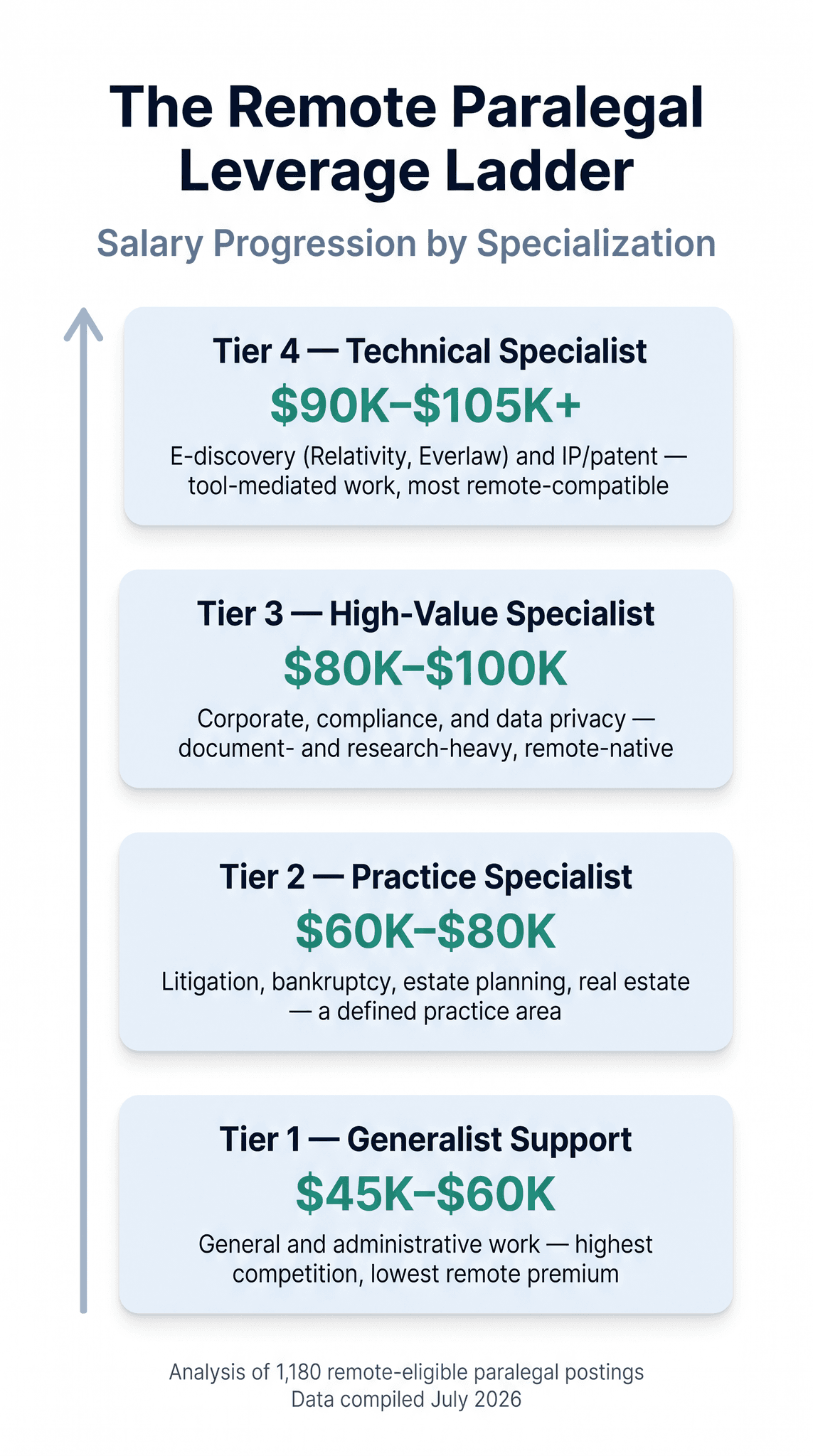
The Remote Paralegal Leverage Ladder: a four-tier framework for where a paralegal's specialization and remote-readiness place them in the distributed market.
- Tier 1 — Generalist Support ($45K–$60K): General and administrative paralegal work, immigration intake, family-law support. Highest competition, most exposed to in-office friction (courthouse runs, wet-signature filing, in-person client intake), lowest remote premium.
- Tier 2 — Practice Specialist ($60K–$80K): Litigation, bankruptcy, estate planning, real estate. A defined practice area raises your value, but how remote you can actually be depends on your jurisdiction's e-filing maturity.
- Tier 3 — High-Value Specialist ($80K–$100K): Corporate and transactional, compliance, data privacy. Document- and research-heavy work that was effectively remote-native before "remote" was a benefit.
- Tier 4 — Technical Specialist ($90K–$105K+): E-discovery (Relativity, Everlaw) and IP/patent paralegals. The most remote-compatible and the highest-paid — the work is tool-mediated and barely depends on physical presence.
How to use it: Find your tier by your actual practice area and tool stack — not your title. The fastest self-test: if your week still involves physical filing or wet-signature runs more than a couple of times a month, you're anchored in Tier 1–2 no matter how senior you are. If 80 percent or more of your output already lives inside Relativity, Clio, or a research platform, you can credibly target Tier 3–4 today. Then read the criteria for the tier above. That gap is your repositioning plan, and it's almost always a specialization or a platform skill, not another two years of service.
The jump from $60K to $90K as a remote paralegal is rarely about years served — it's about whether your work survives without a courthouse.
The pattern shows up in hiring constantly: a paralegal with eight years at a mid-size firm that still runs on paper and shared drives loses a fully remote role to someone with half the tenure and two years in Relativity, and the offer gap runs $20K or more. The hiring manager isn't being unfair. They're pricing the thing that makes you productive on day one without a file room down the hall. Tenure built in a paper office is the one kind of experience that doesn't transfer cleanly to remote — which is exactly the trap most senior generalists don't see coming.
Stop Applying Manually
Our AI applies to hundreds of matching jobs while you sleep. Wake up to interviews, not more applications.
Where the Remote Money Actually Lives: Specializations
If you want the remote-and-well-paid overlap, four specializations carry most of it. The pattern is not random. The roles that pay the most are the ones whose core work is documents, research, and software — not physical presence. That's the same quality that makes them remote-compatible, which is why the highest-paying paralegal niches and the most remote-friendly ones are largely the same list.
| Specialization | Base Salary Range | Why It Pays / Goes Remote |
|---|---|---|
| IP / Patent | $85,883 avg | Specialized filings, high billing value, document-driven |
| E-Discovery | $54.5K–$89.5K (90th percentile $103.5K) | Platform-mediated, high-volume, ALSP demand |
| Senior Corporate | $87,187–$96,204 | Transactional volume, governance, research-heavy |
| Corporate / Transactional | $68K–$85K | M&A and contracts work translates cleanly to remote |
| Litigation | $60K–$75K | Remote-able where e-filing is mature |
| Bankruptcy | $58K–$72K | Document- and deadline-driven |
| Estate Planning | $55K–$68K | Some wet-signature friction remains |
| Immigration | $45K–$65K (+$5K–$10K bilingual) | High demand, but intake often in-person |
Specialization figures from ZipRecruiter (June 2026), Salary.com e-discovery data (June 2026), PayScale senior corporate paralegal data (2025), and paralegaledu.org. Ranges reflect base salary for remote-eligible roles.
According to ZipRecruiter's 2026 compensation data, IP and patent paralegals average about $85,883 — well above the generalist median — because patent prosecution work is specialized, deadline-critical, and billed at a premium. E-discovery sits right behind it for a structural reason worth understanding: litigation now generates enormous volumes of electronic documents, and reviewing them happens inside platforms like Relativity and Everlaw, not in a file room. That work was built to be done from anywhere, and the alternative legal service providers that dominate it were remote-first before the pandemic made it fashionable.
A paralegal who knows Relativity is not competing in the same market as a paralegal who knows how to file at the county clerk.
Companies Hiring Remote Paralegals
The fastest-growing source of remote paralegal roles isn't traditional law firms — it's the ALSP and legal process outsourcing (LPO) sector. That market is projected to grow from $21.68B in 2025 to $26.41B in 2026, a 21.8% compound annual rate per The Business Research Company's 2026 report, and those firms are built around distributed legal teams. Robert Half's 2025 report logged 24,300 paralegal postings, with legal paralegal unemployment at 3.6% versus the 4.3% national average.
Where remote paralegal roles concentrate in 2026:
- Axiom Law — Fully remote and hybrid engagements for Fortune 100 legal departments; litigation, corporate, and contracts work. Glassdoor pegs the average paralegal pay around $67,187, with senior legal roles reaching $115K+.
- UnitedLex — LPO focused on e-discovery, contract management, and IP services; remote-first operations.
- Elevate Services — Legal-tech-and-services hybrid; contract analytics, litigation management, remote document review.
- Epiq — E-discovery and class-action administration; e-discovery paralegals average around $71K nationally per ZipRecruiter (2026).
- Robert Half Legal — Staffing agency placing remote and hybrid paralegals across practice areas, typically $55K–$87K per the Robert Half 2026 Salary Guide.
- Legal Soft — Virtual legal staffing serving 1,000+ law firms with remote paralegal placements.
But not all of these employers are the same job, and the title hides the difference. Axiom-style work is closer to secondment — you're placed inside a Fortune 100 legal department doing real corporate or litigation work, often with conditions that beat the firm you came from. High-volume LPO review is the opposite end: it's piecework. A lot of entry-tier ALSP roles are document review with daily production quotas, and reviewers in Reddit communities like r/paralegal regularly describe 200-plus-documents-a-day targets and burning out inside two years. Both are genuinely remote and both will say "e-discovery paralegal" on the posting. One is a career; the other is a credential you collect for eighteen months and then trade up from. Know which one you're applying to before you sign, because the listing won't tell you.
The takeaway isn't "apply to these six companies." It's that the remote paralegal market has a center of gravity, and it's the specialized, tech-enabled corner of legal services. That's where you point your search.
Stop Applying Manually
Our AI applies to hundreds of matching jobs while you sleep. Wake up to interviews, not more applications.
The Skills and Tools That Get Remote Paralegals Hired
Remote paralegal postings filter on a specific tool stack, and 71% (n=838/1,180) of the roles we analyzed required hands-on experience with at least one platform from it. If your résumé lists "proficient in legal software" instead of the actual platform names, you're getting filtered before a human reads it — the same way a tech résumé that says "coding" instead of "Python" gets dropped.
| Category | Tools That Show Up Most | Why It Matters |
|---|---|---|
| E-discovery | Relativity, Everlaw, DISCO | Highest-leverage skill for remote, high-pay roles |
| Practice / case management | Clio, MyCase, iManage, NetDocuments | Core of small-to-midsize and corporate workflows |
| Legal research | Westlaw, LexisNexis, Lexis+ AI | Near-universal requirement |
| E-filing / courts | PACER, CM/ECF, state portals | Federal filing is fully remote; state varies |
| Productivity | Excel, Microsoft Teams, Slack, SharePoint | Baseline for distributed work |
If you only have bandwidth to learn one platform, make it Relativity. It's the single strongest signal for the Tier 4 roles that pay the most, and Relativity's own training portal (Relativity Academy) has a free certification track you can put on a résumé in a weekend. Relativity holds a 4.2/5 rating across 57 reviews on Capterra, where reviewers call it the standard for document review while flagging a genuine learning curve — which is exactly why demonstrated experience with it commands a premium. Clio, the small-firm staple, holds 4.6/5 across 1,024 reviews on G2. Everlaw is a close second and worth it if a target employer uses it; Clio is the safer pick if you're aiming at small and midsize firms rather than e-discovery shops. Picking up a tool nobody in your target tier uses is wasted effort — match the platform to the tier you're climbing toward.
Beyond the platforms, remote roles screen for habits that in-office roles take for granted. In a remote role, the question that used to be a quick turn to the desk beside you becomes a written message that either unblocks someone in ten minutes or sits unread for three hours. The difference is concrete: "Quick q on the Henderson production" forces the attorney to open a thread and pull it out of you. "Henderson production is staged in Relativity — 1,240 docs, privilege log attached. Need your sign-off to release by Thursday 3pm or we miss the discovery deadline. Anything you want pulled first?" closes the loop in one read. Remote postings screen hard for the second kind of writer. Self-directed docketing and deadline management replaces the partner walking past your desk to ask where the motion stands. And data-security discipline isn't a nice-to-have: under ABA Model Rule 5.3, the firm is professionally responsible for any confidentiality breach that starts on your end, which is why remote postings increasingly require VPN access, encrypted storage, and a hard rule against client data on personal devices. Strong written communication and clear, documented communication habits are what let a hiring manager trust you to work unsupervised.
Certifications: What Actually Moves Your Salary
Certification is one of the few paralegal investments with a measurable return, and the data is specific enough to plan around. 54% (n=637/1,180) of the remote postings we analyzed listed a certificate or certification as preferred or required.
| Credential | Issuer | Cost | Salary Signal |
|---|---|---|---|
| Certified Paralegal (CP) | NALA | $250–$275 | $59,660 vs. $55,187 non-certified (about +$4,500) |
| Advanced Certified Paralegal (ACP) | NALA | + specialty fee | $73,321 vs. $57,340 (about +$16,000) |
| Registered Paralegal (RP) | NFPA | $225–$250 | Within the $4K–$16K premium range |
| Professional Paralegal (PP) | NALS | $150–$200 | Within the $4K–$16K premium range |
Certification premium figures from NALA and paralegaledu.org (2025–2026). Graduates of ABA-approved paralegal programs earn roughly 10 to 15 percent more than non-ABA-program peers.
The headline number is the ACP. Stacking a specialty certification on top of the base CP correlates with about a $16,000 annual premium — and not by coincidence. The ACP signals exactly the specialization (corporate, litigation, discovery) that remote employers pay for. A general CP removes you from the "no" pile; an ACP in your specialty moves you up the Leverage Ladder. The honest caveat: that premium lives almost entirely inside ALSPs and corporate legal departments — the same employers driving remote hiring. A lot of small and midsize firms barely register the credential and won't pay a dollar more for it, so the certification only returns if you're aiming at the employers who price it. An ACP in a niche nobody in your target tier needs is a line on your résumé, not a raise. Certify into the demand, not away from it.
California is the only state with a statutory definition of "paralegal," and it imposes real qualification requirements: an ABA-approved program, 24 law-related semester units, or a degree plus supervised experience under a California-admitted attorney — plus 4 hours of ethics and 4 hours of law continuing education every two years. Here's the part remote workers miss: these rules follow the supervising attorney, not your zip code. If you work remotely from Texas for a California-licensed attorney on California matters, you must meet California's standard. Confirm the requirement before you accept, not after.
How to Land a Remote Paralegal Job
Here's the uncomfortable part, and it changes how you should run your search.
The BLS projects essentially flat paralegal employment through 2034 — about 39,300 openings a year, almost all of them backfilling retirements and turnover rather than net-new growth. So the listings you see are real, but the market isn't expanding. At the same time, an ABA-published survey of 28 paralegals (September 2024) found 82% work remotely in some capacity and 32% are fully remote — yet Robert Half's 2025 report found only 23% of legal postings are advertised as hybrid. The flexibility exists; firms just don't advertise it.
That last point is the strategic key. Remote paralegal roles aren't hidden because they're rare — they're hidden because firms don't advertise the flexibility they already allow. Which means volume-applying to posts tagged "remote" leaves most of the real opportunities invisible. You have to target employers whose work is structurally remote-friendly and ask about flexibility directly.
Three moves separate paralegals who land remote roles from those who keep applying:
Search where the remote work actually is. Point your search at ALSP and LPO career pages, corporate legal departments, and litigation-support firms — not just the "remote" filter on a generalist job board. The roles in remote compliance and legal-adjacent functions overlap heavily with remote-friendly paralegal work, and many of the same employers hire across both.
Lead your résumé with specialization and tools, not duties. The summary line should name your practice area and platforms — "Litigation paralegal, 6 years, Relativity and CM/ECF" — before it describes responsibilities. If you've done any distributed or async work, make it explicit; remote employers want proof you can operate without a desk to walk by.
Pass the remote-readiness interview. Remote paralegal interviews probe two things in-office interviews skip: how you handle confidential documents off-site, and how you keep a docket clean without anyone watching it. Have a specific answer for each. "I'm organized" is not an answer. "I run a shared deadline calendar with 48-hour buffers and never touch client files outside the firm's encrypted system" is.
| Translates Cleanly to Remote | Resists Remote |
|---|---|
| Legal research and writing | Courthouse runs in non-e-filing counties |
| Document drafting and review | In-person intake for sensitive clients |
| E-filing via PACER / CM/ECF | Physical notarization (eased by RON in 45 states + DC) |
| Contract review and analysis | Physical deposition and exhibit logistics |
| E-discovery and doc review | In-courtroom trial support |
Two things the job descriptions won't tell you, so ask before you celebrate. First, plenty of "remote-friendly" corporate legal departments still expect you online during East Coast business hours whether you live in Phoenix or Portland — the geography is flexible, the clock often isn't. Second, a meaningful share of "remote" litigation roles still need the occasional courthouse run, wet-signature filing, or in-person notarization that the posting quietly leaves out. Neither is a dealbreaker, but finding out in week three instead of the final interview is.
If you're not getting traction, the problem is usually positioning, not qualification — the same pattern behind why qualified candidates stop getting interviews. And once you're in a process, a disciplined follow-up after the application matters more in a flat market where every opening draws a crowd. For the broader picture of where remote roles clear $80K, the high-paying remote jobs guide maps where the money is across functions, and the remote HR and operations guide covers adjacent corporate roles paralegals often move into.
Stop Applying Manually
Our AI applies to hundreds of matching jobs while you sleep. Wake up to interviews, not more applications.
Frequently Asked Questions
I have 5 years of in-office paralegal experience — how do I actually move to a fully remote role?
Start by repositioning, not just applying. Identify which of your skills are remote-native — research, drafting, e-filing, e-discovery — and lead your résumé with the specialization and platforms behind them. If you've done any distributed or async work, even informally, make it explicit. Then target employers whose work is structurally remote-friendly (ALSPs, corporate legal departments, litigation support) rather than filtering a generalist job board for "remote." The flexibility is more common than the listings suggest: an ABA-published survey of 28 paralegals found 32% are fully remote, but Robert Half's 2025 report found only 23% of legal postings advertise it.
Which paralegal specialization pays the most if I want to work remotely?
IP/patent paralegals lead at roughly $85,883 on average, with e-discovery close behind (top earners clear $103,500). These are Tier 4 roles on the Remote Paralegal Leverage Ladder — and it's not a coincidence that the highest-paid niches are also the most remote-compatible. Their core work is documents, research, and software, not physical presence, which is exactly what survives outside an office.
Is a paralegal certificate or CP certification worth it for remote jobs?
Yes, with a caveat about which one. 637 of the 1,180 remote postings we analyzed listed a certificate or certification as preferred or required, so a base credential removes you from the automatic "no" pile. But the real return is in the specialty: NALA's Advanced Certified Paralegal correlates with about a $16,000 annual premium ($73,321 vs. $57,340) because it signals the specialization remote employers actually pay for.
Are remote paralegal jobs actually fully remote, or just hybrid?
Both exist, and the split is wider than postings imply. An ABA-published survey of 28 paralegals found 82% work remotely in some capacity and 32% are fully remote, while 14% never work remotely. But Robert Half's 2025 report found only 23% of legal postings advertise hybrid flexibility — meaning many remote-capable roles aren't labeled as such. Ask directly in the interview rather than relying on the job tag.
What tools do I need to know to get hired as a remote paralegal in 2026?
The non-negotiables are legal research (Westlaw and LexisNexis) and at least one practice-management or e-discovery platform — Clio, NetDocuments, or Relativity. 838 of the 1,180 remote roles we analyzed required hands-on experience with a named platform. For the highest-paying remote work, Relativity or Everlaw experience is the single strongest signal. List the actual platform names on your résumé, not "legal software."
How do I know which tier of the Remote Paralegal Leverage Ladder I'm on?
Map your actual practice area and tool stack, not your title. If you do general or intake work and handle physical filing, you're Tier 1 ($45K–$60K). A defined practice area like litigation or estate planning puts you at Tier 2 ($60K–$80K). Corporate, compliance, or data-privacy work is Tier 3 ($80K–$100K). E-discovery or IP/patent with platform fluency is Tier 4 ($90K–$105K+). To move up, target the next tier's criteria — usually a specialization or a platform skill, not more years.
Can I work remotely as a paralegal in California, or do the state rules block it?
You can, but you have to meet California's qualification standard under Business and Professions Code 6450 — an ABA-approved program, 24 law-related units, or a degree plus supervised experience — and complete 8 hours of continuing legal education every two years. These rules follow the supervising attorney's jurisdiction, so if you work remotely from another state for a California-licensed attorney, California's standard applies to you regardless of where you sit.
Why does BLS say paralegal jobs are flat if there are so many remote listings?
Because the overall occupation is flat (about 39,300 openings a year, mostly backfilling turnover) while the remote-eligible, specialized slice is growing. The ALSP and legal-outsourcing sector — which runs on distributed teams — is expanding at a 21.8% compound annual rate, per The Business Research Company's 2026 report. Total paralegal headcount isn't climbing, but the share of roles that are remote and specialized is, which is why the listings feel more plentiful than the BLS outlook suggests.
Start Your Remote Paralegal Career
The remote paralegal market rewards a narrow thing: a specialization whose work survives outside the building, backed by the tools and credentials that prove it. The title on your business card matters far less than whether you're in the crowded generalist tier or the specialized, tech-enabled corner where remote and $80K+ actually meet.
Use the Remote Paralegal Leverage Ladder to find your tier honestly, then build toward the criteria above you — usually a platform skill or a specialty certification, not another two years of service. Browse remote paralegal roles and the broader remote legal job category to see what's open, filter for remote roles paying $75K and up, and let Remote Job Assistant's auto-apply tool surface the genuinely remote, salary-transparent listings instead of making you sort through hundreds that aren't.
The county clerk needs you in the building. Relativity, Westlaw, and a clean discovery log don't care where you sit.
Ready to Find Your Remote Job?
Browse thousands of curated remote jobs or let AI apply for you.
Browse Remote JobsRelated Job Guides
Remote Physician Jobs: 2026 Salary and Career Path Guide
Remote physician jobs in 2026: six career paths from telemedicine to medical director, real pay from $150K to $300K+, licensing strategy, and who's hiring.
23 min read

Remote Event Planning Jobs: What Actually Goes Remote
Only 12% of event job postings are fully remote and none were titled Event Planner. See which titles actually go remote, what they pay, and how to pivot.
24 min read

Remote Insurance Jobs: Pay, Top Roles, and How to Get Hired
Remote insurance jobs pay $62K-$130K+ by specialty. Real 2025 wage data for adjusters, underwriters, and actuaries — plus which roles are truly remote.
22 min read