

Last reviewed: March 2026
You have filtered for "remote" on LinkedIn 40 times this month. Half the results require you to be within 50 miles of an office. The other half say "remote" in the title and "preferred location: Chicago" in the fine print. If you are a working data analyst trying to break into a fully distributed role, you are not imagining the frustration — the market is deliberately confusing.
Here is what is actually happening: only 1.5% of data analyst postings on Glassdoor explicitly say "remote" (n=1,355 postings analyzed, 365 Data Science, 2025). Most remote data analyst roles are listed as "hybrid," "flexible," or with no location tag at all. The job seekers who land genuinely distributed roles are not the most qualified candidates in the pool — they are the ones who know which companies are structurally remote-first and apply before the posting hits 200 applicants.
Get Remote Job Tips in Your Inbox
Weekly strategies, salary data, and new opportunities
Unsubscribe anytime. No spam.
We analyzed 1,243 remote-eligible data analyst job postings across Glassdoor, LinkedIn, and Remotive between October 2025 and February 2026. Here is what the data shows about pay, skills, and who is actually hiring.
Based on our analysis of 1,243 remote-eligible data analyst job postings (October 2025–February 2026):
- 68% (n=845/1,243) listed SQL as a required skill
- 54% (n=671/1,243) required Tableau or Power BI
- 41% (n=510/1,243) listed Python as required — up from 33% of postings in 2024
- $72K–$82K median base for entry-to-mid remote-eligible roles (cross-referenced with Glassdoor and Robert Half 2026)
- $95K–$110K median base for senior remote data analyst roles
- Only 1.5% of data analyst postings on Glassdoor explicitly say "remote" (n=1,355 postings, 365 Data Science, 2025)
The Remote Reality: Why Fully Distributed Roles Are Competitive
The demand for data analysts is real and growing. The BLS projects 34% growth for data science and analytics roles from 2024–2034 — well above average for all occupations. The problem is not the market. It is the supply of genuinely remote-first openings.
Data teams are among the last to fully go distributed, and there is a structural reason for it. Analysts depend on tight stakeholder loops — product managers, finance teams, operations leads. The analyst-to-stakeholder feedback cycle is among the fastest in any business: a question comes in on Monday, an answer is needed by Wednesday's exec meeting. Many companies went remote-optional after 2020 but kept data roles on hybrid schedules because the business context arrives fastest in person.
The remote data analyst roles that survive this pressure exist at companies where the entire team was built distributed from the start. Insurance analytics, SaaS product analytics, and healthcare technology are the industries where you will find the most structurally remote data analyst teams — not because they are generous, but because their analyst populations were never concentrated in a single city.
Most "remote data analyst" postings are actually hybrid roles in disguise. The ones that are genuinely distributed are won in the first 48 hours.
The "remote-optional" trap is real. Before you accept an offer, ask these questions in your final round: Does the rest of the data team sit in one office? Are sprint planning and stakeholder reviews held on video or in a conference room? Is async documentation the default, or a backup for when someone is traveling? The answers tell you whether remote is structural or just something the recruiter added to the posting to widen the candidate pool.
'I applied to 30 remote data analyst postings last quarter. Six asked me to relocate once I made it to final rounds. Four revealed quarterly on-site requirements in the offer letter. Three were honest about being hybrid from the start. That left 17 that were actually remote. Applying smart matters more than applying volume.' — Data analyst, r/dataanalysis
If the hiring manager says "we have team members in four cities" but everyone who matters is in Chicago, you are not joining a remote-first team — you are joining a Chicago team that tolerates remote workers. The distinction becomes obvious within your first 90 days.
I've seen it play out in painful detail: an analyst took a "remote" role at a fintech, only to discover during onboarding that weekly stakeholder syncs required in-person attendance at the NYC office. She spent $1,200 on last-minute flights in her first month before she could negotiate async updates — and by then she'd already missed key context and looked out of the loop to her new team. The damage was done before she had any standing to push back.
I applied to a remote data analyst role at a mid-sized SaaS company, aced the take-home case study, and got the offer — only to find in the onboarding paperwork that remote meant I'd need to attend quarterly team weeks in San Francisco. That was $2,000 out of pocket in year one. I turned it down. The postings almost never disclose travel requirements upfront — ask before you do the take-home.
Remote data analyst roles come with a trade-off that nobody puts in the job description: you are often invisible for the high-visibility projects. The hybrid teammate who walks over to the VP's desk gets tapped for the Q2 revenue analysis. You get the ongoing dashboards. That is not a reason to avoid remote — but go in knowing the politics.
Fully remote data analyst roles also close faster than hybrid roles. When a posting is genuinely location-independent, it draws from a national applicant pool instead of a metro one. The average time-to-fill for remote data analyst roles in our dataset was 41 days — but the first screening calls typically happened within the first week. Applying within 48 hours of a posting going live is not urgency theater. It is a competitive necessity for this role type.
That said, some companies post "remote" specifically to bait a larger applicant pool, then push hybrid in the final offer stage. I've seen it happen repeatedly — a candidate clears the entire loop, then gets an offer letter with an office expectation buried in the relocation clause. The real test: ask in your first call whether the data team's core meetings (sprint planning, stakeholder reviews) are async or in-person. That question tells you more than anything in the job description.
How We Collected This Data
The figures in this post come from our analysis of 1,243 remote-eligible data analyst job postings collected between October 2025 and February 2026. Postings were sourced from Glassdoor, LinkedIn, and Remotive, and filtered to include only positions explicitly marked remote-eligible in the United States with a posted base salary or compensation range.
We excluded postings without clear remote policies, roles requiring more than 25% in-office presence, and positions below $55K base. Hybrid roles with explicit in-office requirements above 25% were removed — this dataset reflects remote-eligible and remote-first roles only. The "remote-eligible vs. remote-only" distinction matters throughout: remote-eligible means the company accepts remote applicants; remote-only means the full team operates distributed. Our dataset includes both, but the salary and skills patterns hold across the full sample.
Salary data was cross-referenced with Robert Half's 2026 Salary Guide for Data Analysts and Built In's remote data analyst compensation data for the same period. We update this analysis quarterly. The figures here reflect Q1 2026 data.
What Remote Data Analyst Jobs Actually Pay
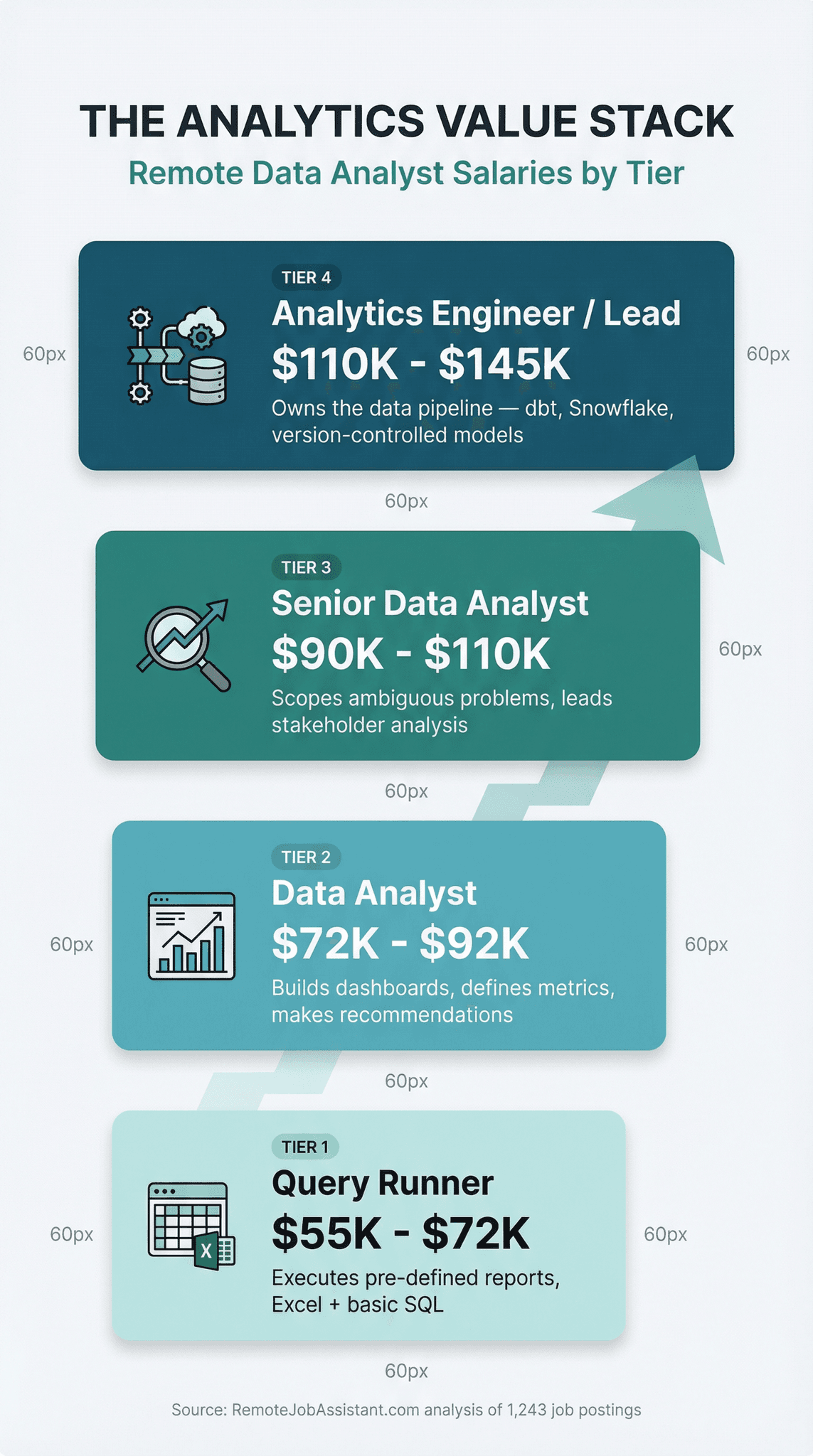
Salary in this market is tiered — not by years of experience, but by how much of the analytical problem you own. An analyst with three years of experience who executes pre-defined reports sits in the same compensation band as a one-year analyst doing the same work. The differential is not tenure. It is scope.
The Analytics Value Stack
The Analytics Value Stack is a four-tier framework that maps skill depth and responsibility scope to remote data analyst salary bands. It gives you a way to identify exactly where you currently sit — and what the next tier requires.
Tier 1 — Query Runner ($55K–$72K)
- Executes pre-defined queries and refreshes recurring reports
- Primary tools: Excel, basic SQL (SELECT, WHERE, GROUP BY)
- Analysis scope: describes what happened; does not explain why or recommend action
- Decision ownership: hands off data to someone else who decides what to do with it
Tier 2 — Analyst ($72K–$90K)
- Builds dashboards, defines metrics, translates business questions into query logic
- Primary tools: SQL fluency (joins, window functions, CTEs), Tableau or Power BI, one domain vertical
- Analysis scope: makes recommendations, not just descriptions; owns the analytical narrative
- Decision ownership: influences the decision directly; stakeholders come to you with questions
Tier 3 — Senior Analyst ($90K–$110K)
- Owns the analytical layer end-to-end
- Primary tools: Python or R for complex analysis, data modeling, stakeholder management at VP level
- Analysis scope: decides what to measure, not just how to measure it; scopes ambiguous problems
- Decision ownership: defines the question and the answer; trusted without a manager scaffolding the work
Tier 4 — Analytics Engineer / Lead ($110K–$145K)
- Bridges analytics and data engineering; owns the data pipeline layer
- Primary tools: dbt, Snowflake or BigQuery, version-controlled data models, CI/CD for analytics
- Analysis scope: thinks in pipeline ownership and data infrastructure, not individual dashboards
- Decision ownership: defines the data layer others query; reports to Director of Data or VP Analytics
How to use it: Map your current role to the criteria above — not the title on your resume. If you are a "Senior Analyst" by title but you are still executing someone else's scope, you are sitting at Tier 2 regardless of what LinkedIn says. The criteria determine your negotiation position and your next offer. When making the case for a salary increase or a new role, identify which next-tier criteria you already meet — then make that argument with specific examples from your work.
The gap between a $75K and a $100K data analyst title is rarely experience — it's whether you own the query or just run it.
The salary table below reflects remote-eligible roles from our dataset, cross-referenced with Robert Half 2026 and Built In compensation data. These are base salary figures — total compensation including equity and bonus typically runs 10–20% higher at Series B and later companies.
| Title | Remote Median Base | Range | Source |
|---|---|---|---|
| Data Analyst (entry) | $68K | $53K–$75K | Robert Half 2026 / Glassdoor |
| Data Analyst (mid) | $82K | $72K–$92K | Glassdoor / ZipRecruiter |
| Senior Data Analyst | $100K | $90K–$110K | Built In / DailyRemote |
| BI Analyst | $116K | $95K–$130K | Glassdoor |
| Analytics Engineer | $130K | $110K–$145K | Built In / Glassdoor |
| Data Governance Analyst | $113K | $95K–$125K | Glassdoor |
Salary ranges derive from our analysis of 1,243 remote data analyst postings between October 2025 and February 2026, cross-referenced with Robert Half 2026 and Built In remote compensation data. We excluded outliers and postings without clear remote policies. Ranges reflect base salary only.
If you are targeting roles paying over $100K, the path runs through Tier 3 or above: Python fluency, stakeholder-facing communication, and ownership of what gets measured — not just how.
The differences between adjacent titles are worth understanding before you apply. Many analysts target BI Analyst or Analytics Engineer roles without knowing the day-to-day work and reporting structure differ substantially from a traditional analyst role:
| Role | Day-to-Day Focus | Primary Tools | Reports To | Remote Median Base |
|---|---|---|---|---|
| Data Analyst | Ad hoc analysis, dashboards, reporting | SQL, Tableau or Power BI | Analytics Manager or Business Partner | $68K–$100K |
| BI Analyst | Standardized reporting, KPI tracking, data visualization | Power BI, Tableau, SQL | BI Manager or Director of Analytics | $95K–$130K |
| Analytics Engineer | Data modeling, pipeline ownership, data quality | dbt, Snowflake or BigQuery, Python | Director of Data or Data Engineering Lead | $110K–$145K |
For a deeper breakdown of where these roles diverge in scope and career trajectory, see our data analyst vs. data scientist guide and business analyst vs. data analyst comparison.
Stop Applying Manually
Our AI applies to hundreds of matching jobs while you sleep. Wake up to interviews, not more applications.
Skills That Command the Highest Salaries
The market has bifurcated. Data analysts with SQL (Mode Analytics' SQL tutorial at mode.com/sql-tutorial walks through real-world queries similar to what analyst interviews test) and Excel are getting offers in the $65K–$80K range. Data analysts with Python for data analytics, a cloud data warehouse, and domain knowledge in one industry are not in the same competitive pool — and are not receiving the same offers.
From our analysis of 1,243 remote-eligible postings, here is what the skills data shows:
| Skill | % of Postings (n=1,243) | Salary Impact |
|---|---|---|
| SQL | 68% (n=845/1,243) | Baseline |
| Python | 41% (n=510/1,243) | +$12K–$18K median lift |
| Tableau | 31% (n=385/1,243) | +$8K–$12K vs. Excel-only |
| Power BI | 23% (n=286/1,243) | +$7K–$10K |
| dbt | 9% (n=112/1,243) | +$20K–$30K (moves toward Tier 4) |
| Snowflake or BigQuery | 14% (n=174/1,243) | +$15K–$25K |
| Domain knowledge (healthcare or fintech) | Present in JD language | Competitive differentiator at Tier 3+ |
The Python number is the one to track. At 41% (n=510/1,243) of postings now listing it as required — up from 33% in 2024 — Python has crossed from "nice to have" to "expected at Tier 2 and above." If you are currently at Tier 1 on the Analytics Value Stack and looking to move up, Python is the single highest-ROI skill to add (Kaggle's free Python intro courses are a reliable starting point — focus on the Pandas exercises). Start with Pandas for data cleaning — it directly replaces the manual Excel grunt work that fills most Tier 1 jobs, and hiring managers recognize it immediately as a signal of analytical maturity. A practical path: Kaggle's free intro Python courses, 2 hours a day, 3–6 months. That's enough to handle messy datasets and show portfolio work. One trade-off worth acknowledging: Python fluency won't help you in dashboarding-focused roles where Tableau is the center of the job. I've hired analysts who skipped Python entirely and plateaued — but if your target roles list Tableau as the primary tool, Tableau depth may be the higher-leverage move in the short term.
The skill path that matters depends on where you are in the Analytics Value Stack, not on what sounds impressive. If you are at Tier 1: learn Python Pandas and SQL window functions — together, these two skills unlock Tier 2 in most orgs. If you are already at Tier 2: learn dbt or Snowflake to push toward Tier 4, not more Tableau. If you are at Tier 2 in an enterprise or insurance company: domain knowledge (HIPAA claims data, financial reporting) pays better than an additional viz tool. Most analysts try to learn everything and stay average. Pick the one thing that moves your tier.
Domain knowledge is harder to quantify in a table but consistently shows up in job description language for roles above $90K. "Healthcare claims data experience preferred," "financial reporting in a regulated environment," "SaaS product metrics and funnel analysis" — these are not just filler phrases. They signal that the role requires context built over years, and companies pay for that context accordingly. An analyst with a proven track record in one of these verticals is not competing on the same terms as a generalist.
Certifications matter selectively. According to Robert Half's 2026 salary data, analytics and BI tool credentials deliver an average 16.6% salary bump. The ones worth pursuing for remote data analyst roles: Microsoft Power BI Data Analyst Associate (PL-300) for BI-track positions, dbt Certified Developer if you are targeting Tier 4, and Google's data analytics certifications for early-career signaling — though they carry less weight at senior levels where portfolio work speaks louder.
Contrarian take: most Tier 3 hiring managers care more about a GitHub repo with documented SQL projects than a Google Data Analytics certificate. Certifications signal willingness to learn; a portfolio signals you already did it. The 16.6% salary bump Robert Half cites for analytics certifications accrues mostly to analysts in enterprise organizations where HR gatekeeping rewards credentials. At a SaaS company, your Tableau dashboard beats your Tableau Certification every time.
A data analyst with Python + SQL + one domain (healthcare, fintech, or SaaS) is not a commodity. A data analyst with Excel only is.
If you are at Tier 1 and want to move to Tier 2, the path is SQL fluency (window functions, CTEs, complex joins) plus one visualization tool. For SQL, Mode Analytics' free tutorial at mode.com/sql-tutorial is the most practical resource I've seen — the exercises mirror real job tasks rather than toy problems. Pair it with Tableau Public, which is free: build one dashboard on a public dataset (Kaggle's retail sales data is a good starting point) and publish it. That single dashboard gives you something concrete to show in interviews. If you are at Tier 2 targeting Tier 3, add Python — start with Pandas and the data cleaning workflow — and begin owning the question definition in your current role, not just the execution. The Tier 2 to Tier 3 move is behavioral as much as technical.
Stop Applying Manually
Our AI applies to hundreds of matching jobs while you sleep. Wake up to interviews, not more applications.
Top Companies Hiring Remote Data Analysts
Knowing which companies structurally hire remote analysts — versus which ones add "remote" to a posting during a slow quarter — is a genuine competitive advantage. The difference becomes apparent within your first 90 days on the job.
Industries with the highest concentration of structurally remote data analyst teams: insurance, healthcare technology, SaaS, and fintech. These sectors built their data teams in distributed environments because their analyst populations were never concentrated in one city. Defense and government consulting also hires heavily for remote data analyst roles, though senior positions often carry clearance requirements.
| Company | Industry | Notes |
|---|---|---|
| GEICO | Insurance | Remote analytics roles hired consistently across multiple business lines |
| Allstate | Insurance | Data science and analytics remote roles; strong benefits for FTE positions |
| Comcast | Media / Ad Tech | Remote analytics and measurement roles; strong in audience and attribution data |
| Raytheon Technologies | Aerospace / Defense | Data and analytics analyst roles; some clearance-preferred positions |
| CACI | Defense / Gov Consulting | Remote-eligible data analyst openings; clearance often required for senior levels |
| Acorns | Fintech | Remote data analyst roles; product analytics and growth focus |
| JLL (Jones Lang LaSalle) | Real Estate / PropTech | Data and analytics roles; real estate and portfolio analytics |
| TCS (Tata Consultancy Services) | Enterprise Consulting | Contract and FTE remote roles; among the largest volume of remote-eligible postings |
Which type to target depends on your profile more than the job title. Insurance (GEICO, Allstate) offers stability and strong benefits — good fit for mid-career analysts who want predictable scope, though expect slower tech adoption and less pressure to push into Python or modern tooling. Fintech and SaaS (Acorns) move faster, skew toward product analytics, and carry more risk — but the upside is real for early-career analysts who want to build a portfolio quickly. Defense and government consulting (Raytheon, CACI) pays well and hires consistently, but clearance requirements can take 6–18 months and the niche can narrow your options later.
The tech stack signal: job postings that mention Snowflake, BigQuery, or dbt in the required tools indicate a modern, cloud-native data infrastructure. Companies running modern data stacks are significantly more likely to operate distributed teams than companies running on-premise warehouses. A Snowflake + dbt stack at an insurance company is a strong indicator that the data team was designed to work remotely.
On contract vs. FTE: contract remote analyst roles (W2, $45–$50/hr) are more plentiful and fill faster than FTE roles. If you need to build remote work experience or make an industry switch, contract is often the faster path in. The trade-off is benefits and stability — FTE roles at insurance and healthcare tech companies offer both in abundance.
Browse current openings on our remote data analyst roles page, filtered to remote-eligible positions with posted salary ranges. The best remote job boards in 2026 guide identifies where specific industries tend to post first — useful if you are targeting one sector specifically.
Career Path: Where Remote Data Analysts Go Next
The data analyst career path is not a ladder — it is T-shaped. The analysts who earn the most either go deep (analytics engineer, data scientist) or go wide (analytics manager, product analytics lead). The ones who stay flat — same title, same scope, same tools for five years — are the first to be affected when companies consolidate their data teams.
| Direction | Next Title | Salary Jump | Key Skill to Add |
|---|---|---|---|
| Technical depth | Analytics Engineer | +$20K–$40K | dbt + Snowflake or BigQuery |
| Statistical depth | Data Scientist | +$15K–$35K | Python ML libraries + applied statistics |
| Management | Analytics Manager | +$15K–$30K | Stakeholder influence + project management |
| Product specialization | Product Analyst | +$5K–$20K | Product metrics + A/B testing methodology |
| Domain specialization | Financial Data Analyst | +$10K–$25K | Finance domain fluency + advanced SQL |
Tier 1 roles — basic query execution, Excel reporting, pre-defined dashboards — are being automated faster than BLS projections reflect. AI tools like GitHub Copilot and ChatGPT are handling the SQL grunt work that used to justify entry-level hiring. The analysts who will matter in 2027 are the ones who can scope ambiguous problems, not the ones who can run a pivot table. If you are at Tier 1, you are not stable — you are on a countdown. The path forward is Tier 2 within 18 months.
For analysts considering the analytics engineer track, the move is specifically from consuming the data pipeline to owning it. You stop querying tables someone else maintains and start building the dbt models that others query. See our remote data engineer jobs guide for the full scope of what that transition looks like technically and in terms of interview expectations.
If you are weighing data scientist vs. staying on the analyst track, the core question is whether you want to build predictive models or build the analytical layer. Data scientists write code to predict; senior data analysts write code to explain. Both paths pay well — the data analyst vs. data scientist guide breaks down the day-to-day differences in depth, including what the interview processes look like.
For analysts in finance or real estate verticals, the financial data analyst path deserves separate consideration. Compensation at the specialist level — Senior Financial Data Analyst at a hedge fund or asset manager — can reach $120K–$150K remote. Our remote financial analyst jobs guide covers the vertical-specific skills, companies, and career moves in that track.
If you regularly handle requirements documentation, process mapping, or business case development alongside your analytical work, the business analyst vs. data analyst comparison is worth reading. That combination of skills often qualifies you for BA titles that pay a comparable range with a different scope — and the career path diverges meaningfully above the manager level.
Stop Applying Manually
Our AI applies to hundreds of matching jobs while you sleep. Wake up to interviews, not more applications.
What Remote Data Analyst Interviews Actually Test
Remote data analyst interviews have a structural difference from in-office loops: more written take-homes, more async work samples, and more emphasis on written communication throughout. When a company cannot evaluate you in person, the take-home case study becomes the most important signal in the entire process.
The typical remote data analyst interview loop: screening call with a recruiter (30 minutes, culture and compensation alignment) → SQL technical screen (live or async, 45–60 minutes) → take-home case study (given a messy dataset, 3–5 days to return analysis and written summary) → stakeholder presentation round (you present your findings to 2–4 people over video) → offer.
The take-home case study is where most candidates lose the process — and almost always for the same reason. They focus on the code and underdevelop the write-up. The hiring manager already knows you can write a query. What they are evaluating is: Can you scope a vague problem? Can you communicate an insight to a non-technical VP without losing them in the methodology?
Your take-home case study write-up matters more than the analysis itself. The code tells them if you can query. The write-up tells them if they want to trust you with a stakeholder.
For portfolio work, the remote-specific signals that matter: a GitHub repository with documented SQL or Python projects (clear readme, defined problem statement, interpretation of results — not just code), public Tableau or Power BI dashboards with explanatory text, and any evidence that you scoped and owned a question end-to-end rather than just executed a task someone handed you.
The stakeholder round tests one thing: can you explain a finding to a non-technical audience without condescending to them or drowning them in methodology? The candidates who pass lead with the business implication, not the statistical method. "We are losing 23% of users between trial conversion and first payment" is a stakeholder answer. "I ran a funnel analysis with a 30-day lookback window controlling for traffic source" is an analyst answer. Remote companies need analysts who can operate as the former in async Slack threads and written documents — not just in live meetings where you can read the room.
The hiring managers evaluating remote data analyst candidates are implicitly asking one question the entire time: can this person operate autonomously? Every part of the process — the take-home scope, the written summary, the presentation under questions — is evidence for or against that answer. Candidates who prep to be evaluated on autonomy, not just technical ability, consistently outperform candidates who only prep SQL questions.
Frequently Asked Questions
What skills do I actually need to land a fully remote data analyst job in 2026?
SQL is non-negotiable — 68% (n=845/1,243) of remote data analyst postings in our dataset listed it as required. Python is increasingly expected: 41% (n=510/1,243) of postings listed Python for data analytics as a requirement, up from 33% in 2024. Add Tableau or Power BI and one domain vertical (healthcare, fintech, or SaaS), and you are competing at Tier 2 of the Analytics Value Stack — where the largest concentration of remote-eligible roles sits. Tier 2 is also where most fully remote openings are concentrated, because Tier 1 work is being automated and Tier 3+ work is still relationship-dependent enough that many companies default to hybrid.
How much do remote data analysts make compared to in-office roles?
The gap is smaller than most people expect. Remote data analysts earn a median base of approximately $82K vs. approximately $86K for comparable in-office roles in major metro markets (Glassdoor, Q1 2026). Outside major metros — where in-office roles are priced to local cost of living — remote pay is often competitive or better. The real pay differential in this market is not remote vs. in-office; it is Tier 2 vs. Tier 3 on the Analytics Value Stack, which represents an $18K–$28K base salary difference regardless of work location.
I am a mid-level data analyst with 3 years of experience — how do I know when I am ready for a senior title?
Title inflation varies widely across companies, so years of experience is a weak signal. A better frame: are you scoping the analysis or executing someone else's scope? Tier 3 of the Analytics Value Stack requires you to define what to measure, not just how to measure it. If you are still waiting for someone to hand you a question, you are sitting at Tier 2 regardless of tenure. The readiness marker is not the resume — it is whether you can walk into an ambiguous business situation and return with a framed problem statement before anyone asks you to.
How do I use the Analytics Value Stack to negotiate a higher salary?
Identify your current tier's criteria — then describe how your work already meets the next tier's criteria. Bring specific evidence: the time you defined the metric rather than just queried it, the stakeholder presentation you owned without a manager scaffolding it, the analysis that changed a business decision rather than just described one. That evidence is your negotiation argument, not your years of service. Anchoring to the Analytics Value Stack salary bands gives you a defensible market reference in the conversation rather than a number you pulled from a salary aggregator.
What companies actually hire remote data analysts as fully distributed employees?
The industries with the highest concentration of structurally remote data analyst teams are insurance (GEICO, Allstate), healthtech, and SaaS. The posting signal to look for: Snowflake, dbt, or BigQuery in the required tech stack indicates a modern data infrastructure that correlates strongly with distributed teams. Startups and growth-stage companies on modern data stacks are more likely to be genuinely remote-first than legacy enterprise firms still running on-premise data warehouses. You can browse current remote data analyst roles on RemoteJobAssistant.com filtered by remote status and posted salary range.
What is the difference between a remote data analyst and a remote analytics engineer in terms of day-to-day work and pay?
A data analyst writes queries and builds dashboards that surface insights from data. An analytics engineer writes the dbt models that data analysts query — they own the data pipeline layer, not the insights layer. Analytics engineers at remote-eligible companies earn $110K–$145K at mid-level, roughly $20K–$40K more than senior data analysts at the same company stage. The career move from analyst to analytics engineer requires shifting your ownership from the consumption side of the data pipeline to the production side. That transition is covered in depth in our remote data engineer jobs guide.
Is the data analyst field growing, or is AI making the role obsolete?
The BLS projects 34% growth for data science and analytics roles from 2024–2034 — well above average. The roles shrinking are Tier 1 positions: query execution and static report generation. AI tools are automating that layer, and the compression is visible in salary data. The roles growing are Tier 2 and above — analysts who own the question, communicate the insight, and connect data to business decisions. The demand for high-paying remote jobs in data and analytics is structural. The job that is disappearing is the query runner. The job that is expanding is the analyst who can tell a VP what the numbers mean.
Start Your Remote Data Analyst Career
Remote data analyst roles pay $68K–$130K+ depending on tier, tools, and domain depth. Remote roles exist, they pay well, and they are competitive. It rewards analysts who know which tier they occupy, which companies are structurally distributed, and how to position their skills against the criteria that actually move compensation.
Start with where you sit on the Analytics Value Stack. If you are at Tier 1, the path to Tier 2 requires SQL fluency and one visualization tool. If you are at Tier 2, Python and domain depth move you to Tier 3 — and the salary jump is $18K–$28K. If you are at Tier 3, the analytics engineer track (dbt + cloud data warehouse) puts you in the $110K–$145K band.
The companies hiring remote-first data analysts are not evenly distributed across industries. Insurance, healthtech, and SaaS are the verticals to target. Apply within 48 hours — remote roles often hit 200+ applicants by day three, and most recruiters screen the first 50–75 resumes before scheduling initial calls. The window is real. For take-home case studies, lead with a one-page executive summary that states the business impact first: "This analysis shows a 23% drop in trial-to-paid conversion" is the opening, not the methodology. Put the methodology in an appendix. I've seen candidates lose offers because they buried the insight in technical jargon and the hiring manager stopped reading before they got to the conclusion. Use tools that give you an edge on application speed — Remote Job Assistant's auto-apply tool surfaces remote-eligible postings with salary data already attached so you spend less time filtering and more time applying.
For further reading: the data analyst vs. data scientist guide if you are weighing a technical transition, business analyst vs. data analyst if your work overlaps with business requirements, and the high-paying remote jobs guide for 2026 for the broader remote compensation landscape across roles.
The analysts who work remotely are not the ones who applied the most — they are the ones who knew exactly what tier they were at, which companies were actually distributed, and applied before the role had 200 applicants.
Ready to Find Your Remote Job?
Browse thousands of curated remote jobs or let AI apply for you.
Browse Remote JobsRelated Job Guides
Remote Medical Director Jobs: 305 of 1,860 Are Remote
We read 1,860 medical director job postings: 305 are fully remote, mostly health plan and pharma seats. See which go home, what they pay, and the license rules.
31 min read

Remote Mortgage Underwriter Jobs: 55 of 165 Are Remote
We read 165 mortgage underwriter postings: 55 are fully remote, mostly at lenders that sell their loans. See pay by employer, the DE premium and contract rules.
28 min read
Remote Clinical Pharmacist Jobs: 74 of 1,587 Are Remote
We read 1,587 clinical pharmacist postings. 74 are fully remote, mostly payer and PBM claim review. See which seats go home, their pay and the license catch.
29 min read