
Last reviewed: October 2026
You've drawn the reference architecture, sat through the customer's security review, and finished the RFP's integration questions at 11 p.m. so the account executive could submit on time. So you search "remote solutions architect jobs." LinkedIn's page promises "11,000+ Remote Solutions Architect Jobs in United States," then shows a city on all 60 of its first cards, a salary on none, and a note that asks "Where are the filters?" because its remote filter is gone. Remote Rocketship says the average remote solutions architect in the US earns $175,478. Built In tags a $215,000-to-$260,000 solutions architect posting "Entry level." Not one page on the first screen uses the words OTE, territory or travel.
The title is the problem. "Solutions architect" names three different jobs, and in our data the pre-sales version posts $28,000 more at the median than the other two ($193,000 against $165,000 for both). Some solutions architects design the deal so a salesperson can close it. Some design and build the system for a client who pays by the hour. Some design their own employer's systems and sit on its review board. And the company that employs more solutions architects than anyone barely hires them remotely: Amazon has expected corporate staff in the office five days a week since January 2, 2025, and on October 13, 2026, 4 of the 269 US solutions architect postings on AWS's careers site carried a "Virtual Location." The government doesn't count the job at all. O*NET files "Solutions Architect" as a sample title under Computer Systems Engineers/Architects, a group whose parent category paid a $116,580 median in May 2025.
Get Remote Job Tips in Your Inbox
Weekly strategies, salary data, and new opportunities
Unsubscribe anytime. No spam.
Two lines in a posting predict its pay and its remote odds better than the cloud it names or the certification it asks for: who sells the thing you'd design, and how close your seat sits to the number someone carries. Vendor pre-sales seats in our data posted a $205,000 median midpoint and said remote in 108 of the 134 that state a work model. In-house architecture seats at end-customer employers posted $163,625 and said remote in 44 of 96.
Remote Job Assistant read 1,079 US postings whose title names a solutions architect, from 741 employers, pulled October 13, 2026, with posting dates from October 2025 to October 2026 (956 of them listed since July 1). They came from LinkedIn (398, from 60 keyword searches), the Indeed network via SimplyHired (332), 585 Workday career sites (170), 1,038 Greenhouse, Lever, Ashby and SmartRecruiters boards (160), and the remote boards Himalayas and Jobicy (19). We counted AWS's own 269 solutions architect postings separately, and read 691 Solutions, Sales and Customer Engineer postings and 441 Cloud, Enterprise and Technical Architect postings as comparison sets.
Based on our analysis of 1,079 US solutions-architect-titled postings at 741 employers (posted October 2025–October 2026), plus AWS's careers site:
- 71.7% (n=514 of 717) of postings that state a work model are fully remote, with Himalayas (a remote-only board) set aside; 344 of the 1,079 say nothing about where you'd work
- 1.5% (n=4 of 269) of AWS's US solutions architect postings listed a Virtual Location on October 13, 2026
- $205,000 median midpoint for vendor pre-sales seats (n=121 with pay), remote in 80.6% (n=108 of 134); in-house architecture seats at end-customer employers post $163,625 (n=101), remote in 45.8% (n=44 of 96)
- 11.4% (n=4 of 35) of bank, insurer and fintech solutions architect postings that state a work model are remote
- 59.9% (n=646 of 1,079) post pay; the median posted range is $144,190–$200,000, a $175,000 midpoint
- 20.3% (n=219 of 1,079) mention OTE, commission or variable pay: 32.1% (n=98 of 305) of pre-sales seats and 13.3% (n=38 of 286) of in-house seats; only 76 label the posted range itself as OTE
- 35.1% (n=107 of 305) of pre-sales seats mention travel; the median stated travel share is 30% (n=59)
- 22.0% (n=237 of 1,079) name a specific certification; 1.3% (n=14) say one is required
The remote seats at the top of the pay scale cluster in one place, and it isn't the hyperscalers' own careers pages.
75 of the 314 remote postings with pay (23.9%) carry a midpoint of $200,000 or more, at 56 employers. 53 of the 75 are at vendors that sell software, cloud or hardware, and 44 of the 75 are pre-sales seats. At vendors, 53 of 138 remote postings with pay clear $200,000; at in-house employers, 2 of 37 do. Databricks (6), NVIDIA (4), Red Hat (4), the reseller Myriad360 (4) and Salesforce (3) post the most of them.
How We Collected This Data
Start with what we couldn't read. Indeed and ZipRecruiter block automated reading on their own sites, so Indeed's listings appear here only through SimplyHired, which carries its feed. Glassdoor and Reddit were unreadable to our crawler. Partner-only and referral-only requisitions never reach a public board. And no posting tells you how a sales team treats a missed quarter, how a territory performed last year, or how many hours the review board actually eats; those you have to ask for in interviews. And the four startup applicant-tracking systems we swept are used mostly by software companies, which tilts that slice toward vendors; LinkedIn, SimplyHired and Workday put consultancies, staffing firms, federal contractors and in-house employers back in.
Three more biases shape every number. Pay is posted on 59.9% of postings (646 of 1,079: 143 of 170 Workday rows, 114 of 160 applicant-tracking rows, 197 of 398 LinkedIn rows, 188 of 332 SimplyHired rows and 4 of 19 remote-board rows), so medians lean toward employers with pay-transparency blocks. 344 of the 1,079 (31.9%) state no work model, so every remote share in this guide is a share of postings that state one. And Himalayas lists only remote jobs, so its 18 rows are set aside from remote shares and kept in pay figures. One more bias runs the same way: half of our SimplyHired queries and 11 of our 60 LinkedIn searches asked for remote jobs, which pushes those sources up (257 of 291 SimplyHired postings that state a work model are remote). Workday career sites and applicant-tracking boards, which we read in full with no remote filter, are the cleaner baseline: 144 of 232 remote. Compare remote shares between groups, not against zero. On LinkedIn, our 60 keyword searches returned 4,545 cards, 1,912 with a solutions architect title and 1,218 unique title-and-employer pairs; we fetched 704 full postings in fixed-seed random order until a 7:30 p.m. cutoff on October 13, and 398 survived dedupe as unique solutions architect postings.
A posting counted if its title named a Solution or Solutions Architect or Solutions Architecture. We sorted titles into plain solutions architects, cloud-named ones (AWS, Azure, GCP, "Cloud"), ecosystem ones (Salesforce, ServiceNow, SAP, Oracle, Workday and similar), and solutions architecture managers and directors. We set aside Solutions, Sales and Customer Engineer titles and Cloud, Enterprise and Technical Architect titles as comparison sets, and dropped building architects, recruiters, interns, non-English postings and 18 offshore seats posted under US labels. Amazon's postings are counted separately, from amazon.jobs's AWS business category.
Dedupe started from 6,301 rows. 4,051 were US postings dated within the year, and 3,583 passed title and body checks; from those we removed 331 exact copies, 444 per-city clones of one requisition and 95 copies under sibling employer names, then collapsed 370 duplicates found on two sources, leaving 2,343 unique postings across the solutions architect, comparison and Amazon sets. Work model comes from the posting text, not the board's remote flag. Employer type comes from curated vendor, reseller, consultancy, staffing and federal-contractor lists, LinkedIn's industry label and career-site type, with 81 manual corrections at the lock. Seat type comes from counted duty language with title overrides: demos, proofs of concept, RFPs and account executives for pre-sales; onboarding, adoption and renewals for post-sales; statements of work, billable hours and go-live for delivery; review boards, target state and business units for in-house architecture.
The audit at lock changed three things in the framework below. In-house employers held the middle employer point in the interim version; services firms out-posted them ($170,000 against $162,500), so the order flipped. A specialist point for AI, data or security work was flat at senior levels ($193,830 against $193,625 for leads), so it is reported, not scored. An executive-audience point replaced it ($184,700 against $168,000), counted only after "account executive" and similar sales titles were stripped out. Our title classifier also missed AWS postings without "AWS" in the title, including one of its remote seats, so the AWS count comes straight from amazon.jobs.
Salary cross-references: BLS OEWS May 2025 (sales engineers $124,900 including commissions; computer network architects $134,050; computer occupations, all other $116,580; computer and information systems managers $175,140), the BLS Occupational Outlook Handbook page for sales engineers, O*NET's Computer Systems Engineers/Architects profile, and the Levels.fyi Solution Architect page, a self-reported $217,000 US median total compensation across 1,214 submissions. Figures reflect postings pulled October 13, 2026; we refresh this analysis quarterly.
The Quota Distance Score: Why Two Remote "Senior Solutions Architect" Jobs Pay $114,000 Apart
The standard advice is to pick a cloud and collect its certification. That gets you past a recruiter's keyword filter and does close to nothing else: postings that name a specific certification post a $177,000 midpoint against $173,000 for those that don't, and 14 of 1,079 say one is required. What moves the number is the seat, meaning how many steps sit between the diagram you draw and a sales number somebody gets paid on.
Here are two remote postings with the same title. Capital Blue Cross, a Pennsylvania health insurer, posted a remote "Senior Solutions Architect" in September at $102,310 to $190,015. The job "leads and supports enterprise architecture (EA) activities that guide the development and management of a portfolio of solutions," works with product owners, and aligns designs with "architectural governance and standards." Nobody in that posting sells anything. Databricks posted a remote "Sr. Solutions Architect" in October, tagged "Central - United States," at $219,100 to $301,300. That seat will "drive consumption strategy, own executive-level relationships, and serve as the definitive technical authority for your accounts," and it asks for a "proven track record of driving consumption growth and platform adoption in large accounts." The midpoints sit about $114,000 apart. Part of that gap is the pay mix itself: Databricks says its range "represents the expected salary range for non-commissionable roles or on-target earnings for commissionable roles," so a slice of that number may be variable.
The Quota Distance Score: a 0–7 rubric that scores any solutions architect posting, or your current job, on how close the seat sits to a sales number, using only what the posting says. The closer to the quota, the higher the posted pay.
The two-minute seat check. Ask four questions of any posting before you score it:
- Who sells what you'd design? Your employer (a vendor), your employer's hours (a consultancy or reseller), or nobody (you design your own company's systems)?
- Who would you sit next to? An account executive, a project manager, or an IT director?
- Does the pay line say OTE, commission or variable?
- Does the posting name a territory, region, segment or named accounts, and who would you present to?
The score turns those answers into points. Every component below was audited against posted pay at the lock; the midpoints are medians of posted ranges.
Scoring:
- Employer (0–2): in-house end customer, such as a bank, insurer, health system or manufacturer = 0 ($162,500, n=110 with pay); services firm, meaning a systems integrator, consultancy, managed-services provider, staffing firm, federal contractor or reseller = 1 ($170,000, n=278); vendor that sells the product (software, cloud, hardware, telecom) = 2 ($190,292, n=258)
- Seat (0–2): desk or delivery work, meaning architecture for your own company's estate or a client project under a statement of work = 0 ($165,000, n=374); vendor post-sales work keeping existing customers deployed, or a vendor seat with no sales cue = 1 ($192,200, n=81); pre-sales work, meaning discovery, demos, proofs of concept and RFPs alongside account executives = 2 ($193,000, n=191)
- Variable pay (0–1): the posting mentions OTE, commission or variable pay ($180,000, n=190, against $172,500 without)
- Territory (0–1): the posting names a territory, region, segment or named accounts ($192,000, n=113, against $170,000)
- Audience (0–1): the posting puts you in front of executives: C-level, CIO, CTO or CISO, executive briefings ($184,700, n=227, against $168,000)
Reported, not scored: an AI, data or security specialty (flat for principals and leads), certifications named, travel, hands-on coding cues, clearance and partner-ecosystem work.
The bands:
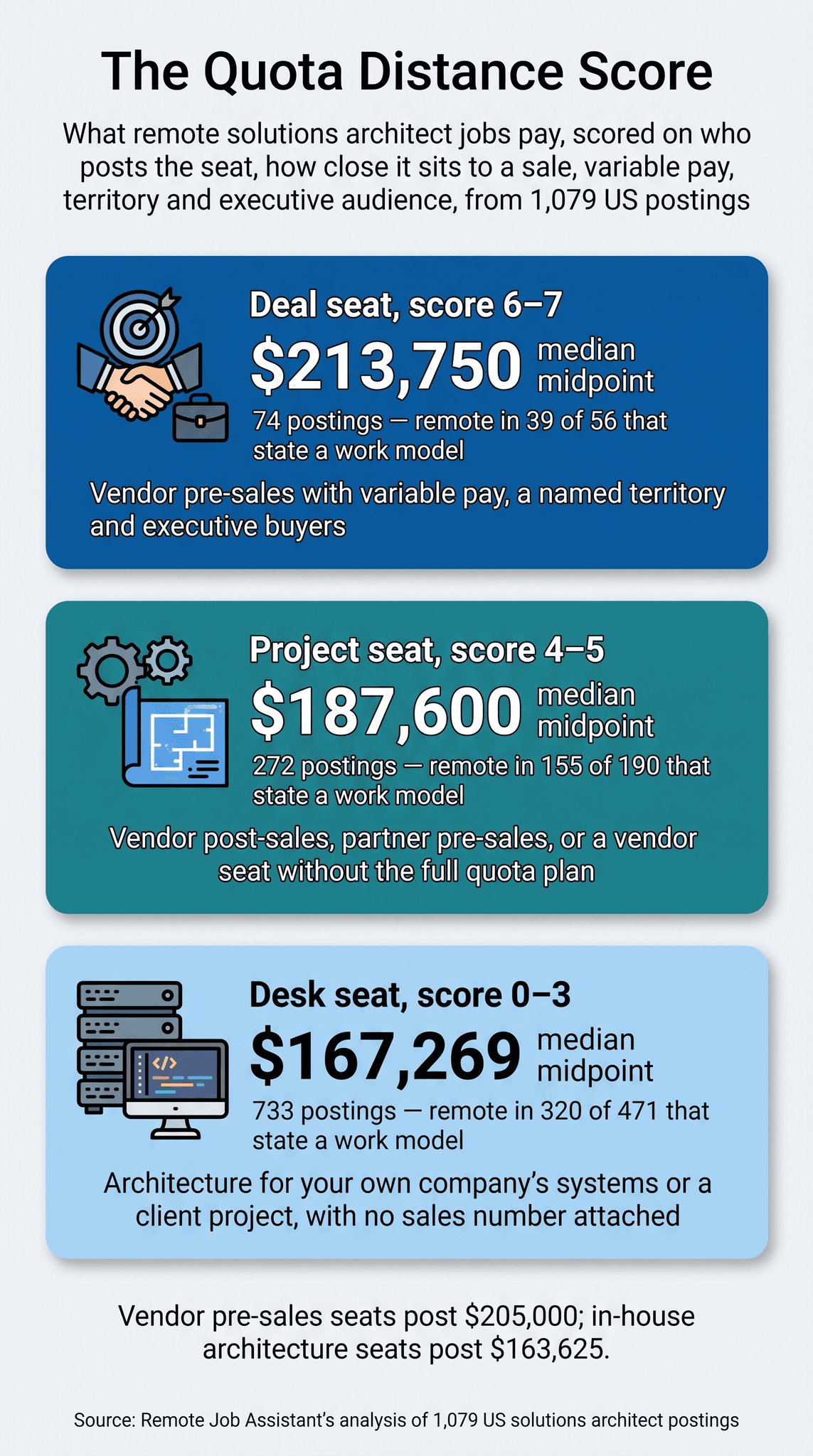
- Desk seat (0–3): $167,269 median midpoint (n=412 with pay of 733), remote in 320 of 471 that state a work model. You architect your own company's systems or a client's project. You join review boards, keep a roadmap, write implementation plans. No sales number touches your pay. 427 of the 733 sit at services firms and 177 in-house.
- Project seat (4–5): $187,600 (n=178 of 272), remote in 155 of 190. A vendor seat without the full quota machinery (post-sales, a pre-sales seat with no variable pay or territory) or a partner's pre-sales seat. 204 of the 272 are at vendors.
- Deal seat (6–7): $213,750 (n=56 of 74), remote in 39 of 56. Vendor pre-sales with variable pay, a territory and executive buyers. 53 of the 74 name a territory and 56 mention variable pay. This is the best-paid seat, and its version of remote is a home office inside a patch of customers.
The single-score ladder, printed as it came out: 0 $159,500 (n=67); 1 $168,045 (n=150); 2 $162,500 (n=99); 3 $177,750 (n=96); 4 $182,500 (n=89); 5 $190,085 (n=89); 6 $210,625 (n=42); 7 $213,850 (n=14). It isn't a straight line at the bottom, which is why the bands group 0–3 together, and the remote share falls at the very top: 6 of the 14 score-7 postings that state a work model are remote, against 79 of 95 at score 5. Our read: the top of the scale buys its pay with your calendar. 35 of the 74 Deal-band postings mention travel, against 135 of the 733 in the Desk band.
| Seat band | Score | Postings | Remote (of stated) | Median midpoint (n) | Mention variable pay | Mention travel | Typical employers |
|---|---|---|---|---|---|---|---|
| Desk | 0–3 | 733 | 67.9% (320 of 471) | $167,269 (412) | 75 of 733 | 135 of 733 | Booz Allen Hamilton, Tata Consultancy Services, Citi, CACI, Cognizant |
| Project | 4–5 | 272 | 81.6% (155 of 190) | $187,600 (178) | 88 of 272 | 79 of 272 | Stripe, CoreWeave, Blue Yonder, GitLab, Fivetran |
| Deal | 6–7 | 74 | 69.6% (39 of 56) | $213,750 (56) | 56 of 74 | 35 of 74 | Databricks, Cloudflare, Red Hat, Equinix, Elastic |
Seniority doesn't explain the gap. Among titles with no seniority word, Desk seats post a $162,000 midpoint (n=244), Project seats $177,000 (n=103) and Deal seats $206,250 (n=28). Among Senior titles the same three bands post $170,000, $178,375 and $207,250.
A pre-sales engineer in a 2021 Ask HN thread described the deal seat better than any posting does: "Sales Engineers or Solution Architects own the "technical close" of a deal. Once the customer says your technology solves their problems and they're not looking at any competitors, your job is done." He added that "Base + Commission can be easily $250k plus equity." Easily is doing a lot of work there: 45 of the 646 postings with pay have a midpoint of $250,000 or more.
The deal seat pays more for a plain reason: its output is revenue the vendor can count. When a solutions architect's proof of concept turns into a signed order, the company can tie that seat to bookings, and OTE is how it shares the result. One pre-sales architect usually covers several account executives' pipelines, so each seat touches a lot of revenue. The desk seat is the hybrid one for the opposite reason. It serves stakeholders who sit in the building and reports into IT, which is exactly the function every office mandate is written for. Delivery seats post the least because a client pays for them by the hour against a utilization target, and the consultancy, not the architect, keeps the margin.
Sanity check: the gap isn't one source talking. Vendor pre-sales against in-house architecture is $214,550 against $167,045 on Workday and applicant-tracking boards, $190,000 against $163,662 on LinkedIn, and $205,000 against $163,625 among postings listed since July 1. SimplyHired shows the weakest version, $160,000 against $154,525, on small counts (16 and 22 postings with pay).
How to use it. Score your current job, then score every posting, in two minutes each. The biggest single move is the seat: going from desk or delivery work to pre-sales adds two points and, at vendors, about $36,000 at the median ($169,225 for vendor internal seats against $205,000 for vendor pre-sales). The next biggest is who posts the job. The trade you're making is base certainty and some travel for pay and a better shot at remote. Decide the base-to-variable split you can live with before the recruiter call, not after the offer.
A remote solutions architect job is usually a sales job with an architecture title: vendor pre-sales seats posted $205,000 and went remote in 108 of 134, while in-house architecture seats posted $163,625 and went remote in 44 of 96.
The postings won't line themselves up by seat for you, and LinkedIn reposts one requisition in city after city, so the shortlist is the slow part.
Stop Applying Manually
Our AI applies to hundreds of matching jobs while you sleep. Wake up to interviews, not more applications.
If you'd rather spend the evening scoring seats than re-reading the same Denver, Austin and Chicago copies of one req, Auto-Apply applies at volume to the postings you approve and reads each one's work-location line, so a "remote" title with an office requirement in the body doesn't slip through.
Remote Solutions Architect Salary: What 646 Posted Ranges Show
Salary ranges in this section come from the 646 of our 1,079 postings that print a range, pulled October 13, 2026 and posted between October 2025 and October 2026. We cross-referenced them with BLS wage data, which has no solutions architect occupation, and with Levels.fyi's self-reported pay. Ranges shift as the market moves; check the linked sources for current figures.
The overall median posted range is $144,190 to $200,000, a $175,000 midpoint. Level moves it less than seat type does.
| Level (title wording) | Postings | Remote (of stated) | Median range | Median midpoint (n) |
|---|---|---|---|---|
| No seniority word | 683 | 73.1% (321 of 439) | $140,000–$190,000 | $165,000 (375) |
| Senior | 185 | 70.7% (94 of 133) | $149,500–$200,000 | $173,500 (120) |
| Principal, staff or distinguished | 132 | 69.2% (63 of 91) | $159,250–$220,800 | $190,000 (88) |
| Lead, manager, director or VP | 68 | 67.4% (29 of 43) | $151,200–$242,000 | $193,830 (55) |
| Junior or associate | 11 | 63.6% (7 of 11) | $98,800–$128,020 | $111,150 (8) |
A pre-sales seat with no seniority word ($184,800, n=107) out-posts a Senior desk or delivery seat ($170,000 for both). Years matter at the margin: 522 postings name a minimum, the median is seven years, and postings asking for 11 or more post $183,511 (n=37) against $155,000 for four or fewer (n=60).
What the number is matters as much as the number. Most postings don't say.
| What the posted range is | Postings | Remote (of stated) | Median range | Median midpoint (n) |
|---|---|---|---|---|
| Labelled OTE (base plus target variable) | 76 | 73.8% (45 of 61) | $153,000–$214,968 | $182,701 (76) |
| Labelled base salary | 183 | 69.8% (88 of 126) | $142,600–$200,000 | $170,000 (183) |
| Not labelled | 820 | 71.9% (381 of 530) | $142,800–$200,000 | $175,000 (387) |
Inside pre-sales seats the labelled ranges barely differ: OTE-labelled ranges post $194,250 (n=37) and base-labelled ones $190,292 (n=64). That means a base range and an OTE range of the same size aren't the same offer, because the base-labelled seat often has variable pay on top. DigitalOcean's AI/ML posting prints both: "Base: $150,000 - $215,000 / Target OTE: $200,000 - 285,000." SHI prints a base range of $128,000 to $200,000 and adds: "The estimated on-target earnings, or OTE, which includes a base salary and bonus is $160,000 - $250,000."
So what is the solutions architect salary? It depends on who's counting. Our median posted midpoint is $175,000. Remote Rocketship's US figure is $175,478 from 2,027 openings, which is close, because it also averages posted ranges. Levels.fyi's Solution Architect page reports a $217,000 US median total compensation, with a $180,000 median base and a $2,500 median bonus, from 1,214 self-reported submissions that include stock. Its Sales Engineer page reports $208,000 with a $33,000 median bonus (295 submissions), which is the base-versus-variable split in one line. BLS proxies sit lower because they exclude equity and fold in older, non-software roles: sales engineers $124,900 (commissions included, and $153,410 inside software publishing), computer network architects $134,050, computer and information systems managers $175,140.
AWS pay, from all 269 of its US solutions architect postings, runs from a median low of $153,600 to a median high of $228,600 across each posting's widest city band, a $191,100 midpoint. Levels.fyi's US median for Amazon solution architects is $325,000 in total compensation, but only 15 records sit behind that figure, and it includes stock. Contract seats exist mostly at consultancies and staffing firms: 33 postings quote an hourly rate, a median of $71 to $81.63 an hour, and 74 are contracts.
Who Hires Remote Solutions Architects (and Why AWS Is the Exception)
The remote share depends far more on who posts the job than on the job.
| Employer type | Postings | Remote (of stated) | Median range | Median midpoint (n) |
|---|---|---|---|---|
| Software, cloud and hardware vendors | 395 | 75.8% (207 of 273) | $159,375–$218,400 | $190,500 (253) |
| Telecom carriers | 6 | 5 of 5 | $152,066–$220,000 | $177,410 (5) |
| Resellers and solution providers | 47 | 82.5% (33 of 40) | $150,000–$185,000 | $170,000 (39) |
| Consultancies, SIs and MSPs | 298 | 77.3% (157 of 203) | $140,000–$190,000 | $170,000 (146) |
| Federal contractors | 104 | 73.5% (36 of 49) | $131,300–$225,000 | $179,750 (78) |
| Staffing firms | 52 | 60.0% (24 of 40) | $135,000–$170,000 | $152,500 (15) |
| Healthcare and life sciences | 43 | 67.9% (19 of 28) | $142,050–$207,447 | $183,511 (32) |
| Manufacturers, energy, other in-house | 57 | 61.3% (19 of 31) | $140,000–$185,179 | $167,500 (32) |
| Banks, insurers, fintech | 49 | 11.4% (4 of 35) | $125,760–$189,800 | $159,750 (36) |
| Retail, consumer, media | 17 | 5 of 7 | $135,000–$160,000 | $147,500 (5) |
| Education, nonprofit, government | 11 | 5 of 6 | $114,930–$159,151 | $134,385 (5) |
AWS is the obvious exception. It posts more solutions architect jobs than any other employer, 269 in the US on October 13, 2026, at a $191,100 median midpoint. Four of the 269 listed a Virtual Location, and all four are customer-segment seats: two in energy and utilities, two covering Great Lakes higher education and state and local government. Andy Jassy's return-to-office memo of September 16, 2024 put staff back five days a week, and its one standing exception is the customer: before the pandemic, "if you were on the road seeing customers or partners ... people worked remotely. This was understood, and will be moving forward as well." That is a carve-out for travel, not for working from home. If you want the AWS skills without the AWS office, our remote AWS jobs guide shows where those roles land, and they mostly land at partners and at the vendors that sell on top of the clouds.
The largest employer of solutions architects is the least remote: 4 of AWS's 269 US solutions architect postings carried a Virtual Location, against 207 of 273 at the vendors that sell on top of the clouds.
Those vendors are the remote core: data platforms, security, observability, developer tools and AI. Partners and consultancies are just as remote (157 of 203) but post $20,000 less at the median, because their architects bill. Federal contractors look remote on paper, 36 of 49, and gate seats behind clearance: 139 of 1,079 postings mention one. In-house employers are where the hybrid seats live, and banks most of all. 35 bank, insurer and fintech postings state a work model, and 4 are remote. State Street's posting reads "Onsite 4 days a week in office and one day remote." Our read, and it is an opinion: for a remote search, the in-house bank seat is the worst trade in this data. It has the lowest remote odds of any employer type (31 of the 49 bank, insurer and fintech postings say hybrid), a $159,750 midpoint that beats only staffing, retail and education, and a job built around governance: 176 of the 286 desk-seat postings mention a review board or governance process.
The title is a tell, too. Solutions Architect titles are more remote than their sibling titles and, at the same employers, better paid.
| Title family | Postings | Remote (of stated) | Median midpoint (n) | At vendors |
|---|---|---|---|---|
| Solutions Architect | 1,079 | 71.7% (514 of 717) | $175,000 (646) | $190,292 (258) |
| Solutions, Sales or Customer Engineer | 691 | 57.1% (253 of 443) | $170,000 (462) | $177,500 (333) |
| Cloud, Enterprise or Technical Architect | 441 | 39.7% (120 of 302) | $184,325 (323) | $202,800 (108) |
At the 68 employers that post both solutions architect and solutions or sales engineer titles with pay, the architect title posts a median $21,518 more, and it's higher at 44 of the 68. If you're a sales engineer at a vendor, the architect title is usually a level up, not a lateral move. You'll hear the opposite take, that vendors hand out the architect title to pay less than a sales engineer for the same quota work. At the same employers, our counts say otherwise. Enterprise architect titles, the in-house version, are remote in 16 of 38. And cloud-named architect titles ("AWS Solutions Architect," "Azure Cloud Solutions Architect") post less, $156,926 (n=46), because 56 of the 86 are at services firms. A cloud name in the title usually flags a delivery seat. Our remote cloud engineer guide covers the build side of those same stacks.
Two cautions on counting. LinkedIn repeats one requisition once per city, and its own remote solutions architect page repeated 7 employer-and-title pairs in its first 60 cards. And Built In's Colorado, Austin and Chicago "remote" hubs share 19 of their first 25 cards, so a busy page isn't a busy market.
Stop Applying Manually
Our AI applies to hundreds of matching jobs while you sleep. Wake up to interviews, not more applications.
A posting can say "Remote - USA" in the title and "East" in the body. If you're applying to remote solutions architecture roles at $200K and up, Auto-Apply reads the location line on every posting you approve, so the region-bound ones get flagged before you've spent a cover note on them.
Pre-Sales, Delivery or In-House: What Each Remote Solutions Architect Seat Does All Week
The three seats share a title and a diagramming tool. The weeks look nothing alike, and the posting language tells you which week you're signing up for.
The deal seat (pre-sales, 305 postings). Your week runs on the account executive's calendar. 165 of the 305 postings mention account executives or the sales team, 171 mention demos, 152 discovery, 101 proofs of concept and 88 RFPs. Proof's posting is typical: "You'll partner with Creditors Rights account executives on discovery, demos, RFPs, and proposals." Iron Mountain warns that "you won't just draw diagrams or present slides." Monday is a discovery call where the customer's platform lead disagrees with their own VP. Wednesday the proof of concept you scoped for two weeks needs a third, because the customer's single sign-on team didn't open a firewall port. Friday is a forecast call where your name is next to a deal you don't control. One engineer answering a 2021 Ask HN thread on landing a fully remote $250,000 job warned that pre-sales people "usually report to sales, which can be good or bad depending on sales culture at your company," and to "be prepared for some really intense weeks and late nights preparing for critical engagements." Blue Orange Digital pitches the seat to exactly the people this guide is for: "If you have been a sales engineer who wanted to stay hands-on, or a solution architect who wanted a seat in the deal, this is the role that gives you both." The audience is senior: 160 of the 305 mention executives, and Datadog wants "someone who can sit across from a startup CTO, earn credibility in the first five minutes." Some seats carry the number directly. Pure Storage's MSP architect is told "your primary measure is pipeline and bookings won with MSP partners." Others say the opposite in so many words; RevStar promises pre-sales discovery "without the burden of carrying a sales quota." Either way, the BLS handbook's warning about sales engineers applies: their "work may be stressful because their income and job security often depend on their success in sales and customer service."
The delivery seat (368 postings). Your week runs on the project plan. 218 of the 368 mention implementation, 110 migrations, 43 statements of work and 33 go-live, cutover or hypercare. Bryant Park Consulting wants you to "draft implementation project plans, work breakdown structure, and resource allocations." The friction is the scope: a statement of work signed by someone who left the sale before you joined it, and a client who reads phase one as everything. The pay plan tells you what the firm counts. Blue Orange Digital's principal AI architect posting lists "Utilization‑based performance bonus tied to billable hours." Delivery seats post $165,000 at the median, remote in 182 of 240, with 90 of 368 mentioning travel, mostly to client sites for kickoffs and go-lives.
The desk seat (in-house architecture, 286 postings). Your week runs on the governance calendar. 176 of the 286 mention governance or a review board, 145 a roadmap, 119 business stakeholders and 66 a current, target or future state. Guardian Life's principal architect will "lead complex design decisions across value streams and business units." The friction is getting six people to agree: the review board that meets in person on Tuesdays, the product owner who needs the design before the budget is approved, the technical debt nobody funds. These seats post $165,000 at the median and are remote in 103 of 181 that state a work model, the lowest of the three.
The ecosystem tracks follow the same pattern. Salesforce architect titles are remote in 30 of 35 that state a work model and post $170,250 (n=18), and 33 of the 49 are at consultancies and partners, so most are delivery seats. If that's your stack, the Salesforce skill page shows current openings. SAP architect titles post more, $203,300 (n=13), and are remote in 9 of 15; our remote SAP jobs guide covers that market in detail. ServiceNow titles post $172,500 (n=11), remote in 9 of 12.
Will AI replace solutions architects? The postings point the other way. 119 solutions architect titles name AI, GenAI, ML or agents, and they post a $183,598 midpoint (n=73) against $172,500 for other titles, remote in 54 of 82. 324 of the 1,079 bodies name generative AI tools, retrieval, agents or model platforms. What those postings ask for is the architect's old job applied to a new stack: evaluate a model platform for a customer, prove it works on their data, and design the guardrails. The work getting automated is the boilerplate: first-draft RFP answers and diagram tidying. The customer conversation isn't.
The Remote Small Print: Territory, Travel, OTE, Clearance and Commute Lines
A remote solutions architect posting can still tie you to a place. These are the lines to read for, counted across the 532 postings that say remote.
| Small-print line | Remote postings that include it | Example (verbatim) |
|---|---|---|
| Mentions travel | 27.6% (147 of 532); median stated share 25% (n=84) | NVIDIA: "This role requires up to 35% travel to customer, partner, and data center sites" |
| Names a region or segment in the title | 9.0% (48 of 532) | Temporal: "primary customer-facing technical leader within the New Logo team, with a focus on the Central region" |
| Mentions OTE, commission or variable pay | 23.5% (125 of 532) | Elastic: "Compensation for this role is in the form of base salary plus a variable component, that together comprise the On-Target Earnings (OTE)." |
| Clearance or public trust | 9.4% (50 of 532) | Dragos: "US citizenship and active TS (Top Secret) security clearance are required." |
| US citizenship | 8.5% (45 of 532) | Federal and defense seats, mostly |
| Time zone or working hours | 6.4% (34 of 532) | Globant: "This is a remote role, but candidates must be located in the Central Time Zone" |
| Commute or office-hub residence | 0.8% (4 of 532); 11 of all 1,079 | Clarivate: "Must live within a commutable distance to one of our US office locations." |
| W-2 or corp-to-corp contract terms | 3.0% (16 of 532) | 11 of the 16 at consultancies and staffing firms |
Travel is where remote gets real for the deal seat. 107 of the 305 pre-sales postings mention travel, and the median stated share is 30%. Ramp's procurement architect expects "Travel up to 30%+ for onsite discovery workshops, executive briefings, and solution validation sessions." Brady's pre-sales seat is listed as remote and says "The selected candidate must be able to travel up to 75%." The BLS handbook for sales engineers puts it plainly: they "often travel to meet with customers," and "some sales engineers travel extensively, which may require being away from home for several days each month." A pre-sales engineer in that same Ask HN thread said it in two sentences: "Most of it can be done remotely, but for important customers, you travel in your territory. As long as you're close to an airport, you're good."
Why do customer-facing seats stay remote when everything around them goes back to the office? Because every large return-to-office memo writes the same exception. Amazon's keeps time on the road with customers. Salesforce's 2024 rules, as reported by the SF Standard, add: "Unless working from a client site, the ability to be fully remote will be granted only on an exemption basis." Microsoft's three-day rule, which started in the Seattle area on February 23, 2026, exempts "certain customer-facing roles like field sales and consultants," according to GeekWire. IBM told most US sales staff in 2025 to work three days a week "from the client location where their assigned territory decision-makers work, a flagship office, or a sales hub." None of these memos names solutions architects. All of them carve out the people who sit in front of customers.
For a solutions architect, remote is a territory, not a time zone: the seat is drawn around customers, which is why every big office mandate carves out the people who sit in front of them.
If the posting says remote and names a region, then expect to live in or near that region and travel inside it. If it says remote and names variable pay, then ask for the split and the cap before the first interview, because a $200,000 OTE at 70/30 is a $140,000 base. Only 8 of 1,079 postings print the split: three at 70/30 (all Elastic), three at 80/20 (Harvey and Zendesk) and two at 75/25 (Expel and OutSystems). Expel shows the math in one sentence: "The targeted base salary range for this role is $186,000 to $195,000 USD, with a 75/25 pay mix resulting in targeted on-track earnings (OTE) of $248,000 to $260,000 USD." If it says remote and names a hub, a commute radius or a headquarters visit, then you're interviewing for a hybrid job with a remote label. FM's posting is honest about it: "Remote within the US with periodic travel to headquarters in Rhode Island required."
| Line in the posting | What it's really telling you | What to ask | Green flag |
|---|---|---|---|
| Remote title, a region in the body | The seat is mapped to a territory's accounts | Which states does the territory cover, and where do the anchor accounts sit? | The posting names the patch and the travel share |
| One range, no label | Employers print either base or OTE without saying which | Is that range base or on-target, and what's the split? | Both numbers printed, as DigitalOcean and SHI do |
| Remote plus a commute radius | A hybrid policy with a remote label | How many days a month in an office, and which office? | Remote within the US, with travel stated as a percentage |
| Pre-sales duties, no variable pay mentioned | Some vendors pay pre-sales on base plus bonus | What's the bonus tied to: team bookings, your accounts, or company results? | A written plan with the measure named |
| Clearance eligibility on a remote seat | Federal work can pull you to a secure facility | Is any of the work classified, and where is the facility? | Unclassified work stated, or remote with a public trust only |
Stop Applying Manually
Our AI applies to hundreds of matching jobs while you sleep. Wake up to interviews, not more applications.
OTE ranges and base ranges look identical in a job feed until you read the fine print. When you send applications through Auto-Apply, you choose which seats to target, and it applies to the ones you've approved, so the hours go into the recruiter calls where those questions get answered.
How to Move From a Desk Seat to a Deal Seat in 90 Days
The fastest pay move in this data is changing seats, not clouds. Here's the decision tree, starting from where you sit now.
- You're an in-house enterprise or solutions architect (Desk, score 0–1). Your realistic first jump is a services firm's pre-sales seat or a vendor's post-sales seat, which moves you to 3–4. Services pre-sales seats post $180,350 (n=41) and are remote in 46 of 59. Lead with the domain: a payer architect who knows claims adjudication is exactly who a healthcare software vendor sends to a health plan. Fails when you can't name one buying decision you shaped; if every story ends at the review board, collect one before you apply.
- You're a delivery architect at an SI or consultancy (Desk, score 1–2). Move to the vendor whose product you implement most. Vendor post-sales seats post $191,400 and vendor pre-sales seats $205,000, against $165,000 for services delivery. Fails when the vendor hires you into its own delivery team instead: vendor delivery seats post $170,000 (n=26), barely above what you earn now. Ask which team the requisition sits in before the first call.
- You're a sales or solutions engineer at a vendor (Project, score 4–5). Ask for the architect title and the territory. Same employer, the architect title posts $21,518 more at the median. Fails when the title arrives without the territory or the variable plan; then you've taken on the architecture work at the old pay.
- You're a cloud, platform or DevOps engineer. You have the build depth but not the customer reps. A partner's pre-sales seat or a vendor's post-sales seat is the bridge, and our remote DevOps jobs guide shows which of your current skills transfer. Fails when you treat the interview like a design review; the buyer wants the trade-off in one sentence, then the demo.
Three search strings find deal seats faster than the word remote does. On LinkedIn and most boards that accept quotes: "solutions architect" plus "pre-sales" or "presales"; "solutions architect" plus "OTE" or "on-target"; and "solutions architect" plus a region word (East, West, Central, Majors, Public Sector). The first finds the seat, the second the pay mix, the third the territory.
Where the move goes wrong is usually the interview, not the job. Pre-sales loops test whether you can sell the architecture, not only design it. Databricks prints its loop in the posting: "Recruiter Screen → Hiring Manager Screen → Design and Architecture Interview → Live Coding Assessment → Build, Demo, Pitch! Presentation → Reference Check." Our read: a desk architect who has never demoed to a skeptical buyer, or a delivery architect who answers a discovery question with a full design, loses that round. Rehearse a 20-minute demo of something you built, against a list of hostile questions, before you apply. The PreSales Collective community is a good place to find working pre-sales people who will run that rehearsal with you.
Certifications won't make the move for you, but they won't hurt either. 64 of 1,079 postings name an AWS certification, 53 an Azure one, 100 a Salesforce one and 64 TOGAF; 14 say a certification is required. The AWS Certified Solutions Architect – Associate exam costs $150, runs 130 minutes with 65 questions and lasts three years; the Professional exam costs $300 for 180 minutes and 75 questions, and its new version (SAP-C03) opens for registration on October 27, 2026, with the old one retiring after November 16. Passing one gets you 50% off the next. A cert helps you clear a recruiter's keyword screen, and that's about all it does. For a wider view of which certifications pay off in remote roles, see our guide to certifications for remote jobs.
Rewrite three résumé lines before you apply. These are illustrations, not quotes:
- Desk version: Led architecture review board for 14 internal applications. Deal version: Ran technical evaluations for 14 business-unit platform decisions, including two vendor bake-offs I scored and presented to the CIO.
- Delivery version: Delivered Salesforce migration on time and budget. Deal version: Scoped the Salesforce migration with the client's sales team, wrote the statement of work, and turned phase one into a phase-two extension.
- Engineer version: Built Terraform modules for multi-account AWS. Deal version: Built a reference architecture customers adopted in proofs of concept; three became production accounts.
Then take these questions into the first recruiter call, and let the answers sort the seat for you:
- Who carries the number this seat supports? If they name account executives and how many each architect covers, it's a deal seat; ask about the variable plan next. If nobody carries a number, it's a desk or delivery seat with a sales-flavored title, so price it against the Desk band, not the Deal band.
- Is the posted range base or OTE? If it's OTE, get the split, the cap and last year's team attainment before you compare it with a base offer; an OTE is a target, not a promise. If it's base, ask what sits on top, because a base-labelled pre-sales range usually beats an OTE range of the same size.
- Which territory, and what's the real travel? If the answer is a region, ask where the three biggest accounts sit; that's where you'll fly. If the answer is anywhere in the US, ask for it in the offer letter.
- What does remote mean in writing? If the answer includes a commute radius, a hub or a headquarters week, treat it as hybrid. If it says remote within the US with travel as a percentage, it's the real thing.
- Who decides the architecture? If the answer is a review board, you're in a desk seat whatever the title says.
Our account executive guide explains how the seller you'd be paired with gets paid, which tells you a lot about how your own variable plan will behave.
Frequently Asked Questions
I'm an enterprise architect at a bank on a hybrid schedule. Would a remote pre-sales solutions architect job pay more, and what would I give up?
Usually yes. Vendor pre-sales seats in our data post a $205,000 median midpoint and are remote in 108 of 134 that state a work model, against $163,625 and 44 of 96 for in-house architecture seats; only 4 of 35 bank, insurer and fintech postings are remote. You'd give up a predictable base for a base-plus-variable plan, take on travel (107 of 305 pre-sales postings mention it, median 30%), and trade a review board for a sales forecast.
Is a remote solutions architect salary base or OTE, and how do I tell from the posting?
Most postings don't say: 820 of 1,079 print a range with no label, 183 label it base and 76 label it OTE. Look for the words around the range, such as "on-target earnings," "variable component" or "commissionable roles," and ask for the split if they're missing. Inside pre-sales seats, OTE-labelled ranges ($194,250) and base-labelled ones ($190,292) sit close together, so a base range usually means more total pay than an OTE range of the same size.
Can you get a fully remote solutions architect job at AWS in 2026?
Rarely. Amazon has expected corporate staff in the office five days a week since January 2, 2025, and on October 13, 2026, 4 of its 269 US solutions architect postings listed a Virtual Location, all of them customer-segment seats such as energy and utilities or Great Lakes higher education. If remote matters more than the badge, the vendors that sell on top of AWS hire the same skills and say remote in 207 of 273 postings.
What does a Quota Distance Score of 4 mean, and what moves it to 7?
A 4 is the bottom of the Project band ($187,600 median midpoint, remote in 155 of 190): typically a vendor seat without pre-sales duties, or a partner's pre-sales seat. To reach 7 you need a vendor employer, a pre-sales seat, variable pay, a named territory and an executive audience, which puts you in the Deal band at $213,750. The trade at the top is location: Deal seats are remote in 39 of 56 that state a work model, because territories pin you to a region.
Do I need an AWS certification to get a remote solutions architect job?
No. 64 of 1,079 solutions architect postings name an AWS certification, and 14 of 1,079 say any certification is required. Postings that name a specific certification post $177,000 against $173,000 for those that don't, a far smaller gap than the $28,000 between desk seats and pre-sales seats. The Associate exam costs $150 and is worth it as a keyword, not as a pay lever.
Will AI replace solutions architects?
Not on the evidence of the postings, though the job is shifting. 119 solutions architect titles name AI, GenAI, ML or agents, and they post a $183,598 midpoint against $172,500 for other titles, remote in 54 of 82. Our read: the paperwork around the sale goes first, such as first-draft RFP answers and diagram cleanup, while employers pay more for the person who can prove a model works on the customer's own data and talk a CIO out of the wrong use case.
Is solutions architect an entry-level job?
No. 11 of 1,079 postings carry a junior or associate title, and the 522 that name a minimum ask for a median of seven years. Built In tags some $200,000-plus solutions architect postings "Entry level," which is a tagging error, not a career path. The usual routes in are a sales or solutions engineer seat at a vendor, a delivery role at a partner, or a senior engineering role on the platform you'd later sell.
Start Your Remote Solutions Architect Search
Start with the seat, then the employer. If you're coming from the build side, browse remote engineering and technical roles and the software engineer job listings for platform seats that lead into post-sales work. If you're ready for the deal seat, the pre-sales openings sit next to the sellers in sales and business development jobs, and remote roles paying $150K and up is where most of them land. Our remote sales jobs guide covers how the rest of the deal team is hired, and the best remote job boards post ranks the boards that carry these postings. Then score each posting with the Quota Distance Score, ask the five questions, and let Auto-Apply handle the volume while you take the calls.
The cloud doesn't need you in the building. The customer does, and the remote solutions architect job is the one where the customer is the office.
Ready to Find Your Remote Job?
Browse thousands of curated remote jobs or let AI apply for you.
Browse Remote JobsRelated Job Guides
Remote iOS Developer Jobs: What 370 Postings Pay (2026)
Remote iOS developer jobs: we read 370 US postings. Apple flagged 26 of 4,384 US jobs Home Office, none of them iOS. Where the remote seats are, and the pay.
48 min read
Remote AWS Jobs: What 759 Postings Actually Pay (2026)
Remote AWS jobs: we read 759 US postings. Amazon's AWS org listed 16 of 5,370 jobs as virtual, so the remote seats sit elsewhere. Pay by role and employer.
43 min read
Remote SAP Jobs: What 2,031 Postings Actually Pay (2026)
Remote SAP jobs: we read 2,031 US postings. Ticket-queue seats post $126K, S/4HANA design seats $160K, and the most remote SAP seats pay the least of all.
38 min read