
Last reviewed: June 2026
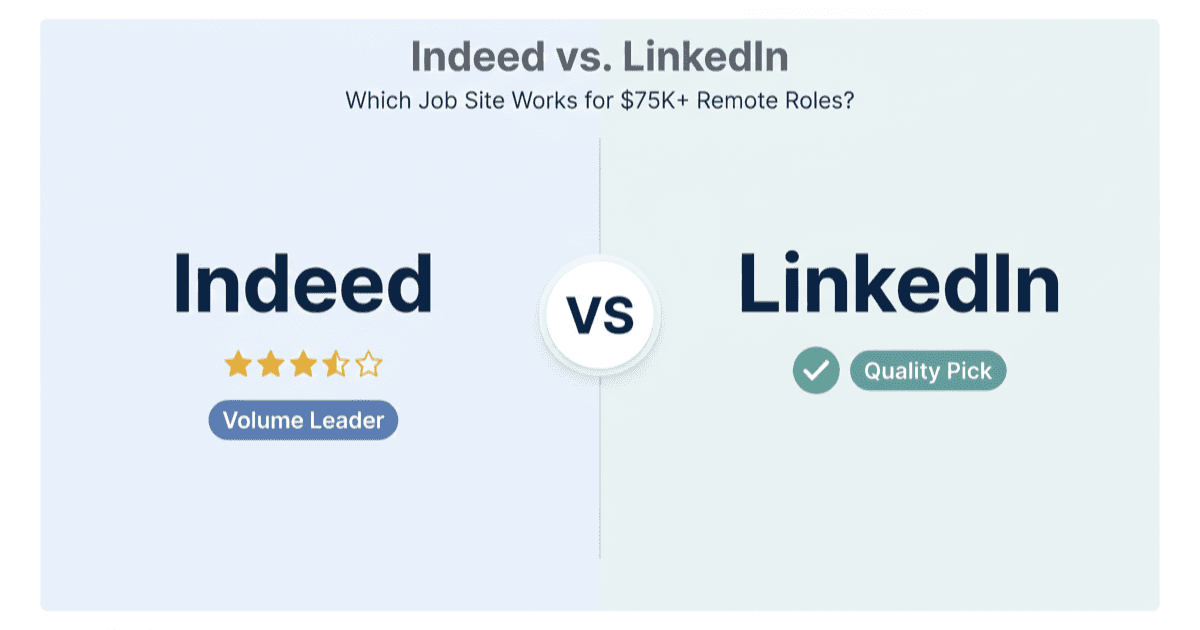
For $75K+ remote roles, LinkedIn wins on quality and recruiter access while Indeed wins on raw volume — but both share the same failure, the application black hole, and roughly 1 in 7 Indeed listings plus more than 1 in 4 LinkedIn listings are ghost jobs that waste your time either way. That's the honest version most "Indeed vs. LinkedIn" comparisons skip.
Here's how we evaluated both platforms: we compared current job-seeker pricing, listing volume, recruiter access, remote-filter reliability, and trust data, then cross-checked roughly 16,000 combined Trustpilot reviews against millions of app-store ratings, a February 2026 study that analyzed 176,268 Indeed listings, and published conversion data. This comparison is built for the experienced remote professional, not the entry-level seeker.
Get Remote Job Tips in Your Inbox
Weekly strategies, salary data, and new opportunities
Unsubscribe anytime. No spam.
The real question isn't Indeed vs. LinkedIn. It's how few of either platform's listings are real jobs you can actually get a response from.
Use LinkedIn as your primary for $75K+ remote roles — it's where recruiters actually source candidates, the remote filter is cleaner, and a strong profile attracts inbound outreach. Use Indeed as a volume backstop for wider coverage. Neither solves the real bottleneck: getting enough tailored applications in front of real openings.
Bottom line: The platform matters less than your application throughput. Layer Remote Job Assistant's Auto-Apply over both to escape the black hole.
Both platforms are free to start, so the cost question isn't really about money — it's about your time. Here's what the data shows before we break down each decision.
Based on our comparison and analysis of public ratings, pricing, and ghost-job research (June 2026):
- Indeed: 350M+ monthly visitors, close to half of all online job postings; roughly 2.0–2.3/5 Trustpilot (from approx. 12,500 reviews, as of June 2026) yet 4.8/5 App Store rating (from approx. 4 million ratings)
- LinkedIn: 1.3 billion members, 310M monthly active; approx. 15.7M active job listings; 1.2/5 Trustpilot (from approx. 3,615 reviews, as of June 2026) yet 4.8/5 App Store rating (from approx. 641,000 ratings)
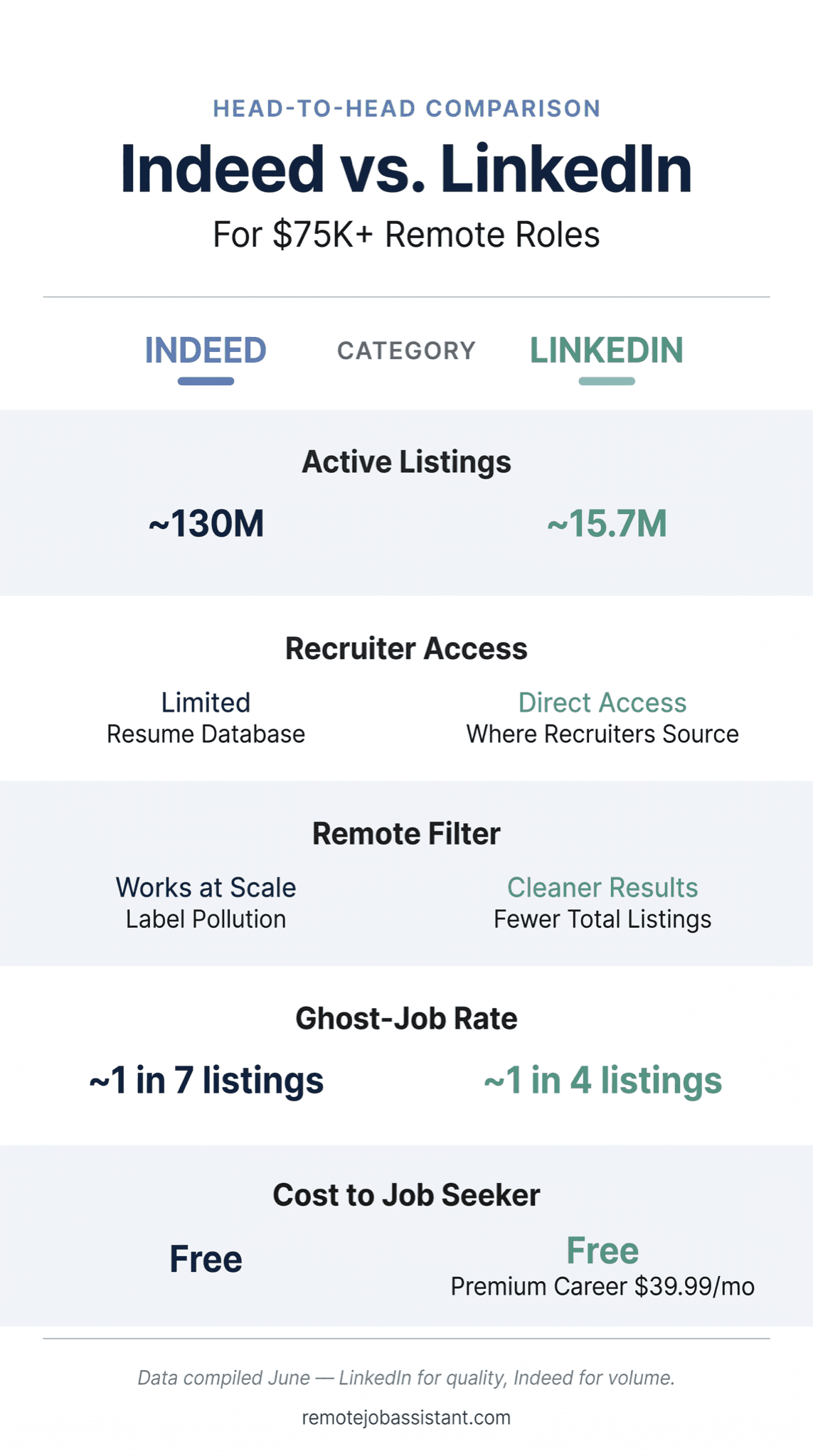
- Ghost jobs: about 14%, or 1 in 7, of active Indeed listings (across 176,268 listings analyzed by Clarify Capital, February 2026)
- LinkedIn Premium Career: $39.99/month or $239.88/year — we could not locate a broadly available Indeed paid job-seeker tier comparable to it
Indeed vs. LinkedIn at a Glance
These are two different tools, not two versions of the same tool. Indeed is an aggregator: it scrapes and hosts listings from across the web, which is why it has the largest pool of jobs anywhere. LinkedIn is a professional network with a job board bolted on, which is why its real value is the recruiter pipeline sitting behind every listing.
That distinction drives every decision below. Indeed is where you find the most jobs. LinkedIn is where the most jobs find you. For a $75K+ remote professional, the second dynamic usually matters more — but not always.
| Dimension | Indeed | |
|---|---|---|
| Model | Aggregator / search engine | Professional network + job board |
| Cost to job seeker | Free | Free; Premium Career $39.99/mo |
| Active listings | approx. 130M listed | approx. 15.7M (posted directly) |
| Best for | Volume, wide coverage, all wage levels | $75K+ knowledge roles, recruiter access |
| Recruiter access | Limited (resume database) | Direct — where most recruiters source |
| Remote filter | Works at scale, label pollution | Cleaner, fewer total listings |
| Salary data | Listed on most direct postings | Premium feature, crowd-sourced |
| Biggest weakness | Ghost jobs and scrape pollution | Easy Apply black hole |
Pricing: What Each Actually Costs You
Indeed's core job search is free for job seekers. As of this writing, we could not locate a broadly available paid job-seeker tier comparable to LinkedIn Premium Career — the bulk of Indeed's revenue comes from employers paying to sponsor listings. LinkedIn is freemium: the free tier is genuinely useful, but the upsell to Premium Career is constant.
| Plan | Price | What You Get |
|---|---|---|
| Indeed (job seeker) | $0 for core job search | Search, Indeed Apply, resume upload, company reviews |
| LinkedIn Free | $0 | Profile, search, Easy Apply, limited recruiter messaging |
| LinkedIn Premium Career | $39.99/mo or $239.88/yr | 5 InMail credits/mo, applicant insights, "who viewed you" (365-day), salary insights, LinkedIn Learning |
LinkedIn raised Premium Career to $39.99/month for new subscribers around April 2026 (some legacy accounts remain at $29.99) — LinkedIn hasn't prominently announced the increase, so verify the price at checkout. Pricing verified on LinkedIn's compare-plans page in June 2026: premium.linkedin.com/careers/compare-plans.
Is Premium worth it? For a $75K+ seeker, conditionally yes — the InMail credits to reach recruiters directly and the applicant insights are the two features that move the needle. But note the asymmetry: for senior roles, the paid-tier decision only really exists on LinkedIn — we could not locate a broadly available paid Indeed job-seeker tier to compare against.
Where the Jobs Actually Are: Volume vs. Quality
Indeed wins volume decisively, hosting close to half of all online job postings. LinkedIn's pool is a fraction of that. But volume and outcomes aren't the same thing.
A Breezy HR analysis found Indeed drove the large majority of total applications — several times LinkedIn's raw application volume — yet LinkedIn applications converted to interviews at a higher rate (2.5% vs 2.0%). The reason is structural: most recruiters live in LinkedIn Recruiter, searching for passive candidates, and many of them barely glance at the Easy Apply pile. The advantage isn't that LinkedIn's job board is better — it's that the recruiters doing the hiring are already on the platform, looking for profiles like yours before you ever apply.
That advantage is conditional, and here's the part most comparisons won't say out loud: LinkedIn only beats Indeed if your profile is already strong enough to get found. If your profile is thin, LinkedIn's recruiter pipeline does nothing for you, and Indeed's sheer volume can feel less demoralizing while you build one. The uncomfortable truth at the senior level is that most $75K+ remote roles get filled through recruiter outreach or a warm intro — not through anyone's application form. The job board is the backup plan, not the plan.
There's a threshold effect worth naming: LinkedIn's advantage is strongest above roughly $90K, where corporate recruiters cluster in LinkedIn Recruiter. Drop much below that and the signal-to-noise ratio collapses fast — the recruiter pipeline thins out and you're left with the same Easy Apply pile Indeed gives you for free. And be honest about survivorship bias: LinkedIn "feels" better partly because the people who succeed there already had strong profiles and networks. The platform gets credit that really belongs to the candidate.
For $75K+ remote roles in tech, finance, marketing, and management, LinkedIn is home territory. Indeed casts a wider net but buries those roles under hourly and on-site listings you'll have to filter out aggressively.
Indeed shows you more doors. LinkedIn puts you in the room where someone might open one for you.
The Ghost Job Problem Nobody Mentions
Here's the data neither platform puts on its homepage: a large share of the listings you're applying to aren't real openings.
In a February 2026 analysis of 176,268 active Indeed listings, Clarify Capital found 1 in 7 — about 14% — were ghost jobs with no genuine intent to hire. Roughly 4% of 176,268 listings had been sitting active for four months or more, and in some sectors the ghost rate climbs past half. (Clarify Capital, 2026) Indeed's aggregation model makes this worse, because scraped third-party listings often stay up long after the role is filled or pulled.
LinkedIn isn't cleaner. A ResumeUp.AI analysis (reported by Entrepreneur) flagged 27.4% of US LinkedIn listings as likely ghost jobs — using listing age of 30+ days as its proxy — and a ResumeBuilder survey of 649 hiring managers found that among companies posting fake jobs, 70% used LinkedIn and 49% used Indeed. (ResumeBuilder, 2024) Zoom out and Bureau of Labor Statistics JOLTS data paints the same picture: 7.4 million openings versus 5.2 million hires in 2025 implies a persistent gap between posted openings and actual hires.
Why does this happen? In the survey of 649 hiring managers, the reasons given for posting jobs they'd never fill were telling: appear open to talent (67%), signal growth (66%), collect résumés (59%). None of those reasons involve hiring you. One story that surfaces again and again in r/recruitinghell is the candidate who poured weeks into a posting only to learn the company had filled the role internally and left the listing up to "keep the pipeline warm." And there's a structural factor on Indeed's side: aggregated listings tend to persist longer, and Indeed does not publish its purge criteria.
Before you apply, screen for the patterns that flag a ghost. After enough rejections, experienced seekers learn to check these before spending a tailored application:
- Posting age over 30–45 days with no "reposted" refresh — in the Clarify Capital sample, a slice of listings sat live for four months or more
- The same role reposted every week or two under a slightly different title — a sign of resume-collection, not an open seat
- No salary band on a senior role, or a band so wide ($90K–$220K) it's clearly a net, not an offer
- A generic, copy-paste job description with no team name, manager, or specific project — nobody who's actually hiring writes this vaguely
- No corroborating hiring signal — the company has no other open roles, no recent funding, and no recruiter activity on LinkedIn
None of these is proof on its own. Two or more together, and you're probably looking at a ghost.
A one-in-seven ghost-job rate doesn't just waste applications — it poisons the signal you use to decide where to spend your time.
The Application Black Hole: Both Platforms' Shared Failure
Indeed Apply and LinkedIn Easy Apply were built to make applying frictionless. They succeeded — and that's the problem. When applying takes one click, every posting collects hundreds of applicants, and the hiring team responds to almost none.
On Reddit's job-search communities — r/recruitinghell and r/jobs in particular — the pattern is identical across both platforms: people describe submitting 50, 100, even 200 applications and hearing nothing back, the "Applied" badge piling up like a participation trophy. Part of the reason is invisible: a large share of one-click applications get filtered by the applicant-tracking system on keyword and screening-question rules before a human ever opens them. The "Applied" confirmation doesn't mean a person saw it.
So when should you bother with one-click versus going direct? A simple rule that holds up: for any role you'd genuinely take, apply directly on the company's own career site. Reserve Easy Apply and Indeed Apply for wide-net coverage on roles you're lukewarm about. The reasoning, repeated across those Reddit threads: job seekers on Reddit widely believe some ATS setups deprioritize applications funneled through third-party boards, and a recruiter scrolling LinkedIn Recruiter will often never open the Easy Apply queue at all. The board is for discovery; the company site is for actually being seen.
This is the bottleneck. Not which board you choose — how many tailored applications you can get in front of real openings before your motivation runs out. That's exactly the gap Remote Job Assistant's Auto-Apply closes: it submits tailored applications at scale across real listings, so you're working the volume math instead of drowning in it. If you want the full field of where to search, our guide to the best remote job boards in 2026 breaks down every option.
Trust Scores: Why 4.8 Stars and 2 Stars Are Both True
If you check ratings, you'll find a contradiction that looks impossible. Both apps score 4.7–4.8 stars from millions of reviewers, while both companies score in the 1.2–2.3 range on Trustpilot from thousands. Both numbers are real.
| Platform | Source | Rating | Reviews |
|---|---|---|---|
| Indeed | App Store rating | 4.8/5 | approx. 4,000,000 |
| Indeed | Play Store rating | 4.7/5 | approx. 10,500,000 |
| Indeed | Trustpilot (as of June 2026) | roughly 2.0–2.3/5 | approx. 12,500 |
| Indeed | Better Business Bureau (as of June 2026) | A+ (accredited 2017) | — |
| App Store rating | 4.8/5 | approx. 641,000 | |
| Play Store rating | 4.0/5 | approx. 3,300,000 | |
| Trustpilot (as of June 2026) | 1.2/5 | approx. 3,615 |
This isn't a paradox — it's a selection effect. App-store ratings get captured in the first week, when finding a platform full of jobs feels good. Trustpilot reviews come from people frustrated enough months later to seek out a review venue, after the account locks, billing disputes, and stretches of zero responses that reviewers commonly describe. The 4.8 measures the honeymoon. The 2.0 measures the marriage. For your decision, weight the Trustpilot complaints, because they describe the experience you'll have after week one.
One caveat on Indeed's A+ Better Business Bureau rating (as of June 2026): it reflects how the company handles complaints, not how often problems occur — which is why it coexists with thousands of one-star reviews.
The Job Board Signal Score
Every comparison eventually dates itself. So instead of just ranking these two, here's a rubric you can apply to any job board — Indeed, LinkedIn, or whatever launches next year.
The Job Board Signal Score: a 10-point rubric that scores a job board on whether your time there actually converts to interviews, across three axes — signal quality, response likelihood, and remote-filter reliability.
Scoring:
- 1–3 Low Signal: High density of fraudulent or stale listings, applications vanish with no response, remote filter mislabels hybrid and on-site roles
- 4–6 Mixed Signal: Some real openings buried in noise, occasional employer response, remote filter works but needs heavy manual verification
- 7–10 High Signal: Mostly verified live roles, applications reach real decision-makers, remote designation set by the employer and reliable
Scored on this rubric: Indeed lands around 4 — enormous volume, but ghost-job density and scrape pollution drag the signal down. LinkedIn lands around 6 — cleaner listings and real recruiter access, held back by the Easy Apply black hole. A focused remote service like Remote Job Assistant scores higher because every listing is a vetted remote role and applications go out tailored, not blasted.
How to use it: before you sink a week into any platform, score it yourself on these three axes. If it lands below 5, treat it as a supplement, not your main channel. And here's the harder call most seekers avoid — when to abandon a platform versus double down. Track your own response rate for two weeks. If fewer than 1 in 20 applications draws any human reply, the platform is failing you regardless of its listing count; redirect that time to the channels (direct applications, recruiter outreach, referrals) that are actually answering.
Which Should You Use for Remote $75K+ Roles?
Both have legitimate use cases — the trick is matching the tool to your situation rather than treating one as universally better.
Lead with LinkedIn if you want recruiters to find you, you're targeting senior knowledge-work roles, you value a cleaner remote filter, or you're willing to invest in profile visibility and direct outreach. For most $75K+ remote seekers, this is the primary channel. One reality check: not every recruiter InMail is a real opportunity — a meaningful share are agency recruiters bench-building or sourcers hitting outreach quotas for roles that may never open. Treat inbound as a conversation to qualify, not a guaranteed pipeline. Our guide to high-paying remote jobs pairs well with a recruiter-forward LinkedIn strategy.
Add Indeed if you want maximum coverage, you're casting a wide net across roles and locations, or you're in a field that's underrepresented on LinkedIn. But be blunt about its limits: Indeed's "remote" filter is polluted enough with mislabeled hybrid and on-site roles that serious remote candidates should treat it as a discovery tool of last resort, not a primary feed. A specific gotcha to watch for: a large share of "remote" listings on Indeed come from staffing agencies, and many will only actually consider candidates in a specific metro despite the remote label. Always verify remote status — and whether the poster is the actual employer — on the company's own site before you spend a tailored application on it.
A note on the LinkedIn Premium upsell while you're deciding: it's mostly wasted money unless you'll actually use the InMail credits to reach specific recruiters and hiring managers by name. If you're just going to keep hitting Easy Apply, the $39.99/month buys you a badge and some vanity metrics, not interviews.
Stop relying on either alone if you're tired of the black hole. Both reward whoever submits the most tailored applications to the most real openings, fastest — and at the senior level, the real game was never which job board you picked. It's getting your materials in front of an actual human. That's a throughput problem, and no amount of platform-switching solves it.
Indeed vs. LinkedIn vs. Remote Job Assistant
The comparison most readers actually need isn't Indeed against LinkedIn — it's either of them against a workflow that fixes their shared weakness. Indeed gives you volume but floods you with ghost jobs. LinkedIn gives you recruiter access but drops you in 200-applicant Easy Apply piles. Both leave the hardest part — applying at scale with tailored materials — entirely on you.
Remote Job Assistant isn't a job board competing for the same listings. It's the layer that submits tailored applications across vetted remote openings, so your effort goes into roles that are real and remote, not into filtering noise. The difference between a job board and Remote Job Assistant isn't where the jobs are — it's whether you're applying at human speed or machine speed.
| Feature | Indeed | Remote Job Assistant | |
|---|---|---|---|
| Remote-only focus | No | Filterable | Yes |
| Ghost-job exposure | High | Moderate | Vetted listings |
| Recruiter access | Limited | Strong | N/A (apply direct) |
| Tailored auto-apply | No | No | Yes |
| Cost | Free | Free / $39.99 mo | See Auto-Apply |
You can read how the broader field stacks up in our FlexJobs review and We Work Remotely review, or browse live openings on the remote jobs board.
Stop Applying Manually
Our AI applies to hundreds of matching jobs while you sleep. Wake up to interviews, not more applications.
Frequently Asked Questions
Is Indeed or LinkedIn better for finding remote jobs? For $75K+ remote roles, LinkedIn is usually the better primary platform — its listings are posted directly by employers (so the remote label is more reliable), and it's where most recruiters actively source candidates. Indeed has far more total listings and is worth monitoring for coverage, but you'll filter out a lot of hourly and on-site noise. Most experienced seekers use both, with LinkedIn as the main channel.
Is LinkedIn Premium worth it for job seekers in 2026? It depends on how you'd use it. Premium Career costs $39.99/month or $239.88/year, and the two features that justify the price for senior seekers are the 5 monthly InMail credits to message recruiters directly and the applicant insights that show how you rank. If you won't use InMail to start recruiter conversations, the free tier covers most of what you need.
Are there really that many fake jobs on Indeed and LinkedIn? Yes, and it's measurable. Clarify Capital found roughly 1 in 7 active Indeed listings were ghost jobs in its 176,268-listing analysis, and a comparison of BLS JOLTS data — 7.4 million openings versus 5.2 million hires in 2025 — implies a persistent gap between posted openings and actual hires. The practical takeaway: assume a meaningful share of any board's listings won't respond, and apply at volume accordingly.
I've applied to 50 jobs on Indeed and heard nothing — is that normal? Unfortunately, yes — it's the default experience on high-volume boards. One-click apply tools generate hundreds of applicants per posting, and many listings are ghost jobs that were never going to respond. The fix isn't applying harder to the same listings; it's applying to more real, vetted openings with tailored materials, and following up directly on company sites where possible.
Should I use LinkedIn Easy Apply or apply directly on the company site? When you have time, apply directly on the company's career site. A recurring theme in Reddit job-search communities is the widely held belief that some ATS setups deprioritize applications routed through Easy Apply or Indeed Apply. Use Easy Apply for speed and coverage, but for roles you genuinely want, go direct — or use a tool that submits tailored applications through the proper channels.
Does the "Open to Work" badge hurt me for senior roles? It's debated. LinkedIn's own data says the public badge roughly doubles recruiter contact, but former Google recruiter Nolan Church told CNBC it can read as desperation. The safe middle ground for $75K+ seekers: enable the recruiter-only visibility setting instead of the public green banner, so you signal availability without broadcasting it.
How do I tell if a job board is worth my time? Score it on the Job Board Signal Score: signal quality (how many listings are real), response likelihood (do applications reach a human), and remote-filter reliability. Spend a week, track how many applications get a genuine response, and if the board lands below 5 out of 10, demote it to a supplement rather than your main channel.
Is Indeed free? What about LinkedIn? Indeed's core job search is free — we could not locate a broadly available paid job-seeker tier comparable to LinkedIn Premium Career. LinkedIn is free to use, with an optional Premium Career upgrade at $39.99/month. You can run an effective search on the free version of both; paying is only worth it if you'll actively use LinkedIn's recruiter-messaging features.
Which platform has better salary information? Indeed lists salary on most jobs posted directly to its site, while LinkedIn's deeper salary insights sit behind Premium and are crowd-sourced from member self-reports. Both are rough — cross-reference anything important against a dedicated source like Glassdoor or BLS wage data before you use it in a negotiation.
What's the best alternative to spamming applications on Indeed and LinkedIn? Stop optimizing for which board and start optimizing for throughput on real openings. Remote Job Assistant's Auto-Apply submits tailored applications across vetted remote roles, so your time goes into interviews instead of filtering ghost jobs — the one thing neither Indeed nor LinkedIn does for you.
Use LinkedIn as your primary platform for $75K+ remote roles and Indeed as a volume backstop — but recognize that both share the same flaw: a flood of ghost jobs and an application black hole that swallows your effort. Picking a side barely matters; what moves the needle is getting tailored applications in front of enough real, remote openings to beat the odds. That's a throughput problem, and it's the one Auto-Apply was built to solve.
Indeed finds you more listings; LinkedIn finds you more people. Neither one decides whether you get hired — the count of real, remote roles you actually reach with tailored materials does.
Ready to Automate Your Job Search?
Let AI apply to hundreds of jobs for you while you focus on interviews.
Start Auto-ApplyingRelated Tool Comparisons
Remote Rocketship Review: Is the Paid Remote Job Board Worth It? (2026)
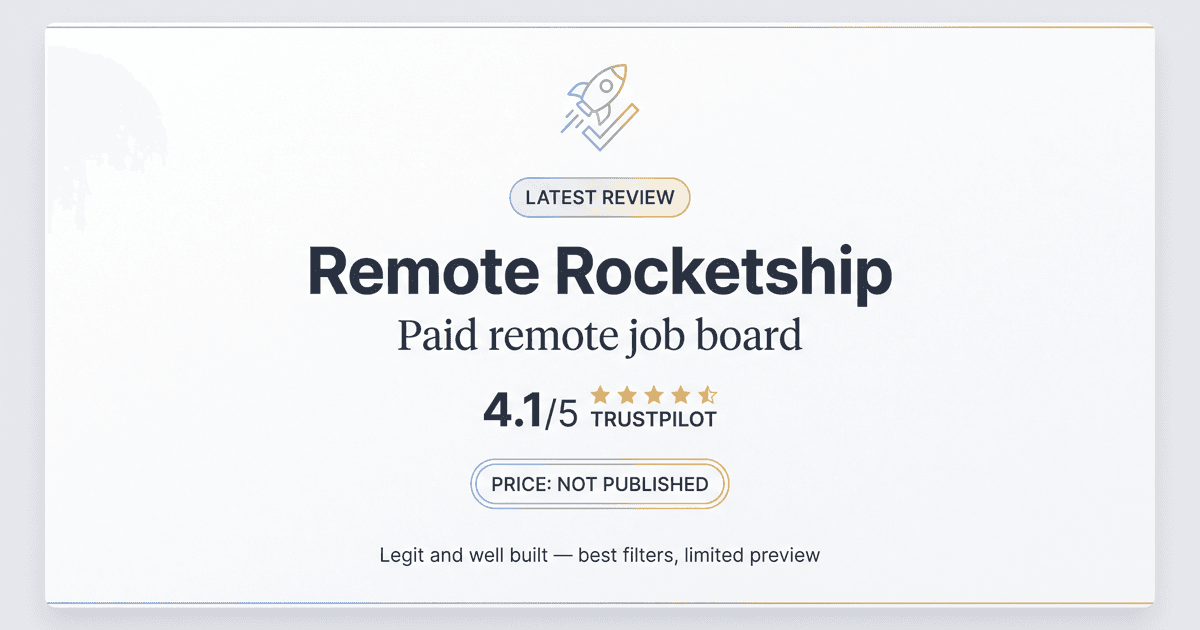
Remote Rocketship scores 4.1/5 on Trustpilot from 71 reviews, but it won't publish its price anywhere. Our verified review of the paid remote job board.
20 min read
HiringCafe Review: Is the AI Job Search Engine Worth It?
HiringCafe pulls remote jobs straight from 116,000+ company career pages — but is it worth using? We tested it for 7 days. Here's the honest verdict.
20 min read
Nodesk Review: A Curated Remote Job Board That Finds the Jobs — But Won't Apply for You (2026)
Nodesk is a free remote job board curating 10,000+ listings from legit employers like GitLab and Stripe — but no auto-apply or resume tools. Full 2026 review.
19 min read