
Last reviewed: October 2026
You've run the diary study, coded 40 interviews into five findings, and watched the product team ship the version your participants struggled with anyway. So you search "remote UX researcher jobs." LinkedIn promises "2,000+ Remote User Research Jobs in United States," then shows a salary on none of its first 60 cards. Remote Rocketship puts the average remote UX researcher in the US at $152,246. Built In's remote page says $124,057. And on the remote boards, listings addressed to "UX Researchers" and "User Researchers" pay $10 or $88, one time, for feedback on somebody else's research tool.
The market you're searching is smaller and less remote than the one most researchers trained for. Indeed counted UX research listings down 71% from their early-2022 peak, and Kathryn Brookshier, who wrote that analysis, added in January 2026 that postings have "stabilized" since the second half of 2023, "likely at the baseline level." User Interviews' surveys show the share of researchers working fully from home falling from 89% in 2021 to 51% in 2023. The government doesn't track the job at all: O*NET files "UX Researcher" as an alternate title under Web and Digital Interface Designers, whose May 2025 median wage was $104,000.
Get Remote Job Tips in Your Inbox
Weekly strategies, salary data, and new opportunities
Unsubscribe anytime. No spam.
Three lines in a posting predict its pay better than its title does: who uses what you find, whether it asks for statistics, and whether the product is AI. Remote is a fourth line, and it runs the other way. In our data, fully remote UX researcher postings paid about $32,000 less at the median than hybrid ones ($144,000 against $176,000), and the gap isn't random: remote postings skew mid-level, contract and agency.
Remote Job Assistant read 211 US job postings whose title names UX, user, design or experience research, from 179 employers, pulled October 14, 2026, with posting dates from December 2025 to October 2026 (199 of them listed since July 1). They came from LinkedIn (114, from 43 keyword searches plus LinkedIn's own job pages), the Indeed network via SimplyHired (33), the remote board Himalayas (23), 1,054 Greenhouse, Lever, Ashby and SmartRecruiters boards (22), and 585 Workday career sites (19). Nine more listings were titled like UX research jobs but were paid-feedback tasks or AI-evaluator gigs. We set those aside.
Based on our analysis of 211 US UX-research-titled postings at 179 employers (posted December 2025–October 2026):
- 33.9% (n=39 of 115) of postings that state a work model are fully remote, with Himalayas (a remote-only board) set aside; 73 of the 211 say nothing about where you'd work
- $144,000 median midpoint for remote postings (n=27 with pay) against $176,000 for hybrid postings (n=39)
- 55.0% (n=116 of 211) post pay; the median posted range is $136,875–$198,000, a $165,959 midpoint
- $188,250 median midpoint for in-house seats at software companies (n=65) against $116,825 at agencies, staffing firms, consultancies and federal contractors (only 10 of their 63 postings show an annual range)
- $192,030 median midpoint when the research is on an AI product (n=50) against $151,988 when it isn't (n=66)
- 16.6% (n=35 of 211) are contracts; 16 of the 24 contracts that state a work model are remote, against 23 of 91 full-time postings
- 9 listings titled like UX research jobs were paid-feedback tasks or AI-evaluator gigs ("$10 one-time" to "$150–$250/hour") and are not in the 211
Two cautions before these numbers do any work. The remote median rests on 27 postings with pay and the agency median on 10, so read small gaps as noise. And the remote seats at the top of the pay range aren't where most remote UX research postings are.
Of the 27 remote postings with an annual range, 13 had a midpoint of $150,000 or more, at 13 different employers. Eleven were in-house at software companies (Instacart, Airbnb, Pinterest, Figma, HighLevel, Apollo.io, Mural, EvenUp, onX, Clair and Meta), two were in-house elsewhere (Oura and Rula), and none were at an agency or staffing firm. Nine of the 13 land in the top band of the Research Reach Score below.
None of those 13 is a contract, and three write office time into the remote seat anyway: monthly in-person working sessions at Airbnb, quarterly trips at onX and in-person onboarding at Figma. The well-paid remote seat exists; it's just rarer than the remote contract. The rest of this post shows how to tell which kind of remote you're reading.
How We Collected This Data
Start with what we couldn't see. Indeed, ZipRecruiter and Glassdoor block automated reading, so Indeed-network listings reached us only through SimplyHired, which carries part of that feed. Reddit's r/UXResearch, where a lot of the job-market talk happens, is closed to crawlers too, so the practitioner voices in this post come from Hacker News threads. Referral-only searches and internal transfers never post at all.
Our searches lean remote, so we corrected for it. Ten of the 43 LinkedIn searches and half of the SimplyHired queries asked for remote jobs, and Himalayas lists only remote jobs. We report remote shares without Himalayas and check them against Workday and the startup ATS boards, which we searched with no remote filter: 10 of 32 postings there that state a work model are remote (31.2%), close to the 33.9% for the whole set. Six of the 39 remote calls outside Himalayas rest on LinkedIn listing only "United States" with no office.
What counted. Titles naming UX, user, user experience, design, experience or product research or researcher, including quantitative and mixed-methods researchers and research managers and directors. Eight titles that say only "Researcher" stayed in because the body describes UX research. We set aside and report separately 14 designer-researcher hybrids, 105 consumer, customer and market insights roles, 46 human factors engineers, 2 research-operations roles and the 9 gigs.
Cleaning. We collapsed 8 postings that appeared on two boards (same employer, same title, same pay range), corrected the employer type on 44 postings (staffing firms that LinkedIn files as education companies, a design agency filed as software), and read the work model from the posting body rather than the job card. Level comes from title words, so an untitled posting that asks for 13 years of experience still counts as mid-level.
Pay. 116 of 211 postings print an annual range and 21 print an hourly rate. Ranges are base pay; equity and bonus rarely appear in postings.
The framework audit. We tested five candidate pay drivers against posted ranges within each level before naming the framework. Two failed. Strategy and roadmap language appears in 139 of 211 postings and doesn't move pay once you compare like levels. A three-step qualitative, mixed and quantitative method score paid less, not more, at the senior level. The three drivers that held are the framework.
How much to trust the medians. The remote median rests on 27 postings with pay, the agency and staffing median on 10, and some level-by-band cells on 2 to 4. Treat gaps under about $10,000 as noise, and read every median here as what a typical posting printed, not what a typical offer paid.
Cross-references. BLS Occupational Employment and Wage Statistics for May 2025, Web and Digital Interface Designers (SOC 15-1255: median $104,000, 75th percentile $158,820, 90th $201,550); O*NET; User Interviews' State of User Research 2025 (485 respondents); the UXPA 2024 salary survey; Levels.fyi (212 US submissions); and Payscale (410 profiles). Ranges last checked October 14, 2026.
The Research Reach Score: Why Two Remote "Senior UX Researcher" Jobs Pay $40K Apart
Most advice on UX researcher pay says to learn quantitative methods and earn 10% to 25% more. The pages that say it don't show data. Our postings point at something simpler: UX research pay follows how far a finding travels: into a client's slide deck, into a bank's app, or into a software product the employer sells.
The Research Reach Score is a 0–4 rubric that scores any UX research posting, or your current job, on how far a finding from that seat travels. It uses three lines the posting already prints.
The two-minute posting check. Answer four questions before you read the requirements list:
- Who uses what you learn? A client of your employer (agency, staffing firm, consultancy, federal contractor), your employer's own customers of something that isn't software (a bank, insurer, retailer, health system), or users of a software product your employer sells?
- Does the posting name a statistical method, a PhD or a quantitative title? Regression, ANOVA, significance testing, sample sizing, survey methodology and psychometrics count. "Quantitative and qualitative methods" on its own doesn't.
- Is the product AI? Research on an AI, machine learning or LLM product or feature counts. Using AI tools to speed up your synthesis doesn't.
- How many research platforms does it list? Two or more (UserTesting, Qualtrics, Dovetail, UserZoom, Maze) usually means a service desk.
The first three answers are the score. The fourth is a tell we explain below.
Scoring:
- Employer (0–2): where the finding lands. Agency, research vendor, staffing firm, consultancy or federal contractor = 0 ($116,825 median midpoint, n=10 with pay; remote 17 of 34). In-house at a company whose product isn't software = 1 ($152,500, n=41; remote 7 of 36). In-house at a software or internet company = 2 ($188,250, n=65; remote 15 of 45).
- Evidence (0–1). The posting names statistics vocabulary, a PhD or a quantitative title: $176,450 (n=53) against $157,000 (n=63). It holds inside every level: $161,500 against $125,550 at mid-level, $155,475 against $142,128 at senior, $226,375 against $182,638 at staff and principal.
- AI product (0–1). The research is on an AI product or feature: $192,030 (n=50) against $151,988 (n=66), and higher at every level (mid +$14,450, senior +$7,528, staff and principal +$38,619, managers +$48,825).
Bands:
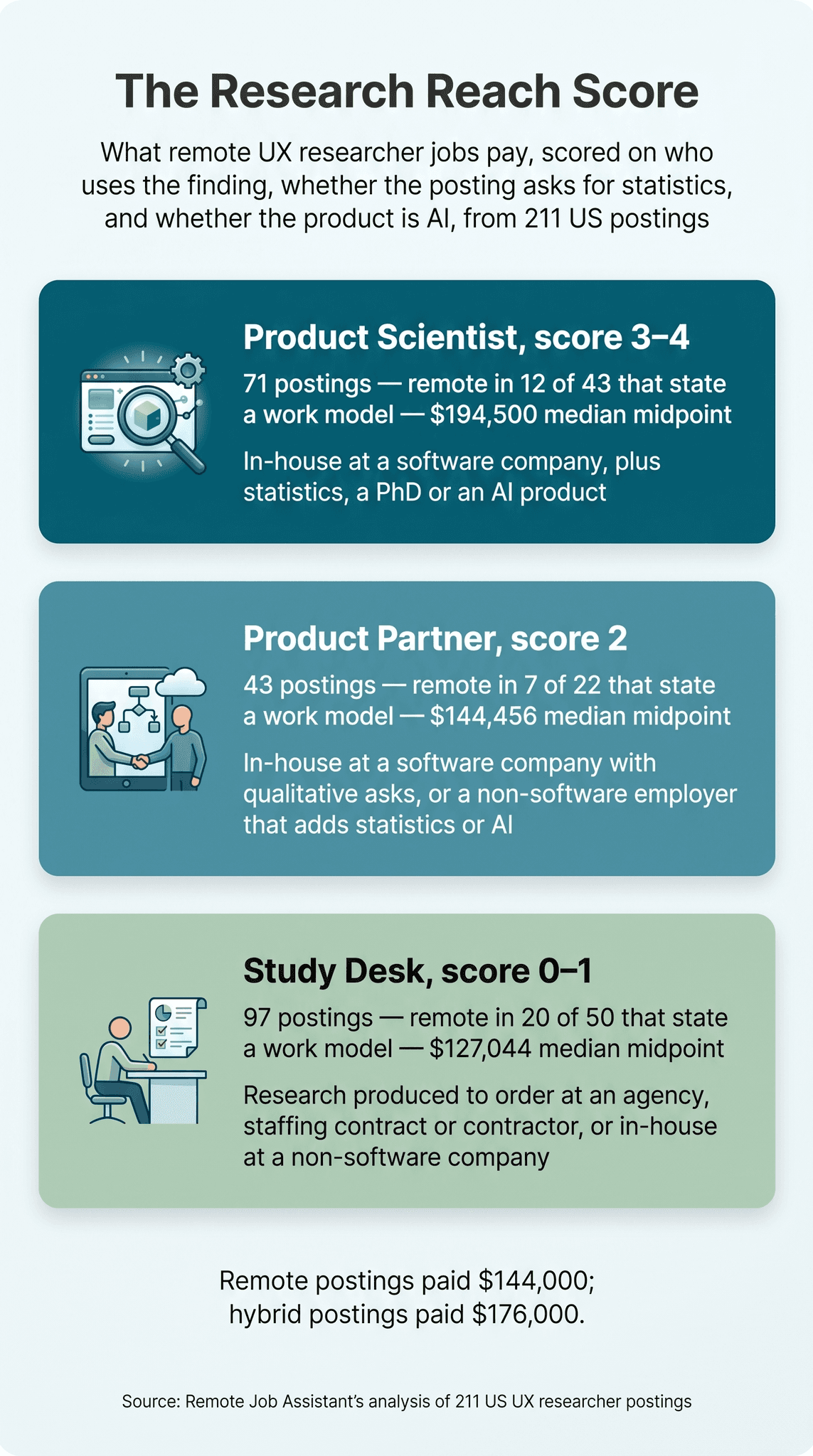
- Study Desk (0–1): $127,044 median midpoint (n=28 of 97 postings), remote 20 of 50. Research produced to order: usability rounds, interviews, readouts and a repository, at an agency, staffing contract or contractor, or in-house at a non-software company with no statistics or AI asks.
- Product Partner (2): $144,456 (n=27 of 43), remote 7 of 22. In-house at a software company with qualitative asks, or a non-software employer that adds statistics or AI.
- Product Scientist (3–4): $194,500 (n=61 of 71), remote 12 of 43. In-house at a software company plus statistics, a PhD or an AI product. Google (7 postings), Amazon (4) and Capital One (3) lead the band.
| Band | Score | Postings | Remote (of those stating) | Median midpoint (n with pay) | Who posts it most |
|---|---|---|---|---|---|
| Study Desk | 0–1 | 97 | 20 of 50 | $127,044 (28) | Photon, Conifer, SteerBridge, INSPYR, PayPal, Fidelity |
| Product Partner | 2 | 43 | 7 of 22 | $144,456 (27) | WHOOP, JPMorganChase, HoYoverse, Snowflake, HP |
| Product Scientist | 3–4 | 71 | 12 of 43 | $194,500 (61) | Google, Amazon, Capital One, Intuit, Microsoft, TikTok USDS |
We print the single-score ladder too, because it isn't a smooth line: 0 posts $117,000 (n=7), 1 posts $153,500 (n=21), 2 posts $144,456 (n=27), 3 posts $189,560 (n=45) and 4 posts $215,275 (n=16). Scores 1 and 2 pay about the same. The break comes at 3. Inside a level the bands do climb: $116,650, $132,975 and $166,018 at mid-level, and $126,588, $147,753 and $167,000 at senior. The middle band is thin at staff and manager level (two and three postings), so don't read much into it there.
How to use it. Score your current job, then score every posting before you apply. Moving from an agency to a software company's in-house team is usually worth more than learning statistics ($188,250 against $116,825 at the median), and it usually costs remote odds: agencies, staffing firms and contractors said remote in 17 of 34 postings, software companies in 15 of 45, other in-house teams in 7 of 36. The evidence point is the cheapest to earn, because one statistical method used on real data qualifies you for postings that ask for it. Across the bands, Study Desk postings said remote 20 times in 50 and Product Scientist postings 12 times in 43.
Here's what the score looks like on two real postings with the same title and the same work model.
PetPlace's Senior UX Researcher sits in a pet-insurance group's digital platform, says "Job Location: Remote – USA," and posts $112,522 to $140,653. It scores 1: in-house at a company whose product isn't software (1), no statistical method, PhD or quantitative title (0), no AI product (0). The posting asks for the full method set: "Plan and conduct generative and evaluative research (interviews, usability testing, surveys, field studies)." The job also includes "Contribute to research processes, repositories, and best practices to enable continuous discovery," which is research operations folded into the role.
onX's Senior UX Researcher, Mixed Methods (Remote – United States) posts $154,000 to $180,000. It scores 3: in-house at a software company (2) and an evidence ask (1): "Design and execute quantitative studies, using descriptive and inferential statistics to turn survey, behavioral, and CX data into clarity we can act on." Same title, both remote, $40,400 apart at the midpoint. The onX posting also asks for "Ability to travel quarterly for multiple days to a corporate office or other onX strategic location," which is the kind of small print a remote seat at the top of the band tends to carry.
Why does the employer move pay the most? At a software company the product is the thing being researched, so a finding that lifts conversion or retention by a point moves revenue directly, and the research team is budgeted next to product and data science. Those are the people you get compared with, and data scientists' May 2025 median was $120,230 against $104,000 for the designer category O*NET files UX researchers under. At a bank or retailer, research serves a digital channel of a business that sells something else. At an agency or staffing firm the research is sold by the study or the hour, and the client keeps the decision. That's why 32 of the 35 contracts in our data sit there, and why only 10 of those 63 postings print an annual range.
Why does evidence pay? Statistics makes a finding defensible at the scale a large product runs at. A Google researcher on Hacker News described the origin of Google's quantitative UX team in April 2026: it "was created for exactly this problem: a service which became popular before the right metrics existed, meaning metrics need to be derived first, then optimized" (stevenae on Hacker News).
Why does AI pay? Because the AI product is the bet the company is making now, and research on it reaches the people deciding where the money goes. The premium is mostly a software-company premium: inside software companies, AI-product postings post $208,800 (n=37) against $166,509 (n=28); at banks, insurers and other non-software employers the gap is $160,000 (n=11) against $148,200 (n=30). Gusto's quantitative staff posting defines success as "a clear-eyed view of where our AI experiences are working or falling short, and senior executives that trust your evidence to guide where Gusto invests next."
Two Study Desk postings out-pay most Product Scientist ones. Oura's remote Senior UX Researcher scores 1 and posts $172,550 to $203,000. Kalshi's UX Researcher scores 1 and posts $180,000 to $275,000. Both sell through an app, but our employer rule doesn't count them as software companies because the product is a ring and a regulated exchange. Score the posting, then read the range.
Reading 211 postings one at a time is how we found the 13 remote ones above $150,000. You can do the same scoring in two minutes per posting, or let Remote Job Assistant's Auto-Apply send applications to the remote, in-house postings you approve while you spend the time on portfolio case studies.
Stop Applying Manually
Our AI applies to hundreds of matching jobs while you sleep. Wake up to interviews, not more applications.
Remote UX Researcher Salary: What 116 Posted Ranges Show
Salary ranges in this section come from the 116 postings that printed an annual range between December 2025 and October 2026, cross-referenced with BLS, Levels.fyi, Payscale and two practitioner salary surveys. They're base pay. We excluded hourly contract rates, which we report separately below.
| Level (from title words) | Postings | Median posted range (n with pay) | Median midpoint | Remote (of those stating) |
|---|---|---|---|---|
| Mid-level (no seniority word, I or II) | 90 | $112,200–$158,500 (34) | $128,100 | 25 of 50 |
| Senior | 60 | $125,900–$177,796 (36) | $153,750 | 7 of 33 |
| Staff, principal or lead researcher | 39 | $167,900–$242,570 (30) | $208,584 | 7 of 22 |
| Manager, director or head of research | 19 | $140,000–$219,000 (15) | $187,500 | 0 of 8 |
Three entry-level postings aren't in the table (one posted pay: $75,000 to $95,000). Postings that state experience ask for a median of 5 years (n=103): 3 at mid-level, 5 at senior and 7 at staff and principal.
A remote UX research job paid less than a hybrid one in our postings: $144,000 against $176,000 median midpoints. Remote is a trade, not a perk. The gap has two causes, and both are visible in the table. Remote postings skew mid-level: 25 of the 50 mid-level postings that state a work model are remote, against 7 of 33 senior ones. And the remote lane carries the contracts: 22 of the 62 remote postings are contracts, mostly through staffing firms that print hourly rates or no pay at all. Meanwhile the best-paid in-house teams sit under office policies. Amazon's five postings in our set all name an office, and Google's seven name a city and say nothing about remote. Managers and directors stated remote 0 times in 8.
The quant premium, measured
Two blog posts that rank for "UX researcher salary" put the quantitative premium at "10 to 20 percent" and "15-25%," with no data behind either. Here's what our postings show. Quantitative and mixed-methods titles posted $179,344 (n=13) against $156,475 for UX researcher titles (n=88), but the gap depends on level: $169,922 (n=4) against $126,800 at mid-level, $156,297 (n=4) against $153,750 at senior, and $221,750 (n=5) against $208,369 at staff and principal. The title matters less than the ask. Postings that name statistics, a PhD or a quantitative title (80 of 211) post more at every level, and that's the evidence point in the score. One common take says quantitative UX research is a data analyst job with a UX title. The postings disagree: of the 21 quantitative-titled postings, 14 also ask for interviews, 18 for surveys, 11 for experiments and A/B tests, and 2 mention dashboards.
Why every site gives a different UX researcher salary
| Source | Figure | What it measures | Sample | Date |
|---|---|---|---|---|
| Remote Job Assistant postings | $165,959 median midpoint | Posted base ranges, US | 116 postings | Dec 2025–Oct 2026 |
| BLS OEWS, SOC 15-1255 (proxy) | $104,000 median | Web and digital interface designers, all employers | 113,330 employed | May 2025 |
| Payscale | $107,470 average base | Self-reported base pay | 410 profiles | Updated June 2026 |
| User Interviews State of User Research | $105,500 median | Researchers worldwide, self-reported | 485 responses | Jul–Aug 2025 |
| UXPA salary survey | $120,000 median | "User Researcher" title, all countries | 388 salaries (all titles) | Apr–Oct 2024 |
| Glassdoor | $122K median total pay | Self-reported total pay | Not stated for the median | October 2026 |
| Remote Rocketship | $152,246 average | Remote US postings | 157 job openings | October 2026 |
| Levels.fyi | $205,000 median total comp | Base plus stock and bonus | 212 submissions | Updated Oct 14, 2026 |
None of these are wrong. They measure different things. BLS has no UX researcher occupation, so its $104,000 is the designer category O*NET files the title under. Survey medians include researchers outside the US and outside tech. Levels.fyi's UX researcher page counts stock, and its sample leans toward the companies that grant it: its Google median is $348,656. Posted ranges sit above self-reported base because the employers that publish ranges are disproportionately large, in-house and in pay-transparency states. If you're comparing an offer, compare base to base: our $165,959 posted midpoint, or the UXPA survey's $142,000 median for all US UX titles.
The contract lane
Twenty-one postings print an hourly rate, 19 of them at staffing firms, consultancies or agencies. The median midpoint is $58 an hour (lowest $29, highest $100), which works out to about $119,600 at 2,080 hours, before you pay for your own time off and, on many contracts, your own health insurance. The terms run from "Duration: 2 Months Contract (End of Dec 2026)" at Akraya to "Duration: Multi Year ongoing contract" at Beacon Hill. User Interviews' salary report with Levels.fyi puts the US freelancer median at $125,000 (n=166), which is about where our hourly median lands if you bill full time.
Who Hires Remote UX Researchers (and Why the Best-Paid Seats Are Hybrid)
| Employer type | Postings | Remote (of those stating) | Median posted range (n with pay) | Median midpoint | Contracts | Most frequent |
|---|---|---|---|---|---|---|
| Software and internet companies, in-house | 80 | 15 of 45 | $155,000–$222,000 (65) | $188,250 | 3 | Google 7, Amazon 5, Intuit, Microsoft, TikTok USDS |
| Other in-house: banks, insurers, retail, health, industrial | 68 | 7 of 36 | $124,400–$180,000 (41) | $152,500 | 0 | JPMorganChase 4, Capital One 3, PayPal, Fidelity, WHOOP, Oura |
| Agencies, staffing firms, consultancies, federal contractors | 63 | 17 of 34 | $80,750–$148,400 (10) | $116,825 | 32 | Photon 3, Conifer, SteerBridge, INSPYR, PTR Global, OGC Global |
The most remote employer type is the one that pays least. Agencies, staffing firms, consultancies and federal contractors said remote in 17 of 34 postings, and 32 of their 63 postings are contracts. Seer Interactive calls itself "a remote first agency." Blink's embedded practice "supports long-term contract opportunities (6-18 months) with some of Blink’s largest client." Those are real jobs, and for a researcher who wants to stay remote they're the widest door. They're also where the research is most often sold as a deliverable, and where the posted ranges tell you least: Photon's two ranges run $44,000 to $154,000 and $52,000 to $182,000. On a staffing seat, ask for the hourly bill rate and whether it's W-2 before you talk about a number.
Non-software employers are the least remote. Banks, insurers, retailers and health systems said remote 7 times in 36. Vanguard's Senior User Experience Researcher posting says "Fully remote work is not available for this role." AAA Mountain West Group's says "NOTE: This role is hybrid and requires 3 days a week in our Walnut Creek, CA office." Verizon's research leadership posting describes "a minimum of three days per week in the office, which will be set by your manager." These teams pay well ($152,500 median) and do serious work, but the decision makers they serve are in the building.
Software companies split. The biggest ones run office policies: Amazon told corporate staff in its September 2024 memo to "return to being in the office the way we were before the onset of COVID," effective January 2, 2025; Microsoft's September 2025 update set three days a week, starting with the Puget Sound area by the end of February 2026; Meta moved to three days a week from September 5, 2023, according to Fortune; and Google asked some remote employees near offices to come in three days a week, team by team, according to CNBC. Suno's qualitative researcher posting asks you to "work 5 days per week at our Venice Beach office." The remote $150,000-plus seats are mostly at smaller software companies that call themselves remote-first: HighLevel describes "a global, remote-first organization," Rula says "Rula is a remote-first company," and Instacart's staff posting says "This role is remote."
If you want the research-adjacent roles that sit next to UX researchers, our guides to remote UX designer jobs and remote product designer jobs cover the design side, and remote data science jobs covers the analytics teams quant researchers work beside.
Most of the remote $150,000-plus postings appear on one board or one company careers page, not on every aggregator. If you'd rather apply to the ones that pass your filter than hunt for them, Auto-Apply applies at volume to the postings you approve.
Stop Applying Manually
Our AI applies to hundreds of matching jobs while you sleep. Wake up to interviews, not more applications.
What the Job Is in 2026: Smaller Teams, AI Products, Fewer Usability-Only Seats
The field went through a correction before this data was collected. MeasuringU's January 2025 survey found "35% of organizations losing staff," which it called "roughly double what it was from 2022 all the way back to 2009." User Interviews' 2025 State of User Research (485 respondents) found 21% of researchers saw researchers laid off at their company, and nearly 14% of companies with no dedicated researcher at all, up from 6% in 2022. Maze's 2026 survey found product managers running research in 39% of organizations. Judd Antin, who helped grow Facebook's research team, put the diagnosis bluntly in 2023: "we do way, way too much middle-range research" (The UX Research Reckoning is Here).
That's the backdrop for what the postings ask for now. The three bands describe three different weeks.
A Study Desk week is study production. Blue Cross NC's remote UX researcher coordinates "research sessions, including participant recruitment and session scheduling," keeps the "research repository," and works with a "just enough research" mindset because "We have a small team and can’t test everything we’d like." The friction is the readout that lands after the sprint already decided, and a repository nobody outside the research team opens. Research-operations duties in a researcher's posting are a pay cut in disguise. Postings with repository or participant-recruiting duties (57 of 211) post $135,600 against $177,719 without them, $144,456 against $201,500 inside software companies, and they're more often remote (19 of 36 against 20 of 79).
A Product Partner week is one product team's questions, start to finish. Clair's remote UX researcher posting describes it: "personally recruit participants, write the discussion guide, conduct the interviews, synthesize the findings, and present your recommendations." You're the only researcher in most of those rooms, and the hard part is getting the PM to change the roadmap rather than the copy.
A Product Scientist week mixes methods at scale. Meta's quantitative researcher posting asks for "Experience applying statistical analysis methods such as Regressions, ANOVA, and T-Tests" and "Hands-on experience assessing impact of generative AI on users." Amazon's AWS experience-analytics researcher builds "the metrics and frameworks that assess experience impact at scale." Postings that name behavioral or log data (63 of 211) post $184,500 against $155,000.
So pick the week before you pick the title. If remote matters more than anything, the Study Desk lane is where it lives: remote in 20 of 50 postings, mostly contracts and agencies, at a $127,044 median. If you want your findings to decide things, target Product Partner seats at software companies, where you're often the only researcher in the room. If you want the top of the pay range, it's Product Scientist work, and it's hybrid more often than not: remote in 12 of 43.
One common piece of advice says the real filter at top companies is defending a finding in front of executives. The postings don't pay for that line. Postings that name an executive audience (64 of 211) post less at senior level and above: $141,688 against $155,850 at senior, $202,950 against $210,150 at staff and principal. Every researcher presents. The pay goes to the seats where the finding reaches the product.
Is AI replacing UX researchers?
Not in these postings. AI shows up as the thing being researched in 72 of 211 postings, and those pay more: $192,030 against $151,988. Oscar's posting "will specifically support Oswell and Oscar’s consumer-facing AI experiences." Figma's is for "Figma’s Agentic Experiences." AI also shows up as a tool you're expected to use in 62 postings. HP asks for "Experience leveraging AI-enabled research tools and workflows to accelerate study planning, synthesis, and insight generation while maintaining methodological rigor." Anthropic's bar is higher: "you already run your work through it and use it to build your own analyses and tooling." Don't expect AI-product research to be exotic, though. Forty-two of the 72 AI-product postings still list usability testing; the feature is new, the method often isn't.
What AI is replacing is the gig layer and the generalist. One laid-off researcher on Hacker News described his eight-year job as "the UX Researcher, Designer, Front-End Dev and Customer UX Support" (paul7986, January 2026). A design leader in the 2023 Hacker News thread on Antin's essay said T-shaped generalists had become exceedingly hard to hire at $130,000 to $150,000 a year, "because they just don't exist" (pcurve). The postings agree: 21 ask the researcher to coach non-researchers. Gusto wants "experience enabling and coaching non-researchers to conduct their own research." The specialist who designs the study and judges the evidence is still hired. The generalist who runs every test personally is competing with PMs who now run their own.
The Remote Small Print: Contracts, Time Zones, Clearance and Tool Lists
A remote label tells you where you'll sit, not what you've agreed to. We counted the small print in all 62 remote postings, Himalayas included.
| Small print in remote postings | Postings (of 62) | Example line |
|---|---|---|
| Contract or temporary term | 22 | "Duration: 2 Months Contract (End of Dec 2026)" (Akraya) |
| Travel or office visits | 9 | "There will be occasional onsite meetings on the client site in Washington, DC." (ICF) |
| Security clearance, public trust or US citizenship | 7 | "U.S. Citizenship is required due to federal contract requirements." (ICF) |
| Time-zone or core-hours rule | 6 | "Must be able to work EST business hours." (AllSTEM Connections) |
| State or residency limit | 6 | Slingshot Aerospace hires residents of 32 states plus DC: "We are unable to consider candidates residing in other U.S. states at this time." |
| In-person research sessions | 6 | "Experience with remote and in-person research facilitation across public sector contexts" (Scrumconnect) |
Some of the best remote seats carry the most small print. Airbnb's staff researcher posting says "This position is US - Remote Eligible, but includes monthly in-person working sessions at the San Francisco Airbnb office." That's still a remote job. It's also 12 trips a year.
The longer a UX research posting's tool list, the lower its pay: postings that name no research platform post $179,050; postings that name two or more post $128,700. Fifty-one of 211 postings name at least one platform, led by Qualtrics (28), UserTesting (25), Dovetail (14), UserZoom (9) and Maze (8). The gap holds inside each level ($141,250 against $107,706 at mid-level, $179,050 against $144,000 at senior) and inside software companies ($194,500 against $155,750). The reason is what the list is for. A posting that screens on tools is hiring someone to run studies in a system that already exists. A posting that screens on judgment is hiring someone to decide which studies to run.
What the offer letter won't say
The conditional clauses in these postings tell you what can change after you sign. Figma's remote researcher posting adds: "Additionally, if hired you will be required to attend in person onboarding." Fidelity's two remote researcher postings say "Onsite expectations are likely to evolve as the rollout continues," then "This transition does not apply to fully remote roles." The federal seats at ICF and Technatomy are "contingent upon contract award," so the job can disappear before your start date. MVF's fully remote seat is "Maternity Cover (up to 12 months FTC)," a fixed-term contract, and TeamSoft's is "Contract-to-Hire (6+ Months)." Even the interview is moving back into rooms: Wolters Kluwer asks candidates to "include in-person interviews in our hiring process," and NBCUniversal says "external candidates may be required to attend an in-person interview with an NBCUniversal employee at one of our locations prior to a hiring decision." If remote is the reason you're applying, get it in the offer letter, with the travel cadence, before you accept.
The gig trap
Nine listings in our sweep were titled like UX research jobs and weren't jobs. Terac posted four listings that open "We're running a paid study," with titles such as "UX Researchers: Feedback on a Study Creation Workflow," paying $10, $15, $21 and $88, one time. Codefeast's "User Experience Researcher | $10/task" pays "Compensation: $10 one-time" and "Payment: Upon approval of completed work." Mercor posted "Design Researcher - Fully Remote | Upto $250/hr" for paid AI design research studies. Ethos's "Expert Opportunity - UX Researcher ($70/hr, up to $1,400/week)" is for researchers "who can help train their latest language model on professional document, spreadsheet, and slide deck tasks." AuraOne's is "a remote review track for evaluating AI outputs." Some of that work pays well by the hour. None of it is a UX researcher job, and remote boards file it next to the real ones.
| Red flag | Why it happens | What to ask | Green flag |
|---|---|---|---|
| Contract with the client's name withheld | Staffing seat; the client sets the office policy and the end date | Who is the client, W-2 or corp-to-corp, is there a conversion date? | Named employer and a written conversion path |
| Two or more research platforms listed | Research run as a service desk; tool fluency is the screen | What decision did the last study change? | Posting names the decisions or metrics research informs |
| Repository and participant-recruiting duties | Research operations folded into the researcher's job | Is there a ResearchOps person, panel or recruiting vendor? | A named ops partner or recruiting budget |
| "Remote" plus a time zone or state list | Eligibility rules, not location freedom | Which states can you hire in, and what are core hours? | States listed up front |
| "Remote eligible" plus in-person sessions | Monthly or quarterly travel to a hub | How often, and who pays for it? | Travel frequency and budget stated |
| "Paid study," "one-time" pay or "train a model" | A task or AI-evaluator gig, not a job | Nothing; skip it | A salary range, benefits and a team |
If the posting says remote and names a client site, expect occasional on-site meetings and a contract that can end with the client's budget, as at ICF: "This role is contingent upon a contract award." If it says remote and lists states, check your state before you write a cover letter. If it says remote eligible and names an office, ask for the travel cadence in writing before the final round. If it says remote and nothing else, ask whether remote is written into the offer letter.
Before you spend an evening on a take-home exercise, cut the gigs and the contract-only seats out of your list. Auto-Apply reads the work-location and pay lines in each posting and applies only to the ones that pass your filter.
Stop Applying Manually
Our AI applies to hundreds of matching jobs while you sleep. Wake up to interviews, not more applications.
How to Move Up a Band in 90 Days
Pick the branch that matches your current seat. Each one has a gain and a cost.
If you're at an agency, research vendor or staffing contract (score 0): move in-house, to a software company if you can. The gain: $188,250 at the median for software companies and $152,500 at other in-house employers, against $116,825 where you are. The cost is remote odds, from 17 of 34 postings at services firms to 15 of 45 at software companies and 7 of 36 at other in-house employers. Your best proof is one case study where the client shipped what you found.
If you're in-house at a bank, insurer, retailer or health system (score 1): you have two routes. Stay and add a point by taking the survey program with real statistics or the team's AI feature; Capital One posted three researcher seats in the top band that way. Or move to a software company for the employer point. The second route doesn't cost remote odds (software companies said remote 15 times in 45, your current group 7 times in 36), but expect a portfolio review that asks what shipped.
If you're a qualitative researcher at a software company (score 2): earn the evidence point or move to the AI product team. Product Scientist postings post $194,500 against $144,456 for Product Partner, at about the same remote share (12 of 43 against 7 of 22). Statistics vocabulary appears in 64 of 211 postings, Python or R in 30, SQL in 16, and 72 research an AI product. One survey study with a regression you can defend counts.
If you're a designer or PM who does research: apply as a researcher if your portfolio supports it. The designer-researcher hybrid titles we set aside posted $107,425 (n=10), below every research band. The cost is that you'll be screened on method, not on shipped design.
Interviewers for quantitative seats test judgment, not just method names. A Hacker News commenter who builds experiments for a team of user researchers described the rule the team works by: "researchers consider the experiment final as soon as you peek at the data" (bsimpson). If you can explain why, and what you'd do with an underpowered study instead, you're having the conversation a Product Scientist interview is looking for.
What postings ask for. A PhD is named in 36 of 211 postings (17.1%), usually as one option among several: Meta's quantitative posting accepts "Bachelor's degree with 13+ years of relevant experience in user experience, applied research and/or product research and development or a Master's degree and 11+ years relevant experience, or PhD and 8+ years relevant experience." A master's is named in 58. A portfolio or case studies are asked for in 63. Strong written communication shows up in nearly every readout duty, and the communication skills that get a PM to act on a finding are what the Product Partner seats screen for in interviews.
What certifications do. The Nielsen Norman Group's UX Certification costs approximately $6,500 for five courses, plus $95 per exam, and doesn't expire. The UXPA 2024 survey found 9% of respondents held it. Their median pay was "slightly higher for those with a certificate, although not statistically" different ($122,000 against $118,790). Buy it for the training if you want the training. It isn't a pay lever in these postings.
Lead your résumé with what changed. If your last study changed a metric the company tracks (conversion, retention, support tickets), lead with the metric. If it changed a decision but you never saw the metric, lead with the decision and the team that made it. If it changed neither, lead with the method and the scale, the number of participants and the statistical test, because that's the evidence point, and it's what Product Scientist postings screen for. Tool names go last: the postings that screen on them pay least.
The recruiter call. Ask five questions: Who acts on the findings, and what did the last study change? Is there a data science partner on the team? What share of the work is on AI features? Is remote written into the offer, and what travel does it include? If it's a contract, what's the conversion path and who is the client? Listen hardest to the answer about the last study. A specific answer (a feature cut, a pricing page rebuilt, a launch delayed) means research has a vote. A vague answer about how much the team valued the work means it has a seat. If your applications aren't turning into calls, our guide to why you're not getting interviews covers the résumé side.
Frequently Asked Questions
Do remote UX researcher jobs pay less than hybrid ones?
In our postings, yes. Remote UX research postings had a $144,000 median midpoint (n=27 with pay), against $176,000 for hybrid postings (n=39). Remote postings skew mid-level and include most of the contract and agency work, while the best-paid in-house teams at large software companies work under three- to five-day office policies.
I saw a remote "UX researcher" listing that pays $10 per task. Is that a real job?
No. We found 9 listings titled like UX research jobs that were paid studies, feedback tasks or AI-evaluator gigs, from "$10 one-time" to "$150–$250/hour." Tells: one-time compensation, the words "paid study" or "train a model," no salary range, and no team. Real UX researcher postings in our data showed a median range of $136,875–$198,000.
I'm a qualitative UX researcher at an agency. Can I get a remote in-house job, and what would it pay?
Yes, but the move usually costs some remote odds. In-house postings paid $152,500 (non-software employers) and $188,250 (software companies) at the median, against $116,825 at agencies, staffing firms and contractors. Agencies said remote in 17 of 34 postings; in-house teams at non-software employers said remote in 7 of 36.
What does a Research Reach Score of 2 mean, and what moves it to 4?
A 2 usually means a software company's in-house seat with qualitative-only asks, or a non-software employer whose posting asks for statistics or AI work. Product Partner postings (score 2) posted a $144,456 median midpoint, and Product Scientist postings (3–4) posted $194,500. Adding an evidence point (statistics, a PhD or a quantitative title) and research on an AI product takes a software company's seat from 2 to 4.
Do I need a PhD or statistics to earn $180K+ as a UX researcher?
Not a PhD: it's named in 36 of 211 postings, usually as one option among several. Statistics helps more: postings that ask for statistics, a PhD or a quantitative title (80 of 211) posted $176,450 against $157,000, and the gap holds at every level. The other route to the top band is research on an AI product, which posted $192,030.
Is AI replacing UX researchers in 2026?
The postings say AI is changing the job, not ending it. AI products are the subject of research in 72 of 211 postings, and those posted $192,030 against $151,988. Another 62 postings expect you to use AI tools in your own work. User Interviews' 2025 survey found 80% of researchers already use AI, and 21% saw researchers laid off at their company.
Why does every site give a different UX researcher salary?
They measure different things. Payscale's $107,470 is self-reported base pay, BLS's $104,000 is a designer category with no UX researcher occupation, Glassdoor's $122K is total pay, and Levels.fyi's $205,000 is total compensation including stock. Posted ranges in our data had a $165,959 median midpoint (n=116), base only.
Start Your Remote UX Research Search
Score the posting before you read the requirements: who uses the finding, whether it asks for statistics, whether the product is AI. Then decide whether you're trading pay for remote, or remote for pay, and let Auto-Apply send the applications once the list is set.
Browse remote product design jobs for UX research and design seats, and data and analytics roles for quantitative research and data analyst openings next door. Filter by $150K-plus remote jobs when you're targeting the top band, or $100K-plus roles for in-house moves. Our guide to remote job boards covers where the smaller remote-first software companies post, and data analyst vs. data scientist explains the analytics roles quant researchers get compared with. Outside our site, Built In's remote UX researcher search labels each card with its work arrangement ("Remote," "Remote or Hybrid," "In-Office or Remote"), User Interviews runs a UX research job board, the ResearchOps Community covers the operations side, and the Hacker News thread on Antin's essay is still the most candid discussion of what happened to the field.
Your interviews can happen from anywhere. Your pay depends on where the finding goes next.
Ready to Find Your Remote Job?
Browse thousands of curated remote jobs or let AI apply for you.
Browse Remote JobsRelated Job Guides
Remote Solutions Architect Jobs: Pay by Seat Type (2026)
Remote solutions architect jobs: we read 1,079 US postings. Vendor pre-sales seats post $205,000 and say remote 81% of the time. AWS listed 4 of 269 remote.
42 min read
Remote iOS Developer Jobs: What 370 Postings Pay (2026)
Remote iOS developer jobs: we read 370 US postings. Apple flagged 26 of 4,384 US jobs Home Office, none of them iOS. Where the remote seats are, and the pay.
48 min read
Remote AWS Jobs: What 759 Postings Actually Pay (2026)
Remote AWS jobs: we read 759 US postings. Amazon's AWS org listed 16 of 5,370 jobs as virtual, so the remote seats sit elsewhere. Pay by role and employer.
43 min read