
Last reviewed: August 2026
You searched "remote mortgage jobs" and got 9,000 LinkedIn listings, a ZipRecruiter page with "$30–$32/hr" jammed into the title, and roughly zero explanation of what separates any of these jobs from each other. Loan officer, processor, underwriter, closer, post-closing specialist. They read like variations on the same job. They are not.
Here is the part that costs people money: the listings advertising the biggest numbers have the smallest guaranteed pay. Remote loan officer ads promise $50,000 to $200,000. The published base on those same ads is $12.00 to $16.50 an hour, drawn against commission you have not earned yet. Meanwhile the function that posts real six-figure salary bands, needs no license at all, and was built to run distributed is the one nobody puts in a headline.
Get Remote Job Tips in Your Inbox
Weekly strategies, salary data, and new opportunities
Unsubscribe anytime. No spam.
Every useful decision here comes down to one question: does the role require an NMLS license or not. That single fork predicts your compensation structure, whether "remote" is real, and how fast you can start. We pulled every remote mortgage posting we could find carrying an employer-published pay figure — 43 postings across 21 lenders and 8 applicant tracking systems in August 2026. Twenty-nine of them were fully remote. This is what the data says about where the money actually is.
Based on our August 2026 review of mortgage postings carrying an employer-published pay figure:
- 29 of 43 postings with published pay were fully remote (n=29 of 43, across 21 lenders and 8 applicant tracking systems)
- 12 of 29 remote postings were underwriting roles — the single most represented remote function. Counting credit QC, 14 of 29
- $12.00–$16.50/hr remote loan officer base against commission at AmeriSave, and $15/hr DOE at LendingTree — two independent lenders, against advertised targets of $50,000–$200,000
- $123,600–$206,000 was the highest remote band found: M&T Bank, Senior Affordable Agency Underwriter, listed "Remote, USA"
- 0 of 29 CrossCountry Mortgage "Remote USA" mortgage postings published a pay range. Newrez published none across 136 postings
- $76,690 median for Loan Officers per O*NET 2025 data, with 301,400 employed and 20,300 annual openings projected through 2034
The License Line: The Only Distinction That Matters
Mortgage hiring splits along one seam, and almost nobody writing about remote work in this industry says it out loud.
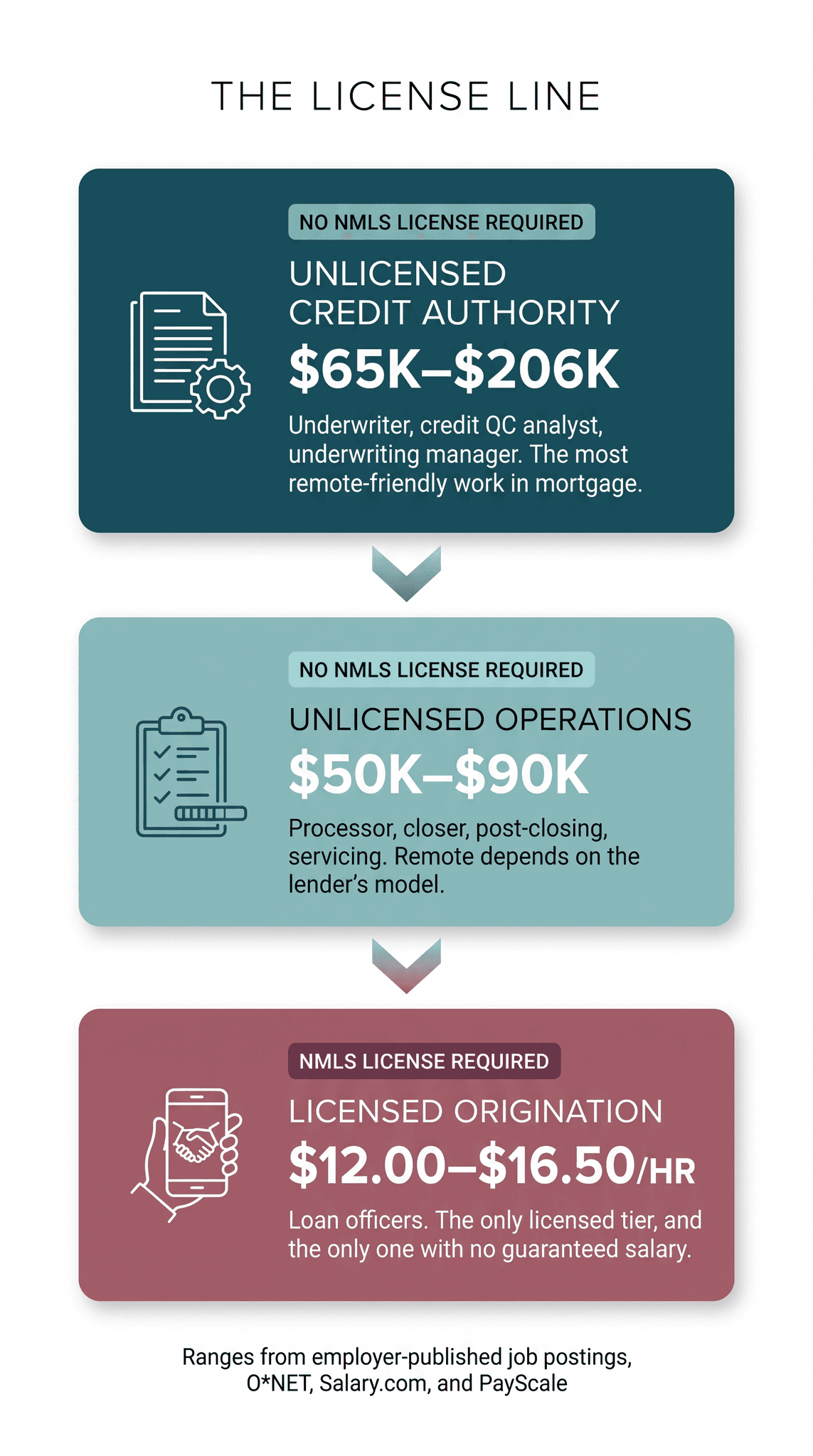
The License Line is the divide between roles that require an NMLS license and roles that don't. Which side you land on determines how you get paid, whether the job is genuinely remote, and how long it takes to start.
Tier 0 — Unlicensed Operations ($50K–$90K). Processor, closer, funder, post-closing, servicing. No NMLS. Hourly or salaried base with a bonus, never commission. Whether these go remote depends entirely on the lender's operating model, not the job itself. Fastest entry, lowest ceiling.
Tier 1 — Unlicensed Credit Authority ($65K–$206K). Underwriter, credit QC analyst, compliance analyst, underwriting manager. No NMLS required. Salaried or hourly with bonus. This is the most remote-friendly function in mortgage, and entry is gated on demonstrated credit judgment rather than a license.
Tier 2 — Licensed Origination ($12.00–$16.50/hr base against commission; advertised target $50K–$200K). Loan officers and mortgage loan originators, plus loan officer assistants who discuss terms with borrowers. Requires 20 hours of NMLS pre-licensing education, a 75% pass on the SAFE exam, a background and credit check, and an employer willing to sponsor you. Remote at direct-to-consumer lenders, onsite at retail branches.
How to use it: before you pay for a 20-hour NMLS course, identify which tier you are actually aiming at. If the job you want sits in Tier 0 or Tier 1, the license buys you nothing. Tier 1 is where the remote money is.
The reason the line falls exactly there is regulatory, not cultural. The SAFE Act of 2008 was a consumer-protection response to the housing crisis, and it regulates who is allowed to talk to a borrower about loan terms. It says nothing about who is allowed to evaluate the file. So the person negotiating your rate needs a license and the person deciding whether you get the loan at all does not.
The license everyone tells you to get is required for exactly one function in mortgage, and it is the one function where remote work pays you $12 an hour to find your own customers.
If you are mapping this against adjacent paths, the same licensing logic shapes remote banking roles and explains why compliance and risk positions tend to be portable. Both sit on the unlicensed side.
Stop Applying Manually
Our AI applies to hundreds of matching jobs while you sleep. Wake up to interviews, not more applications.
How We Collected This Data
The figures in this post come from 43 mortgage job postings collected in August 2026, each one carrying a pay figure published by the employer. Postings were pulled from lender applicant tracking systems directly: Workday, Jobvite, Greenhouse, Lever, Ashby, Rippling, Workable, and SmartRecruiters. We included United States roles in origination, processing, underwriting, closing, post-closing, servicing, and credit QC. We excluded any posting without an employer-stated pay figure, and we excluded postings whose remote claim was contradicted by the description text.
That last exclusion matters more than it sounds. SoFi's Home Equity Loan Closer lists "Charlotte, NC" in its applicant tracking system, but the description says the role "follows a hybrid schedule with an expectation of working onsite at least two days per week." All eight of Tomo Mortgage's roles carry a remote flag, and all eight descriptions say in office Monday through Wednesday. We read every description end to end rather than trusting the badge.
Salary figures were cross-referenced against O*NET occupational data for Loan Officers (13-2072.00) and Credit Analysts (13-2041.00), plus Salary.com and PayScale benchmarks. Ranges reflect base pay. We re-verify quarterly; this reflects August 2026.
This sample is biased, and you should know how. Most mortgage employers publish no pay range at all. The ones that do are disproportionately operating in states with pay-transparency statutes, which means our numbers skew toward California, Washington, New York, Colorado, and Illinois employers. CrossCountry Mortgage runs 29 remote mortgage postings and publishes a range on none of them. Treat these figures as a floor on what is knowable, not a census.
What Remote Mortgage Roles Actually Pay
The aggregator ranges you have been reading are commission-inflated fiction. Indeed reports an average mortgage loan officer salary of $185,329, but fetching its generic loan officer page returns byte-identical data — same figure, same sample size, same date. The mortgage-specific URL quietly redirects to a broader occupation. Glassdoor reports remote mortgage loan processors at $114,901, which is higher than its own figure for underwriters and roughly 2.3 times what ZipRecruiter reports for the same role. These are aggregation artifacts, not salaries.
Here is what employers actually published, organized by The License Line.
| Role | NMLS license | Compensation model | Remote-viability | Published pay (Aug 2026) |
|---|---|---|---|---|
| Mortgage Underwriter | Not required | Hourly or salary + bonus | Highest | $70,000–$80,000 (HomeXpress); $29.80–$53.02/hr by level (Visio Lending) |
| Sr. Agency / Jumbo Underwriter | Not required | Salary + bonus | High | $81,300–$114,400 (Movement); $123,600–$206,000 (M&T Bank) |
| Underwriting Manager | Not required | Salary | High | $110,000–$125,000 (Hometap) |
| Credit QC / Compliance Analyst | Not required | Salary | High | $54,100–$90,100 (M&T Bank) |
| Loan Processor | Not required | Hourly + commission | Model-dependent | $60,000–$80,000 (RenoFi); $60K–$120K target (AmeriSave) |
| Closer / Funder | Not required | Hourly or salary + bonus | Mixed | $63,000–$80,000 (Quontic); manager $74,600–$124,400 (M&T Bank) |
| Servicing / Default | Not required | Salary | Lowest | $70,300–$99,750 by location tier (Point); $85,360–$128,040 analyst (Figure) |
| Post-Closing / Final Docs | Not required | Hourly | Low, paper-bound | approx. $65,000 QC analyst; $15.38/hr final docs (Atlanta, onsite) |
| Loan Officer Assistant | Sometimes | Salary | Moderate | $70,000–$80,000 (Better Mortgage) |
| MLO / Loan Officer | Required | Base against commission | D2C yes, retail no | $12.00–$16.50/hr (AmeriSave); $15/hr DOE (LendingTree) |
These ranges come from the 43 August 2026 postings described above, cross-referenced with O*NET and Salary.com benchmarks for the same period. Where a lender published both an hourly base and an annualized target, both appear, because in origination those two numbers describe completely different things.
Two things in that table deserve more attention than they usually get.
First, the underwriting spread is enormous, and tenure is not what drives it. A general underwriter at HomeXpress posts $70,000 to $80,000. M&T's senior affordable agency underwriter posts $123,600 to $206,000. The difference is not fifteen years of experience. It is the product: agency and affordable-housing work carries Fannie Mae and Freddie Mac guideline complexity that most underwriters never touch, and jumbo and non-QM files require judgment where no automated engine will render a decision. Specialization moves you further than seniority does, which is why Movement's jumbo and non-agency underwriter clears $114,400 while general underwriting sits forty thousand below it.
Second, look at the loan officer row again. The base is real; the ceiling is a projection. AmeriSave and LendingTree are unrelated lenders on unrelated hiring systems and they landed within three dollars an hour of each other. That is not a coincidence, it is the market rate for a remote origination seat where you build your own pipeline.
In mortgage, a published salary range is not a sign of a good employer. It is a sign of a state pay-transparency statute.
If your target is the upper half of that table, it lines up with the broader $100K+ remote roles we track, and with the finance and accounting category generally. The entry band maps to $75K+ positions.
Stop Applying Manually
Our AI applies to hundreds of matching jobs while you sleep. Wake up to interviews, not more applications.
Which Mortgage Roles Are Genuinely Remote
"Remote" in mortgage is not a policy decision. It is a function of what the work physically touches.
Underwriting and credit QC went remote first and stayed remote because the loan file was already digital before anyone went home. An underwriter reads income documentation, pulls credit, checks the appraisal against guidelines, and renders a decision. Every one of those artifacts is a PDF. There is nothing in the workflow that requires a building.
Post-closing, funding, and final documents did not go remote, and the reason is physical. Collateral documents, wet signatures, and recorded instruments are objects. Somebody has to receive them, ship them, and store them. AmeriSave's final docs specialist role is in Atlanta at $15.38 an hour and it is in Atlanta because that is where the paper is.
Servicing is the least remote function in mortgage, and here the constraint is supervisory rather than physical. Default servicing carries compliance exposure that most lenders manage through call monitoring and floor supervision. Newrez writes the arrangement directly into its job titles — "Closing Specialist (On-site)," "Funding Specialist (On-site)" — across South Carolina, Texas, and Arizona. Movement Mortgage requires two to three days a week in Indian Land, South Carolina. The remote exceptions we found, like Figure's servicing portfolio analyst at $85,360 to $128,040, are analytical roles rather than operational ones.
The pattern in ranked order, based on what the postings themselves say:
- Underwriter — most remote-friendly. Visio Lending posts all three underwriter levels remote across 15 named states. Movement's jumbo underwriter sits at a Workday location literally named "Virtual_ID_Capitolbldg-PST Time."
- Credit QC and compliance — M&T puts "Remote" in the job title. AmeriSave tags its post-closing QC analyst as telecommute.
- Loan processor — splits by business model. Remote at direct and centralized lenders like AmeriSave and RenoFi, onsite at branch and retail lenders.
- Loan officer — bifurcated. Direct-to-consumer lenders go remote, retail branch lenders do not.
- Closer and funder — mixed, with funding the least portable.
- Post-closing — splits by seniority, not function. Analyst work goes remote, document handling does not.
- Servicing and default — least remote.
Underwriting is the most remote-friendly seat in mortgage for a boring structural reason: the loan file was already digital before anyone went home.
A remote badge in an applicant tracking system means nothing. All eight of Tomo Mortgage's roles carry a remote flag and all eight descriptions specify in office Monday through Wednesday. SoFi's loan closer shows a city and buries a two-day onsite requirement in paragraph nine. Read the description. Never trust the badge.
Vetting a posting's actual arrangement is the same skill as vetting the posting generally, which is why the job boards worth using are the ones that surface the description rather than the tag. It also affects which roles come with real benefits.
The NMLS License: When You Need It, When You're Wasting Money
The licensing industry sells the 20-hour course to everyone who searches "mortgage career." Only Tier 2 of The License Line needs it.
If you are going into origination, here is the actual path. The SAFE Act requires 20 hours of NMLS-approved pre-licensing education before an individual MLO license is issued. That breaks down as 3 hours of ethics covering fraud, consumer protection, and fair lending, 2 hours on nontraditional mortgage products, and 12 hours of general origination instruction. You then pass the SAFE Mortgage Loan Originator Test with a score of 75% or higher, obtain an NMLS unique ID, submit fingerprints, and authorize a credit report pull. One 20-hour course satisfies the federal minimum in every state, though individual states layer on their own requirements.
Then there is the requirement nobody puts in the course sales page: you cannot hold an active license without an employer sponsoring it. The license is not a credential you carry into interviews. It is something that activates when a lender attaches you to it and deactivates when you leave. Which means the sequence most career-changers assume — get licensed, then get hired — is backwards. You get hired, and sponsorship follows.
If you are targeting Tier 1, put the NMLS course budget into agency guideline training instead. The Fannie Mae Selling Guide is free, public, and is the actual document underwriting postings screen against — start with the income and asset documentation chapters, because that is where files break. Guideline fluency is the difference between the $70,000 general underwriting band and the $123,600 agency band.
How to Break Into Remote Mortgage Work
Your entry path depends on your tier, and the highest-paying tier has the least obvious door.
If you are coming from outside the industry, the underwriting apprenticeship is real and underused. AmeriSave posts a junior underwriter role at $15 an hour targeting $35,000 to $50,000. That is a genuinely low starting number and we are not going to dress it up. It is also a paid entry point into a function that tops out above $200,000 remote, in an industry where the senior seats are chronically hard to fill. You are trading twelve to eighteen months of low pay for entry into Tier 1. Whether that trade is worth it depends on what you are earning now, but the trade exists and most people never see it advertised.
If you are already in mortgage operations, the processor-to-underwriter ladder is the most reliable move in the business. You already read files. The gap is credit authority, and credit authority is granted by demonstrating guideline fluency, not by tenure. Processors who learn agency guidelines get signing authority. That is the whole ladder, and it moves you from a $60,000 to $80,000 band into a $70,000 to $206,000 one without a license.
It is not a clean job. The file comes back from QC three times because the income calculation on a self-employed borrower can be defended two different ways. The borrower will not clear a condition and the rate lock expires Friday. A 4:45pm escalation lands on your desk because the loan needs a decision today and the automated engine kicked it out. Month-end is genuinely bad, every month, because that is when the closing calendar compresses and every file becomes urgent at once.
One thing to go in with your eyes open about: general conventional underwriting is a capped career. The $200,000 seats are agency and jumbo, almost without exception. In our sample the general underwriting roles clustered at $70,000 to $80,000 while the agency and jumbo roles ran $81,300 to $206,000. If you enter Tier 1 and stay on conventional files, you plateau in the eighties. The guideline specialization is not a bonus, it is the entire salary difference.
The reason these jobs are hard to find is mechanical, not competitive. Mortgage lenders buy enterprise hiring software, and aggregators index it badly. The 43 postings behind this article sat across eight different systems: Workday, Jobvite, Rippling, Greenhouse, Lever, Ashby, Workable, and SmartRecruiters. CrossCountry Mortgage runs 29 remote mortgage postings on a tenant most job boards never crawl. Longbridge Financial posts reverse mortgage underwriter and processor roles with "Remote" sitting in the job title and they still do not surface in a standard search. You are not losing these jobs to other applicants. You are losing them to a crawler. Our auto-apply service exists for exactly this shape of problem: many small fragmented sources, each requiring its own application.
Two adjacent reads if your applications are going nowhere: why you are not getting interviews covers the screening failures that kill finance applications specifically, and how to follow up on an application matters more in mortgage than most fields because underwriting teams hire on urgency. Strong Excel skills still carry weight in credit analysis, and the financial analyst path overlaps more than people expect.
Stop Applying Manually
Our AI applies to hundreds of matching jobs while you sleep. Wake up to interviews, not more applications.
Frequently Asked Questions
Do I need an NMLS license to work a remote mortgage job?
Only for origination. Of the 29 remote postings with published pay we reviewed in August 2026, 12 were underwriting roles and none of them required an NMLS license. Under The License Line framework, Tier 0 operations roles and Tier 1 credit roles need no license at all — the requirement applies to Tier 2, meaning loan officers and the assistants who discuss terms with borrowers.
I'm a loan processor. Is underwriting actually a realistic step up, or do I need a degree?
It is the most reliable ladder in the industry and it does not require a degree. What it requires is credit authority, which lenders grant based on demonstrated agency guideline fluency rather than tenure or education. You already read files; the gap is judgment on income calculation, asset documentation, and guideline exceptions. Expect the move to shift you from roughly $60,000–$80,000 into a band that runs to $206,000 at the senior agency level.
Which mortgage jobs are actually fully remote and not just hybrid?
Underwriting and credit QC are genuinely remote — 12 of the 29 remote postings we found were underwriting, and Visio Lending posts all three underwriter levels remote across 15 states. Servicing, funding, and final-document handling are largely not, because they involve physical collateral or supervised call work. Newrez writes "(On-site)" directly into its servicing job titles.
Remote loan officer ads say $50K–$200K. Is that real?
The ceiling is a projection, not a salary. AmeriSave publishes a $12.00–$16.50 hourly base against commission and LendingTree publishes $15/hr DOE — two unrelated lenders landing within three dollars of each other. You can absolutely reach the top of that advertised range, but only by building your own borrower pipeline. Nothing above the hourly base is guaranteed.
Which tier of The License Line should I target if I want to start remote fastest?
Tier 1, unlicensed credit authority. It skips the 20-hour course, the SAFE exam, and the employer-sponsorship dependency entirely, and it is the most remote-friendly function in the industry. Tier 0 has a faster door but a ceiling around $90,000; Tier 2 requires licensing before you can be paid at all.
Can I get a remote mortgage job with no mortgage experience?
Yes, through the junior underwriting route. AmeriSave posts a junior underwriter position at $15/hr targeting $35,000–$50,000, which is a low starting figure in exchange for entry into a function that pays above $200,000 at the senior end. Credit QC and compliance analyst roles are also more open to adjacent finance backgrounds than origination is.
Why do so many remote mortgage postings have no salary range?
Because most states do not require one. CrossCountry Mortgage published a range on 0 of 29 remote mortgage postings, and Newrez published none across 136. The lenders that do publish are concentrated in pay-transparency states like California, Washington, New York, Colorado, and Illinois. A published range tells you about the employer's legal jurisdiction, not its generosity.
Do remote mortgage jobs pay less than in-office ones?
No source we could retrieve publishes a defensible remote-versus-onsite split for mortgage roles. Talent.com appears to show one, listing remote mortgage underwriters at $111,125 against $87,500 for the general title, but its search endpoint keyword-matches posting text, so adding "remote" simply swaps in a higher-paying mix of postings. In our own sample the highest band found, $123,600–$206,000 at M&T Bank, was a remote role.
Start Your Remote Mortgage Career
The whole decision reduces to one question asked early: which side of The License Line are you aiming for? If it is origination, budget for the 20 hours, the SAFE exam, and a sponsoring employer, and understand that your guaranteed pay is the hourly base and nothing else. If it is underwriting, credit QC, or compliance, skip the license entirely and spend that time on Fannie and Freddie guideline fluency, because that is what the $123,600 postings are screening for.
Start with the $100K+ remote roles we track, look at how the same credentialing logic plays out in remote banking and broader finance roles, and if the fragmentation across eight different hiring systems is what's slowing you down, that is what auto-apply was built for. For the wider salary picture, our guide to high-paying remote jobs puts these bands in context alongside remote accounting paths.
A mortgage file doesn't care where it gets read. The industry has known that since the paper went digital — it just kept advertising the one job that still requires you to hustle.
Ready to Find Your Remote Job?
Browse thousands of curated remote jobs or let AI apply for you.
Browse Remote JobsRelated Job Guides

Remote UX Researcher Jobs: What 211 Postings Pay (2026)
Remote UX researcher jobs: we read 211 US postings. Remote seats paid $144K vs $176K hybrid; employer type, statistics and AI work set the $190K+ band.
38 min read
Remote Solutions Architect Jobs: Pay by Seat Type (2026)
Remote solutions architect jobs: we read 1,079 US postings. Vendor pre-sales seats post $205,000 and say remote 81% of the time. AWS listed 4 of 269 remote.
42 min read

Remote iOS Developer Jobs: What 370 Postings Pay (2026)
Remote iOS developer jobs: we read 370 US postings. Apple flagged 26 of 4,384 US jobs Home Office, none of them iOS. Where the remote seats are, and the pay.
48 min read