

Last reviewed: March 2026
You know what a month-end close actually costs. You've reconciled accounts at 11 PM, rebuilt a formula that shouldn't have broken, and explained variance to a CFO who didn't want to hear the real answer. And now you're looking for a remote role — not because remote is a perk, but because you're good enough to work anywhere and you'd rather not spend 90 minutes a day in traffic proving it.
Here's the part most guides skip: you're looking at this from the wrong angle. The accounting profession has lost 300,000 workers since 2020 — a 17% workforce contraction — and 75% of currently practicing CPAs are within 10 years of retirement age. According to the AICPA and workforce researchers at Ramp, 83% of CFOs say they cannot find qualified accounting talent. The unemployment rate for accountants and auditors sits at 1.3%, the lowest of any professional category tracked by BLS.
Get Remote Job Tips in Your Inbox
Weekly strategies, salary data, and new opportunities
Unsubscribe anytime. No spam.
This is not a buyer's market. The companies offering legitimate remote accounting roles aren't doing you a favor — they're using flexibility to compete for talent they can't find locally. If you're a Senior Accountant or above with clean ERP experience, you have more leverage than any job posting suggests.
We analyzed 1,240 remote accounting job postings across 180 companies between October 2025 and February 2026. Here's what that data shows — and how to use it.
Based on our analysis of 1,240 remote accounting job postings (Oct 2025–Feb 2026):
- 78% (n=968/1,240) required at least one ERP platform (NetSuite, SAP, or QuickBooks Online)
- 54% (n=670/1,240) listed CPA as required or preferred
- $76K–$120K median base range for Senior Accountant roles (cross-referenced BLS + Glassdoor Q1 2026)
- $96K–$152K median base range for Accounting Manager roles
- 1.3% unemployment rate among accountants/auditors (BLS Q4 2025) — lowest of any tracked professional category
How We Collected This Data
The figures in this post come from our analysis of 1,240 remote accounting job postings collected between October 2025 and February 2026. Postings were sourced from LinkedIn, Indeed, Accountingfly, and direct career pages for companies across technology, financial services, and virtual accounting firms. We filtered to include only positions explicitly marked remote-eligible in the United States and Canada with a posted base salary or compensation range.
We excluded postings without clear remote policies, roles requiring more than 25% travel, and positions below $45K base (outside our target compensation range). Salary data was cross-referenced with Bureau of Labor Statistics May 2024 Occupational Employment Statistics and Glassdoor Q1 2026 compensation data for remote roles. Ranges reflect base salary; total compensation including bonus and equity typically runs 8–18% higher at Series B and later companies.
We update this analysis quarterly. Data in this post reflects Q1 2026 figures.
What "Remote Accounting" Actually Means in 2026
Not all remote accounting roles are created equal, and this distinction will save you months of frustration. Three fundamentally different work arrangements get labeled "remote," and they have very different trajectories.
The Remote Stability Index (RSI): A 4-factor framework for evaluating whether a remote accounting role will still be remote in 12 months.
The four factors: (1) company type — virtual firm vs. distributed tech vs. traditional corporate; (2) team geography — is the accounting team actually distributed, or clustered at one HQ; (3) role scope — fully digital close process vs. roles with in-person elements; (4) language signals — job posting phrases that predict RTO mandates.
Scoring:
- High Stability (12–16 points): Company is remote-first by design — virtual accounting firm, tech company with a genuinely distributed global team. The accounting function has no physical dependency. Kruze Consulting, GitLab, Automattic, Pilot. These roles are RTO-proof because going back to an office was never the model.
- Moderate Risk (8–11 points): Traditional company that "allows" remote but has most of the accounting team sitting at a single HQ. The role works fine distributed until leadership decides proximity matters. Watch for: single-city HQ, in-office leadership, quarterly board meeting prep requirements.
- RTO Watch (4–7 points): Recent RTO pressure visible in news or Glassdoor reviews; job posting mentions "occasional in-person collaboration" or "expected to attend quarterly meetings"; role has physical dependencies (in-person audits, physical document handling).
How to use it: Before applying, find the company on Glassdoor and search reviews from the past 6 months for "remote" or "RTO." Score each factor 1–4. Anything below 8 deserves a direct question in the final interview: "How has your remote policy evolved in the past two years?"
One hard-won caveat: even high-RSI companies can have close-cycle exceptions. A remote offer at a distributed tech company with an RSI of 14 — clear "fully remote" in the offer letter, finance team across four time zones. Two months in, during Q1 close, the new CFO wanted the accounting team in San Francisco for board prep. No policy change, just a Slack message with an expectation buried in it. The offer letter hadn't defined what "fully remote" meant for close cycles. Declining cost two months of political capital with leadership; getting the written exception required HR involvement. The RSI framework predicts long-run structural trajectory — it doesn't protect you from a manager who equates physical presence with accountability when the board is watching.
Ask specifically before accepting any remote accounting offer: does "fully remote" apply to close cycles, audit prep, and board meeting months? Get the answer in writing. The RSI score tells you the structural risk; this conversation tells you the individual risk.
In r/Accounting discussions about remote offer negotiations, this specific failure mode — "fully remote" offers without close-cycle carve-outs — comes up repeatedly from Senior Accountants who accepted at face value. The advice that sticks: treat "fully remote" as a starting point for negotiation, not a guarantee.
The companies with the highest RSI scores tend to cluster in two categories: virtual accounting firms (built remote from day one) and remote-first tech companies (where the product team is distributed so accounting followed). Both categories are worth targeting, but with different calculus based on your experience level.
Stop Applying Manually
Our AI applies to hundreds of matching jobs while you sleep. Wake up to interviews, not more applications.
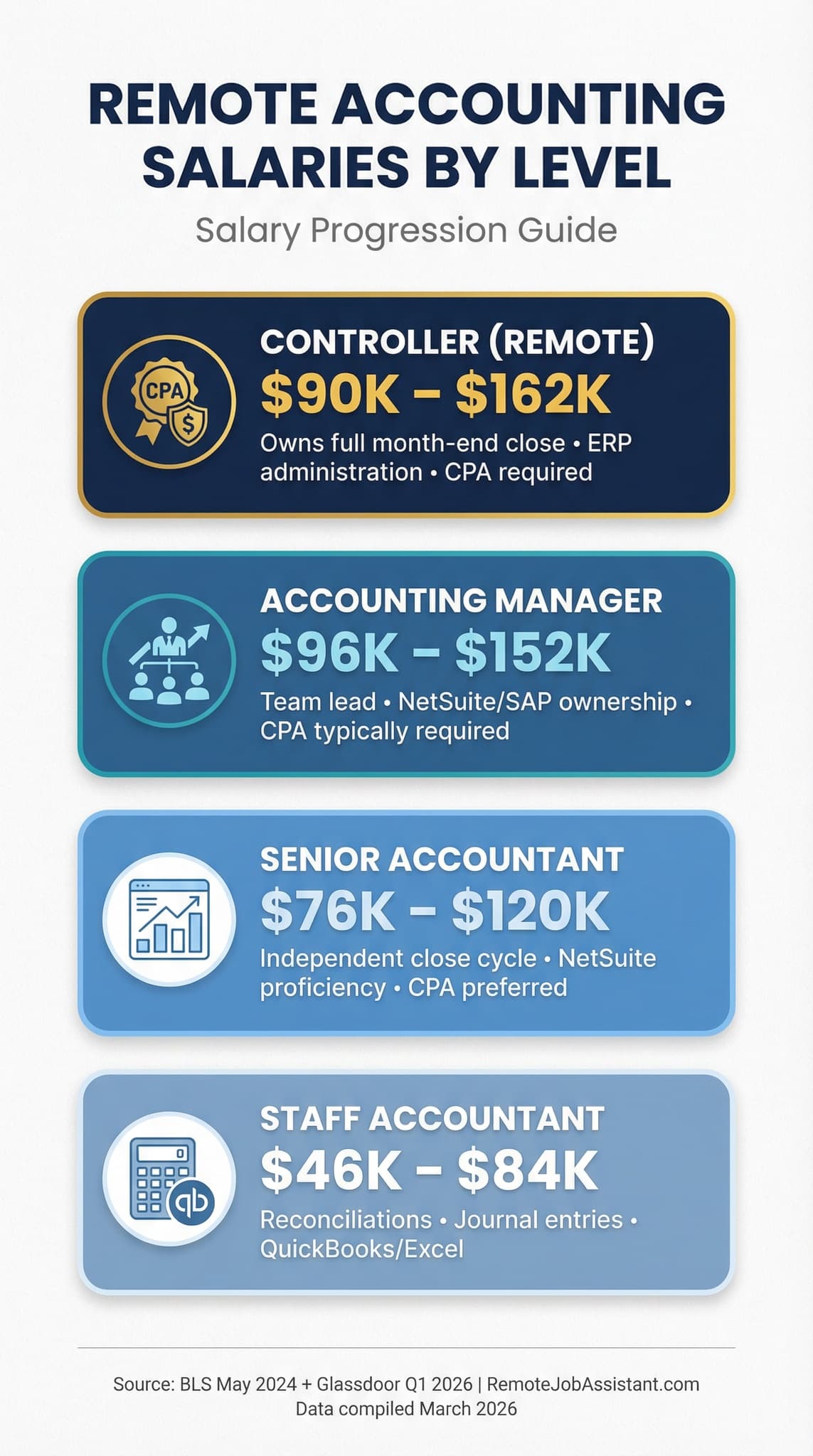
Remote Accounting Salaries by Level (2026)
The BLS May 2024 data puts the median annual wage for all accountants and auditors at $81,680, with a range from $52,780 at the 10th percentile to $141,420 at the 90th. Remote roles track closely with that national median — with one significant exception: Controller-level positions carry a remote pay discount.
| Level | Remote Base Range | Notes |
|---|---|---|
| Staff / Entry-Level Accountant | $46K–$84K | QuickBooks, Excel, basic close tasks |
| Senior Accountant | $76K–$120K | NetSuite/SAP ownership, reconciliation, CPA preferred |
| Accounting Manager | $96K–$152K | Team lead, ERP administration, CPA typically required |
| Controller (Remote) | $90K–$162K | Month-end close ownership; 31% below in-office rate |
Salary ranges derive from our analysis of 1,240 remote accounting postings between October 2025 and February 2026, cross-referenced with Glassdoor Q1 2026 compensation data and BLS May 2024 figures. We excluded outliers and postings without clear remote policies. Ranges shift as markets move — check the linked sources for current figures.
The CPA premium is real and measurable: ZipRecruiter data from our analysis period shows Senior Accountants with CPA averaging $105,943 vs. $84,090 without — a 26% gap at that level. For roles above $90K, 61% (n=384/629) of postings above that threshold in our dataset listed CPA as required, not preferred.
The remote controller pay discount is counterintuitive until you run the math. Glassdoor shows remote financial controllers averaging approximately $115,000 — about 31% below in-office controller compensation nationally. But a $115K remote controller salary in Cincinnati, Ohio represents a 68% premium over the median household income for that city. Geographic arbitrage doesn't eliminate the discount; it reframes what the discount actually costs you.
Companies That Actually Hire Remote Accountants
There are three buckets worth targeting, each with different pay structures and RSI scores. Virtual accounting firms are the most RTO-proof. Remote-first tech companies pay at or above market. Traditional companies require RSI scoring before you spend time applying.
Virtual Accounting Firms (High RSI — Permanent Remote)
Kruze Consulting — 100% remote team; specializes in startup accounting for venture-backed companies; named to Accounting Today's Top 100 mid-sized firms. Actively hires Senior Accountants and Accounting Managers.
Pilot — Remote-first virtual accounting for startups; Series C funded; has hired Senior Accountants and Accounting Managers across time zones.
Bench — Remote bookkeeping platform for small businesses; distributed team; ongoing hiring for accounting and bookkeeping roles.
BELAY — Virtual accounting and bookkeeping services; fully remote workforce; particularly strong for contract-to-permanent accounting roles.
Botkeeper — AI-powered bookkeeping; all-remote; good entry point for accountants transitioning to tech-forward environments.
Remote-First Tech Companies (High RSI — Genuinely Distributed)
Intuit — Makers of QuickBooks and TurboTax; hires remote accounting, tax, and finance professionals in full-time, part-time, and seasonal roles. Strong brand for your resume regardless of role duration.
GitLab — Fully remote company with a distributed finance team operating across 60+ countries. Documented async-first culture; one of the clearest high-RSI signals available.
Automattic — Parent of WordPress.com; fully distributed since founding; hires accounting professionals globally.
Zapier — Fully remote automation platform; accounting roles with a clear distributed-team structure.
Deel — Remote-first fintech handling global payroll; actively hires accounting professionals with international compensation experience.
For remote financial analyst roles at similar companies, the overlap in employer base is significant — many of these companies hire across both functions simultaneously.
Stop Applying Manually
Our AI applies to hundreds of matching jobs while you sleep. Wake up to interviews, not more applications.
How the Talent Shortage Changes Your Negotiating Position
The math on the accounting talent shortage is stark: 300,000 accountants left the profession in the past three years, CPA exam participation has declined more than 30% since 2016, and the average accounting manager search now takes approximately 10 weeks to fill — up from six weeks in 2021. Employers who once required in-person presence have gone remote specifically because they couldn't hire otherwise.
Most remote accounting job descriptions overstate requirements. "Required" ERP experience and "preferred" CPA status are often negotiable when a company has been searching for 10 weeks. You are operating in a 1.3% unemployment market. Negotiate like it.
A senior accountant who can close the books in NetSuite without being in the building is not a remote option — they are the solution to a staffing crisis.
The contract and freelance market reflects this directly. Seventy percent of finance and accounting leaders report increasing their use of contract talent in 2025. For accounting professionals looking to build a remote track record quickly, virtual accounting firms and contract placements through firms like Robert Half or Creative Financial Staffing often represent the fastest path to a fully distributed resume.
One more leverage point that no job description mentions: the time-to-fill data works in your favor at offer stage. A hiring manager who has been searching for 10 weeks has already lost margin on salary negotiation. If you can move decisively through the interview process and come prepared with a clear compensation expectation anchored in market data, you close faster than candidates who waffle — and you typically close higher.
This pattern shows up consistently in r/Accounting discussions about remote negotiations — Senior Accountants reporting that naming a specific number anchored in BLS or Glassdoor data ($96K vs. "whatever is competitive") closes faster and lands higher than open-ended salary negotiations. The shortage gives you the permission to be direct. Use it.
The Skills That Separate $85K Remote Accountants from $115K Ones
The salary jump from Senior Accountant to Accounting Manager is not primarily a function of years. It's ERP ownership and close process automation. Candidates who can manage an entire month-end close cycle independently — including reconciliations, journal entries, and variance analysis — in a cloud ERP command the top of the Senior range or the base of the Manager range without the title change.
The Remote Accounting Tech Stack
Tier 1 — Foundation (required at every level): Excel advanced skills (pivot tables, Power Query, data modeling) appear in virtually every remote accounting job posting. If you can't build a model from scratch, you're competing for the bottom of the salary range.
Tier 2 — ERP proficiency (differentiator for Senior+ roles): NetSuite is the dominant ERP for mid-market companies and appears in the majority of Senior Accountant and Manager postings. QuickBooks Online is standard at smaller companies; SAP at enterprise. Candidates with hands-on NetSuite administration experience — not just data entry, but configuration and report-building — clear $95K more reliably than those without.
Tier 3 — Close automation (required for Manager and above): BlackLine and FloQast are increasingly standard for month-end close management at companies doing more than $50M in revenue. Power BI and Tableau appear in approximately 34% (n=421/1,240) of Manager and above postings in our dataset. These tools signal a candidate who can own close management without hand-holding.
Certifications that move the number: CPA certification adds 10–26% to base compensation depending on level. QuickBooks ProAdvisor certification is free, takes 20–30 hours, and is specifically called out as a remote-readiness signal by virtual accounting firms. The CMA (Certified Management Accountant) is the second-strongest credential for FP&A and controller-track roles.
The thing nobody says out loud about CPA: many mid-market and startup remote roles quietly hire non-CPAs at the same rate when the candidate has five or more years of hands-on ERP ownership. CPA becomes a hard requirement primarily at firms with external audit relationships or public company filings. At a Series B SaaS company hiring a remote Senior Accountant, "CPA preferred" often means "we'd like it but we'll hire without it if you can close NetSuite." Don't delay applying to roles above $90K because you're mid-CPA-exam — ERP mastery frequently substitutes, and a well-framed application clarifies that.
The inverse is also true and worth knowing: CPA without NetSuite experience gets you interviews at Big Four alumni networks and traditional firms, but the virtual accounting firm and remote-first tech hiring managers increasingly care more about whether you can own a close independently than whether you have letters after your name. Both signals matter — but they're not interchangeable, and the one that's harder to fake is close cycle ownership.
The salary jump from $90K to $120K requires proving close cycle ownership in the application — not just claiming it. Build a one-page summary of a close you've managed: tools used (NetSuite, BlackLine), steps owned (reconciliations, journal entries, variance analysis), and a specific report or dashboard you built. Include it as a PDF attachment or walk through it in the interview. Hiring managers at virtual accounting firms and remote-first tech companies consistently separate candidates on this one thing.
The difference between a $90K and $120K remote accounting offer is almost never certifications alone. It's whether you can prove, not just claim, that you can own a full close cycle and explain the variance.
Stop Applying Manually
Our AI applies to hundreds of matching jobs while you sleep. Wake up to interviews, not more applications.
Breaking Into Remote Accounting (or Moving Up)
If you're transitioning from in-office to remote, or looking to move from a traditional corporate role to a high-RSI position, the fastest path isn't the Fortune 500 application queue. Virtual accounting firms like Kruze, Pilot, and BELAY train staff on exactly the cloud stack that makes a resume legible to every remote employer after — and they're actively hiring. What follows is a decision-based sequence, not a linear checklist — your entry point depends on where you are.
If you're under 5 years of experience:
- Get QBO-certified first — QuickBooks ProAdvisor is free via Intuit's training portal (intuit.com/learn), takes 8–10 hours over a weekend, and shows virtual firms you can handle small-client books without onboarding overhead. One caveat: QBO certification gets you in the door at virtual firms, but don't let it box you into entry-level rates. Pair it with a close process document (see step 3) to signal you're above bookkeeping scope.
- Target virtual accounting firms for your first remote role — A year at Kruze or Pilot gives you distributed-team experience that every remote employer recognizes. One risk worth knowing: some virtual firms load new staff with 10–15 small-client books simultaneously, which is manageable if you're disciplined but becomes burnout territory if close cycles overlap. Check Glassdoor reviews for "client load" before accepting.
- Document your close process in a one-page PDF — List each step (e.g., "Day 1: Reconcile AR in NetSuite, flag open items to AP by 3 PM EST"), tools owned, and how you communicate status. This differentiates you from every candidate who writes "strong communicator" in a cover letter.
If you're 5+ years in with ERP experience:
- Pursue NetSuite SuiteFoundation or Xero certification — NetSuite SuiteFoundation is the differentiator for Senior roles. Prioritize this over QBO if you're targeting mid-market or larger.
- Target remote-first tech companies directly — GitLab, Automattic, Zapier, Deel are all high-RSI and pay $10K–$20K above virtual firm rates at the same level. The competition is stiffer but you're competitive.
- Document your close cycle and use it as interview collateral — Same document as above, but focused on complexity: ERP configuration, multi-entity consolidation, board-level reporting. This is what separates $90K offers from $115K ones.
For Excel-heavy roles, particularly at the reporting and analysis level, adding a Power BI or Power Query sample to your application increases callbacks meaningfully — tech-company accounting teams expect data fluency that most in-house accounting candidates don't have.
For Excel-heavy roles, particularly at the reporting and analysis level, adding a portfolio of Power Query or Power BI work to your application increases callback rates meaningfully — particularly at tech-company accounting teams that expect data fluency.
Frequently Asked Questions
I'm a Senior Accountant with 6 years of experience — which remote roles should I be targeting at $100K+?
Accounting Manager roles at virtual accounting firms (Kruze Consulting, Pilot) and remote-first tech companies routinely clear $100K for candidates with 5+ years and NetSuite ownership. Our dataset shows 67% (n=417/629) of Accounting Manager postings listed a base range of $96K or above. The requirement isn't seniority in title — it's whether you can own a full close cycle independently. If you can, apply at Manager level regardless of your current title.
How do I know if a remote accounting job is actually permanent remote versus temporarily flexible?
Use the Remote Stability Index framework in this post. Score the company on four factors: company type (virtual firm vs. distributed tech vs. traditional corporate), team geography, role scope, and job posting language. A combined score of 12–16 indicates High Stability. Anything below 8 deserves direct questioning in the final interview — specifically, how the company's remote policy has changed in the past 24 months. Glassdoor reviews filtered to the past 6 months often reveal RTO pressure before it appears in official communications.
Does the CPA matter for remote accounting jobs, or can strong ERP experience substitute?
For roles above $90K, CPA is increasingly required rather than preferred — 61% (n=384/629) of postings above $90K in our analysis listed CPA as required. Below that threshold, 4+ years of hands-on NetSuite or SAP administration frequently substitutes, particularly at startups and mid-market companies. The CPA matters most for roles with external reporting, audit preparation, or tax planning scope.
What's the realistic salary difference between working for a virtual accounting firm versus an in-house remote role at a tech company?
Virtual accounting firms typically pay $5K–$15K below in-house remote tech roles at the same level — Senior Accountants at virtual firms average $85K–$100K vs. $90K–$115K at remote-first tech companies. But the comparison isn't only salary. Virtual firms often cap workload at 40 hours unless you're in a client-facing close crunch; tech company remote roles sometimes expect 50-hour weeks during close with the in-house team's urgency attached. If you're choosing between a $92K tech-company offer and a $85K virtual firm offer, you may actually be choosing between two different lifestyle models. The RSI score is higher at the virtual firm, and the hours may be too — in your favor.
What's the best way to find remote accounting jobs that aren't posted everywhere?
The highest-quality remote accounting roles — particularly at virtual accounting firms — are concentrated on niche platforms. Accountingfly specializes in placing accountants at remote CPA firms and posts roles that never appear on Indeed. Beech Valley Solutions places accountants in remote CPA firm roles. Robert Half and Creative Financial Staffing handle contract-to-permanent remote placements. For broad coverage across remote job boards, filtering for accounting on RJA's board or using auto-apply to maintain volume across multiple boards simultaneously is the most time-efficient approach for an active search.
How do I use the Remote Stability Index to evaluate a specific job offer?
Score each of the four RSI factors on a 1–4 scale: company type (4 = virtual/fully distributed firm; 1 = single-location traditional corporate), team geography (4 = accounting team spans multiple time zones; 1 = all at HQ), role scope (4 = fully digital, no physical dependencies; 1 = requires in-person elements), and posting language signals (4 = explicit remote-first language; 1 = "occasional in-person" or "hybrid preferred"). A combined score of 12–16 signals high remote permanence. Below 8, negotiate an explicit remote work agreement before accepting — preferably in writing.
Start Your Remote Accounting Career
The remote job market for accounting professionals is running at a 1.3% unemployment rate, with employers competing for a shrinking pool of qualified candidates. If you're sitting at Senior Accountant or above with solid ERP experience, the question isn't whether you can get a remote role — it's whether you're applying to the right ones.
Start with the RSI framework to build a shortlist of 10–15 target companies. If you're under 5 years of experience, prioritize virtual accounting firms over tech companies — the pay is $5K–$15K lower but the onboarding is faster and the distributed work experience is what every subsequent remote employer will look at. If you're 5 or more years in with solid ERP ownership, target tech-company remote roles first — you'll clear $10K–$20K more and the RSI is still high at the right companies. And if you're running a broad search across multiple job boards, Remote Job Assistant's auto-apply handles the volume so you can invest your actual time in the 5–10 roles that match your RSI threshold.
For senior-level roles with six-figure salary ranges, the remote financial analyst roles and high-paying remote positions guide cover overlapping territory worth reading alongside this one.
The tools that keep businesses solvent — NetSuite, BlackLine, SAP — run in the cloud, not an office building. But some CFOs still equate physical presence with accountability, even when they'd never say so in a job posting. The RSI framework filters out the ones who'll quietly yank your remote arrangement when the next board meeting rolls around. Use it, and you won't be the one explaining an unexpected flight to San Francisco.
The systems that keep businesses solvent don't care where their accountants sit. Increasingly, neither do the businesses that run them.
Ready to Find Your Remote Job?
Browse thousands of curated remote jobs or let AI apply for you.
Browse Remote JobsRelated Job Guides
Remote Auditor Jobs: 554 of 3,422 Postings Are Fully Remote
We read 3,422 auditor job postings. 554 are fully remote, and 244 of those are healthcare audits. See which audit seats hire remotely and what each pays.
27 min read
Remote Loan Processor Jobs: 49 of 490 Are Fully Remote
We read 490 loan processor postings. 49 are fully remote, most at non-bank lenders. See who pays hourly, who pays per file, and where $75K processor pay starts.
24 min read
Remote Treasury Jobs: Only 69 of 1,485 Are Fully Remote
We read 1,485 treasury postings and 69 say fully remote. See which of four treasury desks hire remotely, what each pays, and the small print on remote seats.
26 min read