
Last reviewed: September 2026
You passed the exams. You sat through the study hours, the once-a-year sittings, the raise-per-exam schedule that turned your twenties into a spreadsheet. Then your carrier announced four days in the office, and you typed "remote actuary jobs" into Google for the first time.
What came back was a grid. LinkedIn says 1,000+. Indeed says 551. ZipRecruiter offers a city average with no sample size behind it and, on one page, a title tag that reads "$115k-$110k," a range that runs backwards. Two actuarial recruiters round out page one with their own listing grids. Not one result is an article, and not one tells you the single fact that decides your odds: which line of insurance the posting sits in.
Get Remote Job Tips in Your Inbox
Weekly strategies, salary data, and new opportunities
Unsubscribe anytime. No spam.
Because that is the whole story. Remote actuarial hiring is concentrated in one kind of employer, and the carriers most actuaries work for are the ones pulling people back into the building. A health plan and a life carrier can post the same title, the same credential requirement, and the same week, and one of them will be remote seven times out of ten while the other will be remote about one time in seven. We analyzed 153 US actuarial job postings across 42 insurer, health-plan, reinsurer and consulting job boards on September 21, 2026, and read every description body rather than the remote flag. Here is what the postings actually say.
Based on our sweep of 42 employer job boards on September 21, 2026 (153 US actuarial postings after removing interns, non-actuarial titles and non-US locations):
- 33% (n=50 of 153) were genuinely remote after reading the description body, not the location tag
- 70% (n=30 of 43) of health-plan and pharmacy-benefit-manager postings were remote, against 17% (n=9 of 52) at property and casualty carriers, 12% (n=4 of 33) at life and annuity carriers, and 6% (n=1 of 16) at actuarial consulting firms
- 8 of 8 Nationwide postings were remote, which makes one company 9 of the 13 remote carrier roles in the sample
- 7 of 153 listed "Remote" or telecommuting in the location field but described a hub-office or commuting-radius policy in the body
- 79% (n=121 of 153) published a base salary range, the highest disclosure rate of any role we have analyzed
- $118K–$197K median posted range on remote postings (n=38) against $128K–$191K on hybrid postings (n=69)
- 11 of 50 remote postings restricted remote work to a named list of states
- $130,000 national median for Actuaries, SOC 15-2011.00 (BLS 2025 wage data, accessed via O*NET), with roughly 2,400 openings a year projected through 2034
The 70% against 17% split is real, and it comes with a catch the listing grids cannot show you: some of the carrier postings that say "Remote" in the location field turn out to be three-day hybrid jobs in the body, and some of the health-plan postings that are genuinely remote tell you which states you may live in and which time zone you will keep. Both halves are below.
The Filing Calendar Test
An actuary's remote odds are not set by the credential, the level, or the city. They are set by what the deliverable physically is and whose calendar it runs on. That is the idea behind the framework we use for the rest of this post.
The Filing Calendar Test: a 1–10 score for how remote-portable an actuarial seat is, based on whether its output is a document filed on a regulator's calendar, a price negotiated with people in a building, or a governed model reviewed where it lives.
Scoring:
- 8–10 Filing-Driven ($100K–$158K median posted range at health plans; insurtech higher): Output is a filed document with a federal or state due date: a Medicare Advantage bid, an ACA rate filing, a Medicaid capitation rate, a risk-adjustment or trend file. Inputs are claims data, which arrive as files. Measured remote share: 36 of 52 postings (69%). Employers in this band: Humana, Centene, CareSource, Highmark, Blue Cross NC, Horizon, Prime Therapeutics, Oscar, and the insurtechs Lemonade, Kin, Openly and Pie.
- 4–7 Underwriter-Adjacent ($118K–$195K median, P&C carriers): Output is a price or a reserve that gets negotiated with underwriters, claims and product people who sit somewhere specific. Measured remote share: 9 of 52 (17%), and 8 of those 9 are Nationwide. Employers: AIG, The Hartford, Travelers, USAA, GEICO, CNA, Everest, Arch.
- 1–3 Model-Governed ($145K–$205K median at life carriers; $107K–$191K in consulting): Output is a governed model, such as statutory valuation, PBR and LDTI reporting, asset-liability management or pension valuation, reviewed under a model-risk framework in the building. Or it is consulting work delivered wherever the client sits. Measured remote share: 5 of 49 (10%). Employers: Pacific Life, Transamerica, Prudential, Venerable, Mercer, Oliver Wyman.
How to use it: Score the seat, not the company. Then read the hub-office section below, because a band-5 seat can be tagged remote and still be hybrid, and Nationwide proves a band-5 seat can be fully remote when an employer decides it should be.
The reason the calendar matters is not cultural. A Medicare Advantage bid is due to CMS by the first Monday in June, a date written into 42 CFR Part 422, Subpart F, whether or not anyone is in Louisville. A rate filing goes to a state department of insurance as a PDF. The people who build those files can be anywhere the claims data can be, and the biggest health plans figured that out and built distributed actuarial teams around the bid cycle. A reserve review at a P&C carrier is a meeting. A valuation sign-off at a life carrier is a governance event with a model-risk function in the room. Those are presence problems, and no amount of SQL fixes a presence problem.
Stop Applying Manually
Our AI applies to hundreds of matching jobs while you sleep. Wake up to interviews, not more applications.
How We Collected This Data
Two public, unauthenticated applicant-tracking-system sweeps, both run on September 21, 2026.
The first swept 1,809 employer board tokens, including roughly 200 insurer, reinsurer, insurtech, health-plan and actuarial-consulting slugs added for this post, against the Greenhouse, Lever, Ashby and SmartRecruiters APIs. 2,360 boards responded with 44,315 live postings, and exactly 17 titles contained "actuar." Insurers are not on startup ATS platforms, so this sweep contributed the insurtech rows and almost nothing else.
The second swept 50 validated Workday tenants (insurers, reinsurers, health plans, pharmacy benefit managers and actuarial consultancies) for "actuary" and "actuarial," and fetched the full posting body for every hit. That returned 331 actuarial-titled postings. We removed interns, co-ops, summer programs and early-careers reqs; non-actuarial titles that carry the word (a software engineer on an actuarial platform is an engineer); and every non-US location, which took out Manulife's Asia postings, Prudential's Asia and Africa postings, PwC's European and Asian offices, Allstate Canada, Mercer Calgary and Cigna Hong Kong. Postings were deduplicated by board, title and description fingerprint. That left n=153 US actuarial postings across 42 employer boards.
Work model was classified from the description body, never the ATS flag. Workday's remote-type field was blank on 112 of the 153 postings, and the location field lies in both directions: The Hartford lists "United States - Remote" as a location on roles whose body says three days a week in Hartford, and Prime Therapeutics lists "Home" with a title ending in "REMOTE" and no policy sentence at all. Pay figures are employer-posted base ranges only (n=121). We cross-referenced the occupational baseline against O*NET's republication of the BLS wage series for Actuaries, SOC 15-2011.00 and the Ezra Penland 2025–26 Actuarial Salary Surveys.
Four gaps, stated plainly. Reddit is blocked to automated access, so nothing here reflects practitioner sentiment. BLS.gov returns 403 to automated requests, so the wage series was read through O*NET, which labels its source. Glassdoor and ZipRecruiter figures were visible only in search snippets and appear here as evidence of what page one says, not as data. And Liberty Mutual, Progressive, State Farm, MetLife, Lincoln, Unum, Milliman, WTW and Aon run career sites with no open endpoint, so they are absent; treat the carrier and consulting counts as floors, not totals. Figures reflect postings live on September 21, 2026.
Which Actuarial Employers Actually Post Remote Roles
The job boards treat "actuary" as one market. The postings describe three, and the split between them is not close.
| Employer type | Postings | Remote | Remote share | Hybrid or office | Hub-conditional | Boards in sample |
|---|---|---|---|---|---|---|
| Health plans and PBMs | 43 | 30 | 70% | 11 | 2 | Humana, Centene, CareSource, Highmark, Blue Cross NC, Horizon BCBSNJ, CVS/Aetna, Cigna, Elevance, Oscar, Prime Therapeutics, Brown & Brown |
| Insurtechs and startups | 9 | 6 | 67% | 1 | 0 | Lemonade, Kin, Openly, Pie, Coalition, Akur8, Waymo |
| P&C carriers and reinsurers | 52 | 9 | 17% | 32 | 4 | Nationwide, AIG, The Hartford, Travelers, USAA, GEICO, Allstate, CNA, Everest, Arch, AXIS, MS&AD |
| Life, annuity and retirement carriers | 33 | 4 | 12% | 26 | 1 | Pacific Life, Transamerica, Prudential, Venerable, Penn Mutual, TruStage, RGA, Guardian, NAIC |
| Actuarial consulting | 16 | 1 | 6% | 15 | 0 | Mercer, Oliver Wyman, Nyhart |
All counts from our September 21, 2026 sweep, n=153. Eleven postings stated no work model anywhere and are excluded from the hybrid column.
Health plans at 70% is a structural number, not a policy fad, and the postings are candid about what the work is. Centene's remote Associate Actuary "supports quarterly forecasting, Medicare bid target setting, and key business decisions." Humana's remote pricing actuary is hired for "Medicare Advantage bid filing" and asked to keep Eastern hours. Remote at a health plan does not mean bid season goes away; it means bid season happens in your house, on the regulator's clock. What it does mean is that the location field is telling the truth. Humana posts eight actuarial roles, all "Remote Nationwide," with the only travel language being "occasional travel to Humana's offices for training or meetings." Highmark posts five, every one of them "Working at Home" in a named state. Centene posts three with a location field that lists fifteen states, one per line, "Remote-CA, Remote-TN, Remote-KS." CareSource posts four, all "Remote." These are the employers whose actuarial output is a Medicare bid, a Medicaid rate certification or an ACA filing, and whose inputs are claims. Note the state scoping, though: 11 of the 51 remote postings in the sample name the states you are allowed to live in, and health plans wrote most of them. "Remote Nationwide" and "Remote-KS" are not the same job.
Carriers at 17% and 12% have written their policies into the postings. Pacific Life posts sixteen actuarial roles from Newport Beach, Omaha and Charlotte, and eleven of the sixteen say "on-site 4 days"; the other five say "hybrid schedule." USAA says "on-site four days." AIG says the company asks "team members to be primarily in the office." GEICO says "Hybrid three days a week." Elevance says "2 days per week." Prudential says the arrangement "is hybrid or virtual and may require your on-site presence on a reoccurring basis as determined by your business," and that "your manager will provide additional details," which is a policy that will be announced to you after you accept. Ten boards with three or more postings each had zero remote roles: Pacific Life, Mercer and Oliver Wyman, AIG, The Hartford, Elevance, Everest, MS&AD, CNA, Prudential and Travelers.
Consulting at 6% is the client's calendar, not the firm's. Mercer and Oliver Wyman's fifteen actuarial postings all state "three days per week" or "hybrid role." A consulting actuary's deliverable is delivered where the client is, and the client is a carrier.
The Nationwide exception
Nationwide posted eight actuarial roles across P&C pricing, life valuation, life experience studies and group benefits, and all eight are remote. The language is unambiguous: "This role can be staffed fully remote." "Choose a fully remote work arrangement or work from Nationwide's Columbus, Ohio headquarters." The posted ranges run from $118K–$222K for senior associates and consultants to $154K–$290K for an AVP.
Say the carrier number both ways, because both are true. With Nationwide, P&C and life carriers posted 13 of 85 roles remote (15%). Without Nationwide, they posted 5 of 77 (6%). A carrier actuary who wants to stay in P&C or life and go remote is, on this sample, mostly looking at one employer.
The remote actuary market is a health-plan market. Health plans, PBMs and insurtechs posted 69% of their actuarial roles remote; P&C and life carriers posted 15%, and most of that 15% is one company.
The Hub-Office Clause
The most expensive mistake in this search is trusting the location field. Seven of the 153 postings list "Remote" or telecommuting as a location and then describe, further down, a policy that is hybrid or geographically fenced for most of the people who will apply. Four patterns, quoted.
The hub-consideration pattern. The Hartford lists four of its nine actuarial postings with Hartford, Charlotte and Chicago as locations and "United States - Remote" alongside them. The body reads: "This role can have a hybrid work arrangement (Tuesday – Thursday in office) in hub offices located in Hartford CT, Chicago IL, Charlotte NC, or Columbus OH. Candidates who do not live near one of these office locations may be considered for a remote work arrangement with occasional travel." Read that as a remote job for people in Boise and a three-day hybrid job for anyone within commuting distance of a hub, at the company's discretion.
The distance-rule pattern. Blue Cross NC tags roles "Remote Flex" and explains: "In a Hybrid-Flex role, you'll work in the office at least two days a week for collaboration and connection. In a Remote Flex role, you'll work virtually, with a few in-office visits each year for meaningful moments that matter. Whether your role is Hybrid Flex or Remote Flex depends on the nature of the work and distance from our Durham headquarters." The posting decides your work model after it knows your address.
The future-hub pattern. Oscar says, in one posting: "You will be fully remote; however, our approach to work may adapt over time. Future models could potentially involve a hybrid presence at the hub office associated with your metro area." That is a remote job with a disclosed reversion clause.
The commuting-radius pattern. RGA lists an Actuary, Americas Risk Management role as telecommuting-eligible and then states: "A qualified applicant must reside within commuting distance of the Chesterfield, MO office, as occasional on-site work is required." That is a St. Louis job with a home-office chair, and it is the reason we count it as hub-conditional rather than remote.
Why carriers write it this way is worth understanding, because it tells you where the risk is. A large insurer opens one requisition, attaches a dozen office locations plus a remote line so the req surfaces in every candidate's search, and then lets the business unit set the actual policy in the body. The remote line is a recruiting-funnel field. The policy is in paragraph nine. Actuarial functions are also the part of a carrier that a state examiner, an appointed-actuary sign-off or a model-risk review physically visits, and that is when "may be considered for remote" quietly becomes "we need you in Hartford that week."
Open the full description and use your browser's find function on "days," "hub," "on-site," "distance," and "may be considered." Those five strings caught every hub-conditional posting in our sample, and they take thirty seconds against a four-thousand-word job description.
The genuinely remote postings carry their own fine print, and it is more specific than most candidates expect. These are all quoted from remote-classified postings in the sample:
- Residency fences. Horizon BCBSNJ: "employees must live in New Jersey, New York, Pennsylvania, Connecticut or Delaware." Lemonade: "we cannot consider applicants from these states: Alaska, California, Colorado, Montana, Hawaii, New Mexico and Puerto Rico." Oscar's remote Senior Director excludes nine states outright. Centene and Highmark list the eligible states one per line in the location field.
- Time-zone clauses. Humana's remote Actuary, Pricing for Individual Medicare Advantage requires "willingness to accommodate a work schedule according to Eastern Time Zone." Akur8 welcomes applicants "based in the Eastern or Central time zones" and adds "+/- 5 days of travel per month."
- Home-office conditions. Humana: "Work from a dedicated space lacking ongoing interruptions to protect member PHI / HIPAA information," and the company "reserves the right to require associates to upgrade their internet service if necessary." Allstate specifies "minimum speeds of 50 MB download and 5 MB upload" and "a dedicated, private workspace free from distractions." Openly, on the other side of the ledger, pays "a $1,500 upfront allowance to build your ideal remote workspace, plus a $75 / month internet stipend."
- Travel that is not zero. Every Humana posting: "While this is a remote position, occasional travel to Humana's offices for training or meetings may be required." CareSource: "Up to 15% (Occasional) travel" on director roles. The NAIC's remote Actuary Reviewer "requires regular, out-of-state, overnight travel" for member meetings.
None of that is a reason to skip the posting. It is a reason to read it before the first-round screen asks where you live.
A carrier posting that lists "United States - Remote" next to three hub cities is a hybrid job for anyone who lives near a hub. The tag is a location field. The policy is in paragraph nine.
Stop Applying Manually
Our AI applies to hundreds of matching jobs while you sleep. Wake up to interviews, not more applications.
What Remote Actuary Jobs Actually Pay
Of the 153 postings, 121 published an explicit base range. That is 79%, the highest disclosure rate of any role we have analyzed, and the reason is mechanical: an insurer posts one requisition across Colorado, New York, California, Washington and Illinois, any one of which triggers a pay-transparency law, so the range goes on every copy. Every figure below is an employer's own posted number on September 21, 2026. No aggregator averages, no salary-tool estimates.
Salary figures in this section derive from our sweep of 42 employer boards on September 21, 2026, filtered to US actuarial roles that published a base range (n=121 of 153). We cross-referenced the occupational baseline against the BLS wage series for SOC 15-2011.00 via O*NET and against the Ezra Penland 2025–26 survey. Ranges are base salary only; every carrier in the sample pays an annual bonus on top, and the credentialed ranges assume the credential.
| Level | Postings with a range | Median posted low | Median posted high | Remote-only postings | Remote median range |
|---|---|---|---|---|---|
| Analyst / associate (student) | 25 | $79K | $136K | 9 | $88K–$140K |
| Senior analyst / senior associate | 28 | $118K | $200K | 7 | $118K–$222K |
| Actuary (credentialed, unleveled title) | 17 | $138K | $180K | 9 | $129K–$178K |
| Manager / lead / principal | 15 | $120K | $204K | 6 | $106K–$197K |
| Director / AVP | 26 | $159K | $238K | 7 | $157K–$237K |
| VP / chief actuary | 3 | $147K | $210K | 0 | no remote postings |
Now the number the job boards get wrong. Across all 121 postings with a range, remote roles carry a median $118K–$197K (n=38) and hybrid roles carry $128K–$191K (n=69). Read quickly, that looks like a remote discount of about ten thousand dollars at the low end. It is not. It is composition.
| Employer type | Postings with a range | Median posted range | Midpoint |
|---|---|---|---|
| Life, annuity and retirement carriers | 29 | $145K–$205K | $175K |
| P&C carriers and reinsurers | 44 | $118K–$195K | $159K |
| Actuarial consulting | 12 | $107K–$191K | $147K |
| Health plans and PBMs | 33 | $100K–$158K | $128K |
The remote pool is health-plan-heavy, because that is who posts remote. The hybrid pool is life-carrier-heavy, because Pacific Life alone contributes sixteen hybrid postings at $145K–$249K. Compare like with like and the gap closes: remote health-plan postings carry a median $107K–$178K (n=25), above the health-plan pool as a whole, because Humana and Prime Therapeutics post credentialed and director-level roles remote while Elevance and CVS/Aetna post analyst-level roles hybrid. There is no remote discount in actuarial postings. The remote pool pays less because it is health-plan-heavy, not because it is remote.
Make it concrete with the remote rows themselves:
- Nationwide, Actuarial Senior Associate, Excess Casualty Pricing: $118K–$222K
- Nationwide, Sr. Actuary, Filings Transformation Leader: $149K–$262K
- Nationwide, AVP, Actuary, Group Benefits and Pet: $154K–$290K
- Humana, Actuary, Pricing, Individual Medicare Advantage: $129K–$178K
- Humana, Associate Actuarial Director, Individual Medicare Advantage: $157K–$215K
- Blue Cross NC, Consulting Actuary, ACA Risk Adjustment: $144K–$230K
- Prime Therapeutics, Sr. Director, Actuarial Forecasting: $164K–$279K
- Pie Insurance, Director, Actuary: $180K–$240K
- Oscar, Senior Director, Regional Actuarial: $197K–$287K
- Horizon BCBSNJ, Actuarial Analyst II: $79K–$106K
Put that next to the occupational baseline. O*NET's republication of the BLS wage series puts the national median for Actuaries at $130,000 on 2025 data, across 33,600 people employed, with growth projected at 7% or higher through 2034 and roughly 2,400 openings a year. Our credentialed-actuary rung sits at a median $138K–$180K, and the reason posted ranges run above the BLS median is that a posted range is a band with a senior top, while the BLS figure is one number across every employer in the country, including state insurance departments and small mutuals that do not appear on Workday.
The practical use of a 79% disclosure rate is that, in this profession, you can benchmark a counteroffer from postings alone. If you hold an FSA in a life valuation seat and your carrier offers $140K, Pacific Life's posted $145K–$205K for the same title is a public document. Print it.
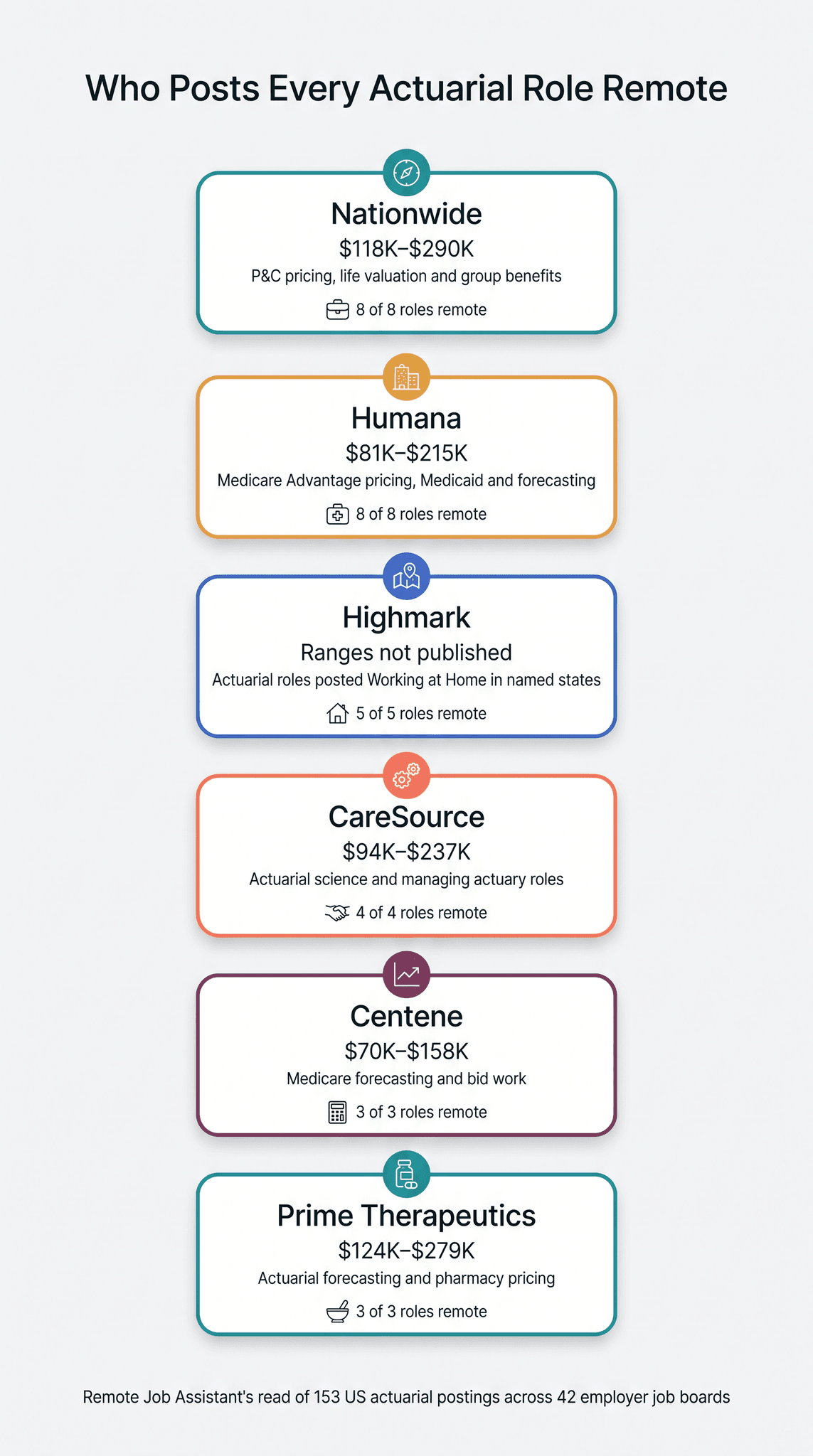
Who posted every actuarial role remote
| Employer | Actuarial postings | Remote | Posted base ranges across those roles |
|---|---|---|---|
| Nationwide | 8 | 8 | $118K–$290K |
| Humana | 8 | 8 | $81K–$215K |
| Highmark | 5 | 5 | ranges not published |
| CareSource | 4 | 4 | $94K–$237K |
| Centene | 3 | 3 | $70K–$158K |
| Prime Therapeutics | 3 | 3 | $124K–$279K |
Five of the six are health plans or pharmacy benefit managers. The sixth is Nationwide. That table is the remote actuarial market in one screen.
The Exam Ladder: What It Costs and What It Pays
Actuarial pay has a feature no other analytical profession has: the raise schedule is published. Employers tie increases to exams passed and to the two credential milestones, associate and fellow, and the recruiters who place actuaries publish the resulting ladder every year. The posting tells you where on that ladder you are being hired.
According to the Ezra Penland 2025–26 Actuarial Salary Surveys, which report base plus paid bonus for the middle 85% of packages, the ladder by practice area runs roughly like this:
| Practice area and credential | Year 5 | Year 10 |
|---|---|---|
| P&C, four exams (no credential) | $100K–$135K (year 4) | $142K–$187K |
| P&C, ACAS | $129K–$195K | $163K–$236K |
| P&C, FCAS | $162K–$267K | $199K–$344K |
| Health, ASA | $109K–$167K | $133K–$217K |
| Health, FSA | $139K–$223K | $164K–$305K |
| Life, ASA | $113K–$177K | $128K–$209K |
| Life, FSA | $141K–$220K | $155K–$306K |
| Pension, FSA | $130K–$194K | $157K–$231K |
The consulting premium is visible in the same survey: a year-ten FCAS in consulting reports $198K–$360K against $187K–$338K at a carrier that is neither a consultancy nor a reinsurer. DW Simpson's 2025 salary trends note puts an FSA with five to seven years in a consulting or insurance setting at $155K–$190K base, and adds that "the shift toward hybrid and remote work over the last few years has flattened geographic pay differences," which matches what we see: the posted ranges do not move much between Columbus, Louisville and Newark.
What the postings ask for, in their own words. Of the 153, 112 name a credential: FSA appears in 57, ASA in 52, FCAS in 34, ACAS in 29. Fourteen state a specific exam count, and the spread is the whole student ladder. Penn Mutual wants "One exam" for a remote Actuarial Analyst at $75K–$90K. Openly wants "3+ exams" for a remote Actuarial Analyst II. Everest wants "4+ exams" for a Senior Actuarial Analyst. Highmark wants six exams for a remote Associate Actuary. The Hartford wants "7 actuarial exams" for a small-business pricing seat. And the exam-support language is where employers show their hand:
- Arch: "Exam program: Up to $75k of raises available, and flexibility and support so you can study and pass."
- CNA: an "Actuarial Education Program which provides competitive study support and exam raises as you grow your skills."
- CVS/Aetna: "The Actuarial Development Program is a full-time, dynamic, 4 1/2 year (minimum) program."
- Pacific Life: "paid study time, expense reimbursement for registration fees and study materials, along with special bonuses and raises."
- GEICO: "Actuarial exams not required, but exam support is provided for qualified candidates interested in pursuing that track."
- The Hartford, on an Assistant Director seat: "ACAS or FCAS credential required (exam support is not provided with this role)."
That last line is the one to read twice. Nineteen of 153 postings describe a student or exam-support program. When a carrier says support is not provided, it is hiring the credential you already hold and pricing the seat accordingly.
What the exams cost if you pay for them yourself, at list price from the two societies. The SOA's 2026 fee schedule prices Exam P at $275, FM at $275, FAM at $408, ALTAM and ASTAM at $500 each, SRM at $357, PA at $1,234, the FAP Final Assessment at $1,316 and the virtual Associateship Professionalism Course at $658, with each Fellowship exam at $1,150 and FSA modules at $337. The page states, in capitals, that "Examinations are NON-REFUNDABLE." The CAS fee schedule, updated April 2025, prices MAS-I and MAS-II at $550 each, Exams 5 through 9 at $850 each, and the PCPA exam and project at $300 and $700, with a $200 cancellation fee and a forfeited fee plus $100 for a no-show. Add those up on a clean first-pass run and you are past $5,000 in fees on either track before a single study manual.
The fee is not the real price, though. The SOA exam schedule gives P and FM four computer-based windows a year and FAM, SRM and PA two each, but ALTAM and ASTAM sit once a year, in April. A fail on either one costs twelve months of ladder, and a twelve-month delay on a credential that moves base pay by tens of thousands is the actual cost of the exam.
Reading the exam language in a posting: five rules
- If it says "exam support is not provided," you are being hired for the credential you hold. Price the seat against the credentialed rung, not the student rung.
- If it names a student or development program, ask for the raise-per-exam number and the study-hours allowance before you compare offers. Arch publishes "up to $75k"; most do not.
- If it says "3+ exams" or "4+ exams," you are being hired as a student, and in our sample those seats held their remote tag: Openly, Highmark and Penn Mutual all posted them remote.
- If it says "FSA or FCAS required" at a P&C or life carrier, expect the hub-office clause. Search the body before you apply.
- If it is a health plan, ask which filing or bid cycle you will own. That answer tells you your calendar for the next three years and whether the team was in the office for the last one.
Stop Applying Manually
Our AI applies to hundreds of matching jobs while you sleep. Wake up to interviews, not more applications.
Moving Into a Remote Actuarial Seat
If the Filing Calendar Test scored your seat at 1–7 and you want remote, the efficient move is a practice-area change, not a longer search inside the practice you are in. Which change is determined by what you already produce, and each one has a price.
P&C pricing to health-plan pricing and trend. The rate-making logic transfers almost intact: you are still estimating expected cost per exposure and loading for risk, the exposure is a member-month instead of a car-year, and the data is claims and risk scores instead of loss triangles. The price is the ceiling. Health-plan postings carry a median $100K–$158K against $118K–$195K at P&C carriers, and at the top of the ladder the Ezra Penland year-ten FCAS band runs $35K higher than the year-ten health FSA band. You trade ceiling for portability. The employers are Humana, Centene, CareSource and Prime Therapeutics, and every one of them posted every actuarial role remote.
Life valuation to health forecasting and analytics. The tools transfer: SQL appears in 72 of 153 postings, Python in 61, R in 58, Excel in 64, SAS in 33, and none of those care which side of the industry you learned them on. GGY AXIS does not transfer, and neither does the fellowship-track content. Your FSA still counts, because 57 postings ask for one and none of them specify the track. The price is a first year explaining to a Medicaid actuary why you keep saying "reserve" when they say "IBNR."
Stay in P&C or life and target the exception. Nationwide posted eight remote actuarial roles across both sides. The insurtechs posted six of nine remote, at Lemonade, Kin, Openly, Pie and Coalition, but the sample is nine postings and only three published a range, so treat that lane as real and thin at the same time.
None of these is clean. Expect a practice-area move to cost you a title level for a year, because you are trading domain seniority for domain novelty and every hiring manager prices that in. Expect the first Medicare bid season to feel like an exam sitting. That is a cost worth paying once, against the alternative of competing for the 5 of 77 non-Nationwide carrier postings that were remote at all. Ask one question in the final round, tuned to the employer type. At a health plan: which filing or bid cycle will I own, and where was the team during the last one? At a carrier: how many actuaries on this team live outside a hub metro? At a consultancy: what share of last quarter's billable hours were on a client site?
You can shortcut the search half of this. Our auto-apply service filters by role and work model, so you are not opening 153 postings by hand to find the 50 that are real, which is, roughly, the exercise this post documents. If you have been applying steadily into carrier reqs and hearing nothing, why you're not getting interviews covers the other half of the problem.
Frequently Asked Questions
I'm an ACAS at a P&C carrier that just went to four days in office. Where are the remote actuarial jobs actually?
Mostly not at P&C carriers. In our September 2026 sweep, P&C carriers and reinsurers posted 9 of 52 actuarial roles remote (17%), and 8 of those 9 were Nationwide. The remote market is at health plans and pharmacy benefit managers, which posted 30 of 43 roles remote (70%), and at insurtechs, which posted 6 of 9. If you want to stay in P&C, Nationwide and the insurtechs are the realistic list; if you want volume, the move is into health-plan pricing or trend work.
Do remote actuary jobs pay less than hybrid or in-office ones?
Not once you compare the same kind of employer. Across all postings with a published range, remote roles carried a median $118K–$197K (n=38) against $128K–$191K for hybrid roles (n=69), but that gap is composition: the remote pool is health-plan-heavy and health plans post a median $100K–$158K, while the hybrid pool is weighted by Pacific Life's sixteen life-carrier postings at $145K–$249K. Remote health-plan postings alone carried a median $107K–$178K, and remote credentialed-actuary postings ran $129K–$178K.
How many exams do I need before a remote actuarial job is realistic?
Fewer than you would guess. Of 153 postings, 14 stated an exam count, and the remote ones ranged from "One exam" at Penn Mutual ($75K–$90K) to "3+ exams" at Openly and six exams for Highmark's remote Associate Actuary. The seats that require a fellowship at a P&C or life carrier are the ones most likely to carry a hub-office clause, so the remote odds do not improve with the credential; they improve with the employer type.
How do I score a posting on the Filing Calendar Test?
Ask what the deliverable physically is. If it is a document filed on a regulator's calendar, such as a Medicare bid, an ACA or Medicaid rate filing, or a risk-adjustment file, score it 8–10; those employers posted 36 of 52 roles remote. If it is a price or reserve negotiated with underwriters and claims, score it 4–7; those carriers posted 9 of 52 remote, mostly Nationwide. If it is a governed model reviewed in the building, such as statutory valuation or PBR, or consulting delivered at a client site, score it 1–3; those employers posted 5 of 49 remote.
Is Nationwide really fully remote for actuaries?
On the postings, yes. All eight of Nationwide's actuarial roles in our sample were remote, with body language such as "This role can be staffed fully remote" and "Choose a fully remote work arrangement or work from Nationwide's Columbus, Ohio headquarters," across P&C pricing, life valuation, experience studies and group benefits, at posted ranges from $118K–$222K to $154K–$290K. Nationwide alone accounted for 8 of the 13 remote carrier postings; without it, carriers posted 5 of 77 remote.
What do the SOA exams cost if my employer won't pay for them?
At the SOA's 2026 list prices, Exam P and FM are $275 each, FAM is $408, ALTAM and ASTAM are $500 each, SRM is $357, PA is $1,234, the FAP Final Assessment is $1,316 and the virtual APC is $658, with each Fellowship exam at $1,150. Fees are non-refundable. The larger cost is the calendar: ALTAM and ASTAM are offered once a year, in April, so a fail on either delays the credential, and the raise tied to it, by twelve months.
Can a life or P&C actuary move into health to work remotely, and what does it cost in pay?
Yes, and the price is ceiling rather than floor. Health-plan postings carried a median $100K–$158K against $145K–$205K at life carriers and $118K–$195K at P&C carriers, and the Ezra Penland year-ten FCAS band runs about $35K above the year-ten health FSA band. Your credential transfers, because 57 postings ask for an FSA without specifying a track, and so do SQL, Python and R, which appear in 72, 61 and 58 postings respectively. Expect to give up a title level for the first year.
Start Your Remote Actuary Job Search
Three things to do with this, in order.
First, score your seat on the Filing Calendar Test and write the number down. If you are at 1–7 and your employer just announced four days in the office, the fix is a change of employer type, not a better resume.
Second, go to the boards directly, not the aggregators. Every posting cited here came from an employer's own applicant tracking system, which is public. Start with the six employers that posted every actuarial role remote: Nationwide, Humana, Highmark, CareSource, Centene and Prime Therapeutics. Then read the body of every carrier posting for the hub clause before you spend an evening on the application.
Third, price the offer against the postings. With 79% of actuarial reqs publishing a range, you can benchmark from public documents in this field in a way you cannot in remote finance jobs or remote financial analyst positions. For the adjacent seats inside a carrier, our guides to remote underwriting roles, remote claims adjuster jobs, remote risk management jobs and remote insurance jobs cover the rest of the building. If your next move is toward the analytics side, remote data science roles and remote data analyst jobs pay for the same SQL and Python, and you can browse current roles paying over $150K, remote roles above $100K, and finance and accounting openings alongside financial analyst openings on our board.
A rate filing is due on the regulator's calendar, not the office's. That is why the actuaries who file them are the ones working from home.
Ready to Find Your Remote Job?
Browse thousands of curated remote jobs or let AI apply for you.
Browse Remote JobsRelated Job Guides

Remote Business Development Jobs: Four Jobs, One Title
We read 286 US business development postings across 138 employer boards. Four jobs share the title; only one is reliably remote. Pay by seat and the 3-day trap.
32 min read

Remote Regulatory Affairs Jobs: Who Actually Posts Them
We read 184 US regulatory affairs postings on 47 employer boards. Only 14% were remote, none at the 12 biggest posters. Pay by level, plus the hub-office trap.
32 min read

Remote Creative Director Jobs: Pay & Who's Hiring (2026)
Remote creative director jobs: we read 79 US creative-leadership postings from 38 employers. Only 18 are remote, and agency pay bands run 2.3x wide. What pays.
24 min read