

Last reviewed: September 2026
You own the submission. The 510(k) you built in eSTAR went to CDRH from your kitchen table. The labeling change you negotiated with OPDP never required a badge. The Module 3 you assembled for the CMC section lived in Veeva Vault, and nobody on the review team could have told you which city you were sitting in when you locked it. Then the memo arrived: four days a week, or three, or "site-by-design," and the job you have been doing from home for three years now comes with a commute.
So you type "remote regulatory affairs jobs" into Google and get a grid. LinkedIn says "1,000+." Indeed says 771. ZipRecruiter prices the profession at "$31–$56 an hour," which is a specialist's wage stretched over a director's job title. One aggregator has 1,500 words of advice that says remote is "strongest at senior levels" and offers no number behind it. Not one result tells you the thing that decides your odds: which employers actually post remote regulatory roles, and at what rung.
Get Remote Job Tips in Your Inbox
Weekly strategies, salary data, and new opportunities
Unsubscribe anytime. No spam.
Here is the short version. The work is portable. The employers, mostly, are not. The twelve companies with the most US regulatory affairs postings put up 103 roles between them and not one was remote. The remote roles that exist come from a shorter, different list of boards, they start at Manager, and they are the seats whose deliverable is a file rather than a chair in a health-authority meeting. We read 184 US regulatory affairs postings across 47 pharma, biotech, device, diagnostics, CRO and distributor job boards on September 22, 2026, and classified every one from the description body rather than the location tag. This is what the postings say.
Based on our sweep of 47 employer job boards on September 22, 2026 (184 US regulatory affairs postings after removing interns, non-RA titles and non-US locations):
- 14% (n=26 of 184) were genuinely remote after reading the description body; 18% (n=26 of 147) among postings that state a work model at all
- 0 of 103 were remote at the twelve boards with five or more postings: Abbott 25, Gilead 9, Revolution Medicines 8, AstraZeneca 8, BD 8, Johnson & Johnson 8, Bristol Myers Squibb 7, Vertex 7, Merck 7, Regeneron 6, Intuitive 5, Stryker 5
- 15% (n=16 of 105) of pharma and biotech postings were remote, against 9% (n=6 of 64) at device, diagnostics and distribution employers
- 0 of 17 Specialist or Associate-titled postings were remote; 7 of 27 Senior Specialist, 5 of 21 Manager, 5 of 36 Director
- 8 of 184 listed a remote location but described a hub-office or commuting-radius policy in the body
- 88% (n=162 of 184) published a base salary range; pharma Director postings ran a median of $196K–$272K (n=29) while device Senior Specialist postings ran $91K–$159K (n=15)
- The RAC credential was mentioned in 39 of 184 postings, required in 0, and "preferred" or "a plus" in 15; RAPS's 2024 survey of 1,961 regulatory professionals found RAC holders earn 12% more, and 30% more at the specialist rung
- $80,730 national median for Regulatory Affairs Specialists and $141,900 for Regulatory Affairs Managers (BLS 2025 wage data, accessed via O*NET)
The 14% figure is real and it comes with two catches the listing grids cannot show you. Some of the postings that say "Remote" in the location field turn out to be three-day hybrid jobs in paragraph nine, and the remote roles that are genuinely remote almost never carry a Specialist title. Both halves are below.
The Day-Count Test
A regulatory seat's remote odds are not set by the title. The same Senior Manager, Regulatory Affairs requisition is fully remote at one company and four days in the building at another, and the posting tells you which in the first screen if you know where to look. That is the idea behind the framework we use for the rest of this post.
The Day-Count Test: a 1–10 score for how remote-portable a regulatory affairs seat is, read from two things the posting states: the employer's written office policy, and where the deliverable physically lives.
Scoring:
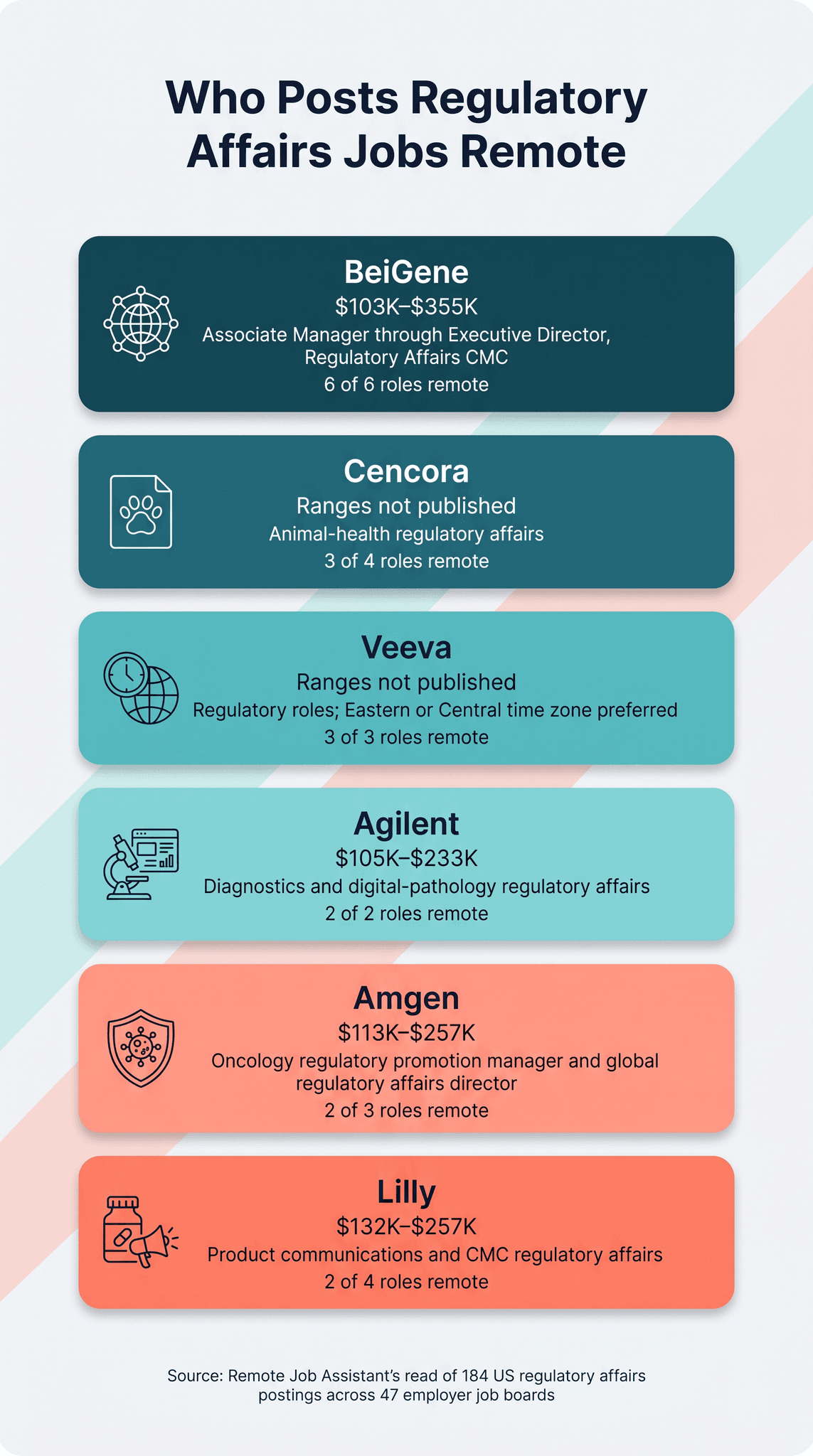
- 8–10 Remote-by-Design (posted ranges $103K–$355K on the BeiGene ladder; median remote range $135K–$194K, n=19): The location reads "Remote (US)" and the body never adds a day count or a commuting radius. The deliverable is a document: a submission, a label, an ad/promo review, a regulatory information management record. Employers in this band in our sweep: BeiGene (6 of 6 postings remote), Cencora (3 of 4), Veeva (3 of 3), Agilent (2 of 2), Amgen, Lilly, Biogen, Medline, Cardinal Health. Measured: 26 of 184 postings.
- 4–7 Flex-Designated: The employer has a named policy with a remote exception written into it. Vertex posts "Flex Designation: Hybrid-Eligible Or On-Site Eligible." Bristol Myers Squibb writes "Our roles are structured across four work models: site-essential, site-by-design, field-based and remote-by-design." Takeda says the position "is currently classified as 'hybrid' following Takeda's Hybrid and Remote Work policy." Lilly posts a CMC director to "US, Remote" and adds "A remote option may be considered." Remote is negotiated per requisition, and all 8 of the hub-conditional postings in our sweep live in this band.
- 1–3 Day-Count: The posting states the days or the radius. BD: "a minimum of 4 days of in-office presence per week." Regeneron: "4 days per week on site." AstraZeneca: "a minimum of three days per week from the office." Gilead's Kite unit: "two days of remote working and three days working onsite." AbbVie: "3 days in office, 2 days remotely." Stryker: "must reside within commuting distance of Irvine, CA." Dexcom: "within commuting distance of your assigned Dexcom site (typically 75 miles/120km)." Abbott puts "(on-site)" in the job title on 20 of its 25 postings. Measured: 113 of 184 postings (84 hybrid plus 29 on-site).
How to use it: Score the board before the seat. Then check the rung, because 0 of 17 Specialist postings were remote at any band, and check the deliverable, because document-anchored functions (ad/promo, labeling, regulatory operations) posted 12 of 63 roles remote while strategy and general RA posted 5 of 75.
The reason the day counts landed on regulatory affairs specifically is not that the work changed. On April 1, 2025, HHS terminated roughly 3,500 FDA employees, about a fifth of the agency, and the device side felt it first: FDA issued 11 De Novo decisions between January and mid-June 2025 against 22 in the same window a year earlier, according to Osprey Life Sciences' tracking of the cuts. Sponsors responded the way sponsors do, with more internal review of every submission before it goes out and more cross-functional meetings to manage the uncertainty. Regulatory affairs sits inside the R&D and quality organizations that got the company-wide presence memo, and the posting inherited it. The counter-example is the proof that the work itself is not the constraint: BeiGene runs its global regulatory function from "Remote (US)" all the way up to an Executive Director, Regulatory Affairs, CMC posted at $274,800–$354,800.
Stop Applying Manually
Our AI applies to hundreds of matching jobs while you sleep. Wake up to interviews, not more applications.
How We Collected This Data
Start with what we could not see. Reddit is closed to crawlers, so there is no r/regulatoryaffairs sentiment in this post. Glassdoor and ZipRecruiter salary pages return 403s, so their figures appear here only as search-snippet claims we are correcting. The full tables in RAPS's compensation report are members-only; we used the public executive summary. And a long list of employers who post regulatory roles run career sites we could not query: Boston Scientific, Edwards Lifesciences, Zimmer Biomet, Hologic, Parexel, ICON, Medpace, Syneos, Teva, Viatris and Novo Nordisk among them. Treat the device count in this post as a floor.
What we could see was two public, unauthenticated applicant-tracking-system sweeps run on September 22, 2026. The first searched 43 Workday career sites (Pfizer, Gilead, BMS, Novartis, Sanofi, Thermo Fisher, Abbott, Fortrea, Amgen, AstraZeneca, Labcorp, GSK, Vertex, Medtronic, IQVIA, Roche, Stryker, Dexcom, ResMed, Zoetis, Philips, McKesson, CVS Health, Humana, Elevance, Cigna, 3M, Baxter, Illumina, Agilent, Kenvue, Siemens Healthineers, BeiGene, Biogen, Medline, Solventum, Johnson & Johnson, Regeneron, Takeda, Merck, Lilly, BD, Cencora, Cardinal Health, Henry Schein and Smith+Nephew) for "regulatory affairs" and "regulatory," and fetched the full description of every title containing "regulatory": 474 postings. The second swept 721 life-science employer slugs across Greenhouse, Lever, Ashby and SmartRecruiters: 850 boards responded, 7,520 live postings, 76 with regulatory titles.
We excluded interns, trainees and postdocs; titles that carry the word but are not regulatory affairs (legal counsel, government affairs, environmental and trade compliance, IT quality-systems compliance, regulatory writing, clinical start-up); and non-US locations. That last filter matters: Thermo Fisher's 13 regulatory postings were all in Europe or China and 12 of the 13 were "Fully Remote," Fortrea's 11 were in Brazil, India, Japan and the UK, and Pfizer's 5 were in Germany, the Philippines and Malaysia. After deduplication: 184 US postings across 47 boards, 149 from Workday tenants and 35 from the startup ATSs.
Work model was classified from the body, never the flag. Workday's remote-type field was blank on 90 of the 149 Workday postings. Hybrid was counted only on a requirement pattern (a day count, "within commuting distance," "hub office," or an #LI-Hybrid tag), not on the word "hybrid" appearing in an EEO paragraph. Pay figures are employer-posted ranges only (n=162), cross-referenced with BLS Occupational Employment and Wage Statistics for SOC 13-1041.07 and 11-9199.01 via O*NET, and with the RAPS 2024 Global Compensation and Scope of Practice executive summary. Ranges were verified on the collection date and will drift.
Which Employers Actually Post Remote Regulatory Affairs Jobs
The split is by employer type, it is not close, and the policies are written into the postings.
| Employer type | Postings | Remote | Share | Hybrid | On-site | Hub-conditional | Boards in sample |
|---|---|---|---|---|---|---|---|
| Pharma / biotech | 105 | 16 | 15% | 59 | 6 | 6 | BeiGene, Lilly, Biogen, Amgen, Gilead, BMS, J&J, Vertex, Merck, Regeneron, AstraZeneca, Sanofi, Takeda, GSK, Revolution Medicines, Nurix, Scholar Rock, BridgeBio, Olema, Septerna, Keros, Absci, Insitro, Fate, Twist |
| Device / diagnostics / distributor | 64 | 6 | 9% | 23 | 22 | 1 | Abbott, BD, Stryker, Medtronic, Intuitive, Siemens Healthineers, Dexcom, Medline, Solventum, Cardinal Health, Agilent, Baxter, Roche Diagnostics, Smith+Nephew, Treace, 3M, Illumina, ResMed, Philips, Henry Schein |
| CRO / services / software | 10 | 4 | 40% | 0 | 0 | 0 | IQVIA (7, six with no stated model), Veeva (3 of 3 remote) |
| Payer / consumer / animal health | 5 | 0 | 0% | 2 | 1 | 1 | Oscar, McKesson, Cigna, Kenvue, Zoetis |
Remaining postings in each row stated no work model. Cencora's animal-health regulatory arm posted 3 of 4 US roles remote and is counted with pharma.
The twelve zero boards. Abbott, Gilead, Revolution Medicines, AstraZeneca, BD, Johnson & Johnson, Bristol Myers Squibb, Vertex, Merck, Regeneron, Intuitive and Stryker each had five or more US regulatory postings live on the collection date. Together that is 103 postings and 0 remote. The policies are not hidden. BD: "For most roles, we require a minimum of 4 days of in-office presence per week to maintain our culture of excellence and ensure smooth operations." Regeneron: "Work Location: Sleepy Hollow, NY or Warren, NJ 4 days per week on site." AstraZeneca: "That's why we work, on average, a minimum of three days per week from the office." Gilead, on a Kite requisition: "Kite supports a flexible working policy, offering a balanced approach with two days of remote working and three days working onsite." AbbVie, on an ad/promo associate director: "This role will work a hybrid work schedule (3 days in office, 2 days remotely) from our Mettawa, IL; Florham Park, NJ or Irvine, CA AbbVie headquarters." Merck prints "Flexible Work Arrangements: Hybrid" in the footer of all seven. Abbott simply writes it into the title: "Regulatory Affairs Manager – Vascular (on-site)." The reason is structural rather than a view about regulatory work: these are company-wide return-to-office policies, and the RA requisition inherits whatever the R&D or quality organization it sits in was told.
The remote boards, by name. Remote regulatory hiring in this sweep came from 13 of the 47 boards, and it is lumpy. BeiGene posted 6 of 6 US regulatory roles to "Remote (US)," from an Associate Manager, US Regulatory Affairs at $103,000–$138,000 up to that Executive Director, RA CMC at $274,800–$354,800. Cencora posted 3 of 4 (animal-health regulatory, "Remote, Pennsylvania"). Veeva posted 3 of 3, "a remote position with a preference for Eastern or Central Time Zone." Agilent posted 2 of 2 ("It includes the option to work remotely," $104,774–$163,710 for a diagnostics RA seat). Amgen posted 2 of 3 to "United States - Remote." Lilly posted 2 of 4, including a Director, Global Regulatory Affairs, CMC listed against both "US, Remote" and Indianapolis. Biogen posted 2 of 4 to "Remote, USA." Medline posted 1 of 3 ("This role will be remote," a Senior Regulatory Affairs Specialist at $92,000–$138,000) beside a manager on a "hybrid work model" in Eagan, Minnesota. Cardinal Health posted its Regulatory Affairs Manager, Labeling with an "#LI-remote" tag across five listed locations at $105,100–$150,100.
Device against pharma. Device, diagnostics and distribution boards posted 6 of 64 remote (9%) against 16 of 105 (15%) in pharma and biotech. The cause is where the deliverable lives. Device regulatory affairs is tied to design controls and to a manufacturing site: Abbott posts by division and plant, Stryker requires "commuting distance of Irvine," Dexcom requires you to live near "your assigned Dexcom site." A pharma dossier leaves the building as an eCTD sequence. The six device remote roles make the point from the other side: they are a labeling manager (Cardinal Health), a digital-pathology regulatory expert (Agilent), a distributor's specialist (Medline) and Biogen's international device seat, which are document jobs that happen to sit at device companies, not plant jobs.
One more context point. The remote CRO market is real, and in this sweep it was not a US market: Thermo Fisher's PPD unit posted 12 of its 13 regulatory roles as "Fully Remote," every one of them in Europe or China, and IQVIA's US regulatory postings mostly stated no work model at all, with one Senior Director "US remote with ability to travel approximately 20%." If you are searching from the United States, the CRO remote grid you see on an aggregator is largely a European grid.
Twelve employers posted 103 US regulatory affairs roles between them in September 2026 and not one was remote. Remote RA hiring lives at a different, shorter list of companies.
The Hub-Office Clause
The most expensive mistake in this search is trusting the location field. Eight of the 184 postings carried a remote location and a hub or commuting policy in the body, and they cluster into three patterns you can learn to spot in the first screen.
The both-flags pattern. Revolution Medicines lists "Remote (United States)" as the location on its Director, Regulatory Affairs Labeling posting and then writes: "The position can be based at our Redwood City, CA site in a hybrid work schedule (preferred) or remote-based with quarterly and as needed travel." Its Director, Global CMC Regulatory carries the same remote location, an "#LI-Hybrid" tag, and a salary range stated "for candidates working onsite at our headquarters in Redwood City, CA." BridgeBio lists "Remote - USA" on a Director, Regulatory CMC and adds: "This is a hybrid role and requires in-office collaboration 2-3x per week in our San Francisco Office."
The radius pattern. Dexcom's Senior Manager, Regulatory Affairs, LATAM is posted to "Remote Florida." The body: "You must live within commuting distance of your assigned Dexcom site (typically 75 miles/120km)." Johnson & Johnson's two OTTAVA surgical-robotics regulatory roles carry remote-flagged locations and the single word "commutable." Stryker's version is the clearest: "Work Flexibility: Hybrid: candidates must reside within commuting distance of Irvine, CA and be able to work onsite several days per week."
The future-hub pattern. Oscar's Senior Analyst, Regulatory Affairs is "Remote," and then: "Future models could potentially involve a hybrid presence at the hub office associated with your metro area." That sentence is a policy with a date left blank.
The reason postings read this way is mechanical. A regulatory requisition is usually posted once against several sites plus a "Remote" row, because the remote row widens the applicant funnel and the ATS treats location as a filter, not a promise. The work-model policy belongs to the business unit and gets pasted in lower down. Nobody is lying to you. The location field and the policy paragraph are simply written by different people for different purposes.
Open the full description and search for these before you spend an hour on the application: "days" (catches every day-count policy), "commut" (catches "commuting distance" and "commutable"), "hub" (Oscar, and the health-plan pattern generally), "onsite" and "on-site" (Abbott, Medtronic, Nurix write it plainly), and "#LI-" (the LinkedIn tag recruiters paste in tells the truth: #LI-Hybrid, #LI-Onsite, #LI-Remote). If none of the five appears and the location says remote, you are probably looking at a Remote-by-Design seat.
A regulatory posting that says "Remote (United States)" and "#LI-Hybrid" in the same body is a hybrid job. The location field is a recruiting filter. The policy is in paragraph nine.
Stop Applying Manually
Our AI applies to hundreds of matching jobs while you sleep. Wake up to interviews, not more applications.
What Remote Regulatory Affairs Jobs Actually Pay
There is no remote discount in regulatory affairs postings. There is a rung-and-sector mix, and there is an aggregator pricing the wrong job.
| Level | Pharma / biotech (n) | Pharma median posted range | Device / diagnostics (n) | Device median posted range |
|---|---|---|---|---|
| Specialist / Associate | 1 | $87K–$137K | 10 | $73K–$123K |
| Senior Specialist | 3 | $109K–$170K | 15 | $91K–$159K |
| Principal Specialist | 1 | $117K–$201K | 11 | $120K–$200K |
| Manager | 10 | $117K–$176K | 7 | $114K–$228K |
| Senior Manager / Lead | 16 | $139K–$203K | 3 | $149K–$248K |
| Associate Director | 19 | $164K–$225K | 3 | $149K–$294K |
| Director | 29 | $196K–$272K | 2 | $183K–$291K |
| Senior Director | 13 | $232K–$327K | — | — |
| VP / Head of Regulatory | 4 | $304K–$347K | — | — |
Salary ranges derive from the 162 of 184 US regulatory affairs postings in our September 22, 2026 sweep that published an employer-stated base range, cross-referenced with BLS wage data for SOC 13-1041.07 and 11-9199.01 (via O*NET) and the RAPS 2024 compensation survey. Ranges are base salary only; 85 of 184 postings mention a bonus and 98 mention equity or stock. They shift as markets move, so check the linked sources for current figures.
Read the table by column before you read it by row. At every rung where both sectors have a sample, pharma posts higher, and the gap widens with seniority: a device Senior Specialist runs $91K–$159K (n=15) and a pharma Director runs $196K–$272K (n=29). The Director rung is also where the pharma ladder takes its biggest single step, roughly $30K on both ends over Associate Director. In device, the wide ranges at Manager and above ($114K–$228K, $149K–$294K) are mostly Abbott, which posts one national range per title and lets the location set the number.
Now the composition argument. Across all sectors, the remote postings ran a median of $134,600–$193,600 (n=19), the hybrid postings $157,590–$235,750 (n=79), and the on-site postings $100,000–$199,350 (n=28). That looks like a remote discount until you notice who is in each pool. The remote pool is manager-heavy and includes the device distributors; the hybrid pool is director-heavy pharma. Compare like with like and the gap closes: BeiGene's remote Senior Director, Global Regulatory Affairs is $211,200–$281,200, Bristol Myers Squibb's hybrid Senior Director, Global Regulatory Lead is $226,750–$313,460; Lilly's remote CMC Director is $148,500–$257,400, Gilead's hybrid CMC Director is $210,375–$272,250. At the same title, the remote seat showed no base-pay discount in this data. Two things it did not show: any remote Director-or-above posting at the twelve largest boards, which are also the ones whose postings most often mention equity (98 of 184 overall), and any remote posting at all at the Specialist rung.
Regulatory affairs goes remote at Manager, not at Specialist. Zero of 17 specialist-titled postings were remote; the remote roles start at about five years in.
The remote rows, with the employer's own range:
- BeiGene — Associate Manager, US Regulatory Affairs — $103,000–$138,000
- BeiGene — Senior Manager, Global Regulatory Process and Compliance — $139,800–$184,800
- BeiGene — Executive Director, Regulatory Affairs, CMC — $274,800–$354,800
- Amgen — Regulatory Affairs Manager, Oncology and Regulatory Promotion — $112,744–$152,536
- Amgen — Global Regulatory Affairs Director, Inflammation and Rare Disease — $189,632–$256,561
- Lilly — Associate Director, Global Regulatory Affairs, Product Communications — $132,000–$193,600
- Biogen — Senior Manager, International Device Regulatory Affairs — $138,000–$184,500
- Keros — Director, Regulatory Operations (Lexington, MA hybrid or remote) — $206,000–$227,000
- Agilent — Regulatory Expert, Digital Pathology — $124,160–$232,800
About that "$31–$56 an hour." Annualized, ZipRecruiter's range is roughly $64K–$116K, and its Houston "average" of $37.79 an hour is about $79K. Those figures blend contract coordinator and specialist postings with the full-time market, and they describe the bottom of the table above. The posted pharma Manager median is $117K–$176K (n=10). A Senior Manager who reads the ZipRecruiter title tag and concludes remote regulatory pays a discount is comparing their job to a different job.
For the national baseline, BLS wage data for Regulatory Affairs Specialists, SOC 13-1041.07, accessed through O*NET, puts the 2025 median at $80,730 with about 33,300 projected annual openings in the parent occupation and growth of 3% to 4%. Regulatory Affairs Managers, SOC 11-9199.01, show a $141,900 median and faster growth of 5% to 6%. Both medians sit below the posted ranges here for a reason worth knowing: the BLS specialist series covers government, financial and environmental compliance as well as life sciences, and our sweep is pharma- and device-heavy by design.
The profession's own numbers land in between. According to the RAPS 2024 Global Compensation and Scope of Practice Report, which drew 1,961 responses in March and April 2024, US average base salary was $218,941 for the Vice President through Associate Director group, $145,766 for Senior Managers and Managers, and $105,025 for Specialists, Associates and Coordinators. The same report has the figure to take into your next negotiation: respondents who accepted a new job at a different company in 2023 received a 13.3% base increase, against 5.1% for those who stayed and were not promoted.
One structural advantage this profession has over almost every other role we track: 88% of postings (n=162 of 184) publish a range, because a single regulatory requisition is typically posted across California, New York, Washington and Colorado and trips every pay-transparency statute at once. You can benchmark a counter-offer from postings alone, which is not true in most fields.
Moving Into a Remote Regulatory Seat
The fastest route to a remote regulatory seat is a function move and a board move, not a title move. Three bridges, with the friction stated.
Device RA specialist to pharma ad/promo or labeling. Advertising-and-promotion review posted 7 of 34 roles remote (21%), the highest share of any function, and labeling 1 of 5. The reason is that the OPDP review cycle is a document workflow with a submission date: the deliverable is a Form 2253 and a marked-up piece, not a plant tour. The pay bridge is real but not free. Ad/promo ran a median of $122K–$201K (n=29), above the device Senior Specialist band and below CMC. The boards posting it remote were Amgen (Regulatory Affairs Manager, Oncology and Regulatory Promotion, $112,744–$152,536) and Lilly (Associate Director, Product Communications, $132,000–$193,600); AbbVie and Regeneron post the same function at three and four days in the building.
Strategy RA to regulatory operations. Regulatory operations and submissions posted 4 of 24 remote, and Veeva Vault is named in 20 of 184 postings, 7 of them remote, which is the highest tool-to-remote ratio in the data. The seat is publishing, RIM and submission management, and it pays more than the title suggests: median $135K–$223K (n=18), with Keros posting a Director, Regulatory Operations at $206,000–$227,000 as Lexington hybrid or remote. If you make this move, learn eCTD v4.0 before the interview; FDA has accepted it for new NDA, BLA, ANDA, IND and master-file submissions since September 16, 2024, per the FDA eCTD page, and only new applications can use it. On the device side, eSTAR has been mandatory for 510(k)s since October 1, 2023 and for De Novo requests since October 1, 2025, per the CDRH Portal page; a regulatory operations candidate who has built one in the interactive PDF has a talking point most strategy candidates do not.
Stay in CMC, change boards. CMC regulatory is the best-paid function in the sweep, median $186K–$264K (n=41), and it posted 9 of 44 roles remote. Read that number carefully: 5 of the 9 are BeiGene. Strip one company and CMC is 4 of 38. The employers to target for remote CMC are BeiGene, Lilly and Biogen; Vertex, Gilead, Bristol Myers Squibb and Merck post the same function hybrid, and Gilead's Head of CMC Regulatory Affairs, Small Molecules is on-site in Foster City at $302,005–$390,830.
The stakes the sign-off carries explain why employers guard it. Under the FY2026 PDUFA fee schedule, an application requiring clinical data costs $4,682,003 to file; under MDUFA, a 510(k) is $26,067, a De Novo $173,782 and a PMA $579,272. A refuse-to-file on a $4.7 million submission is a governance event, and the companies that want the person who signs it in the building have said so in writing. Meanwhile the European side keeps generating work regardless of where anyone sits: 26 of 184 postings name EU MDR or IVDR, because legacy devices must reach MDR conformity by December 31, 2027 (class III and class IIb implantables) or December 31, 2028 (the rest) under Regulation (EU) 2023/607.
Three questions to ask, one per band of the Day-Count Test. At a Day-Count board: "How many of the regulatory team's last twelve hires live outside a commuting radius of this site?" At a Flex-Designated board: "Is this requisition designated remote-by-design or site-by-design, and who signs the exception?" At a Remote-by-Design board: "Which health-authority meetings in the last year required someone to be physically present, and who went?" The answers tell you more than the location field ever will. If you are running this search across dozens of boards at once, auto-apply with the five strings above as your filter is the fastest way to skip the hub-conditional postings before you invest an hour in each.
The RAC: What It Costs and What It Pays
The Regulatory Affairs Certification is priced by two sources that rarely get put side by side: the postings and RAPS's own survey. They agree, and what they agree on is that the credential is worth more at the bottom of the ladder than at the top.
What the postings say: 39 of 184 mention the RAC. Zero require it. Fifteen call it "preferred," "a plus" or "desirable." Abbott's version appears on nearly every one of its 25 postings: "Certification is a plus (such as RAC from the Regulatory Affairs Professionals Society)." Treace: "Regulatory Affairs Certification US (RAC) through Regulatory Affairs Professional Society (RAPS) is preferred." Intuitive lists it as one of three acceptable credentials alongside the PMP. Among the 26 remote postings, 3 mention it. The remote boards care less about the letters, not more.
What RAPS says, from the 2024 Global Compensation and Scope of Practice executive summary: "For US-based respondents, professionals with a Regulatory Affairs Certification (RAC) credential earned 12% more than their peers without one. The impact was most pronounced for Specialist/Associate/Coordinator, where RAC holders earned 30% more." The credential is held by 46% of the Vice President through Associate Director group, about one-third of managers, 27% of specialists and 6% of regulatory information analysts. The premium inverts with seniority for a simple reason: at Director, everyone has the ten years of experience the RAC proxies for, so the letters stop discriminating.
What it costs, at RAPS's 2026 list:
| Item | 2026 figure |
|---|---|
| Eligibility | Bachelor's plus 3 years of regulatory or regulatory-related experience; master's plus 2; doctorate plus 1; or 10 years without a degree |
| Exam fee | $605 RAPS member / $760 non-member |
| Administrative fee | $100 |
| Transfer to the next window after the deadline | $285 |
| Form change | $50 |
| Windows | Spring (apply by Feb 12, test Mar 23–Apr 24), Summer (apply by Jul 9, test Aug 18–Sep 11), Autumn (apply by Sep 24, test Nov 2–Dec 4) |
| Format | 120 multiple-choice questions in 2.5 hours (expanded from 100 questions in 2 hours starting with the Spring 2026 window) |
| Scoring | Reported on a 0–550 scale; RAPS does not publish the number of correct answers needed |
| Results | Emailed "typically within 12 weeks of the end of the testing window" |
| Retake | "Eligible to retake the exam in the following window. You cannot retake the exam during the same window." |
| Recertification | 36 RAC recertification credits every three years |
The gotcha is the calendar, not the fee. Results can take twelve weeks and a fail can only be retaken in the next window, so a Spring fail waits until August and an Autumn fail waits until the following March. Budget the year, not the $760. The RAC-Drugs content split, from the 2026 candidate guide, is 30% US FDA, 30% EU, 40% globally applicable ICH material, weighted across five domains: regulatory intelligence and research 27%, submissions 27%, strategy 22%, collaboration 13%, project management 11%. A US-only device specialist who studies only the FDA third is studying for 30% of the exam.
Sit for it or skip it:
- Sit for it if you are a Specialist or Senior Specialist with three to six years and you are targeting a pharma board. That is the rung where RAPS measured a 30% premium and where the posting's "preferred" line is doing real screening work.
- Skip it if you already hold a Director title. 46% of your peers have it; at that rung it is table stakes, not a raise.
- Device RA: the postings count your 510(k)s, PMAs and MDR files (35, 25 and 26 mentions respectively) more than the credential (39 mentions, 0 required). Spend the study hours on an eSTAR build instead.
- Never let a "preferred" line stop an application. Zero of 184 postings required the RAC.
- If you sit, sit in Spring. A Spring fail can be retaken in Summer; an Autumn fail costs you until March.
Stop Applying Manually
Our AI applies to hundreds of matching jobs while you sleep. Wake up to interviews, not more applications.
Frequently Asked Questions
I'm a regulatory affairs specialist at a device company with three years' experience. Are there actually remote RA jobs, or is everything hybrid now?
At your rung, in this sweep, no: 0 of 17 Specialist or Associate-titled postings were remote, and device employers overall posted 6 of 64 remote (9%). The odds change one title up. Senior Specialist postings were 7 of 27 remote and Manager postings 5 of 21, and the remote device seats were labeling, digital pathology and distributor roles rather than plant-based product RA. The practical move is to target the Senior Specialist rung at a document-anchored function and score the board with the Day-Count Test before you apply.
Do remote regulatory affairs jobs pay less than hybrid or in-office ones?
Not once you compare the same rung at the same kind of employer. The raw medians were $134,600–$193,600 for remote postings (n=19) against $157,590–$235,750 for hybrid (n=79), but the remote pool is manager-heavy and the hybrid pool is director-heavy pharma. BeiGene's remote Senior Director is $211,200–$281,200 and Bristol Myers Squibb's hybrid Senior Director is $226,750–$313,460; Lilly's remote CMC Director is $148,500–$257,400 and Gilead's hybrid one is $210,375–$272,250. The remote seat pays the job. It just does not exist at Specialist.
Is the RAC certification worth it for getting a remote regulatory affairs job?
For getting a remote job specifically, no: only 3 of the 26 remote postings mention it and 0 of 184 require it. For pay, it depends on your rung. RAPS's 2024 survey of 1,961 regulatory professionals found RAC holders earn 12% more overall and 30% more at the Specialist, Associate and Coordinator level, which is where the $605–$760 exam fee pays for itself fastest. At Director, 46% of your peers already hold it and the premium largely disappears.
How do I score a regulatory affairs posting on the Day-Count Test?
Read the employer's policy sentence first, then the deliverable. If the location says "Remote (US)" and a search for "days," "commut," "hub," "onsite" and "#LI-" finds nothing, score it 8–10 (BeiGene, Cencora, Veeva, Agilent, Amgen, Lilly, Biogen, Medline, Cardinal Health in our sweep). If the employer names a policy with a remote exception, such as Vertex's "Hybrid-Eligible or On-Site Eligible" or BMS's "remote-by-design," score it 4–7 and expect to negotiate. If the posting states days or a commuting radius (BD 4, Regeneron 4, AstraZeneca 3, Stryker "commuting distance of Irvine," Abbott "(on-site)"), score it 1–3 and apply only if you can commute. Then check the rung: 0 of 17 Specialist postings were remote at any band.
Which pharma and device companies hire regulatory affairs remotely?
In our September 22, 2026 sweep, 13 of 47 boards posted at least one remote US regulatory role. The boards where remote was the rule rather than the exception were BeiGene (6 of 6), Cencora (3 of 4), Veeva (3 of 3) and Agilent (2 of 2), followed by Amgen (2 of 3), Lilly (2 of 4), Biogen (2 of 4), Medline (1 of 3) and Cardinal Health. The twelve largest posters, Abbott, Gilead, Revolution Medicines, AstraZeneca, BD, J&J, BMS, Vertex, Merck, Regeneron, Intuitive and Stryker, posted 103 roles and 0 remote.
What does "Remote (United States)" mean when the posting also says #LI-Hybrid?
It means hybrid. Revolution Medicines posts "Remote (United States)" as the location and then writes that the role "can be based at our Redwood City, CA site in a hybrid work schedule (preferred) or remote-based with quarterly and as needed travel," with the salary range stated for candidates working on-site. BridgeBio's "Remote - USA" director "requires in-office collaboration 2-3x per week." Dexcom's "Remote Florida" requires you to "live within commuting distance of your assigned Dexcom site (typically 75 miles/120km)." Eight of 184 postings followed this pattern. The location row widens the applicant funnel; the policy paragraph is the job.
Should I move from device RA to pharma RA, and what does it cost or pay?
Pharma posts higher at every rung where we have both samples, and the gap widens with seniority: device Senior Specialist $91K–$159K (n=15) against pharma Senior Manager $139K–$203K (n=16) and Director $196K–$272K (n=29). Pharma also posts a higher remote share, 15% against 9%. The bridge most device specialists can cross is ad/promo or labeling, because the OPDP review workflow is document-based and posted 7 of 34 roles remote; CMC pays the most ($186K–$264K median, n=41) but its remote roles are concentrated at BeiGene. Expect to trade device-specific 510(k) and MDR depth for eCTD, ICH and OPDP fluency, and to enter one rung below where you would land in device.
Start Your Remote Regulatory Affairs Job Search
The search that works is the reverse of the one the aggregators sell. Score the board before you read the title: the twelve largest posters are day-count employers and will stay that way for the length of this hiring cycle, while BeiGene, Cencora, Veeva, Agilent, Amgen, Lilly, Biogen, Medline and Cardinal Health posted remote regulatory roles as the rule. Check the rung, because the remote market opens at Senior Specialist and Manager, not below. Pick a document-anchored function, ad/promo, labeling or regulatory operations, if you can, because those posted 12 of 63 roles remote against 5 of 75 in strategy. And search the five strings in every description before you apply, because 8 of 184 remote-tagged postings were hybrid jobs in paragraph nine.
If you are also weighing adjacent paths, our guides to remote clinical research jobs, remote biotech jobs, remote medical writer roles and remote compliance jobs use the same posting-level method, and the remote pharmacist jobs and remote project manager jobs guides cover two functions regulatory people move into and out of. Current healthcare and life-sciences openings, project manager openings, remote roles above $100K and roles paying over $150K are on the board. If the applications are going out and nothing is coming back, read why you're not getting interviews and how to follow up on a job application before you send another.
A submission leaves the building as a file. The employers that still want the person who built it in the building have written that down. Read it before you apply.
Ready to Find Your Remote Job?
Browse thousands of curated remote jobs or let AI apply for you.
Browse Remote JobsRelated Job Guides

Remote Business Development Jobs: Four Jobs, One Title
We read 286 US business development postings across 138 employer boards. Four jobs share the title; only one is reliably remote. Pay by seat and the 3-day trap.
32 min read
Remote Actuary Jobs: Which Lines of Insurance Go Remote
We analyzed 153 US actuarial postings across 42 insurer boards. Health plans post 70% of roles remote, carriers 15%. Real pay by level and the hub-office trap.
32 min read

Remote Creative Director Jobs: Pay & Who's Hiring (2026)
Remote creative director jobs: we read 79 US creative-leadership postings from 38 employers. Only 18 are remote, and agency pay bands run 2.3x wide. What pays.
24 min read