
Last reviewed: August 2026
You've built the models. You can explain a confusion matrix to a VP without putting them to sleep. And every remote data science posting you open already has 400 applicants — because unlike the hybrid role down the street, a remote posting is visible to every data scientist in the country.
Here's the reframe most guides skip: the remote data science market isn't small, it's nationally contested. LinkedIn lists over 1,000 remote data scientist openings in the US and Indeed lists 1,343 more — but a 2026 analysis by 365 Data Science of 827 data scientist postings on Monster found only about 5% (n=41 of 827) were explicitly marked remote. Plenty of jobs exist in absolute terms. Each one just draws the deepest applicant pool in tech.
Get Remote Job Tips in Your Inbox
Weekly strategies, salary data, and new opportunities
Unsubscribe anytime. No spam.
That changes your strategy. You don't win a national contest with a slightly better portfolio. You win it by targeting the skills that actually appear in 2026 postings — which have shifted hard toward production ML and GenAI — and by applying at a volume most candidates can't sustain manually. This guide covers what remote data science jobs pay by level, which skills now filter candidates, which companies hire remote, and how to run an application strategy built for a national field — using that 827-posting analysis, BLS 2024–2034 projections, and July 2026 ZipRecruiter compensation data.
Based on 365 Data Science's 2026 analysis of 827 data scientist postings (Monster), plus BLS and ZipRecruiter data:
- 69.3% (n=573 of 827) required machine learning — the single most demanded skill
- 57% (n=471 of 827) listed Python, down from 78% in 2024
- 19% (n=157 of 827) required NLP skills, up from 5% in 2024 — a near 4x jump in one year
- Approx. 5% (n=41 of 827) of postings were explicitly remote
- 34% projected employment growth 2024–2034 (BLS: 245,900 to 328,300 jobs, about 23,400 openings per year)
- $112,590 BLS median wage (May 2024); $98.5K–$136K is where most remote data scientists land per ZipRecruiter (July 2026)
If you're a working analyst, engineer, or scientist targeting $100K+ and you can commit to a real application campaign, this guide was written for you. If you're brand new to data work, start with our remote data analyst guide — it's the more common entry point.
How We Collected This Data
The figures in this post come from three primary sources. Skills, education, and remote-share percentages come from 365 Data Science's 2026 job market research, which analyzed 827 relevant data scientist postings (filtered from an initial 1,000) collected from Monster. Employment growth and median wage figures come from the Bureau of Labor Statistics Occupational Outlook Handbook, using May 2024 wage data and 2024–2034 projections. Remote-specific salary ranges come from ZipRecruiter's July 2026 remote data scientist data, cross-referenced with Built In's remote salary pages and live posting counts from Haystack (198 remote data science jobs listed as of August 2026).
Where sources disagree — and salary sources always disagree — we show the range and explain the variance rather than averaging it away. Postings with ambiguous remote policies ("remote flexible," "remote to start") were treated as not remote. One honest limitation: the skills percentages come from a single job board's postings, and posting data always lags what teams actually do day to day — so treat the numbers as directional signals of what employers screen for, not a census of the market. Cross-check against what practitioners report in communities like r/datascience if a figure drives a career decision. All figures were verified in August 2026.
What Remote Data Science Jobs Actually Look Like in 2026
"Data scientist" stopped being one job several years ago. In 2026 postings, the title splits into three practical variants: analytics-heavy roles (experimentation, product metrics, dashboarding), production ML roles (models that ship behind APIs and get monitored like software), and a fast-growing GenAI variant (LLM evaluation, retrieval pipelines, fine-tuning). The skills data shows the shift: classical machine learning appears in 69.3% of postings (n=573 of 827) — it's assumed — while NLP demand nearly quadrupled in a single year as companies raced to ship LLM features.
Why is only about 5% of the market explicitly remote when the work is a laptop job? Three structural reasons. First, data governance: companies handling health, financial, or user data often restrict where that data can be accessed, and legal teams find office networks easier to certify than 200 home offices. Second, model review culture: many DS orgs still run whiteboard-heavy review processes and haven't built the written async habits that make remote work function. Third, general RTO drift has hit data teams harder than pure engineering, because data scientists sit closer to business stakeholders who are themselves back in the office.
The remote roles that do exist skew toward product-mature tech companies and remote-first organizations that already solved those three problems. That's good news for you: remote data science postings cluster at companies that pay well and operate asynchronously by design.
To figure out where you stand in this market — and what you should be applying for — use the framework we apply throughout this guide.
The Deployment Ladder: the inflection points where a data science career shifts from producing analysis to owning production models to owning decisions.
- L1 — Insight Producer ($80K–$110K): Works in notebooks and dashboards. Builds models that inform decisions but rarely ship to production. Output is analysis someone else acts on.
- L2 — Production Modeler ($110K–$160K): Ships models behind APIs. Owns experiments end to end — design, deployment, monitoring, iteration. Partners with engineering instead of handing off to them.
- L3 — Decision Owner ($160K–$250K+): Decides whether a problem needs a model at all. Sets ML and GenAI strategy, owns business outcomes rather than model metrics, and is accountable when the model is the wrong answer.
How to use it: Identify your current rung honestly, then build your resume bullets and interview stories around the next rung's criteria. Hiring managers pay for the rung you can demonstrate, not the years you've accumulated.
Most job seekers misread their own rung — they price themselves at L2 while presenting L1 evidence. We'll come back to this in the salary and interview sections.
Stop Applying Manually
Our AI applies to hundreds of matching jobs while you sleep. Wake up to interviews, not more applications.
Remote Data Scientist Salary by Level
The single biggest predictor of remote data science pay isn't years of experience — it's which rung of the Deployment Ladder your work actually sits on. Two candidates with six years of experience can be $70K apart because one has been iterating dashboards for six years and the other has owned production models.
Here's how 2026 remote compensation breaks down:
| Level | Base Range (2026) | What Actually Moves You Up |
|---|---|---|
| Entry / Junior (L1) | $80K–$110K | First production contribution, strong SQL + Python fundamentals |
| Mid-level (L2) | $110K–$145K | End-to-end model ownership, deployment and monitoring experience |
| Senior (L2/L3 boundary) | $145K–$185K | Cross-team influence, models tied to revenue or cost outcomes |
| Senior at top-tier tech | $160K–$210K | Same as above, at companies with elite comp bands |
| Staff / Principal (L3) | $180K–$250K+ | Deciding what gets modeled; org-level ML/GenAI strategy |
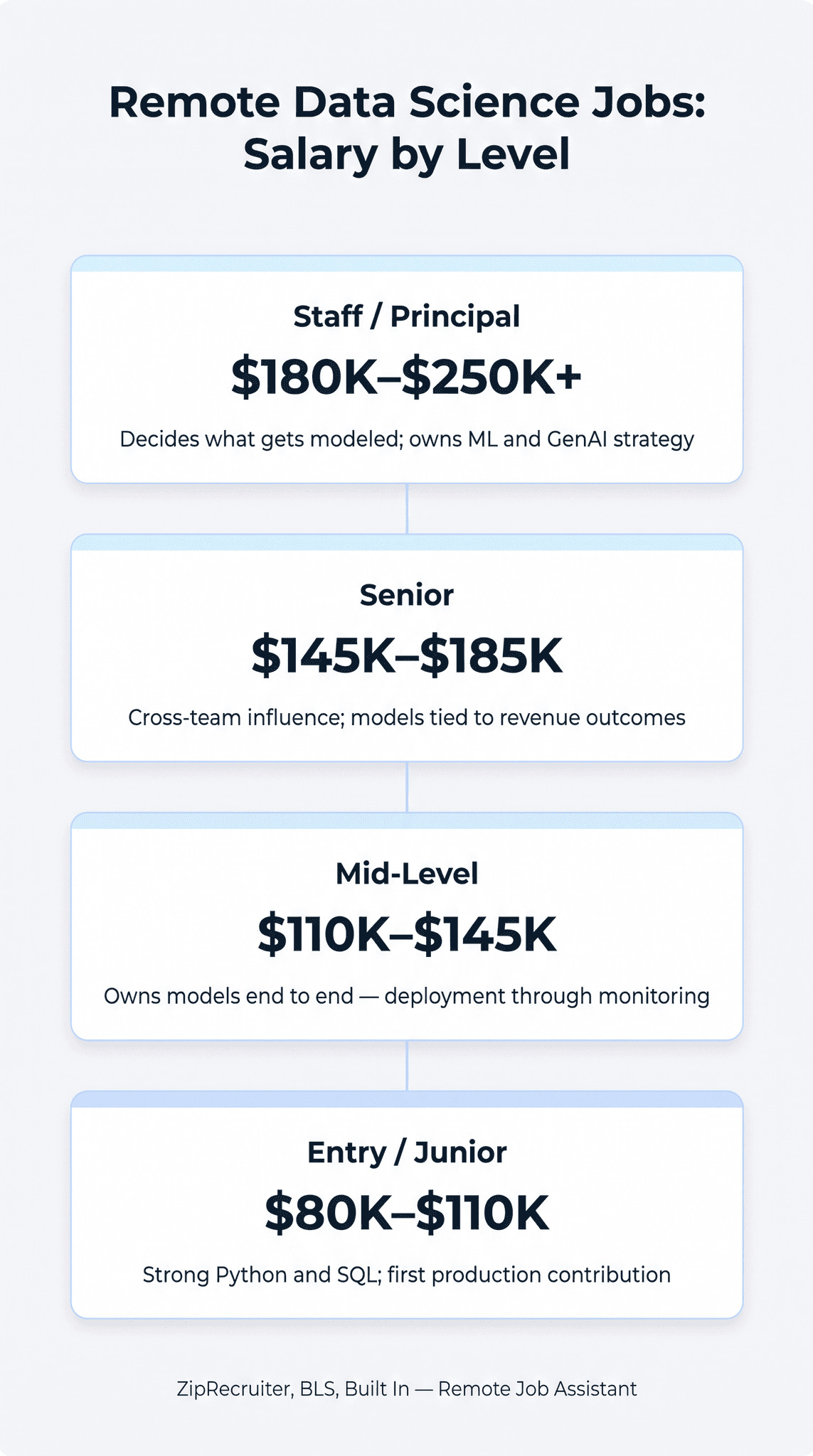
Salary ranges derive from ZipRecruiter's July 2026 remote data scientist data (average $122,738, with most earners between $98,500 and $136,000), Built In's 2026 remote salary pages, and advertised ranges on remote job boards (typical advertised spread of $98K–$225K), anchored against the BLS May 2024 median of $112,590 for all data scientists. Ranges reflect base salary — total compensation at later-stage tech companies typically runs 15–30% higher once equity and bonus stack.
Two things explain the wide variance. Industry margin: a data scientist at a high-margin software company earns dramatically more than the same title at a hospital system or retailer, because the employer's economics support it. And remote comp philosophy: remote-first companies increasingly pay location-agnostic bands for $100K+ roles, while location-adjusted employers may dock 10–20% for a low-cost-of-living address. Ask which policy applies before the offer stage, not after.
The gap between a $110K and a $180K remote data science offer is rarely modeling skill. It's whether your models ever made it to production.
If you're targeting the top of these bands, filter your search to $150K+ remote positions and expect L3 interview questions: not "how does gradient boosting work" but "tell me about a model you killed and why."
The 2026 Data Science Skills Shift: What Remote Postings Require
The most useful thing the 827-posting dataset shows isn't any single number — it's the direction of movement between 2024 and 2026.
| Skill | % of 2026 Postings (n=827) | Trend |
|---|---|---|
| Machine learning | 69.3% | Steady — now baseline, not differentiator |
| Python | 57% | Down from 78% in 2024 |
| R | 33% | Stable, concentrated in research/biostat roles |
| SQL | 30.4% | Stable — still the universal filter |
| AWS | 19.7% | Rising with MLOps demand |
| NLP | 19% | Up from 5% in 2024 — fastest riser |
| Azure | 14.3% | Rising in enterprise postings |
| Deep learning | 11.7% | Stable |
| Tableau | 11.5% | Slowly declining in DS (moving to analyst roles) |
Two of those movements deserve a causal explanation, because they look strange until you understand why they happened.
Python dropping from 78% to 57% of postings is actually bad news for candidates — it means the baseline rose. Employers stopped listing Python for the same reason they stopped listing "email proficiency": they assume it, along with SQL, and they spend requirement lines on what still filters people out. If your resume leads with "Python, pandas, scikit-learn," you're announcing that you're calibrated to the old baseline — advertising the entry fee as if it were the edge.
The NLP quadrupling is the real 2026 story. When 19% of postings (n=157 of 827) require natural language processing — up from 5% two years earlier — that's the posting-data signature of every mid-size company shipping LLM features at once: retrieval pipelines, evaluation harnesses, fine-tuning, prompt systems that need statistical rigor behind them. This work lands on data scientists because it is fundamentally an experimentation problem, and experimentation is your job.
In 2026, machine learning knowledge doesn't differentiate you. It appears in 69% of postings — it's the entry fee, not the edge.
The practical move: one deployed GenAI project outperforms another classical portfolio project by a wide margin, because it maps to the fastest-growing requirement in the dataset. Be specific about what "deployed" means here — a retrieval system with an actual evaluation harness (Ragas and promptfoo are the open-source tools interviewers recognize), quality metrics you measured before and after changes, and a writeup of where retrieval failed. A fine-tuning notebook with no evaluation is a classical portfolio project wearing a GenAI costume, and interviewers can tell.
Stop Applying Manually
Our AI applies to hundreds of matching jobs while you sleep. Wake up to interviews, not more applications.
Data Scientist vs Data Analyst vs Data Engineer
Before you apply anywhere, make sure you're targeting the right title — the three data roles have diverged in pay, day-to-day work, and remote availability.
| Role | Core Focus | Typical Remote Base | Best If You Want |
|---|---|---|---|
| Data analyst | Reporting, dashboards, business questions | $70K–$110K | Fast entry, business proximity |
| Data scientist | Models, experimentation, GenAI systems | $100K–$165K+ | Statistical depth, product impact |
| Data engineer | Pipelines, infrastructure, data quality | $100K–$165K+ | Software engineering, systems work |
The education data undercuts a persistent myth here. In the 827-posting analysis, 29.6% of postings asked for a master's, 24.1% for a PhD, 19.8% for a bachelor's — and 26.5% didn't specify a degree at all. PhDs concentrate in research-track roles; for L1 and L2 product data science, demonstrated production work beats a third degree. If you're weighing the analyst-to-scientist move, our data analyst vs data scientist comparison breaks down the transition path in detail, and the remote data analyst guide covers the adjacent market. If you keep gravitating toward pipelines instead of models, you may be a data engineer who hasn't admitted it yet — that market pays comparably with less applicant competition per role.
Companies Hiring Remote Data Scientists
As of August 2026, Haystack tracked 198 live remote data scientist openings with 140 added in a single week — turnover is fast, which matters for your application timing. The companies fall into three useful buckets.
Product tech companies — Pinterest, Roku, and Block all hire remote data scientists for experimentation, ads, and risk modeling. Comp sits at the top of the bands above.
Consulting and government-adjacent — Leidos and McKinsey's QuantumBlack hire remote and remote-flexible data scientists; expect clearance requirements or travel percentages in some postings.
Remote-first distributed companies — GitLab, Automattic, and Deel run fully distributed data teams and hire across many countries. These orgs already operate async, which makes them the strongest cultural fit for remote DS work.
Watch the third bucket closely even when openings are scarce: remote-first companies re-post data roles in cycles, and being early matters when a posting draws hundreds of applicants in 48 hours. New remote data science roles appear on our remote job board daily, alongside the broader set of high-paying remote openings if you're keeping adjacent titles in scope.
How to Actually Land a Remote Data Science Job
Remember the market math: about 5% of data science postings are remote, and every one of them is visible nationally. Three moves separate candidates who convert from candidates who apply for six months and stall.
Position yourself one rung up the Deployment Ladder
Audit your evidence against the Ladder before touching your resume. If you're at L1, your interview stories should demonstrate L2 criteria: pick the one project where your model actually shipped — even a small one — and build your narrative around deployment, monitoring (tools like Evidently or Arize come up in these conversations, and knowing them signals you've lived with a model in production), and what broke. If you're at L2 targeting senior bands, your stories need L3 texture: a model you argued against building, a metric you tied to revenue.
Here's the failure mode that kills otherwise strong candidates: you ace a churn-model take-home, reach the final round, and lose the offer because the hiring manager asked when you'd push back on a stakeholder who wants a model that shouldn't exist — and you had no story. The hiring-manager logic is brutal and consistent: monitoring can be taught, judgment can't. The real filter at senior levels isn't modeling skill — it's whether you've ever killed a project that leadership wanted. Hiring managers hear a hundred candidates describe accuracy scores. They hire the one who describes consequences, including the projects they refused.
Target the 2026 skill signals
Rewrite your resume against the posting data, not against tradition. Machine learning and Python get one line — they're assumed. Give the space to what filters candidates now: NLP and GenAI production work, cloud deployment (AWS appears in 19.7% of postings, n=163 of 827), experiment design at scale. One deployed retrieval system with an evaluation framework will generate more interview conversation than three Kaggle finishes.
Run a volume strategy — because the field is national
This is the part most guides won't say plainly: at 400+ applicants per remote posting, response rates for even strong candidates run in the low single digits. Applying to five jobs a week manually is a six-month timeline with no guarantee. The candidates who convert treat applications as a pipeline problem — sustained targeted volume across every matching posting, applied early, while tailoring energy goes into the interviews that come back.
Use a simple triage rule for where each application effort goes. Hand-craft the application when you have a warm connection or the company is one of your top ten targets — a referral still beats any funnel. Network first when the company is remote-first and small, because those teams hire from their communities (MLOps.community and DataTalks.Club are where remote DS hiring conversations actually happen) before postings get traction. Automate everything else — the long tail of matching postings where being early matters more than being artisanal.
That's the exact problem Auto-Apply was built for: Remote Job Assistant surfaces remote data science roles that match your salary floor and skills, then submits applications for you at a volume you couldn't sustain manually — without the spray-and-pray of a LinkedIn Easy Apply blast that dumps you into the same 400-applicant pile late. Volume plus early targeting is the whole edge; automation is just how you get both while employed.
And prepare for the friction nobody advertises — the kind that fills r/datascience threads every hiring season: take-home assignments that quietly demand 4–6 hours (sometimes multiples of that), ghosting after strong second rounds, "remote" postings that turn hybrid at the offer stage, and roles marked remote that still require four hours of daily US time zone overlap — a dealbreaker they mention in round three, not in the posting. Some companies have learned that posting "remote" widens the applicant pool even when they quietly prefer candidates willing to come in occasionally; the 5% explicit-remote figure understates how much filtering happens after you apply. None of it is personal. It's what a nationally contested market feels like from inside.
The remote data science market isn't small — it's nationally contested. Every remote posting you see is being seen by every data scientist in the country.
Stop Applying Manually
Our AI applies to hundreds of matching jobs while you sleep. Wake up to interviews, not more applications.
What Nobody Tells You About Remote Data Science Work
Remote data science is a writing job. In an office, your model gets adopted because you walked a stakeholder through it. Remote, your model gets adopted because your experiment doc was clear enough to be believed by someone reading it alone at 7am in another timezone. The data scientists who thrive remotely are the ones whose written analysis travels without them — and the whiteboard-dependent review culture at many companies is precisely why so few DS postings go remote in the first place. Demonstrating strong async writing in your interview process (a crisp take-home writeup, a clear follow-up memo) is a remote-specific hiring signal most candidates never think to send.
AI tooling is compressing L1 work. The notebook-and-dashboard layer of data science — the Insight Producer rung — is exactly what code assistants and automated analysis tools are getting good at. BLS still projects 34% growth through 2034, but that growth concentrates in production ML and GenAI systems work, not in analysis that a tool can now draft. The ladder isn't optional anymore; it's the escape route.
Treat that as a planning input, not a scare. The same tooling that compresses L1 makes a single L2 data scientist dramatically more productive — which is why companies keep hiring them.
Frequently Asked Questions
Is data science still a good career in 2026 now that AI can automate analysis?
Yes — with a level caveat. BLS projects 34% employment growth from 2024 to 2034 (245,900 to 328,300 jobs, roughly 23,400 openings per year), making data scientist the fourth fastest-growing US occupation. But the growth concentrates in production ML and GenAI work; pure notebook analysis is the layer AI tooling is absorbing. Aim your skill-building at the Deployment Ladder's L2 and above.
Do I need a PhD to get a remote data science job?
No for most product roles. In the 2026 analysis of 827 postings, 24.1% asked for a PhD while 26.5% didn't specify a degree at all; master's (29.6%) and bachelor's (19.8%) cover the rest. PhDs matter for research-track positions. For L1–L2 product data science, one shipped production model outweighs a third degree.
I'm a data analyst — how do I move into a remote data science role?
Close three gaps in order: statistical depth (experiment design, causal inference), production Python beyond notebooks, and one deployed model with measurable outcomes. Many analysts make the jump internally first — it's easier to get your first production ML work at your current employer than to interview for it cold. Our data analyst vs data scientist comparison maps the full transition.
Should I learn classical machine learning or focus on LLMs to get hired in 2026?
Both, but weight new effort toward LLM work. Classical ML appears in 69.3% of postings (n=573 of 827) — you need it, but it's assumed. NLP requirements nearly quadrupled from 5% to 19% of postings between 2024 and 2026, making GenAI/LLM production experience the fastest-rising differentiator. A retrieval system with a real evaluation framework is the highest-ROI portfolio piece right now.
How do I know which level of the Deployment Ladder I'm on?
Ask where your work stops. If your models inform decisions but someone else productionizes them, you're L1 (Insight Producer). If you own deployment and monitoring end to end, you're L2 (Production Modeler). If you decide which problems get modeled at all and answer for business outcomes, you're L3 (Decision Owner). Price yourself by the rung you can evidence in stories, then interview one rung up.
How much do remote data scientists make compared to in-office roles?
Comparable to slightly higher, because remote postings cluster at product-mature tech companies with strong comp bands. ZipRecruiter's July 2026 data puts the remote average near $123K with most earners between $98.5K and $136K, against a BLS all-data-scientist median of $112,590. The bigger variable is location policy: remote-first companies increasingly pay location-agnostic bands, while location-adjusting employers dock 10–20% by address.
Why do so few data science postings offer remote work?
Three structural reasons: data governance rules that restrict where sensitive data can be accessed, whiteboard-heavy model review cultures that never built async habits, and RTO drift hitting stakeholder-adjacent roles hardest. Only about 5% of postings (n=41 of 827, 2026) were explicitly remote — which is why each remote opening draws a national applicant pool, and why application volume matters more in data science than in most tech roles.
Start Your Remote Data Science Career
The 2026 remote data science market rewards exactly two things: evidence that your work ships, and an application strategy sized to a national field. Audit yourself against the Deployment Ladder, put one GenAI project into production, and stop hand-applying into 400-applicant pools one posting at a time — Auto-Apply handles the volume while you prepare for the interviews it generates. If you're still calibrating your target title, start with our data analyst vs data scientist breakdown, scan the best remote job boards beyond the big aggregators, and browse current remote data openings to see the market for yourself.
The remote data science job you want exists. So do the four hundred other people applying to it — and the only ones who feel the competition are the ones applying by hand.
Ready to Find Your Remote Job?
Browse thousands of curated remote jobs or let AI apply for you.
Browse Remote JobsRelated Job Guides
Remote Interior Design Jobs: What 1,409 Postings Show (2026)
Remote interior design jobs are rare: 40 of 1,409 US postings were remote. See which designer, planner, and FF&E seats pay $75K+ from home, and where.
46 min read
Remote Journalism Jobs: What 1,438 Postings Show (2026)
Remote journalism jobs are rare: 77 of 1,438 US newsroom postings were remote. See which reporter, editor, and audience seats pay $75K+ from home, and where.
39 min read

Remote Architecture Jobs: What 1,574 Postings Show
Remote architecture jobs are rare: 25 of 1,574 postings. See which roles go remote, what they pay, and why most firms still want you at the pin-up wall.
35 min read