

Last reviewed: September 2026
You have 25 years of experience, a resume full of titles people recognize, and a clear idea of the work you want to keep doing. Then you search for remote jobs for seniors and get customer service at $18 an hour, online tutoring, transcription, and a video promising "no degree required."
Those lists are written for retirees looking for pocket money. A lot of the people reading them aren't. They're 55-year-old program directors, finance leads, engineers and sales leaders who want to keep working at the level they've earned, from home, and who suspect the remote market quietly screens them out. After 60 applications and no calls, that suspicion is easy to believe.
Get Remote Job Tips in Your Inbox
Weekly strategies, salary data, and new opportunities
Unsubscribe anytime. No spam.
So we went looking for the screen. We read the postings, and the application forms behind them, for every place an employer could write age into the process. In remote postings that pay $75K or more, the age filter almost never shows up in the ad. It shows up in the dates you hand over.
On September 26, 2026 we read 54,334 postings on 689 employer job boards (Greenhouse, Lever, Ashby and SmartRecruiters), plus 6,772 remote postings from the Workday career sites of 126 large employers. After removing hybrid, field-territory and non-U.S. roles, 4,435 fully remote U.S. postings from 340 employers had a posted base salary starting at $75,000 or more. We parsed every one for experience requirements, experience ceilings and age-coded language, and read 1,772 of their Greenhouse application forms field by field.
Based on 4,435 remote U.S. postings with a posted base floor of $75K or more, from 340 employers, read September 26, 2026:
- $201K median posted floor when 15+ years are required (n=119), against $115K at 0–4 years (n=787)
- 38.5% (n=1,484 of 3,855 postings that state years) require 8 or more years of experience
- 3 of 4,435 postings set an explicit experience cap; 3.6% (n=139 of 3,855) write a range that tops out at 7 years or less
- 0 of 1,772 Greenhouse application forms ask for a date of birth; 6.0% (n=106) ask for a school date and 0.4% (n=7) require one
- 31.8% (n=563 of 1,772) of those forms require a LinkedIn profile URL
- 12 of 12 "digital native" mentions describe a customer segment, not the candidate
- 56.1% (n=2,490 of 4,435) score as "Depth-Seeking" on the Depth Fit Score, with a median posted floor of $159K
- 4 of 4,435 postings are part-time; 13 (0.3%) are part-time, contract or fixed-term
If you only have a minute, this is the answer.
Remote employers paying $75K or more price experience as an asset: the median posted floor rises from $115K when a posting asks for 0–4 years to $201K when it asks for 15 or more. Written age screens are rare. We found 3 explicit experience caps in 4,435 postings and no date-of-birth question on 1,772 application forms. The risk sits in the dates you volunteer: graduation years on your resume, the optional school-date fields on 6.0% of forms, and the LinkedIn profile 31.8% of forms require. Aim at postings that ask for depth, which is more than half of them, and take the dates off.
What the Usual Lists Get Wrong About Working After 50
Search "remote jobs for seniors" and only 2 of the first 9 results are articles. Five are job-listing pages and two are videos. The articles that do rank anchor at $14 to $25 an hour: customer service, data entry, transcription, tutoring, telemarketing. Four of the ten we read give no pay figures at all. None counts a single job posting.
They also skip the question you actually have. None of them mentions the Age Discrimination in Employment Act (ADEA), experience caps, graduation-year fields on application forms, or how Medicare and Social Security change which offer is better. One popular list says remote work is "not physically demanding—creating an even playing field for seniors applying for work." The data on older workers says otherwise. AARP's 2025 survey of 1,656 workers age 50 and older found that 64% have seen or experienced age discrimination at work, and 22% feel they're being pushed out of their job because of their age.
The field isn't level. But the unevenness isn't where most people look for it, and that changes what you should do about it. This guide covers:
- which remote postings are written for someone with 20 years behind them, and what they pay
- where age screening actually happens, and which of those places you control
- the part-time and contract options that exist at professional pay (fewer than you'd hope)
- the Medicare, Social Security and 401(k) rules that change the math on an offer after 50
How We Collected This Data
Start with what we couldn't see. We couldn't read recruiter screens, AI resume scoring, or the application forms on Workday, Lever and Ashby, and Workday alone hosts 1,731 of the 4,435 postings (39.0%). Reddit and Glassdoor block automated reading. Employers on iCIMS, Taleo and SuccessFactors publish no open feed, so they're missing.
Here's what we could see. On September 26, 2026 we read 54,334 postings from 689 employer boards on Greenhouse, Lever, Ashby and SmartRecruiters, plus 6,772 remote-tagged postings from 126 large employers' Workday sites (up to 120 per employer). We kept postings that are fully remote and open to U.S. candidates, removed 202 duplicates, and dropped field-territory, hybrid-in-title and on-site roles. That left 6,565 remote U.S. postings from 406 employers, 5,005 with a posted pay range, and 4,435 with a posted base floor of $75,000 or more, from 340 employers. Most are current: 2,224 of the 2,398 dated board postings were posted or updated since June 27, 2026, and 1,301 of the 1,731 Workday postings were under 30 days old (87 showed no date).
For each posting we recorded the largest required minimum years of experience, whether that requirement is a closed range ("3–5 years") or open-ended ("5+ years"), any explicit cap, and age-coded language. In a 50-posting audit, the years parser was exact on 48. It was right on 25 of 25 closed ranges we sampled. For the 1,774 Greenhouse postings in the set, we pulled each application form from Greenhouse's public job-board API and its embedded form, and read 1,772 of them label by label. Pay is the posted base floor. It excludes bonus and equity.
The Depth Fit Score: Was This Posting Written for 20 Years of Experience?
You can't see the recruiter, the hiring manager or the screening software. You can see the posting, and the posting tells you who it was written for. So we built a score you can run in about 60 seconds.
The Depth Fit Score rates a posting from 0 to 10 on how well it fits someone with decades of experience, using only what the employer wrote down.
Experience floor (0–4 points): 4 if it requires 10 or more years; 3 for 8–9; 2 for 5–7, or if no years are stated; 1 for 3–4; 0 for 2 or fewer.
Ceiling (0–2 points): 2 if the requirement is open-ended ("8+ years"); 1 if it's a closed range that tops out at 8 or more ("10–15 years"); 0 if the range tops out at 7 or less ("3–5 years"), or if the posting sets an explicit cap ("no more than 5 years").
Title scope (0–2 points): 2 for Staff, Principal, Lead, Manager, Director, Head, Architect, VP or Chief; 1 for Senior, Specialist or a level III or IV; 0 for an unlabeled title.
Early-career framing (0–2 points): 2 if there is none; 0 if the title says Junior, Associate, Entry or "I", or the text calls the role ideal for an early-career hire.
Depth-Seeking (8–10): the posting asks for what you have. 2,490 of 4,435 postings (56.1%), median posted floor $159K.
Open (5–7): the posting doesn't ask for depth, but doesn't cap it either. 1,706 postings (38.5%), median floor $129K.
Early-Career Built (0–4): a short range, a junior label or an explicit cap. 239 postings (5.4%), median floor $106K.
How to use it: score every posting before you apply. Put most of your applications into 8–10. Apply to 5–7 when the work is a clear match. Treat 0–4 as a pass unless you have a referral or a specific reason the range doesn't mean what it says.
Here's the score on two real September 2026 postings. Guardian Life's Underwriting Large Case Specialist (remote, $110,350 to $181,285) asks for a "Minimum of 15-20 years of experience in individual life underwriting." That's 4 for the floor, 1 for a range that tops out at 20, 1 for "Specialist" and 2 for no early-career framing: 8, Depth-Seeking.
Now a Staff Technical Program Manager posting at Affirm, paying $230,000 to $290,000: "You have 2–4 years of experience as a technical leader in a software engineering organization." That's 0 for the floor, 0 for a range capped at 4, 2 for "Staff" and 2 for no early-career framing: 4, Early-Career Built, on a Staff title. The title says senior. The range says someone with a few years of leadership experience. When those two disagree, believe the range.
| Band | Depth Fit Score | Share of 4,435 postings | Median posted floor | Middle 50% of floors | What the posting usually looks like |
|---|---|---|---|---|---|
| Depth-Seeking | 8–10 | 56.1% (2,490) | $159K | $125K–$200K | "10+ years," Director, Principal or Lead title, no range cap |
| Open | 5–7 | 38.5% (1,706) | $129K | $100K–$166K | "5+ years" or no years, Senior or unlabeled title |
| Early-Career Built | 0–4 | 5.4% (239) | $106K | $88K–$130K | "2–4 years," Associate or Junior title, or an explicit cap |
The score only reads what's written, so it can't see a manager who wants someone "hungry" and means young. But it reliably sorts the pile. More than half of the $75K+ remote postings in our data are written for depth, and they pay the most.
That's a volume problem, not a quality problem. If 2,490 postings ask for what you have, the constraint is how many of them you can reach before they close.
Stop Applying Manually
Our AI applies to hundreds of matching jobs while you sleep. Wake up to interviews, not more applications.
Where Experience Pays: Remote Roles That Ask for 10+ Years
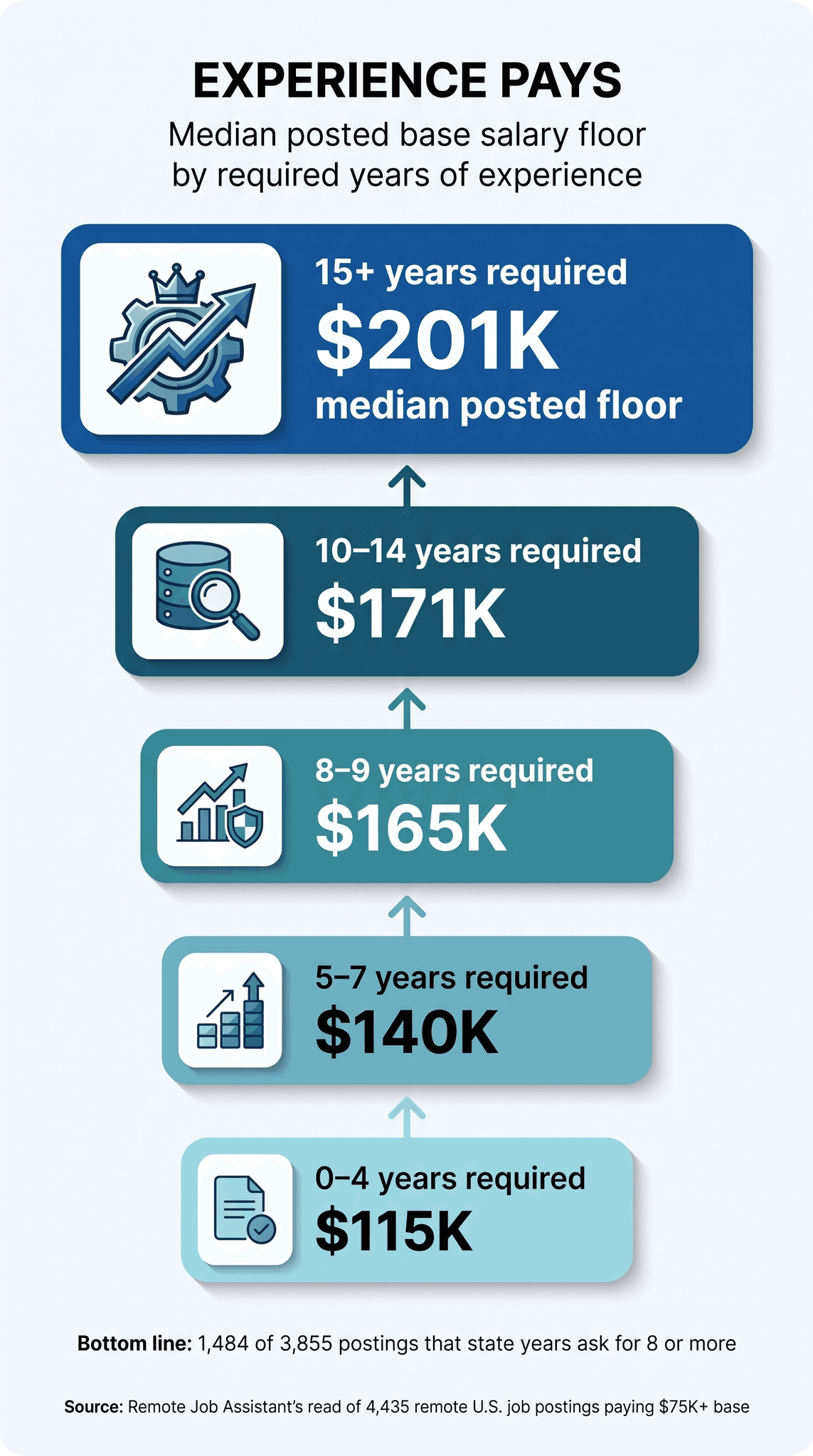
Start with the number most "jobs for seniors" lists get backwards. In remote postings that pay $75K or more, every added band of required experience comes with a higher posted floor.
| Required experience | Share of postings that state years | Median posted base floor | Median posted midpoint | Employers |
|---|---|---|---|---|
| 0–4 years | 20.4% (787 of 3,855) | $115K | $138K | 202 |
| 5–7 years | 41.1% (1,584) | $140K | $170K | 255 |
| 8–9 years | 16.5% (637) | $165K | $199K | 162 |
| 10–14 years | 18.9% (728) | $171K | $209K | 165 |
| 15+ years | 3.1% (119) | $201K | $247K | 60 |
These figures come from 4,435 remote U.S. postings with a posted base floor of $75K or more, read September 26, 2026. 3,855 of them state a required minimum, and 580 state no years (median floor $139K). The floor is the bottom of the posted base range, before bonus and equity, and multi-zone postings usually list their highest-cost zone first. Posted ranges move with the market, so treat these as a snapshot.
The shape of the curve matters more than any single number. The floor rises $25K from 0–4 years to 5–7, and another $25K to 8–9. From 8 to 14 years it barely moves ($165K to $171K). Then it jumps $30K at 15+. The market pays for eight years and for fifteen. The years in between mostly buy you access, not a higher floor.
Where do the depth-seeking postings cluster? This table covers role groups with 30 or more postings. It shows the share that require 10+ years and what those 10+ postings pay.
| Role group | Postings | Median posted floor | Require 10+ years | Median floor at 10+ years | Depth-Seeking share |
|---|---|---|---|---|---|
| Partnerships / business development | 103 | $153K | 33.3% (30 of 90) | $175K | 74.8% |
| Operations / strategy (RevOps, BizOps) | 173 | $135K | 31.4% (50 of 159) | $195K | 76.3% |
| Finance / accounting | 187 | $135K | 29.7% (51 of 172) | $173K | 67.9% |
| Marketing | 210 | $140K | 27.9% (51 of 183) | $171K | 78.1% |
| Legal / compliance / risk | 111 | $125K | 25.5% (26 of 102) | $165K | 63.1% |
| Engineering manager / director | 72 | $200K | 23.7% (14 of 59) | $224K | 94.4% |
| Sales leadership | 77 | $134K | 23.5% (16 of 68) | $198K | 74.0% |
| Program / project manager | 117 | $125K | 22.6% (24 of 106) | $151K | 77.8% |
| Product manager | 228 | $172K | 21.4% (44 of 206) | $187K | 84.2% |
| Software engineer (IC) | 673 | $157K | 15.9% (89 of 560) | $172K | 38.8% |
| Data / business analyst | 195 | $114K | 11.5% (20 of 174) | $132K | 35.9% |
| Customer success manager | 40 | $118K | 3.7% (1 of 27) | n/a (1 posting) | 70.0% |
There's a reason depth clusters in operations and project leadership, finance, partnerships and management. Those jobs are paid to make judgment calls with incomplete information: which vendor contract to renegotiate, which forecast to believe, which partner deal will survive legal review. Pattern recognition is the product, and it only comes from having seen the pattern before. Individual-contributor analyst and engineering roles skew shorter because many teams build them as ladders. They hire at 3 to 5 years and promote from within.
Turn the table into a starting list:
- You ran a function (ops, finance, a sales team): start with operations/strategy and finance postings. About 3 in 10 that state years ask for 10+, and the 10+ postings post floors of $195K and $173K.
- You managed engineers or product: engineering manager and director postings scored Depth-Seeking 94.4% of the time, the highest of any group, at a $200K median floor.
- You're a senior individual contributor who wants to stay hands-on: software engineering still works, but only 15.9% of those postings ask for 10+ years. Filter for Staff and Principal titles: 51 of those 136 postings (37.5%) ask for 10+ years, against 38 of 424 (9.0%) for other engineering titles, at a $203K median floor.
- You're coming from a client-facing role: partnerships and business development had the highest 10+ share of any group (33.3%). Customer success had the lowest (1 of 27).
The postings at the top of the range state it plainly. In September 2026 postings:
- Revolution Medicines' VP of Portfolio Sales and Field Team ($294K–$367K) asks for "25+ years of biopharmaceutical industry experience."
- Oura's VP of Global Tax ($270K–$300K) asks for "20+ years of progressive tax leadership experience."
- NVIDIA's Distinguished Engineer, Security Architecture ($320K–$488,750) asks for experience "typically 20+ years."
- An Amgen Senior Director posting ($220,272–$298,015) asks for commercial experience of "ideally 22 - 26 years."
If you've run programs, look at remote program manager openings and our remote program manager guide. If you've owned a P&L or an operating cadence, look at operations manager roles. If your last title was on the product side, remote product manager roles posted a $172K median floor, and 84.2% of them scored Depth-Seeking. For the full list above $150K, browse remote jobs paying $150K+.
In $75K+ remote postings, experience is priced as an asset: the median posted floor climbs from $115K at 0–4 required years to $201K at 15+.
Where Age Bias Actually Hides (It Isn't the Job Ad)
If postings reward experience, why do experienced people feel shut out? Because the posting is one of four places age can enter the process, and it's the cleanest of the four.
The ad copy is almost clean
Federal law bans age preferences in job ads. The ADEA covers workers 40 and older at employers with 20 or more employees, and the EEOC's regulation on help-wanted notices names the words that violate it: "age 25 to 35, young, college student, recent college graduate, boy, girl." Employers' lawyers read that list, and it shows. In the 4,435 postings:
- "Digital native" appeared in 12 postings at 3 employers, and all 12 described a customer segment (Databricks' "Digital Native Business" team, Cloudflare's "Digital Native" sales teams). None described the candidate.
- "Young" appeared in 18 postings, and none of them about the hire. They described young learners, "a young company" or systems that "are young enough that your technical judgment will shape them."
- "Recent graduates" appeared once, in a Hartford attorney posting that says it "will consider recent graduates." That widens the pool rather than narrowing it.
- "Early-career" appeared in 19 postings. Four framed the role itself for an early-career hire. The other 15 described people the hire would mentor or recruit, or said the company hires "from early-career PMs through product leaders."
Experience ranges are rare, and legal
A closed range is the closest thing to a written age screen, and it's uncommon. Just 264 of 3,855 postings (6.8%) write their requirement as a range, and 139 (3.6%) top out at 7 years or less. Explicit caps are rarer still: 3 postings from 2 employers in 4,435. One is a Humana clinical pharmacist posting that "Typically requires Bachelor's degree or equivalent and less than 5 years of technical experience." The other employer's cap applies only to the junior level of a multi-level design posting.
In 2014, a 58-year-old attorney applied for a senior in-house role whose posting required "3 to 7 years (no more than 7 years) of relevant legal experience." The company hired a 29-year-old. In Kleber v. CareFusion, a divided en banc Seventh Circuit held in 2019 that the ADEA's disparate-impact provision does not cover outside job applicants. The Eleventh Circuit reached the same answer in 2016 in Villarreal v. R.J. Reynolds. That case involved screening guidelines that targeted candidates "2–3 years out of college" and said to "stay away from" applicants "in sales for 8–10 years."
That ruling is why ranges survive. An experience range is a filter a 58-year-old can't bring a disparate-impact claim over, in two federal circuits. Most ranges are leveling templates, not plots. Humana's "Typically requires..." line reads like one. You can read the full Kleber opinion yourself. The practical point is simpler. When a posting caps experience, you're unlikely to argue your way past it, so spend the application elsewhere.
The application form asks less than you think
We expected the application form to be where birth years leak. It mostly isn't, at least on Greenhouse. Across 1,772 forms from 148 employers:
- 0 asked for a date of birth or age (only "are you at least 18" attestations)
- 106 (6.0%) at 17 employers showed a school-date field, almost all of them the "End date year" field in Greenhouse's education section
- 7 (0.4%) at 5 employers made a school date required. The other 99 education-date fields could be left blank.
- 563 (31.8%) required a LinkedIn profile URL
At least four states ban these questions on the initial application. Connecticut has since October 2021, for employers with three or more employees. Delaware followed in 2022, and Colorado's Job Application Fairness Act has applied since July 1, 2024 to employers of every size. Oregon passed its ban in 2025, and it runs until the first interview. Colorado's labor department guidance goes further than you'd expect. Employers can't ask for "dates of attendance" or graduation, or anything else that reveals age indirectly. Splitting the application into steps and asking later "still violates JAFA." Colorado's rules exempt only jobs "performed entirely outside Colorado."
The screen you can't see
The fourth place is the one no posting reveals: the recruiter, the hiring manager and the software in between. In Mobley v. Workday, a federal judge in May 2025 granted preliminary certification of a nationwide collective under the ADEA. It covers applicants 40 and older who, since September 24, 2020, applied through Workday's platform and were denied employment recommendations, and it rests on the allegation that Workday's AI recommendation system screened them out. That's a preliminary certification, not a finding that anyone discriminated. Workday hosts 39.0% of the postings in our data, but the case concerns Workday's AI recommendation features, and we can't tell which employers use them.
You can't audit an employer's software, but you can watch your own results. If a Depth-Seeking posting where you meet every listed requirement sends a rejection within a day, a person probably never read your application. Send your next application at that employer through a person: a referral, or a short note to the hiring manager before you apply. And if you believe a rejection was based on age, the EEOC's deadline to file a charge is 180 days, and state laws can extend it.
What you can control is what any screen sees: dates. A graduation year, a first job from 1994 or a LinkedIn profile that starts in 1989 lets anyone do the math in two seconds.
Red flags that a posting was written for someone younger, and why they matter:
- A closed range topping out at 7 or less on a senior title ("Staff... 2–4 years"). The pay band was set for a less experienced hire, and the range is how the recruiter enforces it. It's rare: 28 of 2,695 postings with a Senior-or-above title (1.0%) cap the range at 5 years or less, so when you see one, it was written on purpose.
- "Ideal for an early-career professional" or "designed for an early-career attorney." The team has already decided what the ladder looks like, and you'd be a rung above it.
- A required graduation-year field. Only 7 of 1,772 Greenhouse forms do this, so it tells you something about the process owner. In Connecticut, Delaware, Colorado and Oregon it's likely unlawful on an initial application.
- Culture copy that sells energy over judgment ("high-energy, high-volume marketers who thrive in the heat"). Energy language showed up in 57 postings, across roles from sales engineering to product management. It isn't illegal. It tells you how the team spends its week, which matters more at 60 than at 30.
The age filter isn't in the job ad anymore. It's in the date fields you volunteer.
You can't fix the screen, but you can fix the inputs, and you can send enough applications that one screen's bias isn't the whole outcome.
Stop Applying Manually
Our AI applies to hundreds of matching jobs while you sleep. Wake up to interviews, not more applications.
How to Apply at 55+ Without Handing the Screener a Birth Year
None of this is about hiding experience. The postings are asking for depth, so show all of it. What you remove is the arithmetic.
Your resume. Show the last 15 years in full: titles, scope and results. Collapse everything earlier into one line with no dates ("Earlier roles: financial planning and analysis at two Fortune 500 manufacturers"). Delete graduation years. Keep a date on a certification only if it proves the credential is current. For titles that match the level you're targeting, see our resume title examples.
The form. If the education section offers an optional "End date year," leave it blank. That's 99 of the 105 education-date fields we saw. If the field is required, and it was on 7 of 1,772 forms, fill it in. A blank required field means the form won't submit. If you're a Colorado resident, the state's model notice says applicants "may redact or remove age-identifying information such as age, date of birth, or dates of school attendance or graduation."
Your LinkedIn. Nearly a third of forms require it, so it's part of the application. Match it to the resume: remove graduation years, trim roles older than 15 years to a line, and make sure the headline matches the level you're applying for, not the level you held in 2011.
| What the posting shows | Depth Fit component | What to do |
|---|---|---|
| "10+ years," Director or Principal title | Floor 4, Scope 2 | Apply the same day. Lead with the biggest scope you've owned. |
| "5+ years," Senior title, no cap | Floor 2, Ceiling 2 | Apply. Frame depth as speed: what you'll fix in the first 90 days. |
| "3–5 years" on a Senior or Staff title | Ceiling 0 | Apply only with a referral, or skip. The band is set. |
| "No more than X years" or "less than X years" | Ceiling 0 | Skip. |
| "Ideal for an early-career..." | Early-career 0 | Skip unless you want a deliberate step down in scope and pay. |
| Required graduation-year field | Not scored | Fill it in or skip. In CO, CT, DE or OR, it's likely unlawful on a first application. |
Before and after: one resume line, rewritten for a 58-year-old operations director
Before: "1998–2026: Progressed from analyst to Director of Operations over 28 years at Acme Logistics; extensive experience in all areas of operations."
After: "Director of Operations, Acme Logistics (2014–2026): ran a 140-person, 3-site network; cut cost-to-serve 11% in 18 months by consolidating two carriers and renegotiating 22 vendor contracts."
The first line leads with tenure and invites the math. The second leads with scope and a result, and still shows 12 years of continuous seniority.
The "overqualified" call. When a recruiter says you might be overqualified, they usually mean one of three things. They worry you'll want more money, get bored, or leave when something better comes along. Answer the concern, not the word: "The scope here is the work I want to do. My range is [X], which I saw is inside your posted band, and I'm looking for a place to stay five years." Don't mention age. Don't apologize for experience.
Then listen to what comes back, because the same word covers two different conversations. If the recruiter asks a follow-up (what you'd want in year two, how you feel about reporting to someone younger, whether the band works), the concern is real and you're still in the process. Answer it directly. If the call ends with "we'll keep your resume on file" and no question about you, "overqualified" was the polite version of no. Don't argue it. Spend the effort on the next Depth-Seeking posting. If the same objection keeps coming back, why you're not getting interviews walks through the other common causes. These templates for messaging a hiring manager help you get past the first filter entirely.
Part-Time, Contract and Fractional Work at $75K+
Many readers of "jobs for seniors" lists want fewer hours, not a different career. The honest data point first: professional part-time work barely exists on job boards. Only 4 of the 4,435 postings were part-time, and 13 (0.3%) were part-time, contract or fixed-term. A few examples from September 2026 postings:
- Lyra Health posted a part-time psychiatrist role at $150,000, "approximately 24 hours per week."
- ICF posted a Lead Historic Preservation Specialist at 30 hours a week, $81,499 to $138,549.
- 1Password posted a 6-month contract for a Senior Compensation Consultant at $136K to $197K.
- Oura posted a contract Senior Consumer Insights Manager at $172,550 to $203,000.
The reason is structural. Headcount budgets are written in FTEs (full-time equivalents), and a reduced schedule is something managers negotiate for a person they already want. It rarely starts as a posting.
The better signal is inside full-time postings. 132 postings from 8 employers, including Teladoc and T-Mobile, state how part-time pay or benefits work. Those employers have a process for reduced schedules, even when this particular role isn't one.
| Employer | Postings | What the posting says |
|---|---|---|
| Capital One | 46 | "Salaries for part-time roles will be prorated based upon the agreed upon number of hours to be regularly worked." |
| Nationwide | 37 | Listed ranges "reflect full-time compensation. Actual compensation may be prorated based on the number of hours." |
| Medline | 14 | Full benefits at 30+ hours a week; under 30 hours, "401(k) contributions, paid time off" and the employee assistance program |
| Fortrea | 8 | Employees "working 20 or more hours per week are eligible for comprehensive benefits including: Medical, Dental, Vision" |
| Booz Allen Hamilton | 2 | Employees "working at least 20 hours a week on a regular basis are eligible to participate" in its benefit programs |
| Shield AI | 6 | "part-time employees are not eligible for benefits" |
Proration means your salary scales with your hours. A $160K role at 0.8 FTE (32 hours a week) pays $128K.
The decision rule: if you want 60–80% of a full-time schedule, apply to the full-time, Depth-Seeking posting at an employer that publishes a proration rule. Get the offer first, then negotiate the hours. Before you do, find the benefits threshold. At Fortrea and Booz Allen, 20 hours keeps you on the medical plan. At Medline it takes 30. At Shield AI, part-time means no benefits at all.
If you've run a finance or operating function, the fractional route is the other real option: a few days a week across two or three companies. Our guides to fractional CFO jobs and fractional COO jobs cover rates and where those roles get posted.
Whether you go full-time or negotiate hours after the offer, the path starts with the same full-time postings, and there are a lot of them to get through.
Stop Applying Manually
Our AI applies to hundreds of matching jobs while you sleep. Wake up to interviews, not more applications.
The Offer Math After 50: Medicare, Social Security and Catch-Up Contributions
Two offers with the same salary can be worth very different amounts after 50. These rules change which one is better, and none of the usual lists mention them.
| Your situation | The rule (2026) | What it changes about the offer |
|---|---|---|
| 65+, employer has 20+ employees | The group health plan pays first, Medicare second. The employer must offer you the same benefits as younger employees. | You can usually stay on the employer plan, delay Part B, and sign up later in a Special Enrollment Period. |
| 65+, employer has fewer than 20 employees | Medicare pays first, the group plan second | Medicare becomes your main coverage, so plan on Part B and budget for its premium. |
| Leaving a job at 65+ | 8-month Special Enrollment Period to sign up for Part B. COBRA doesn't extend it. | Sign up when the job ends, not when COBRA ends. |
| You have an HSA and are near 65 | Part A coverage backdates up to 6 months, and your HSA limit is zero once you're enrolled | Stop HSA contributions 6 months before you apply for Medicare or Social Security. |
| Claiming Social Security before full retirement age (67 for anyone born in 1960 or later) | $1 withheld for every $2 earned above $24,480. In the year you reach full retirement age: $1 for every $3 above $65,160. No limit from that month on. | At a $120K salary, up to $47,760 a year would be withheld. The withheld benefits aren't lost; they're added back after full retirement age. |
| Age 50+ with a 401(k) | $24,500 limit plus an $8,000 catch-up. At ages 60–63 the catch-up is $11,250. | A strong match is worth more because you can put more in. |
| Prior-year wages from this employer above $150,000 | Catch-up contributions must go in as Roth | The catch-up is after-tax. Plan the tax bill. |
Sources: Medicare's "How Medicare Works with Other Insurance" and its working past 65 page; the Social Security Administration's 2026 earnings test amounts; the IRS's 2026 contribution limits.
Three decision rules fall out of that table:
- At 65+, check headcount before you compare salaries. A 15-person startup and a 5,000-person company offering the same base give you different health coverage. The first puts Medicare in front.
- If you've already claimed Social Security and you're under 67, a full-time remote salary mostly cancels the check. Either delay claiming or accept the withholding as a forced deferral. It isn't lost, but it isn't spending money this year either.
- Between 60 and 63, a job with a real 401(k) match is worth more than the salary line suggests. You can defer $35,750 a year ($24,500 plus $11,250). For a comparison of benefits across remote employers, see our guide to remote jobs with benefits.
This is general information from the agencies' own pages, not tax or benefits advice. Check your numbers with a planner before you accept an offer.
Frequently Asked Questions
I'm 58 with 30 years of experience. Will remote employers think I'm overqualified?
Some recruiters will, but the postings mostly won't. In our data, 2,490 of 4,435 remote postings paying $75K+ (56.1%) scored as Depth-Seeking, and the median posted floor rises from $115K at 0–4 required years to $201K at 15+. Apply to postings that ask for 8 or more years. When the "overqualified" question comes, answer the real worry: pay, boredom or flight risk.
Should I take my graduation year off my resume and LinkedIn?
Yes. Only 106 of 1,772 Greenhouse application forms (6.0%) asked for a school date, and just 7 (0.4%) required one, so in most applications the resume and LinkedIn are the only places the year appears. Leave optional date fields blank. Fill in a required one rather than lose the application. In Connecticut, Delaware, Colorado and Oregon, asking for it on the initial application is restricted by state law.
How can I tell if a remote job posting is written for someone younger?
Run the Depth Fit Score: points for required years (0–4), no ceiling (0–2), title scope (0–2) and no early-career framing (0–2). A score of 8–10 means the posting asks for what you have. A closed range topping out at 7 years or less on a senior title, or "ideal for an early-career professional," puts it at the bottom. Only 239 of 4,435 postings (5.4%) scored 0–4.
Is it legal for a job posting to ask for "3 to 5 years" of experience?
Usually, yes. Federal rules ban age words in ads, like "young" or "recent college graduate," but not experience ranges. Two federal appeals courts (the Seventh Circuit in Kleber v. CareFusion and the Eleventh Circuit in Villarreal v. R.J. Reynolds) held that outside applicants can't bring a disparate-impact age claim over that kind of screen. A posting that openly states an age preference is a different matter under the ADEA.
What remote jobs pay $100K+ for someone over 60 who wants to work fewer hours?
Very few are posted that way. Only 4 of 4,435 remote postings paying $75K+ were part-time. The practical route is a full-time, Depth-Seeking role at an employer that publishes a proration rule, such as Capital One or Nationwide, followed by negotiating hours after the offer. The other route is fractional finance or operations work across several companies.
I'm 66 and on Medicare. Does it matter if I join a small startup?
Yes. If the employer has fewer than 20 employees, Medicare pays first and the company plan pays second. At 20 or more employees, the group plan pays first, and the employer must offer you the same benefits it offers younger employees. Compare the health coverage, not just the base salary.
Can I collect Social Security and still take a remote job?
Yes, but before your full retirement age, which is 67 for anyone born in 1960 or later, Social Security withholds $1 for every $2 you earn above $24,480 in 2026. In the year you reach full retirement age the threshold rises to $65,160 and the withholding drops to $1 for every $3. From that month on there's no limit, and benefits withheld earlier are added back to your monthly check.
Your Next Remote Role After 50
The top-ranked lists for this search still lead with customer service and data entry at $14 to $25 an hour. The postings we read ask for 8 or more years of experience 38.5% of the time and post a $171K median floor when they do. Your job is to find those postings, show the experience without the arithmetic, and read the offer with the rules that apply after 50.
- Score before you apply. Use the Depth Fit Score and put most of your applications into 8–10. Start with remote jobs paying $100K+.
- Strip the dates. Take graduation years and pre-2011 roles off your resume and LinkedIn, and leave optional date fields blank.
- Price the offer. Check employer headcount at 65+, the Social Security earnings test before 67, and the catch-up limits at 60–63.
- Keep the volume up. More than half of the $75K+ remote postings ask for what you have, so the constraint is how many you reach. Remote Job Assistant's Auto-Apply applies to matching remote roles on company career pages in the background, so your time goes to the interviews.
For more ways to aim high, see our high-paying remote jobs guide and the easiest remote jobs that pay $100K.
The posting is asking for your twenty years. Don't let a graduation date answer for you.
Ready to Find Your Remote Job?
Browse thousands of curated remote jobs or let AI apply for you.
Browse Remote JobsRelated Job Guides
Best Certifications for Remote Jobs: What 2026 Postings Say
We read 4,476 remote jobs paying $75K+ in 2026. Only 2.1% require a certification. See which credentials lock doors, which break ties, and which to skip.
32 min read
Easiest Jobs That Pay $100K: What 3,702 Remote Postings Ask
We read 3,702 remote jobs paying $100K+ in 2026. Only 30% hard-require a degree; years are the real gate. See the easiest $100K roles and their hidden catch.
32 min read
Remote Jobs for Introverts: The $75K+ Roles That Talk Least
We scored 2,737 remote jobs paying $75K+ for live talk. 58.6% ask for none. See which roles stay heads-down, what they pay, and how to spot the loud ones.
29 min read