
Last reviewed: September 2026
You make $88,000. You've done the job long enough to do it half-asleep, and the next number you want starts with a 1. So you search for the easiest jobs that pay $100K, and the lists tell you to become an air traffic controller, a real estate agent, a pilot, or, on one of them, a professional sleeper.
Those lists have two problems. They quote ceilings as if they were salaries ("up to $127,000," "the top 10% earn...") and several of their "$100K" jobs pay less than $100K at the typical level. And not one of them reads a job posting. They can't tell you what an employer actually writes into a $100K opening you could apply to this month, or whether you could do the job from your kitchen table.
Get Remote Job Tips in Your Inbox
Weekly strategies, salary data, and new opportunities
Unsubscribe anytime. No spam.
So we read the postings. The short version: at $100K, the degree is rarely the gate. The years are. Only 30.4% of the remote postings we read with a $100K+ base hard-require a degree. The median posting asks for 7 years of experience, against 5 years in postings that pay $75K to $99.9K.
This guide scores 29 role groups by how many written gates stand between you and a $100K+ offer. It covers the hidden price each easy door charges once you're through it, how many extra years the step to $100K costs in your role, and a 60-second way to score any posting before you apply.
On September 26, 2026 we read 54,334 postings on 689 employer job boards (Greenhouse, Lever, Ashby and SmartRecruiters), plus 6,772 remote postings from the Workday career sites of 126 large employers. After removing hybrid, field-territory and non-U.S. roles, 3,702 fully remote U.S. postings from 327 employers had a posted base salary starting at $100,000 or more. We parsed every one for three written gates: required years of experience, a hard degree requirement, and a required license, certification or clearance.
Based on 3,702 remote U.S. postings with a posted base floor of $100K or more, from 327 employers, read September 26, 2026:
- 74.0% (n=3,702 of 5,005) of remote U.S. postings with a posted range start at $100K+; the median posted floor is $155K
- 7 years is the median required experience at $100K+ (n=3,215 postings that state one), against 5 years at $75K–$99.9K (n=640)
- 16.4% (n=528 of 3,215) ask for 4 years or fewer; 25.0% (n=804) ask for 10 or more
- 30.4% (n=1,125 of 3,702) hard-require a degree; 44.0% (n=1,628) never mention one
- 4.2% (n=155 of 3,702) require a license, certification or clearance in writing
- 34.6% (n=1,282 of 3,702) score as "Open Door" on the Six-Figure Gate Score, with a median posted floor of $146K
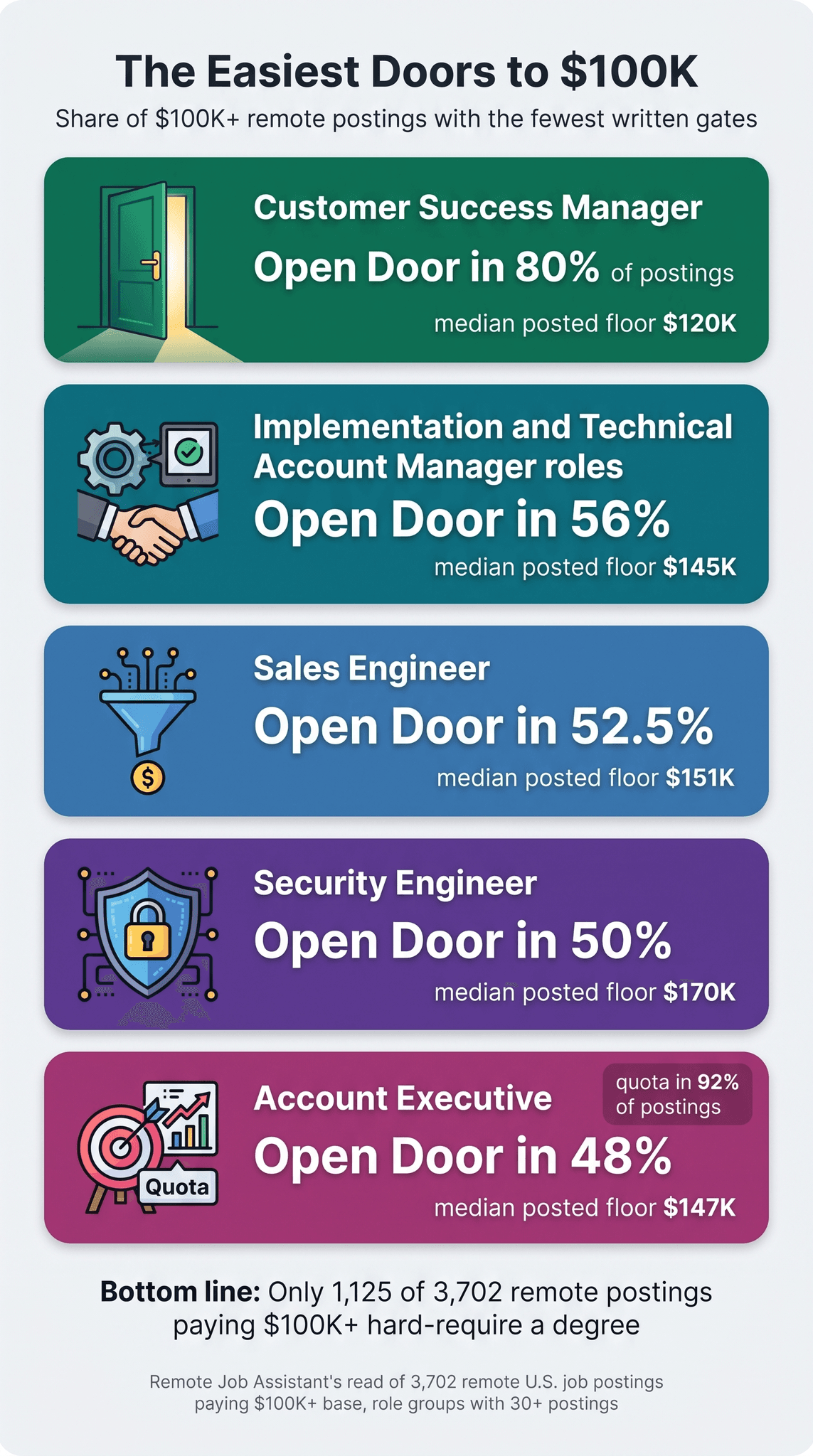
- Most open: customer success manager 80.0% (n=28 of 35), implementation, TAM and forward-deployed roles 56.0% (n=51 of 91), sales engineer 52.5% (n=42 of 80)
If you only have a minute, this is the answer.
If you've spent the last few years on customer calls, renewals or technical demos, your fastest route to $100K is probably customer success, implementation or sales engineering, not the next rung of the ladder you're on. Customer success, implementation and technical account management, sales engineering, and new-business sales carry the fewest written gates across 3,702 postings: most name no hard degree requirement and no license, and many ask for 5 years or fewer. If your job doesn't involve customers, these "easy" roles ask you to learn that skill while carrying a number. Quota shows up in 92% of account executive postings, and travel of 25% or more in 29% of sales engineer postings.
Why Most "Easiest Jobs That Pay $100K" Lists Get It Wrong
We read the nine pages that rank for this search, start to finish. They fail in four ways, and the fourth one matters most if you want to work remotely.
- Ceilings dressed up as salaries. Most of the figures are "up to" numbers or top-10% cutoffs. A role where the top tenth clears $140,000 is not a role that pays $100K.
- "$100K" jobs that don't pay $100K. One list of nine roles includes three with averages below $100,000. Another lists 31 jobs, and 12 of them have medians below $100,000.
- "Easy" means "no degree," and then the licensed jobs show up anyway. Physician assistant and optometrist both appear on "easiest" lists, and both require a graduate degree and a state license.
- Remote doesn't exist. None of the nine pages says whether a listed job can be done from home, or how many of its openings are remote.
The reason is structural. These lists are built from occupation data: the median wage and typical education of everyone who holds a job title today. That describes the average incumbent, not a specific opening. Take software developers. O*NET, which republishes Bureau of Labor Statistics wages, puts their 2025 median at $135,980, and 85% of the workers it surveyed said a new hire needs a bachelor's degree. Yet 465 of the 589 remote software engineer postings we read paying $100K+ have no hard degree line. For sales engineers, O*NET shows a $124,900 median and 57% saying a bachelor's is required. In our data, 73 of 80 sales engineer postings paying $100K+ don't require one outright.
There's also a reason you can read pay straight off a remote posting now. Colorado's labor department says its pay-disclosure law covers a remote job posting "even if it says Coloradans won't be considered", and California's Labor Commissioner applies its law to any position that "may ever be filled in California, either in-person or remotely." Washington, New York and Illinois have posting rules of their own. That's why 5,005 of the 6,565 remote U.S. postings we read carried a pay range.
So we skipped the occupation tables and measured "easy" from the postings themselves.
How We Collected This Data
Start with what this method can't see. A posting tells you what an employer writes down, not whether a hiring manager bends it for a strong referral. Reddit, Glassdoor and the Bureau of Labor Statistics block automated reads, so there's no forum sentiment here, and the BLS wage figures we quote come through O*NET, which republishes them. Employers on iCIMS, Taleo, SuccessFactors and Phenom publish no open data feed, so many large insurers and banks are missing, along with any role filled by referral before it was posted.
The postings came from two places. The first was a same-day read of 689 startup and growth-stage boards on Greenhouse, Lever, Ashby and SmartRecruiters: 54,334 postings. The second was the Workday career sites of 126 large employers, including Humana, Cigna, CVS Health, Nationwide, Travelers, Capital One, Salesforce and Pfizer, where we took up to 120 remote-tagged postings per employer (6,772 in total).
We kept U.S.-eligible, fully remote roles. Hybrid day-count rules, "not a remote position" and office-proximity clauses were dropped. So were 516 field and territory roles (a city or territory in the title, field sales, clinical and service work), and duplicates by employer, title and pay. A posted base floor of $100,000 or more left 3,702 postings from 327 employers: 2,406 from startup boards and 1,296 from Workday. Another 733 postings between $75,000 and $99,999 became the comparison group.
For each posting we parsed three gates from the raw text. Years: the largest required minimum ("5+ years," "3–5 years" counts as 3), ignoring years marked preferred; lines that offer degree pathways ("Bachelor's and 10 years, or Master's and 8") use the bachelor's path. A hand check of 50 random postings found 48 exactly right; the other two were off by one or two years on an "or" path. Degree: hard (required, no substitute) or soft ("or equivalent experience," "in lieu of a degree"). "Or a related field" counts as hard, because it offers a different major, not a substitute. A held-out check got the hard-or-soft call right in 28 of 30 postings. Licenses, certifications and clearances: the classifier from our certification study, which labeled 96 of 100 hand-checked mentions correctly. We also flagged quota, pay ranges labeled as on-target earnings (OTE), on-call rotations, and travel of 25% or more.
Pay is the posted base floor: the bottom of the first posted range, with ranges labeled OTE skipped. Multi-zone postings usually list the top zone first, so a few floors run high. Every posting was live on September 26, 2026, and 2,046 of the 2,219 dated startup-board postings had been updated since late June. We re-run this analysis quarterly.
The Six-Figure Gate Score: A Way to Measure "Easy"
"Easy" is useless as a ranking word until you define it. For someone who already has a career, easy means: how many written barriers stand between my resume and this $100K offer? So we built a score for exactly that.
The Six-Figure Gate Score counts the written barriers in a $100K+ posting on a 0–10 scale: how many years it demands, whether the degree is hard or soft, and whether a license, certification or clearance is required.
Experience gate (0–4 points): 0 if no years are stated or 2 or fewer; 1 for 3–4 years; 2 for 5–6 years; 3 for 7–9 years; 4 for 10 or more.
Degree gate (0–3 points): 0 if no degree is mentioned, it's preferred, or it's explicitly not required; 1 for a degree "or equivalent experience"; 2 for a bachelor's required with no substitute; 3 for a master's, PhD, JD or MD required.
License gate (0–3 points): 0 if none; 1 for a credential with an "or equivalent" alternative; 3 for a required license, certification or clearance, including titles that legally require one (physician, nurse practitioner, physician assistant, attorney).
Open Door (0–2): a mid-career candidate clears it on paper. Typical shape: "5+ years" with no hard degree line, or "3–4 years" plus "bachelor's or equivalent experience." 1,282 of 3,702 postings (34.6%), median posted floor $146K.
Screened (3–5): one real hurdle. Typical shape: 7+ years, or a hard bachelor's plus 5 years. 1,871 postings (50.5%), median floor $157K.
Gated (6–10): stacked hurdles. Typical shape: a license plus a degree plus 5+ years, or 10+ years plus a hard degree. 549 postings (14.8%), median floor $175K.
How to use it: score the last three postings you saved. If they're all Screened or Gated, look for the Open Door role next to your current job before you spend money on a credential.
Here's how it works on a real posting. Reddit's Backend Engineer, IAM asks for "3+ years of experience designing and developing distributed backend systems," has no degree line, and posts a base salary range of $164,200 to $229,900. That's 1 + 0 + 0 = 1, Open Door. Compare a line from an enterprise director posting in the same data: "Bachelor's degree and 10 years of directly related experience." That's 4 + 2 + 0 = 6, Gated.
The gates do buy some pay, but less than you'd think. The median posted floor is $146K for Open Door postings and $175K for Gated ones. That's roughly $29K at the floor, and every one of those postings is already above $100K.
One caution: the score counts what's written. 453 of the 1,282 Open Door postings state no years at all, and a "Staff" or "Director" title still implies seniority. We checked whether that skews the ranking below, and it doesn't.
Open Door postings are also the ones where volume decides who gets interviews. When the posting doesn't screen you out on paper, the question becomes how many of them you reach in the first few days.
Stop Applying Manually
Our AI applies to hundreds of matching jobs while you sleep. Wake up to interviews, not more applications.
The Easiest Jobs That Pay $100K, Ranked by Gate Score
We scored 29 role groups with 20 or more $100K+ postings. The table shows the 16 most open, ranked by their share of Open Door postings. Salary figures are posted base floors from 3,702 remote U.S. postings at 327 employers, read September 26, 2026; ranges labeled as on-target earnings are excluded. The median floor is the middle of the bottom-of-range figures, so half the postings in a role start higher. Ranges move, so check the live postings in remote jobs paying $100K+ before you plan around a number.
| Role | $100K+ postings | Open Door share | Median years asked | No hard degree | Median posted floor | The catch |
|---|---|---|---|---|---|---|
| Customer success manager | 35 | 80.0% (28) | 5 | 97% (34) | $120K | Lowest floor of the top group |
| Recruiter / talent acquisition | 23 | 60.9% (14) | 6 | 96% (22) | $150K | Small sample |
| Implementation, onboarding, TAM, forward-deployed | 91 | 56.0% (51) | 5 | 75% (68) | $145K | Travel 25%+ in 6 of 91 |
| Sales engineer / solutions consultant | 80 | 52.5% (42) | 5 | 91% (73) | $151K | Travel 25%+ in 23 of 80 |
| Security engineer / analyst | 154 | 50.0% (77) | 7 | 93% (143) | $170K | On-call in 10 of 154 |
| Account executive (new business) | 138 | 47.8% (66) | 6 | 80% (111) | $147K | Quota in 127 of 138 |
| Software engineer | 589 | 44.7% (263) | 6 | 79% (465) | $165K | On-call in 65 of 589 |
| Product designer / UX | 52 | 44.2% (23) | 7 | 92% (48) | $170K | Portfolio asked in 35 of 52 |
| Data / business analyst | 122 | 43.4% (53) | 5 | 70% (85) | $132K | Floor below other data roles |
| Account manager | 30 | 43.3% (13) | 7 | 77% (23) | $148K | Travel 25%+ in 7 of 30 |
| Solutions architect | 60 | 41.7% (25) | 6.5 | 95% (57) | $161K | Travel 25%+ in 11 of 60 |
| Product manager | 214 | 39.7% (85) | 7 | 80% (172) | $178K | Years, not paper |
| Data scientist / ML engineer | 127 | 38.6% (49) | 6 | 67% (85) | $187K | Hard degree in 42 of 127 |
| SRE / DevOps / cloud | 129 | 35.7% (46) | 8 | 87% (112) | $155K | On-call in 25 of 129 |
| Program / project manager | 96 | 35.4% (34) | 7 | 69% (66) | $132K | Hard degree in 30, 23 at enterprises |
| Marketing | 176 | 29.5% (52) | 8 | 82% (144) | $147K | 8-year median ask |
Postings that state no years don't prop up the top of this table. Counting only the 3,215 that state a requirement, the same six roles lead: customer success, recruiting, sales engineering, implementation and TAM, account executive, and account management.
Customer Success Manager: The Most Open Door, the Lowest Floor
Customer success is the most open $100K door in the data: 28 of 35 postings score Open Door, and 34 of 35 have no hard degree line. The postings are explicit about what counts. Account management appears as qualifying experience in 17 of the 24 experience lines we could parse. Scribe's mid-market CSM posting asks for "3 to 6 years in Customer Success, Account Management, or a customer-facing SaaS role" and lists a $110K to $170K range.
The market prices that easy entry. At a $120K median floor, customer success pays the least of the six most open roles. And read past the title: renewal shows up in 24 of the 35 postings, retention or churn in 26, and expansion or upsell in 25. LaunchDarkly wants "experience owning the renewal process and being held accountable to a retention quota." In a lot of these seats, the renewal number is the job.
Account load is the other thing the title hides. Ashby's postings say its mid-market CSMs "typically manage a book of 60+ customers," while its strategic CSMs manage "a book of ~20 strategic customers, exceeding $2m in total ARR." Those are different jobs under one title. In the interview, ask how many accounts you'd carry, how much ARR they add up to, and whether a renewal or expansion quota sits on your number. It's still a six-figure base, and it's the most natural next step for an account manager or renewals lead. Our remote customer success jobs guide covers the ladder, and current customer success manager openings show which companies are hiring.
Implementation, TAM and Forward-Deployed Roles
This group (implementation managers and engineers, onboarding leads, technical account managers, and the newer "forward-deployed" engineers) is the widest door for technical people who like customers. 51 of 91 postings are Open Door, and the median ask is 5 years at a $145K median floor. The experience lines are unusually generous: 22 of 69 accept any "customer-facing" technical role, and 21 name consulting.
Sift's technical account manager posting spells it out: "5+ years in a technical, customer-facing role – Technical Account Management, Solutions Engineering, Implementation, or Technical Support." Webflow's senior forward-deployed engineer asks for "4-6 years of experience in solutions engineering, forward deployment, or a customer-facing technical role" with a top-zone range of $158,300 to $190,000.
Read the whole posting, though. Skydio's deployment engineer role pays a $115,000 to $135,000 base for "3+ years experience supporting cloud connected devices." It also says "Ability to travel 75% of the time," and Skydio asks new hires to earn the FAA's Part 107 drone certification within their first 60 days (strongly encouraged for everyone, required for some roles). Remote, technically.
Sales Engineer and Solutions Consultant
On paper, sales engineering is almost degree-free: 73 of 80 $100K+ postings have no hard degree line, 42 of 80 are Open Door, and the median floor is $151K. 1Password's mid-market sales engineer posting offers a base of $100,000 to $140,000, commission-eligible, for "4+ years of experience in customer-facing technical sales, solutions engineering, or a similar role."
There are two catches. First, the years usually have to be in the seat: 47 of 71 experience lines name solutions or sales engineering specifically. Postscript is one of the more flexible ones, accepting "at least 3 years in a revenue-driving, customer-facing technical role — solutions engineer, sales engineer, support engineer, or related." Second, 23 of 80 postings ask for travel of 25% or more, including 1Password's "Travel up to 25% as needed."
Sales engineering postings rarely ask for a degree, but most ask for years in a pre-sales role, not years in tech. If your pre-sales work sits under a support or implementation title, put it where the recruiter looks. Instead of "Technical Support Engineer, 2020–2026," write "Technical Support Engineer, 2020–2026: [N] years running technical demos and proofs of concept for prospects alongside the sales team." Use your real numbers, and match the posting's phrase ("customer-facing technical role") word for word.
Security Engineering: More Open Than Its Reputation
Most high-paying-job lists treat security as a certification fortress. The postings disagree. 77 of 154 $100K+ security postings are Open Door, 143 of 154 have no hard degree line, and only 5 of 154 require any certification or clearance in writing. The median floor is $170K. The real gate is time: the median ask is 7 years, and 22 of the 122 experience lines we parsed accept software engineering years instead of security years. That makes security a lateral move for engineers, not a starting point. It also makes security easier to enter at $100K than marketing: 50.0% of security postings are Open Door against 29.5% of marketing postings (52 of 176), with a lower median ask (7 years against 8). Our remote cybersecurity jobs guide breaks down the specialties, and our certification study explains why a CISSP rarely decides who gets hired.
Account Executive: Easy In, Hard to Stay
Account executive is one of the most open $100K doors on paper. 66 of 138 postings score Open Door, only 27 hard-require a degree, and LaunchDarkly's mid-market posting asks for "2+ years of full-cycle sales experience." It's also the door with the steepest toll. 127 of 138 postings (92%) tie the job to a quota, and 44 of 138 say the posted range is, or may be, on-target earnings rather than base. 54 of 138 ask for a track record of exceeding quota, so have your attainment by year ready before the first call. If you've never carried a number, this is the one open door on the list that tests you on something you can't show yet. The SDR, BDR and AE breakdown explains how the ladder works, and the remote account executive guide covers what enterprise loops look like.
Software Engineer and Data or Business Analyst
Software engineering is the biggest pool here by far: 589 postings, 263 of them Open Door, at a $165K median floor. The catch is operational: 65 of 589 mention an on-call rotation. It's the largest role group in our $100K+ data, and current remote software engineer openings show the same breadth.
Data and business analysts sit at the other end of the pay range, with a $132K median floor, but 53 of 122 postings are Open Door and the median ask is 5 years. Affirm's Quantitative Analyst II posting asks for "2+ years of relevant experience" with a base range of $145,000 to $205,000 in its highest-cost states. As the next section shows, the analyst step to $100K costs the fewest extra years of any role we measured. Our remote data analyst guide covers the stack, and you can browse current data analyst openings.
Recruiting is the small-sample surprise: 14 of 23 postings are Open Door and 22 of 23 have no hard degree line. Coinbase's senior recruiter posting lists a base of $130,900 to $154,000 for "5+ years of full-lifecycle recruiting experience," and Headway asks for "3+ years of full-cycle recruiting experience" at $105K to $155K. See the remote recruiter guide and current recruiter openings.
The lowest written bar for a $100K remote job sits next to the customer, not the codebase or the ledger.
The Hardest $100K Doors, and Why They're Locked
At the other end of the scale, the pattern is just as clear.
- Attorney and counsel: 0 of 60 postings are Open Door; 53 are Gated. Practicing law requires bar admission, which 44 of the 60 postings spell out, and 48 name a JD.
- Physician, nurse practitioner and physician assistant: 0 of 95 Open Door; 67 Gated, with the highest median floor of any role group at $208K.
- Medical affairs and medical science liaisons: 4 of 35 Open Door, and only 6 of 35 without a hard degree line; 23 of 35 require an advanced degree (PharmD, PhD or MD). Travel of 25% or more appears in 14 of 35.
- Finance and accounting: 26 of 155 Open Door, a median ask of 8 years, and 69 of 155 with a hard degree line.
- Actuaries: 11 of 31 postings require an actuarial exam credential in writing.
The highest-paying doors in this data are also the worst switch targets on the list. When the law requires a named license holder, experience can't substitute for it, and the degree is the only road to the license. If you're outside these fields, no amount of adjacent experience lowers these gates.
The reason is licensure and liability. When a law or an auditor requires a named, credentialed person to sign (a bar-admitted attorney, a licensed physician, an exam-certified actuary), an employer can't accept "equivalent experience." Finance is gated differently. Most seats don't need a CPA, but the ladder itself is long: a median ask of 8 years at $100K+, against 5 years at $75K to $99.9K. If you're already inside one of these fields, your $100K move is usually a step up the same ladder. If you're outside, pick almost anything else on this page.
Degree or Years: What Actually Stands Between $90K and $100K
Start with the degree, because that's what every "easiest jobs that pay $100K" list obsesses over. In our data, 2,577 of 3,702 postings (69.6%) have no hard degree gate. 1,628 never mention a degree at all.
The split by employer type is the useful part. On startup and growth-stage boards, 1,460 of 2,406 $100K+ postings (60.7%) never mention a degree. On the Workday sites of large enterprises, 641 of 1,296 (49.5%) hard-require one. The degree gate is mostly an enterprise HR feature. If you don't have one, the postings that ignore it cluster at younger companies. That matches the broader trend: Indeed's research team found that 52% of U.S. postings on Indeed mentioned no formal education requirement as of January 2024, up from 48% in 2019.
Don't read too much into a soft degree line, though. When the Burning Glass Institute and Harvard Business School tracked employers that dropped degree requirements, the share of hires without a degree into those roles rose by only about 3.5 percentage points. Across all U.S. hiring, the report put the gain at "not even 1 in 700 hires last year" (2023). "Or equivalent experience" is permission to apply. It isn't a promise that the recruiter will read your resume that way, so make the equivalent experience impossible to miss.
Years are a different story. Here's how the median required experience changes when you move from $75K–$99.9K postings to $100K+ postings in the same role. The lower band is thin for some roles (13 postings each for SRE and sales leadership, 14 for product managers), so weigh the +3 and +4 gaps more than the +1s.
| Role | $75K–$99.9K postings (median years) | $100K+ postings (median years) | Extra years for $100K |
|---|---|---|---|
| Data / business analyst | 73 (5) | 122 (5) | +0 |
| Implementation, onboarding, TAM | 31 (5) | 91 (5) | +0 |
| Account executive | 51 (5) | 138 (6) | +1 |
| Sales engineer | 16 (4) | 80 (5) | +1 |
| Software engineer | 84 (5) | 589 (6) | +1 |
| Account manager | 19 (5) | 30 (7) | +2 |
| Product manager | 14 (5) | 214 (7) | +2 |
| Program / project manager | 21 (5) | 96 (7) | +2 |
| Security engineer / analyst | 16 (5) | 154 (7) | +2 |
| Finance / accounting | 32 (5) | 155 (8) | +3 |
| Legal / compliance / risk | 28 (4) | 83 (7) | +3 |
| Operations / strategy | 24 (5) | 149 (8) | +3 |
| SRE / DevOps / cloud | 13 (5) | 129 (8) | +3 |
| Sales leadership | 13 (4) | 64 (7) | +3 |
| Marketing | 34 (4) | 176 (8) | +4 |
Across all roles, the median jumps from 5 years to 7, and the share of postings asking for 10+ years goes from 6.7% (43 of 640) to 25.0% (804 of 3,215). But the price varies a lot by role. An analyst or implementation specialist at 5 years is already at the $100K+ median. A marketer at 4 years faces a posting median of 8.
At $100K, the degree is rarely the gate. The years are, and the price in years depends on your role.
If your role's step is +3 or +4, waiting it out is the slow option. A lateral move into a +0 or +1 role that counts your existing experience is often faster. That's usually a customer-facing technical seat.
When the paper gate is soft, the constraint shifts to reach: how many relevant postings you find, and how early you apply to them.
Stop Applying Manually
Our AI applies to hundreds of matching jobs while you sleep. Wake up to interviews, not more applications.
The Hidden Price of an Easy Door
Written gates aren't the only barriers. Across all 3,702 $100K+ postings, 254 carry quota, 218 ask for travel of 25% or more, 151 label the posted range as on-target earnings, and 137 mention an on-call rotation. Those flags cluster in exactly the roles that look easiest.
- Quota: 127 of 138 account executive postings, 36 of 64 sales leadership postings, 39 of 94 partnership and business development postings.
- Travel of 25% or more: 23 of 80 sales engineer postings, 14 of 35 medical science liaison postings, 7 of 30 account manager postings, 11 of 60 solutions architect postings.
- On-call: 25 of 129 SRE, DevOps and cloud postings; 65 of 589 software engineer postings.
There's a reason the easy doors are the ones with a toll. Employers relax the paper requirements when they can measure performance after the hire. A quota, a renewal number and an incident pager are running tests, so the posting doesn't need a credential to screen for competence. The roles that stay credential-heavy are the ones where a mistake is expensive and slow to detect, like a bad legal opinion or a wrong dose.
Posting lines that tell you the real price:
- "The range provided is on-target earnings" or "OTE." The number includes commission you have to earn. Base can be half of it.
- Pay listed by zone, tier or state. At least 346 of the 3,702 postings list more than one base range by location, and many of them show the highest-cost locations first. Outschool's Tier 1 range starts at $165,600 and its Tier 3 range ("all other cities and states") at $124,200. Oura's Region 1 floor is $143,650 and its Region 3 floor $117,300. Find your zone before you anchor on a number.
- "Travel up to 50%" or "must be based in [region]." That's a territory job in remote clothing. Skydio's "Ability to travel 75% of the time" is the extreme case.
- "Participate in an on-call rotation." Ask how often, how many people share it, and whether it's paid.
- "Obtain [certification] within N months of hire." The gate moved to after the offer. Ask who pays for the exam and what happens if you fail it.
- "Bachelor's degree required" with no "or equivalent," at a large enterprise. The applicant tracking system will likely screen on it. Spend your applications where the line is soft.
An easy door doesn't mean an easy job. It means the test happens after you're hired.
How to Pick Your Easiest Route to $100K
Start with the price you won't pay. If a quota, heavy travel or a pager is a dealbreaker, the table shows which of the more open roles rarely carry it.
| If you want to avoid... | Open roles where it's rare in $100K+ postings |
|---|---|
| A quota | Security engineer (0 of 154), software engineer (0 of 589), recruiter (1 of 23), implementation and TAM (2 of 91) |
| Travel of 25% or more | Security engineer (0 of 154), product designer (0 of 52), recruiter (0 of 23), software engineer (6 of 589) |
| An on-call rotation | Customer success (0 of 35), sales engineer (0 of 80), account executive (0 of 138), recruiter (0 of 23) |
Then pick the Open Door role that counts the experience you already have. These moves are grounded in what the postings accept.
Account manager or renewals lead at $80K–$95K → customer success manager. Account management counts as qualifying experience in 17 of 24 CSM experience lines. See the remote account manager guide for how the two roles overlap.
Support engineer or implementation specialist → implementation, TAM or forward-deployed. 22 of 69 experience lines accept any customer-facing technical role, and Sift names "Technical Support" outright.
Sales engineer at a smaller company → sales engineer at $100K+. 47 of 71 postings want years in that seat, so count every one of yours.
Software engineer → security engineer. 22 of 122 security experience lines accept software engineering years, and only 5 of 154 postings require a certification.
Analyst at $85K → analyst at $100K+ somewhere else. The median ask is 5 years in both bands, so the raise is usually a company change, not a new ladder.
Marketer at $90K → expect a longer climb. The median ask goes from 4 years to 8. A customer-facing role that values your domain knowledge can get you there sooner.
Then run the 60-second check on every posting before you apply. Count the years line. Find the degree line and look for "or equivalent." Scan for a license or clearance. Then scan for OTE, a travel percentage, and on-call. Add it up on the Gate Score, and put your effort into the Open Door postings where your years already match.
Two more habits help. Don't buy a certification to clear a posting that doesn't require one; the certification data shows how rarely they gate $75K+ remote roles. And mirror the posting's wording in your experience line. If a TAM posting says "customer-facing technical role," your resume should say it too. If you're applying and not hearing back, why you're not getting interviews walks through the usual causes.
When nothing on paper screens applicants out, timing and reach do the screening instead. Reaching every relevant posting in its first few days is the part worth automating.
Stop Applying Manually
Our AI applies to hundreds of matching jobs while you sleep. Wake up to interviews, not more applications.
Frequently Asked Questions
What is the easiest job to get that pays $100K a year?
For someone with 5+ years of professional experience, the easiest remote $100K jobs are customer-facing technical and relationship roles. In our read of 3,702 remote postings paying $100K+, customer success manager scored Open Door in 80.0% of postings (28 of 35), implementation and technical account manager roles in 56.0% (51 of 91), and sales engineer in 52.5% (42 of 80). Their median posted base floors were $120K, $145K and $151K.
Can I make $100K in a remote job without a college degree?
Yes, in most roles outside law, medicine and some finance. 2,577 of 3,702 remote postings paying $100K+ (69.6%) have no hard degree requirement, and 1,628 never mention a degree. Startup boards are friendlier than enterprises: 60.7% of startup postings (1,460 of 2,406) skip the degree entirely, while 49.5% of large-enterprise postings on Workday (641 of 1,296) hard-require one.
How many years of experience do I need for a $100K remote job?
The median $100K+ remote posting asks for 7 years (n=3,215 postings that state a requirement), against 5 years for postings paying $75K to $99.9K. Only 16.4% of $100K+ postings (528 of 3,215) ask for 4 years or fewer. The gap depends on the role: data analysts and implementation roles ask for a median of 5 in both bands, while marketing jumps from 4 to 8.
I'm an account manager making $85K. What's my fastest route to $100K?
Customer success is the most direct move. Account management counts as qualifying experience in 17 of 24 CSM postings we parsed, 28 of 35 CSM postings are Open Door, and the median posted floor is $120K. Implementation and TAM roles are a second option if you've handled technical onboarding. Check each posting for renewal or expansion targets, which appear in 5 of 35 CSM postings.
What does a Six-Figure Gate Score of 3 mean?
A score of 3 puts a posting in the Screened band: it has one real hurdle, usually 7+ years or a hard bachelor's degree plus 5 years. Half of all $100K+ remote postings (1,871 of 3,702) are Screened, with a median posted floor of $157K. Apply if you meet the one hurdle; if you don't, look for an Open Door posting in the same role at a younger company.
What is the least stressful job that pays $100K?
Postings don't measure stress, but they do show the usual sources of it: quota, travel and on-call. By that measure, product manager (0 of 214 postings flagged for any of the three), product designer (0 of 52) and recruiter (1 of 23 with quota, none with on-call or heavy travel) carry the fewest built-in pressure points. Customer-facing roles that are easy to enter usually carry at least one.
Is account executive really an easy way to make $100K?
It's easy to get into and hard to stay in. 66 of 138 account executive postings paying $100K+ are Open Door, but 127 of 138 (92%) tie the job to a quota, and 44 say the posted range is or may be on-target earnings rather than base. If you've carried a number before, it's one of the fastest routes. If you haven't, expect the test to start on day one.
Find the Open Door Next to Your Current Job
The lists that rank the easiest jobs that pay $100K are answering a question for students. For a working professional, the postings say three things. The degree matters less than the lists claim. Years matter more. And the easiest doors sit next to the customer, where the test comes after you're hired.
Start by scoring the postings you've saved on the Six-Figure Gate Score: the years line, the degree line and any license first, then the price tags (OTE language, a renewal or retention quota, a travel percentage, an on-call rotation). Then browse remote jobs paying $100K+, compare role pay in our high-paying remote jobs guide, and check which boards carry the most Open Door roles in our ranking of remote job boards. When you find the door that counts your experience, Auto-Apply can get your application into every matching posting while it's still new.
The easiest $100K job isn't the one nobody gates. It's the one whose gate you've already walked through.
Ready to Find Your Remote Job?
Browse thousands of curated remote jobs or let AI apply for you.
Browse Remote JobsRelated Job Guides
Best Certifications for Remote Jobs: What 2026 Postings Say
We read 4,476 remote jobs paying $75K+ in 2026. Only 2.1% require a certification. See which credentials lock doors, which break ties, and which to skip.
32 min read
Remote Jobs for Introverts: The $75K+ Roles That Talk Least
We scored 2,737 remote jobs paying $75K+ for live talk. 58.6% ask for none. See which roles stay heads-down, what they pay, and how to spot the loud ones.
29 min read
Remote Jobs for Military Spouses: Which Ones Survive a PCS
We tested 2,753 remote jobs paying $75K+ for PCS portability. 89.6% never say which states they hire in. Here's how to find remote work that follows orders.
35 min read