
Last reviewed: November 2026
You've run the month-end close for years. You know which reconciliation breaks every quarter, which auditor asks for the same schedule twice, and how long a clean close really takes. You've also seen the number: fractional controllers averaged $115 an hour on November 9, 2026, according to Go Fractional's live controller rate benchmark, built that day from 27 job posts and 153 candidate profiles. So you search "fractional controller jobs."
Here's what came back in the same week. Vessel Advisors' "Full-Time Fractional Controller" pays $95,000 to $120,000 for 40-plus hours. Your Part-Time Controller, an outsourced accounting firm for nonprofits, pays $100,000 to $125,000 "based on a 35-hour work week." Ascertain, a healthcare AI company, offers $8,000 to $11,000 a month for "a contract engagement of about two days per week." Same job family. At stated hours that's roughly $46-$58, $55-$69 and, if a day is eight hours, $115-$159 an hour.
Get Remote Job Tips in Your Inbox
Weekly strategies, salary data, and new opportunities
Unsubscribe anytime. No spam.
The title tells you how the client buys the work. Who employs you decides how much of the rate reaches you, and most of the listings sit with a firm that keeps the difference.
We analyzed 169 US fractional, part-time, outsourced and interim controller seats (234 listings) across 148 employers, all live on November 9, 2026, and 156 of them posted since August 1.
In a job title, "fractional" usually describes what the client buys: 18 of the 30 "fractional" titles we read were firm jobs, several of them full-time. Across 169 seats, 63 are firm jobs and 74 are interim cover; only 32 are a company hiring its own part-time controller. Salaried firm seats work out to a median $60 an hour, interim to $78, and direct contract engagements to $101.50 on just 5 posted rates. The worst-paid seat is the company "part-time controller" job at $45, and 41 of 169 seats name remote as the base location.
Each figure below carries its count, so you can hold it against the listings in your own search.
Based on our analysis of 169 US controller seats (234 listings, 148 employers) live on November 9, 2026:
- 37.3% (n=63 of 169) are firm jobs: an accounting, CFO or outsourced-accounting firm employs you and sells your hours to its clients
- 43.8% (n=74 of 169) are interim or temporary cover; 18.9% (n=32 of 169) are a company hiring its own part-time controller
- 60.0% (n=18 of 30) of seats with "fractional" in the title are firm jobs
- $124,000 median salary midpoint for salaried firm seats (n=23), about $60 an hour at stated hours
- $101.50 an hour median for direct contract engagements (n=5), against $45 for company part-time jobs (n=11)
- 24.3% (n=41 of 169) name remote as the base location; interim seats 6.8% (n=5 of 74)
- 7.7% (n=13 of 169) require a CPA, while 68.6% (n=116 of 169) mention one
The Spread Test: Four Kinds of Fractional Controller Job
Start with the word itself. Of the 30 seats in our set with "fractional" in the title, 18 are firm jobs (60.0%), 11 are companies hiring directly and one is an interim seat. Several of the firm jobs are plainly full-time: Dogwood Tax & Advisory hires "a full time Fractional Controller" at $75,000 to $90,000, and Kirsch CPA Group's "Business Advisory Manager – Fractional Controller" pays $100,000 to $200,000 on a full-time schedule. The client gets a fraction of a controller. You get a job.
"Fractional" describes how the client buys controller work, not how you get paid for it.
So before you compare money, sort the listing. We call the sort The Spread Test, because what separates these seats is who keeps the spread between what the client pays for controller hours and what reaches you.
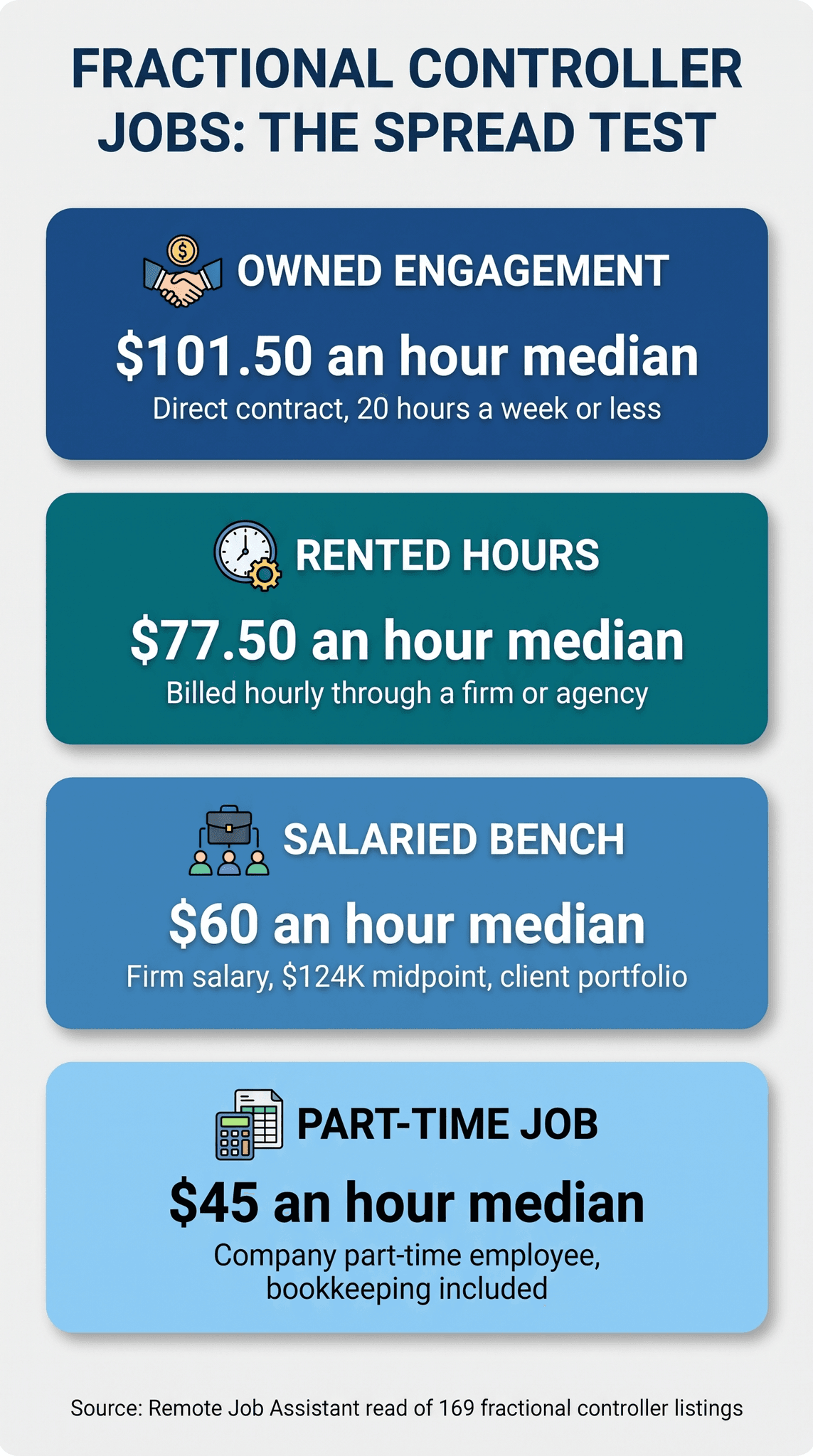
The Spread Test: who keeps the gap between what the client pays for controller hours and what you're paid. Read three lines in any listing (who pays you, how an extra hour is paid, and how the hours are written), and it lands on one of four levels.
Scoring (169 US seats, effective hourly pay at range midpoints; salaries divided by stated weekly hours, else 40):
- L1 Part-Time Job: median $45 an hour ($25-$72; 11 of 19 seats post pay). The company hires you as its own part-time employee on a schedule of 20 to 35 hours or a part-time salary. Payables, payroll or bookkeeping sit in the duties. One set of books, no client portfolio.
- L2 Salaried Bench: median $60 an hour ($40-$87; salary midpoint median $124,000; 23 seats). A firm employs you on salary to run closes for a portfolio of its clients. The firm sets the hours (35 to 55 in the listings that say), owns the clients and pays the benefits. You never sell.
- L3 Rented Hours: median $77.50 an hour ($40-$152; 72 of 73 seats post pay). A firm or staffing agency bills your hours: hourly bench seats (12 seats, median $72.50) and interim cover (60 seats, median $78). You're paid for every hour, but the agency owns the client and your next assignment.
- L4 Owned Engagement: median $101.50 an hour ($85-$137; 5 of 7 seats post pay). The company that owns the books contracts you directly for a scoped load (20 hours a week or less, a day count, or a monthly retainer), and a bookkeeper or staff does the entries. You keep the rate and carry the selling, the gaps between clients and the tax.
How to use it: place each listing, and any offer you already hold, on a level before you compare pay. To compare an L2 salary with an L4 rate, convert the rate at the hours you can actually bill, then take off self-employment tax and your own benefits.
Here's how the four levels compare on the lines that matter when you decide.
| Level | Who pays you | Hours as written | Seats (with pay) | Median per hour | Remote as base location |
|---|---|---|---|---|---|
| L1 Part-Time Job | The company, as an employee | 20-35 a week or a part-time salary | 19 (11) | $45 | 3 of 19 |
| L2 Salaried Bench | A firm, on salary | 35-55 a week | 23 (23) | $60 | 11 of 23 |
| L3 Rented Hours | A firm or agency, by the hour | Full-time cover or a firm's hourly load | 73 (72) | $77.50 | 10 of 73 |
| L4 Owned Engagement | The client, directly | 20 or fewer a week, or a retainer | 7 (5) | $101.50 | 2 of 7 |
Which level to aim for depends on what you need this year, not on what the benchmark says.
- Take L2 if you need benefits and a full client load from the first month and don't want to sell. Get the client count and close deadlines in writing; Kruze's is 15 to 20 startup clients.
- Take L3 if you need income within weeks and can work on-site. 69 of the 74 interim seats don't name remote as the base location.
- Hold out for L4 only if two or three people who have watched you close books would hire you directly. Boards alone won't fill an L4 calendar: 7 of 169 seats.
- Take L1 only when the schedule itself is the point, like BikesOnline's 30-hour week with benefits, not as a step into fractional work.
The order isn't an accident. A firm carries three costs you never see on a salaried bench: unbilled hours when a client leaves, the invoice it has to collect, and the client relationship it has to keep. ScaleUp Financial Solutions says the quiet part out loud: "You are compensated on a commission basis where we pass through a percentage of collected billings to you," and "As a Controller your commission could be up to $100 per hour." Cornerstone Finance pays its independent controllers $50 to $65 an hour and asks them to "Coordinate deadlines and handoffs with the Finance Partner who leads each client relationship." The partner owns the client. You own the close.
L1 sits at the bottom for a different reason. A company hiring its own part-time controller prices the seat against the local accounting market, then fills the hours with whatever needs doing. Moritz Development wants "Willingness to personally handle bookkeeping, invoice organization, and contractor follow-up alongside financial analysis." That's a controller title on a bookkeeper's week.
L4 pays the most because nobody stands between you and the client, and the scope is the deliverable rather than a schedule. Then again, only 5 of 169 seats posted an L4 rate. The best seat is also the rarest one you'll see on a board.
If you're filtering listings by hand, the Spread Test is the first filter to apply. It's faster to drop L1 seats on the title line than to discover the bookkeeping in round two.
Stop Applying Manually
Our AI applies to hundreds of matching jobs while you sleep. Wake up to interviews, not more applications.
How We Collected This Data
We pulled listings on November 9, 2026 from four places. LinkedIn's public job search gave 825 cards across 10 keyword searches (fractional, part-time, outsourced, interim, contract and virtual controller, plus client accounting services), and we read 342 full listings. SimplyHired, which republishes the Indeed network, gave 1,416 cards across seven queries run for remote and for the whole US; we read 95 listings. Fractional Pulse's board carried 118 Controller-tagged listings out of 503 live roles. We also swept 4,581 company job boards on Greenhouse, Lever, Ashby and SmartRecruiters, including about 100 outsourced-accounting and CFO firms. Only Burkland, Kruze and Supporting Strategies had open controller boards there; most firms' controller openings surfaced on LinkedIn instead.
That produced 486 controller-titled listings and 410 distinct seats once we counted one employer and title as one seat and kept US and non-US copies apart. We excluded 148 permanent full-time in-house controller jobs the fractional searches returned anyway, 42 assistant-controller rungs, 41 non-US seats and 10 others: four identical LinkedIn template posts, two volunteer roles, an expert-network gig, a $20-an-hour bookkeeper, a talent pool and one senior-accountant role. That left 169 US seats.
We read every one by hand for seat type, pay, hours and work model. "Remote as base location" means the listing names remote as where you work, with occasional travel allowed. Pay is the midpoint of the posted range; we divided salaries by the stated weekly hours (35 at Your Part-Time Controller, 45 to 55 at Vessel, 40 at Kruze) or by 40 hours. 115 of the 169 seats post pay. Our salary cross-reference is the BLS figure for financial managers, the series that includes controllers.
Three things broke and got fixed. Fractional Pulse pages carry a "Similar Opportunities" sidebar, which stamped another firm's $100-$150 rate onto three listings that post no pay. LinkedIn's "$80.00/hr - $95.00/hr" pay box read as $80 until we fixed the parser. And a staffing firm's Canadian 18-month contract merged with its remote New York seat until we split US and non-US copies. Indeed, ZipRecruiter and Glassdoor pages blocked our reader, Reddit was unreachable, and referral-only work never hits a board at all.
What Fractional Controllers Earn: Benchmarks vs. Listings
Every rate you'll find answers a different question. Lined up, they explain most of the confusion.
| Source | Figure | What it measures |
|---|---|---|
| Go Fractional benchmark (Nov 9, 2026) | $115 an hour average; middle 50% $85-$150 | 27 job posts and 153 candidate profiles, last 90 days |
| Go Fractional, employer offers | $99 an hour average ($75-$120) | Rates posted in live listings |
| Go Fractional, talent asks | $121 an hour average ($85-$150) | Rates candidates set on profiles |
| Go Fractional, CFO | $178 an hour average | 39 job posts and 436 profiles |
| Fractional Work Report 2026, finance | $229 an hour mean | VP-level and above, all functions n=546 |
| BLS financial managers (May 2025) | $166,570 a year, $80.08 an hour | Full-time employees, controllers included |
| Our L2 Salaried Bench | $60 an hour (salary midpoint $124,000) | 23 firm seats with salaries |
| Our L3 Rented Hours | $77.50 an hour | 72 hourly and interim seats |
| Our L4 Owned Engagement | $101.50 an hour | 5 direct contracts with posted rates |
Salary and rate figures on this page come from our read of 169 US listings live on November 9, 2026, cross-referenced with the BLS financial managers profile and Go Fractional's live benchmark. Ranges are posted pay, not offers. Check the linked sources before you set a number, because they move.
They move fast, too. Go Fractional's own blog post from October 23 quoted a $118 average, a $100 median, a 13-hour week, and "46% of posted controller roles are fully remote." Seventeen days later, on November 9, the live page said $115, $110, 14 hours and 33% remote. It's a rolling window, not a fixed fact, which is why we date every figure.
The gaps have causes. Benchmark profiles are asks, and employers post $22 an hour below them on average. The Fractional Work Report's $229 is a VP-and-above number, so it describes fractional CFOs better than controllers. Firms post salaries, not the billing rate they charge for you. Put those together and you can see how a controller who prices off the $115 average ends up looking at firm offers that work out to $55 an hour.
The benchmark rate is what the client pays. Whether you see it depends on whose name is on the invoice.
If your target is a salaried seat, the useful comparison is the BLS median for full-time financial managers at $80.08 an hour, and the remote jobs that clear it sit in our $100K-plus remote jobs list. If your target is the next rung, the fractional CFO benchmark of $178 an hour is a different job with a different pitch, covered in our guide to fractional CFO rates and channels.
The Firm Bench: Fractional Controller Jobs That Are Full-Time Jobs
Firms posted 63 of the 169 seats, and they read like what they are: client-service jobs. Multi-client language shows up in 54 of the 63 (85.7%). They're also the most remote seat type, with 29 of 63 (46.0%) naming remote as the base location.
The biggest single poster was Your Part-Time Controller, with 11 listings in 11 metros. The job is to "Serve as the outsourced Controller/CFO for multiple non-profit clients," and the pay is $100,000 to $125,000 "based on a 35-hour work week for this non-exempt position" ($110,000 to $150,000 in the Bay Area). Non-exempt matters: hours past the standard week are paid. Vessel Advisors is the opposite case. Its consulting controller is "Full-Time W-2 (45-55 hours/week, including travel time)" at $105,000 to $130,000, and the construction version screens for someone "Able to carry a portfolio of concurrent clients, keep each close on schedule, and switch context without losing quality."
Two listings say how big the portfolio is. Kruze Consulting's controller works "in a multi-client environment supporting 15 to 20 startup clients" on a 40-hour week for $100,000 to $125,000. Wells Group's salaried controller works with "approximately 10 clients at any given time" for $120,000 to $200,000. Do that arithmetic at Kruze and you get 2 to 2.7 hours per client per week, which only works if most of each close is done before it reaches the controller.
Not every bench seat is salaried. Keiter CPAs hires its fractional controllers as W-2 employees for 15 to 30 hours a week at "rates ranging from $70-$115 per hour depending on the type of work being performed (such as billable or administrative work)." Attivo pays part-time controllers $75 to $90 an hour, and "This position is not benefits eligible." Ascent CFO, which ranks on page one for this search, pays $78 to $88 an hour plus benefits for "generally between 30 and 40 hours/week." Syncopated Synergy pays $70 to $90 but warns that "work availability is not guaranteed."
The bench is the right seat if you want benefits, a steady client load and a fast education in how a dozen companies close their books. It's the wrong seat if you're trying to keep the rate. If your niche is nonprofits, our guide to remote nonprofit jobs covers the employers; the staff and senior rungs below the bench controller are mapped in our remote bookkeeping jobs guide.
Interim Controller Jobs: The Hourly Seat That Rarely Goes Remote
Interim is the biggest category: 74 of 169 seats. It's also the most transparent, since 60 of the 74 post pay, at a median $78 an hour. And it's almost never remote. Only 5 of 74 interim seats (6.8%) name remote as the base location.
The reason is built into the job. Interim work exists because a seat is empty: a controller left, went on leave or retired. Beacon Hill's client needs cover "as the current controller moves into retirement"; Conexus's is "during a planned leave of absence." The company wants someone in the building through the transition, so the listings say things like "Fully Onsite," "4 days onsite, 1 Remote" and "Hybrid 3-4 days a week." Terms run three to six months, sometimes temp-to-perm. Gate Gourmet's version is a 90-day temp-to-perm seat at $140,000 to $150,000.
The pay range is wide. Robert Half has an on-site part-time contract at $57 to $60 an hour "anticipated to average 10-20 hours per month, mostly at month-end." BDO's Strategic Resources group pays $85 to $95. SolomonEdwards and Brilliant post $120 to $150, and one Kforce construction controller contract posts $140 to $165. Our read of the top of the range: it pays for urgency and presence. Brilliant's $100-$125 seat is "3-4 months Onsite in Louisville, KY M-F!" with help on temporary housing.
Interim is a good way to earn L3 money while you build a book. Each engagement is a new set of people who've seen you close their month. If remote is non-negotiable, the full-time remote seats are covered in our remote controller jobs guide.
Stop Applying Manually
Our AI applies to hundreds of matching jobs while you sleep. Wake up to interviews, not more applications.
Direct Part-Time Controller Jobs: The Best and Worst Seats
Thirty-two seats are a company hiring its own part-time or fractional controller. They split cleanly. Nineteen are L1 part-time jobs, seven are L4 engagements, and six don't say enough to tell.
The tell is who does the transactions. The AI Policy Network inherits "a bookkeeper handling transaction-level work" and wants someone to run the function for a "$4,500–$6,500 monthly retainer," at 10 to 15 hours a week "with flexibility around close, audit, and filing deadlines." That's $83 to $120 an hour at the midpoint of their hours. Ascertain is blunter: "This is not a bookkeeping role." Envision Builders posts "12–20 Hours Per Week | $80–$125 Per Hour" for a construction controller who also covers CFO work. Phoenix Solutions wants "a fractional controller to work 10-16 hours (flexible) per week on a contract basis" at $75 to $95.
The L1 seats read differently. Sauce Advertising's "Fractional Controller & Administrative Coordinator" pays $45 an hour. A recruiter's "Fractional Controller" listing in Omaha starts at $25 an hour, on-site. SeekOne Roofing pays a $70,000 part-time salary for "a hands-on, part-time role." The word fractional is in two of those three titles.
Benefits cut both ways. Some L1 jobs include them: BikesOnline pays $110,000 to $115,000 for 30 hours "with benefits," about $72 an hour and the best L1 seat we found. Engagements don't. Superlogic says it plainly: "As this is a part-time aka fractional role it is not benefits eligible." If health coverage is the deciding factor, our guide to remote jobs with benefits is the comparison to run first.
Our read: don't take a "part-time controller" job as your way into fractional work. It's the lowest-paid seat in the market at a median $45 an hour, it usually includes the bookkeeping, and it doesn't build a client book. A salaried bench seat or interim work pays more and introduces you to more people who might hire you directly later.
Bench Salary vs. Going Independent: The Math
Once you've placed a listing on the Spread Test, the real question is whether L4 beats L2 for you. The answer turns on billable hours, which most rate pages skip. The Fractional Work Report 2026 found the median fractional worker bills 21 client-facing hours a week. Here's what 21 hours buys across 48 working weeks.
| Path | Rate | Billed hours a week | Gross a year | Who pays tax and benefits |
|---|---|---|---|---|
| L2 Salaried Bench (median midpoint) | Salary | 35-55 | $124,000 | Firm pays its half of payroll tax and benefits |
| Independent at the employer-offer average | $99 | 21 | $99,792 | You |
| Independent at the benchmark average | $115 | 21 | $115,920 | You |
| Independent at the 75th percentile | $150 | 21 | $151,200 | You |
To match a $124,000 salary at $115 an hour, you need 22.5 billed hours a week for 48 weeks. At $99, you need 26.1. Both figures come before self-employment tax, which the IRS sets at 15.3% (12.4% Social Security plus 2.9% Medicare, with the Social Security part applying to the first $184,500 of combined earnings in 2026). They also come before the health insurance and retirement match a firm would have paid.
Billable hours for a controller have a shape, too. Robert Half's part-time contract runs "mostly at month-end." The AI Policy Network asks for flexibility "around close, audit, and filing deadlines." The Brand Guild's 60 hours a month come with a warning that the "weekly hour requirement may vary based on time of month." Vessel screens for keeping "each close on schedule" across concurrent clients. Every client wants the books closed in the same first two weeks.
A controller's capacity isn't hours per week. It's how many closes fit in the same ten days.
Our read on what follows from that: stagger close deadlines when you sign clients, and price a client who needs a day-5 close above one that closes on day 15. Quarterly-close clients and audit-prep projects fill the back half of the month.
Then there's finding the work. In the Fractional Work Report, 94% of fractional workers won clients through network referrals, and 72% found their first client through someone they already knew. Referrals come from people who have watched you close their books, which is the strongest argument for a few years of L2 or L3 first.
Skills, Systems and the CPA Question
The systems named across the 169 seats are a short list. QuickBooks appears in 62 (36.7%), NetSuite in 30 (17.8%), Sage Intacct in 21 (12.4%), Xero in 10 and Dynamics or Business Central in 9. A bench controller moves between them weekly, which is why firms ask for adaptability more than any single system. Spreadsheet work underpins all of it; the employers that test for it show up in our Excel jobs data.
Niches get their own seats. Nonprofit fund accounting has Your Part-Time Controller, Vault Consulting, Flex-Able Solutions and EisnerAmper. Construction job costing and work-in-progress schedules have Vessel, Redpath and CEFO Advisors. Private equity and fund work has CrossCountry Consulting and a contract fund controller seat at DataAxxis ($85 an hour W-2, $95 corp-to-corp or 1099). If you have one of those ledgers, lead with it, because it's how firms staff portfolios.
The CPA question has a clear answer in the data. A CPA is mentioned in 116 of 169 listings (68.6%) but stated as a hard requirement in 13 (7.7%). The requirement clusters where someone signs off on numbers others rely on: Walters Accountancy's contract quality-control reviewer ($100 to $150 an hour, about three hours a week) needs an active California license and 10-plus years, and Ascertain wants an active CPA for its revenue-recognition work. Elsewhere it's a preference that moves you up the shortlist, not a gate. The wider finance hiring picture is on our finance and accounting jobs page.
Stop Applying Manually
Our AI applies to hundreds of matching jobs while you sleep. Wake up to interviews, not more applications.
How to Land Fractional Controller Work, by Seat
Before the playbook, the lines that should slow you down. Each one is quoted from a listing in our set, and each has a reason behind it.
- "Fractional" and "full-time" in the same title (Vessel Advisors, Anexus CFO). It's an L2 salary. Compare it with salaried jobs, not with hourly rates.
- A billable-hours goal on a salary ("Meet or exceed billable hours goals while maintaining service excellence," All In One Accounting). The salary has to cover the hours the firm can't bill too. Ask for the target and last year's average.
- No floor on the work ("work availability is not guaranteed," Syncopated Synergy; "no guarantee of consecutive engagements or consistent hours," CampusWorks). An hourly bench without a minimum is a talent pool. Ask what the last three people placed actually averaged.
- Pay tied to collections (ScaleUp's "percentage of collected billings"). You share the firm's collection risk. Ask what happens to your cut when a client pays 60 days late.
- Transaction work under a controller title (Phoenix Solutions: "Set up new jobs in Peachtree and invoice customers per contract"). Decide whether you're pricing bookkeeping at a controller's rate or a controller at a bookkeeper's.
- "Not benefits eligible" plus a schedule the company sets. The IRS's general rule for independent contractors is that the client "has the right to control or direct only the result of the work and not what will be done and how it will be done." If the listing sets your hours, ask how they're classifying you.
Each level gets hired a different way, so use a different approach for each.
L2 Salaried Bench: apply like a job, because it is one. Ask four things on the first call: how many clients you'll carry, their close deadlines, the billable-hour target, and whether the seat is exempt or non-exempt.
L3 Rented Hours: register with two or three interim agencies and expect on-site work. Ask about extension terms and whether a conversion fee blocks a direct hire later.
L4 Owned Engagement: work your referral network first: former employers, their outside CPAs, their bankers. Scope by the close (entities, deadline day, transaction volume, who books the entries) and quote a monthly retainer, not an hourly guess.
Any listing: run the Spread Test in one call. Who sends the invoice? What happens to an extra hour? Who books the entries?
The three questions take five minutes and save you from accepting an L1 schedule because the title said fractional.
As for where to look: on November 9, Fractional Pulse's board carried 118 Controller-tagged listings, though 33 were outside the US and 72 had interim, contract or fixed-term titles. Go Fractional and Fractional Jobs run talent networks where you list a profile instead of applying. The interim agencies posting most in our set were GHJ, Vaco, BDO's Strategic Resources group and Robert Half, and the two bench firms posting most were Vessel Advisors (13 listings) and Your Part-Time Controller (11). If your background is already CFO-adjacent (forecasts, lenders, a board), the step up is covered in our fractional CFO guide, and the broader accounting path sits in our remote accounting jobs guide.
Frequently Asked Questions
I'm a controller with 10 years of experience. How much should I charge as a fractional controller?
On November 9, 2026, Go Fractional's live benchmark put employer offers at $99 an hour on average and candidate asks at $121, with the middle half of rates between $85 and $150. In our data the direct engagements that posted a rate ran $85 to $137 (n=5). Quote a monthly retainer based on the close you'll own rather than an hourly guess.
Is a "fractional controller" job at an outsourced accounting firm really fractional?
Usually not for you. 18 of the 30 seats with "fractional" in the title were firm jobs, several full-time, like Vessel Advisors' 40-plus-hour "Full-Time Fractional Controller" at $95,000 to $120,000. The client buys a fraction; the firm employs you on salary, a median $60 an hour across 23 salaried firm seats.
Can I be a fractional controller without a CPA?
Yes, for most seats. A CPA appeared in 116 of 169 listings (68.6%) but was a stated requirement in 13 (7.7%), mostly review, audit-facing and revenue-recognition roles. It still helps you win clients who face an audit.
How many clients can a fractional controller handle at once?
The two firm listings that state a number say "15 to 20 startup clients" on a 40-hour week (Kruze) and "approximately 10 clients at any given time" (Wells Group). At Kruze that is 2 to 2.7 hours per client per week. On your own, the limit is how many closes you can finish in the first two weeks of the month, not your weekly hours.
Which level of The Spread Test is a salaried CAS controller job, and how do I move up?
It's L2, the Salaried Bench: a firm salary for running closes across its clients, a median $124,000 midpoint, about $60 an hour at stated hours. Moving up means interim work (L3, median $78) or direct engagements (L4, median $101.50), which mostly come through referrals.
Are fractional controller jobs remote?
Less often than you'd think. 41 of 169 seats (24.3%) name remote as the base location. Firm seats are the most remote at 29 of 63 (46.0%), and interim seats the least at 5 of 74 (6.8%).
What's the difference between a fractional controller and a fractional CFO, and which pays more?
A controller owns accurate books on time: the close, the statements, the controls. A CFO owns the forward look: forecasts, capital and the board. On November 9, 2026, Go Fractional's benchmarks put CFOs at $178 an hour on average against $115 for controllers.
Start Your Fractional Controller Search
Start with the Spread Test on every listing, then pick the level that fits where you are. If you want a full-time remote seat while you build referrals, the remote controller jobs guide maps who hires. If you're ready to sell forecasts and capital strategy as well as clean books, the fractional CFO guide covers the rate and the pitch. Salaried seats that clear the senior bands are in our $150K-plus remote jobs list, and the broader market is on the finance and accounting jobs page.
Clients buy controllers by the fraction. Make sure the fraction you sell is yours.
Ready to Find Your Remote Job?
Browse thousands of curated remote jobs or let AI apply for you.
Browse Remote JobsRelated Job Guides

Remote Bookkeeping Jobs: What 579 Postings Actually Pay
We read 579 US bookkeeper postings. The title tops out near $70K, and senior seats go on-site. Client accountant titles post $75K and stay remote more often.
25 min read

Remote Contract Specialist Jobs: What 826 Postings Pay
We read 826 US contract specialist postings. Federal 1102 seats: 0 of 52 remote. Elsewhere, four lines in the posting predict both the pay and the remote odds.
28 min read
Remote Implementation Specialist Jobs: What 481 Postings Pay
We read 481 US implementation specialist postings. Setup desks pay about $80K. Four lines in a posting lift the median to $98K-$105K, and remote odds hold.
28 min read