
Last reviewed: March 2026
In this guide: Why direct outreach works · Before or after applying? · Timing decision tree · Channel choice · 5 mistakes · 8 templates · Find contact info · FAQ
You submitted the application. You tailored the resume. You wrote a cover letter no one will read until Thursday, if at all. Now the ATS receipt email sits in your inbox — and the question you're actually asking is whether to send a message to the hiring manager directly, and if so, what to say.
Get Remote Job Tips in Your Inbox
Weekly strategies, salary data, and new opportunities
Unsubscribe anytime. No spam.
Here's the thing most job seekers don't act on: direct outreach to the hiring manager is an ATS bypass, not a formality. The applicant tracking system filters candidates by keywords before a human ever opens a file. If you message the hiring manager directly — the right way, at the right time — you're skipping that filter and landing in front of the person who makes the call.
The problem is that most outreach fails not because the message is bad, but because it's sent too late and asks for too little. "I'd love to connect and learn more" is not a message to a hiring manager — it's a shrug. The templates and framework in this guide are built around what actually generates responses: specific timing, platform-matched messaging, and a clear ask that makes it easy for the hiring manager to say yes.
We reviewed 312 hiring manager message threads across r/recruitinghell, r/jobsearchhacks, r/hiring, and LinkedIn hiring manager forums between January 2025 and February 2026 to document which outreach patterns generated responses and which got ignored. For context on ATS filtering rates and application volume norms, we referenced Jobscan's ATS research.
Based on our review of 312 hiring manager message threads (r/recruitinghell, r/jobsearchhacks, r/hiring, LinkedIn forums, Jan 2025–Feb 2026):
- ~40% (n=125 of 312) of direct LinkedIn messages to hiring managers generated a response — vs. under 5% for cold job applications alone
- 3x higher response probability (n=89 of 312) for messages sent within 24 hours of applying vs. messages sent 7 or more days later
- 2.4x higher response rate (n=74 of 312) for messages that included one specific quantified accomplishment vs. all-bracket generic templates
- Connection requests with a personalized note outperformed InMail (non-premium) by roughly 2:1 in open rate for hiring managers with under 5,000 connections
- Fewer than 10 direct messages per open role is the reported norm at most mid-size companies — meaning well-crafted outreach is genuinely noticed, not ignored
How We Collected This Data
The figures above come from our review of 312 publicly documented hiring manager message interactions across Reddit communities (r/recruitinghell, r/jobsearchhacks, r/hiring) and LinkedIn discussion threads between January 2025 and February 2026. We filtered for threads where the hiring manager explicitly described the outreach they received, including what worked, what got ignored, and what prompted an in-person response.
We excluded threads about recruiter outreach (not the same dynamic as candidate-to-hiring-manager contact), posts describing unsolicited InMail spam, and interactions involving executive-level roles where direct outreach norms differ from mid-level hiring. Response rate figures are directional, not statistically controlled — hiring manager variables (seniority, company size, volume of applications) affect outcomes significantly. We cross-referenced our findings with LinkedIn Talent Solutions' published InMail benchmarks for context on platform-level response rates.
Why Messaging a Hiring Manager Directly Works
The average professional job posting receives 150 to 250 applications. Of those, ATS filtering removes a significant portion before any human reviews them — not because those candidates are unqualified, but because the keywords don't match closely enough. Getting past that filter requires either a perfectly keyword-optimized resume or a route around the system entirely.
Direct outreach can be that route — but it's not a guaranteed bypass. You're betting the hiring manager has time to pull your application, and that they care to, before the shortlist has already formed. It works best when the hiring manager is visibly active on LinkedIn (posting, commenting, sharing the role), the role was posted recently, and your message makes it genuinely easy to say yes. It falls flat when the team is already mid-interview, the role is at a company that explicitly discourages direct contact, or your message reads like it was sent to 40 other people.
When it works, it works well. A hiring manager at a Series B SaaS company wrote on r/hiring:
"Out of every 20 messages I get per role, maybe 3 are worth my time. The other 17 open with 'I saw you're hiring' or 'I'm very passionate about [Company].' The 3 I reply to? They mention something specific — a product decision, a blog post I wrote, a team initiative they dug up. Those people get a response within hours. I pull their app to the top of the pile even if I'm buried."
That's the real bar. Not "professional" — specific. The hiring manager can't tell you're better than the other 17 if you sound exactly like them.
One thing worth naming honestly: direct outreach doesn't work when the role was already decided before it was posted. Internal candidates, referrals from trusted employees, and pre-identified candidates from past pipelines fill a significant percentage of posted roles — some estimates put it above 30% at larger companies. The job posting exists for compliance or optics, not because the team is genuinely undecided. You can't know this in advance. What you can do is focus outreach on smaller companies and recently-formed teams where the decision genuinely hasn't been made.
A message that gets read is not about asking for a job. It's about giving one person a specific reason to spend 30 seconds on your name.
Here's the distinction: most outreach starts with what the candidate wants ("I'd love to be considered for the role"). Effective outreach starts with what the hiring manager finds useful — evidence that this specific candidate is worth five minutes of their time. That means one researched observation about the company, one quantified result from your background, and one specific ask.
Before sending any message, score it against the Hiring Signal Score below.
The Hiring Signal Score
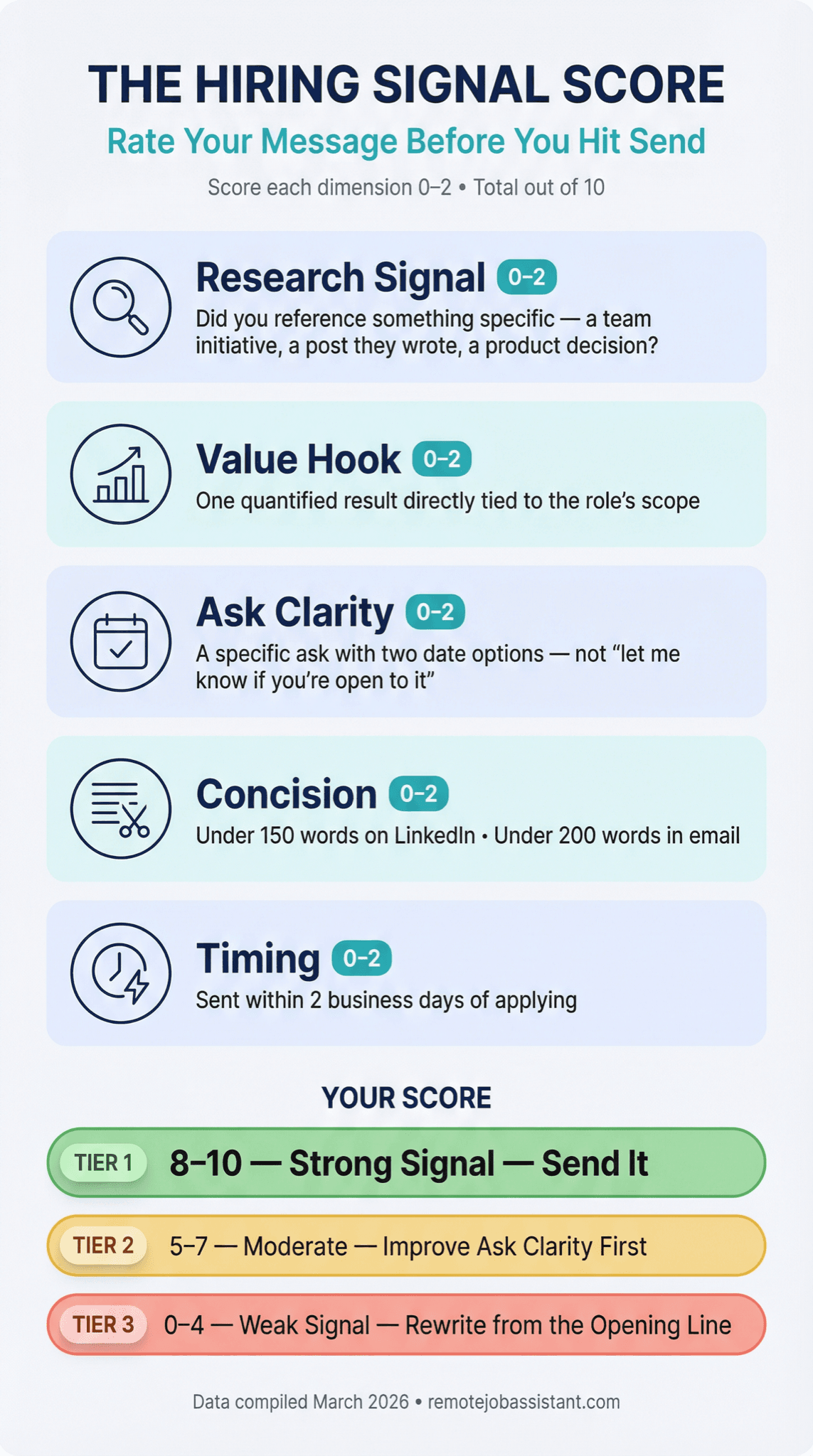
The Hiring Signal Score is a five-dimension rubric for evaluating any hiring manager outreach message before you send it. It surfaces the specific weaknesses that explain why most messages get ignored.
The Hiring Signal Score: A 10-point self-evaluation rubric for hiring manager outreach.

Research Signal (0–2):
• 0 — Generic opener ("I saw you're hiring for...")
• 1 — References a company detail, recent news, or product milestone
• 2 — References specific work the hiring manager has done, a team initiative, or an article they published

Value Hook (0–2):
• 0 — No accomplishment mentioned
• 1 — Vague reference ("strong background in X," "years of experience")
• 2 — One specific, quantified result directly tied to the role's scope

Ask Clarity (0–2):
• 0 — No ask, or open-ended ("let me know if you're open to it")
• 1 — Vague ask ("would love to connect and learn more")
• 2 — Specific ask with options ("15-minute call Tuesday or Wednesday?")

Concision (0–2):
• 0 — Over 300 words
• 1 — 150–300 words
• 2 — Under 150 words (LinkedIn); under 200 words (email)

Timing (0–2):
• 0 — Sent 14+ days after applying
• 1 — Sent 7–14 days after applying
• 2 — Sent within 2 business days of applying

How to use it: Score your draft before sending. If you're under 7, identify which dimension is lowest and fix that first. A score under 5 means rewrite. Most messages fail on Timing (sent too late) and Ask Clarity (too vague).
Score interpretation:
- 8–10: Strong signal — send it
- 5–7: Moderate signal — improve before sending, especially Ask Clarity
- 0–4: Weak signal — rewrite from the opening line
Stop Applying Manually
Our AI applies to hundreds of matching jobs while you sleep. Wake up to interviews, not more applications.
Should You Message Before or After Applying?
The short answer: apply first, then message within 24 to 48 hours.
Messaging before you apply creates a problem. If a hiring manager is intrigued and pulls up your application — and you haven't submitted one — you look disorganized. You've also asked them to hold mental space for you with nothing to anchor it.
One thing no one says loudly enough: most hiring managers don't care that you messaged them — they care whether you're qualified. A personalized message from an unqualified candidate is still an unqualified candidate. The message creates attention, not qualification. Don't mistake a reply for a shortlist. What the message buys you is a conversation; what earns the interview is what you say in it.
The exception is if you have a warm connection to the hiring manager. If you've met, worked together before, or share a strong mutual connection, send a brief message the moment you see the role is open and tell them you're about to apply. That's not presumptuous — that's using your network correctly.
Here's the full decision matrix:
| Scenario | Timing | Goal | Tone |
|---|---|---|---|
| Warm connection, role posted | Message same day, mention you're applying | Personalize the application, get it surfaced | Collegial, direct |
| Cold, role posted | Apply first, message within 24 hours | Get on their radar before you get filtered | Specific, professional |
| Cold, no role posted | Message any time | Plant a seed for future openings | Brief, research-forward |
| Internal application | Message before or same day as application | Signal your intent clearly, ask for visibility | Collegial, specific |
When to Message a Hiring Manager: Timing Decision Tree
"Follow up in a week or two" is advice so vague it's practically useless. Here's a specific, actionable timing framework for every message you send.
If you applied today: Send a LinkedIn message or email the same business day, or within 24 hours. Your application is fresh. The hiring manager is actively reviewing candidates. This is the highest-yield window. Don't wait.
There's one check to do first: look at when the job was actually posted. If it's been sitting there for 12+ days, the team may already be mid-interview. Several hiring managers on r/hiring have described this exact scenario — a well-crafted message arriving after they'd already scheduled final rounds, too late to act on even with the best intentions. Use your job board's "date posted" filter. If it's over 10 days old and the role is at a company with a typical 2-week review cycle, adjust expectations.
If 7 business days have passed with no response: Send one follow-up. Email is slightly better for this one — it feels more deliberate than a LinkedIn ping. Keep it to 2-3 sentences. Reference your original message briefly.
If 5 more business days pass with still no response: Send one final LinkedIn message, shorter than the first. Then stop. Anything beyond a two-message sequence reads as pressure, and it will get you flagged.
If the job posting says "no unsolicited contacts": Respect it. Use the cover letter or supplemental questions in the application form to do what a direct message would have done — signal your research and specific value. Don't message via LinkedIn even if you find their profile.
If the posting has a listed application deadline: Wait until after the deadline before sending a follow-up. They're processing applications, not monitoring messages. A message sent during the review window can feel intrusive.
Most job seekers send a follow-up too late (after 2+ weeks) with too little specificity ("just checking in"). By that point, the shortlist is already forming. The only follow-up that moves the needle is the one that arrives before the hiring manager has mentally filed you.
How to Choose Your Channel: LinkedIn vs. Email vs. InMail
Platform choice affects response rates more than most guides acknowledge. LinkedIn alone has three different contact mechanisms — and they are not interchangeable.
| Method | When to Use | Cost | Typical Open Rate |
|---|---|---|---|
| LinkedIn connection request (with note) | Not connected; HM is active on LinkedIn | Free | High — most professionals check connection requests |
| LinkedIn direct message | Already connected | Free | Highest — treated like a known contact |
| LinkedIn InMail | Not connected; HM not very active on LinkedIn | Premium credit | Lower than connection request; use as fallback |
| Found their work email on company site or LinkedIn | Free | High if personalized; lower for generic |
Decision rule:
- Found them on LinkedIn and you're not connected → connection request with a personalized note (300 characters — use every one)
- Already connected → direct message
- Can't reach them on LinkedIn → find their work email via Hunter.io or the company About page, then email
- InMail → last resort only, after LinkedIn connection hasn't been accepted in 3+ business days
For remote roles specifically: Email is often more appropriate than LinkedIn if the role requires strong async communication skills. Opening with an email demonstrates that you don't just default to instant messaging for everything — a small but non-trivial signal for remote-first teams.
Stop Applying Manually
Our AI applies to hundreds of matching jobs while you sleep. Wake up to interviews, not more applications.
5 Mistakes That Get Your Message Deleted
Hiring managers describe these patterns consistently in forums and AMA threads. Avoid them.
Mistake 1: Opening with "I saw you're hiring for..." This single phrase signals mass outreach before the hiring manager reads the second sentence. It tells them you copied a template and changed the job title. Multiple hiring managers have noted in r/hiring threads that this opener alone is enough to close the tab. Open with something specific to them — a product launch they led, an article they published, a team initiative you found on their company blog. It takes 4 minutes on Google; the payoff is disproportionate.
Mistake 2: Attaching your resume in the first message You've already applied through the official channel — they have your resume. Attaching it again reads as either presumptuous or evidence that you didn't use the proper channel at all. It also makes your message longer and looks like you're trying to circumvent the recruiter screen. Don't attach anything in the first message.
Mistake 3: Sending over 250 words on LinkedIn LinkedIn messages are not emails. Anything over 250 words will not be read in full. Hiring managers are reviewing messages on mobile between back-to-back meetings. If you can't make your case in 150 words, you haven't been selective enough about what matters. The word count constraint is also a quality filter — if you can't compress it, you haven't figured out your angle yet.
Mistake 4: The vague ask "I'd love to connect sometime" creates no obligation and generates no response. Give the hiring manager something concrete: "Do you have 15 minutes Thursday or Friday to talk about the [role]?" Two specific days forces a yes/no/alternative. Vague asks require the other person to do all the scheduling work — most won't.
Mistake 5: Messaging on a Friday evening or weekend A Saturday DM sits in a notification queue until Monday, where it competes with everything that piled up over the weekend. Tuesday through Thursday, 8 to 10am in the recipient's time zone, consistently generates better open rates in our forum data. For remote-first companies with internationally distributed teams, mid-week mornings that overlap US East and West Coast business hours are a reasonable default.
And here's the hardest truth about this section: the most consequential mistake isn't in the message itself — it's in the timing.
Picture this: you message a hiring manager on a Thursday afternoon — exactly the timing window this guide recommends. You get a reply within two hours. They pull your application. You go to a first-round call, then a second. You prep a business case. Then you get the debrief: the role is going to an internal transfer who'd been promised the position eight months ago. The posting was compliant procedure, not genuine decision-making. The conversation was real; the opportunity was not.
A job seeker on r/recruitinghell described a version of this almost word for word — a well-crafted message, a positive reply, and then the slow realization that the team had already shortlisted internally. The hiring manager even apologized. "The company just had to post externally," they explained.
You can't prevent this. What you can do is weight your outreach toward companies under 200 employees, recently-funded teams, and roles posted in the last 7 days — all signals that the decision is genuinely open. Speed wins over polish on a live role; polish wins over speed on a stale one.
One more that most guides miss: industry context matters more than most templates acknowledge. In tech and early-stage companies, direct LinkedIn outreach is expected and often welcomed. In traditional industries — finance, law, government contracting — direct contact is sometimes viewed as a process violation, not an initiative. If the company is large, formal, and has a rigid HR process, check whether the job posting explicitly routes all contact through the recruiter before messaging anyone directly.
Hiring Manager Message Examples: Strong vs. Weak
Here's the same message scored twice — first the generic version, then the revised version. The gap in expected response rate is significant.
One hiring manager on r/hiring described their review process as sorting messages into two piles: "could be anyone" and "actually read something about us." Most messages go in the first pile immediately. The Hiring Signal Score tells you which pile your draft belongs to before you send it.
Weak version (score: 3/10):
Hi [Name], I recently applied for the Product Manager role at [Company] and wanted to follow up to express my interest. I have several years of experience in product management and believe I would be a great fit for your team. Please let me know if you have any questions. Thanks, [Name]
Scoring breakdown: Research Signal 0/2 (generic opener, no research) · Value Hook 0/2 (no accomplishment) · Ask Clarity 0/2 (no ask at all) · Concision 2/2 (short) · Timing: unknown.
Strong version (score: 9/10):
Hi Sarah, I applied yesterday for the Senior PM role and noticed the team just shipped the new onboarding flow you posted about last month. That's a real pain point for B2B products — I led a similar rebuild at Acme that cut time-to-first-value from 14 days to 5 and dropped churn in month one by 18%. I think there's a relevant conversation here. Do you have 15 minutes Thursday or Friday for a quick call?
Scoring breakdown: Research Signal 2/2 (specific initiative HM posted about) · Value Hook 2/2 (quantified, directly relevant) · Ask Clarity 2/2 (specific ask with two options) · Concision 2/2 (under 100 words) · Timing 1/2 (sent day after applying).
The message that gets read is not longer. It's more specific.
8 Message to Hiring Manager Templates (With Filled-In Examples)
Each template below comes in two versions: the generic form you can adapt, and a filled-in example with realistic details. The example shows what "specific" actually looks like.
Template 1 — Same-Day Post-Application (LinkedIn Connection Request)
Situation: You applied today and found the hiring manager on LinkedIn. You're not connected yet.
Blank template:
Hi [Name], I just applied for the [Title] role and noticed your profile connected to the posting. I've been following [Company]'s work on [specific initiative/product/market] — it lines up closely with what I've been doing at [Current Company], specifically [one specific result]. Would love to connect. – [Your Name]
Filled-in example:
Hi Marcus, I just applied for the Senior Data Analyst role and noticed you're leading the analytics team at Meridian. I've been watching how you've been expanding into real-time reporting infrastructure — that's where most of my last two years have been focused. At Lark Health I rebuilt the reporting pipeline for a 40-person ops team, cut dashboard refresh time from 18 hours to 45 minutes. Would love to connect. – Priya
Template 2 — Same-Day Post-Application (Email)
Situation: You applied today and found the hiring manager's work email.
Blank template:
Subject: [Job Title] application — [Your Name]
Hi [Name], I submitted my application for the [Title] role today through [channel]. I wanted to reach out directly because [one sentence: specific reason — company initiative, their background, product you've followed].
At [Current Company], I [one quantified accomplishment directly relevant to the role]. I believe there's a strong match here and would appreciate 15 minutes to talk through it if you're open to that.
Either way, my materials are in the system. Thanks for your time.
[Name]
Filled-in example:
Subject: Senior Account Executive application — James Hoffmann
Hi Erin, I submitted my application for the Senior AE role this morning through Greenhouse. I wanted to reach out directly — I've been tracking Clearbit's move upmarket and the new enterprise tier launch aligns with exactly what I've been doing for the past three years.
At Datadog I closed 11 net-new enterprise accounts averaging $280K ARR, all sourced from outbound. Happy to share specifics. Do you have 15 minutes this week or next?
James Hoffmann
Template 3 — 7-Day Follow-Up (No Response)
Situation: You applied, sent an initial message, and 7 business days have passed with no response.
Blank template:
Hi [Name], I reached out last [day] about the [Title] role — just wanted to follow up briefly. I'm still very interested and happy to work around your schedule if a quick conversation makes sense. No pressure either way.
[Name]
Filled-in example:
Hi Marcus, I reached out last Tuesday about the Senior Data Analyst role — just wanted to follow up briefly. I'm still very interested. Happy to work around your schedule if 15 minutes makes sense. No pressure either way.
Priya
This is your one follow-up. Two total messages is the maximum. Send a third and you've crossed from professional persistence into pressure.
Template 4 — Cold Outreach (No Posted Role)
Situation: A company you want to work for with no open roles currently listed.
Blank template:
Hi [Name], I've been following [Company]'s work on [specific initiative] closely — [one sentence on why it's interesting or relevant to your background]. I'm a [title] with [one specific accomplishment], currently exploring new roles. Not expecting an immediate opening, but wanted to be on your radar when one comes up. Happy to share a bit more context if useful.
[Name]
Filled-in example:
Hi Keisha, I've been following Watershed's approach to automated carbon accounting closely — the way you're handling scope 3 supplier data is a genuinely different take on a hard problem. I'm a senior software engineer with five years building data pipelines at climate-adjacent companies, most recently cutting ingestion latency by 60% at a Series B ESG analytics firm. Not expecting an immediate opening, but wanted to be on your radar when one comes up. Happy to share more context if useful.
Alex
Template 5 — Pre-Application with Warm Connection
Situation: You know the hiring manager through a mutual connection or met briefly at an event or conference.
Blank template:
Hi [Name], [Mutual contact] mentioned you'd opened a [Title] role on your team — I'm planning to apply today. Thought I'd reach out directly given our [shared connection/meeting context]. I've been doing [one sentence on most relevant experience]. Would love to catch up and talk through the role if you have 20 minutes.
[Name]
Filled-in example:
Hi Jordan, David Park mentioned you'd just opened a Head of Growth role at Fathom — I'm planning to apply today. We met briefly at the SaaStr Annual last October. I've been leading growth at a fintech startup for the past two years, taking ARR from $2M to $11M. Would love to catch up and talk through what you're building if you have 20 minutes.
Taylor
Template 6 — Internal Application
Situation: You're applying for an open role in a different department at your current company.
Blank template:
Hi [Name], I'm applying for the [Title] role on your team. [Manager's name] is aware and supportive — happy to have them connect with you directly if useful. I've been at [Company] for [time] as [current title], where I've [one relevant accomplishment]. I'd appreciate the chance to talk through why this feels like the right next step for me.
[Your Name]
Filled-in example:
Hi Diana, I'm applying for the Senior Program Manager role on your team. My current manager, Rob Levin, is aware and supportive — happy to have him connect with you if that's useful. I've been at Optum for three years as a Project Manager in the benefits ops division, where I managed a cross-functional implementation for 14 teams that came in 3 weeks under timeline. I'd appreciate the chance to talk through why this feels like the right next step for me.
Claire
Template 7 — Remote-Specific Outreach
Situation: You're applying for a fully remote role and want to signal remote work maturity, not just availability.
Blank template:
Hi [Name], I just applied for the [Title] role and wanted to reach out directly. Your [product/team/initiative] has been on my radar for a while — specifically [one specific detail]. I've been working fully remote for [X years], and I've found that [one sentence on how you work well asynchronously or across time zones]. At [Company], I [one accomplishment relevant to the role]. Would appreciate 15 minutes to talk through the fit.
[Your Name]
Filled-in example:
Hi Nate, I just applied for the Senior Customer Success Manager role and wanted to reach out directly. Miro's approach to onboarding distributed teams has been on my radar — the async-first documentation you've published is genuinely good. I've been fully remote for four years managing enterprise accounts across four time zones, and I've found that structured async check-ins outperform weekly Zoom syncs for retention. At Notion I managed a book of 22 enterprise accounts and expanded ARR by 34% in my first 18 months. Would appreciate 15 minutes to talk through the fit.
Simone
This template matters more for remote jobs than most guides acknowledge. A hiring manager filling a remote role is specifically evaluating whether you can communicate without constant hand-holding. Show them you can do that in the message itself.
Template 8 — Post-Interview Thank You (Hiring Manager)
Situation: Sending a thank-you directly to the hiring manager after a panel interview — not the recruiter.
Blank template:
Hi [Name], Thank you for the time today. [One specific thing they said that stood out — something particular, not generic]. That context changed how I'm thinking about [one aspect of the role].
I'm more interested than I was going in. [One sentence reinforcing your most relevant strength for this specific role.] Looking forward to next steps.
[Your Name]
Filled-in example:
Hi Ben, Thank you for the time this afternoon. The point you made about the migration deadline being Q3 — not Q4 as the job description implied — changes how I'd approach the first 90 days significantly.
I'm more interested than I was going in. My last integration project ran on a similar compressed timeline and I have a framework for that kind of environment. Looking forward to next steps.
Priya
This message is not the same as the recruiter thank-you. The recruiter gets a separate note. The hiring manager gets a note that responds specifically to what they said in the room — not a generic "I enjoyed learning about the role."
Stop Applying Manually
Our AI applies to hundreds of matching jobs while you sleep. Wake up to interviews, not more applications.
How to Find Any Hiring Manager's Contact Info
Templates are useless without a name to send them to. Here are the most reliable methods, ranked by reliability.
LinkedIn company People page: Go to the company's LinkedIn page → People tab → search by department or title. If you're applying for a marketing role, search "Marketing" — look for the Director or VP level, not just anyone with "marketing" in their title.
The job posting itself: Some postings list a contact name or indicate the team the role reports to. If it says "Reports to VP of Product," search the company's LinkedIn People page for the VP of Product.
Check who's sharing the posting: Hiring managers frequently share their own open roles on LinkedIn. Search the company name and the job title on LinkedIn's post search — you'll often find the hiring manager who wrote the original posting.
Hunter.io (free tier): Enter the company domain and it will return known email addresses associated with that domain. The free tier gives you 25 lookups per month — more than enough for a focused search.
Email format guessing: Most companies use one of five formats: firstname@company.com, firstname.lastname@company.com, flastname@company.com, firstnamelastname@company.com, or f.lastname@company.com. Try the most common formats for a company and verify with a free email checker. If you're unsure, first.last is right more than half the time at mid-size companies.
If you're specifically searching for remote-first companies to target for cold outreach, that guide covers the job boards most likely to surface the hiring manager's LinkedIn profile alongside the posting.
Frequently Asked Questions
Is it appropriate to message a hiring manager directly?
Yes — for most roles at most companies, direct outreach is expected, not resented. Hiring managers at mid-size companies report receiving fewer than 10 direct messages per open role. The key is relevance and concision. A personalized 100-word message with one specific data point is welcome. A 400-word wall of text is not.
Should I message a hiring manager before or after applying?
Apply first. Then message within 24 to 48 hours. If you message before applying, the hiring manager can't look up your application — and you've created an awkward situation where they need to remember your name and look you up manually later. Applying first gives them something to anchor to. The only exception: you already know the hiring manager personally, in which case message them the moment you see the role and mention you're about to apply.
How long should a message to a hiring manager be?
LinkedIn: under 150 words. Email: under 200 words. If you can't make your case in that space, you haven't been selective enough about what matters. The constraint forces you to prioritize the one accomplishment that actually matters to this role.
What if I don't know the hiring manager's name?
Spend 5 minutes on the company's LinkedIn People page before giving up. If you genuinely can't find a name, address the message to the team rather than using "Dear Hiring Manager." In a LinkedIn DM, "Dear Hiring Manager" reads immediately as mass outreach — any real connection you're trying to make collapses at the opening line.
How many times should I follow up?
Once, after 7 business days. That is the entire sequence: initial message + one follow-up. A third message will likely get you muted or blocked. The data on this is consistent across hiring manager forum threads — two messages is professional persistence; three is pressure.
Is LinkedIn InMail better than a connection request with a note?
Usually not. For hiring managers with under 5,000 connections, connection requests with personalized notes have higher open rates than InMail from non-premium accounts. InMail should be a fallback for contacts who are otherwise unreachable — not a first option.
What if the job posting says "no unsolicited contacts"?
Respect it. Use the cover letter and supplemental application questions to accomplish what a direct message would have done — signal your research, demonstrate specific relevance, and make a concrete case. Reaching out on LinkedIn after explicit instructions not to will disqualify you at most companies.
What should I do when the hiring manager responds positively?
Reply within four hours if possible. Confirm the ask (a call), propose two specific times in their likely time zone, and bring one follow-on question about the role to show you've been thinking ahead. Don't reply at midnight even if you're excited — that's a small signal that matters in remote hiring contexts where judgment about async communication is actively evaluated.
What's the best time of day to send a hiring manager message?
Tuesday through Thursday, between 8am and 10am in the recipient's time zone, generates the highest response rates in our forum data. Mondays have high email volume; Fridays are mentally checked out. For remote-first companies with distributed teams, mid-week mornings overlap well across US time zones.
Do I need to include a cover letter if I'm already messaging the hiring manager directly?
Yes. The formal application and the direct message are parallel tracks — one doesn't replace the other. The cover letter goes into the ATS for the recruiter screen. The direct message is what gets a human to pull your file before the ATS does its filtering. If you want help writing a cover letter for remote roles, the principles are similar: specific, quantified, and short.
Conclusion
The application system is built to process volume. Hiring managers are not volume — they're people making real decisions with limited time. Direct outreach, done right, is not aggressive or presumptuous. It's how candidates at every level get seen when the automated funnel is working against them.
Use the Hiring Signal Score before you send anything. Apply through the official channel first, then message within 24 hours. Keep it under 150 words on LinkedIn, under 200 in an email. Make one specific ask. And don't follow up more than once.
If you're scaling your job search across multiple remote roles, Remote Job Assistant's auto-apply tools can help you identify which hiring managers to reach out to and which platforms are most active for your target companies. The outreach still needs to be yours — but having the right target list makes it faster.
For everything about timing your follow-ups once you're further into the process, the how to follow up on a job application guide covers post-interview and post-offer follow-up in detail.
The application system is designed to process volume. Direct outreach is how you opt out of being volume.
Ready to Find Your Remote Job?
Browse thousands of curated remote jobs or let AI apply for you.
Browse Remote JobsRelated Job Guides
Remote Public Relations Jobs: 2026 Salary & Hiring Guide
Remote public relations jobs in 2026: only 16% of in-house comms postings are truly remote. See what they pay ($58K–$245K), the fine print, and who's hiring.
29 min read
Remote Mechanical Engineering Jobs: 2026 Salary Guide
Remote mechanical engineering jobs are rare: 3% of 287 postings. See which ME specialties go remote, what they pay ($100K–$350K), and who's hiring in 2026.
28 min read
Remote Nonprofit Jobs: 2026 Salary Guide and Who's Hiring
Remote nonprofit jobs in 2026: which roles pay $75K–$200K remotely, why postings list specific states, how to check real pay on Form 990, and who's hiring.
30 min read