

Last reviewed: September 2026
You've run operations at a company that grew. You've read that fractional COO jobs pay $8,000 to $18,000 a month per client, and that a good operator can carry three of them. Then you open the listings. A practice in Texas wants a fractional COO for about 10 hours a month at $500 to $1,500. A tour company in Palm Springs offers $3,000 to $5,000 a month, on site. A dermatology practice wants 20 to 25 hours a week, in person, for $50,000 to $75,000 a year.
None of those reaches the bottom quarter of the published benchmark. Go Fractional's live data puts the 25th-percentile retainer at $7,800 a month. The listing counts don't help either. LinkedIn returns "3,000+" results for "fractional COO," and only 3 of the first 55 distinct cards even had "fractional" in the title.
Get Remote Job Tips in Your Inbox
Weekly strategies, salary data, and new opportunities
Unsubscribe anytime. No spam.
Those listings aren't mispriced. They're charging for exactly what they offer. A COO has no authority of their own. Every decision a fractional COO makes is borrowed from the founder: who they can manage, what they can sign, which meeting they run. Most of the listings that post their pay lend you almost none of that, and they pay accordingly. One contract-to-hire listing we read put the real skill in its screening question: "Briefly describe a time you were responsible for something you had no authority over and got it done anyway."
Most "fractional COO" listings aren't fractional COO jobs. On September 24, 2026, we read 89 listings across three boards, 73 of them distinct, and only 9 were a company paying cash for part-time operations leadership. Below: which listings are real, what the rate data says once you reconcile it, and The Borrowed Authority Test, a way to score a seat before you price it.
- 9 of 73 distinct fractional COO listings (12%) were a company directly paying a part-time operations leader in cash; 34 of 73 (47%) were permanent full-time jobs (RJA classification of 3 boards, September 24, 2026)
- 6 of 73 (8%) were part-time seats built to convert to full-time; 8 of 73 (11%) were equity-only or co-founder asks
- 3 of 8 direct-hire paid listings on HireAFractionalExec were remote; 4 of 8 posted pay, and none of the monthly or annual figures reached $7,800 a month; the one hourly posting topped out at $120/hr
- $193/hr average fractional COO rate, middle 50% at $150-$230/hr, about 13 hours a week and $7,800-$11,900/month (Go Fractional, 9 job posts and 519 candidate profiles, 90 days to September 24, 2026)
- $175/hr median employer-posted rate across 12 hourly ranges (Fractional Pulse, October 2025 to August 2026)
- $215/hr average for the operations function across fractional executives (Fractional Work Report 2026, n=546 rate subsample)
- 7 of 9 listings that used the word "integrator" were full-time hires
Where each of those numbers came from, and what the data can't see, is next.
How We Collected This Fractional COO Listing and Rate Data
On September 24, 2026, HireAFractionalExec's fractional COO page said "23 open," and we retrieved all 23 listing bodies. Fractional Pulse tagged 7 of its 561 live listings as COO. LinkedIn's public search for "fractional COO," filtered to the United States and remote, reported "3,000+" results; we read the first 59 in full. That is 89 listings. Same employer plus same body, or same employer plus same pay and location, counted once, within a board and across boards. That left 73 distinct listings we could classify, plus one Fractional Pulse listing with no description, which we dropped.
Each listing went into one of eight types, defined in the table in the next section. LinkedIn's remote filter is loose: it returned roles whose bodies required three office days a week, and one that said "This is not a remote or fractional role." We recorded what the body said, not the filter.
Rates come from sources that state what they measured. The Go Fractional COO rate benchmark updates on a rolling 90-day window and, on September 24, rested on 9 job posts and 519 candidate profiles; we read it through a text mirror because the site blocks direct requests. Fractional Pulse's COO dataset covers 31 qualified listings and 12 usable hourly ranges. The Fractional Work Report 2026 surveyed 1,733 people, 688 of them aspiring fractionals who had not yet done the work, and its rate figures use a 546-person subsample. It is run by a fractional talent network. Full-time anchors are BLS medians read through O*NET's Chief Executives profile, which lists COO as a sample title. This is a one-day snapshot of three boards, not a census: everything publicly posted on the two dedicated fractional boards that day, plus the first page of the largest general one. Referral-only engagements, where many senior seats get filled, never appear on a board. Neither do Glassdoor, ZipRecruiter, Indeed, Reddit, or Go Fractional's own pages, which block automated reads; Glassdoor's figure below is a search-result number with its disclosed sample of 5.
What Fractional COO Jobs Actually Are: Eight Listing Types
"Fractional COO" is a search term, not a job category. The 73 distinct listings split into eight offers, and each one gives itself away in the first paragraph.
| Listing type | Count (of 73) | What it actually is | Example from the sample | Worth your time if… |
|---|---|---|---|---|
| Full-time COO | 34 (47%) | A permanent job the keyword matched | Aon Totalis COO, $310K-$400K; Blacksmith Agency, full-time remote | You want a full-time seat. Run that search on purpose |
| Direct paid part-time seat | 9 (12%) | A company pays you cash to lead operations part-time | CPR Certification Labs, 15-20 hrs/week on retainer | The authority matches the price (see below) |
| Equity-only or co-founder | 8 (11%) | Ownership instead of pay | Soundspace: "does not offer a traditional salary" | You would invest the time as capital |
| Bench seat | 6 (8%) | A consultancy hires you to serve its clients | Cardone Ventures, $110K-$140K for 12-15 clients | You want the title without the sales job |
| Audition seat | 6 (8%) | Part-time now, full-time if it works | Pepstep, 20-25 hrs/week, then $110K-$160K at launch | You want the full-time job and can afford the trial |
| Interim | 4 (5%) | Full-time, temporary | Finatal, 6-12 months at a PE-backed manufacturer | You want a defined full-time stint |
| Other | 4 (5%) | RFPs, offshore staffing, deal partners | A county economic-development RFP | Rarely |
| Upwork gig | 2 (3%) | An operations task priced as freelance work | $20-$80/hr; $25-$30/hr | No |
Why does the COO title get borrowed more than CFO or CTO? Operations has no credential gate. A CFO is expected to sign financial statements, and a CTO gets tested in a code review. Anyone who runs a business can call the person who fixes scheduling and vendors a COO, and a keyword engine will index it. That is how a $297,000-to-$316,000 full-time role with a 401(k) and relocation assistance ended up on a fractional board. It is also how a practice that wants a part-time operations manager ends up posting for a Chief Operating Officer.
The bench seats deserve a second look, because they are real jobs with real pay. Cardone Ventures wants an operator to "operate as a fractional COO for 12-15 clients" at $110,000 to $140,000. Spread across that many clients, the firm is paying roughly $611 to $972 per client per month for your time. SMB Team's listing is titled, without irony, "Fractional COO (Full Time Role)": $125,000 to $135,000 to serve law-firm owners 5 to 17 hours a month each. These are salaried consulting jobs. Take one if you want pattern recognition across many owners without selling. Just don't mistake it for a fractional practice: the clients belong to the firm, so read the non-solicit clause before you sign, because your book stays behind when you leave. (Our fractional CFO guide found job boards making the reverse mistake, reporting one client's retainer as if it were a salary.)
On a job board, "fractional COO" is a search term. The engagement is whatever authority the founder is willing to lend you.
Fractional COO Rates: What Listings Post vs. What Benchmarks Say
Both sets of numbers are accurate. They describe different seats.
| Source | Figure | Sample | What it measures |
|---|---|---|---|
| Go Fractional (live) | $193/hr average; $150-$230/hr middle 50%; $7,800-$11,900/month at 13 hrs/week | 9 job posts, 519 profiles | Curated marketplace, rolling 90 days |
| Go Fractional, offers vs. asks | Employers offer $179/hr; talent asks $194/hr | Same | The $15/hr negotiation gap |
| Go Fractional placements | Clients pay $235/hr | 6 engagements | What placed talent actually bills |
| Fractional Pulse | $175/hr median employer-posted rate | 12 hourly ranges | Employer-posted, Oct 2025 to Aug 2026 |
| Fractional Pulse published table | $250-$500/hr hourly | No sample given | Contradicts its own $175 median |
| Fractional Work Report 2026 | $215/hr, operations function | n=546 | Self-reported, VP-level and above |
| HireAFractionalExec COO page | $8,000-$18,000/month per client | None given | The same site's guide says $2,000-$15,000 |
| Direct-hire listings that posted pay (our sample) | $500-$1,500/month; $3,000-$5,000/month; $50K-$75K/year at 20-25 hrs/week; $90-$120/hr | 4 of 8 listings | What owners actually post |
| Glassdoor "fractional COO" | $109,963/year | 5 self-reports | A salary widget, not a rate |
| BLS via O*NET, full-time medians (2025) | Chief executives $213,990 ($102.88/hr); general and operations managers $105,770 ($50.85/hr) | National | Full-time anchors |
The listing figures come from our read of HireAFractionalExec's 23 COO listings on September 24, 2026; the benchmark rows come from each source's own published sample. Rates move with the rolling windows, so check the linked pages before you quote one to a client.
Three things explain the gap between the top and bottom of that table.
Who posts publicly. The listings with posted pay came from a dermatology practice, a patient-facing practice in Texas, a tour company, and one Santa Monica listing with no description. These are owner-operated businesses without an investor network to source from. Venture- and PE-backed companies mostly hire through people: in the Fractional Work Report's survey (1,733 responses, 810 from currently active fractionals), 94% of fractional workers have won clients through network referrals, and 72% found their first client through someone they knew.
What they're buying. The dermatology listing works out to about $38 to $72 an hour. That straddles the median for general and operations managers, $50.85 an hour, not the chief-executive median of $102.88. The practice is buying a part-time practice manager. The title is the part that's free.
How small the benchmarks are. Go Fractional's average rests on 9 job posts. Fractional Pulse's median rests on 12 ranges. One or two well-funded postings move either number, and neither one sees the practice listings at all, because those post annual or monthly pay that doesn't convert to an hourly benchmark.
Two more corrections before you build a budget. First, "remote" is not the default for this seat. Go Fractional's 9 posts split 4 remote, 4 hybrid, 1 in-office, and only 3 of the 8 direct-hire paid listings on HireAFractionalExec were remote. The law-firm listing on that board required a commute to McLean, Virginia. Second, a $10,000 retainer is not a $120,000 salary. You pay self-employment tax of 15.3%, fund your own benefits, and spend unbilled hours finding the next client.
Fractional COO pay follows authority, not title. The listings that tell you the pay are usually the ones that won't give you the authority.
Only 9 of those 73 listings were direct, paid part-time seats, and 34 were full-time COO jobs the keyword pulled in. Most operators end up running both searches at once. Auto-Apply takes the volume on the full-time side, so your hours go to the founder calls that need judgment.
Stop Applying Manually
Our AI applies to hundreds of matching jobs while you sleep. Wake up to interviews, not more applications.
The Borrowed Authority Test: Scoring a Fractional COO Seat Before You Price It
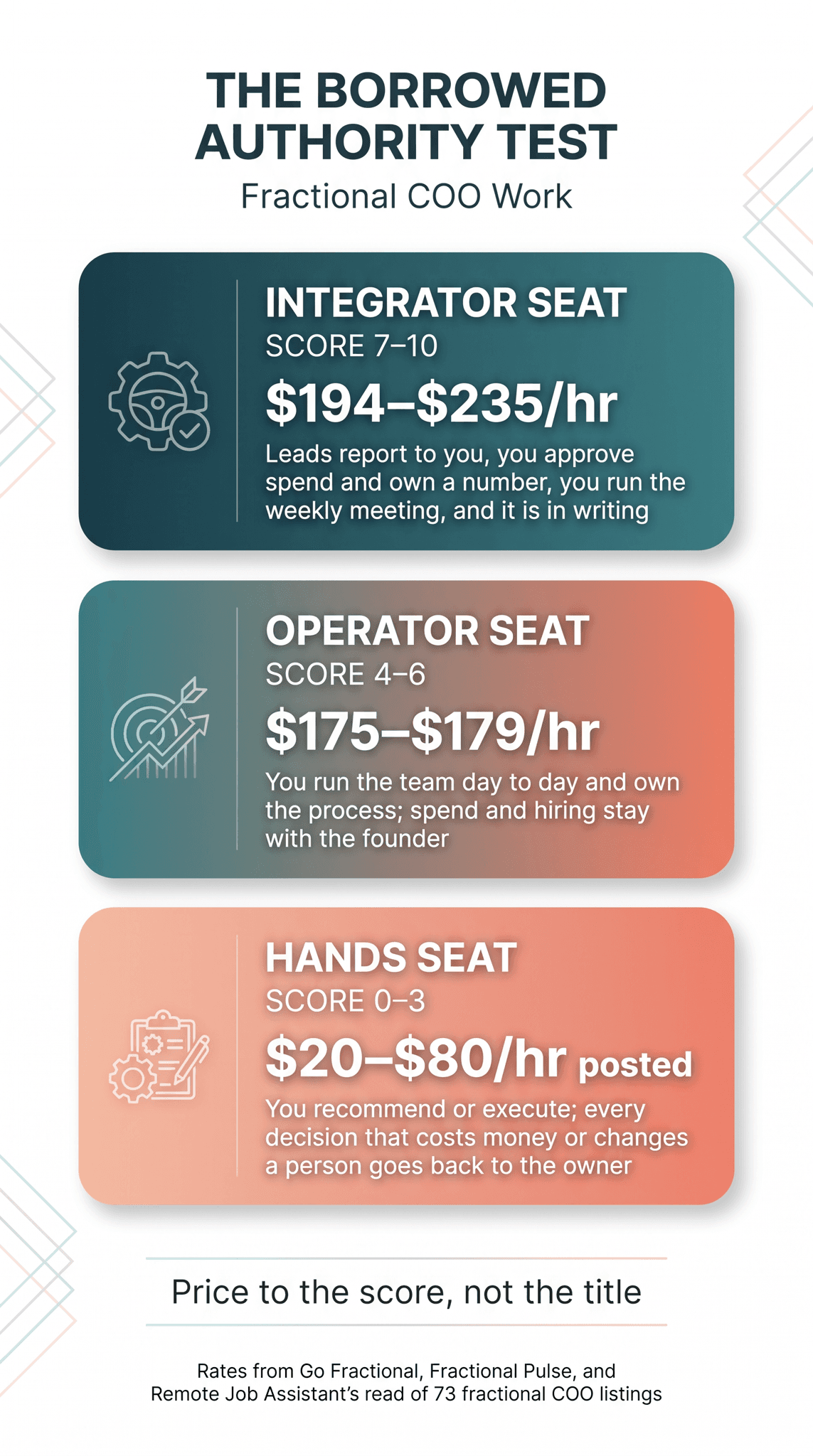
A fractional CFO's output is the close. A fractional CTO's is the system. A fractional COO's output is other people's work, and you can only direct that work with authority the founder lends you. The Borrowed Authority Test scores how much is lent, and whether anyone wrote it down.
The Borrowed Authority Test: a 10-point score of how much decision authority a fractional COO engagement actually gives you. Score one point per item unless noted.
- People (up to 2): 1 if you manage a team; 2 if two or more leads or functions report to you
- Spend (1): you can approve spend or sign vendor terms without the founder
- A number (1): you own a P&L, a budget, or a named metric
- People calls (up to 2): 1 if you can hire; 2 if you can also make the exit call on someone who isn't working out
- Cadence (1): you run the leadership meeting and set the quarter's priorities
- Founder handoff (1): the founder has named what they are stepping away from
- In writing (1): all of the above is in the statement of work or offer letter. A listing can't show this, so a listing tops out at 9
The score maps to three seats:
- 0-3, Hands Seat. You recommend or execute, and every decision that costs money or changes a person goes back to the owner. The tells: "advisor to ownership," "not responsible for managing the day-to-day office staff," "escalate issues to the owner when decisions are required." Posted pay in our sample: $20 to $80 an hour, $500 to $1,500 a month, $3,000 to $5,000 a month, $50,000 to $75,000 a year for 20 to 25 hours a week.
- 4-6, Operator Seat. You run the team day to day and own the process; spend and hiring stay with the founder. Price anchor: the employer-posted averages, $175 to $179 an hour (Fractional Pulse, 12 ranges; Go Fractional offers).
- 7-10, Integrator Seat. Leads report to you, you approve spend and own a number, you run the weekly meeting, the founder has said what they're dropping, and it's in writing. Price anchor: what talent asks and gets, $194 an hour on Go Fractional profiles and $235 an hour on its placements.
How to use it: score the listing, then score it again after the first founder call. Price to the score, not the title. If a founder wants integrator outcomes from a seat that scores 3, negotiate the missing points (named reports, a spend limit, the meeting) before you negotiate the rate.
Here is how eight real listings from the sample score, based only on what each listing says.
| Listing | Hours | Posted pay | Score | Seat |
|---|---|---|---|---|
| Texas practice, "advisor to ownership" | About 10 per month | $500-$1,500/month | 0 | Hands |
| Healthcare practice (Upwork) | Not stated | $20-$80/hr | 0 | Hands |
| NYC education nonprofit (Upwork) | 15 per week | $25-$30/hr | 1 | Hands |
| Palm Springs tour company | 3-6 months, on site | $3,000-$5,000/month | 2 | Hands |
| Charter school network | 25-30 per week, 10 months | Not posted | 2 | Hands |
| Santa Monica dermatology practice | 20-25 per week, on site | $50K-$75K/year | 3 | Hands |
| Korrus, President (contract-to-hire) | Not stated | "Discussed directly" | 4 | Operator |
| CPR Certification Labs | 15-20 per week | You propose it | 6 (7 if written) | Operator, one signature from Integrator |
Every direct-hire listing in the sample that posted pay and described the job scored 3 or below. (The fourth, a Santa Monica listing at $90 to $120 an hour, had no description to score.) The two highest scorers withheld pay: CPR Certification Labs asks for "your proposed monthly retainer at 15–20 hrs/week," and Korrus says compensation is "discussed directly."
The charter network is the one to study. It offers network-wide operations across facilities, HR administration, compliance, and finance coordination, at 25 to 30 hours a week for 10 months. By scope, that is a COO. By stated authority, it scores 2: no spend approval, no hiring or exit calls, and "represent operations in board and leadership meetings as needed" rather than running them. Scope is not authority. A seat can be enormous and still lend you nothing.
What a Low Score Looks Like After You Sign
A low score doesn't announce itself on day one. It shows up in the plumbing: vendor invoices that still route to the founder for approval, a Monday meeting the founder still chairs, direct reports who copy the founder on decisions you've already made because nobody told them the reporting line changed. Left alone, that turns you into the founder's messenger with a bigger calendar, while the results you were hired for depend on approvals you don't control.
The fix is an audit, not a conversation. At day 30, check four things you can count: who approved the last five vendor invoices, who chaired the last four leadership meetings, who made the last hiring or exit decision on your team, and how many of your decisions were reversed. If the founder's name comes up on most of them, re-score the seat honestly and either reprice it or renegotiate the points.
The harder case is the founder who agrees to everything on the call and won't write it down. Score verbal authority as zero. Offer a one-page authority addendum for a 30-day trial instead of a full SOW rewrite. If they won't sign a page, you have your answer, and the rate should be an advisor's rate. Some founders who post for a fractional COO want the feeling of having one without the discomfort of delegating, and a signature is the cheapest test of which kind you're talking to.
Red Flags in Fractional COO Listings, and What Each One Costs You
Each flag has a mechanism. Decide on the mechanism, not the feeling.
- "Advisor to ownership… not responsible for managing the day-to-day office staff." A Hands Seat by definition. You'll be judged on results you can't touch. Price it as a recurring audit, not a COO.
- "Hours exclusively for [company]" at an hourly rate. The LERU listing pairs exclusivity with $25 to $30 an hour for 15 hours a week, about $1,625 to $1,950 a month. Exclusivity belongs with a retainer, because it costs you the second client.
- "Clear path to full-time" with no date and no salary. You're paid fractional rates during a trial for a number nobody has stated. Pepstep got this right by publishing the post-launch band, $110,000 to $160,000.
- Social media, patient experience, and vendor contracts in one "COO" scope. The dermatology listing includes all three and no leads under you. You are the team.
- "Compensation: TBD" or equity-only. Eight of 73 listings. Fine only if you'd put the same hours into the company as an investor.
- A commute on a "remote" board. Five of the 8 direct-hire paid listings on HireAFractionalExec were on site or hybrid.
- Big scope, no decision rights. Ask for the spend limit and the meeting before you discuss the rate.
The decision rule, in five lines:
- Score 7 or higher, retainer offered: take it, and price at the talent-ask band or above
- Score 4 to 6, fair rate: take it on a 90-day term with a written re-score at day 90
- Score 0 to 3, priced like a COO: negotiate the missing authority before anything else
- Score 0 to 3, priced like an operations manager: it is an operations-manager job. Take it only if that's the job you want
- Exclusivity plus hourly pay: skip
When a founder wants integrator results from a low-scoring seat, you don't need a speech. Something like this works: "I can own the operating cadence and the metrics, but to hit that number I need the ops lead and support lead reporting to me, a spend limit of $X without sign-off, and the Monday leadership meeting. If we write those three into the SOW, my retainer is $Y. Without them, I'm an advisor and I'll price it that way." It turns a vague title into three specific points you can put in a contract.
The "in writing" point needs actual language. A short authority clause in the statement of work can look like the sample below. It is not legal advice; have your own counsel review anything you sign.
- Reporting: during the term, the Director of Operations and the Support Lead report to the Fractional COO.
- Spend: the Fractional COO may approve operating expenses and vendor commitments up to $[X] per transaction and $[Y] per month without the Founder's approval.
- Cadence: the Fractional COO chairs the weekly leadership meeting and sets quarterly operating priorities, reviewed with the Founder at quarterly planning.
- People: hiring and exit decisions for roles reporting to the Fractional COO require consultation with the Founder, not approval.
- Handoff: from [date], the Founder stops approving vendor invoices under $[X] and stops attending the weekly operations stand-up.
Each line maps to a point on The Borrowed Authority Test. Signed as written, the clause alone covers 8 of the 10, before you've done any work.
If the full-time seats are the better fit after all, the remote operations roles on our job board and the operations and project management category are where to look. That is also where Auto-Apply does its best work while you vet the fractional ones by hand.
Stop Applying Manually
Our AI applies to hundreds of matching jobs while you sleep. Wake up to interviews, not more applications.
The Integrator Seat: What EOS Founders Mean by Fractional COO
Nine of the 73 listings used the word "integrator," and seven of those nine were full-time hires. The word comes from EOS, the Entrepreneurial Operating System that many founder-led companies run on. EOS Worldwide describes the Integrator as the person who integrates sales, marketing, operations, and finance and runs the business day to day, and says the Integrator "commonly holds a title like COO." The founder is the Visionary. EOS's own explainer on the pairing says "Neither is the other's boss. They are partners," and names the failure mode bluntly: "The founder who refuses to let go of daily operations. Growth caps at their capacity." The Texas practice listing is that founder in writing: a COO title, monthly evaluations, and no authority over the staff. The owner wants a COO's results and keeps every approval.
That gives you a company-size screen. EOS says one person can usually hold both seats until a company reaches somewhere around 10 to 25 employees. Below that, a founder hiring an "integrator" is often hiring help, not handing over a seat.
What a real integrator listing lends looks like this one from Blacksmith Agency, a full-time remote role: four department leads reporting to the seat, "the call when one of them is not going to get there," the meeting rhythm and the quarter's priorities, profit measured on attainment, client contract redlines and vendor terms, and "the decisions that wait on the founder today, made the same day instead." On The Borrowed Authority Test that listing scores 8 before anything is signed.
An EOS company also hires you into its format. Threat Tec's listing says "Run weekly L10s, manage Rocks"; Native Forest Nursery's says "You run the Level 10 Leadership Meeting." If you've never run that format, say so on the first call. It's learnable in a quarter. Pretending isn't.
Why are most integrator seats full-time? The weekly leadership meeting and the people calls need someone present every week. A 13-hour engagement can hold the meeting rhythm. It rarely holds the authority to let a department lead go. The fractional versions that work are either player-coach seats (Go Fractional's "Fractional COO / Integrator (Player-Coach)," which has you mentoring a junior operator) or seats with a Director of Operations underneath, like CPR Certification Labs.
Four questions settle it on the first call:
- Who reports to me on day one, by name?
- What can I sign without you, and up to what amount?
- Which meeting do I run?
- What are you going to stop doing?
If the founder can't answer the fourth, the Visionary hasn't agreed to move over yet, and no rate fixes that.
An integrator without the leadership meeting is an operations consultant with a better title.
Audition Seats and Bench Seats: When a Fractional COO Job Isn't Fractional
Two of the eight listing types are real jobs that won't build you a fractional practice. Decide which one you're building before you apply.
Audition seats. Six listings were built to convert, and two more mentioned a path: CPR Certification Labs is "open to growing into a full-time COO role," and LERU promises a "clear path to full-time." The founder is buying trust before committing to a salary. Korrus said it directly: "trust and fit at this level cannot be judged in an interview." If you want a full-time COO seat, an audition is one of the few ways in without a referral. If you're building a practice of two or three clients, it absorbs the hours your second client needed. Before you accept, get three things in writing: the conversion date, the full-time pay band, and whether you can keep one other client during the trial.
Bench seats. Salary, benefits, no pipeline to build, and a thin slice of every client. The SMB Team listing asks for EOS Integrator experience and pays $125,000 to $135,000 for serving law-firm owners 5 to 17 hours a month each. That's a fast way to watch a lot of owner-run firms up close. It is not a place to set your own rate. If that trade appeals, compare it against full-time roles on our remote operations jobs guide and the operations manager openings before you decide the fractional route is the only one.
Where Paid Fractional COO Work Actually Comes From
The high-authority seats mostly come through people, not boards. In the Fractional Work Report's 2026 survey (1,733 responses, 810 from currently active fractionals), 94% of fractional workers have won clients through network referrals, 64% work with two or more clients, 60% of engagements run six months or longer, and 46% bill mainly on a monthly retainer. Those are all-function figures, but nothing in our COO sample points the other way.
Boards are better for calibration than sourcing. Fractional Pulse had 7 COO listings out of 561 live roles on the day we checked. HireAFractionalExec's 23 URLs held 17 distinct listings. Read them to learn how owners describe the job, then source through people.
Use CPR Certification Labs' first screening question as the frame for your own pitch: "Name one operational system or process you personally built and put into production. What it replaced, who runs it today, whether it's still in use." The key phrase is "who runs it today." Founders hiring a fractional COO want proof that your systems survive your absence, because your absence is built into the arrangement. (Our fractional CMO guide found the CMO's trap is hours drifting into execution. The COO's is authority that never arrives.)
The listings say what background they want, and it's rarely the COO title itself. Drag & Fly names "Director of Operations, General Manager, integrator, hospitality executive, or senior operations consultant." If you're coming from remote program manager roles, people operations, or supply chain, lead with the cross-functional cadence you ran, not your last title. Tools matter less than proof, but listings do name them. CPR runs its funnel through HubSpot, and several ask for project management depth in plain terms.
Your network does most of the work on the fractional side, and that takes months. Keep the full-time pipeline moving in the meantime with the $150K-plus remote roles that fit your background.
Stop Applying Manually
Our AI applies to hundreds of matching jobs while you sleep. Wake up to interviews, not more applications.
Who Should Not Take Fractional COO Work
Run these on yourself the way you'd run The Borrowed Authority Test on a listing.
- You've never made the exit call on a direct report. The people-calls points are the ones founders withhold longest. If you haven't done it with full authority, you won't do it well with borrowed authority.
- Your best operating results depended on a CEO who backed you in the room. As a fractional, the founder who has to back you changes with every engagement, and so does whether they will.
- You need steady income within 90 days. In the Fractional Work Report's survey, 72% of fractional workers found their first client through their own network. If yours is thin, take a bench or audition seat on purpose rather than waiting on referrals.
- You want to deliver recommendations, not implement them. Four of the 15 part-time seats in our sample (9 direct, 6 auditions) explicitly turned advisors away. Drag & Fly: "We are not looking for someone to spend three months observing the business and then deliver a PowerPoint telling us what we should do."
Frequently Asked Questions
I'm a VP of Operations with 15 years in. What should I charge as a fractional COO?
Price to the authority the seat gives you, not your title. Go Fractional's live data puts the middle 50% at $150 to $230 an hour, or $7,800 to $11,900 a month at 13 hours a week, based on 9 job posts in the 90 days to September 24, 2026. Seats that score 7 or higher on The Borrowed Authority Test justify the upper half of that range. In our sample, no seat scoring 3 or lower posted pay anywhere near it.
Why do fractional COO job listings pay so much less than the rate guides say?
Most public listings with posted pay come from owner-operated businesses buying a part-time operations manager. In our sample, 4 of 8 direct-hire listings on HireAFractionalExec posted pay. None of the monthly or annual figures reached Go Fractional's 25th-percentile retainer of $7,800 a month, and the one hourly posting topped out at $120, below its $150 25th-percentile rate. Funded companies mostly hire fractional COOs through referrals and marketplaces, so their rates show up in benchmarks, not on boards.
A founder wants a fractional COO but won't let me manage the team. Should I take it?
That is a Hands Seat, scoring 0 to 3 on The Borrowed Authority Test. You'll be held to operating outcomes while every people and spend decision goes back to the founder. Either price it as a recurring advisory engagement or ask for named direct reports and a spend limit in the statement of work before you agree to a COO rate.
How do I score a listing on The Borrowed Authority Test?
Give up to 2 points for people reporting to you, 1 for spend authority, 1 for owning a number, up to 2 for hiring and exit calls, 1 for running the leadership meeting, 1 for a founder who has named what they're giving up, and 1 if it's in writing. A listing can show at most 9, since the writing comes at signing. CPR Certification Labs scored 6 on its listing text alone.
Is a fractional COO role that converts to full-time a good deal?
It is if the full-time seat is what you want, because it gets you in without a referral. It's a poor deal if you're building a multi-client practice, since the trial takes the hours a second client would need. Six of the 73 listings we classified were built to convert. Ask for the conversion date, the full-time pay band, and permission to keep one other client.
Is an EOS integrator the same thing as a fractional COO?
They overlap. EOS Worldwide says the Integrator "commonly holds a title like COO," and the role runs the leadership team and the weekly meeting. But 7 of the 9 listings in our sample that used the word "integrator" were full-time hires, most likely because the meeting cadence and people calls need someone present every week.
Are fractional COO jobs actually remote?
Less often than the job boards imply. Only 3 of the 8 direct-hire paid listings on HireAFractionalExec were remote, and Go Fractional's 9 recent COO posts split 4 remote, 4 hybrid, and 1 in-office. Check the body of the listing, not the board's remote tag.
Start Your Fractional COO Search
Sort the listing first. Only 9 of the 73 we classified were direct, paid part-time seats, and most of the rest give themselves away in the first paragraph. Then reconcile the rate: the benchmarks at $150 to $230 an hour describe funded seats found through referrals, while the listings that post pay mostly describe operations-manager jobs. Then score the authority, and price fractional COO jobs to the score.
If the full-time seat fits better, our remote operations jobs guide covers the full-time ladder, and the $200K-plus remote roles list covers the senior end of that market. For operators coming from HR or finance, the people operations guide and finance and accounting openings are worth a look too. If you want applications to go out while you're on founder calls, Auto-Apply handles the volume.
A founder can hand you the COO title in a sentence. The authority you have to get in writing, and price accordingly.
Ready to Find Your Remote Job?
Browse thousands of curated remote jobs or let AI apply for you.
Browse Remote JobsRelated Job Guides
Fractional CTO Jobs: Real Rates and the Custody Test
Only 12 of 90 fractional CTO jobs we classified were paid part-time roles. Real 2026 rates, the listings to skip, and how to score custody before you sign.
27 min read
Remote Contract Manager Jobs: 268 Postings, 58 Remote
We read 268 US contract manager postings at 63 employers. 58 were remote, 43 at health plans, pharma or CROs. Pay by level, clearance rules, what to learn.
26 min read
Remote People Operations Jobs: 259 Postings, 44 Remote
We read 259 US people ops postings at 137 employers. 44 were remote, and 30 of those were comp or HRIS roles. Real pay by specialty, plus what to learn next.
23 min read