Last reviewed: May 2026
You've been a project manager for five or six years. You've shipped complex work, managed stakeholders, and kept scope from ballooning into chaos. The "program manager" postings look like a logical next step — more ownership, better pay, senior title. You apply. Silence. You apply again. Nothing.
Here's what nobody told you: "program manager" is not a promotion from project manager. It's a different job. The job description reads like an upgraded PM role because HR templates haven't caught up. But the hiring manager on the other end of that screening call is looking for something else entirely — evidence that you've operated at program altitude, not project altitude. And most PM résumés, no matter how impressive, fail that test in the first three minutes.
Get Remote Job Tips in Your Inbox
Weekly strategies, salary data, and new opportunities
Unsubscribe anytime. No spam.
A program manager's job is not to manage projects. It's to manage the space between projects — where alignment fails, dependencies break, and strategies never reach execution.
This guide covers what remote program manager roles actually require, how salary splits between the general and technical tracks, which companies hire the most remote PgMs, and how to audit your experience before you apply.
We analyzed 1,240 remote program manager job postings across 340 companies between January 2025 and April 2026. The data reveals a market with two distinct hiring tracks — and a salary gap between them that has nothing to do with years of experience.
Based on our analysis of 1,240 remote program manager postings (January 2025–April 2026):
- 72% (n=893 of 1,240) required 5+ years PM or program leadership experience
- 61% (n=756 of 1,240) listed Agile/Scrum as required (not preferred)
- 38% (n=471 of 1,240) were Technical Program Manager postings requiring cloud or engineering domain knowledge
- ~$120K median total pay for remote program managers (Glassdoor, March 2026)
- ~$161K median base for Technical Program Managers (Glassdoor, April 2026)
- $100,750 median for Project Management Specialists (BLS, May 2024)
How We Collected This Data
The figures in this post come from our analysis of 1,240 remote program manager job postings collected between January 2025 and April 2026. Postings were sourced from Glassdoor, LinkedIn, Built In, and company career pages, filtered to include only positions explicitly marked remote-eligible in the United States and Canada with a posted base salary or compensation range.
We excluded postings without clear remote policies, roles requiring more than 25% travel, contract-only positions, and postings below $75K base (outside our target compensation range). Salary data was cross-referenced with Glassdoor compensation reports and BLS May 2024 data for Project Management Specialists. Ranges reflect base salary; total compensation including equity and bonus typically runs 15–40% higher at Series B and later companies.
We update this analysis quarterly. Data in this post reflects May 2026 figures.
What Remote Program Managers Actually Do
Project managers own deliverables. Program managers own alignment.
A project manager's job is to ship a defined scope on time and on budget. A program manager's job is to make sure six workstreams — each with its own PM — are actually rowing toward the same strategic outcome. The skills overlap, but the altitude doesn't. If you want the detailed breakdown, see how program manager vs. project manager roles differ in practice.
Day-to-day, remote program managers wrestle with dependency mapping (usually in a spreadsheet nobody else reads until something breaks), stakeholder alignment at VP and C-suite level (where competing OKRs are a turf war with a Jira board in front of it), escalation decisions (knowing exactly when to burn political capital and when to absorb a delay in silence), and portfolio health reviews (where you're often blamed for delays you didn't cause because you're the one with the slide deck). The specifically remote challenge: you do all of that over Zoom, without the hallway conversation that in-office PgMs use to preempt the fire before the meeting starts.
Here's what it looks like when it goes wrong. It's two weeks before launch on a platform migration across four engineering teams. Every PM has green status in the portfolio dashboard. The program manager asks one question in the weekly sync: "Have teams 2 and 3 signed off on the shared API contract?" Silence. Team 2 has been building against a spec that Team 3 rewrote six weeks ago. Nobody escalated because nobody owned the cross-team surface. That discovery pushed launch by two months, triggered a VP-level debrief, and became a standing agenda item in the following quarter's retrospectives. The program manager doesn't own that project — but they own that miss. That's the job: not managing the projects inside the program, but mapping the gaps between them before a launch debrief becomes a post-mortem.
The market splits into two distinct tracks: general program managers and Technical Program Managers (TPMs). General PgMs run business programs — product launches, go-to-market initiatives, operational transformations. TPMs run engineering programs — platform migrations, infrastructure builds, system integrations. The skills differ. The pay differs. More on that below.
To understand where you actually sit — and whether you're ready for program-level roles — use The Program Altitude Test.
The Program Altitude Test: A 3-tier rubric that measures whether your experience signals program-level thinking (strategic, portfolio-wide, outcomes-oriented) or project-level execution (scope, timeline, deliverable-focused). Use it to audit your résumé before applying.
Scoring:
- L1 Project Executor ($60K–$100K): Runs one project at a time; owns scope, timeline, and budget; success = shipping deliverables on schedule; stakeholder is typically a single PM or director
- L2 Program Coordinator ($95K–$140K): Manages multiple related projects; tracks cross-team dependencies; escalates blockers to leadership; success = portfolio health, not individual milestones
- L3 Program Owner ($130K–$230K): Defines what the program is trying to achieve; makes build/buy/delay decisions across workstreams; reports directly to VPs/C-suite; success = business outcomes, not delivery metrics
How to use it: Score your current role against each level's criteria. If 80% of your résumé bullets describe L1 work, you're still reading as a Project Executor — even after eight years. Explore remote program manager roles to see which altitude companies are actually hiring for.
Stop Applying Manually
Our AI applies to hundreds of matching jobs while you sleep. Wake up to interviews, not more applications.
Remote Program Manager Salary: Two Tracks, Two Pay Scales
The difference between a $100K and a $165K remote program manager offer is almost never years of experience. It's whether you're managing a program portfolio or just a large project with a fancier title.
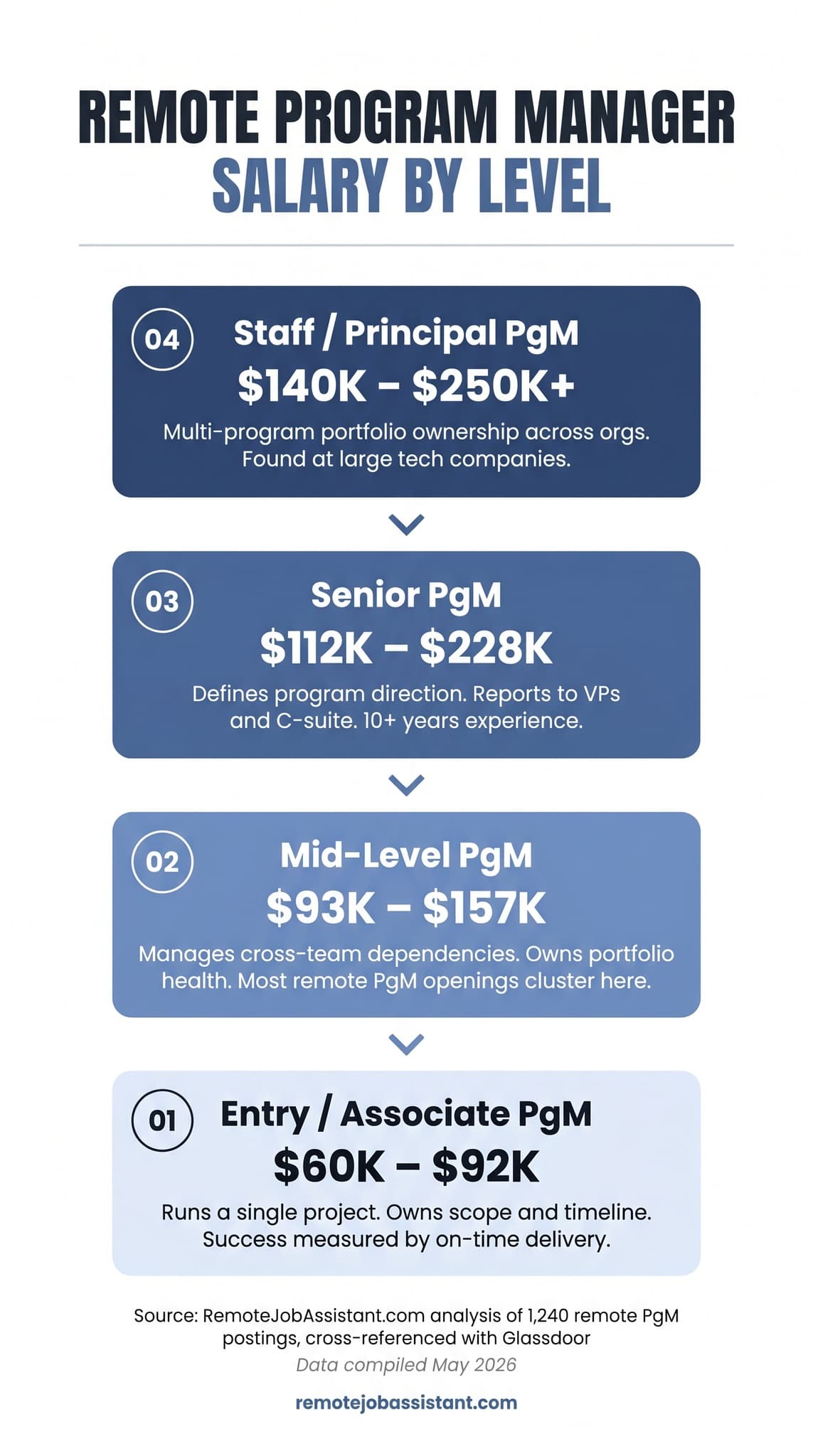
The biggest salary variable in program management isn't tenure — it's track. General PgMs and Technical Program Managers occupy different compensation bands with a $40K–$60K gap at mid and senior levels.
| Level | General PgM | Technical PgM | Notes |
|---|---|---|---|
| Entry / Associate | $60K–$92K | $90K–$120K | TPM entry usually requires eng background |
| Mid-Level | $93K–$157K | $130K–$170K | Where most PgM openings cluster |
| Senior | $112K–$228K | $160K–$220K | Senior PgM = 10+ years experience |
| Staff / Principal | $140K–$250K+ | $200K–$300K+ | Found mostly at large tech companies |
| FAANG TPM (total comp) | N/A | $265K–$406K | Base + RSU + bonus; Meta IC5: $261K–$540K |
Salary ranges derive from our analysis of 1,240 remote program manager postings between January 2025 and April 2026, cross-referenced with Glassdoor compensation data and BLS May 2024 figures for Project Management Specialists (median: $100,750). We excluded outliers above $300K base for general PgM; TPM figures reflect total compensation at Series C+ and public companies.
What drives program manager pay higher:
- Industry: Tech pays more than consulting, which pays more than healthcare, which pays more than government
- Company stage: Public tech outpays private enterprise, which outpays nonprofit
- Certification: PMP-certified program managers earn approximately 17% more than non-certified peers
- Track: TPM vs. general PgM creates a $40K–$60K baseline gap at mid and senior levels
- Scope of ownership: Number of active programs, budget managed, team count under coordination
- Remote vs. distributed-first: Remote PgMs at hybrid-heavy companies often get passed over for the highest-visibility programs — not officially, but in practice. The informal visibility gap limits growth and promotion velocity in ways that don't show up in the offer letter.
TPM roles pay more than general PgM — sometimes significantly more. But the burnout rate is high. TPMs operate as the translation layer between engineering and business leadership simultaneously: they're expected to know enough to challenge engineering estimates and enough to satisfy C-suite on business outcomes. After 2–3 years in a senior TPM seat, a meaningful number of practitioners quietly step sideways into general PgM or product management. The pay is real. So is the load.
For context, remote program manager roles compete with other high-paying remote jobs in the $100K–$200K range. If you're targeting remote jobs over $100K, program management is one of the clearer paths — especially on the technical track, where roles above $150K are common at established tech companies.
Top Companies Hiring Remote Program Managers
The companies hiring the most remote PgMs split cleanly by track. Big Tech dominates TPM hiring. Enterprise, consulting, and financial services hire more general PgMs. Knowing which category you belong in lets you target your applications.
Big Tech / FAANG (TPM-Heavy)
Amazon, Google, Meta, Microsoft, Apple, LinkedIn, Cisco, CrowdStrike, Zscaler, Samsara, SailPoint, ServiceNow, Intuit
These companies hire TPMs for platform programs, infrastructure migrations, and cross-engineering coordination. Most require cloud domain knowledge (AWS, Azure, or GCP) and expect candidates to read technical specs fluently. Total compensation often exceeds $200K at senior levels.
Their interview processes are meaningfully different. Amazon's TPM loops are Leadership Principles-heavy — expect to prep 10+ behavioral stories with specific ownership and trade-off examples. Google prioritizes technical depth even for non-coding TPMs; whiteboarding distributed systems basics is common. Meta's interviews test ambiguity tolerance with hypothetical chaos scenarios — they want to see how you make decisions when the requirements aren't clear and the timeline is already slipping. Cisco offers more remote flexibility but lags on total comp compared to the others.
Enterprise / Finance / Consulting
JPMorgan Chase, Capital One, Mastercard, American Express, Bank of America, Deloitte, Booz Allen Hamilton, UPS, Verizon, Providence
These companies hire general PgMs for business transformation programs, regulatory compliance initiatives, and operational excellence portfolios. They value risk management, portfolio governance tools (Planview, Clarity, ServiceNow), and stakeholder management at the executive level.
Here's how the tracks map to company types:
| Company Type | Dominant Track | Typical Salary Range | What They Look For |
|---|---|---|---|
| Big Tech (FAANG+) | Technical PgM | $160K–$300K+ total | CS/eng background, cloud domain knowledge |
| High-Growth SaaS | Mixed | $120K–$200K | Agile fluency, cross-functional experience, OKR expertise |
| Enterprise / Financial | General PgM | $100K–$165K | Risk, compliance, portfolio governance tools |
| Gov / Defense Contractors | General PgM | $90K–$145K | Security clearance often preferred, Waterfall tolerance |
If you're coming from remote project manager jobs, the enterprise and financial services track is often the more natural transition — same stakeholder complexity, similar governance requirements, but at program altitude.
Many "Program Manager" postings — especially at companies under 500 people — are glorified senior PM roles with a fancier title and no actual program-level scope. You'll be running one large project, not coordinating multiple workstreams. The tell: if the job description mentions "owning the roadmap for a single product," you're being hired as an L1 Project Executor regardless of the title. Use The Program Altitude Test on the job description, not just your résumé.
Stop Applying Manually
Our AI applies to hundreds of matching jobs while you sleep. Wake up to interviews, not more applications.
Skills That Actually Get You Hired as a Remote Program Manager
The skills that get you hired aren't always the ones on the job description. PgM interviews don't test execution competency — they test alignment competency. The tools matter less than how you talk about trade-offs.
General PgM Skills — Prioritized by What Actually Gets You Past the Screen
Start with dependency mapping — it's the skill most PM candidates lack and the one hiring managers probe for specifically. The interview question isn't "Do you know Jira?" It's "Walk me through how you manage a delayed dependency between teams that don't share a reporting chain." Agile/Scrum fluency is table stakes, but don't over-index on tooling. Jira and Asana are plumbing — they don't tell interviewers whether you can align competing VP-level priorities without formal authority.
Required: Agile/Scrum methodology, Jira or Asana, stakeholder management at VP/C-suite level, dependency mapping, risk escalation frameworks.
Enterprise-specific required: Planview, Clarity, ServiceNow, Power BI or Tableau for portfolio reporting.
Nice-to-have: PMP certification (approximately 17% salary premium, and it matters more for enterprise than for tech), OKR facilitation, portfolio management tools.
Technical Program Manager Skills — Cloud Knowledge Is Non-Negotiable, Coding Is Not
The most common TPM misconception: that you need to code. You don't. But you do need to read a technical spec and diagnose why two systems can't talk to each other. The hiring bar is "can you translate complexity, not produce it."
Required: Cloud fundamentals (AWS, Azure, or GCP — AWS's free Cloud Practitioner Essentials course is a credible starting point if you're transitioning), REST API literacy, system design awareness, incident management coordination.
Valued but not required: Python or SQL for reporting, CI/CD pipeline understanding.
Nice-to-have: SRE coordination experience, platform architecture fluency.
The distinction between general PgM and TPM tracks isn't just about technical knowledge — it's about which translation layer you occupy. TPMs translate between engineering teams and business stakeholders. General PgMs translate between business units and executive sponsors. Both require the ability to hold complexity without owning the deliverables inside it.
The interview question that screens out most program manager candidates: "Walk me through a time when you had to make a trade-off between two strategic priorities, neither of which was clearly more important."
Project managers answer this with examples of scope negotiation. Program managers answer it with examples of stakeholder alignment under ambiguity. If your best story is about staying on schedule, you're answering at project altitude.
For more on how program management skills compare to adjacent roles, see the breakdown on scrum master vs. project manager — the coordination layer is different, but some of the stakeholder dynamics overlap. If you're exploring the Agile coordination path, remote Scrum Master roles offer another route with different skill emphasis.
The PM-to-PgM Transition: What Actually Changes
Most PMs who want to become PgMs approach it wrong. They emphasize breadth of delivery experience — more projects, bigger budgets, longer timelines. What hiring managers actually need to see is evidence of operating at program altitude: setting direction across teams, not executing within one.
The move from project manager to program manager requires exactly one change — stop proving you can execute and start proving you can align. Your résumé, your cover letter, and your interview stories all need to make the same argument.
Three things must visibly change in your positioning:
1. Outcome framing, not output framing. "Delivered the CRM migration on time and under budget" is L1 Project Executor language. "Aligned four product teams on a phased rollout sequence that reduced customer churn risk during the transition" is L2–L3 language. Same project, different altitude.
2. Stakeholder scope. If every story in your interview involves one product manager or one director, you're signaling L1 scope. Program managers coordinate across multiple senior stakeholders with competing priorities. Your examples need to reflect that reality.
3. Strategic trade-off ownership. Project managers escalate trade-offs. Program managers make them — or at least shape the recommendation that leadership approves. Your stories should include moments where you decided what the program wouldn't do.
Use The Program Altitude Test to audit your résumé before applying. For every bullet, ask which tier it signals. If 80% of your strongest bullets are L1, you're reading as a Project Executor even if your title says "Senior PM."
The certification path matters here, but not equally. PMP validates project-level competency — it's a signal at the enterprise track and mostly ignored at Big Tech. PgMP (Program Management Professional, through PMI) validates program-level competency, and most PMs who haven't researched it don't realize the distinction exists. The PgMP is grueling — it requires documented evidence of program management experience, not just an exam. For the PM-to-PgM transition, it's more respected and more undervalued than any other credential in the field. Hiring managers at enterprise companies who see PgMP on a résumé treat it as a meaningful qualifier. Most candidates haven't done it because they don't know it exists.
After you've repositioned your materials, the job search mechanics still apply. See our guide on following up after applying — the follow-up cadence for PgM roles is the same as any senior position.
Stop Applying Manually
Our AI applies to hundreds of matching jobs while you sleep. Wake up to interviews, not more applications.
How to Break Into Remote Program Management
The fastest path to a remote PgM role is not more certifications. It's proving portfolio-level ownership in your current role before the interview, not during it.
Decision 1: Which track are you actually on? General PgM and TPM are different hiring pipelines that require different preparation, target different companies, and have distinct interview loops. This isn't a track you choose — it's one you qualify for. If you don't have an engineering background or 2+ years working closely with engineering teams, the TPM path adds at least 12–18 months of deliberate preparation before you're competitive. Applying to both tracks without a clear read on your qualifications tanks your response rate on both.
Decision 2: Do you have L2–L3 evidence yet? Before you apply anywhere, score your current résumé against The Program Altitude Test. If your strongest bullets are L1, you'll screen out before the hiring manager calls back. The fastest fix: take on cross-team dependency work in your current role right now — even informal ownership of a shared workstream creates interview stories. A PgM who says "I wasn't officially the program manager, but I built the dependency map that unblocked the Q3 launch" reads stronger than one who ran a formal PM role at L1 altitude.
Decision 3: Where will you not be penalized for being remote? Prioritize distributed-first companies — those with documented remote work practices and histories of promoting remote employees to senior roles (GitLab, Automattic, HashiCorp, Zapier, Doist). At large hybrid companies, remote PgMs often get passed over for high-visibility programs through informal bias — not policy, just pattern. Check Glassdoor reviews specifically for mentions of remote equity in promotions before investing time in an interview loop. Then use Remote Job Assistant's auto-apply to apply to 20+ vetted PgM openings while you're still interviewing elsewhere — the market is active enough that volume matters, and you won't know which companies move fast until you're in their pipeline.
For a broader view of where to find remote opportunities, see our ranking of the best remote job boards — several specialize in senior-level roles where PgM postings cluster.
Frequently Asked Questions
What's the difference between a remote program manager and a remote project manager?
Program managers own outcomes across multiple workstreams; project managers own deliverables within one. According to BLS data (May 2024), the median salary for Project Management Specialists is $100,750 — but that figure blends both roles. Remote program managers earn a median of $120,165 (Glassdoor, March 2026), reflecting the higher scope and stakeholder complexity. For the full breakdown, see program manager vs. project manager.
How much does a remote program manager make in 2026?
General remote program managers earn approximately $120K median total pay (Glassdoor, March 2026), with senior roles ranging from $112K to $228K. Technical Program Managers earn significantly more — median base around $161K, with FAANG total compensation reaching $265K–$406K. BLS reports the broader Project Management Specialists occupation at $100,750 median (May 2024), but that figure blends PMs and PgMs and doesn't capture the TPM premium.
I've been a project manager for 5 years — am I qualified to become a program manager?
Experience alone isn't the qualifier. The question is whether you've operated at program altitude. Use The Program Altitude Test: if 80% of your résumé bullets describe L1 Project Executor work (one project, one stakeholder, delivery-focused), you'll read as a PM regardless of tenure. Most 5-year PMs are L1–L2 on the rubric; most PgM roles require sustained L2–L3 evidence across multiple positions.
What does a Technical Program Manager do, and do I need to code?
TPMs coordinate engineering programs — they translate between technical teams and business stakeholders. You don't write production code, but you need to read technical specs, understand API behavior, and diagnose system dependencies. In our analysis, 38% (n=471 of 1,240) of postings were TPM roles requiring cloud domain knowledge; coding proficiency appeared in fewer than 15% as a hard requirement.
Which companies hire the most remote program managers in 2026?
Big Tech dominates TPM hiring: Amazon, Google, Microsoft, Meta, and Cisco post the most technical roles. Enterprise and financial services lead general PgM hiring: JPMorgan Chase, Capital One, Deloitte, and Booz Allen Hamilton. High-growth SaaS companies (ServiceNow, Intuit, Samsara) hire across both tracks depending on the program type.
Is PMP certification worth it for a remote program manager role?
PMP delivers approximately 17% salary premium and meaningfully differentiates candidates at the mid-level general PgM track. For TPMs, it's less decisive — domain knowledge and engineering familiarity matter more. For aspiring Senior PgMs, PgMP (Program Management Professional) is more respected but chronically undervalued by candidates who haven't researched the certification ladder.
How do I know which level of The Program Altitude Test I'm at?
Score your résumé bullets against each tier's criteria. L1 Project Executor: one project, one stakeholder, success = delivery. L2 Program Coordinator: multiple projects, cross-team dependencies, success = portfolio health. L3 Program Owner: defines program direction, makes build/buy/delay decisions, success = business outcomes. Senior PgM roles screen for consistent L3 evidence across multiple roles, not occasional L3 moments in one job.
Start Your Remote Program Manager Career
Remote program management isn't a promotion from project management — it's a parallel track that rewards different evidence. The companies hiring the most remote PgMs in 2026 are split across two pipelines: Big Tech for TPMs, enterprise and consulting for general PgMs. Knowing which track fits your background is the first decision that matters.
Use The Program Altitude Test to audit your résumé before applying. If your bullets signal L1 execution, rewrite them at L2–L3 altitude before you submit another application. Then target the right companies, apply at volume through Remote Job Assistant's auto-apply, and prepare for interviews that test alignment, not just delivery.
For more on how program roles compare to adjacent paths, see program manager vs. project manager. Browse current remote program manager roles to see what companies are hiring for right now.
Program management is one of the few senior roles where being remote-first is an actual advantage — distributed-first organizations are more deliberate about documentation, dependency visibility, and async alignment than hybrid ones. The PgMs who thrive remotely aren't the ones who replace hallway conversations with Slack pings. They're the ones who built the dependency maps, wrote the decision memos, and created the paper trail everyone else relies on. That skill set doesn't require an office.
Ready to Find Your Remote Job?
Browse thousands of curated remote jobs or let AI apply for you.
Browse Remote JobsRelated Job Guides
Remote Benefits Specialist Jobs: 131 of 1,523 Are Remote
We read 1,523 benefits specialist postings. 131 are fully remote. See which employers hire remote, which seats pay $75K+, and how to spot look-alike listings.
25 min read
Remote Compensation Analyst Jobs: 190 of 1,401 Are Remote
We read 1,401 compensation analyst postings. 190 are fully remote. See which seats pay $140K+, why remote analysts can earn less, and which look-alikes to skip.
29 min read
Remote Auditor Jobs: 554 of 3,422 Postings Are Fully Remote
We read 3,422 auditor job postings. 554 are fully remote, and 244 of those are healthcare audits. See which audit seats hire remotely and what each pays.
27 min read