
Last reviewed: August 2026
You ran the numbers on going fractional, and the job boards talked you out of it. ZipRecruiter puts the average fractional CFO at $151,302 a year. The Bureau of Labor Statistics puts the median financial manager at $161,700. On that comparison, leaving a salaried finance seat to run your own book means less money, no benefits, and all of the client risk.
That comparison is broken, and not in a subtle way. $151,302 is almost exactly what one mid-band fractional CFO retainer annualizes to. The board isn't reporting what fractional CFOs earn. It's reporting what one of their clients pays, then printing it in a box labeled "salary."
Get Remote Job Tips in Your Inbox
Weekly strategies, salary data, and new opportunities
Unsubscribe anytime. No spam.
In August 2026 we read the fractional CFO listing counts off six job boards and marketplaces, recording the query scope for each, and compiled rate bands from four independent published benchmark sets. Two things came out of it. The listing counts disagree with each other by a factor of 6.4, and the rate you can charge has almost nothing to do with your years of experience. Below: what the work actually pays by scope tier, why the boards can't agree on how much of it exists, and the four channels engagements arrive through — only one of which any job board carries.
- $189/hr average fractional CFO rate, with the middle 50% running $150/hr to $250/hr (Go Fractional 2026 CFO benchmarks)
- $8,000–$18,000/month US retainer band per client; the midpoint annualizes to $156,000 from a single client (Fractionus, 2026)
- $151,302/yr — ZipRecruiter's reported average fractional CFO "salary" as of August 2026, within 3% of that one-client midpoint
- $211,194/yr — Glassdoor's average for the same job title in 2026, roughly 40% higher, because it measures practitioners rather than engagements
- 558 versus 87 — Indeed's fractional CFO listings in Texas alone against LinkedIn's count for the entire United States, both read in August 2026
- 69.5% of fractional professionals bill $5,000–$10,000 per month per client (Vendux, 2025 — measured across all fractional executive roles, not CFOs alone)
- $161,700 — BLS median annual wage for financial managers, May 2024, against projected 15% employment growth from 2024 to 2034
Every number above is either counted or published with a date attached. Here is exactly where they came from.
How We Collected This Fractional CFO Salary and Rate Data
Listing counts were read directly off six job boards and marketplaces in August 2026 — Indeed, LinkedIn, Glassdoor, SimplyHired, ZipRecruiter, and Go Fractional — recording the geographic and remote scope of each query, because the counts contradict each other and that contradiction is the finding rather than a rounding problem.
Rate bands were compiled from four independent published benchmark sets: Go Fractional's 2026 CFO rate benchmarks, Fractionus's 2026 US retainer benchmarks, Graphite Financial's stage-based rate guidance, and cfo-recruit.com's seniority bands. Salary figures come from ZipRecruiter (August 2026) and Glassdoor (2026) and are reported side by side rather than averaged, because they measure different units. All of it is cross-referenced against the BLS Occupational Outlook Handbook entry for financial managers, May 2024.
Two things were deliberately excluded. First, a widely recycled claim that self-identified fractional titles on LinkedIn grew 5,400% — the year labels contradict each other in every copy of it and no primary source exists. Second, vendor claims of a three-to-six-month practice ramp, which come from firms selling practice-building courses and contradict the 12-to-18-month figure everywhere else. Rates were verified in August 2026. The rungs move slowly; the retainer floor moves with the funding market, so if you're reading this well after a Series A drought, expect the S3 band to have compressed before the S1 band does.
What Fractional CFO Jobs Actually Pay: The Scope Ladder
Most fractional CFOs underprice for one reason: they let the client define scope after the engagement has already started. A $3,000-a-month engagement and an $18,000-a-month engagement are different jobs wearing the same title, and the six-fold spread in published retainers isn't noise and isn't seniority — it's scope. The fastest way to lose a year of income is to accept capital-raise deliverables on a bookkeeping-cleanup budget because you were too polite to name the gap on the first call.
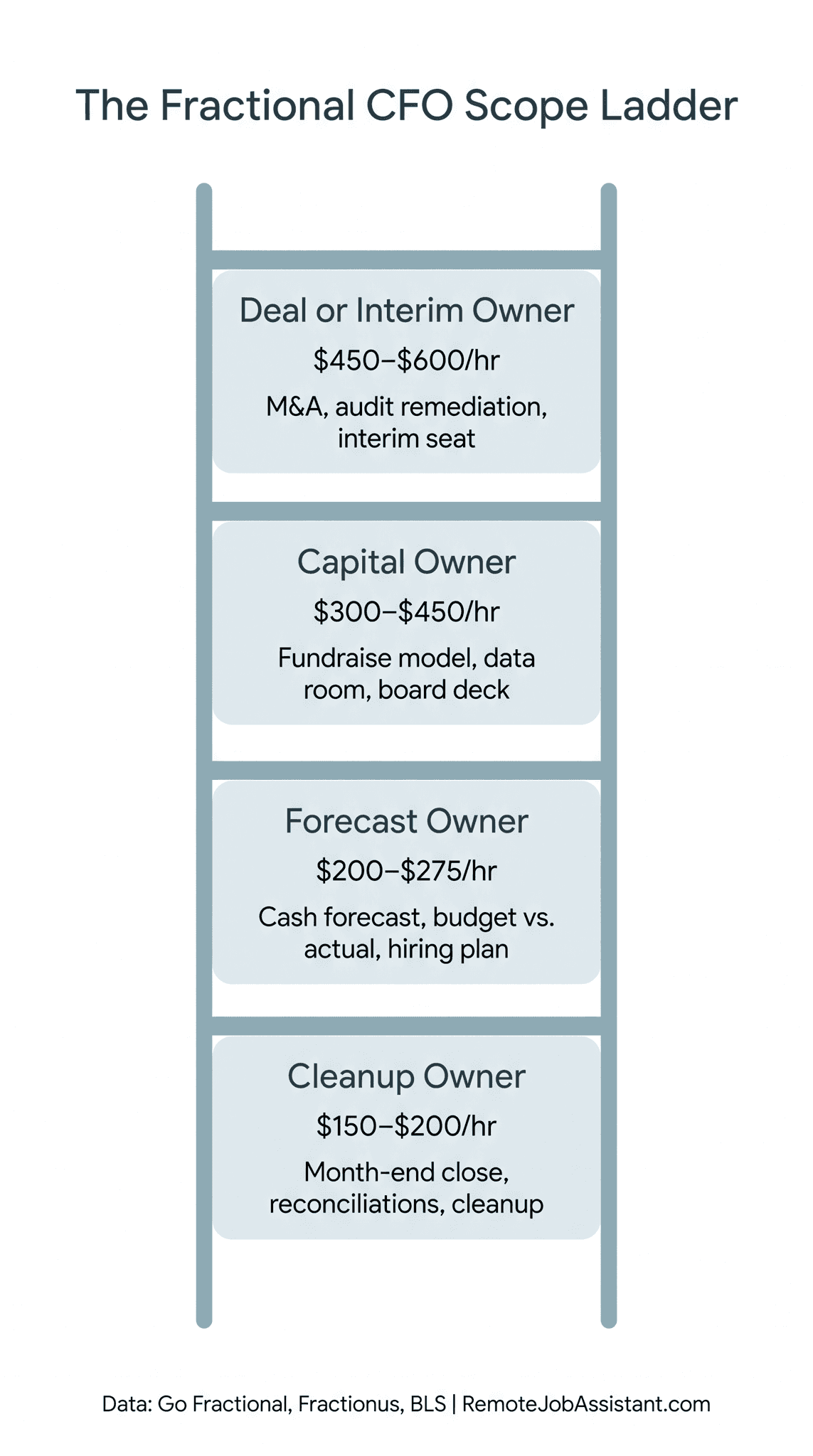
The Fractional CFO Scope Ladder is a four-rung rubric that maps what a client is actually buying to the rate that scope supports.
- S1 Cleanup Owner — $150–$200/hr, $3K–$5K/mo, 8–15 hrs/mo. Month-end close, reconciliations, cleaning up two years of historical books nobody trusts. You are upgrading a bookkeeper's output, not advising a board. The client is pre-revenue to roughly $2M in revenue and has no trigger event — just discomfort. Ceiling worth knowing: this rung rarely converts to S3 with the same client, because the relationship was framed as cleanup on day one.
- S2 Forecast Owner — $200–$275/hr, $5K–$10K/mo, 15–40 hrs/mo. A 13-week cash forecast, budget versus actual, unit economics, a hiring plan the founder can defend. The client has a growth constraint but no dated external event. This is where most fractional billing sits, and it's where the $189/hr market average lands.
- S3 Capital Owner — $300–$450/hr, $10K–$18K/mo, 40–90 hrs/mo. Fundraise model, data room, board deck, investor diligence, lender covenant negotiation. Requires a dated trigger — a raise, an audit, a refinance. The client is typically $3M–$10M in ARR, with Series A as the center of gravity.
- S4 Deal or Interim Owner — $450–$600/hr, or $1,500–$4,000 per day. Buy-side or sell-side M&A, audit remediation, private equity portfolio operations, an interim seat with actual signing authority. Priced on outcome risk and calendar exclusivity rather than hours. Effectively closed to you without a prior sponsor or portfolio-company reference.
How to use it: before you quote, decide which rung the client believes they are buying, then confirm they have the trigger event that rung requires. If they want S3 deliverables on an S1 budget, that gap is the negotiation — and failing to name it is the most common reason fractional CFO work gets underpriced.
Fractional CFO Rates: Experience vs. Scope
Now compare how the market prices experience against how it prices scope:
| Priced by | Rate band |
|---|---|
| 5–10 years of experience | $150–$250/hr |
| 10–15 years of experience | $250–$350/hr |
| 15+ years, specialized | $350–$500/hr |
| Operational engagement | $186–$275/hr |
| Strategic engagement | $330–$600/hr |
The two halves of that table overlap almost completely, and the overlap is the tell. Fifteen years of experience doesn't pay $350/hr on its own — it pays $350/hr when it's the evidence a client uses to believe you can hold the strategic rung. Take an S1 cleanup engagement with twenty years behind you and you will be paid S1 rates for all twenty of them.
Your rate isn't set by your years of experience. It's set by which rung of the scope ladder the client thinks they're buying.
Rate bands here come from four published benchmark sets compiled in August 2026, cross-referenced against BLS financial-manager wage data for May 2024. According to Go Fractional's 2026 CFO rate benchmarks, the middle 50% of the market runs $150/hr to $250/hr against an average of roughly $190/hr. Treat that average as a benchmark aggregate, not a market price — it is pulled from one marketplace's transaction mix, and a marketplace's mix skews toward the rungs marketplaces are good at selling. The sources disagree at the floor, too: Graphite Financial starts at $175/hr where cfo-recruit.com starts at $150/hr. If you are setting your own rate, the rung matters more than any of these averages.
Three Ways Fractional CFO Engagements Get Underpriced
Three client pathologies live in the gaps between those rungs, and all three are priced, not personal:
- The scope escalator. You are hired for an S2 forecast. Three weeks in, the founder asks for the Series A model and the data room "since you're already doing the forecast anyway." That is a rung change, not a favor, and if you absorb it you have just delivered $15,000 of work for $6,000 while holding a slot a real S3 client needed.
- The controller in CFO clothing. A meaningful share of engagements sold as fractional CFO work are reconciliation and close work the client won't call bookkeeping, because "we have a CFO" reads better to their board than "we hired a contractor to fix the books." The work is legitimate and it pays S1. Just price it as S1 and stop waiting for it to become strategic.
- The future full-time. PE-backed companies in particular will float an eventual full-time seat as consideration for S3 or S4 work at S2 rates. Sometimes it's real. Price the work in front of you as though it isn't, because the option has no cash value and you cannot invoice it.
There's a reason the second pathology is so common. Search LinkedIn and the title is everywhere, while LinkedIn itself carried only 87 posted fractional CFO roles nationally in August 2026. That gap is not all thriving practices — a good portion of it is experienced controllers and finance directors between jobs, using the title to signal availability. Which means the buyers you meet have often been burned by someone who was not actually operating at the rung they claimed, and your first job on any call is separating yourself from that pool with specifics.
If you're mapping your own background onto the ladder, the pattern is consistent: a Controller or FP&A lead moves into S1 and S2 natively, because those rungs are the work you already do with the reporting line removed. Roles like remote financial analyst positions and senior FP&A seats build exactly the forecasting muscle S2 clients pay for, and the modeling depth behind it is the same advanced Excel work that shows up in every S2 engagement. Getting to S3 takes something different, and it isn't another certification.
Stop Applying Manually
Our AI applies to hundreds of matching jobs while you sleep. Wake up to interviews, not more applications.
Fractional CFO Salary Data: Why the Job Boards Disagree
Before you use any board's listing count to judge whether this market is worth entering, look at what the boards actually report. All of these were read in the same window:
| Source | Query scope | Listings | As of |
|---|---|---|---|
| Indeed | Texas only | 558 | Aug 2026 |
| Indeed | Work-from-home, US | 485 | Jun 24, 2026 |
| Go Fractional | Curated marketplace, US | 313 | Aug 9, 2026 |
| Entire United States | 87 | Aug 2026 | |
| SimplyHired | Remote | roughly 25 | Aug 2026 |
| Glassdoor | Remote | 24 | Jul 2026 |
Indeed's count for a single state is 6.4 times LinkedIn's count for the whole country. Both cannot be describing the same market.
They aren't market measurements at all — they're keyword-matching artifacts, and the mechanism is specific. Indeed matches "fractional" and "CFO" loosely across a posting's full body text, so it catches every CFO-services firm running a recruiting ad, every 1099 consulting solicitation, and every posting that merely mentions fractional arrangements somewhere in the description. LinkedIn requires a structured job record tied to a verified employer entity and matches the title field tightly, so it returns roughly only postings genuinely titled Fractional CFO. Glassdoor filters tighter still. The spread between 24 and 558 measures how loosely each platform matches a word, not how much work exists — and the counts can't be added together, because they overlap heavily.
Indeed lists 558 fractional CFO roles in Texas. LinkedIn lists 87 in the entire United States. Neither number is wrong — they're just not measuring a market.
Why the Fractional CFO Salary Widgets Are Wrong
The salary widgets have the same problem in a more expensive form. According to Fractionus's 2026 US retainer benchmarks, the fractional CFO retainer band is $8,000–$18,000 per month per client. The midpoint of $13,000 a month annualizes to $156,000. ZipRecruiter's fractional CFO salary data as of August 2026 reports an average of $151,302. Those agree to within 3%, which is not a coincidence — the board is annualizing posted engagements. Glassdoor's $211,194 for the same title runs about 40% higher precisely because it weights self-reported practitioner income, and some of those practitioners are running more than one client.
A reader who trusts the salary widget concludes that fractional CFO work pays less than a salaried financial manager job and stays where they are. The widget is quoting a per-client retainer. Comparing it to a full-time salary is comparing one customer's invoice to an entire year's income, and every board on the first page of results presents it without that caveat.
This fragmentation is not unique to fractional work — it's how remote job boards split inventory generally. It's just unusually severe here, because "fractional" is a contract structure rather than a job function, and no board's taxonomy has a field for it. The same engagement gets posted as a fractional CFO role, a part-time CFO role, an outsourced CFO role, and a finance consultant role, and no single search string catches all four. If you want a reliable read on volume, search by function inside the finance and accounting job category rather than by the word "fractional," and expect to check several boards rather than one.
Where Fractional CFO Jobs Actually Come From: The Four Channels
Engagements arrive through four channels. Job boards carry the first one badly and the other three not at all.
1. CFO service firms. FocusCFO, NOW CFO, Preferred CFO, ProCFOPartners, The CFO Centre, and dozens of regional equivalents recruit experienced CFOs, place them with client companies, and stay in the relationship. There's a tell hiding in plain sight on the search results page: the highest-ranking result for "fractional CFO jobs" that isn't a job-board aggregator is FocusCFO's own careers page — a firm recruiting CFOs, not a company hiring one. These firms are the fastest path to your first client and the lowest-margin path to your fourth, because they take a cut permanently and they own the client relationship, not you.
2. Marketplaces. Toptal, Paro, Go Fractional, and Fractional Jobs curate and vet, then introduce. Go Fractional listed 313 fractional roles in August 2026. Fractional Jobs reports a pool of 30,000-plus professionals and charges companies a one-time referral fee in the $3,000–$5,000 range rather than an ongoing cut, which means you keep the client. Slower than a firm placement, better economics, and in practice these transact mostly S2 scope.
3. Private equity and venture portfolio referrals. Sponsor-side consulting firms such as Accordion, plus direct relationships with PE and VC operating partners. This is the highest rate band in the market and it transacts S4 work. It is also effectively closed to you until you have one portfolio-company reference, which is a genuine chicken-and-egg problem and the reason most practices never reach this channel.
4. The professional referral network. CPAs, business attorneys, commercial bankers, and business brokers.
The fourth channel dominates in practice, for a structural reason worth understanding: the decision to hire a fractional CFO is event-driven, not headcount-driven. A trigger event surfaces first to the company's accountant, lawyer, or banker — the term sheet, the audit letter, the LOI — often weeks or months before anyone drafts a job description. By the time a posting exists, the referral channel has already been worked and the shortlist already has two names on it. The boards look thin because they're showing you the residue.
Run it as a decision, not a menu. Your client count picks the channel for you.
Zero clients: firm or marketplace, and don't agonize over the margin. You are buying pipeline with margin, which is the correct trade when the alternative is zero revenue. Building a referral network from a standing start takes six to twelve months of being useful to CPAs and bankers before the first introduction arrives — that is a real cost, and you cannot pay it with no income.
One or two clients and stalling: referral network only. It is the sole channel that scales without permanently surrendering margin. Pick four professionals who serve companies your size — one CPA, one commercial banker, one attorney, one broker — and be useful to them for two quarters before you ask for anything.
Three or more clients: start declining S1 work. The practitioners with the best economics stop taking cleanup engagements around year two, because the rate is poor and the clients most likely to run the scope escalator are the ones who hired you for cleanup.
Chasing S4 rates: you need a sponsor or portfolio-company reference, and the reliable way to buy one is an S3 engagement at a PE-backed company priced at the low end on purpose. That is a deliberate investment in a reference, not underpricing — and it is the only version of underpricing worth doing.
Two of these channels never post publicly, which means the listings you can actually see are scattered across at least six boards plus individual firm career pages. Keeping eyes on that surface manually is a part-time job in itself, which is why our auto-apply service exists — it watches the fragmented board layer so you can spend your hours on the two channels that require a human being.
Stop Applying Manually
Our AI applies to hundreds of matching jobs while you sleep. Wake up to interviews, not more applications.
The Trigger Events That Create Fractional CFO Jobs
Every engagement traces back to something with a date on it. These are the five that generate almost all of the work:
| Trigger | What the CFO is actually for | Typical stage |
|---|---|---|
| Fundraise (Series A center of gravity, roughly $3M–$10M ARR) | Fundraise-ready model, data room, holding up under diligence | Seed to Series A |
| First audit notice | Audit prep and remediation ahead of an independent firm | Any |
| Outgrowing spreadsheets | ERP and close-process implementation, internal controls, mentoring the existing finance team | Growth |
| M&A, buy side or sell side | Valuation framing, deal modeling, diligence response | Growth and later |
| Covenant or lender pressure | Cash forecasting, lender reporting, renegotiation | Any |
Nobody hires a fractional CFO because they want better financial reporting. They hire one because something has a date on it — a raise, an audit, a diligence request. No date, no engagement.
That has a direct consequence for how you qualify. A prospect with no dated event is not an early-stage lead; it's a client who will churn inside a quarter, because the discomfort that made them call you fades faster than an invoice cycle. Worse, they'll churn while occupying the calendar slot you needed for a real engagement — which is how a pipeline problem gets misdiagnosed as a delivery problem.
Ask: "What's the date on the thing that made you start looking?"
A real answer has a month in it — "our term sheet expires in November," "the auditors arrive in six weeks." Those are S3 conversations and you can price them as such.
The dodge is more common, and it has a shape: "we just feel like we need more financial visibility," or "the board has been asking better questions lately," or "we want to be ready when we do raise." None of those are dates. When you hear one, don't argue and don't walk — say "so nothing external is forcing a timeline yet," and let them confirm it. You have just moved the engagement to S1 or S2 pricing with the client's own agreement, before anyone wrote a proposal. That single sentence is worth more than any rate card.
The audit trigger deserves particular attention, because it is the most underrated entry point into higher-rung work. Audit remediation sits at the boundary between finance and remote compliance work, it recurs annually, and it produces exactly the kind of documented, referenceable outcome that opens the private equity channel.
What You Need to Qualify for Fractional CFO Work
A CPA is not required, and the reason is worth being precise about. Clients are buying pattern recognition — the judgment that comes from having personally closed books through a bad quarter and personally survived a diligence process. The credential is a proxy for that experience, not a substitute for it, and experienced buyers know the difference. Where the CPA still carries real weight is reporting- and tax-heavy engagements, and in the referral channel, because CPAs refer to CPAs. For advisory-led practices, a CMA or CFA paired with genuine operating depth substitutes without much friction.
What actually gates you is the seat you held before. Controller, VP of Finance, Director of FP&A, or a full-time CFO tour — these are the backgrounds clients recognize. A bachelor's in accounting or finance is standard; an MBA is common enough that it no longer differentiates anyone. Roles across remote accounting careers and broader remote finance positions are the usual on-ramps, and the bookkeeping and close fundamentals underneath them are what make an S1 engagement fast instead of painful.
Two deliverables establish credibility faster than any credential, and practitioners cite both consistently: a 13-week cash flow forecast, and a documented $25,000 to $100,000-plus in identified cost savings, both inside the first two weeks. They work because they're falsifiable. The client can check them.
Mapping this back to the ladder: a Controller background lands S1 and S2 natively. S3 requires a fundraise or an audit that you personally ran — not one you watched from two seats away. That distinction is the single most common gap between people charging $200/hr and people charging $400/hr, and closing it usually means taking one S3-adjacent engagement at S2 pricing on purpose. If you're benchmarking the ceiling, remote roles above $150K and the broader six-figure remote market are the salaried comparison you're being measured against.
Stop Applying Manually
Our AI applies to hundreds of matching jobs while you sleep. Wake up to interviews, not more applications.
Building a Fractional CFO Practice: Prospecting Competes With Delivery
A fractional practice reaches full income in 12 to 18 months. Four to eight concurrent clients supports roughly $240,000 to $480,000 a year. Both figures are achievable, and the gap between them is where people quit — because month nine looks nothing like either number. Month nine is typically one or two clients, an income well below the salary you left, and a growing suspicion that the ramp is not going to happen. It usually is happening. It just doesn't produce a visible result until the second client renews and the third signs in the same quarter.
Here's the structural problem, and it's specific to this model. A full-time job search terminates. You accept an offer and the search is over. A fractional book has 6-to-18-month engagement cycles running across three or four clients, which means there is always a slot closing — and prospecting therefore competes with billable delivery every single week of your career.
Delivery wins. It always wins, because delivery has a client on the other end of it and prospecting doesn't. The failure mode is concrete: an S3 fundraise engagement consumes your calendar for six weeks, prospecting stops entirely, the raise closes, the engagement ends, and you restart from a cold pipeline with no revenue and a mortgage. Practices stall at two clients because of the calendar, not the capability.
You can see the same tension in the source data. Go Fractional scopes a typical engagement at roughly 23 hours a week; Graphite Financial describes early-stage engagements at 8 to 10 hours a month. That's better than a tenfold spread, and it isn't an error — it's S3 versus S1. Which is also why "how many clients can I carry?" has no single answer until you know which rungs you're standing on.
This is the honest case for automating the top of the funnel. Not because applying is hard, but because it's the only part of a fractional practice that can run without you while you're heads-down in a data room. Keeping a pipeline warm through the six weeks you're too busy to prospect is the difference between three clients and one, and it's worth reading how high-paying remote roles get sourced alongside the direct channels — the salaried market is where a surprising number of fractional engagements start life before the company decides it can't afford a full-time seat. Fractional CFO work rewards the same operating discipline as any senior business analysis role: the person who instruments the process beats the person who works harder inside it.
Frequently Asked Questions
I'm a Controller with 12 years of experience — can I become a fractional CFO without a CPA?
Yes. Clients are buying pattern recognition from having closed books and survived a diligence process, and the CPA is a proxy for that rather than a requirement. A CMA or CFA paired with genuine operating depth substitutes well for advisory-led work. Where the CPA still matters is reporting- and tax-heavy engagements, and in the referral channel, since CPAs tend to refer to other CPAs.
How many clients does a fractional CFO need to match a $200K full-time salary?
Two to three, at the band where 69.5% of fractional professionals bill — $5,000 to $10,000 per month per client, per Vendux 2025 data covering all fractional executive roles. Three clients at the midpoint of that band is roughly $270,000 a year in gross revenue, against a BLS median of $161,700 for salaried financial managers as of May 2024. Net the difference down for self-employment tax, health insurance, and unbilled prospecting time before you treat those as equivalent.
Are the fractional CFO jobs on Indeed and LinkedIn real, or are they consulting firms recruiting?
Both, in a ratio that varies wildly by platform. Indeed showed 558 fractional CFO listings in Texas alone in August 2026 while LinkedIn showed 87 for the entire United States, because Indeed matches the keywords loosely across full posting text and catches firm recruiting ads and 1099 solicitations. The highest-ranking non-aggregator result for the search term is a placement firm's own careers page, which tells you how much of that inventory is firms recruiting rather than companies hiring.
What should I charge as a fractional CFO in 2026?
Price the rung of the Scope Ladder, not your résumé. Cleanup and close work supports $150–$200/hr, forecasting and operating work $200–$275/hr, fundraise and capital work $300–$450/hr, and deal or interim work $450–$600/hr or $1,500–$4,000 a day. The $189/hr market average reported in Go Fractional's 2026 benchmarks sits inside the forecasting tier, which is where most engagements land.
How do I keep my pipeline full while I'm delivering for current clients?
Assume you won't do it manually, because the evidence says nobody does — a six-week fundraise engagement reliably stops prospecting cold. The two channels that need a human (referral relationships and sponsor introductions) should get your limited slack time, and the board layer, which is fragmented across six-plus platforms, should be automated or delegated. Practically: keep four referral relationships warm with one useful message a month each, and let a tool watch the listings.
How long does it take to build a fractional CFO practice to full income?
Twelve to eighteen months to a full book of four or more concurrent clients. You will see claims of three to six months, and they come almost entirely from firms selling practice-building courses — we excluded them from this analysis for that reason. Budget accordingly: if you need to replace a $200K salary immediately, you need either a firm placement on day one or roughly twelve months of runway.
What's the difference between a fractional CFO, an interim CFO, and a controller?
Scope and authority. A controller owns the close — accurate books, on time, every month. A fractional CFO owns the capital story: forecast, fundraise, lender and board communication, usually across several clients at once. An interim CFO holds the actual seat with signing authority, full-time or near it, for a defined stretch — the top rung of the ladder, priced on exclusivity rather than hours.
Start Your Fractional CFO Practice
Three things to carry out of this. The job-board layer is the smallest and least reliable slice of this market, and its salary widgets are quoting one client's retainer as an annual wage. Your rate is set by the scope rung a client thinks they're buying, not by your years of experience — and the two are priced almost independently. The work itself arrives through four channels, and the boards carry one of them badly.
If you're mapping the next move, the finance and accounting job category is where the salaried comparison lives, remote accounting and controller roles are the usual on-ramp to an S1 or S2 book, and our auto-apply service covers the fragmented board layer while you work the two channels that need a human being. If you do one thing this week, go back through the last five conversations you had with a prospect and write down whether any of them had a date attached. If most didn't, your pipeline isn't small — it's full of S1 clients you've been pricing as S2, and that is a fixable problem rather than a market problem.
Every job board in this market will quote you what one client pays and call it your salary. Counting the clients is your job, and it is the whole job.
Ready to Find Your Remote Job?
Browse thousands of curated remote jobs or let AI apply for you.
Browse Remote JobsRelated Job Guides

Remote Physician Jobs: 2026 Salary and Career Path Guide
Remote physician jobs in 2026: six career paths from telemedicine to medical director, real pay from $150K to $300K+, licensing strategy, and who's hiring.
23 min read

Remote Event Planning Jobs: What Actually Goes Remote
Only 12% of event job postings are fully remote and none were titled Event Planner. See which titles actually go remote, what they pay, and how to pivot.
24 min read

Remote Insurance Jobs: Pay, Top Roles, and How to Get Hired
Remote insurance jobs pay $62K-$130K+ by specialty. Real 2025 wage data for adjusters, underwriters, and actuaries — plus which roles are truly remote.
22 min read