
Last reviewed: November 2026
You run lifecycle marketing, or a data team, or a payments service, and you'd take the same job tomorrow at a company whose product is the thing you watch on Sunday. So you search "remote jobs in sports," and LinkedIn's results page promises thousands of open roles (3,000+ when we checked on November 10, 2026).
Then you open the NBA's career site. Five postings carry the location "New York, USA - Remote." Each says "WORK OPTION: Remote" and, on the next line, names an arena: "Candidates must be able to work all shifts onsite at Van Andel Arena in Grand Rapids, MI." The pay line reads "$200/Daily game rate." The NFL's postings are blunter. On November 10, all 44 of its US listings carried the same sentence: "This role requires onsite presence at an NFL office or stadium location, and remote and/or hybrid working options are not offered."
Get Remote Job Tips in Your Inbox
Weekly strategies, salary data, and new opportunities
Unsubscribe anytime. No spam.
The industry you want to work in is built around buildings and game nights, and its job boards use the word "remote" loosely. The remote seats are real and they pay well. They just aren't where a fan would look first.
We analyzed 10,827 sports job postings on November 10, 2026: 8,603 listings from 952 organizations on TeamWork Online, the board teams and leagues hire through, and 2,224 US postings on the career sites of 75 sports employers.
On the sports industry's own job board, 211 of 8,603 listings are tagged remote, and 129 of those are unpaid scouting internships, per-game data gigs or private coaching. Teams, arenas and owners post 20 remote listings out of 6,752. The salaried remote seats sit at the companies around the game: on employer career sites, 226 of 1,435 professional postings are remote, 153 of them at sportsbooks and sports tech companies, and the posted median is $167,500. Engineers hold 103 of the 226. Before you apply anywhere, score the posting with the Game-Day Test below: it tells you in a minute whether the job can leave the building.
Every number below carries its count, so you can check it against your own search.
Based on our analysis of 10,827 sports job postings (read November 10, 2026):
- 2.5% (n=211 of 8,603 TeamWork Online listings) are tagged remote; 3.2% (n=278 of 8,603) are tagged hybrid
- 0.3% (n=20 of 6,752) of listings from arenas, the five big league groups and multi-team owners are remote
- 61.1% (n=129 of 211) of the board's remote listings are unpaid scouting internships, per-game data gigs or private coaching
- 15.7% (n=226 of 1,435 professional postings on 75 employers' career sites) are remote
- 35.2% (n=94 of 267) of professional postings at sportsbooks and fantasy operators are remote, 28.6% (n=59 of 206) at sports tech and ticketing companies, 1.0% (n=3 of 290) at teams, leagues and venues
- $167,500 median posted pay on remote professional postings (n=187); 92.0% (n=172 of 187) start at $75K or more
- 45.6% (n=103 of 226) of remote professional seats are engineering
- 22.9% (n=197 of 861) of Product Seats on the Game-Day Test are remote, against 1.5% (n=2 of 132) of Game-Day Seats
Where Remote Jobs in Sports Actually Are
Start with the board the industry uses. TeamWork Online is where clubs, leagues, arenas and their vendors post, and it sorts every listing into a group and tags it on-site, hybrid or remote.
| TeamWork Online group | Listings | Remote | Hybrid |
|---|---|---|---|
| Arenas and facilities | 3,448 | 0 | 1 |
| Baseball | 1,269 | 7 | 36 |
| Soccer | 613 | 6 | 55 |
| Multi-property owners | 542 | 4 | 10 |
| Hockey | 437 | 2 | 8 |
| Football | 261 | 0 | 1 |
| Technology | 252 | 134 | 22 |
| Basketball | 182 | 1 | 0 |
| Sporting goods | 179 | 8 | 87 |
| Motorsports | 161 | 1 | 0 |
| Live events | 146 | 19 | 18 |
| College | 120 | 2 | 3 |
| Agency | 68 | 9 | 3 |
| All other groups | 925 | 18 | 34 |
| Total | 8,603 | 211 | 278 |
Source: our read of all 87 TeamWork Online result pages, November 10, 2026.
One group, Technology, holds 134 of the 211 remote listings. The five league groups together post 16 remote listings out of 2,762. Football posts none in 261.
The reason is what a team sells. Of the board's 8,603 listings, 3,618 are tagged Facility Operations/Event Staff, 2,271 Food and Beverage and 1,751 Ticket Sales and Services (a listing can carry more than one tag). A club's revenue walks through a gate on a specific night, so its payroll is ushers, cooks, ticket reps, sponsorship activators and broadcast crews. A team sells a seat in a building on a date. Everything it hires for has to be near that seat.
Now the employers one step off the field. We pulled every open posting from the career sites of 75 sports employers and kept the 1,435 professional ones.
| Employer type | Employers | Professional postings | Remote | Hybrid | Median posted pay | Postings naming nights, weekends or game days |
|---|---|---|---|---|---|---|
| Teams, leagues and venues | 15 | 290 | 3 (1.0%) | 6 | $112K (n=139) | 113 (39.0%) |
| Sportsbooks and fantasy | 10 | 267 | 94 (35.2%) | 81 | $151K (n=235) | 42 (15.7%) |
| Sports tech, data and ticketing | 18 | 206 | 59 (28.6%) | 99 | $176K (n=174) | 8 (3.9%) |
| Sports media | 10 | 64 | 9 (14.1%) | 14 | $160K (n=39) | 11 (17.2%) |
| Apparel, equipment and merchandise | 13 | 393 | 18 (4.6%) | 80 | $142K (n=166) | 17 (4.3%) |
| Connected fitness and wearables | 7 | 189 | 28 (14.8%) | 38 | $172K (n=176) | 1 (0.5%) |
| Agencies | 2 | 26 | 15 (57.7%) | 1 | $92K (n=25) | 2 (7.7%) |
Source: our analysis of 1,435 professional US postings on 75 sports employers' career sites, November 10, 2026. Percentages are shares of each row's professional postings.
Sportsbooks and sports tech together post 153 of the 226 remote seats, which is 32.3% (n=153 of 473) of their own professional postings. The teams, leagues and venues in the same pull, which include the NFL, NBA, MLB, NASCAR, AEG, Monumental Sports and BSE Global, post three.
Employer type isn't the whole story, though. PrizePicks lists 26 of its 28 professional postings as remote, Teamworks 10 of 10 and Gametime 9 of 9. FanDuel lists 1 of 77 and tags 73 hybrid. WHOOP lists 2 of 109, StubHub 0 of 46 and Nike 0 of 146. Two sportsbooks can sit on opposite policies, which is why the test below gets you to the right pile and the posting's own sentence finishes the job. If you're an engineer, the remote software engineer openings we track follow the same split. Sports media has its own rules, and our guide to remote media jobs covers that side.
The Game-Day Test: Score Any Sports Posting in a Minute
Three things decide whether a sports job can leave the building, and none of them is how the hiring manager feels about remote work.
The Game-Day Test: a 0-to-10 score for how tied a sports job is to a building and an event clock, built from three things you can read before you apply.
Scoring (add the points):
- What the employer sells (0-4): tickets, a venue or a schedule (team, league, arena, college) 0; services to those (agency) 1; media rights or a product brand 2; hardware with a subscription 3; software, data, a marketplace or wagers 4
- The event clock (0-3): you have to be at the event 0; the posting names nights, weekends or game days 1; live work done from a screen, such as trading, live operations or social 2; no event clock 3
- How portable the function is (0-3): sport-specific craft such as coaching, scouting or game operations 0; ticket and sponsorship sales, operations, support 1; marketing, creative, finance, legal, trading 2; engineering, data, product 3
Bands (1,435 professional postings):
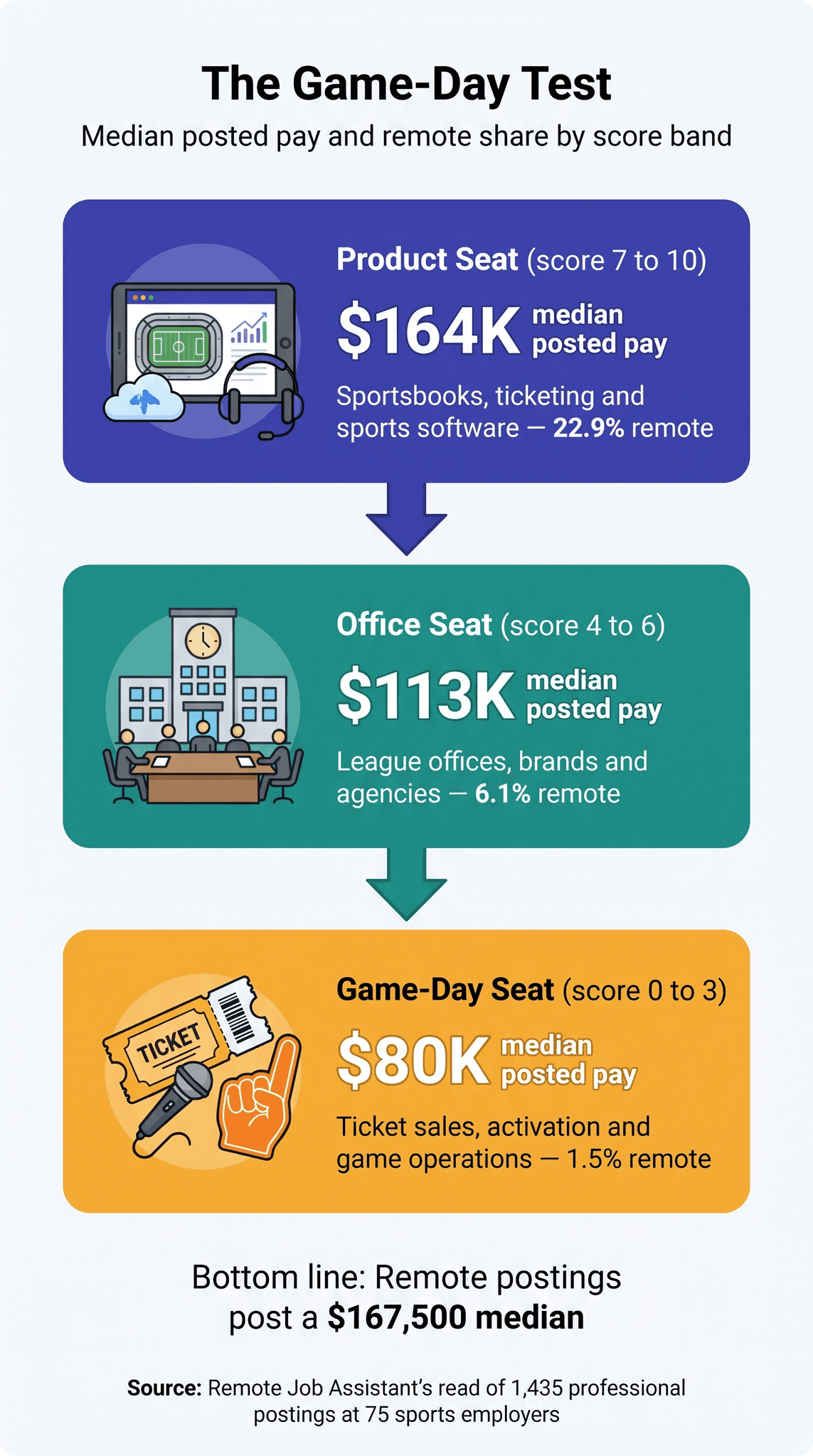
- Game-Day Seat, 0-3: $57K–$122K, median $80K (n=55 with posted pay; 132 postings). 1.5% remote (n=2 of 132). Ticket and premium sales at a club, partnership activation on a campus, event and game operations.
- Office Seat, 4-6: $74K–$155K, median $113K (n=202; 442 postings). 6.1% remote (n=27 of 442), 47 hybrid. League-office finance, brand marketing at an apparel company, agency account work.
- Product Seat, 7-10: $120K–$200K, median $164K (n=697; 861 postings). 22.9% remote (n=197 of 861), 271 hybrid. Engineering, data, product, growth and risk at sportsbooks, ticket marketplaces and sports software companies.
How to use it: score before you apply. Under 4, treat a "remote" tag as a mistake until the posting proves otherwise. At 7 or more, go straight to the location line and the last paragraph for the office rule, because about a third of these seats are hybrid.
The dollar ranges are the middle half of posted pay in each band. At a perfect 10, 36.9% (n=97 of 263) of postings are remote. At 0 to 2, none are (n=0 of 82).
Here's the test on real postings. BSE Global's "Account Executive, Group Sales - New York Liberty" sells tickets (0), is "expected to attend New York Liberty home games and other events as needed, including nights, weekends, and holidays" (1), and is ticket sales (1). That's a 2, and it posts $26.45 an hour in Brooklyn. The NBA's "Finance Manager, WNBA Team Finance" works for a league (0) with no event clock (3) in finance (2): a 5, office-listed in New York at $115,000 to $130,000. PrizePicks' "Manager, CRM Marketing" sells a fantasy product (4), has no event clock (3) and is marketing (2): a 9, remote, $110,000 to $130,000. Hudl's "Engineering Manager" is a 10 and remote at $132,000 to $220,000.
Notice what moved the score from 2 to 9. It wasn't the function. A seller stays a seller. The employer changed.
- If you sell: a ticket rep at a club scores 2. An account executive at a ticketing or team-software company scores 8.
- If you market: brand work at a league office scores 5. CRM and lifecycle at a sportsbook scores 9.
- If you build: an engineer at a league scores 6. The same engineer at a sportsbook or a sports software company scores 10.
- If you coach, scout or run game operations: you score 0 to 3 everywhere, and the job is in the building. That's the work, not a policy.
Seats that score 7 or higher sit on ordinary company career pages under ordinary titles, dozens of employers deep. Finding and applying to all of them by hand is the slow part, and it's the part worth automating.
Stop Applying Manually
Our AI applies to hundreds of matching jobs while you sleep. Wake up to interviews, not more applications.
How We Collected This Data
Start with what we couldn't see. Indeed, Glassdoor and ZipRecruiter block our crawler and Reddit is unreadable to it, so nothing here comes from them. Clubs that hire only through a private applicant system or by referral aren't in the count, and neither are college athletic departments that post on campus HR sites.
The TeamWork Online numbers come from all 87 result pages of its jobs board on November 10, 2026: 8,603 unique listings from 952 organizations, counted with the board's own workplace, level, group and category filters. We then read 411 full job pages (20 more returned a challenge screen and stayed unread).
The career-site numbers come from the public Greenhouse, Lever, Ashby, SmartRecruiters and Workday boards of 86 sports employers: 3,900 postings, 2,224 of them in the United States at 75 employers. We set aside 719 store, warehouse, venue, hourly and seasonal seats and 70 internships, which left 1,435 professional postings. A posting counts as remote only when its location or work-model field says remote and the body doesn't contradict it. A named office with no statement counts as neither remote nor hybrid.
About ten employers post in both places (roughly 300 listings), so every share in this post is computed inside one set and never on the 10,827 total.
We reviewed the remote-tagged career-site postings employer by employer and moved the ones whose text contradicted the tag: the NBA arena jobs, a PrizePicks research seat whose body says hybrid, and the Nike postings whose work-model field reads "Non-Remote Posting," which a keyword match first counted as remote. Function labels come from title keywords, so some postings are misfiled, and 79 landed in "other."
Pay figures are posted base ranges only, taken at the midpoint, with hourly rates multiplied by 2,080. They appear on 954 of the 1,435 professional postings and were cross-referenced with Bureau of Labor Statistics data for the occupation group. The sample leans toward product companies, which use public job boards, and away from small clubs, which often don't. This is a single-day read. We update it quarterly.
What "Remote" Means on a Sports Job Board
Take the 211 remote listings on TeamWork Online apart and three organizations account for 129 of them.
SponsorUnited posts 77, all titled "SponsorUniversity Regional Scout." The compensation line: "Unpaid internship; approved event tickets and venue-access costs are provided for assigned in-person scouting opportunities." The location line: "Must reside within a 60–90 minute travel radius of a listed hiring market and be able to travel to assigned venues as needed."
Akara Markets posts 36 "Sports Data Reporter" listings at $75 to $120 a game. First responsibility: "Travel independently to assigned sporting events within your local area."
Athletes Untapped posts 16 private-coach listings, one per sport. "Set your own rates (typically ranges anywhere from $30–$100/hour)," then go meet the athlete at a field.
None of those is a desk at home. All three are work at a venue that isn't the employer's office, and the board's remote tag is the closest box. In sports, "remote" on a listing often means "not at our office." It does not always mean "at your house." That's also how five NBA technology jobs end up labeled remote while requiring every shift at a G League arena.
If you use the board yourself, set Workplace Type to Remote and then open the Technology group first. That one filter combination holds 134 of the 211 listings, and sorting by organization shows you the three gig posters at a glance.
The other 82 remote listings come from 50 organizations: 18 internships, 18 entry-level seats, 7 part-time and 39 tagged Manager, Director or Senior. Those 39 are 2.0% (n=39 of 1,999) of the board's manager-and-above listings. They're real jobs: PrizePicks engineers and analysts, a "Senior Counsel, Technology & Privacy" at U.S. Soccer, a "VP, Technology" at the WTA Tour, sponsorship sales leads at agencies, and national-team coaches who travel for a living.
Of the 211 remote listings on the industry's main board, 154 are internships or part-time (n=154 of 211, 73.0%). If you're an experienced professional, the board that teams hire through shows you about 39 remote seats at your level in the whole industry.
General aggregators fail in a different way. We ran "sports" with the location set to remote on SimplyHired, which carries Indeed's feed: 277 results. Of the 213 unique listings we read, about half (106) came from a sports employer or carried a sports staff title. Another 36 were sports medicine or health-system jobs, and 43 had no connection to sports that we could find, including a news editor at Apple and a patent analyst. The word "sports" is a poor search term. Employer names and function titles are better ones, and our review of the best remote job boards covers which boards let you search that way.
Remote Sports Jobs by Function
Your function decides more than your fandom does. Here is every professional posting from the 75 career sites, sorted by the work.
| Function | Professional postings | Remote | Remote share | Median posted pay, remote seats |
|---|---|---|---|---|
| Engineering | 426 | 103 | 24.2% | $181K (n=86) |
| Trading, risk and compliance | 45 | 9 | 20.0% | $137K (n=9) |
| Product and program | 84 | 16 | 19.0% | $186K (n=15) |
| Marketing | 102 | 18 | 17.6% | $129K (n=16) |
| Content, creative and production | 199 | 27 | 13.6% | $109K (n=19) |
| Sales, partnerships and client | 149 | 17 | 11.4% | $113K (n=14) |
| Finance, legal and people | 102 | 11 | 10.8% | $159K (n=8) |
| Data and analytics | 118 | 11 | 9.3% | $134K (n=10) |
| Operations and support | 119 | 5 | 4.2% | $73K (n=3) |
| Team and sport operations | 12 | 0 | 0.0% | none posted |
| Other | 79 | 9 | 11.4% | $120K (n=7) |
Source: our analysis of 1,435 professional US postings, November 10, 2026. Remote share is remote postings divided by that row's professional postings.
Read the table as three decisions:
- Remote share of 17% or more (engineering, trading and risk, product, marketing): search your title across every sportsbook, ticketing and sports software company. There are enough seats to be choosy about the office rule.
- 9% to 14% (creative, sales, finance and legal, data): the seats exist but sit at a handful of employers. Work down the table of fifteen in the next section, one career page at a time.
- Under 5% (operations, support, team operations): plan on a hybrid or on-site seat, or move to an adjacent function before you move into sports.
Engineering is the remote sports job. It takes 103 of the 226 remote seats, and 180 of the 226 carry a senior, lead, manager or director title. Fanatics Betting & Gaming posts "Staff Engineer - Backend/Kotlin (REMOTE)" at $144,000 to $235,000. GameChanger posts "Staff Software Engineer, Video Enablement" at $169,000 to $185,000. If that's your lane, our remote software engineer guide covers the interview side.
Marketing is more remote than most people expect, and nearly all of it is retention work at sportsbooks: PrizePicks' "Manager, CRM Marketing" at $110,000 to $130,000, Fanatics Betting & Gaming's "Director, Marketing Investment + Effectiveness" at $189,000 to $235,000, Teamworks' "Senior Product Marketing Manager" at $150,000 to $170,000. Those are remote marketing manager seats that happen to have a sports product, and the skills are the ones in our digital marketing guide.
Sales and partnerships go remote when the buyer is a team rather than a fan. Teamworks' "Senior Account Executive I" sells software to front offices at $150,000 to $190,000. SeatGeek's "Client Success Manager" posts $110,000 to $130,000. The Athletic's "Business Development and Partnerships Director" posts $130,000 to $145,000. Selling tickets to fans stays at the arena. The same motion sold business-to-business shows up among remote account executive roles.
Data and analytics is the surprise. "Sports analytics" is what most people picture when they imagine this career, and it's one of the least remote functions here at 9.3% (n=11 of 118). The analysts at clubs sit near the coaches and the ticket office. The remote data seats are at product companies: PrizePicks' "Manager, Lifecycle Marketing Analytics" at $190,000 to $210,000, The Athletic's "Data Scientist" at $125,000 to $145,000, SeatGeek's "Senior Data Analyst, Supply" at $108,000 to $157,000. Compare them against the wider data and analytics category and our remote data analyst guide.
Finance, legal and risk seats are few and senior. DraftKings posts "Corporate Counsel, General Litigation" remote at $160,800 to $201,000. Underdog posts a "Treasury Manager" at $128,000 to $160,000 and a "Senior Manager, Fraud" at $140,000 to $175,000. Alt, a trading-card marketplace, posts a remote "Controller" at $165,000 to $190,000. Regulated wagering needs lawyers and fraud teams, and it hires them from the same pool as fintech, so the legal and compliance listings and our risk management guide apply directly.
Of the 226 remote seats, 123 are not engineering. They exist. They just sit at a short list of employers, and you have to check each one.
Stop Applying Manually
Our AI applies to hundreds of matching jobs while you sleep. Wake up to interviews, not more applications.
What Remote Sports Jobs Pay
Remote professional postings in this dataset post a median of $167,500 (n=187). Of those 187, 172 start at $75,000 or more, 156 at $100,000 or more and 116 at $150,000 or more. Everything that isn't remote posts a $143,500 median (n=767).
Remote pays more here for a plain reason: the remote seats sit at the employers that pay like software companies. The remote sports job is a software job with a scoreboard in the product. It pays like one, and it interviews like one.
The discount people talk about in sports is real, and it sits with the clubs and leagues. Same function, two kinds of employer:
| Function | Teams, leagues and venues | Sportsbooks and sports tech | Gap |
|---|---|---|---|
| Engineering | $138K (n=29) | $184K (n=170) | $46K |
| Sales, partnerships and client | $72K (n=29) | $104K (n=32) | $32K |
| Content, creative and production | $105K (n=23) | $133K (n=24) | $28K |
| Finance, legal and people | $118K (n=12) | $144K (n=23) | $26K |
| Data and analytics | $121K (n=10) | $120K (n=39) | none |
Source: median posted base pay, professional US postings with a posted range, November 10, 2026. First-party data.
Salary ranges derive from our analysis of 1,435 professional postings on 75 sports employers' career sites, read November 10, 2026, of which 954 post a base range. Bonus and equity are not included, and several employers name them next to the range: DraftKings' postings add "plus bonus, equity, and benefits." Ranges move with the market, so check the linked sources for current figures.
The league-office numbers flatter the team side. On TeamWork Online, where the clubs themselves post, we read 96 team, arena and owner listings tagged Manager or above. Pay appeared on 49, at an $84,000 median: $72,800 for the Manager tag (n=29), $105,000 for Director (n=13) and about $170,000 for Senior (n=7). Below that tier the numbers drop quickly. Monumental Sports posts "Account Executive, Inside Sales (Caps)" at $18.40 an hour.
For scale, the Bureau of Labor Statistics puts the median wage for entertainment and sports occupations at $59,400 in May 2025, against $50,980 for all occupations, with coaches and scouts at $47,320. That group is performers, coaches and officials. The remote seats are software, marketing and finance occupations that happen to sit inside sports companies, which is why they clear the $100K remote salary band so easily and why 116 of them reach the $150K tier.
Not every remote seat pays like that. Fifteen of the 187 post under $75,000, all in live trading, VIP service, community, agency design or operations. Penn Interactive's "Sportsbook Trader, Live - Evenings & Weekends" is remote at $50,000 to $55,000. Those are the entry rung of the sportsbook ladder, and the title tells you the schedule.
Who Posts Remote Sports Jobs, and Their Office Rules
Fifteen employers post 197 of the 226 remote professional seats.
| Employer | What it sells | Remote of professional postings | Median posted pay, remote seats |
|---|---|---|---|
| PrizePicks | daily fantasy | 26 of 28 | $168K |
| Fanatics Betting & Gaming | sportsbook | 21 of 64 | $190K |
| DraftKings | sportsbook | 19 of 46 | $159K |
| Alt | trading-card marketplace | 18 of 20 | $210K |
| iFIT | connected fitness | 18 of 24 | $146K |
| Penn Interactive (theScore, ESPN BET) | sportsbook | 15 of 17 | $169K |
| SeatGeek | ticketing | 15 of 34 | $176K |
| GMR Marketing | sponsorship agency | 15 of 15 | $88K |
| Teamworks | team software | 10 of 10 | $168K |
| Gametime | ticketing | 9 of 9 | $215K |
| TeamSnap | youth sports software | 9 of 9 | not posted |
| The Athletic | sports media | 6 of 9 | $136K |
| PlayOn Sports | high school streaming and ticketing | 6 of 10 | not posted |
| Underdog | fantasy and sportsbook | 5 of 5 | $170K |
| GameChanger | youth sports app | 5 of 7 | $177K |
Source: our analysis of professional US postings on each employer's career site, November 10, 2026.
The mix inside each employer differs, and it matters if you aren't an engineer. Penn Interactive's remote seats are 13 engineering out of 15. PrizePicks spreads its 26 across engineering (12), marketing (3), trading (3) and analytics, product and government affairs. DraftKings' 19 split between engineering (6), marketing and VIP (4) and legal and people (4). GMR Marketing's 15 are designers, producers and account leads, and it is the only employer on the list where a creative title is the norm. The boards are public, so you can check today's count yourself: PrizePicks, DraftKings, Fanatics Betting & Gaming, Penn Interactive and Teamworks all list every opening on one page.
A fan may not enjoy this, but the best-paid remote work in sports is in wagering. Sportsbooks and fantasy operators post 94 of the 226 remote seats, more than every other kind of sports employer, and four of the top six employers in that table take bets or entry fees.
Now the other direction. These employers put the rule in writing, so you don't have to guess.
| Employer | The sentence in the posting | Postings carrying it |
|---|---|---|
| NFL | "remote and/or hybrid working options are not offered" | 44 of 44 |
| FanDuel | "a hybrid role with an expectation of three days per week in our New York City office" | 73 of 77 tagged hybrid |
| StubHub | "Hybrid (3 days in office/2 days remote)" | 27 of 47 |
| Strava | "more than half your time on-site in our San Francisco Office" | 19 of 21 |
| Sportradar | "we are an office-first business operating on a hybrid model, with team members working in the office three days a week" | 6 of 11 |
| Fubo | "Candidates must be located in NYC, and willing to come into the office on a hybrid basis, three times a week" | 7 of 7 |
| Fanatics Collectibles | "expected to be onsite in our Seattle office five days per week" | 12 of 186 |
| SeatGeek | "work as many days a week in the office as you’d like or 100% remotely" | 31 of 38 |
| PrizePicks | "we are open to qualified applicants from anywhere in the U.S." | 25 of 32 |
Source: verbatim sentences from each employer's US postings, November 10, 2026.
The location line needs the same reading. Five patterns in these postings should slow you down:
- "Remote" next to a named venue. The NBA's arena jobs. The work is at the venue. Our guess is that the location field had no better box for a job based nowhere near headquarters.
- "Remote" with a per-game or per-day rate. Akara's $75 to $120 a game, the NBA's $200 a game day. That's event staffing, paid by the event.
- "Remote" with a travel radius. "Must reside within a 60–90 minute travel radius" means you drive to the work.
- A state list. Hudl takes remote applicants "who reside in one of the following states" and names 30. GameChanger writes that it is "unable to hire in AK, DE, HI, IA, LA, MS, MT, OK, and SC." Eight of the 226 remote postings carry a list like this (n=8 of 226), so check yours before you write a cover letter.
- "Open to remote for the right candidate." Excel Sports Management's phrasing on a senior agent seat. It's an office job with an exception. You'd be negotiating for the exception, so ask about it in the first call.
A rule that works: at a Game-Day score of 7 or more with a written remote sentence, apply. At 7 or more with a hybrid sentence, apply only if you live in that city or will move. Under 4, move on, whatever the tag says.
What a Sportsbook Job Asks That a Software Job Doesn't
Sportsbooks post more remote seats than any other kind of sports employer, and they come with three conditions a SaaS company wouldn't set.
A license. DraftKings puts the same sentence in all 53 of its US postings: "As a regulated gaming company, you may be required to obtain a gaming license issued by the appropriate state agency as a condition of employment." Across sportsbooks, 19.5% (n=52 of 267) of professional postings mention gaming licensing. PrizePicks asks senior hires for the "ability to pass key personnel submissions and background checks as part of gaming licenses." Rush Street Interactive tells support agents they "will be required to obtain and maintain a license with one or more gaming regulatory agencies."
What that involves varies by state. As one example, Colorado's Division of Gaming fee table lists a two-year key employee license at $275 with fingerprinting, $215 to renew, plus a $1,000 background deposit billed at $84 an hour. A support employee license is $115. Expect fingerprints and a background questionnaire, and ask the recruiter which states your role would be licensed in and who files the paperwork.
You can't bet where you work. State rules bar operator employees from their own product. FanDuel's Wyoming restricted-person page quotes the rule: employees "as well as those within the same household, may not wager with the sports wagering operator or sports wagering vendor for which he or she is employed unless using a test account." If your spouse has an account, that sentence applies to them too.
The event clock follows you home. Sportsbooks name nights, weekends or game days in 15.7% (n=42 of 267) of professional postings, against 3.9% (n=8 of 206) at sports tech and ticketing companies. Live trading and VIP seats are remote and on the game schedule. DraftKings' remote "VIP Service Representative" posts $64,000 to $80,000 and asks for "willingness to travel and work nights and weekends." Engineers should ask too: a sportsbook is busiest when the games are on, so find out how on-call is split during the season.
If you want sports and ordinary hours, pick the software and ticketing companies over the sportsbooks. They post fewer remote seats (59 against 94), but under 4% of their postings mention a night or a weekend, and nobody fingerprints you. If you want the highest remote count and you're comfortable in a regulated business, sportsbooks are the larger pool, and our remote compliance guide covers what that environment is like from the inside.
Either way, the list of employers worth applying to is short, and each one has to be checked on its own career page. Doing that for 30 companies every week is the kind of task that gets skipped by week three.
Stop Applying Manually
Our AI applies to hundreds of matching jobs while you sleep. Wake up to interviews, not more applications.
How to Run the Search
A five-step plan:
- Pick the lane by score. Use the Game-Day Test on your own function. If the answer is under 4 at every employer, the job you want is in a building, and this post can only save you time.
- Search employers, not the word "sports." Go to the career pages of the companies in the table above and their competitors. An aggregator search for "sports" returns coaching, orthopedics and gigs.
- Search your function title. "Lifecycle marketing manager," "staff backend engineer," "treasury manager." The posting won't have "sports" in the title, because to the employer it's a marketing or engineering job.
- Read the last paragraph first. That's where the office-day sentence, the state list and the licensing line live.
- Lead your resume with the function. One line of sport is enough.
On that last point, here's the pattern as a template. A weak line reads: "Lifelong NFL fan with a passion for the business of sports." A strong one reads: "Ran the lifecycle program for N subscribers; cut 90-day churn from X to Y." Fill in your own numbers. The hiring manager at a sportsbook is filling a CRM seat. They assume you like sports, since everyone who applies does.
Three questions to ask in the first interview, because the postings don't always answer them:
- How many office days does this team keep, and who decides exceptions?
- Is this team on the event clock? What did the last playoff week or opening weekend look like?
- Does this role need a state license, in which states, and who files it?
Where each function should look first:
- Engineers, data engineers and product managers: sportsbooks, ticket marketplaces and team software. The remote data engineer guide and the program manager listings cover adjacent titles.
- Marketers: sportsbook CRM and lifecycle teams first. For brand and sponsorship work, agencies: GMR Marketing lists 15 of 15 professional postings remote at an $88,000 median. See our brand manager guide.
- Sellers: account seats at team-software and ticketing companies, where the customer is a front office. Our account executive guide and business development guide explain how those quotas are built.
- Finance and legal: sportsbooks and collectibles marketplaces, where money movement is regulated. The finance and accounting listings show comparable ranges outside sports.
- Analysts: product companies, not clubs. Start from the remote data analyst openings.
Frequently Asked Questions
Can I work remotely for an NFL, NBA or MLB team?
Almost never. On TeamWork Online, arenas, the five big league groups and multi-team owners post 20 remote listings out of 6,752 (0.3%), and football posts 0 of 261. The NFL writes the policy into every US posting (44 of 44 on November 10, 2026): "remote and/or hybrid working options are not offered." The exceptions are seasonal design contracts, national-team coaches who travel, and a handful of league technology and legal roles.
I'm a software engineer and I want to work in sports. Which companies actually hire remote?
Engineering holds 103 of the 226 remote professional seats we found (45.6%), at a posted median near $181,000. The employers posting them are sportsbooks and fantasy operators (PrizePicks, Fanatics Betting & Gaming, DraftKings, Penn Interactive, Underdog), ticket marketplaces (SeatGeek, Gametime) and sports software companies (Teamworks, GameChanger, TeamSnap, Hudl). FanDuel, StubHub and Strava hire many engineers but tag nearly all of them hybrid.
What does "remote" mean on a sports job listing?
Often it means the work happens away from the employer's office, not at your home. Of the 211 remote listings on TeamWork Online, 129 (61.1%) are unpaid scouting internships that send you to venues, per-game data-reporter gigs or private coaching. Five NBA postings tagged remote require every shift at a named arena. Check for a venue name, a per-game rate or a travel radius before you trust the tag.
How do I score a posting with the Game-Day Test before I apply?
Add three numbers: what the employer sells (0 for a team or venue up to 4 for software, data or wagers), the event clock (0 if you must be at the event up to 3 for none), and how portable your function is (0 for coaching up to 3 for engineering, data or product). Seats scoring 7 to 10 are remote 22.9% of the time (n=197 of 861) with a $164,000 posted median. Seats scoring 0 to 3 are remote 1.5% of the time (n=2 of 132).
Do remote sports jobs pay less than the same job outside sports?
Not at the companies that post them. Remote professional postings in our dataset post a $167,500 median (n=187), and 172 of the 187 start at $75,000 or more. The discount shows up at clubs and leagues: sales and partnership seats post a $72,000 median there (n=29) against $104,000 at sportsbooks and sports tech companies (n=32).
Do I need a gaming license to work remotely for DraftKings or FanDuel?
Possibly, depending on the role. DraftKings says in all 53 of its US postings that "you may be required to obtain a gaming license issued by the appropriate state agency as a condition of employment." Requirements vary by state. Colorado, for example, lists a two-year key employee license at $275 plus a $1,000 background deposit. State rules also bar you, and in some states your household, from betting with your own employer.
I work in marketing or sales, not tech. Are there remote sports jobs for me?
Yes, 123 of the 226 remote professional seats are outside engineering. Marketing is remote in 17.6% of postings (n=18 of 102), mostly CRM and lifecycle roles at sportsbooks, such as PrizePicks' CRM marketing manager seat at $110,000 to $130,000. Sales and partnerships is remote in 11.4% (n=17 of 149), mostly account seats that sell software or ticketing to teams. Sponsorship agencies are the other source: GMR Marketing lists every professional posting as remote.
Start Your Remote Sports Job Search
Three things to carry out of this. The remote jobs in sports sit at the companies that sell to the game or take bets on it, not at the clubs. A posting's Game-Day score tells you which pile it's in, and its last paragraph tells you the office rule. And the seats that are remote pay a $167,500 posted median, because they are engineering, marketing, finance and product jobs first.
If you're building a target list, start with the function guides: remote software engineer jobs and remote digital marketing jobs. Check pay against remote jobs paying $100K or more, and use the best remote job boards to cover the employers we didn't sweep.
The game has to be played in the building. Most of what gets built around it doesn't.
Ready to Find Your Remote Job?
Browse thousands of curated remote jobs or let AI apply for you.
Browse Remote JobsRelated Job Guides
Remote Jobs for Retirees: What 5,652 Listings Really Pay
We read 5,652 remote part-time and contract listings. Part-time posts $34 an hour, contract $55. Plus what Social Security and Medicare take back in 2027.
35 min read
Fractional Controller Jobs: What 169 Listings Really Pay
We read 169 US fractional controller listings. Most are firm jobs on salary near $60 an hour; direct engagements post $85-$137. Here's who keeps the rate.
26 min read

Remote Bookkeeping Jobs: What 579 Postings Actually Pay
We read 579 US bookkeeper postings. The title tops out near $70K, and senior seats go on-site. Client accountant titles post $75K and stay remote more often.
25 min read