
Last reviewed: October 2026
You've done the super-user training, built the cheat sheet the night shift actually uses, and talked three physicians through the new order sets. On a day off you search "remote health informatics jobs," and LinkedIn says there are 9,000+. We opened that page on October 20, 2026. Of the first 60 listings, 15 had "informatics" in the title. Thirty-two had "Epic" in it.
The informatics jobs that do show up are mostly hospital jobs, and the hospital informatics job is the one that needs you on the unit. It's go-live weeks, at-the-elbow support, rounding with the charge nurse, and an on-call week when the medication administration record breaks at 2 a.m. Hospitals posted three out of four informatics jobs we found, and they made 17 of 339 fully remote.
Get Remote Job Tips in Your Inbox
Weekly strategies, salary data, and new opportunities
Unsubscribe anytime. No spam.
Remote health informatics jobs are real, but they sit somewhere most nurses don't look first: at health plans, health-tech companies, and federal contractors, with requirements lists that read like an analyst's. We read 453 informatics-titled job postings at 323 health-care employers, all first listed between January and October 2026, plus 469 Epic and EHR analyst postings from the same searches, to find where the remote informatics jobs are, what they pay, and what they ask for. This guide covers the four kinds of informatics seat, the pay at each, what an RN license does and doesn't buy you, the Epic certification clock, and a route from the unit to a seat you can work from home.
Based on our read of 453 informatics-titled postings at 323 US health-care employers, first listed January–October 2026:
- 10.8% (n=49 of 453) were fully remote after reading the full text; 17.2% (n=78) were hybrid; in the 445 postings found by searches without remote words, 9.9% (n=44) were fully remote
- 5.0% (n=17 of 339) of hospital and health-system postings were fully remote, against 37.8% (n=31 of 82) remote or listed remote at health plans, health-tech vendors, government contractors, and consultancies
- 31 of 52 remote seats sit off the hospital payroll, though those employers posted only 82 of the 453 jobs
- 3 of 73 nursing-informatics titles were fully remote, and 6 of 96 postings that require an RN license were remote
- 42.3% (n=22 of 52) of remote seats name SQL, against 8.4% (n=26 of 311) of on-site seats
- $108,850–$160,000 is the median posted range for fully remote seats (n=30 of 49), against $92,350–$137,342 on site (n=116 of 311)
- 102 postings require Epic certification; 37 give new hires a deadline to earn it, most often 180 days
- $105,850 is the BLS median for computer systems analysts (May 2025), the occupation O*NET files health informatics specialists under; registered nurses: $97,550
How We Collected This Data
One posting shows why we read every listing instead of trusting the filters. SimplyHired, which carries Indeed's network, tags Highmark Health's Senior Clinical Informaticist job "Remote." The posting itself lists the work environment as "Office-based." Tags and titles are written by the employer's job template, not by the hiring manager, so we treated them as hints and decided the work model from the text.
We read about 1,300 job pages from four places. LinkedIn's public job search returned 1,792 listings across 28 informatics searches, and we read 809 of them in full. SimplyHired added 432 job pages from 16 searches, each run once filtered to Remote and once across the United States. We searched 49 Workday career sites at health systems, health plans, and vendors directly (55 informatics postings), and probed 106 health-tech, telehealth, and payer boards on Greenhouse, Lever, Ashby, and SmartRecruiters (9 more).
A posting counted if its title used informatics, informaticist, or informatician, or was a CMIO or CNIO seat, at a US health-care employer. We excluded bioinformatics, Informatica (the data-integration tool), 21 drug-discovery and lab-research informatics jobs, 10 sales, marketing, and claims-data jobs, 2 AI-training gigs, 13 non-US jobs, and 24 first listed before 2026. Repeats of the same employer and title were removed, and 244 copies of the same job read on two or more sites were collapsed into one. That left 453 postings at 323 employers, first listed January 1 to October 20, 2026.
We read every posting marked remote, hybrid, or remote-tagged, and every on-site posting that used a remote word. Twelve list only a country or a state as the location and say nothing about where the work happens; we left them out of the remote count. For comparison, we applied the same rules to 469 Epic, EHR, and clinical-application analyst postings that came up in the same searches.
Our blind spots: Indeed, Glassdoor, and ZipRecruiter block automated reading, and most hospital career sites outside Workday weren't swept directly, so hospital jobs reached us mainly through LinkedIn and SimplyHired. A few searches used remote words, which pushes the remote share up; the 9.9% from non-remote searches is the better estimate. Pay figures are posted ranges (191 of 453 posted one), with hourly rates multiplied by 2,080 hours. Data reflects postings live as of October 20, 2026. We update this analysis quarterly.
The Bedside Distance Scale: Remote Odds Rise as You Leave the Unit
"Is it remote?" is the wrong first question for an informatics job. The better ones are how far the seat sits from patient care, and who signs the paycheck. Those two answers predict the work model and the pay better than the word "remote" in a title does.
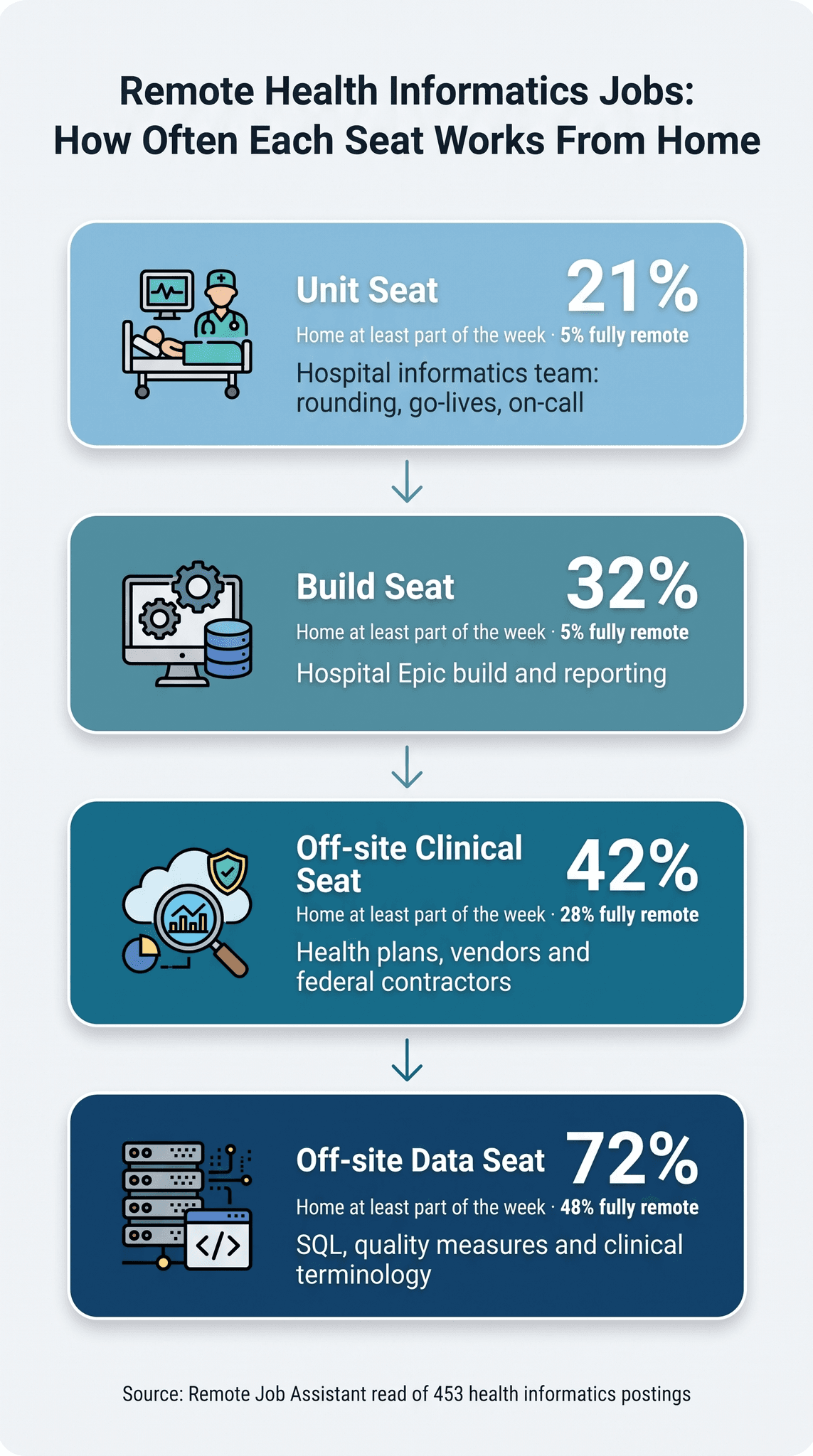
The Bedside Distance Scale ranks health informatics seats by how far the work sits from the bedside. The chance of working from home rises with each rung, and posted pay is highest on the two off-site rungs.
Scoring, from the rung closest to patients to the one farthest away (pay is the median posted range for individual-contributor titles, leaving out managers, directors, and executives):
- Rung 1, Unit seat (fully remote 5.1%, n=14 of 274; median posted $85,681–$134,174, n=90): A hospital or health-system informaticist, clinical informatics specialist, or nurse informaticist. The ticket is a clinical license or clinical experience. The work is rounding, training, workflow fixes, go-lives, and at-the-elbow support; 47 of 274 postings name elbow or go-live work and 38 name on-call. One in five lets you work from home at least part of the week.
- Rung 2, Build seat (fully remote 4.6%, n=3 of 65, plus 1 listed remote; median posted $85,182–$116,909, n=18): A hospital seat that requires Epic or other EHR certification, or names SQL or a reporting tool. You configure order sets, documentation templates, and reports. Hybrid is common here (26.2%); fully remote is rare. Postings often give you a deadline to get certified, such as MUSC Health's "Epic Certification is required within 6 months of hire/transfer."
- Rung 3, Off-site clinical seat (fully remote 28.3%, n=15 of 53, plus 2 listed remote; median posted $94,776–$137,922, n=20): A health plan, health-tech vendor, government contractor, or consultancy that pays for clinical judgment: utilization-management criteria, clinical content, terminology, or a federal EHR program. Licenses still matter. Cohere Health asks for an "active RN license"; Optum's pharmacy informatics lead needs a pharmacist license "in the state of residence."
- Rung 4, Off-site data seat (fully remote 48.3%, n=14 of 29; median posted $110,300–$148,700, n=14): The same employers, but the requirements list names SQL, Python, or a BI tool. Quality measures, terminology mapping, data validation. Seven in ten let you work from home at least part of the week, and none of the 29 mention on-call.
Here's the scale with the posting signals that put a job on each rung.
| Rung | Who posts it | Ticket in the requirements | Fully remote | Home at least part of the week | Median posted pay (individual contributors) | Postings |
|---|---|---|---|---|---|---|
| 1. Unit seat | Hospitals and health systems | RN, PharmD, MD, or clinical experience | 5.1% | 20.8% | $85,681–$134,174 (n=90) | 274 |
| 2. Build seat | Hospitals and health systems | Epic/EHR certification, or SQL/reporting | 4.6% | 32.3% | $85,182–$116,909 (n=18) | 65 |
| 3. Off-site clinical seat | Health plans, vendors, government contractors, consultancies | License or clinical experience | 28.3% | 41.5% | $94,776–$137,922 (n=20) | 53 |
| 4. Off-site data seat | Same employers as rung 3 | SQL, Python, or a BI tool | 48.3% | 72.4% | $110,300–$148,700 (n=14) | 29 |
Another 32 postings, mostly university research informatics jobs, sit outside the scale.
How to use it: two questions place any posting. Does a hospital or health system sign the paycheck? Does the requirements list name SQL, Python, or a BI tool such as Tableau or Power BI? Then run the tie-breakers, because a few phrases move a job up or down a rung no matter who posts it.
Tie-breakers: three phrases that move a posting
- A list of states. "Permitted to live in the following states" or "Remote - South Carolina" means the seat is remote only where the employer runs payroll. Treat it as remote if you live there, and as closed if you don't.
- "Go-live," "at the elbow," or "on-call." Each one pulls a seat one rung toward the unit. A remote posting with a go-live clause still puts you on a plane or in a hospital for a few weeks a year (10 of the 52 remote seats name go-lives); an on-call clause means the 2 a.m. page follows you home.
- A deadline on Epic certification. "Within 180 days of hire" means the employer will put you through Epic's training. That's the door into rung 2 if you don't hold a certification yet.
Cut by title instead of employer and the same pattern shows: nursing-informatics titles were fully remote 3 times in 73, pharmacy informatics 6 in 35, informatics managers 7 in 37, and trainer or educator titles 0 in 18. In health informatics, the remote jobs are off the hospital payroll: hospitals posted 339 of 453 informatics jobs and made 17 of them fully remote.
Stop Applying Manually
Our AI applies to hundreds of matching jobs while you sleep. Wake up to interviews, not more applications.
What Remote Health Informatics Jobs Pay
Remote informatics seats pay more than on-site ones, and the reason isn't that remote is a perk employers pay extra for. It's who posts them and how senior they are. Health plans and software companies post higher ranges than hospitals, and 28 of the 52 remote seats carry a senior, lead, manager, director, or chief title, against 86 of the 311 on-site seats.
Salary ranges come from the 191 of 453 postings that published one, with hourly rates multiplied by 2,080 hours for comparison. We cross-referenced them with Bureau of Labor Statistics wage data for computer systems analysts (May 2025), the occupation O*NET uses for health informatics specialists, and with the HIMSS 2022 Nursing Informatics Workforce Survey. Ranges move as markets do, so check the linked sources for current figures.
| Title lane | Postings | Fully remote | Posted ranges | Median posted range |
|---|---|---|---|---|
| Clinical informatics analyst, specialist, informaticist | 208 | 23 | 89 | $85,000–$118,206 |
| Nursing informatics | 73 | 3 | 29 | $89,648–$135,533 |
| Pharmacy informatics | 35 | 6 | 15 | $125,840–$174,928 |
| Informatics manager | 37 | 7 | 18 | $108,742–$160,000 |
| Director of informatics | 33 | 3 | 12 | $147,484–$197,600 |
| Physician informaticist or medical director | 10 | 0 | 4 | $160,241–$221,350 |
| CMIO, CNIO, or VP | 22 | 2 | 5 | $279,500–$440,500 |
Cut the same 191 ranges by work model and employer, and the employer effect shows up plainly.
| Slice | Posted ranges | Median posted range | Median midpoint |
|---|---|---|---|
| Fully remote | 30 of 49 | $108,850–$160,000 | $133,675 |
| Hybrid | 41 of 78 | $78,857–$118,286 | $98,572 |
| On site | 116 of 311 | $92,350–$137,342 | $115,934 |
| Health plans | 15 of 17 | $103,000–$161,700 | $133,522 |
| Health-tech vendors | 15 of 22 | $97,500–$156,200 | $140,000 |
| Hospitals and health systems | 125 of 339 | $90,000–$136,739 | $112,840 |
Hybrid seats post the lowest pay because hybrid is mostly a hospital arrangement (60 of the 78 hybrid postings are at hospitals) for specialist and analyst jobs: you come in for go-lives and staff meetings, and you're paid on the hospital's IT or nursing scale. The BLS median for computer systems analysts is $105,850, and for registered nurses it's $97,550. In the HIMSS survey of more than 1,100 nurse informaticists, 60% reported base pay over $100,000, up from 49% in 2020 and 33% in 2014.
One caution on the big ranges. CVS Health posts whole job grades, so a Senior Medical Director-Clinical Informatics seat shows $184,112–$396,550 and a Manager-Clinical Informatics seat shows $54,300–$159,120. Neither number is the offer. Ask the recruiter for the target salary for the role, not the band.
A remote informatics offer pays more because the employer is a health plan or a software company, not because the job is remote. If you want the pay without the move, the move you need is the employer, and the six-figure remote job listings skew the same way.
Remote Nursing Informatics Jobs: What the RN License Buys You
The RN license is the ticket into rung 1. It isn't, on its own, a ticket out of the building. Of 73 postings with nursing-informatics titles, 3 were fully remote: Bluestone Physician Services (a home-office seat with travel to clinical sites in its Minnesota, Wisconsin, and Florida markets), Connexall (about 50% travel), and the Washington State Health Care Authority. Nine more were hybrid.
Widen the lens to any posting that requires an RN license, and it's 96 postings, 6 of them remote. Four of those six sit off the hospital payroll: Cohere Health, b.well Connected Health, Mosai, and the Washington State Health Care Authority, which pays a remote nurse informaticist $120,288–$197,112 to lead Medicaid prior-authorization interoperability, provided you live in Washington. The other two are at SCA Health and Community Health Network, which limits its remote staff to seven states. If utilization review appeals to you, remote utilization review nurse jobs are the larger payer-side market for RNs; the informatics versions ask for the same clinical judgment plus terminology or data work.
Licensure is less of a barrier than it looks. Eighteen of the 96 RN-required postings mention a compact or multistate license, and the Nurse Licensure Compact now covers 43 jurisdictions. The bigger barrier is experience, and that's where the certification trap sits.
ANCC's Informatics Nursing Certification requires an RN license, a BSN, two years full time as an RN, 30 hours of informatics continuing education, and 2,000 hours of informatics nursing practice in the last three years (or 1,000 hours plus 12 graduate credits, or a graduate program with a 200-hour practicum). The exam costs $395, or $295 for ANA members.
That last requirement is the catch: you can't log 2,000 informatics hours without an informatics job. The good news is that hiring managers know it. The certification is named in 32 of 453 postings, and in 15 of those it's only preferred. Hospitals named it in 23 of 339 postings and government employers and contractors in 7 of 30; not one of the 17 health-plan postings did. The certification you need for the first informatics job usually comes from the first informatics job. Read the ANCC eligibility page before you pay for a prep course; if you don't have the hours, the course can wait. Our guide to certifications worth getting for remote work covers which ones employers actually ask for.
The HIMSS survey says nearly 8 in 10 nurse informaticists work remotely at some point in the week, and 81% of those do it at least twice a week. That's true, and it doesn't contradict our 4.1%. The survey counts people already in informatics jobs, including hybrid days; we counted job postings that let a new hire work fully remote. Read it as the order of events: a hybrid seat first, then a remote one. The same survey says what moves people who are already in informatics: among those planning a job change, 43% wanted a promotion or bigger role and 38% higher pay, against 25% who wanted more flexible schedules or remote work. For the broader picture of what nurses can do from home, see our remote nursing jobs guide.
Why Hospitals Keep Informaticists on Site
It isn't stubbornness. Four things keep hospital informatics seats on site, and three of them are written into the postings.
The work happens on the unit. At-the-elbow support, rounding, workflow observation, and go-live coverage show up in 47 of the 274 rung 1 postings. Memorial Hermann's Clinical Informaticist at the Texas Medical Center lists "rounding in clinical areas, observing workflows, conducting time studies" and "at-the-elbow support to clinical staff," and the posting is "100% onsite ... with no remote or hybrid option." Emory Healthcare's hybrid specialist seat expects "roughly 30% of time with onsite visits for either project based work or supporting Epic go-lives."
On-call. Thirty-eight of 274 unit seats name on-call; Memorial Hermann runs "a rotating, one-week after-hours on-call schedule." Not one of the 29 off-site data seats mentions it. A hospital that needs someone to fix a broken order set at 2 a.m. wants that person close enough to walk onto the floor.
Payroll states. Hospitals that hire remote often limit it to states where they already run payroll, because each new state adds its own tax registration, leave rules, and pay-transparency laws. Across both of our sets, 27 of 102 hospital remote seats name a state limit, against 5 of 60 remote seats at health plans, vendors, and contractors. OhioHealth's boilerplate says remote positions "are only eligible for work from Ohio." Ochsner Health goes the other way: people who live in Colorado, California, Hawaii, Illinois, Maryland, Minnesota, New Jersey, New York, Vermont, Washington, or Washington, D.C., "are not eligible for remote work position."
The org chart. At many hospitals, informatics reports to nursing or pharmacy, and the Epic analysts report to IT, so the two follow different remote policies. In searches that didn't use remote words, hospital Epic and EHR analyst postings were fully remote or listed remote 11.0% of the time (32 of 291), against 4.5% for hospital informatics titles (15 of 336). Same software, different department, more than twice the remote odds.
A hospital will pay you to learn informatics, certify you in Epic, and give you the hours ANCC wants. It wants you in the building while it does. Plan to take that seat for the training and leave for the remote one later, not to talk the hospital into making its unit seat remote.
Who Hires Remote Health Informatics Staff
Here are the employers behind most of the 52 remote and listed-remote seats, grouped by who pays, with posted pay where they published it and the catch in each posting.
| Employer type | Who posted remote seats | Posted pay | The catch |
|---|---|---|---|
| Health plans | CVS Health (4), Humana and CenterWell (3), Optum (1) | Humana $117,600–$161,700; Optum $112,700–$193,200 | CVS posts whole grade bands; Optum wants a pharmacist license in your state of residence and prefers a PGY2 informatics residency |
| Health-tech vendors | Inovalon (2), Siemens Healthineers (2), Cohere Health, Veeva, Mosai, b.well, OpenLoop, Aledade, Connexall, FUJIFILM | Inovalon $135K–$160K; Veeva $80,000–$115,000; Cohere $85,000–$100,000 | Inovalon puts anyone within 40 miles of an office on a 2-day hybrid schedule; FUJIFILM and Connexall travel 50–75% |
| Government and federal contractors | Washington State Health Care Authority, VA (Gary, Indiana), Mathematica, Leap Orbit, Telligen, SBG Technology Solutions, Artemis Arc, Trilogy Federal | Leap Orbit $160,000–$180,000; Mathematica $140,000–$165,000 | Federal seats ask for a Public Trust or VA background check; the state seat needs Washington residence |
| Hospitals that hire remote | Mass General Brigham, Vanderbilt University Medical Center, Bassett, Mount Sinai, University Hospitals, Community Health Network, Baptist Health (KY/IN), MUSC Health, Nemours | Mass General Brigham $117,707–$171,205; Bassett $133,099–$173,035 | Six of 18 name a state or market limit; several are pharmacist seats |
Our read of what these seats actually do: the remote informatics job is usually a measures, terminology, and data-exchange job, not a workflow job. Twenty-two of the 31 off-payroll remote seats name quality measures, terminology, interoperability, prior authorization, or claims; only 54 of the 274 unit seats do. If your experience is fixing workflows on a unit, the translation you need is from workflow to data.
Two more patterns stand out. First, pharmacists do better on remote than nurses: 6 of 35 pharmacy informatics postings were fully remote, against 3 of 73 nursing ones. Two of the six are Epic Willow medication-build seats (Mount Sinai and University Hospitals), work that doesn't need you on a unit. Vanderbilt's Senior Informatics Pharmacist is "open to remote work from most US locations," and the VA's informatics pharmacist in Gary, Indiana, is "authorized for 100% remote work." Our remote pharmacist jobs guide covers the rest of that market.
Second, the federal contractors are hiring because of the VA's EHR rollout. The VA's deployment schedule shows 11 medical centers live on the Federal EHR in 2026, two more on October 24, 2026, and 26 scheduled for 2027. Contractors such as CVP and Aptive post clinical informaticist seats with "United States" as the location and no work-model text; five of the 12 postings in our unclear pile are theirs. Ask before you assume.
Stop Applying Manually
Our AI applies to hundreds of matching jobs while you sleep. Wake up to interviews, not more applications.
The Epic Question: Certification, Sponsorship and the 180-Day Clock
Epic certification is the rung 2 ticket, and the postings show you get it through an employer. Of the 453 informatics postings, 190 mention Epic and 102 require certification. Sixty-five of those want it on day one. The other 37 give you a deadline, and those 37 are the door in.
The deadlines cluster. Of 39 deadline clauses, 18 say 180 days or six months, 10 say 90 days, and 9 say a year. Vitruvian Health spells out how it works: candidates "may hire into position without the Epic Clinical Informaticist certification, but must attain the certification within first 90 days of Vitruvian Health (VH) sponsored Epic training to continue employment." Wellvana, a value-based care company, shows the other side: it "is not an Epic-customer employer, so we cannot sponsor" a renewal.
Two decision rules follow. If you don't hold a certification, apply to the postings with a deadline and skip the ones that say "certification required" with no deadline. And if you do hold one, keep it current through an employer that can renew it, because a vendor or consultancy may not be able to. In the 469 Epic and EHR analyst postings, 310 required certification and 59 gave a deadline, most often 180 days.
Oracle Health (Cerner) is the other system you'll see, named in 51 informatics postings, 36 of them on site. It matters most for the federal contractor seats, since the VA's Federal EHR runs on it.
How to Move Up the Bedside Distance Scale
Most people reading this are on rung 1 or nowhere yet. Where you start decides the route, so find your starting point below and take the branch. Each one names the rung to aim for next and the posting signal to look for.
Start here: which of these is you?
- RN with bedside years and no informatics title. Aim for rung 1 or 2, hybrid. Remote isn't realistic yet: 3 of 73 nursing-informatics postings were fully remote. The trade-off is pay: hospital build seats post a median $85,182–$116,909 for individual contributors, so compare base pay to base pay if your bedside check includes night or weekend differentials. Filter for postings with an Epic certification deadline (37 of 102 that require it give one), and count every hour toward the 2,000 ANCC wants. Plan on 12 to 18 months before you look off site.
- RN already doing super-user, educator, or informatics work. Aim for rung 3. Look for utilization-management, prior-authorization, clinical-content, or terminology seats at health plans, vendors, and state agencies; 4 of the 6 remote RN-required seats were off the hospital payroll. Your license plus documented build or training work is the ticket.
- Pharmacist. Aim for rung 2 or 3 now. Pharmacy informatics had the best remote odds of any clinical lane (6 of 35 fully remote), and Epic Willow build work moves across employers. In the three remote pharmacist seats that mention an informatics residency, it's preferred or an alternative to two years of EHR experience, not a hard requirement.
- Epic analyst without a clinical license. You're already on rung 2's ticket. Add SQL and move to rung 4; hospital Epic analyst postings were remote 11.0% of the time in non-remote searches, and off-site data seats 48.3%.
- Data analyst with no clinical background. Aim for rung 4 directly. Learn one health-care data standard (HEDIS measures, FHIR, or a terminology such as SNOMED or LOINC); 22 of 31 off-payroll remote seats named quality measures, terminology, interoperability, prior authorization, or claims. Our remote SQL jobs guide covers what employers test.
- Physician. Remote CMIO seats are rare (2 of 22 executive postings). The board route now runs through a 24-month ACGME clinical informatics fellowship, the only pathway ABPM's clinical informatics page lists.
Whatever your branch, check the state list before you write a cover letter. Six of the 18 hospital remote seats and 4 of the 31 off-payroll remote seats name one.
Off-site seats describe the work in words hospital postings rarely use, so search on those words. On LinkedIn or any job board, try "informaticist" with HEDIS, "value sets," "clinical terminology," "prior authorization," or FHIR, and "Epic" with "within 180 days" for build seats that will certify you. A plain search won't sort it for you: LinkedIn's "remote nursing informatics" search gave us 130 results, and 31 had informatics in the title.
Here's the scale applied to three real postings, placed from their own wording.
| Question | Memorial Hermann, Clinical Informaticist - TMC | Cohere Health, Sr. Clinical Informaticist | Humana, Lead Data Informaticist |
|---|---|---|---|
| Who signs the paycheck | Hospital system | Health-tech vendor (utilization-management software) | Health plan |
| Ticket in the requirements | "Clinical degree in Nursing, Pharmacy, Medicine, or equivalent"; Epic certification preferred | "BSN or related clinical degree with active RN license required" | "Strong SQL proficiency"; Python preferred |
| Tie-breakers | "at-the-elbow support"; "rotating, one-week after-hours on-call schedule" | "Fully remote opportunity with about 5% travel" | "occasional travel to Humana's offices for training or meetings" |
| Work model | "100% onsite ... with no remote or hybrid option" | "remote-first" | "While this is a remote position" |
| Posted pay | Not posted | $85,000–$100,000 | $117,600–$161,700 |
| Rung | 1: Unit seat | 3: Off-site clinical seat | 4: Off-site data seat |
The Cohere posting is a good model for a nurse's first off-site seat: it wants 4–6 years in clinical informatics, analytics, or digital health, an RN, and work on "ontology mapping, structured data validation, and annotation quality" for AI tools. The Humana seat wants seven or more years in analytics or informatics and a quantitative degree; a clinical background helps, but it isn't the ticket. If the data route appeals to you, our remote data analyst jobs guide and the data and analytics job listings show what those seats look like outside health care.
- "Which states can I live in?" A list of states means payroll limits; if yours isn't on it, stop there. Optum wrote "anywhere within the U.S."; Humana posts its seats as "Remote Nationwide."
- "How many on-site days a month or quarter, counting go-lives?" "A few times a year" is remote. "One to two weeks a month" is Cone Health's hybrid, and it's a commute.
- "Is there on-call, and how often?" Weekly rotations are a unit-seat habit; none of the 29 off-site data seats we read had one.
- "Who pays for Epic certification, and by when?" A date and a sponsor means they'll train you. "You'll need it before you start" means the job isn't for you yet.
- "Is the posted range a grade band or the target?" If the top of the range is more than double the bottom, it's a band; ask for the target before you negotiate.
The SQL line predicts a remote informatics job better than the RN line does. Of the 62 postings that name SQL, 22 were remote; of the 96 that require an RN license, 6 were.
Stop Applying Manually
Our AI applies to hundreds of matching jobs while you sleep. Wake up to interviews, not more applications.
Red Flags and Tie-Breakers in Remote Informatics Listings
Most remote informatics listings are honest. The confusing ones come from templates, tags, and benefits boilerplate. Here's what we found, and what each phrase actually means.
| What the posting says | What it means | Where we saw it |
|---|---|---|
| A "Remote" tag on the job board, "Office-based" in the text | The tag is wrong; trust the text | Highmark Health on SimplyHired |
| "Remote - South Carolina" | Remote only if you live in that state | MUSC Health |
| "Permitted to live in the following states" | A payroll-state list; outside it, you can't take the job | Community Health Network (7 states) |
| "Within a 40-mile radius ... will follow a hybrid work schedule" | Remote only if you live far from an office | Inovalon |
| "Epic certification required" with no deadline | Closed to anyone not already certified | 65 of 102 postings that require it |
| "Must be willing and able to travel" about 80% of the time | A road job with a home base, not a desk at home | Oracle's clinical informatics executive seats |
| "Hybrid care models" in the duties | A care-delivery strategy, not a work arrangement | Montefiore's CMIO posting |
| "Work from home flexibility" in the benefits, "Office based environment" in the job | An office job | Medpace |
| A $54,300–$159,120 range | A grade band, not an offer | CVS Health |
When two offers look close, three rules settle most of them. A national remote seat beats a state-list remote seat, because you can move without losing the job. No on-call beats on-call at the same pay. And if you don't hold Epic certification, a seat that will certify you beats one that pays $5,000 more and assumes you already have it.
Frequently Asked Questions
I'm an RN with eight years on a med-surg unit. Can I get a fully remote nursing informatics job without informatics experience?
Not as a first job. Only 3 of 73 nursing-informatics postings we read were fully remote, and 6 of 96 postings requiring an RN license were. Plan on 12 to 18 months in a hybrid or on-site hospital informatics seat, then apply for off-site clinical or data seats at health plans and vendors. Any course that promises a remote informatics job without that first seat is selling against these numbers.
Which employers hire remote health informatics staff from any state?
Health plans, health-tech vendors, and federal contractors. Across both of our sets, 27 of 102 hospital remote seats named a state limit, against 5 of 60 remote seats at those employers. Humana, Optum, Veeva, and Cohere Health posted remote informatics seats with no state list.
Do I need the ANCC informatics certification (NI-BC) to get hired?
No. It was named in 32 of 453 postings, and in 15 of those it was only preferred. ANCC requires 2,000 hours of informatics practice in the last three years, or a graduate-program route, so most people earn it after their first informatics job.
How do I get Epic certified if my hospital won't sponsor me?
Get hired into a seat that sponsors it. Of 102 informatics postings that require Epic certification, 37 gave new hires a deadline to earn it, most often 180 days, with training arranged by the employer. Skip postings that require certification with no deadline.
Which rung of the Bedside Distance Scale should I target if I want to be remote within two years?
Start at rung 2, a hospital build seat that will certify you, then move to rung 3 or 4. Off-site data seats were fully remote 48.3% of the time (14 of 29), against 4.6% for hospital build seats. The SQL skill is what moves you from rung 3 to rung 4.
How much do remote clinical informatics jobs pay compared with bedside nursing?
Fully remote informatics seats posted a median range of $108,850–$160,000 (n=30 of 49), and nursing-informatics titles $89,648–$135,533 (n=29). The BLS median for registered nurses is $97,550 (May 2025). The highest remote pay sits at health plans and vendors, not hospitals.
Will AI replace health informatics jobs?
The postings point the other way: AI is being added to the job. AI, machine learning, or language models appear in duty sentences in 78 of 453 postings, and in 17 of 52 remote seats. Cohere Health's informaticist validates data for "AI and LLM-enabled healthcare tools," and OpenLoop lists experience using AI models for data QA as a plus.
Find Your Remote Health Informatics Seat
Start by placing yourself on the Bedside Distance Scale, then search the rung you want next. And read the travel lines as closely as the pay: 26 of the 52 remote seats we read mention travel, go-lives, or on-site visits, and 10 name go-lives outright. If you're a nurse, the hybrid hospital seat with an Epic deadline is the training ground; the remote seat is at a health plan or vendor. If you're a pharmacist, the remote odds are better than for nurses, and medication-system build is the skill that travels. If you're a physician, our remote physician jobs guide covers the CMIO and medical director tracks.
The remote data analyst roles are worth a look if SQL is your ticket, and Auto-Apply can send your applications to the off-site seats while you're still working the unit.
In informatics, remote means remote until the next go-live.
Ready to Find Your Remote Job?
Browse thousands of curated remote jobs or let AI apply for you.
Browse Remote JobsRelated Job Guides
Remote School Psychologist Jobs: Vendors Hire, Not Districts
Remote and virtual school psychologist jobs: 87 of 682 postings were fully remote, every one through a vendor. Hourly pay vs. district salary, and the catch.
33 min read
Remote Dentist Jobs: 10 Real Seats in 1,399 Postings (2026)
Remote dentist jobs are payer jobs. We read 1,399 dentist postings and found 10 remote or hybrid seats. Here's what they pay and which licenses they need.
30 min read
Remote Respiratory Therapist Jobs: 12 of 1,518 Are Remote
Remote respiratory therapist jobs are rare: 12 of 1,518 RT postings were fully remote. What they pay vs. the bedside, which licenses they need, where $75K+ is.
33 min read