
Last reviewed: October 2026
You searched "remote school psychologist jobs" on LinkedIn after another week of three buildings and a 40-minute drive between them, and the results looked endless. On October 19, 2026, we opened the first 30 cards for that search. Seven were school psychologist jobs. Three of those were fully remote, three were hybrid, and one let you pick virtual or on site. The other 23 were school counselors, social workers, therapists, a speech-language pathologist, MTSS coordinators, and clinical psychologists.
The real listings come from a short list of companies. Presence, a teletherapy company that ranks on page one, has 49 state pages for remote school psychologists, and every one is the same posting at $48–$51 an hour. One staffing company, Soliant, which also posts as VocoVision, wrote 73 of the 87 fully remote school psychologist postings we found. And the work that keeps a school psychology department running, the evaluation, has a federal clock on it: 60 days from parental consent under IDEA, unless the state sets its own. You can't hand a seven-year-old a box of blocks over Zoom, so somebody still has to be in the room.
Get Remote Job Tips in Your Inbox
Weekly strategies, salary data, and new opportunities
Unsubscribe anytime. No spam.
We read 682 school psychologist job postings at 369 employers, all first listed between January and October 2026, to find every seat you can do from home, who posts it, and what it pays against a district salary. This guide covers where the remote seats come from, why they pay less per hour than the contract seat down the road, the license problem that decides which ones you can take, and the hybrid district jobs that beat both.
Based on our read of 682 school psychologist postings first listed January–October 2026:
- 12.8% (n=87 of 682) were fully remote after reading the full text; in the 455 postings found by searches that didn't use remote words, it was 5.5% (n=25)
- 0 of 282 district postings and 0 of 49 charter or virtual-school postings were fully remote; all 87 remote postings came from staffing or teletherapy vendors
- 73 of 87 remote postings came from one company, Soliant (posting as Soliant and VocoVision)
- $44.05–$60.35 an hour is the median posted range for remote seats (n=19 of 87 that post a rate), against $55–$60 an hour for vendors' in-building seats (n=117 of 226)
- $63,872–$104,808 is the median posted salary range at districts and charters (n=71 of 331 that post one); 43 of 71 top out at $100K or more
- 13 of 87 remote postings say 1099 or independent contractor; 2 say W-2
- 79 of 103 postings that state an experience minimum ask for 1 year
- $95,990 is the BLS median wage for school psychologists (May 2025)
How We Collected This Data
One posting shows why we read every listing instead of trusting the filters. SimplyHired tagged Van Dyke Public Schools' school psychologist job "Remote." The posting itself says "Position Type: Full time and in person." Seven district jobs carried that tag and the same contradiction.
We read 1,108 postings from four places. LinkedIn's public job search returned 1,386 cards across 28 searches, and we read 685 in full. SimplyHired, which carries Indeed's network, added 420 job pages from 12 searches, each run once filtered to Remote and once across the United States. A probe of about 150 teletherapy and staffing employers' Greenhouse, Lever, Ashby, and SmartRecruiters boards added 2 postings at Parallel Learning. Presence's 49 state pages are one template and count once. Stride's career site listed no school psychologist openings on October 19.
A posting counted if it had a school psychologist, LSSP, licensed educational psychologist, or psychoeducational title, or a psychologist title whose body asked for a school psychology credential. Internships, practicum seats, faculty jobs, and eight clinical-license psychologist seats were excluded. Repeats of the same employer, title, and city were removed, and Soliant and VocoVision count as one company. That left 682 postings at 369 employers, first listed January 5 to October 19, 2026.
Of the 148 postings a keyword filter flagged as remote or hybrid, reading confirmed 85 fully remote, 26 hybrid, 14 on site with remote paperwork, 5 unclear, and 18 on site, and it found 2 virtual-school seats the filter missed. The other false alarms came from lines like "hybrid retirement plan."
Both of our blind spots push the remote share up. Ten of the 28 LinkedIn searches and 5 of the 12 SimplyHired searches were aimed at remote work, and we couldn't read Indeed, Glassdoor, ZipRecruiter, or district systems such as Frontline and EdJoin, which carry mostly on-site district jobs. So 12.8% overstates it; the 5.5% from non-remote searches is the better estimate. Pay figures are posted ranges, cross-referenced with the Bureau of Labor Statistics' Occupational Outlook for psychologists (May 2025 wages). These figures reflect postings live as of October 19, 2026, after the spring hiring peak; we update this analysis quarterly.
The Testing Room Ladder: Where the Evaluation Happens Sets the Pay
"Is it remote?" is the wrong first question for a school psychologist. The better one is where the testing happens, and who pays you for it. Those two answers predict the pay, the paperwork, and how secure the job is better than the word "remote" in the title does.
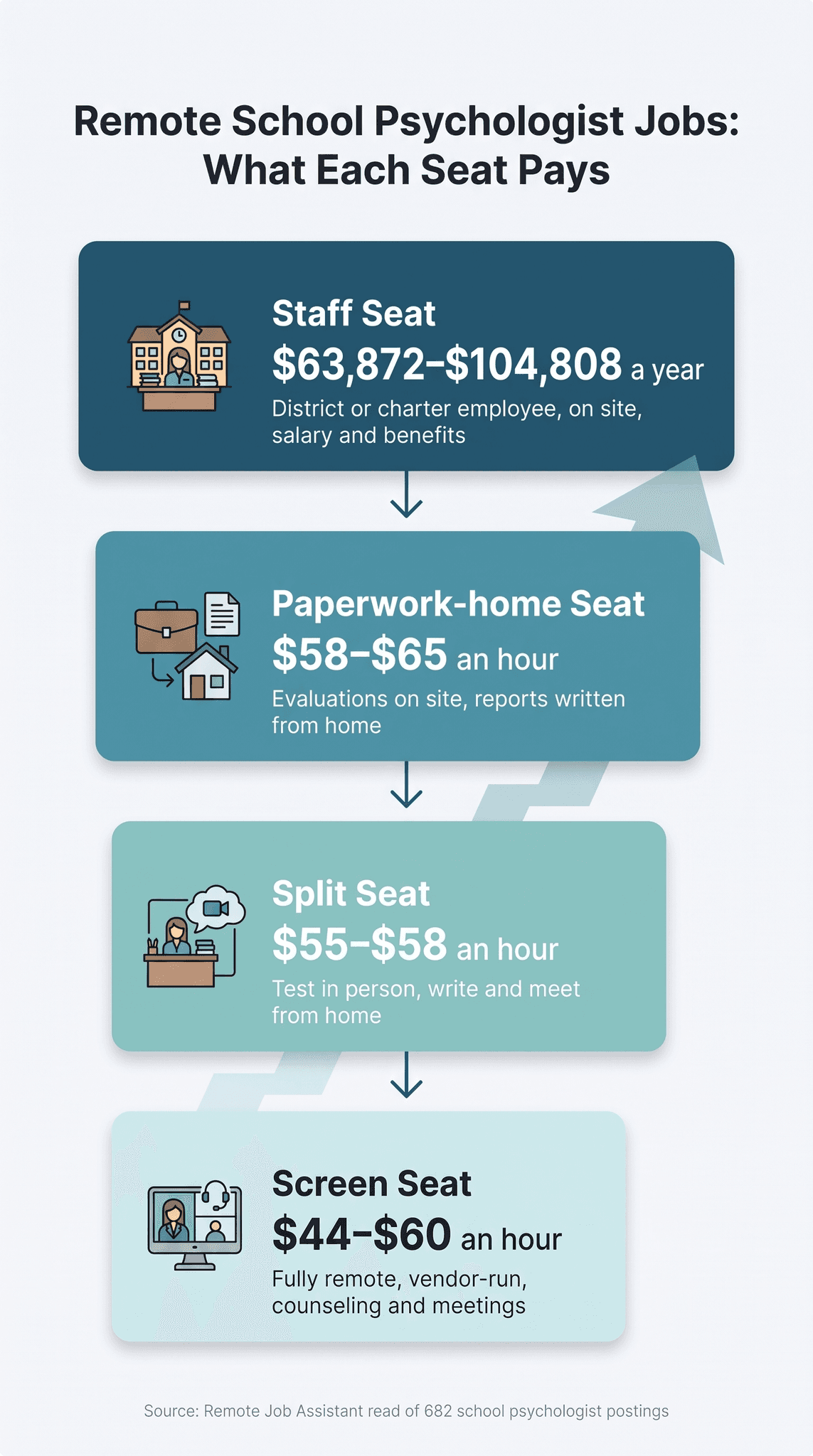
The Testing Room Ladder ranks the four kinds of school psychologist seat by how much of the evaluation leaves the school building, and shows what each rung pays and protects.
Scoring, from the most remote rung to the least:
- Rung 1, Screen seat (median posted $44–$60 an hour, n=19 of 87; one daily rate of $315–$330): Fully remote and vendor-run. You carry the counseling, the IEP and eligibility meetings, the reports, and tele-assessment that depends on a trained adult at the school. Usually a contract or 1099. One state license per seat. Hours follow the caseload, and two postings say outright that "Hours are not guaranteed." We found 87.
- Rung 2, Split seat (vendor median $55–$58 an hour, n=11; district hybrids on salary): In person to test, at home to score, write, and meet. Expect a radius rule, such as "Must reside within 45 minutes of the school district." Appoquinimink School District in Delaware posts a district hybrid seat that is about 75% remote with a $7,500 stipend; Sage Oak Charter Schools posts one at $103,227–$119,612. We found 26.
- Rung 3, Paperwork-home seat (median $58–$65 an hour, n=12): Evaluations on site, with "remote documentation flexibility where permitted." Mostly W-2 contracts; The Stepping Stones Group posted 10 of them at $48–$75 an hour. We found 15.
- Rung 4, Staff seat (median posted $63,872–$104,808 a year, n=71 of 331): A district or charter employee on site. Benefits, a pension in most states, a salary schedule with steps. 43 of 71 posted ranges top out at $100K or more, and the BLS median is $95,990.
Here is the ladder with the posting signals that put a job on each rung.
| Rung | Who posts it | Posted pay | Where testing happens | Terms | Postings |
|---|---|---|---|---|---|
| 1. Screen seat | Staffing and teletherapy vendors (Soliant/VocoVision 73 of 87) | $44.05–$60.35/hr median range (n=19) | At the school, with a facilitator, or not by you | Contract or 1099; hours by caseload | 87 |
| 2. Split seat | Vendors, plus 8 of 331 schools that hire directly | $55–$58/hr vendor median (n=11); $103K–$120K at Sage Oak | In person on set days | W-2 or 1099; radius rules | 26 |
| 3. Paperwork-home seat | Vendors (Stepping Stones 10 of 15) | $58–$64.96/hr median (n=12) | On site, every evaluation | Mostly W-2 contracts | 15 |
| 4. Staff seat | Districts and charters | $63,872–$104,808 median range (n=71) | On site | Salary, benefits, steps | 322 district and charter postings on site |
How to use it: run any listing through the Seat Check below before you apply. A seat can sit on Rung 1 and still be a good job, but only if it scores well on the five things a district salary gives you by default.
The Seat Check: five questions, 2 points each
- Where does testing happen, and who facilitates? 2 points if the posting names in-person testing days or a trained on-site facilitator. 1 point for "virtual evaluations" with no detail. 0 if it asks you to supply "evaluation materials."
- Are the hours guaranteed? 2 points for a full-time caseload or a stated weekly schedule. 1 point for a stated minimum ("15 hours per week"). 0 if the hours aren't stated, or if the posting says "Hours are not guaranteed."
- Is evaluation and report time paid, and how? 2 points for a salary, or an hourly rate the posting says covers documentation. 1 point for a posted hourly, daily, or per-evaluation rate with no word on report time. 0 if the rate is "Discussed during your intake call" or missing.
- Whose license, and who pays for a new one? 2 points for a state you already hold. 1 point if the vendor pays for cross-licensing. 0 if you must add a license, or a doctorate, at your own cost.
- W-2 with benefits, or 1099? 2 points for W-2 with benefits. 1 point for 1099 with a posted rate. 0 for 1099 with no posted rate.
Score 0–4: a gig seat. Use it to fill spare hours; don't replace a salary with it. Score 5–7: a contract seat. Workable for a school year if the hourly rate beats your district rate per school-year hour. Score 8–10: a career seat. Rare, and most of them are hybrid seats posted by the schools themselves.
Most Rung 1 postings lose points before you finish reading: 67 of the 87 post no rate at all, and only 2 say W-2. Here's the Seat Check run on three real postings, scored from their own wording, for a psychologist who already holds that state's credential.
| Seat Check question | Seagull, Arizona virtual school (remote) | Soliant, Kansas (remote) | Appoquinimink SD, Delaware (hybrid) |
|---|---|---|---|
| Testing and facilitation | 0: "Must be currently licensed and certified and have evaluation materials" | 1: evaluations "through a secure telehealth platform," no facilitator named | 2: in person for "assessments that require in-person administration" |
| Hours | 0: "Hours are not guaranteed" | 0: "Schedule: Flexible / School-Based," no hours stated | 2: district full-time, in person "about one week each month" |
| Evaluation and report pay | 1: $53–$68 an hour, report time not mentioned | 1: "$50–$55 per hour," report time not mentioned | 2: district salary plus a $7,500 stipend |
| License | 2: Arizona certification and a fingerprint card | 2: "Appropriate Kansas licensure/credentialing" | 2: Delaware credential |
| Employment terms | 1: rate posted, W-2 or 1099 not stated | 1: "1099 independent contractor position" | 2: district employee with "comprehensive benefits" |
| Score | 4: gig seat | 5: contract seat | 10: career seat |
The Kansas posting also shows why you read past the header. Its first line asks for a "Bachelor's or Master's degree in School Psychology," and its qualifications list asks for a "Doctoral degree in School Psychology, Psychology, or a related field." Ask the recruiter which one the district contract actually requires before you spend an evening on the application.
Stop Applying Manually
Our AI applies to hundreds of matching jobs while you sleep. Wake up to interviews, not more applications.
What Remote School Psychologists Earn Compared With a District Salary
The hourly rates on remote postings look generous next to the BLS hourly figure, and thin next to a school year. Both comparisons are honest. They just use different denominators.
Salary figures below are posted ranges from our 682 postings, January–October 2026. School-year annual figures are our own arithmetic: a 190-day school year at 7.5 hours a day, or 1,425 hours, which is roughly what a full-time school-based contract covers. BLS publishes the occupational median for comparison; its hourly figure assumes 2,080 hours, a year-round schedule school psychologists don't work.
| Seat | Postings with pay | Posted median | At 1,425 school-year hours (our arithmetic) | What's not in the number |
|---|---|---|---|---|
| Screen seat (fully remote) | 19 of 87 | $44.05–$60.35/hr; midpoint $50.94 | About $72,600 at the midpoint | Benefits on most; self-employment tax on 1099; unpaid hours when the caseload thins |
| Vendor in-building seats (on site, paperwork-home, hybrid) | 117 of 226 | $55–$60/hr; midpoint $55.00 | About $78,400 at the midpoint | Same, though more of these are W-2 |
| District and charter staff seat | 71 of 331 | $63,872–$104,808 a year | Already annual | Pension, health plan, paid breaks, step raises |
| BLS median, school psychologists | National survey | $95,990 a year ($46.15 at 2,080 hours) | About $67 an hour over 1,425 hours | Includes all experience levels |
Read that table from the bottom up. A district salary is a better hourly rate than it looks. At the BLS median, $95,990 over a 190-day school year is about $67 an hour. The median remote seat pays $50.94. To reach $75,000 at that rate, you'd need about 1,472 billed hours, which is more than a 190-day school year holds.
The ranges themselves are worth a second look. Soliant and VocoVision post ranges exactly $20 wide in 15 of the 26 postings where they list an hourly rate: $39.69–$59.69 in Colorado, $40.94–$60.94 in New York, $44.05–$64.05 in Massachusetts, $47.99–$67.99 in Vermont. A range that's always $20 wide is a template, not a budget. Treat it the way you'd treat "competitive pay": the real number gets set on the recruiter call, so ask for it before you give your availability.
So can a school psychologist make six figures? Yes, mostly on a district salary schedule at the upper steps. San Diego Unified posted $107,383.61–$155,135.61, Deerfield School District 109 posted $47,986–$152,216, and Brooke Charter Schools posted $90,000–$129,000. Travel contracts paid by the week get close too: seven Aya and AMN postings listed $1,456–$2,900 a week. If you're mapping where six-figure remote work sits across other fields, our $100K+ remote job listings are the place to start, but for school psychology the six-figure seats are almost all in the building.
There's one more cost hidden in the 1099 seats. The IRS self-employment tax is 15.3% for Social Security and Medicare, and as a contractor you pay both halves. Add health insurance and the summer with no caseload, and a $55 contract hour is worth less than a $55 W-2 hour. Our guide to remote jobs with real benefits walks through how to price that gap.
Some seats skip the hourly rate and pay by the evaluation, and every one we found was on site, mostly bilingual and preschool work around New York City. Tiegerman pays "$255/evaluation" for a psychological and "$125/evaluation" for a social history. Achieve Beyond lists $166–$298 per bilingual evaluation in New York City, and $150–$250 on Long Island. New York Therapy Placement Services pays $410 per bilingual preschool evaluation, $270 for the psychological and $140 for the social history and observation, and says providers who complete "around 5 evaluations per week can earn approximately $2,050 weekly." A per-evaluation rate turns into an hourly rate only once you count your own hours per case, including scoring, the report, and the meeting. Do that math before you compare it with a $55 hourly seat.
Why Evaluations Keep School Psychologists in the Building
Remote psychoeducational testing works under conditions the publishers set, and those conditions are why the remote seats pay less and the in-building seats keep the evaluation work. Presence advertises online versions of the Woodcock-Johnson IV and the WISC-V; read what has to be true for those scores to hold up.
Start with the WISC-V. Pearson's telepractice guidance for the WISC-V says "Block Design may only be administered when a professional facilitator is present," and "If a professional facilitator is not used, Block Design is not feasible for telepractice." It also says that without response booklets, "the PSI cannot be derived." A parent can help with the camera and the connection, and the guidance recommends against letting a parent present the blocks. So a remote evaluation still needs a trained adult in the room with the child, and the district has to staff that room.
The vendors' own research sets the same limits. Presence's 2025 white paper on remote administration of psychoeducational assessments, written by Stephanie Taylor, Ed.S., NCSP, who has worked as a teacher, school psychologist, administrator, and at a state department of education, summarizes equivalency studies of 240 students on the WJ IV, 104 on the RIAS-2, and 360 on the WISC-V. The remote scores held up, but only under a specific protocol: test content "properly licensed from the publisher for digital use and presented via a secure, online testing environment (as opposed to holding test pages/materials up to a digital camera or some other process)," audio routed through the platform, and a student screen of at least 15 inches for some RIAS-2 subtests. Block Design wasn't digitized at all; it stayed a physical booklet on the student's desk. And for children under seven, the paper says the RIAS-2 speeded subtests shouldn't be given remotely. If a vendor expects you to hold a stimulus book up to your webcam, the scores you write up won't match the research the vendor cites.
Then there's the clock. Under 34 CFR 300.301, an initial special education evaluation must be conducted within 60 days of parental consent, or within the state's own timeline. Districts buy evaluation throughput, and they pay for it in the building. DSST Public Schools in Denver expects its network psychologists to close "7-9 evaluations per month, on average," and during busier times of year pays a $500 stipend for each evaluation closed above 12 in a month. That's the work the higher rates follow.
The shortage pushes districts to split the job rather than send it home. The interstate compact's sponsors note that NASP recommends 500 students per school psychologist and that national averages are "closer to double that mark." When there aren't enough psychologists, districts carve off the parts that travel well. Soliant's Portsmouth, Virginia, contract hires two part-time telehealth psychologists for "primarily delivering indirect services, hosting all Individualized Education Program (IEP) and Eligibility meetings via telehealth," so that "onsite psychologists" can spend more time with students. Parallel Learning's Georgia seats are "specifically focused on counseling and social-emotional testing." Presence pays "$48- $51 per hour for direct therapy/ counseling services" and says "Evaluations will be compensated on a component billing model that is separate from the hourly rate." The split cuts both ways. Eric Rossen, NASP's director of professional development and standards, describes the testing-only version of the job in that same Presence paper: "The role gets way more narrow, and their skill set is not utilized as effectively." A remote seat that only carries meetings and reports narrows it from the other side.
Remote seats get the parts of the job that don't need a table: counseling, meetings, report writing, and the pieces of an evaluation a facilitator can support. The test kit stays in the building, and so does the higher rate. If evaluations are where your skill and your pay are, a fully remote seat moves you away from both.
Who Hires Virtual School Psychologists
If you want a fully remote seat, you're applying to companies that resell your hours to districts: staffing firms, teletherapy platforms, and virtual-school service providers. Remote school psychology is a vendor market: in 682 postings, not one district hired a fully remote school psychologist directly.
The listings read like a vendor market, too. 70 of Soliant's 73 remote postings open with the same sentence: "Bachelor's or Master's degree in School Psychology, active School Psychologist license and minimum 1+ years School Psychologist experience required." 41 of them announce a "contract opportunity" or "contract position," and 12 post a rate. The BLS notes that school psychologists typically need at least a master's degree in school psychology, so treat that first line as boilerplate; the state credential named further down is the real requirement. Here's who posted the 87 remote seats, and the catch on each.
| Employer | Remote postings | Posted pay | The catch |
|---|---|---|---|
| Soliant (also posts as VocoVision) | 73 | $35–$67.99 an hour where posted | One template per city across 42 state codes; ranges often exactly $20 wide; contract or 1099 |
| Parallel Learning | 3 | From $50, $53, or $57 an hour by state | 1099 only; 8:00am–3:00pm weekdays; "minimum availability of 15 hours per week is ideal" |
| Seagull Student Services | 2 | $53–$68 an hour | Virtual-school students; "Hours are not guaranteed"; Arizona seat says you must "have evaluation materials" |
| Presence | 1 posting on 49 state pages | $48–$51 an hour for direct services | Evaluations paid on a separate component model; "as little as 5 hours per week or work up to 40" |
| Fullmind | 1 | $315–$330 a day | 1099; follows the district calendar |
| Ohana Student Services | 1 | $50–$70 an hour | Utah or Ohio license preferred; assessment "via the web and in person" per the IEP |
| eLuma | 1 | Not posted | Rate "Discussed during your intake call"; eLuma covers cross-licensing fees |
| Blazer Jobs, Birch Agency, PSI Solutions, AXIS Teletherapy, Pediatric Developmental Services | 1 each | $45–$58 at Pediatric Developmental Services (the card says "a week"); others unposted | Blazer is full-time at 37.5 hours; PSI pays per case on W-2; AXIS is 1099 with a 15-hour minimum |
Schools that hire directly post hybrid seats instead, and they're rare: 8 of the 331 district and charter postings we read. Appoquinimink's "District Hybrid School Psychologist" works "remotely approximately 75% of the teacher work year, with the expectation of in-person work for about one week each month," with in-person time reserved for "counseling services not suited for a virtual format" and "assessments that require in-person administration." Wake County Public School System in North Carolina says its school psychologist position "is available for a Hybrid Telework workweek." Tucson Unified posted a hybrid seat built around consultation office hours and triage. Georgia Cyber Academy's seat "is a home based position, however, the role requires 10-20 in office days per school year," plus travel "up to 40% of the time to administer assessments, attend professional development, and/or district meetings."
Most of the other 323 school postings say the opposite, and some say it plainly. Detroit Public Schools Community District lists its school psychologist as "Not eligible for telecommuting." Rocky Mountain Prep in Denver writes, "This position is not remote or hybrid."
Stop Applying Manually
Our AI applies to hundreds of matching jobs while you sleep. Wake up to interviews, not more applications.
The License Problem: One State Per Seat
A remote school psychologist doesn't work "from anywhere." You work for districts in one state, under that state's school psychology credential, and the vendor sells your time into that state's schools. That's why remote postings name a state in the title or the location, and why Soliant posts the same job city by city.
North Carolina shows how much the state decides. The North Carolina School Psychology Association's professional practices page notes that "To be employed by third party contract agencies, school psychologists must hold an NC Psychology Board license." A psychologist employed by a district, or contracting with one directly, can work under the state education (DPI) license alone. That's why Parallel's North Carolina posting says "Due to state regulations for third-party vendors, a PhD or Psy.D in school psychology is required, in addition to the standard DPI license," and why VocoVision's North Carolina posts ask for both a North Carolina Psychology Board license and a Department of Public Instruction license.
The interstate fix exists on paper. The Interstate Compact for School Psychologists became active when Delaware joined Alabama, Colorado, Georgia, Kansas, Nebraska, and West Virginia as the seventh state. Ohio's version, R.C. 4732.42, took effect October 6, 2026. When it works, a member state grants "the closest equivalent license," and renewal requirements stay with your home state. But the compact's own FAQ answers the question you care about directly: can a licensed school psychologist use it now? "No, not at this time." The commission is still building the system. Today the compact changes nothing about which seats you can take; plan your license list as if it didn't exist, and check the compact map before each school year.
Until then, someone pays for each extra state. Presence lists "Cross-licensing support," and eLuma says it "covers cross-licensing fees so you can serve students in additional states at no cost to you." The license also sets your rate at some vendors. Parallel starts California and New York psychologists at $57 an hour, eight states (Colorado, Illinois, Indiana, Massachusetts, Maine, Michigan, Oregon, and Washington) at $53, and 17 others at $50. For a remote school psychologist, the license list is the job description. The same pattern shows up in other license-bound fields; our guide to remote respiratory therapist jobs found one telehealth seat that wanted licenses in 14 states.
What the Work Looks Like After You're Hired
The postings describe the job more honestly than the job titles do. Here's what they say about the work once you're in the seat.
Caseloads can be large. Soliant's full-time telehealth contract in Orangeburg, South Carolina, covers kindergarten through eighth grade with "a full caseload of approximately 670 students," five days and 40 hours a week. The Portsmouth, Virginia, seats are the opposite: indirect work only, hosting every IEP and eligibility meeting by video so the on-site psychologists can test.
Schedules follow the school day, not your time zone. Parallel asks for "Availability during traditional school hours (8:00am-3:00pm) and days (Monday-Friday)." Presence lets you work "as little as 5 hours per week or work up to 40," within "typical school-based hours." Seagull's Colorado seat serves virtual-school students from 8am to 5pm Mountain time, says "There is no case management in this position," and adds that "Hours are not guaranteed."
In-person time doesn't disappear, it gets scheduled. Appoquinimink brings its hybrid psychologist in "for about one week each month." Georgia Cyber Academy asks for 10–20 office days a year and travel to test. Ohana's remote seat delivers assessment "via the web and in person" as each student's IEP requires. Supplemental Health Care's Michigan contract runs "3 Days Remote /2 Days onsite to conduct evals."
The end of the contract is where vendor seats differ most from a district job. Five vendor postings in our data promise guaranteed hours, and all five are on site: TheraPeds' Idaho and Colorado seats, at $56.50–$66.75 and $61.50–$71.75 an hour, list "Guaranteed hours, including designated documentation, administrative, and planning time." None of the 87 remote postings guarantees hours. Summer is the other gap. Seabright's hybrid Delaware contract lists "Summer Insurance Coverage" and "Paid Non-Student Days & Holiday Pay," Aya offers "continued insurance coverage over the summer" if you qualify, and Blazer Jobs' remote seat mentions "summer extension work." Most remote postings say nothing about June at all, and Soliant's Michigan seat is a "2026–2027 school year contract with potential for renewal." The decision rule is simple: if the posting doesn't say what happens to your hours in May and your insurance in July, assume the answer is nothing, and price the seat as nine or ten months of income.
And read the body, not just the title. Several remote postings were clearly built from templates and never fully edited. eLuma's posting headed "Tennessee" asks for psychologists "licensed in Indiana." Soliant's remote Nevada posting asks for an "active Special Education Teacher license." These are small errors, but they tell you the listing was generated for volume, and that a recruiter call is where the real terms get set.
How to Land a Remote or Hybrid Seat Without Taking a Pay Cut
If a district already pays you near the BLS median, don't make a full-time Rung 1 seat your only income. Take a hybrid seat with a salary, or keep the district job and add a part-time remote seat. Here's how to get either.
1. Clear the one-year bar the way vendors count it. 79 of the 103 postings that state an experience minimum ask for 1 year, and Presence and Parallel both exclude the internship or practicum year. If you're in your first year after internship, the vendor seats open next fall.
2. Pick your license states on purpose. Keep the state you hold. Add a state only if the vendor pays for it or the rate tier justifies it: a California or New York license starts at $57 an hour at Parallel, against $50 in 17 states. In North Carolina, vendor work needs a Psychology Board license, not just a DPI license.
3. Build a battery you can defend remotely. Know which subtests need a facilitator, which composites you lose without response booklets, and how you'd document the changes in your report. Vendors ask for "Experience conducting virtual evaluations" as a preference; a clean answer here moves you ahead of applicants who only list the platform.
4. Price every offer per school-year hour. Divide your current salary by the hours in your contract year. If your district pays $95,990 for a 190-day year, your number is about $67. A remote seat has to beat that after self-employment tax and benefits, or it's a lifestyle purchase, not a raise.
5. Look for the hybrid district seat first. They're rare (8 of 331 school postings), so set alerts for "hybrid school psychologist" and "telework" in the districts near you, and check whether your own district would write one. Then decide whether a part-time remote seat on top of a district job gets you what you want.
When you're choosing between two imperfect offers, these rules break the tie:
- Guaranteed hours beat a higher rate. TheraPeds' on-site Idaho seat guarantees hours at $56.50 an hour and up; Seagull's remote Arizona seat posts $53–$68 and says "Hours are not guaranteed." The first pays for the slow weeks; the second doesn't.
- W-2 beats 1099 at the same hourly rate. As a contractor you pay the employer's half of Social Security and Medicare, 7.65% of the 15.3% the IRS charges the self-employed, before you buy your own insurance.
- A license you hold beats a higher tier you'd have to add, unless the vendor will route that state's work to you. Parallel's $57 California and New York rate is $7 an hour above its $50 tier, which is about $10,000 over a 1,425-hour school year.
- A hybrid seat posted by the school beats all three when you can get one, because it comes with the salary schedule.
If you want to stack a part-time seat, our guide to part-time remote jobs covers what a 10-to-30-hour remote week looks like in practice. Before you sign anything, get the terms in writing.
Who facilitates testing at the school? If the answer is "a trained facilitator," ask who trained them and whether their time is in the district's contract. How many hours a week are guaranteed? If the answer is "it depends on referrals," ask what the last psychologist in this seat billed in a slow month. How are evaluations and reports paid? If it's per component, get the component rates in writing; Presence's posting prints the counseling rate, not the evaluation rates. Which state license do I need, and who pays for a second one? Is this W-2 or 1099, and do I get paid in June? If the district ends the contract in March, how much notice do I get, and am I paid for evaluations I've already started?
Applying to vendor seats one at a time burns evenings, because the same seat shows up under three brand names and 49 state pages. Auto-Apply sends applications to the remote and hybrid listings that match the filters you set, while you finish your reports.
Stop Applying Manually
Our AI applies to hundreds of matching jobs while you sleep. Wake up to interviews, not more applications.
Red Flags in Remote School Psychologist Listings
None of these mean a listing is a scam. They mean the terms that matter aren't in the posting yet.
| What the posting says | What it usually means | Where we saw it |
|---|---|---|
| "Hours are not guaranteed" | You're on call for a caseload that may not come | Seagull's Arizona and Colorado virtual-school seats |
| "Must ... have evaluation materials" | You buy and maintain your own test kits and protocols | Seagull Arizona |
| "Discussed during your intake call" | No posted rate; negotiate before you share availability | eLuma |
| A range exactly $20 wide | A template range, not the contract rate | 15 of 26 Soliant/VocoVision ranges |
| 49 state pages, one description | One open pool, not 49 openings | Presence |
| "Remote" tag on a district job | Check the body for "in person" | Van Dyke Public Schools: "Full time and in person" |
| "Remote documentation flexibility where permitted" | Every evaluation is on site; paperwork may go home | 10 Stepping Stones postings |
| "Must reside within 45 minutes of the school district" | Hybrid with a radius; not a work-from-anywhere seat | Strides Therapy (Maryland, Massachusetts) |
| The wrong state or role in the body | A templated post; the recruiter sets the real terms | eLuma Tennessee/Indiana; Soliant Nevada |
If you've been applying to remote listings for months and hearing nothing, part of the reason may be the volume of duplicate vendor posts competing for the same seat. Our breakdown of why qualified applicants don't get interviews covers the other part.
When a posting's signals contradict each other, settle it with these tie-breakers before you apply.
Title vs. body: the body wins. Ten Stepping Stones postings were flagged remote, and every one says "Conduct on-site psychoeducational evaluations."
Job-board tag vs. posting text: the text wins. SimplyHired's Remote tag sat on seven district jobs whose own text says in person.
"Full-time" vs. the hours line: the hours line wins. Seagull's Arizona seat is labeled full-time on LinkedIn and says "Hours are not guaranteed" in the body. Score it as a gig seat.
Header vs. qualifications: ask before you apply. Soliant's Kansas posting asks for a master's degree in one line and a doctorate in another.
Posted range vs. the recruiter's number: the recruiter's number wins, in writing. 15 of 26 Soliant and VocoVision ranges are the same $20-wide template.
Frequently Asked Questions
I'm a school psychologist with six years in a district. Can I go fully remote without a pay cut?
Not at the median remote rate. The median remote posting pays $50.94 an hour at its midpoint (n=19 of 87 postings with a rate), about $72,600 over a 190-day school year, while the BLS median of $95,990 works out to about $67 per school-year hour. A hybrid district seat or a district job plus a part-time remote seat is the closer match.
Can school psychologists do psychoeducational evaluations remotely?
Partly. Pearson's WISC-V telepractice guidance allows remote administration but says Block Design "may only be administered when a professional facilitator is present," and some scores can't be derived without response booklets. That's why most remote seats carry counseling, meetings, and reports, while the test kit stays at the school.
Do I need a license in every state where I see students virtually, and does the interstate compact help yet?
Yes, you need the credential for the state where the students are, and North Carolina requires a Psychology Board license for vendor work. The Interstate Compact for School Psychologists is active in seven states, and Ohio's law took effect October 6, 2026, but the compact's FAQ says licensed psychologists can't use it "at this time."
Which rung of the Testing Room Ladder pays six figures?
Rung 4, the staff seat. 43 of 71 posted district and charter salary ranges top out at $100K or more, and Sage Oak Charter's hybrid seat paid $103,227–$119,612. No fully remote posting we read reached six figures on its posted rate at school-year hours.
Is a 1099 teletherapy school psychologist contract worth it next to a district salary?
As extra income, yes, if it scores 5 or more on the Seat Check. As a replacement for a district salary, it loses at the median rate: a 1099 rate has to cover the 15.3% self-employment tax, your own health insurance, and unpaid summers. Run it through the Seat Check: if the hours aren't guaranteed and evaluation pay is unposted, it scores as a gig seat.
Why do so many remote school psychologist jobs come from the same company?
Soliant, which also posts as VocoVision, wrote 73 of the 87 fully remote postings we found, usually one templated listing per city across 42 state codes. Presence posts one job on 49 state pages. The listing count measures how vendors advertise, not how many seats are open.
Do I need the NCSP to get hired for remote school psychology work?
No. The NCSP appeared in 35 of 682 postings and 5 of the 87 remote ones, and Presence calls it "preferred but not required." The state license and one year of post-internship experience matter far more.
Start Your Remote School Psychologist Search
Remote school psychology is real, but it's a vendor market that pays by the hour for the parts of the job a screen can carry. Before you trade a district salary for it, price it per school-year hour, read where the testing happens, and check whose license the seat needs. If you want home days, ask your own district for a hybrid seat before you call a vendor. Appoquinimink and Wake County have already written one.
When you're ready to apply, start with remote listings in the $75K+ salary range, and let Auto-Apply handle the duplicate vendor posts. If you're weighing a move outside school psychology altogether, our guides to remote case manager jobs and certifications that pay off in remote work show where a clinical background travels.
The IEP meeting moved online years ago. The test kit didn't.
Ready to Find Your Remote Job?
Browse thousands of curated remote jobs or let AI apply for you.
Browse Remote JobsRelated Job Guides

Remote Dentist Jobs: 10 Real Seats in 1,399 Postings (2026)
Remote dentist jobs are payer jobs. We read 1,399 dentist postings and found 10 remote or hybrid seats. Here's what they pay and which licenses they need.
30 min read
Remote Respiratory Therapist Jobs: 12 of 1,518 Are Remote
Remote respiratory therapist jobs are rare: 12 of 1,518 RT postings were fully remote. What they pay vs. the bedside, which licenses they need, where $75K+ is.
33 min read
Remote Brand Manager Jobs: What 829 Postings Pay (2026)
Remote brand manager jobs: we analyzed 829 US postings. Classic CPG roles paid $125K and rarely went remote; software and health roles paid about $170K.
23 min read