

You became a nurse to help people—not to destroy your back lifting patients at 3 AM or miss another family dinner because your shift ran long. If you've been wondering whether there's a way to use your clinical expertise without the physical demands of bedside care, utilization review nursing might be exactly what you're looking for.
At Remote Job Assistant, we track hiring patterns across major healthcare insurers and hospitals—and we regularly hear from nurses who've made this transition after 5–10 years at the bedside, especially from med-surg and ICU backgrounds. Utilization review (UR) consistently ranks as one of the most accessible remote nursing specialties, and demand is surging. With the U.S. healthcare system under pressure to control costs while maintaining quality, UR nurses have become essential gatekeepers who ensure patients receive appropriate, evidence-based care.
The best part? Most UR positions are fully remote, commonly pay in the low-$80Ks to over $100K depending on experience and employer, and offer predictable Monday-through-Friday schedules. No more nights. No more weekends. No more holiday shifts.
Get Remote Job Tips in Your Inbox
Weekly strategies, salary data, and new opportunities
Unsubscribe anytime. No spam.
This guide covers everything you need to land a remote utilization review nurse position—from salary expectations to the companies actively hiring right now.
What Is a Utilization Review Nurse?
A utilization review nurse evaluates whether healthcare services are medically necessary, appropriate, and cost-effective. You'll review patient records, apply clinical criteria, and make coverage determinations—essentially serving as a bridge between patient care and insurance requirements.
According to the American Nurses Association, UR nurses perform three main types of reviews:
Prospective Review: Evaluating treatment requests before care is delivered (prior authorizations)
Concurrent Review: Monitoring ongoing patient care to ensure continued medical necessity
Retrospective Review: Analyzing completed care to verify appropriate billing and reimbursement
While these roles overlap, UR nurses focus primarily on medical necessity determinations and insurance compliance. Case managers handle discharge planning, care coordination, and connecting patients with resources. Many positions combine both functions.
The work is analytical rather than physical. You'll spend your days reviewing electronic medical records, applying evidence-based criteria like InterQual or Milliman guidelines, and communicating with physicians about treatment plans.
Remote Utilization Review Nurse Salary in 2025
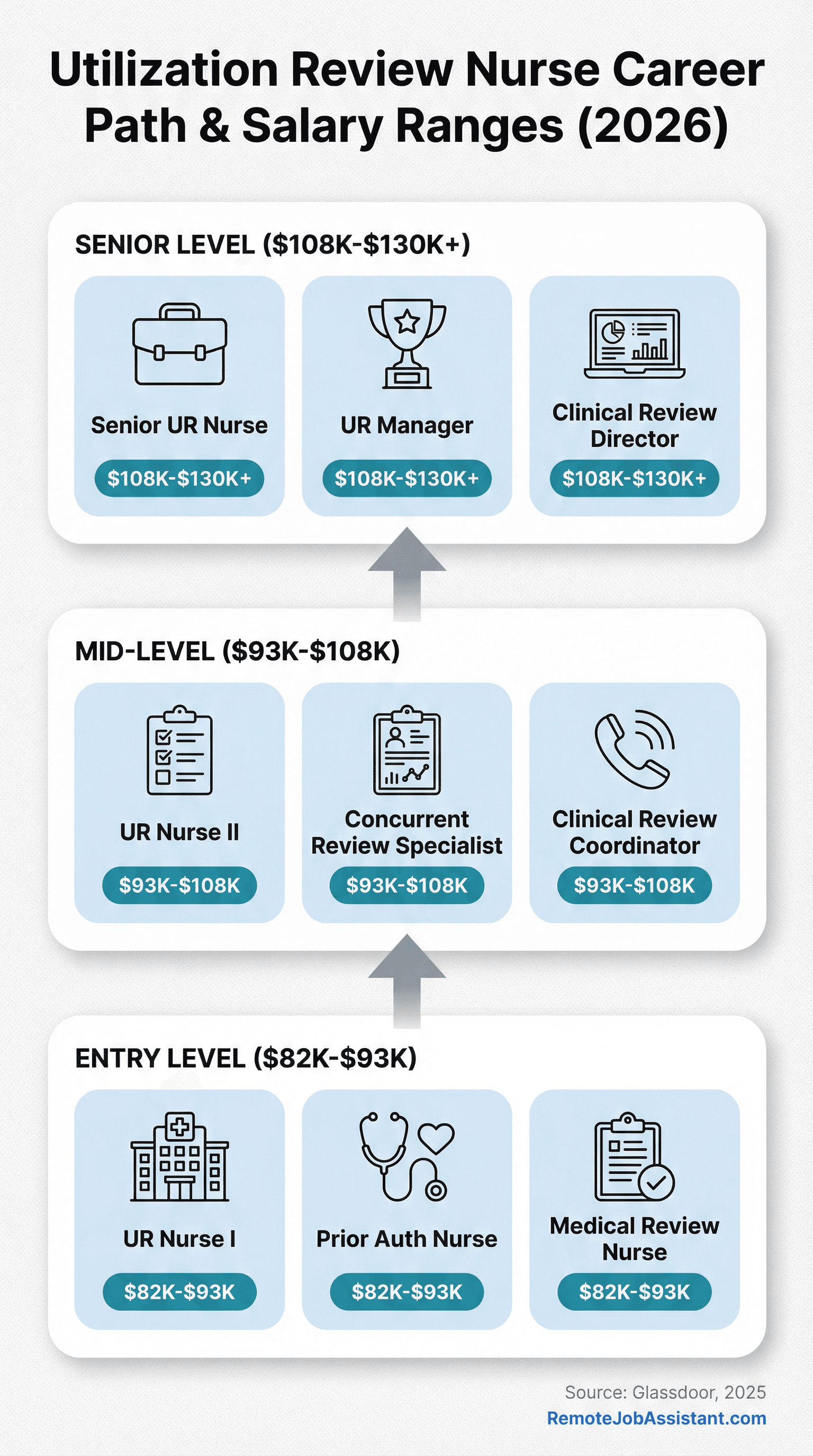
UR nursing pays exceptionally well—especially for a role you can do from your couch. Here's what the latest data shows:
According to Glassdoor's 2025 salary data, utilization review nurses earn:
| Experience Level | Annual Salary | Hourly Rate |
|---|---|---|
| Entry-Level (25th percentile) | $81,903 | $39/hr |
| Median | $93,851 | $45/hr |
| Experienced (75th percentile) | $108,291 | $52/hr |
| Top Earners (90th percentile) | $123,091 | $59/hr |
These figures align closely with Salary.com's December 2025 data, which reports an average around $91,600 for RN utilization review positions.
Salary varies significantly by location and employer:
New York City: $100,290 average (7% above national average)
California: $101,100 average
Texas/Florida: $90,000-$91,000 average
Top-paying industries: Human resources/staffing agencies ($92,006 median) and insurance companies ($86,881 median)
For comparison, the Bureau of Labor Statistics reports the median RN salary at $93,600—meaning UR nurses earn right around the national average while enjoying far better work-life balance than most bedside nurses.
Decode Any Job Posting
Paste a job description and get instant insights: what they really want, red flags to watch, and how to stand out.
Why Utilization Review Is Ideal for Remote Work
UR nursing transitioned to remote work more seamlessly than almost any other nursing specialty. Here's why:
The work is entirely computer-based. You're reviewing electronic records, not performing physical assessments. Everything you need exists in digital systems accessible from anywhere.
Insurance companies were already distributed. Major insurers like UnitedHealth, Humana, and Cigna have operated with remote workforces for years. The infrastructure was already in place.
Demand exploded during COVID—and never reversed. Healthcare organizations discovered remote UR nurses were just as effective (often more so) than on-site staff. According to our analysis of job postings, over 80% of UR nurse positions now offer remote or hybrid arrangements.
Remote UR nurses report higher job satisfaction than their on-site counterparts. The flexibility to work from home eliminates commuting stress, allows for better work-life integration, and reduces exposure to infectious diseases common in clinical settings.
The shift to value-based care models has also increased demand. As healthcare systems focus more on outcomes and cost-effectiveness, UR nurses play a critical role in ensuring appropriate resource utilization.
Companies Hiring Remote Utilization Review Nurses
Major health insurers and managed care organizations consistently hire remote UR nurses. Based on our tracking of job postings and industry sources, these companies regularly have openings:
Major Health Insurers
UnitedHealth Group/Optum — The largest health insurer in the U.S. offers extensive remote UR positions. Glassdoor reports UR nurses at Optum earn $79,000-$98,000 annually. Requires compact RN license for most positions.
Humana — Louisville-based insurer with strong remote culture. UR nurses report $79,000-$96,000 salary range. Known for excellent benefits including 401(k) match and tuition reimbursement.
Cigna — Offers UR positions across multiple states. Frequently cited as a top employer for remote nurses seeking work-life balance.
CVS Health/Aetna — Following their merger, CVS/Aetna has become a major employer of remote UR nurses. Positions include care coordination, prior authorization, and concurrent review roles.
Centene — One of the largest Medicaid managed care organizations. Regularly hires Utilization Review Nurse I positions for their various state health plans. Offers competitive pay plus flexible remote/hybrid options.
Other Major Employers
Molina Healthcare — Focuses on government-sponsored healthcare (Medicaid, Medicare). Strong reputation for training and career development.
Elevance Health (formerly Anthem) — Blue Cross Blue Shield affiliate with nationwide remote opportunities.
Kaiser Permanente — Integrated healthcare system with UR positions in multiple states.
Third-Party Administrators: Companies like CorVel, Davies, and Dane Street hire UR nurses for workers' compensation and specialty review roles.
A multistate compact RN license dramatically expands your job options. Many remote positions require you to be licensed in multiple states or hold a compact license. Check the Nurse Licensure Compact to see if your state participates.
Stop Applying Manually
Our AI applies to hundreds of matching jobs while you sleep. Wake up to interviews, not more applications.
Skills and Qualifications You Need
Transitioning to UR nursing doesn't require going back to school—but you do need the right background and skills.
Required Qualifications
Active RN License: All UR positions require current, unrestricted RN licensure. Compact licenses are increasingly preferred for remote roles.
Clinical Experience: Most employers require 2-5 years of acute care nursing experience. Med-surg, ICU, and emergency department backgrounds are particularly valued.
Education: Associate degree (ADN) is the minimum; many employers prefer BSN-prepared nurses.
Preferred Qualifications
| Credential | Issuing Organization | Notes |
|---|---|---|
| CCM (Certified Case Manager) | CCMC | Most recognized case management certification |
| CPHQ (Certified Professional in Healthcare Quality) | NAHQ | Demonstrates quality improvement expertise |
| CMCN (Certified Managed Care Nurse) | AAMCN | Specifically covers UM and case management |
| HCQM (Health Care Quality Management) | ABQAURP | Focuses on utilization review specifically |
Key Skills Employers Look For:
Critical thinking: You'll make coverage determinations that affect patient care and organizational finances. Employers need nurses who can analyze complex clinical information and apply evidence-based criteria consistently.
Medical record interpretation: Strong documentation review skills are essential. You must quickly extract relevant clinical information from often incomplete or disorganized records.
Communication: You'll interact with physicians, insurance representatives, and patients. Clear, professional communication—especially when delivering unfavorable determinations—is crucial.
Technology proficiency: Comfort with EHR systems, utilization management platforms, and Microsoft Office is expected. Many employers use InterQual or Milliman Care Guidelines software.
Time management: Remote UR nurses typically manage high caseloads independently. You need to prioritize effectively and meet turnaround time requirements.
How to Transition from Bedside to UR Nursing
Making the switch requires strategic preparation. Here's how nurses successfully transition to utilization review:
Step 1: Assess Your Readiness
UR nursing suits nurses who enjoy analytical work over hands-on care. Ask yourself:
- Do you like reviewing documentation and solving puzzles?
- Are you comfortable making decisions that affect coverage?
- Can you work independently without direct supervision?
- Do you handle pressure well when physicians disagree with your determinations?
UR nursing isn't for everyone. If you thrive on patient interaction and hands-on care, you may find the desk-based work unfulfilling. The role also requires delivering unwelcome news—denying coverage is part of the job, even when you empathize with the patient.
Step 2: Build Relevant Experience
If you're currently in bedside nursing, look for opportunities to gain adjacent experience:
Internal transfers: Many hospitals have case management or UR departments. Express interest to your manager or apply for internal postings.
Float to case management: Offer to help the case management team when your unit is slow. This exposure demonstrates initiative and builds relevant skills.
Quality improvement projects: Volunteer for QI initiatives that involve chart review, outcomes analysis, or process improvement.
Step 3: Get Certified (Optional but Helpful)
While certification isn't always required, it signals commitment and competence. The CCM (Certified Case Manager) is the most widely recognized credential and opens doors across case management and utilization review roles.
Step 4: Tailor Your Resume
Highlight transferable skills:
- Documentation review experience
- Insurance authorization knowledge
- Discharge planning involvement
- Quality metrics and outcomes tracking
- EHR proficiency
Decode Any Job Posting
Paste a job description and get instant insights: what they really want, red flags to watch, and how to stand out.
UR Nursing vs. Bedside Nursing: A Comparison
Still weighing whether to make the switch? Here's how the roles compare:
| Factor | Bedside Nursing | UR Nursing (Remote) |
|---|---|---|
| Schedule | Rotating shifts, nights, weekends, holidays | Monday-Friday, standard business hours |
| Physical Demands | High—lifting, standing 12+ hours | Low—desk-based work |
| Patient Interaction | Direct, hands-on care | Minimal—primarily phone/written communication |
| Salary | $93,600 median (BLS) | $93,851 median (Glassdoor) |
| Stress Type | Acute, life-or-death decisions | Deadline-driven, high-volume caseloads |
| Work Location | On-site required | 80%+ positions offer remote options |
| Career Path | Clinical ladder, management, APRN | UM leadership, quality director, compliance |
The salary is comparable, but the lifestyle difference is dramatic. Remote UR nurses consistently report better work-life balance, lower burnout rates, and greater control over their daily schedules.
What a Typical Day Looks Like
Remote UR nurses generally work 8-hour shifts during standard business hours. A typical day might include:
Morning:
- Review overnight requests in your queue
- Process prior authorizations for scheduled procedures
- Conduct concurrent reviews for hospitalized patients
Midday:
- Peer-to-peer calls with physicians to discuss clinical rationale
- Documentation and case notes
- Team meetings (usually virtual)
Afternoon:
- Complete remaining reviews before end-of-day deadlines
- Follow up on pending information requests
- Respond to appeals or escalations
Most UR positions have productivity metrics. Concurrent review nurses might handle 15-30 cases daily, depending on complexity. Prior authorization specialists may process 40-60 straightforward requests per day. Employers typically provide targets during onboarding.
Frequently Asked Questions
How much do remote utilization review nurses make?
Remote UR nurses typically earn in the low-$80Ks to low-$100Ks annually based on 2025 Glassdoor data. Entry-level positions generally start around $82,000, while experienced nurses at top-paying employers can reach $120,000 or more. Salary varies by location, employer, and years of experience.
Do I need case management experience for utilization review?
Not necessarily. While case management experience is helpful, many employers hire nurses with strong acute care backgrounds and provide UR-specific training. Med-surg, ICU, and ED experience are particularly valued because they provide broad clinical knowledge.
What certifications help with utilization review jobs?
The most recognized certifications are CCM (Certified Case Manager), CPHQ (Certified Professional in Healthcare Quality), and CMCN (Certified Managed Care Nurse). Certification isn't always required but can make you more competitive and may increase starting salary.
Can LPNs do utilization review?
Yes, some employers hire LPNs for UR roles, though positions are less common than RN opportunities. LPN UR positions typically focus on initial screening and prior authorization rather than complex medical necessity determinations that require RN-level assessment.
How long does it take to get hired as a UR nurse?
Most nurses report 4-8 weeks from application to offer for entry-level UR positions. The process typically includes an initial phone screen, behavioral interview, and sometimes a clinical assessment or case study. Major insurers often hire in cohorts with scheduled training start dates.
Is utilization review nursing stressful?
UR nursing involves different stressors than bedside care. You'll face productivity metrics, deadline pressure, and sometimes difficult conversations with physicians who disagree with your determinations. However, most nurses find this less stressful than the life-or-death acuity of clinical settings.
Do I need a compact nursing license for remote UR jobs?
Many remote positions require a compact license or the ability to obtain licensure in multiple states. This is because you may be reviewing cases for patients across different states. Check each job posting for specific licensure requirements.
Start Your Remote UR Nursing Career
Utilization review nursing offers a compelling path for RNs seeking remote work, predictable schedules, and competitive compensation—without sacrificing the clinical expertise you've built over your career.
The demand is real. Based on Bureau of Labor Statistics projections, RN employment is expected to grow 5% through 2034, with increasing opportunities in managed care and insurance settings. As healthcare costs continue rising, organizations need skilled nurses who can balance quality care with resource stewardship.
Ready to explore your options? Browse remote nursing positions on our job board, or check out our comprehensive remote nursing jobs guide for more career paths that let you work from home.
If you're a parent seeking flexibility, our remote jobs for moms page highlights positions with family-friendly schedules—many UR roles fit perfectly.
The transition from bedside to remote utilization review isn't just a career move—it's a lifestyle upgrade. Your clinical skills have value beyond the hospital floor. It's time to put them to work from the comfort of your home office.
Ready to Find Your Remote Job?
Browse thousands of curated remote jobs or let AI apply for you.
Browse Remote JobsRelated Job Guides
Remote Interior Design Jobs: What 1,409 Postings Show (2026)
Remote interior design jobs are rare: 40 of 1,409 US postings were remote. See which designer, planner, and FF&E seats pay $75K+ from home, and where.
46 min read
Remote Journalism Jobs: What 1,438 Postings Show (2026)
Remote journalism jobs are rare: 77 of 1,438 US newsroom postings were remote. See which reporter, editor, and audience seats pay $75K+ from home, and where.
39 min read

Remote Architecture Jobs: What 1,574 Postings Show
Remote architecture jobs are rare: 25 of 1,574 postings. See which roles go remote, what they pay, and why most firms still want you at the pin-up wall.
35 min read