
Last reviewed: August 2026
You spent somewhere north of 20,000 hours earning the right to practice medicine. Now you type "remote physician jobs" into a search bar and get the same thing every time: telehealth urgent-care listings paying by the consult, a LinkedIn page claiming 15,000+ openings with no way to tell which ones are real, and job boards that treat an MD the same way they treat an entry-level marketing hire.
Here's what those pages won't tell you: "remote physician" is not one job. It's six different careers wearing the same keyword — and the one everybody pictures, live video visits on a telehealth platform, is the most crowded and most volume-dependent of the six. The quietly better corner of the market is the work that happens away from the webcam entirely: utilization review, peer review, and payer-side medical director roles that pay $164K to $300K+ on salary, with no patient panel, no call schedule, and no productivity treadmill.
Get Remote Job Tips in Your Inbox
Weekly strategies, salary data, and new opportunities
Unsubscribe anytime. No spam.
This guide maps all six paths with real 2026 pay data, explains the licensing strategy that multiplies your income more reliably than any fellowship, and shows you which employers hire for each path. We reviewed 286 remote physician job postings across 94 employers — telehealth platforms, national payers, review organizations, and health systems — between March and August 2026, and cross-referenced compensation against ZipRecruiter, Glassdoor, and Indeed salary data.
Based on our analysis of 286 remote physician postings (March–August 2026):
- 58% (n=166 of 286) were direct virtual care — synchronous telemedicine visits
- 27% (n=77 of 286) never involve a live patient: utilization review, peer review, chart review, or medical director work
- 71% (n=203 of 286) required or preferred licensure in multiple states
- Psychiatry was the single largest specialty at 24% (n=69 of 286) of clinical postings
- $101–$153/hr is the typical telemedicine physician hourly band, per ZipRecruiter's August 2026 data
- $164K–$233K is the typical physician advisor salary range for utilization review roles (ZipRecruiter, June 2026)
- 44 states plus DC and Guam now participate in the Interstate Medical Licensure Compact; 51% of compact licenses are issued within a week
How We Collected This Data
The figures in this post come from our review of 286 remote physician job postings collected between March 2026 and August 2026. Postings were sourced from telehealth platform career pages, payer and health-system career sites, applicant tracking systems with public listings, and major job boards, then filtered to US remote-eligible positions requiring an MD or DO. We excluded physician assistant and nurse practitioner roles, hybrid positions requiring regular on-site presence, and locum tenens assignments with travel requirements.
Salary figures were cross-referenced against ZipRecruiter, Glassdoor, and Indeed compensation pages for the same period. Where sources disagree — and for physician pay they disagree a lot, because self-reported samples skew differently on every platform — we show the divergence rather than picking the flattering number. Per-consult and per-case rates come from posted rate cards and platform disclosures, not estimates.
We update this analysis quarterly. Data in this post reflects August 2026 figures.
The Six Kinds of Remote Physician Jobs
Most physicians researching remote work know about telemedicine and stop there. That's like researching "remote finance jobs" and stopping at bookkeeping. Here's the actual menu:
| Path | What you actually do | Pay structure |
|---|---|---|
| Telemedicine / virtual care | Synchronous video visits: urgent care, primary care, chronic condition follow-up | Hourly ($101–$153) or per-consult ($15–$60) |
| Telepsychiatry | Full psychiatric practice delivered virtually — the deepest remote specialty market | Salary or hourly; $212K–$317K typical |
| Utilization review / UM | Medical necessity determinations for payers using InterQual or MCG criteria | Salary; $164K–$233K |
| Peer review / IME / disability review | Case files, records, and independent exams reviewed asynchronously | Per-case; volume you control |
| Tele-specialty clinical | Tele-ICU, tele-stroke, tele-hospitalist, teleradiology coverage | Shift-based; specialty-dependent |
| Medical director (payer or platform) | Clinical leadership, UM oversight, protocol and quality ownership | Salary + benefits; $200K–$300K+ |
The reason the non-clinical paths exist — and keep growing — is structural. Every insurance denial that gets appealed, every disability claim, every workers' comp dispute, and every prior authorization above a certain threshold legally requires a physician's judgment. That paperwork volume scales with healthcare spending, not with patient demand, which is why review work has been expanding for a decade regardless of what happens to telehealth funding cycles.
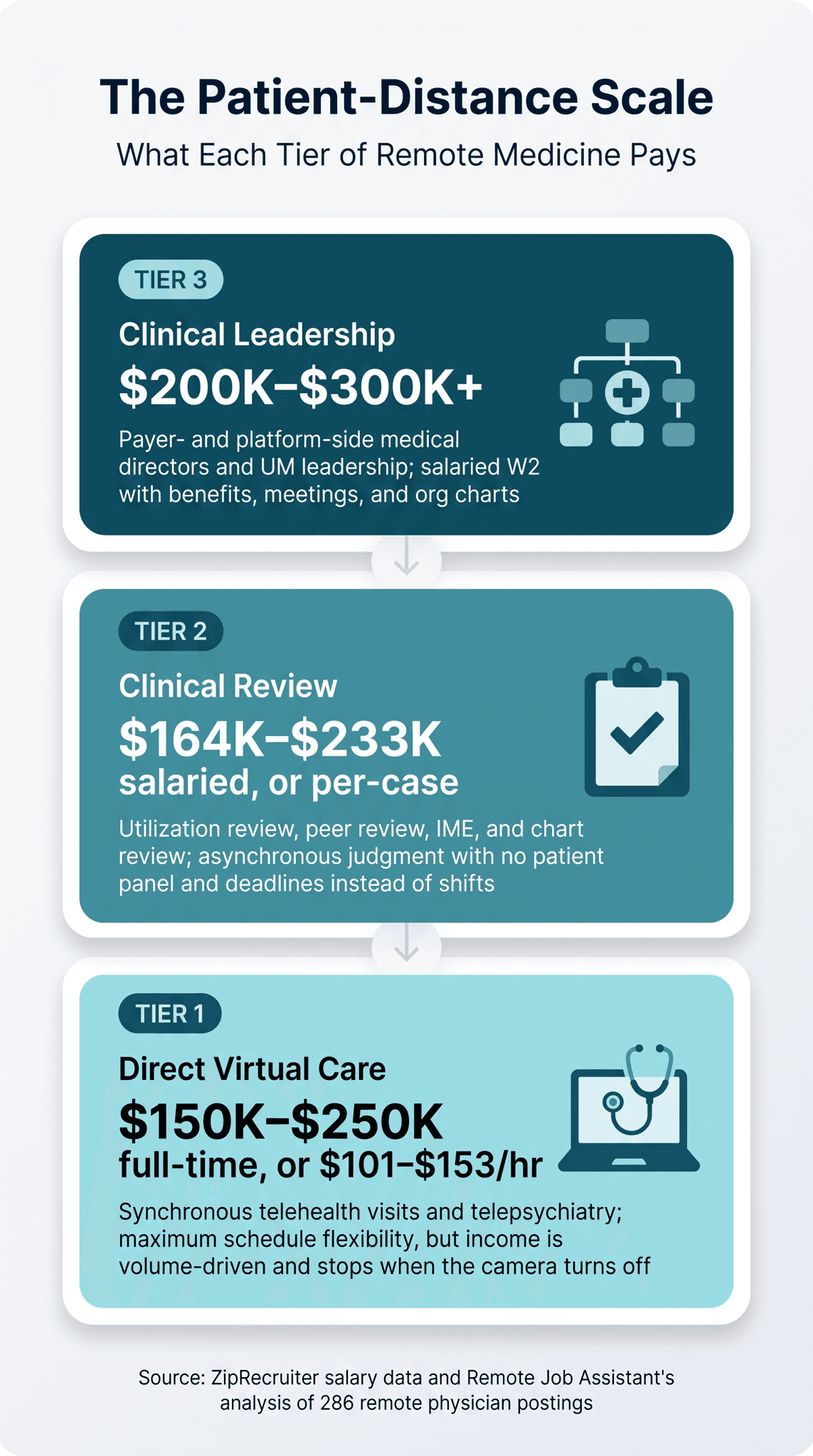
To choose between these six, you need one organizing variable. We call it The Patient-Distance Scale: a 3-tier rubric that classifies every remote physician role by how close it sits to live patient care — because that distance, more than specialty or employer, predicts your pay structure, schedule control, and burnout risk.
- Tier 1 — Direct Virtual Care ($150K–$250K full-time; $101–$153/hr): Synchronous visits — telehealth urgent care, primary care, telepsychiatry. Maximum schedule flexibility, but income is volume-driven: it stops when the camera turns off. Malpractice exposure closest to in-person practice.
- Tier 2 — Clinical Review ($164K–$233K salaried, or per-case): Asynchronous judgment — utilization review, disability peer review, IMEs, chart review. No patient relationship; deadlines instead of shifts. The most under-searched tier in remote medicine.
- Tier 3 — Clinical Leadership ($200K–$300K+): Payer- and platform-side medical directors and UM leadership. Salaried W2 with benefits, meetings, and org charts — the closest thing to an executive track that still requires your board certification.
How to use it: decide what you want less of — patient volume, call, panel ownership — and target the tier that removes it. A burned-out hospitalist who still loves clinical reasoning belongs in Tier 2, not Tier 1. A physician who wants to keep seeing patients two days a week and stack flexible income belongs in Tier 1 plus per-case Tier 2 work. The rest of this guide shows the tells for each.
The one-way door in that decision is time away from patients. Hospital and payer credentialing committees ask about clinical activity, and every year you spend in pure Tier 2 or Tier 3 work makes the eventual "have you practiced in the last 24 months?" question harder to answer without a re-entry program. Treat a move up the Patient-Distance Scale as reversible for about two years and expensive to reverse after that. If you're not sure, keep a clinical toehold — one telehealth shift a week, a locums week a quarter — until you are.
Stop Applying Manually
Our AI applies to hundreds of matching jobs while you sleep. Wake up to interviews, not more applications.
What Remote Physician Jobs Pay in 2026
The tiers don't just pay different amounts — they pay in different shapes, and the shape determines whether the job is sustainable. A $240K telemedicine year built on per-consult volume is a different life than a $220K salaried utilization review year with paid vacation.
| Path | Typical 2026 range | Structure | Patient-Distance tier |
|---|---|---|---|
| Telemedicine physician (FT) | $150K–$250K | Hourly or per-consult, often 1099 | Tier 1 |
| Telepsychiatrist | $212K–$317K | Salary or hourly, W2 and 1099 both common | Tier 1 |
| UR physician advisor | $164K–$233K | Salaried W2 | Tier 2 |
| Peer/IME reviewer | Per-case; scales with volume | 1099, self-scheduled | Tier 2 |
| UM medical director | $200K–$300K+ | Salaried W2 + benefits | Tier 3 |
Salary ranges derive from our analysis of 286 remote physician postings between March and August 2026, cross-referenced with ZipRecruiter, Glassdoor, and Indeed compensation data. We excluded postings without stated compensation or clear remote policies.
Two honest caveats about the numbers, because physician salary data is unusually messy. First, the aggregate sources diverge hard: ZipRecruiter puts the average telemedicine physician at roughly $239K per year as of August 2026, while Glassdoor's estimate runs over $400K — a gap driven by Glassdoor's sample skewing toward established specialists reporting total compensation. Treat the ZipRecruiter band as the realistic planning number and the Glassdoor figure as what's possible with specialty premium and volume. Second, per-consult platforms advertise flexibility, not rates — the posted range runs $15 to $60 per consult depending on complexity and specialty, and the difference between those endpoints is the difference between a side income and a career.
The best-paying remote physician jobs aren't the ones where you see patients — they're the ones where you review what happened to them. A UM medical director at a national payer earns hospitalist money with banker's hours. That role at Integra Partners was recently posted at $250K; UnitedHealth Group's Optum division hires remote UM medical directors continuously. Nobody tells residents this path exists, which is exactly why the $150K-plus remote roles in this category see less competition than telehealth shift work.
One trade-off nobody puts in the posting: in utilization review, your paycheck comes from the party that benefits when the answer is "not medically necessary." Some physicians make peace with that by treating the criteria as a guardrail against bad medicine and overturning the denials that deserve it; others discover they can't stand writing the letter. The tell in an interview is how the medical director answers "what happens when a reviewer disagrees with the criteria set?" — if the honest answer is "they don't," that payer wants a signature, not a physician. Decide which you are before you resign the clinical job, because this is exactly the kind of work you find out you hate after the bridge is burned. The cheapest way to find out is a few months of per-case review on the side, which is why the on-ramp later in this guide starts there.
Where you sit inside each range comes down to three variables: specialty (psychiatry and radiology command premiums), employment structure (W2 salary trades ceiling for floor; 1099 does the reverse), and — for Tier 1 — how many states you can legally cover. Which brings us to the single most underrated fact in remote medicine.
The License Portfolio: Remote Medicine's Real Salary Lever
Telemedicine has one iron rule: you must be licensed in the state where the patient is sitting, not where you are. Every platform, including Wheel and Teladoc, builds its physician matching around this constraint. Which produces a strange market dynamic that almost nobody frames honestly:
Telemedicine platforms don't pay for your clinical skill; they pay for your coverage map. Two internists with identical training are worth wildly different amounts to a platform if one holds a single state license and the other holds ten. More states means more shifts you're eligible for, more patient panels you can join, and more review cases you can legally touch. In our posting analysis, 71% (n=203 of 286) of remote physician roles required or preferred multi-state licensure — it's the closest thing to a universal hiring signal this market has.
The Interstate Medical Licensure Compact turned what used to be a year of paperwork into a process measured in days. The compact now covers 44 states plus Washington DC and Guam. Once the commission verifies your credentials and issues a Letter of Qualification, additional state licenses are issued on an expedited basis — the average is about 19 days, and 51% of compact licenses arrive within a week.
Read the compact's own FAQ before you pay, though, because the fine print disqualifies more physicians than the marketing suggests:
- The eligibility gates are absolute. You need a current ABMS or AOA board certification at entry, no disciplinary or controlled-substance history on any license, no criminal history, no open investigation — and you must have passed each component of the USMLE or COMLEX in no more than three attempts. A fourth attempt on Step 1 twenty years ago disqualifies you today. There is no waiver, and the commission tells you to self-determine eligibility before applying because the fee is non-refundable either way.
- The application fee is $700 plus each state's own fee, all non-refundable. State fees range from $35 (Pennsylvania, MD) to $895 (Texas); Florida is $355 for an MD and Nevada, New Jersey, and DC each sit around $800. Per the compact's published fee table, a five-state portfolio anchored on the expensive coastal boards is a $3,000-plus decision before your first shift.
- Your Letter of Qualification expires in 365 days, no waivers. During that year you can add states for $100 plus the state fee. After it lapses, you reapply and pay the full $700 again. Physicians who get the letter and then "wait for the right job" before choosing states are the ones who pay twice.
- Not every member state can be your anchor. Your State of Principal License must be somewhere you hold a full unrestricted license and either live, pay federal income tax, are employed by an in-state organization, or do at least 25% of your practice. 38 states plus DC and Guam process applications as an anchor state; Hawaii and Vermont issue compact licenses but can't serve as your anchor.
The license portfolio sequence:
- Anchor first. Your state of principal license must be an IMLC member state where you hold a full, unrestricted license and can prove the residence, tax, employer, or 25%-of-practice connection. Current board certification is checked at this step and only this step — a renewed Letter of Qualification doesn't ask for it again.
- Qualify once. Apply through the compact for a Letter of Qualification — one credential verification and one fingerprint submission instead of forty. Then use the letter inside its 365-day window.
- Buy states strategically. Don't collect all 44. Ask target platforms which states they're short on coverage for and license into gaps. Texas ($895) and Florida ($355) are compact states with heavy telehealth demand. California is not a compact member and New York has only introduced compact legislation — so the two biggest patient markets still require a traditional full application, which is a large part of why coverage there stays short and why a physician already holding either license is worth more to a platform than one holding five compact states.
- Run the payback math per state. At the low end of the hourly band ($101/hr), an $895 Texas license pays for itself in about nine hours of shifts. A state that produces no shifts in its first renewal cycle never pays for itself at any price. Each license carries its own renewal fee and CME requirements — prune the ones that don't produce.
The compact is also why the Tier 1 versus Tier 2 decision has a licensing dimension. Direct virtual care rewards the widest possible map. Utilization review and medical director work often need just one active unrestricted license, because you're rendering opinions on records rather than treating patients across state lines. If the licensing treadmill itself is what you're tired of, that's one more argument for moving up the Patient-Distance Scale.
Stop Applying Manually
Our AI applies to hundreds of matching jobs while you sleep. Wake up to interviews, not more applications.
Who's Hiring Remote Physicians in 2026
The employer market maps cleanly onto the three tiers — and the practical move is to match the employer type to your target tier, not to apply everywhere a physician-shaped opening exists.
Tier 1 — platforms and virtual care groups. Teladoc Health, Included Health, and Amwell anchor the established platform market; Included Health's posted physician compensation runs well above the telehealth average, per Indeed's company salary data. Wheel takes a different approach — one credentialing process, then matching across multiple virtual care programs (urgent care, weight management, remote patient monitoring), which solves the death-by-forty-credentialing-packets problem of stacking platforms yourself. Smaller virtual-care groups like Total Life and Wider Circle hire remote physicians continuously, with bilingual clinicians in particular demand.
Tier 2 — review organizations. Dane Street is the volume employer here: at the time of our analysis it listed remote physician reviewer roles across more than a dozen specialties — psychiatry, orthopedic spine, PM&R, cardiology, OB/GYN, ophthalmology, urology, pain medicine — most structured as 1099 per-case work. Disability carriers, workers' comp networks, and IME panels run on the same model. These roles rarely appear on general job boards, which is why physicians who only search the big boards conclude the tier doesn't exist.
Tier 3 — payers and platform leadership. UnitedHealth Group's Optum arm posts remote UM medical director roles on a rolling basis; Centene, CVS/Aetna, Humana, and regional payers follow the same pattern, and specialty benefit managers like Integra Partners post medical directorships at $250K. These are W2 executive-track roles with real interview loops — expect questions about criteria sets (InterQual, MCG), CMS guidelines, and appeal defensibility, not clinical vignettes.
Red flags in remote physician postings. Walk away, or at least ask:
- Per-consult pay with no hourly floor. At $15 a consult you need seven patients an hour to reach the bottom of the $101–$153 hourly band. The platform is selling flexibility; what you're actually buying is the slow-shift risk that used to belong to the employer.
- "OTE" or "up to" in a physician salary. One telepsychiatry employer in our sample advertised $300K–$350K+ OTE — base plus productivity. The headline number is the ceiling, not the offer. Ask for the base and the volume assumptions behind the rest, in writing.
- "Malpractice provided" with no mention of tail. Claims-made policies stop covering you the day you leave unless someone buys tail. If the contract is 1099 and the word "tail" isn't in it, that's your bill — and it arrives when you quit, which is the worst possible time.
- 1099 status with required shift minimums or fixed availability. The employer is claiming contractor economics (no benefits, no payroll tax) while imposing employee control. You carry both sides of the risk. Ask why the role isn't W2.
- "Must hold licenses in the following states" at your expense. After the compact math above, that's $700 plus state fees out of pocket before your first paycheck. Platforms serious about hiring you either reimburse or start you on the states you already hold.
Two questions that sort employers fast, tier by tier: for Tier 1, "what's the consult volume on a slow weeknight shift, and am I paid for the gaps?"; for Tier 2 and 3, "how many cases per day does a reviewer clear, and who signs the final determination?" A vague answer to either is the answer.
W2 or 1099? A five-line rule for comparing two remote physician offers:
- Take the W2 offer if the base alone clears your number and it carries malpractice with tail. A guaranteed $200K with tail beats a "$240K" per-consult ceiling you might not reach.
- Take the 1099 offer only if the rate is at least 20% above the W2 equivalent — that's roughly what you're replacing in employer payroll tax, benefits, and self-funded malpractice before the deductions help.
- Never sign either without the tail-coverage sentence in writing. Not in the recruiter's email — in the contract.
- If the 1099 offer has shift minimums, treat it as a W2 job with the benefits removed and price it accordingly.
- If neither offer will state consult volume or cases per day, the missing number is the one that decides your income. Walk.
And if benefits matter to your family situation, note that they cluster almost entirely in W2 Tier 2 and Tier 3 roles — the trade-offs look a lot like the ones in our guide to remote jobs with benefits.
If your clinical background leans research or pharma-adjacent, two nearby markets are worth a look before you commit to patient-facing telehealth: remote clinical research roles and remote pharmacist positions share the same payer-and-review economy described here, and the broader healthcare hiring market has moved remote faster than almost anyone predicted.
How to Land a Remote Physician Role
Here's the part that surprises physicians coming from traditional hiring: remote physician hiring is a credentialing race, not a resume contest. Platforms and payers are rarely choosing between you and a dramatically better candidate — they're choosing between you and whoever clears licensing, credentialing, and payer enrollment first. The winner is usually the qualified applicant whose paperwork moves fastest.
That reframes the whole playbook:
Start the IMLC process before you apply, not after. A Letter of Qualification in hand converts "we'd need you licensed in six states" from a six-month objection into a three-week formality. It's the remote-medicine equivalent of showing up pre-approved.
Rebuild the CV for the tier. Tier 2 and Tier 3 employers don't want bedside anecdotes — they want documentation quality, denial and appeal experience, and fluency with InterQual or MCG criteria. If you've ever served on a UM committee, done peer review for your hospital, or handled prior auth appeals, that's the lead item, not a footnote under "committee service."
Stack 1099 review work as the on-ramp. The lowest-risk path out of full-time clinical work is adding per-case review alongside your current practice. It costs you nothing but evenings, builds the exact experience Tier 2 and Tier 3 interviews screen for, and tells you whether you actually like the work before you resign anything. Concretely: apply to Dane Street's reviewer panel in your specialty, then learn whichever criteria set your first payer uses — InterQual and MCG are the two that keep coming up in Tier 2 and Tier 3 postings — because the determination letters you write on those cases become the writing samples a medical director interview will ask for.
Read the physicians who already did it before you read another job board. The unvarnished versions of every trade-off in this guide — per-consult rates on specific platforms, which reviewer panels pay on time, who actually got a compact license in six days — show up in the Physician Side Gigs community and in threads on r/medicine and r/telemedicine, not in postings. Spend an evening there before you spend $700 on a compact application; it's the closest thing to a reference check on an employer that physicians have.
Get the paperwork stack in order before the offer, not after. Most of the 60-to-90-day credentialing delay is primary-source verification waiting on you: a current CAQH profile, a clean NPDB self-query, every state license and DEA registration you're claiming, and references who actually answer email. Physicians who show up with that folder ready collapse the timeline; physicians who start it after signing are the ones a quarter behind.
Even after you're hired, platform credentialing routinely takes 60 to 90 days before you see your first patient or paycheck. Physicians who apply to one platform, wait, and then start over lose an entire quarter to sequential paperwork. The physicians who transition smoothly run applications in parallel — multiple platforms, multiple tiers — and let the credentialing timelines race each other.
Parallel applications are exactly the kind of repetitive, form-heavy work that burns out a person who spent a decade training for something better. That's the problem Auto-Apply exists to solve: it submits applications across hundreds of thousands of company career pages on your behalf while you handle the parts only a physician can do — licensing, credentialing, and deciding which tier of remote medicine you actually want. If your applications are going out but interviews aren't coming back, the failure points are usually diagnosable — we broke them down in why you're not getting interviews.
Stop Applying Manually
Our AI applies to hundreds of matching jobs while you sleep. Wake up to interviews, not more applications.
Frequently Asked Questions
What kind of doctors can work remotely?
Psychiatry is the deepest remote market — 24% (n=69 of 286) of the remote clinical postings we analyzed — followed by radiology, internal medicine, family medicine, and pediatrics. But every board-certified MD or DO can do Tier 2 review work in their own specialty: insurers need orthopedic surgeons to review orthopedic claims and cardiologists to review cardiology denials, which is why review organizations post reviewer roles across a dozen-plus specialties at any given time.
I'm board-certified but burned out on patient care — what remote physician jobs don't involve seeing patients?
Utilization review, disability and workers' comp peer review, IME work, chart review, and payer-side medical director roles all use your clinical judgment without a patient panel. In our analysis, 27% (n=77 of 286) of remote physician postings involved no live patient contact at all. UR physician advisor roles run $164K–$233K salaried; medical directorships run $200K–$300K+.
How much do telemedicine doctors actually make per hour?
The realistic band is $101–$153 per hour for telemedicine physicians, per ZipRecruiter's August 2026 data. Per-consult platforms pay $15–$60 per visit, so effective hourly depends entirely on volume — four $25 consults an hour beats one, and slow shifts pay accordingly. Full-time roles typically land between $150K and $250K, with telepsychiatry running higher at $212K–$317K.
Do I need a medical license in every state where I see patients?
Yes — licensure follows the patient's location, not yours, and there is no telehealth exception. The practical fix is the Interstate Medical Licensure Compact: 44 states plus DC and Guam participate, and once you hold a Letter of Qualification, additional licenses average about 19 days, with half issued within a week. Budget $700 for the compact application plus $35 to $895 per state, all non-refundable, and note that California isn't a member — a California patient panel still means a traditional application.
Which tier of the Patient-Distance Scale should I target if I still want some clinical work?
Straddle Tier 1 and Tier 2: keep part-time virtual visits (or your existing practice) and add per-case review work on top. Per-case review is self-scheduled 1099 work, so it flexes around clinical hours instead of competing with them. Pure Tier 2 or Tier 3 is the move only when you're certain you want zero panel ownership — those roles are harder to re-enter clinical practice from after several years away.
Should I take a W2 telehealth job or stack 1099 platform work?
W2 trades ceiling for floor: guaranteed hours, benefits, employer-carried malpractice — usually with tail coverage — but capped upside. Stacked 1099 work has a higher ceiling and meaningful tax deductions W2 physicians can't take, but you're buying your own malpractice and benefits and absorbing volume risk. The deciding question is usually malpractice tail: confirm in writing who pays for it before signing either contract.
How long does credentialing take once I'm hired?
Budget 60 to 90 days from signed agreement to first patient on most platforms — credential verification, payer enrollment, and state-by-state clearances run sequentially if you let them. That's separate from licensing itself, which the IMLC has compressed to weeks. Run platform applications in parallel so the timelines overlap instead of stacking.
Start Your Remote Medicine Career
The remote physician market rewards the people who see its actual shape: six paths, three tiers, and a licensing system that quietly functions as a salary multiplier. Pick your distance from the patient, build the license portfolio that tier demands, and run your applications in parallel instead of one credentialing packet at a time.
Browse remote roles paying $150K and up, see how physician pay compares across the highest-paying remote careers, and let Auto-Apply handle the application volume while your Letter of Qualification does the real negotiating.
Medicine spent a century assuming the physician had to be in the room. The room turned out to be optional — the license, the judgment, and the board certification are not.
Ready to Find Your Remote Job?
Browse thousands of curated remote jobs or let AI apply for you.
Browse Remote JobsRelated Job Guides

Remote Event Planning Jobs: What Actually Goes Remote
Only 12% of event job postings are fully remote and none were titled Event Planner. See which titles actually go remote, what they pay, and how to pivot.
24 min read

Remote Insurance Jobs: Pay, Top Roles, and How to Get Hired
Remote insurance jobs pay $62K-$130K+ by specialty. Real 2025 wage data for adjusters, underwriters, and actuaries — plus which roles are truly remote.
22 min read
Remote SOC Analyst Jobs: 2026 Salary Guide by Tier
Remote SOC analyst jobs in 2026: Tier 1-3 salary bands from $70K to $160K, which certs actually raise pay, the MDR firms hiring, and how to break in fast.
19 min read