You didn't become a nurse to cry in your car before every shift.
But here you are—Googling "remote nursing jobs" at 2am, wondering if there's a way to use your license without destroying your body, your sleep, and your sanity. Wondering if those work-from-home nursing positions are real, or just another thing that sounds too good to be true.
They're real. And you can get one.
Get Remote Job Tips in Your Inbox
Weekly strategies, salary data, and new opportunities
Unsubscribe anytime. No spam.
"I thought I was failing nursing by going remote. Turns out I just changed how I practice it." — ICU nurse, 8 years bedside, now remote case manager
This guide covers everything: what remote nursing jobs actually exist, what they pay, which companies hire, and—most importantly—how to transition from bedside to remote without starting your career over.
- Remote nursing jobs pay $66K-$150K depending on role and experience
- Most common entry points: telehealth triage, case management, utilization review
- You need 2-3 years of bedside experience for most roles (some exceptions exist)
- Compact nursing license = 3x the job opportunities
- Expect 50-100+ applications before landing your first remote role
- See all remote jobs for nurses in one place
Why Nurses Are Going Remote (And Why It's Not About Being Lazy)
Let's get the stats out of the way: 65% of nurses report burnout as their top challenge. 138,000 nurses have left the workforce since 2022. Nearly 40% of RNs plan to leave within five years.
But you already knew the profession was in crisis. You live it.
What the statistics don't capture is the specific exhaustion of caring for people who scream at you, hit you, or die despite everything you did right—then being told you're a "hero" while your hospital cuts staff again.
Remote nursing isn't an escape from nursing. It's a different way to use your clinical brain without sacrificing your physical and mental health to do it.
In short: You spent years learning to assess, triage, and think critically under pressure. Remote roles let you apply those skills from home—often with better pay stability and zero risk of being assaulted by a patient.
What Remote Nursing Jobs Actually Exist
Not all remote nursing is telehealth. Here's the full landscape:
| Role | What You Actually Do | Best Fit For | Typical Pay |
|---|---|---|---|
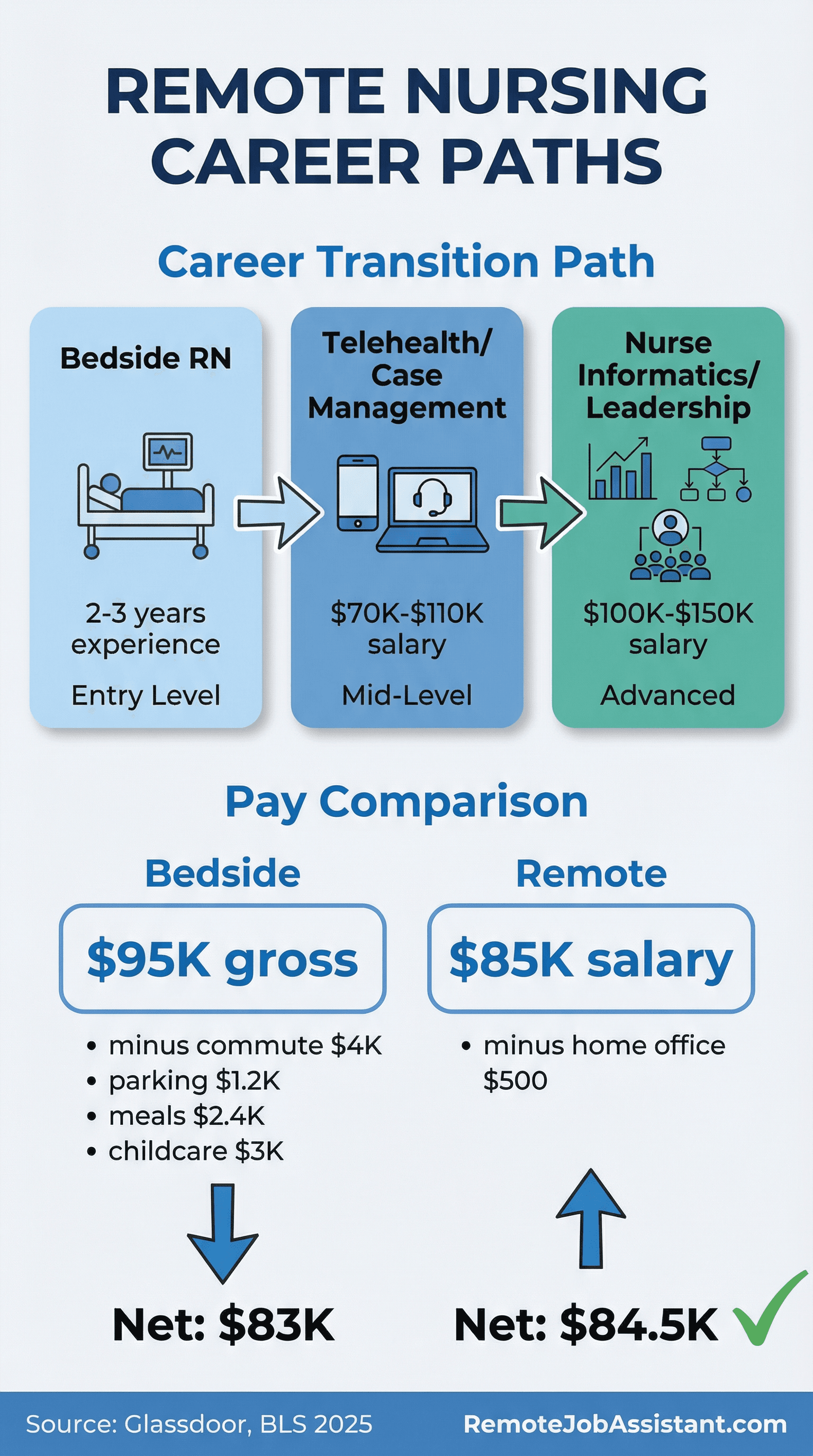
| Telehealth Triage RN | Assess symptoms by phone/video, direct to appropriate care | ER/ICU nurses who miss assessments | $70K-$110K |
| Nurse Case Manager | Coordinate care across providers, manage complex patients | Nurses who love the puzzle of care planning | $73K-$150K |
| Utilization Review RN | Determine medical necessity for insurance coverage | Detail-oriented, documentation-focused nurses | $66K-$102K |
| Clinical Documentation Specialist | Improve chart accuracy for billing/quality | Nurses who were always fixing other people's notes | $70K-$115K |
| Prior Authorization RN | Review and approve medication/procedure requests | Calm under bureaucratic pressure | $60K-$95K |
| Remote Nurse Educator | Train staff, develop curriculum, teach online | Preceptors, charge nurses, natural teachers | $65K-$110K |
| Quality Assurance Nurse | Audit charts, track outcomes, improve processes | Perfectionists who notice everything | $65K-$100K |
| Nurse Informatics | Bridge clinical and IT, optimize EHR workflows | Tech-curious nurses who hate inefficiency | $75K-$130K |
| Legal Nurse Consultant | Review medical records for legal cases | Nurses who read charts like detective novels | $60K-$125K |
| Medical Writer | Create patient education, clinical content | Strong writers who explain complex things simply | $55K-$100K |
In short: Most nurses land their first remote role through telehealth triage, case management, or utilization review—not exotic roles like informatics or legal consulting. Start where the jobs are.
Which One Is Right for You?
If you miss patient interaction: Telehealth triage. You're still assessing, still making clinical decisions, still talking to real people—just without the physical strain.
If you're an introvert who thrives on focused work: Utilization review, prior auth, or clinical documentation. Minimal phone time, lots of independent analysis.
If you loved being a preceptor: Nurse educator roles let you teach without the chaos of bedside orientation.
If you're tech-savvy and hate inefficient systems: Informatics puts you at the intersection of clinical knowledge and technology.
If you want the highest ceiling: Case management. The pay range is widest, the growth is clearest, and it's the most common "first remote role" for bedside nurses.
The Real Math: Remote vs Bedside Pay
Here's what most guides won't tell you: the base salary for remote nursing often looks lower than bedside—until you do the actual math.
Bedside RN (hospital):
- Base salary: $75,000
- Night/weekend differential: +$8,000
- Overtime (often mandatory): +$12,000
- Total: ~$95,000
But subtract:
- Commute costs: -$4,000/year
- Parking: -$1,200/year
- Meals/coffee (you know you do): -$2,400/year
- Childcare for unpredictable shifts: -$3,000+/year
- Physical therapy/chiropractic (because your back is destroyed): -$1,500/year
Net take-home: ~$83,000
Remote Case Manager:
- Base salary: $85,000
- No differentials (but no forced nights either)
- Rarely overtime
- Total: $85,000
Subtract:
- Home office costs: -$500/year (one-time setup, minimal ongoing)
- That's it.
Net take-home: ~$84,500
The numbers are closer than they look. And that's before you factor in the value of sleeping in your own bed, eating lunch with your kids, and not being physically threatened at work.
In short: Remote nursing pays less in gross salary but often equals or exceeds bedside in net compensation—with dramatically better quality of life.
Decode Any Job Posting
Paste a job description and get instant insights: what they really want, red flags to watch, and how to stand out.
Companies Actually Hiring Remote Nurses
Everyone knows about the big names. Here's who's really hiring and what to expect:
Insurance & Managed Care (Largest Employers)
UnitedHealth Group / Optum — The biggest. Hires for case management, utilization review, prior auth. Expect a long interview process (3-5 rounds). Pays competitively. Promotes from within.
Humana — Strong remote nursing presence. Known for better work-life balance than some competitors. Telehealth and case management heavy.
CVS Health / Aetna — Massive hiring volume. Roles range from telephonic nurse to clinical documentation. Some roles require specific state licensure.
Cigna — Utilization management focus. Good benefits. Structured environment.
Anthem / Elevance Health — Large footprint. Case management and clinical review roles. Variable reviews on culture depending on team.
Telehealth Platforms
Teladoc — The household name. Hires NPs and RNs for virtual visits and triage.
Amwell — Growing platform. Various clinical roles.
98point6 — AI-assisted platform. Nurses support the technology layer.
Health Systems with Remote Roles
Mayo Clinic, Cleveland Clinic, Kaiser Permanente — Yes, traditional health systems have remote positions. Usually in quality, case management, or telehealth. Often prefer internal transfers, so if you're already in the system, look internally first.
Specialty & Emerging
Calibrate, Ro, Nurx, Cerebral — Digital health startups. Often hire for specific conditions (weight management, mental health, reproductive health). Can be more flexible but also less stable.
Skip Indeed (too much noise). Go directly to:
- Company career pages (search "[company] remote nurse jobs")
- NurseFern.com (curated remote nursing job board)
- LinkedIn with "remote" filter
- Or browse all remote jobs for nurses to see curated positions
Stop Applying Manually
Our AI applies to hundreds of matching jobs while you sleep. Wake up to interviews, not more applications.
Entry-Level Remote Nursing: Yes, It Exists
The conventional wisdom says you need 5+ years of bedside experience. That's not entirely true.
Roles That Hire With Less Experience
HEDIS Nurse Abstractor — Seasonal (January-May typically). Chart review for quality measures. Many positions accept 1-2 years experience. Great entry point to prove you can work remotely.
Health Coach / Wellness Nurse — Some programs hire newer nurses for telephonic coaching.
COVID/Vaccine Triage Lines — Less common now, but public health emergencies create entry points.
Float/PRN Telehealth — Some companies hire part-time or PRN to build your remote experience while you keep bedside work.
The Real Talk
Entry-level remote nursing is competitive. For every position, there are hundreds of experienced nurses also applying. If you have less than 2 years experience, your strategy should be:
- Apply to HEDIS positions during open season (September-November for January start)
- Look for "new grad" or "early career" in job titles
- Consider PRN/part-time remote to build experience
- Get your compact license before applying
In short: Entry-level remote nursing is possible but competitive. HEDIS abstraction is the most realistic entry point—it's seasonal, it's unglamorous, and it works. Expect to apply to 100+ positions.
Why Your First 50 Applications Will Probably Fail (And What to Do About It)
Let's be honest: getting your first remote nursing job is hard. Not because you're unqualified—but because the competition is intense and most nurses make the same mistakes.
What Hiring Managers Actually Screen For
1. Remote work readiness — Can you work independently without supervision? Do you have a quiet home office? Reliable internet? They're screening for chaos at home.
2. Technology comfort — Multiple monitors, EHR systems, telehealth platforms, Microsoft Office. If your resume doesn't signal tech competence, it goes in the no pile.
3. Specific experience keywords — "Case management," "utilization review," "triage," "documentation." Generic "med-surg experience" doesn't translate. You need to reframe your experience in their language.
4. Compact license or willingness to obtain — Multi-state coverage = more attractive candidate. If you're in a compact state, say so clearly.
How to Reframe Your Bedside Experience
Your bedside experience is valuable—but you need to translate it.
| Instead of This | Say This |
|---|---|
| "Provided patient care on med-surg unit" | "Managed care for 6-8 acute patients per shift, coordinating with interdisciplinary team" |
| "Administered medications" | "Verified medication appropriateness and monitored for interactions across complex regimens" |
| "Communicated with families" | "Provided telephonic updates to families, explaining clinical status and care plans" |
| "Trained new nurses" | "Developed and delivered clinical education for new graduate nurses" |
The pattern: Remote job descriptions emphasize communication, coordination, assessment, and education. Your bedside experience includes all of this—you just need to surface it.
Decode Any Job Posting
Paste a job description and get instant insights: what they really want, red flags to watch, and how to stand out.
The Compact License Arbitrage
Here's the career hack that triples your job opportunities: the Nurse Licensure Compact (NLC).
If you hold a compact license, you can work for employers in any of the 42 compact states without obtaining additional licenses. That's 42 states of job opportunities instead of 1.
Impact on Your Job Search
Many remote positions—especially at insurance companies—require compact licensure or specific state licenses (often Texas, Florida, or their headquarters state). If you're in a compact state and don't have your compact license, you're leaving opportunities on the table.
Non-compact states: California, New York, Massachusetts, Illinois, Oregon, Washington. If you live here, you may need to obtain individual state licenses for some remote positions—factor in the cost (~$200-500 per state) and processing time.
The arbitrage: Nurses in compact states have a structural advantage. If you're considering a move anyway, compact state residency is worth factoring into your decision.
Your 8-Week Transition Plan
Here's the tactical roadmap from bedside to remote:
Weeks 1-2: Foundation
- Update your nursing license to compact (if eligible)
- Audit your resume for remote-relevant keywords
- Set up LinkedIn profile with "Open to Work" for remote nursing roles
- Create a quiet, professional home office space (or plan for one)
- Research 10 target companies and bookmark their career pages
Weeks 3-4: Application Prep
- Rewrite resume using the translation framework above
- Write 2-3 tailored cover letter templates
- Prepare your "why remote?" story for interviews
- Set up job alerts on company career pages and LinkedIn
- Begin applying: aim for 5-10 applications per week
Weeks 5-6: Volume Phase
- Increase to 15-20 applications per week
- Track everything in a spreadsheet (company, date, status)
- Follow up on applications after 1 week if no response
- Practice video interview setup (lighting, background, audio)
- Research common interview questions for your target roles
Weeks 7-8: Interview Prep
- Prepare STAR stories for behavioral questions
- Practice explaining your clinical experience in remote terms
- Have questions ready about training, metrics, and team structure
- Negotiate when you get an offer (remote roles have room)
Reality check: Most nurses don't land a role in 8 weeks. This plan builds momentum. The median time to first remote job offer is 2-4 months of consistent effort.
Stop Applying Manually
Our AI applies to hundreds of matching jobs while you sleep. Wake up to interviews, not more applications.
What Nurses Worry About (Answered Honestly)
"Will I lose my clinical skills?"
Some, yes. Your hands-on assessment skills will fade without practice. But your critical thinking, triage abilities, and clinical judgment stay sharp—and those are what remote roles actually pay for. Many nurses keep PRN bedside work for the first year if skill maintenance matters to them.
"Is remote nursing lonely?"
It can be. You go from a chaotic unit with constant human interaction to a home office with Teams messages. Some nurses love it. Others struggle. Most companies have virtual team meetings and chat channels, but it's not the same as break room conversations. Know yourself.
"What about AI? Will these jobs disappear?"
AI is changing the work, not eliminating it. Chatbots handle simple triage questions; nurses handle complex judgment calls. The nurses thriving in remote roles are the ones embracing AI tools for documentation, research, and efficiency—then adding the clinical insight AI can't provide.
In short: AI makes tech-comfortable nurses more valuable, not less. The risk is to nurses who resist the tools, not those who learn them.
"How competitive is it really?"
Very. Popular remote positions get 200-500+ applications. You're competing against experienced nurses from across the country, not just your metro area. The good news: most applicants don't optimize their materials. A targeted resume and genuine interview presence still differentiate.
Frequently Asked Questions
What is the average salary for remote nursing jobs?
Remote nursing jobs pay between $60,000 and $150,000 depending on role and experience. Telehealth triage nurses average $70,000-$95,000, case managers $80,000-$110,000, and utilization review nurses $70,000-$90,000. Nurse informaticists and senior case managers can exceed $130,000.
Can you be a remote nurse with no experience?
Most remote nursing jobs require 2-3 years of bedside experience. However, some entry points exist for newer nurses: HEDIS chart abstraction (seasonal), health coaching, and PRN telehealth positions. Building remote experience through part-time work while maintaining bedside employment is a common strategy.
What is the easiest remote nursing job to get?
HEDIS nurse abstractor positions are typically the easiest entry point to remote nursing. They're seasonal (January-May), focus on chart review, and many accept nurses with 1-2 years of experience. Telehealth triage is the most common first full-time remote role for experienced nurses.
Do you need a compact nursing license for remote work?
A compact nursing license significantly expands your job opportunities but isn't always required. Many employers accept single-state licenses, though some require compact or specific state licensure. Nurses with compact licenses have access to positions in all 42 compact states, roughly tripling their job options.
Is remote nursing less stressful than bedside?
Remote nursing eliminates physical strain, violence exposure, and commute stress. However, it introduces different challenges: isolation, sedentary work, and metrics-driven performance pressure. Most nurses transitioning from bedside report improved work-life balance and reduced burnout, but the stress doesn't disappear—it changes form.
What equipment do I need for remote nursing?
Most employers provide computer equipment or a stipend. You typically need: reliable high-speed internet (usually 50+ Mbps), a quiet private workspace, a desk and ergonomic chair, and a headset. Some telehealth roles require a second monitor. Confirm specific requirements during the interview process.
How long does it take to get a remote nursing job?
The median time from starting your search to receiving an offer is 2-4 months of consistent effort, applying to 50-100+ positions. Nurses with case management or utilization review experience often find roles faster. Those transitioning from pure bedside work typically take longer as they build relevant experience through HEDIS or PRN work.
Start Your Remote Nursing Job Search
You've spent years developing clinical judgment that can't be automated. Remote nursing lets you use those skills without sacrificing your health to do it.
The transition isn't easy—but neither was nursing school, your first code, or any of the other hard things you've already survived.
Explore remote jobs for nurses to see what's available now, check out entry-level remote positions if you're earlier in your career, or browse flexible schedule remote work if schedule control is your priority.
Stop Applying Manually
Our AI applies to hundreds of matching jobs while you sleep. Wake up to interviews, not more applications.
Salary data compiled from Glassdoor, ZipRecruiter, Salary.com, and Bureau of Labor Statistics (December 2025). Burnout statistics from NCSBN 2024 National Nursing Workforce Study, AMN Healthcare 2025 Survey of Registered Nurses, and Cross Country/FAU "Beyond the Bedside" 2025 report.
Want an ATS-Optimized Resume?
Get our complete resume toolkit with templates, examples, and strategies.
Get the Resume ToolkitRelated Career Transitions

How to Follow Up on a Job Application (Templates That Actually Work)
Learn when and how to follow up on a job application with copy-paste templates for senior professionals—remote-specific guidance, timing data, and a 3-step sequence.
22 min read

How to Get Into Customer Success With No Experience (2026)
Break into customer success without SaaS experience. Transfer skills, entry-level paths, and what hiring managers actually look for.
9 min read

Best Remote Jobs for Former Teachers in 2026 (No Classroom Required)
Former teachers are landing $60K-$90K remote jobs in 2026—and you can too. Your classroom skills translate to instructional design, EdTech, corporate training, and more. See the exact career paths teachers are taking.
14 min read