
Last reviewed: October 2026
You typed "remote respiratory therapist jobs" into LinkedIn after another run of nights, and the first page offered you more nights. On October 19, 2026, the first 30 cards for that search held 23 distinct respiratory therapy postings. We opened all 23. Two were fully remote. Fourteen sent you to patients' houses or a DME branch. Six were hospital shifts, including a Brooklyn night shift and a "Virtual RT" job at Mayo Clinic that turns out to be on site in Rochester with a $15,000 sign-on bonus. One said REMOTE in the title and "set-up and service medical devices" in the body.
Both of those remote seats are equipment-support jobs. Apria's troubleshoots CPAP, BiPAP, ventilators, and oxygen by phone and video; ResPro's keeps advanced PAP patients on therapy. You can't suction a trach over video, so the RTs who work from home are coaching CPAP users through Medicare's 90-day adherence window, checking device data, or running virtual pulmonary rehab. Those seats exist because an equipment supplier or a rehab vendor pays for them, and they pay what that business can afford, which is usually less than your hospital does.
Get Remote Job Tips in Your Inbox
Weekly strategies, salary data, and new opportunities
Unsubscribe anytime. No spam.
We read 1,518 RT-credentialed job postings at 620 employers, all first listed between January and October 2026, to find every seat you can do from home and every one that clears $75K. This guide covers the 12 fully remote seats we found, what they pay against the bedside, why one of them wants licenses in 14 states, and where the $75K+ seats actually are.
Based on our read of 1,518 RT-credentialed postings first listed January–October 2026:
- 0.8% (n=12 of 1,518) were fully remote after reading the full text; 5 more were hybrid or remote-eligible
- 0 of 237 postings with a posted pay floor of $75K or more were fully remote; 214 of the 237 were on site and 16 were field-based industry seats
- $21–$40 an hour is the posted range on the best-documented full-time remote seat (Apria's Respiratory Therapist Telehealth), against a $32.39–$48.98 median posted range across 348 hospital staff RT postings
- 5 of 12 remote seats are part-time, per diem, 1099, or freelance; one pays $20 per 30-minute session
- 7 of 8 patient-facing remote seats require a state RT license; Apria's asks for Florida or Texas now and 14 states over time
- 22 of 28 field-based industry seats state a travel figure, and all 22 ask for 50% or more (the median is above 70%)
- 4 of 398 RT postings returned by 11 LinkedIn "remote," "telehealth," and "virtual" searches were fully remote
- $82,280 is the BLS median wage for respiratory therapists (May 2025); the top 10% earn more than $118,050
How We Collected This Data
Start with what we couldn't see. Indeed, Glassdoor, ZipRecruiter, and Reddit block automated reads, so any RT seat posted only there is missing from our counts. One telerespiratory company, rtNOW, says on its employment page that it alerts RTs to new positions first in a private Facebook group, so its two live board postings likely undercount it.
What we could read came from five places. LinkedIn's public job search returned 1,980 cards across 33 searches built on remote, telehealth, virtual, sleep, ventilator, clinical specialist, sales, education, and plain "respiratory therapist" terms, and we read the full text of all 1,529 RT-related cards. SimplyHired, which carries Indeed's network, added 449 postings we read in full from 36 searches. Workday career sites supplied 229 postings from 18 employers, including Owens & Minor, ZOLL, Philips, ResMed, Medtronic, Baxter, BD, five insurers, and five hospital systems. rtNOW's own board added 2. A probe of about 150 sleep, DME, device, and remote-monitoring employers on Greenhouse, Lever, Ashby, and SmartRecruiters found one RT-adjacent opening.
We kept a posting if it asked for or accepted a CRT or RRT credential, an RT license, or an RT degree, or if it had an RT title. We removed repeats of the same employer, title, and city across sources, and dropped pre-2026 evergreen listings and hiring-event posts. Every work-model call came from reading the posting, not from a tag, and that's where the surprise was. Of the 46 postings a keyword filter flagged as remote or hybrid, 9 held up as fully remote. Seventeen were on-site jobs carrying HR boilerplate such as "Positions that are eligible for hybrid or mobile/remote work mode are at the discretion of the hiring department." Ten sent the RT to patients' homes, and five were territory seats with heavy travel. SimplyHired's "Remote" tag sat on clinical-instructor jobs that require you to stand on a hospital floor with students.
Pay benchmarks come from the Bureau of Labor Statistics' Occupational Outlook for respiratory therapists, which reports May 2025 wages. The Indeed-only and Facebook-only openings make 12 a floor, not a ceiling. Triple it and remote is still under 3% of RT hiring, because 1,314 of the 1,518 postings came from hospitals and care facilities. These figures reflect postings live as of October 19, 2026; we update this analysis quarterly.
The Off-Bedside Ladder: Where an RT Credential Pays Away From the Bedside
"Is it remote?" is the wrong first question. Almost nothing is, and the few seats that are pay less than you make now. The better question is which kind of off-bedside seat a posting is, and what that kind costs you. That's what the Off-Bedside Ladder sorts.
The Off-Bedside Ladder ranks the four kinds of seat an RT credential gets you away from bedside shifts, by posted pay, and scores what each rung costs you in pay basis, license load, and travel.
Scoring, from the lowest posted pay to the highest:
- Rung 1, Screen seat ($21–$40 an hour full time; $20 per 30-minute session to $44–$46 an hour part-time): Fully remote telehealth, remote monitoring, or virtual pulmonary rehab. A license in every state your patients live in, and for some seats the RRT (both rtNOW seats and BreatheSuite require it). No on-call. You may supply the computer: rtNOW asks for a laptop with an operating system "no greater than 6 years old." We found 12.
- Rung 2, Home-care seat (median posted $34.19–$40.00 an hour, n=34): A DME branch plus patients' living rooms. "Home-based" and "remote/home visits" mean the patient's home, not yours. Your car or a company car, mileage, and on-call rotations. 105 postings came from DME and home-care suppliers.
- Rung 3, Campus seat ($80,000–$125,000 in education; $38.71–$58.09 an hour in hospital virtual RT): Hybrid program-director and online-faculty seats that want one to two years of teaching in an RT program (and a master's degree for faculty), plus hospital virtual-ICU desks that sit on campus and can be internal-only.
- Rung 4, Territory seat (median posted floor $115,000, median top $167,000; 16 of 28 post pay): Device and DME clinical specialists, applications specialists, and territory managers. You live in the territory, near an airport, and travel 50% to 100% of the time. Clinical specialist seats typically want an RRT plus three to five years of ICU or critical care; territory manager seats want three-plus years of quota sales.
For comparison, the bedside line: hospital staff RT postings in our set had a median posted range of $32.39–$48.98 an hour, a midpoint of $41.00, or about $85,000 a year at 2,080 hours.
How to use it: Write down the two things you won't trade, your income floor and your travel ceiling. If your floor is above $75K and you won't travel, no rung fits today: stay at the bedside or aim for a campus seat. If you can travel half the month, Rung 4 is the only rung where the median posted floor clears what your hospital pays.
Here's what sits on each rung in our data:
| Rung | Example seats we found | Posted pay | Where you sit | License load | Travel | Postings |
|---|---|---|---|---|---|---|
| 1. Screen seat | Apria telehealth RT; rtNOW PAP setup and adherence; ResPro remote monitoring; Aviary, Bloom, BreatheSuite, and Breathe Better Rehab virtual pulmonary rehab | $21–$40/hr (Apria); $30–$33/hr (rtNOW); $55,000–$60,000 (ResPro); $20 per 30-min session (Aviary, 1099) | Home office | Heavy: named states, often several | None to light | 12 fully remote |
| 2. Home-care seat | Apria, Accendra, Rotech, SuperCare, Aveanna, and Johns Hopkins Care at Home field RTs | Median $34.19–$40.00/hr (n=34) | Branch and patients' homes | One state, sometimes two | Daily driving | 105 DME and home-care postings |
| 3. Campus seat | Boise State online faculty; RT program directors; Mayo "Virtual RT"; Penn Virtual ICU | $80,000–$125,000 (education); $38.71–$58.09/hr (Mayo) | Campus 2+ days a week, or on site | One state | Light | 5 hybrid or remote-eligible, plus on-site virtual desks |
| 4. Territory seat | GE HealthCare, Sentec, Masimo, Philips, Dräger, Hamilton, Baxter, Aerogen, Viz.ai | Median $115,000–$167,000 (16 of 28 post pay) | Home office and car, in your territory | Your home state, or none | 50%–100% | 28 field-based |
The table carries the post's main finding. The 12 seats you can do from home sit on the lowest-paid rung, and the rung that pays most is the one with the most driving and flying. The RT jobs you can do from home pay below the bedside; the RT jobs that pay above it put you in a rental car.
Once you know your two numbers, the next move depends on what you hold now.
You hold an RRT, have three or more years of ICU, and can travel half the month. Go for Rung 4 clinical or applications specialist seats first. GE HealthCare's postings ask for exactly that profile, "an active Registered Respiratory Therapist license with 3-5 years of ICU experience," and post $92,000–$138,000 in Minnesota and $124,240–$186,360 in Sacramento.
You hold only the CRT. Earn the RRT before December 31, 2026. After that date the NBRC's CRT-to-Registry path closes, and the seats that pay best off the bedside, the clinical specialist roles, ask for the RRT by name.
You want flexibility more than income. Keep the bedside job and add one Rung 1 seat on the side: a per diem or 1099 virtual rehab contract, or a PRN telehealth shift. That way the screen seat adds income instead of replacing a bigger paycheck.
You have a master's degree and teaching time in a CoARC program. Look at online degree-completion faculty seats. Boise State's posting says that because "the course delivery is online, the faculty member may function remotely," at $80,000–$90,000 for an 11-month contract.
Whichever branch fits, the bottleneck is the same: the seats are few, and the good ones close fast.
Stop Applying Manually
Our AI applies to hundreds of matching jobs while you sleep. Wake up to interviews, not more applications.
What Remote RT Jobs Pay Compared With the Bedside
Pay figures below are the ranges printed in the postings. Hourly rates are annualized at 2,080 hours, and sign-on bonuses, shift differentials, mileage, and commissions beyond a stated on-target figure are left out. We cross-checked against the BLS May 2025 wage data for respiratory therapists; ranges move, so check the linked source before you negotiate.
| Seat type | Postings with pay | Posted range | Annualized | Against the hospital staff median ($41.00/hr) |
|---|---|---|---|---|
| Territory seat, device and DME clinical specialists and sales | 16 of 28 | Median $115,000–$167,000 | Same | Above at both ends |
| Campus seat, RT program director or online faculty | 3 of 5 hybrid seats | $80,000–$125,000 | Same | Above |
| Hospital "virtual RT" desk, on site (Mayo) | 1 | $38.71–$58.09/hr | $80,517–$120,827 | Around or above |
| Hospital staff RT, bedside | 348 | Median $32.39–$48.98/hr | $67,371–$101,878 | The benchmark |
| Home-care seat, DME field RT | 34 | Median $34.19–$40.00/hr | $71,115–$83,200 | Below at the top end |
| Screen seat, full-time remote patient care | 4 of 4 full-time seats | $21–$40/hr (Apria); $30–$33/hr (rtNOW, two seats); $55,000–$60,000 (ResPro) | $43,680–$83,200 | Below |
| Screen seat, part-time or 1099 | 3 of 5 | $20 per 30-min session (Aviary); $22–$24/hr freelance (Aptara); $44–$46/hr PRN (Breathe Better Rehab) | Depends on hours | Varies; none is full time |
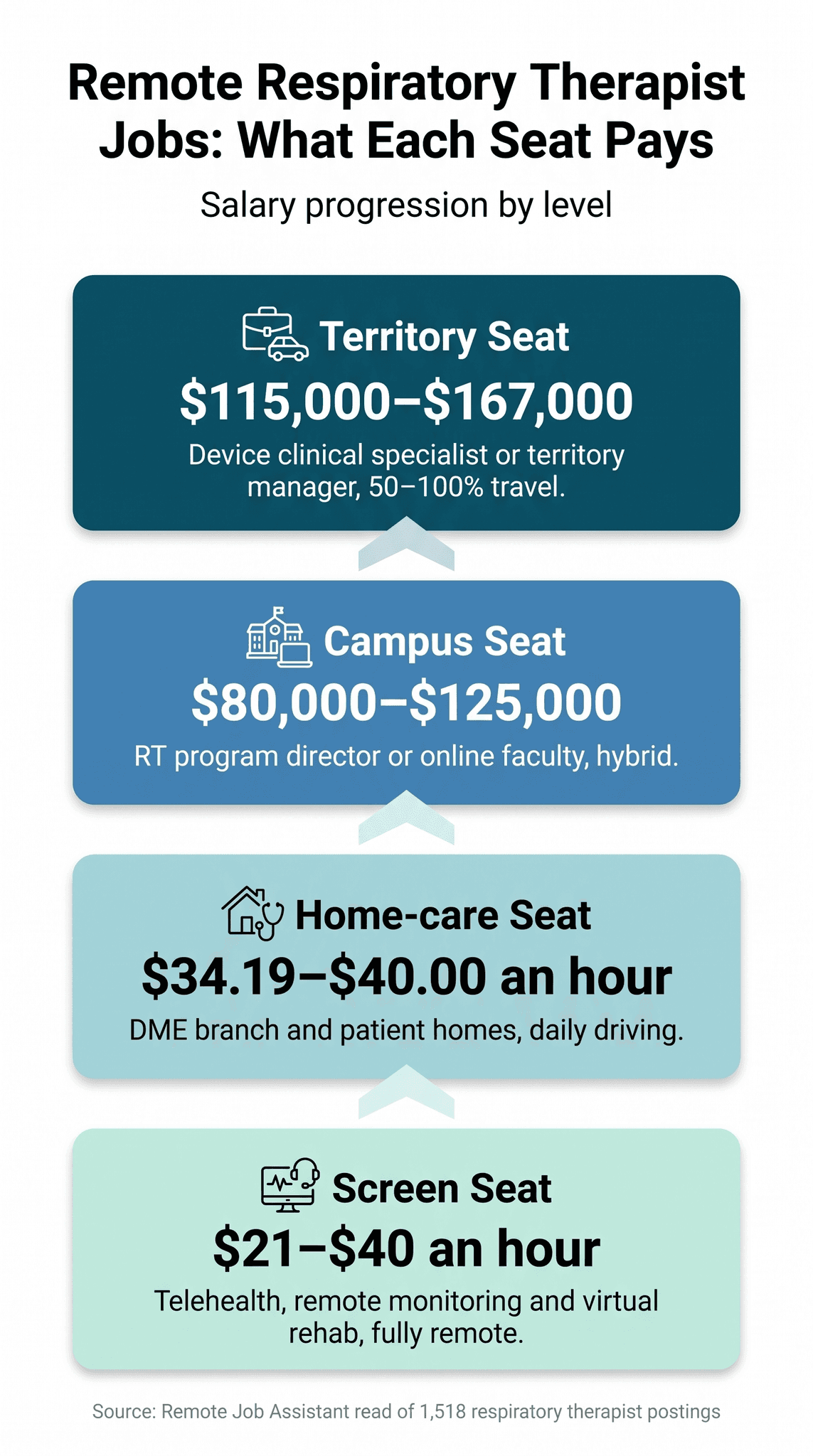
Read the table from the bottom. The best full-time remote ceiling we found is Apria's $40 an hour, or $83,200 a year, and that's the top of a range that starts at $21. rtNOW's two full-time seats, $30–$33 an hour, sit below the bedside median floor of $32.39 at their low end. ResPro's $55,000–$60,000 is under the BLS 10th percentile for the whole occupation ($63,660). Of the 569 postings in our set that printed pay, 237 had a floor of $75,000 or more. None of those 237 was fully remote.
That's why the $75K question has a short answer for RTs. The money off the bedside is real, but it lives on Rung 4, and it comes with a car. Sentec's territory manager postings print $180,000–$200,000 in total compensation with "overnight travel estimated at 50% - 65%." Philips's Upstate New York territory manager prints target earnings of $143,000–$164,000 plus a company car, and asks for a "Minimum 4 of 5 business days each week executing sales calls in the assigned territory." If those numbers look like the remote jobs that pay $100K and up in other fields, that's because they're sales and clinical-education jobs that happen to want an RT on the team.
Read the base before the headline number on any territory seat. Brett Fisher Group's respiratory account manager search posts a $110,000–$115,000 base ("stretch to $120K for RRTs") under a $185,000–$195,000 on-target figure, with a "3-month commission guarantee during onboarding." ZOLL's ventilation territory manager posting, which doesn't ask for an RT credential and so sits outside our 1,518, puts $200,000 "at plan" on a $65,000 base. Philips quotes its $143,000–$164,000 "At 85% to 120% performance achievement." The rule we'd use: if the base is under half the on-target number, price your first year at the base plus whatever guarantee is in writing, because the commission half depends on relationships in a territory you haven't worked yet.
Two caveats keep this honest. First, on-site leadership pays more than either: Kaiser Permanente posts $191,000–$221,100 for a Manager of Respiratory Therapy, and the VA posts $144,665–$188,071 for a Supervisory RRT service chief in Miami that reads "Telework eligible No." Second, location dominates bedside pay. Kaiser's Registered RCP II posting pays $68.83–$74.13 an hour at the bedside, which beats every remote seat in our set by a wide margin. If you live in a high-wage hospital market, the remote seat is an even bigger cut.
So before you trade a bedside job for a full-time screen seat, run the posting through three checks, in this order.
Check 1: the rate against your base, not your take-home. At the hospital staff median midpoint of $41.00 an hour, the bedside pays about $85,280 a year before night and weekend differentials. Apria's telehealth range tops out at $40 an hour, or $83,200, and starts at $21. If the offer letter doesn't put you at or above your current base, the screen seat is a pay cut, whatever the commute savings.
Check 2: the license list and who pays for it. Ask for the states in writing and in order. Apria's posting says "Company support provided for additional state licenses over time," and SuperCare's lists "Additional State Licensing - Paid." If the posting says "as needed" and the recruiter can't name the states, you're agreeing to an open-ended license bill.
Check 3: the hours you're guaranteed. A full-time W-2 seat (Apria, rtNOW, ResPro) is a different job from a per-session contract (Aviary pays "$20 for 30 min; $30 for 60 min") or BreatheSuite's pay on "verified time spent in patient care and documentation." If the pay is per session, multiply the rate by the sessions you can realistically book, not the hours you're online.
If all three pass, take the seat. If check 1 fails but you want the schedule, take it per diem on top of a bedside job instead of in place of one.
The checks work the other way, too: a territory seat that passes check 1 easily usually fails on travel, which the next sections cover.
Why Telehealth RT Seats Pay Less Than the Floor
The pay gap isn't an accident, and it isn't about your skill. It comes from who can bill for your time.
Hospitals bill for the care you deliver on the unit. Off the unit, you're harder to bill for. The American Association for Respiratory Care's 2026 legislative priorities say it plainly: respiratory therapists "already provide these services in clinical practice but cannot bill Medicare directly for them." The same page says Medicare "treats oxygen primarily as durable medical equipment rather than a comprehensive clinical service." So outside the hospital, your clinical time is mostly paid for by whoever rents the equipment.
That is where the remote seat comes from. Medicare keeps paying for a CPAP only if the patient proves they use it. The DME contractor's supplier FAQ on positive airway pressure sets the bar at four or more hours a night on 70% of nights in a 30-day stretch during the first three months, with an in-person re-evaluation between day 31 and day 91. There's no partial credit: "All requirements must be met within the 90-day time frame." The same FAQ names the problem RTs are hired to fix: "Compliance is a major issue with PAP; failure of therapy is often related to mask fit, humidification, ramp time, etc."
So a supplier staffs a team to call new CPAP users, fix the mask, read the download, and get the patient to the 70% line before day 90. rtNOW pitches that service to suppliers in exactly those terms: "Add rtNOW PAP setup and adherence services where we do the work, and you collect the income." The seat is a cost line against a rental, which is why it's priced like one.
The same company can buy that work without an RT at all. Apria posts its Respiratory Therapist Telehealth seat at $21–$40 an hour, and it also posts a full-time "Sleep Coach - Remote" at $20.00–$22.00 an hour to "coach, educate, and encourage patients as they adjust to CPAP therapy" and "Provide basic troubleshooting support for PAP and mask equipment." The coach posting asks for no RT credential; experience with sleep apnea patients is "preferred." rtNOW markets the opposite choice to suppliers: "You will not have a 'sleep coach' who was working at McDonald's two weeks ago taking care of your patients." When the bottom of the RT range sits a dollar above the coach's, your credential is buying the top of the range and the harder cases (ventilators, BiPAP, oxygen), not the seat itself. Ask which cases the RT seat owns before you accept the low end.
A remote CPAP adherence seat is priced off the equipment rental it protects, not off your ICU years. Until Medicare pays RTs for their own time outside the hospital, the screen seat will pay below the floor.
Could that change? The AARC is pushing two bills. The SOAR Act (H.R. 2902 / S. 1406) would "establish a statutory respiratory therapist service component for oxygen management." The AIR Act would let RRTs with a bachelor's degree bill Medicare for tobacco-cessation counseling, but the AARC says it "is still seeking a Congressional sponsor to introduce this legislation." Neither is law, so neither should shape a job decision you make this year.
Who Actually Hires Remote and Remote-Based RTs
Here's who posted the seats, grouped by the business that pays for them. The last column is the line in the posting that changes the math.
| Lane | Employers in our data | Example seat | Posted pay | The catch |
|---|---|---|---|---|
| DME telehealth | Apria (Accendra Health), rtNOW | Respiratory Therapist Telehealth; PAP Adherence; PAP Set Up Bilingual | $21–$40/hr; $30–$33/hr | Apria: FL or TX license now, 14 states over time. rtNOW: "will provide their own computer support" |
| Remote patient monitoring | ResPro Health | Respiratory Therapist (Georgia, South Carolina, and Alabama listings) | $55,000–$60,000 | You oversee Certified Medical Assistants and manage advanced PAP patients from home |
| Virtual pulmonary rehab | Aviary Health, Bloom Medical, BreatheSuite, Breathe Better Rehab (FX Physical Therapy) | Remote pulmonary rehab therapist | $20 per 30-min session; $44–$46/hr PRN; two don't post | All four are part-time, per diem, or 1099; BreatheSuite pays on "verified time spent in patient care and documentation" |
| Payer and documentation review | The van Halem Group (VGM Group) | Clinical Advisor (RN, RT) | Not posted | Wants DMEPOS claims-review experience; a Certified Professional Coder credential is preferred |
| Industry support and informatics | Beacon Biosignals, Emerus | Customer experience specialist; clinical application director | $33.65/hr (Beacon); director not posted | RRT is "preferred," not required; Emerus wants 10+ years of health IT |
| Device field seats | GE HealthCare, Sentec, Masimo, Philips, Dräger, Hamilton, Baxter, Aerogen, Viz.ai | Clinical applications specialist; clinical sales specialist; territory manager | Median $115,000–$167,000 | 50%–100% travel; sales seats want quota history |
The first five lanes are where the 12 fully remote seats live, and they split evenly: 4 keep equipment patients on therapy (Apria, both rtNOW seats, ResPro), 4 run virtual pulmonary rehab, and 4 never talk to a patient (VGM's documentation review, Beacon's customer support, Aptara's test-question writing, and Emerus's clinical-software director). The last lane is where the money is, and most of it is commercial: 16 of the 28 field seats carry sales, account, or territory titles, and the other 12 are clinical, applications, education, or implementation specialists who train customers on the equipment those reps sell. GE HealthCare's clinical applications posting says the quiet part plainly: the RT will "Drive realization of revenue thru execution of on-site or remote clinical education delivery." Your ICU judgment is the product demo. Notice who's missing: none of the five insurer career boards we checked (Humana, CVS, Elevance, Cigna, and Centene) had an RT-credentialed remote posting live. The insurer clinical seats we did see, such as CVS Health's field-based cardiopulmonary patient educators, were written for registered nurses, which is why remote utilization review nurse jobs outnumber anything an RT can apply to on the payer side. The one payer-style RT seat we found, VGM's Clinical Advisor, sits at a consultancy that helps DME suppliers get their paperwork past those same payers.
If you're weighing the sales side of Rung 4, our guide to breaking into remote sales covers the quota and pipeline questions a territory manager interview will ask, and the remote sales and business development listings are where those seats show up outside healthcare boards.
Stop Applying Manually
Our AI applies to hundreds of matching jobs while you sleep. Wake up to interviews, not more applications.
The License Problem: Why One Remote Seat Wants 14 States
A bedside RT needs one license, for the state the hospital sits in. A remote RT needs a license for every state the patients sit in, because the care happens where the patient is. BLS notes that respiratory therapists "must be licensed in all states except Alaska," so a national telehealth team needs a stack.
Apria's telehealth posting spells out what that stack looks like. You need an active license in Florida or Texas to apply, and then you "Will obtain and maintain licensure over time in the following states: TX, OK, LA, KS, NC, SC, GA, TN, FL, VA, AL, MS, MD, DC." That's 14 jurisdictions for a $21–$40 an hour seat. The posting adds "Company support provided for additional state licenses over time," which matters, because each license comes with its own fees, continuing education, and renewal calendar. Among the 8 patient-facing remote seats in our data, 7 require a state RT license, and three name the states up front: Apria's 14, BreatheSuite's "Colorado, Arizona, Utah, or Nevada," and rtNOW's adherence seat, which reads "Actively licensed in SC." rtNOW's setup seat adds "State licensure(s) in assigned service location as needed."
For a remote RT, the license count is the job description. Before you weigh the pay, ask how many states, which ones first, and who pays for each.
The fix on the horizon is the Respiratory Care Interstate Compact. According to the AARC's April 7, 2026 announcement, the compact became "official with the passage of the seventh and eighth states," and the new commission now has to "establish the RCIC bylaws, rules, and regulations." Florida's 2026 House bill analysis explains what a privilege would require once they're issued: an active license in your home state, an active NBRC credential, no adverse action against your license in the previous two years, the state and commission fees, and the remote state's jurisprudence requirement. It also says the privilege covers care delivered "remotely via telehealth."
That's good news for Rung 1, eventually. It doesn't help this year. A commission that is still writing its rules issues no privileges, and only member states will honor them. Plan your next 12 months around the licenses you can actually hold.
What the Work Looks Like After You're Hired
The postings are specific about the day, so here's what they say, in their words where we can quote them.
On a DME telehealth seat, you're on a schedule. Apria's runs "8:30 AM – 5:00 PM with flexibility," with "On-Call: None." You "troubleshoot respiratory equipment remotely, including CPAP, BiPAP, ventilators, and oxygen therapy" by phone and video, and you "maintain compliance with multi-state licensure requirements." rtNOW's adherence RT will "Receive a patient into the adherence process" and "create a communication plan with the patient" per protocol, working "Monday through Friday with occasional weekend" coverage. Its setup seat runs "Days/Evening/Every 4th Saturday," and the RT will "be responsible for computer technology and stable Wifi access and will provide their own computer support." Remote doesn't mean your time zone, either: Apria's team covers the "Central and Eastern Time Zones," Aviary books sessions "between 8am and 10pm ET," and Beacon Biosignals' support seat works "8 AM - 5 PM PT." If you live in Arizona and the team runs on Eastern time, an 8:30 start is 5:30 a.m. from March to November and 6:30 a.m. the rest of the year.
A remote monitoring seat leans more clinical. ResPro's RT will "Manage and support patients on Advanced BiPAP ST, AVAPS, IVAPS, ASV," "Recommend adjustments to PAP settings and create orders in electronic medical records," and "Provide clinical oversight and guidance to Certified Medical Assistants." In other words, you're the licensed clinician on a team that is mostly not RTs.
Virtual rehab is performance work on camera. Breathe Better Rehab's RT leads "45-minute live telehealth pulmonary rehab sessions" and "Must have a dedicated home work space." Bloom Medical's per diem RT must "Maintain a professional on-camera presence by ensuring a clear, well-lit, and distraction-free environment during all virtual patient sessions," and the posting calls the job "a non-clinical position." Aviary's contract runs 15–20 hours a week between 8am and 10pm Eastern, paid "$20 for 30 min; $30 for 60 min." Price your prep and charting time before you sign, because the session is the only thing on the rate card.
The territory seat is the opposite day. GE HealthCare's clinical applications specialist travels "4-5 days per week including some weekends." Masimo's clinical sales specialist needs "minimum 50% overnight travel." Baxter's acute-care clinical sales specialist covers Missouri, Tennessee, and Arkansas from a St. Louis home base at "approx. 60-75% overnight per month." Home is where you charge the laptop, not where you work.
And the hospital "virtual" desk is still the hospital. Penn Medicine's Virtual ICU RT works 7:00 am to 7:00 pm on the Rittenhouse campus, every third weekend, and the role "requires a minimum of 3 years of experience as Registered Respiratory Therapist and a minimum of 3 years as a UPHS employee." It's a promotion inside one system, not a job you can apply into from outside. That isn't true of every hospital virtual desk, though: Mayo's Virtual RT recruits outside hires with a $15,000 sign-on bonus and relocation help. Of the two hospital virtual-RT postings we read, one was internal-only and one was open, and both were on site.
How to Move Up the Ladder Without Losing Ground
Most RTs who leave the bedside for a screen seat take a pay cut they didn't plan for. These steps keep your options open while you aim higher.
1. Lock in the RRT before December 31, 2026. The NBRC's RRT page says the CRT-to-Registry admission policies "will be eliminated effective December 31, 2026." From January 2027, a single Respiratory Therapy Examination awards the CRT at a low cut score and the RRT at a high one. If you hold only the CRT and don't earn the RRT before January 1, 2027, you'll need to be a graduate of a CoARC-accredited program to sit the new exam; CoARC's accredited program finder lists them.
2. Pick licenses for the team you want, not the state you live in. For Rung 1, find out which states the telehealth team covers and get the first one or two before you apply. Apria will take Florida or Texas, and BreatheSuite will take Colorado, Arizona, Utah, or Nevada.
3. For Rung 4, make your ICU years legible. Clinical specialist postings ask for three to five years of ICU or critical care and the RRT. The RRT-ACCS shows it on paper: the NBRC's ACCS page requires one year as an RRT, and the exam costs $300 for new applicants, minus a one-time $40 AARC member discount. Pair it with one ventilator or airway product you know cold.
4. For Rung 3, count your teaching hours. The program-director searches we read want two years of teaching in a CoARC-accredited program. Boise State's online-faculty seat requires a master's degree, at least one year of teaching in an RT program, and fluency with Canvas or a similar learning platform, and prefers three or more years of online teaching.
5. Keep one foot in clinical work. A territory seat that ends in two years leaves you with less recent clinical time to show the next employer. A PRN bedside shift every month or two keeps your skills current and your hospital references fresh.
Before a recruiter call, know what the common posting phrases mean and what to ask back.
"Telemedicine" or "TeleCare" in the title: ask where you sit on day one, because Lincare's sits in its Clearwater office and SuperCare's drives to patients. "State licensure(s) as needed": ask for the state list, the order, and who pays. "Compensation based on verified time": ask what counts as verified and how many patient hours a week are typical. "Remote position requiring residence" in a territory: ask for overnights per month, not just a travel percentage.
If the answers put you on Rung 4, the remote jobs paying $75K and up are where to compare offers. Our guide to certifications for remote jobs covers which credentials actually show up in postings across fields.
Stop Applying Manually
Our AI applies to hundreds of matching jobs while you sleep. Wake up to interviews, not more applications.
Red Flags: When a "Remote RT" Listing Is Something Else
Almost every false lead in our data came from one of these patterns. Read the posting body, not the title or the tag.
| What the listing says | What it means | Example from our data |
|---|---|---|
| "Telemedicine" or "Telehealth" in the title | You may still sit in their office | Lincare's Respiratory Therapist, Telemedicine: "This is NOT a remote position. The RRT sits in an office and assists patients that are off-site." |
| "Virtual RT" or "Virtual ICU" | A hospital desk on campus | Mayo Clinic's Virtual RT in Rochester ($15,000 sign-on, Minnesota license before day one); Penn's Virtual ICU (internal candidates with 3 years at UPHS) |
| "TeleCare Team" | A driving job with telehealth visits | SuperCare Health: "Responsible driving from office to patient home or hospital" |
| "Home-based" or "remote/home visits" | The patient's home | Apria Charlottesville: "Hybrid; 50% office, 50% remote/home visits," $38.50 an hour plus $0.70 a mile |
| "REMOTE" in the title | Check the duties | VieMed's "Sleep Therapy-REMOTE" body: "This job will require the employee to set-up and service medical devices" |
| A "Remote" tag on a teaching job | Clinical instruction on a hospital floor | YTI Career Institute's adjunct clinical RT instructor jobs, tagged Remote on SimplyHired, precept students at hospitals in Lancaster and Williamsport, Pennsylvania, and require you to already work as an RRT at that hospital |
| "Remote position" plus a territory | You'll travel half the month or more | Sentec: "Remote position requiring residence in the Greater Minneapolis or St. Paul, MN area with overnight travel estimated at 50% - 65%" |
| Pay per session or per set-up | Your unpaid time isn't counted | Aviary: "$20 for 30 min"; Rotech PRN: "paid per set-up which ranges from $5.00 - $100.00 per service" |
The common thread is that "remote" in RT listings usually describes the patient, the equipment, or the employer's headquarters. For respiratory therapists, "telehealth" describes the patient's side of the screen, not yours. The SimplyHired numbers make the point: on October 19, 2026, "respiratory therapist" filtered to Remote returned 2 results, both on-site clinical-instructor jobs, out of 7,544 for the same search across the United States.
If you're an RN-RT dual credential holder, the nursing side has far more truly remote seats; our guide to remote nursing jobs and the remote case manager breakdown cover them.
Frequently Asked Questions
I'm an RRT with five years in the ICU. Can I find a fully remote job that pays what I make at the bedside?
Rarely. Of 569 RT postings that printed pay in our January–October 2026 read, 237 had a floor of $75,000 or more, and none of the 237 was fully remote. The best full-time remote ceiling we found was Apria's $40 an hour ($83,200 a year), on a range that starts at $21. ICU years pay best off the bedside in device clinical specialist seats, which post $92,000–$186,360 at GE HealthCare but travel 80% or more.
Is a telehealth respiratory therapist job actually remote?
Not always. Lincare's telemedicine RT posting says "This is NOT a remote position," Mayo Clinic's Virtual RT works on site in Rochester, and SuperCare's TeleCare RTs drive from the office to patients' homes. In our data, 4 of 398 RT postings returned by LinkedIn searches for remote, telehealth, and virtual terms were fully remote after reading the full text.
How many state licenses do I need for a remote RT job, and will the Respiratory Care Interstate Compact fix that?
As many as the states your patients live in. Apria's telehealth seat wants Florida or Texas to start and 14 jurisdictions over time, and 7 of the 8 patient-facing remote seats we read require a state RT license. The compact became official in April 2026, but its commission is still writing rules, so plan on individual licenses for at least the next year.
Which rung of the Off-Bedside Ladder pays $100,000 or more, and what does it cost me?
Rung 4, the territory seat. Device and DME clinical specialists and territory managers posted a median range of $115,000–$167,000 (16 of 28 seats printed pay), with Sentec's territory managers at $180,000–$200,000. The cost is travel: all 22 field seats that stated a travel figure asked for 50% or more, with a median above 70%.
Is a "home-based" respiratory therapist job the same as a remote one?
No. In DME and home care, "home-based" means you drive to patients' homes and a branch, usually with mileage. Apria's Charlottesville posting describes "50% office, 50% remote/home visits" at $38.50 an hour, and the 34 home-care postings with hourly pay had a median range of $34.19–$40.00.
I only have my CRT. Do I need my RRT before 2027?
If you want off the bedside, yes. The NBRC ends its CRT-to-Registry admission policies on December 31, 2026, and starts a single Respiratory Therapy Examination in January 2027. Three of the 12 remote seats in our data require the RRT outright, and the better-paid clinical specialist seats, such as GE HealthCare's, require it too.
What do remote CPAP setup and adherence RT jobs pay?
$21–$40 an hour at Apria and $30–$33 an hour at rtNOW, both full time, in our October 2026 read. That compares with a $32.39–$48.98 median posted range across 348 hospital staff RT postings. The seats exist because Medicare stops paying for a CPAP if the patient doesn't hit 4 hours a night on 70% of nights within the first 90 days.
Start Your Remote Respiratory Therapy Career
The remote RT market is small, and it splits two ways. Screen seats let you work from home for less than the bedside pays. Territory seats pay more than the bedside and keep you on the road. Pick the rung that matches your income floor and your travel ceiling, get the RRT and the right licenses before you apply, and read every posting's body before you trust its title.
If you hold both RN and RT credentials, the remote clinical research roles and the nursing-side review jobs widen your options. When you're ready to apply, Remote Job Assistant's auto-apply can send your applications to every new seat that matches your rung while you're still on shift.
Telehealth moved the patient to the other side of the screen. It didn't move the money.
Ready to Find Your Remote Job?
Browse thousands of curated remote jobs or let AI apply for you.
Browse Remote JobsRelated Job Guides
Remote Dentist Jobs: 10 Real Seats in 1,399 Postings (2026)
Remote dentist jobs are payer jobs. We read 1,399 dentist postings and found 10 remote or hybrid seats. Here's what they pay and which licenses they need.
30 min read

Remote Brand Manager Jobs: What 829 Postings Pay (2026)
Remote brand manager jobs: we analyzed 829 US postings. Classic CPG roles paid $125K and rarely went remote; software and health roles paid about $170K.
23 min read
Remote Project Coordinator Jobs That Actually Pay $75K+
Remote project coordinator jobs are quoted at $50K-$75K, but 1 in 5 postings we tracked clear $75K at the floor. Here's the signal that separates them.
24 min read