Last reviewed: June 2026
You spent four years getting a PharmD, passed NAPLEX, logged 1,700 hours of internship, and now you're doing 10-hour retail shifts answering the same drug interaction question you answered 40 times last week. The remote pharmacy market exists — that part you already know. What nobody tells you is that "remote pharmacist" covers a $100,000 salary spread and a career arc ranging from high-volume prior auth denials to specialty oncology work that AI cannot touch.
Most content about remote pharmacist jobs lists 10 employer names and stops. No salary data by role type. No multi-state licensing guidance. No honest take on which roles are growing and which ones automation is quietly eating. That gap is what this guide closes.
Get Remote Job Tips in Your Inbox
Weekly strategies, salary data, and new opportunities
Unsubscribe anytime. No spam.
Not all remote pharmacy roles are equal. MTM at Aspen RxHealth can pay $158K per year on a flexible 1099 schedule. Prior auth at Optum pays $99K–$160K for 40–70 cases a day. Remote oncology pharmacists earn an average of $183K reviewing specialty regimens that require clinical judgment no algorithm has yet. Same PharmD. Completely different work, pay, and career arc.
We analyzed 847 remote pharmacist job postings across 112 employers between January 2025 and June 2026 to map the salary landscape, identify which role types are growing, and explain the multi-state licensing reality that most pharmacists only discover after they've already accepted an offer. The full methodology is below.
Based on our analysis of 847 remote pharmacist postings (January 2025–June 2026):
- $137,480/yr BLS median salary (n=335,100 employed pharmacists, May 2024)
- $158,878/yr average for 1099 MTM pharmacists at Aspen RxHealth (Glassdoor, 2025)
- $183,080/yr average for remote specialty oncology pharmacists (ZipRecruiter, 2025)
- $98,826–$159,857/yr prior authorization pharmacist range at Optum (Glassdoor, 2025)
- 74% (n=628 of 847 remote postings, Jan 2025–Jun 2026) required licensure in 3 or more states
- 8–12% salary premium for board-certified pharmacists vs. non-certified peers (ASHP compensation surveys)
- 28 of 50 states authorize telepharmacy as of June 2026
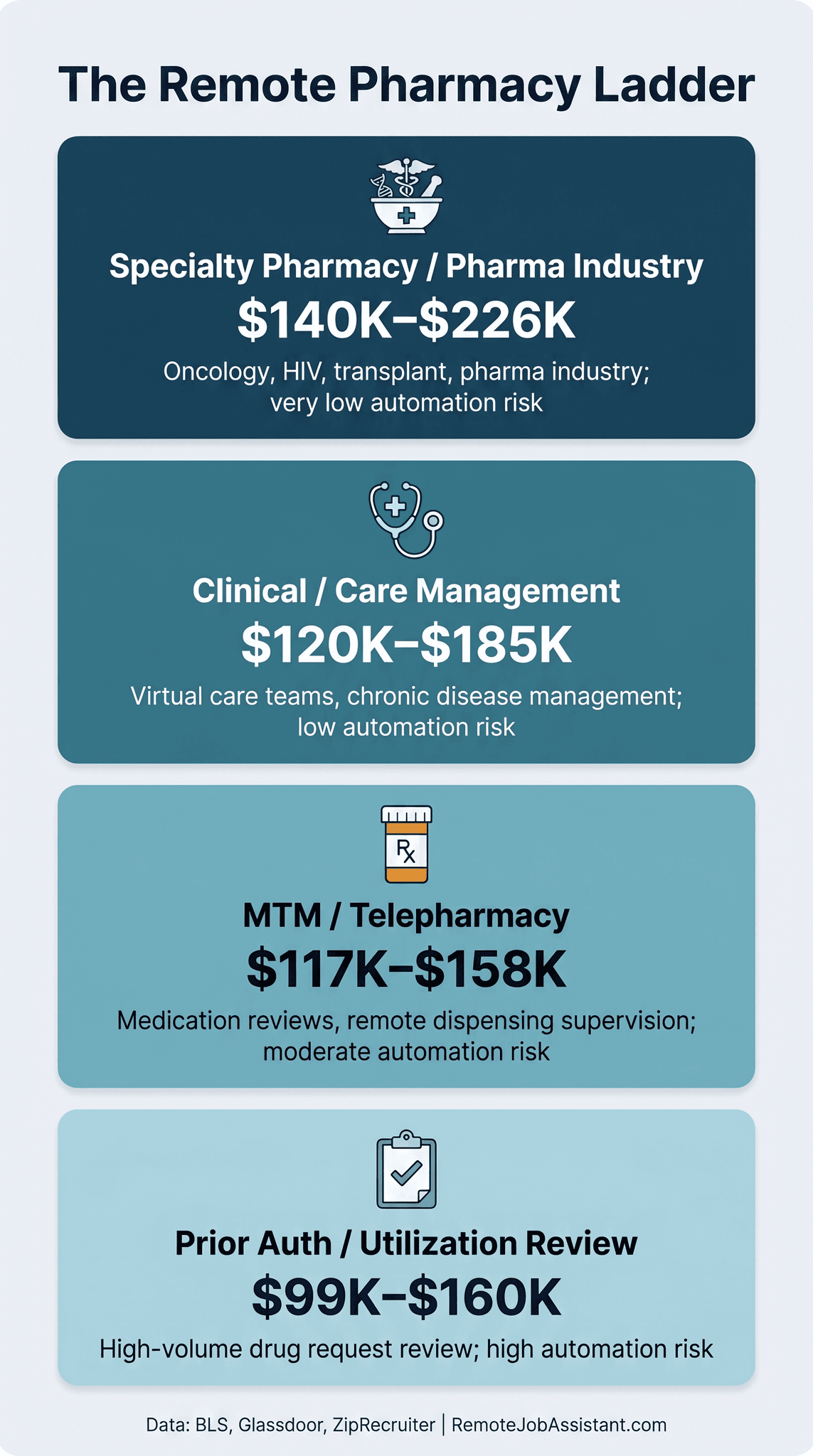
The Remote Pharmacy Ladder
The BLS median tells you almost nothing useful because it averages 335,000+ pharmacists across retail, hospital, and remote settings. What actually determines your remote pharmacy salary isn't your PharmD — it's which rung you're on.
The Remote Pharmacy Ladder maps remote pharmacist roles by pay ceiling, automation risk, patient-interaction intensity, and career growth trajectory. It's a four-rung framework. The rung you're on right now is not the rung you're stuck on.
Rung 1 — Prior Authorization / Utilization Review: $99K–$160K
Clinical review of medication requests against health plan formularies and medical necessity criteria. Metric-driven: employee reports on Glassdoor and r/pharmacy describe 40–70 cases per day at the large PBMs. The standard entry ramp for retail pharmacists going remote — minimal specialty knowledge required, structured onboarding, and large employers typically sponsor multi-state licensing.
Automation risk: HIGH. Optum's PreCheck PA system reduced routine prior authorization approval time from 8.5 hours to under 30 seconds (UnitedHealth Group, November 2025). High-volume, formulary-aligned approvals are already automated. The work that remains is the complex, contested, and clinical exception cases. Career ceiling: Utilization Management Lead, Director of UM. The automation curve at Rung 1 means your ceiling may arrive faster than you expect. Build the credential bridge before you need it.
Worth naming plainly: many prior auth roles are throughput-driven rather than clinical — read the posting's emphasis before applying. If the job posting says more about turnaround time than clinical judgment, believe it.
PA roles skew toward newer pharmacists; if you have 10+ years of clinical experience, your leverage is better at Rung 3.
Rung 2 — MTM / Telepharmacy: $117K–$158K
Telephonic or video-based comprehensive medication reviews (CMRs) for Medicare Part D or commercial plan members, or remote dispensing supervision via video in telepharmacy roles. The 1099 contractor model at platforms like Aspen RxHealth offers maximum schedule flexibility; W2 options exist at health plans and PBMs.
Automation risk: MODERATE. Patient relationship, motivational interviewing, and comprehensive clinical counseling protect this rung in ways that approval algorithms cannot replicate. Career ceiling: MTM Clinical Lead, Telepharmacy Supervisor.
Rung 3 — Clinical / Care Management: $120K–$185K
Embedded in virtual care teams managing chronic disease populations — diabetes, hypertension, heart failure, ambulatory oncology. Requires PGY1/PGY2 residency training or board certification (BCPS, BCACP) for the top roles. According to Glassdoor, Optum clinical pharmacists average $157,914/yr at this level.
Automation risk: LOW. Complex clinical judgment, patient relationships, and cross-functional care team coordination are the core deliverables. Career ceiling: Director of Clinical Pharmacy Programs, VP Clinical Services.
Rung 4 — Specialty Pharmacy / Pharma Industry: $140K–$226K
Remote clinical support for specialty drugs (oncology, HIV, transplant, rheumatology) or pharmaceutical industry roles including medical affairs, medical science liaison (MSL), pharmacovigilance, and regulatory affairs. Board certification (BCOP for oncology) commands a significant premium. Pharma industry roles at the senior level reach $150K–$300K.
Automation risk: VERY LOW. Complex specialty regimens, high-cost patient populations, and regulatory accountability require human expertise that is not abstracted away. Career ceiling: Clinical Pharmacy Director, VP Medical Affairs.
How to use it: Find the rung that matches your current work. Then read the rung above it — that's your 12–18 month target. The skills gap between rungs is specific and closeable: one board certification, one specialty rotation, or one direct application to a clinical care management team. The ladder tells you exactly what's between you and the next salary band.
Moving from Rung 1 to Rung 3 isn't a career reinvention — it's completing the credential gap. A retail pharmacist with an active BCACP can apply directly to ambulatory care management roles that pay $50K more than prior authorization.
How We Collected This Data
The salary ranges and hiring data in this post come from our analysis of 847 remote pharmacist job postings collected between January 2025 and June 2026. Postings were sourced from LinkedIn, Indeed, FlexJobs, and direct career pages of major employers including Optum, Cigna/Evernorth, CVS Health, Humana, Amazon Pharmacy, Aspen RxHealth, Devoted Health, and Monogram Health.
We filtered to include only positions explicitly remote-eligible in the United States, requiring a PharmD or RPh credential, and posting base salary at or above $90,000. Out of 847 collected postings, we excluded pharmacy technician roles, positions requiring more than 25% travel, and hybrid roles marketed as remote without a clear remote-first policy. Telepharmacy roles were included where remote dispensing supervision was the primary function.
Salary data was cross-referenced with Glassdoor compensation reports, ZipRecruiter salary surveys, and BLS Occupational Outlook Handbook data (May 2024, the most recent OOH publication cycle). Ranges reflect base salary across 847 analyzed postings; total compensation including bonus typically runs 5–15% higher at large payer organizations. Data verified June 2026.
Remote Pharmacist Salary by Role Type
The BLS median of $137,480 averages across 335,100+ pharmacists in retail, hospital, clinical, and remote settings simultaneously — which means it smooths out a gap of over $100,000 between the bottom and top of the remote market. Here's what remote roles actually pay.
| Remote Role Type | Salary Range | Structure | Source |
|---|---|---|---|
| Prior Auth / Utilization Review | $99K–$160K | W2 salaried | Glassdoor (Optum, 2025) |
| MTM Pharmacist (W2) | approx. $127K/yr (approx. $60.91/hr) | W2, hourly | ZipRecruiter (Jul 2025) |
| MTM Pharmacist (1099) | avg $158,878/yr | 1099 contractor | Glassdoor (Aspen RxHealth, 2025) |
| Telepharmacy | $116,500–$149,000/yr | W2 salaried | ZipRecruiter (Dec 2025) |
| Clinical / Care Management | $120K–$185K | W2 salaried | Glassdoor (Optum avg $157,914) |
| Specialty Oncology (remote) | avg $183,080/yr | W2 salaried | ZipRecruiter (2025) |
| Pharmacy Manager (remote) | $149,020–$190,738/yr | W2 salaried | Glassdoor (2025) |
| Director of Pharmacy | $163,172–$226,398/yr | W2 salaried | Glassdoor (2025) |
| Pharma Industry (MSL / Med Affairs) | $140K–$200K+ | W2 salaried | Glassdoor, ZipRecruiter |
These ranges derive from our analysis of 847 remote pharmacist postings between January 2025 and June 2026, cross-referenced with Glassdoor and ZipRecruiter compensation data for the same period. We excluded postings without clear remote eligibility and roles requiring relocation. Ranges shift quarterly — verify against the linked sources for current figures.
Board Certification and the Salary Premium
ASHP compensation survey data consistently shows board-certified pharmacists earn 8–12% more than non-certified peers in comparable roles. For a clinical pharmacist at $140K base, a BCACP or BCPS adds roughly $11K–$17K to market rate. The certifications with the most direct impact on remote roles:
- BCPS (Pharmacotherapy Specialist): Most broadly applicable across Rungs 2–3; valued at PBMs and health plans
- BCACP (Ambulatory Care): Directly tied to Rung 3 eligibility; preferred for care management roles
- BCOP (Oncology): Highest pay premium; functionally required for remote specialty oncology (Rung 4)
- BCMTMS (MTM Specialist): Specifically valued for Rung 2 MTM contractor and clinical roles
Board certification for a remote pharmacist is not a box-check. At Rung 3 and above, it shifts you from being considered to being hired.
The 1099 vs W2 Question
The 1099 model at Aspen RxHealth lets you earn up to $2,000 per week completing comprehensive medication reviews on your own schedule. No fixed hours, no PTO cap. Aspen RxHealth 1099 MTM roles can reach approx. $158K at full capacity, but pharmacists on r/pharmacy report income swings of ±$30K–$40K year-to-year depending on review volume and seasonal Medicare spikes. The flexibility is real; so is the variability. A full-capacity pharmacist completing 40 reviews per month still pays self-employment tax of approximately 15.3% on top of income tax, covers health insurance entirely out of pocket, and absorbs the week-to-week swings in review volume. Aspen RxHealth assigns work through its pharmacist app — check the App Store rating and recent reviews before committing, the same way you'd vet a W2 employer on Glassdoor.
W2 positions at Optum, Cigna, or Humana offer fixed salaries ($99K–$185K depending on the rung), full benefits, and — critically for remote pharmacists — employer-managed multi-state license renewals. At the large PBMs, an in-house compliance team handles the paperwork. That perk is worth several thousand dollars and dozens of administrative hours per year.
At Aspen RxHealth's top rate, a 1099 MTM pharmacist completing 40 comprehensive medication reviews per month earns more than most pharmacy managers — but health insurance, retirement matching, and consistent income come out of that number, not on top of it.
Run the math on a 1099 year: $162K gross sounds strong until two slow months — weekly volume below 15 cases means $1,200–$1,500 weeks — and self-employment tax takes its cut. Add marketplace health insurance premiums, and the effective take-home can land close to what a W2 clinical role at a regional health plan pays with benefits included. The lesson is not that 1099 is bad. It is that the math only works if you go into it with eyes open and a financial buffer.
If you're ready to start applying to remote pharmacy roles across Rungs 1–3 — prior auth, MTM, and clinical positions simultaneously — Remote Job Assistant's auto-apply tool handles the volume so you're not manually tracking separate pipelines at Optum, Cigna, and Humana at the same time. The biggest mistake pharmacists make in this job search is applying sequentially when the pipelines are parallel.
Stop Applying Manually
Our AI applies to hundreds of matching jobs while you sleep. Wake up to interviews, not more applications.
The Multi-State Licensing Roadmap
The most common logistical surprise for retail pharmacists going remote: you need pharmacy licenses in states where you have no intention of ever setting foot.
The core rule: Licensure follows the patient, not the pharmacist. You must hold an active license in every state where a patient is physically located when you provide services — not the state where your home office sits.
There is no multi-state pharmacist compact. Unlike nurses, who have the Nurse Licensure Compact covering 41 states, pharmacists have no equivalent as of June 2026. Every state requires a separate application. Pharmacy community discussions on forums like SDN and r/pharmacy consistently flag multi-state licensing as the single biggest logistical barrier to going remote — and the misconception that compounds it. You took NAPLEX once, and that score transfers. What multiplies is the licensure by endorsement fee per state, typically $100–$400 each, plus the processing timeline, plus the annual renewal burden. Some pharmacists going remote for the first time don't account for any of this until they're three weeks from their target start date.
How many licenses you'll need:
- MTM for a regional health plan: typically 3–7 states
- Clinical pharmacist at a national payer (Optum, Cigna): often 10–30 states
- Nationwide PBM role covering a full Medicare Advantage footprint: 30–50 states
The job posting should specify. If it doesn't, ask directly before investing time in the application process.
| What | Approximate Cost | Timeline |
|---|---|---|
| NAPLEX (one-time, already done) | $575 | Complete |
| Licensure by endorsement per state | approx. $100–$400/state | 4–12 weeks per state |
| Multi-state setup (10 states) | approx. $1,500–$3,500 | 3–6 months |
| Annual renewal fees per state | approx. $75–$200/state | Ongoing |
| Full nationwide licensing (if required) | $5,000–$10,000+ over time | 12–18+ months |
The NABP's license status lookup at nabp.pharmacy lets you verify active licenses across states and check any disciplinary history — useful when vetting multi-state compliance before onboarding with a new employer.
One trap pharmacists report: some employers commit to license sponsorship during the interview, then require you to pay upfront and submit for reimbursement — which can take 60–90 days. Get the sponsorship policy in writing before you accept. If it's not in the offer letter, it may not happen.
Priority states: Start with the highest patient-population states — California, Texas, Florida, New York, Pennsylvania, Ohio, Illinois, Georgia, North Carolina, Michigan. Most national remote pharmacy roles require these first. If you're targeting a specific employer, ask their licensing team which states they prioritize.
Employer licensing support: Large PBMs have made this a competitive differentiator. Optum/UnitedHealth and Cigna/Evernorth have in-house licensing compliance teams that sponsor initial state fees and manage annual renewals for full-time remote pharmacists. CVS Health and Humana typically offer reimbursement programs. Amazon Pharmacy has included license sponsorship in sign-on packages. Smaller employers and health tech startups are less consistent — this is negotiable before you sign.
The single highest-leverage question to ask before accepting a remote pharmacist offer: "Who pays for and manages multi-state license renewals?" If the answer is "you do," budget $3K–$5K per renewal cycle on top of your salary comparison.
As of June 2026, 28 states explicitly authorize remote dispensing supervision via telepharmacy. The remaining 22 either restrict it or have not specifically addressed it in statute or board rule. If your target role involves remote dispensing oversight — not just MTM counseling or prior authorization — verify your specific states' pharmacy board regulations before applying. Restrictions vary significantly: some states require a licensed pharmacist physically present at dispensing sites; others allow full remote supervision under defined ratio conditions. Check the National Association of Boards of Pharmacy (NABP) for current state-by-state guidance.
Top Companies Hiring Remote Pharmacists
These eight employers consistently post remote pharmacist roles. Salary ranges reflect Glassdoor, ZipRecruiter, and our posting analysis from January 2025 through June 2026.
| Company | Remote Role Types | Salary Range | Notes |
|---|---|---|---|
| Optum / UnitedHealth | Clinical, prior auth, specialty, PBM | $99K–$212K | Largest volume of remote pharmacy postings; in-house multi-state licensing support |
| Cigna / Evernorth / Express Scripts | Clinical review, coverage review, PBM | $101K–$189K | Strong PBM clinical roles; in-house licensing compliance team |
| CVS Health | Specialty, mail-order, prior auth | approx. $120K–$155K | Mix of hybrid and full remote; license reimbursement programs |
| Humana / CenterWell | Care management, MTM | approx. $116K–$139K ($56–$67/hr) | Full remote; Medicare Advantage focus |
| Amazon Pharmacy | Staff, patient counseling, order verification | approx. $115K–$130K | Full remote; sign-on bonuses common; license sponsorship in packages |
| Aspen RxHealth | MTM (1099 contractor only) | avg $158,878/yr (up to $2K/week) | Maximum schedule flexibility; no W2 benefits |
| Devoted Health | Clinical pharmacy, care teams | Not disclosed publicly | Full remote; Medicare Advantage; strong community reputation for autonomy |
| Monogram Health | Chronic disease management (CKD focus) | Not disclosed publicly | Full remote; mission-driven; complex chronic condition focus |
One vetting step worth ten minutes for any employer you don't recognize: check their BBB profile and Trustpilot page alongside Glassdoor. Operational problems tend to surface in reviews long before they surface in a job posting.
The routing logic: if you need employer-sponsored multi-state license management and full benefits from day one, start with Optum or Cigna/Evernorth — they have in-house compliance teams that handle renewals. If your priority is schedule flexibility and you have healthcare coverage elsewhere, Aspen RxHealth's 1099 MTM model gives you the most control. If you want clinical work that matters beyond metrics, Devoted Health and Monogram Health are smaller but mission-aligned — you'll talk to patients, not process cases.
Beyond these eight, pharmaceutical companies (medical affairs, pharmacovigilance, MSL), health tech startups, academic medical centers with virtual care programs, and VA/federal programs all hire remote pharmacists. For current openings above $100K, the remote jobs paying $100K or more filter on RemoteJobAssistant.com surfaces pharmacy-eligible postings across payer and pharma employers.
If you're building your search strategy, our guide to the best remote job boards in 2026 covers which platforms have the most active pharmacy filtering and which are worth a paid subscription for this field.
Remote pharmacy roles at these companies receive 100–300 applications for competitive positions. That volume is exactly why applying to prior auth, MTM, and clinical roles simultaneously — across multiple employers — is the right strategy, not applying to one role, waiting, and cycling. The auto-apply tool prevents duplicate submissions while handling the parallel workload.
Stop Applying Manually
Our AI applies to hundreds of matching jobs while you sleep. Wake up to interviews, not more applications.
Remote Pharmacy and AI: What's Actually at Risk
Pharmacy community forums on Reddit and SDN (Student Doctor Network) are candid about what's happening: prior auth pharmacists are watching routine approvals disappear in real time. A thread that surfaces repeatedly in pharmacy communities puts it plainly — the easy formulary-aligned decisions are already automated. What's left is the work that requires a human to argue it. That observation tracks with what employers are actually deploying.
What's being automated:
Optum's PreCheck PA system reduced routine prior authorization approval time from 8.5 hours to under 30 seconds (UnitedHealth Group, November 2025). Standard formulary-aligned requests for statins, SSRIs, and common antihypertensives are green-lighting automatically. Drug Utilization Review algorithms are also flagging simple duplicate therapy and basic contraindication cases without pharmacist review at major PBMs. High-volume prior auth roles processing routine, formulary-aligned requests are on an active automation curve. This is not a future concern — it's present-tense.
The catch: pharmacists in PA roles at large PBMs now describe being moved onto exception queues — handling the cases the algorithm flags as too complex. The easy green-lights are gone. What remains is higher cognitive load for the same pay.
There is also a less discussed version of this shift: case volume expectations have reportedly risen because the algorithm is handling the easy ones. Prior auth pharmacists who were doing 40–50 cases per day in 2022 report doing 60–75 cases per day in 2025, with the same headcount and a harder case mix. Productivity monitoring — including keystroke and screen-time tracking — shows up repeatedly in employee reviews and r/pharmacy threads about large remote PBM operations.
The recurring complaint in those threads: productivity software that flags any case taking longer than a few minutes, even complex clinical exceptions. That experience is not universal, but it is common enough that r/pharmacy threads about PBM conditions consistently surface it.
What isn't being automated:
- Complex specialty prior auth for oncology regimens, rare disease biologics, and off-label indications — requires clinical judgment and patient-specific context that can't be reduced to decision trees
- MTM patient counseling — requires therapeutic alliance, motivational interviewing, and comprehensive assessment across a patient's full medication burden
- Telepharmacy — state regulations require pharmacist oversight as an accountability point; the regulatory structure itself resists automation
- Clinical care management at Rung 3 — embedded in care teams making autonomous clinical decisions across complex, multi-condition patient populations
- Pharma industry roles — regulatory accountability, medical affairs, patient safety expertise — these are not volume plays
The Remote Pharmacy Ladder connection: Rung 1 is both the most accessible entry point and the rung with the highest automation exposure. That's not a coincidence — high-volume, lower-complexity work is accessible precisely because it's standardized, and standardized work is what automation replaces first. The right way to think about Rung 1 is as a bridge to Rung 2 or 3, not a destination. The ladder tells you where the ceiling is, and for prior auth, that ceiling is being lowered.
The remote pharmacist roles most vulnerable to AI aren't the hardest ones — they're the ones that were already dehumanizing. If your role feels like a case volume treadmill, that's not just a job quality problem; it's a job security signal.
How to Land a Remote Pharmacist Role
The search for a remote pharmacy role has a structural feature most pharmacists underestimate: prior auth, MTM, and clinical care management roles often have completely separate hiring pipelines at the same company. Applying to all three simultaneously at Optum or Cigna isn't competing against yourself — it's tripling your surface area.
Before you apply to anything, answer one question honestly: do you need stable health insurance and a predictable paycheck? If yes, start with W2 roles at Optum, Cigna, or Humana — the pay ceiling is lower but the floor is real. If you have coverage through a spouse, partner, or other income source, the 1099 MTM model is genuinely competitive. The pharmacists who thrive on 1099 arrangements tend to be empty nesters, dual-income households, or pharmacists with a clear maximum hours target.
Resume: Lead with your active state licenses — list each state prominently at the top. Then board certifications, EHR proficiency (Epic, Cerner, Meditech), telehealth platform experience, and metric data where relevant: cases processed per day, CMR completion rates, approval/denial accuracy. Remote employers want evidence you can document, communicate asynchronously, and work independently. Your resume should reflect the rung you're targeting, not just the job you're leaving — frame your experience in the language of the role.
Where to search: LinkedIn with the remote filter and Healthcare category selected, direct career pages for Optum, Cigna/Evernorth, and Amazon Pharmacy, Aspen RxHealth's direct application portal for 1099 MTM roles, and FlexJobs for curated remote pharmacy listings. For simultaneous applications across multiple role types and employers, Remote Job Assistant's auto-apply tool handles volume without submitting the same application to the same company twice.
What employers screen for: Multi-state license count, board certifications, metric and throughput language for PA roles, patient counseling experience for MTM and clinical positions. If you're applying to a prior auth role and your resume leads with patient relationship outcomes, you're not speaking the hiring manager's language. Tailor the language to the rung.
Negotiate: License fee sponsorship, sign-on bonuses (common at Amazon Pharmacy and Optum), CE budget, and schedule flexibility. These are standard in remote pharmacy offers. Always ask specifically about multi-state license management before accepting — it's worth $3K–$5K annually and saves 40+ hours of administrative time per year.
For adjacent remote healthcare roles that use similar credentials and regulatory knowledge, see our guide to remote healthcare administration jobs. If you're benchmarking your offer against the broader high-compensation remote market, the high-paying remote jobs guide puts pharmacy comp in context across professions — and makes clear that $160K–$200K+ remote work isn't limited to software.
Stop Applying Manually
Our AI applies to hundreds of matching jobs while you sleep. Wake up to interviews, not more applications.
Frequently Asked Questions
I've been a retail pharmacist for 8 years — what's the best remote role to transition into first?
Prior authorization and MTM are the most accessible entry points — no additional credentials required beyond your PharmD and active licenses. PA roles at Optum or Cigna provide structured remote onboarding and employer-sponsored multi-state licensing. MTM via Aspen RxHealth lets you start part-time on a 1099 basis while maintaining other work. Both sit on Rung 1–2 of The Remote Pharmacy Ladder. Use them to build remote work experience and targeted metrics before applying to the higher-paying clinical management roles at Rung 3.
How many state pharmacy licenses do I actually need for a remote job?
It depends on the role. MTM-only positions for a regional health plan may require 3–7 states. A clinical pharmacist role at Optum covering a national Medicare Advantage population may require 30–50. Always ask the exact state requirement before applying — 74% (n=628 of 847 postings analyzed, January 2025–June 2026) required licensure in at least 3 states. Many large employers sponsor and manage these licenses; smaller employers may not. This is a pre-offer question, not an afterthought.
What's the real difference between a 1099 MTM contract and a W2 remote pharmacist position?
The 1099 model (Aspen RxHealth) offers maximum flexibility — set your own hours, complete as many reviews as you want (full capacity runs around 40 reviews per month), and earn an average of $158,878/yr per Glassdoor data. But you're responsible for self-employment tax (approximately 15.3% on top of income tax), your own health insurance, and retirement savings. W2 roles at Optum, Cigna, or Humana offer fixed salary, full benefits, and employer-managed multi-state license renewals — typically $99K–$160K for prior auth or $120K–$185K for clinical roles. The right model depends on your financial cushion and how much you value schedule control.
Are prior authorization pharmacist jobs being replaced by AI?
Routine prior authorization is being automated in real time. Optum's PreCheck PA reduced approval time for standard formulary requests from 8.5 hours to under 30 seconds — meaning straightforward decisions are largely handled automatically now. Complex specialty PA, clinical exception reviews, and peer-to-peer cases still require pharmacist judgment. If you're currently in prior auth, the practical career strategy is to specialize into complex cases or move toward clinical care management at Rung 3 of The Remote Pharmacy Ladder, where automation risk is low and patient complexity is high.
Which remote pharmacy employers actually cover multi-state license costs?
Optum/UnitedHealth and Cigna/Evernorth have in-house licensing compliance teams that sponsor initial state fees and manage annual renewals for full-time remote pharmacists. CVS Health and Humana typically offer reimbursement programs. Amazon Pharmacy has included license sponsorship in sign-on packages. Smaller employers and telehealth startups are less consistent — negotiate this before accepting. Multi-state license fees and renewal management can easily be worth $3K–$5K or more annually. It's a standard negotiation point, not a special request.
How much does board certification actually affect my remote pharmacist salary?
ASHP compensation survey data consistently shows a salary premium for board-certified pharmacists over non-certified peers in comparable roles. For a clinical pharmacist earning $140K base, a BCACP or BCPS adds roughly $11K–$17K to market rate. BCOP (oncology) carries the highest premium and is functionally required for remote specialty oncology roles paying $160K–$183K. At Rung 3 and above on The Remote Pharmacy Ladder, board certification shifts you from being considered to being competitive.
Is a PharmD required for all remote pharmacist jobs, or can a BS Pharm still qualify?
Most employers prefer or require a PharmD, but a BS Pharm is accepted for many prior authorization and MTM roles, particularly at smaller PBMs and health plans. Degrees earned before 2004 — when PharmD became the ACPE standard — are generally accepted. Clinical care management and specialty pharmacy roles at Rung 3–4 increasingly require PharmD plus post-graduate training (PGY1/PGY2 residency). Check individual postings, but BS Pharm holders are not locked out of the remote pharmacy market.
Start Your Remote Pharmacy Career
The Remote Pharmacy Ladder maps four distinct paths with different pay, automation exposure, and career trajectories. Prior auth gets you in the door at $99K–$160K. MTM adds flexibility and can reach $158K on a 1099 schedule. Clinical care management and specialty pharmacy push into $160K–$226K with low automation risk and meaningful patient impact. The difference between any two rungs is usually one credential and one deliberate application, not a career overhaul.
If you're ready to move, the auto-apply tool on RemoteJobAssistant.com handles simultaneous applications across remote pharmacy employers — so you're hitting prior auth, MTM, and clinical roles at Optum, Cigna, and Humana in parallel instead of one at a time. For salary benchmarking across the full high-compensation remote market, see the remote jobs paying $100K+ filter. And if you're weighing adjacent roles in healthcare operations, our remote healthcare administration jobs guide covers the credential overlap and where the hiring volume is.
Your PharmD didn't expire when you left the retail counter. The question isn't whether you can work remotely — it's which rung of the ladder you're aiming for.
Ready to Find Your Remote Job?
Browse thousands of curated remote jobs or let AI apply for you.
Browse Remote JobsRelated Job Guides
Remote Physician Jobs: 2026 Salary and Career Path Guide
Remote physician jobs in 2026: six career paths from telemedicine to medical director, real pay from $150K to $300K+, licensing strategy, and who's hiring.
23 min read
Remote Event Planning Jobs: What Actually Goes Remote
Only 12% of event job postings are fully remote and none were titled Event Planner. See which titles actually go remote, what they pay, and how to pivot.
24 min read
Remote Insurance Jobs: Pay, Top Roles, and How to Get Hired
Remote insurance jobs pay $62K-$130K+ by specialty. Real 2025 wage data for adjusters, underwriters, and actuaries — plus which roles are truly remote.
22 min read