Last reviewed: October 2026
You typed "remote dentist jobs" into LinkedIn, and it told you there are 5,000+ of them. On October 18, 2026, the first 60 cards on that page included 43 psychiatrists, 38 of them from a single telepsychiatry company, and 17 dental listings. We opened all 17. Two were remote. Both were utilization-review seats at Liberty Dental Plan, and both required a New York dental license.
That ratio isn't a LinkedIn glitch. It's the market. You can't seat a crown over video, so the dentists who work from home aren't treating anyone. They're deciding whether someone else's treatment gets paid: prior authorizations, claim denials, appeals, Medicaid hearings. That work exists because an insurer or a state program needs a licensed dentist to sign the "no," and it follows the license, not your zip code.
Get Remote Job Tips in Your Inbox
Weekly strategies, salary data, and new opportunities
Unsubscribe anytime. No spam.
We read 1,399 dentist-credentialed job postings at 374 employers, all first listed between January and October 2026, to find every one that lets you work from home. This guide covers the 10 we found, what they pay against the chair, why seven of them are tied to one state's license, and how to set yourself up for one before you need it.
Based on our read of 1,399 dentist-credentialed postings first listed January–October 2026:
- 0.7% (n=10 of 1,399) were remote or hybrid after reading the full text: 7 remote, 3 hybrid
- 10 of 10 remote or hybrid seats sit on the payer side: dental-plan claims and utilization review, a Medicaid fiscal agent, an independent review organization, an AI claims-review vendor, Medicaid appeal hearings, or dental-plan leadership
- 7 of 10 require a license in one named state (New York twice, California, Hawaii, Nevada, Massachusetts, Washington); 2 of 10 accept any active, unrestricted U.S. license
- 10 of 10 ask for at least five years of practice; 5 of 10 ask for six to ten or more
- 4 of 10 are 1099 contracts, and 0 of those 4 publish pay; posted W-2 staff and senior-staff ranges run $121,700–$185,000
- 0 of 228 Aspen Dental and ClearChoice dentist and specialist requisitions were remote
- 0 of 4 postings that mention teledentistry were remote; all four are in-person clinic jobs
- $170,950 median wage for general dentists (BLS, May 2025), against $160,448 for non-owner general dentists and $228,975 for owners (ADA Health Policy Institute, 2025)
How We Collected This Data
Start with what we couldn't see. Indeed, Glassdoor and ZipRecruiter block automated reads, so any dentist seat posted only there is missing from our counts. That matters for this topic: search snippets showed three payer reviewer roles we could not open (a fully remote Staff Dental Consultant at Delta Dental of Michigan, a part-time dental reviewer at Acentra Health, and a DDS/DMD reviewer contract at Toney HealthCare), so none of them are counted. Reddit blocks us too, so there are no forum quotes here.
What we could read came from four places. LinkedIn's public job search returned 3,759 cards across 40 searches built on dentist, dental consultant, dental director, teledentistry, and claims-review terms, and we read the full text of all 1,215 cards with a dentist title. SimplyHired, which carries Indeed's network, added 250 postings we read in full from 49 searches. Workday career sites supplied Aspen Dental and ClearChoice (228 dentist and specialist requisitions), two community health systems, and seven insurer boards: Cigna, Humana, Elevance Health, CVS Health (Aetna), Centene, Guardian, and BlueCross BlueShield of Tennessee. None of those seven had a dentist title posted on October 18. We also checked 117 dental, dental-tech, and benefits employers on Greenhouse, Lever, Ashby, and SmartRecruiters (only Overjet had dentist seats), plus the Himalayas and Mercor remote boards.
We kept a posting if it had a dentist title, or, for consultant and director titles, if the text required a DDS or DMD. We removed repeats of the same employer, title, and location, and dropped 71 evergreen listings first posted before 2026. Every work-model call was made by reading the posting, not by trusting a tag: 19 postings that looked remote or hybrid to a keyword filter turned out to be clinic jobs, benefits boilerplate, or partnership offers.
Salary benchmarks come from the Bureau of Labor Statistics' May 2025 wage data for general dentists, published through O*NET, and the ADA Health Policy Institute's practice and income research. Which way do our blind spots push the numbers? The Indeed-only seats make 0.7% a floor. But even if the real figure were double, remote would still be under 2% of dentist hiring, because two DSOs, Aspen Dental (319) and Heartland Dental (143), posted 462 of the 1,389 clinic jobs on their own. These figures reflect postings live as of October 18, 2026; we update this analysis quarterly.
The License Tether: How to Score a Remote Dentist Posting
"Is it remote?" is the wrong first question. All 10 seats we found passed that test. What separated them was how tightly each one binds you to a license, to years in the chair, and to an office. That's what the License Tether measures.
The License Tether is a 0–6 score of how tightly a remote dentist posting ties you to one state's license, to recent clinical years, and to physical presence. Score three things, 0 to 2 each:
- License reach: 0 if any active, unrestricted U.S. license works; 1 if the posting names one state; 2 if it names a state and a place you must live, or needs several states at once
- Chair-years gate: 0 if under five years or unstated; 1 for five years; 2 for six or more
- Presence: 0 if fully remote; 1 if remote with occasional onsite days; 2 if hybrid, in-person hearings, or regular travel
Scoring:
- 0–1 Portable: Any license, five years, nobody asks you to come in. Both examples are Overjet's 1099 claims-review contracts: 30-plus hours a week for general dentists, 5 to 10 hours for board-certified orthodontists. Neither publishes pay.
- 2–3 State-tethered: One named license, still fully remote. Dane Street's Hawaii reviewer posting says "candidates without Hawaii licensure will not be considered." Its oral surgeon reviewer seat adds "Must currently reside in Reno, Nevada." Liberty Dental Plan's New York staff dentist pays $150,000–$165,000 and asks for six years in practice.
- 4–6 Anchored: A named license, six to ten years, and some time in an office or a hearing room. Gainwell's California Medi-Cal Dental consultant ($121,700–$173,800) wants ten years of clinical practice and "occasional onsite presence" in Roseville. Delta Dental of Washington's senior dental director ($177,900–$292,200) wants 8–10 years of clinical practice inside 12-plus years overall.
How to use it: Score the posting, then take the license points back off if you already hold that state's license. A 0 or 1 is something you can apply to from any state this week. A 2 or 3 fits only if the named license is already in your wallet. A 4 or higher is a career move you plan a year out.
Here's how all 10 verified seats score:
| Seat | Lane | License | Years asked | Presence | Tether | Posted pay |
|---|---|---|---|---|---|---|
| Overjet, Dental Consultant (General Dentist) | AI claims-review vendor, 1099, 30+ hrs/week | Any active, unrestricted (0) | 5 (1) | Fully remote (0) | 1 Portable | Not posted |
| Overjet, Dental Consultant (Orthodontist) | AI claims-review vendor, 1099, 5–10 hrs/week | Any, plus ortho board certification (0) | 5 (1) | Fully remote (0) | 1 Portable | Not posted |
| Dane Street, Licensed Hawaii Dentist, Clinical Reviewer | Independent review, 1099 | Hawaii (1) | 5+ (1) | Fully remote (0) | 2 State-tethered | Not posted |
| Dane Street, Oral and Maxillofacial Surgeon, Clinical Reviewer | Independent review, 1099 | Nevada, must live in Reno (2) | 5+, board-certified (1) | Fully remote (0) | 3 State-tethered | Not posted |
| Liberty Dental Plan, Staff Dentist (NY) | Plan utilization management, W-2 | New York (1) | 6 (2) | Fully remote (0) | 3 State-tethered | $150,000–$165,000 |
| Liberty Dental Plan, Senior Staff Dentist, Utilization Management | Plan utilization management, W-2 | New York (1) | 6, plus 2 in review (2) | Occasional onsite chart reviews (1) | 4 Anchored | $175,000–$185,000 |
| Gainwell Technologies, Dental Consultant, California | Medi-Cal Dental fiscal agent, W-2, 40 hrs | California (1) | 10, plus 2 at a Medi-Cal Dental organization (2) | Occasional onsite, Roseville (1) | 4 Anchored | $121,700–$173,800 |
| Dental Consultant for an insurer via Randstad (MassHealth hearings) | Medicaid appeal hearings, as needed | Massachusetts (1) | 5 preferred (1) | Home plus local travel to hearings (2) | 4 Anchored | $90–$96 an hour |
| Delta Dental of Michigan, Associate Dental Director, Government Programs | Plan leadership, W-2 | State-specific, as required (1) | 10 (2) | Hybrid (2) | 5 Anchored | Not posted |
| Delta Dental of Washington, Senior Dental Director | Plan leadership, W-2 | Washington (1) | 8–10 clinical, 12+ total (2) | Hybrid (job-board tag) (2) | 5 Anchored | $177,900–$292,200 |
The table carries the post's main finding. The only two seats you can take from anywhere are 1099 contracts that don't publish a rate, and all five seats that do publish pay name a state. A remote dentist job is an insurance job that requires a dental license, and the paid, salaried version requires the right state's license.
Once a posting has a score, the next move depends on where you are now.
The posting scores 0–1 (Portable). Apply if you have five years in practice. Still practicing: keep your clinical days and treat it as a second income. Already left the chair: these are the only seats in our set you can take without adding a license, so start here.
The posting scores 2–3 (State-tethered). Check the named state against your wallet. If you hold it, apply. If you don't, this is a licensing decision, not a job decision; go to the step-by-step plan further down before you spend time on the application.
The posting scores 4–6 (Anchored). Check the years line and the office days. Short on the years it names: skip it for now. Years covered and the onsite days within driving distance: apply, because the two highest posted ranges in our set sat in this band.
You're a board-certified specialist. Your certificate is the entry ticket to the specialty review seats. Overjet's orthodontist contract requires it and runs 5 to 10 hours a week; Dane Street's oral surgeon reviewer requires it and takes cases as your schedule allows.
Whichever branch you're on, the bottleneck is the same: there are very few of these seats, and they don't stay open long.
Stop Applying Manually
Our AI applies to hundreds of matching jobs while you sleep. Wake up to interviews, not more applications.
What Remote Dentist Jobs Pay Compared With the Chair
Salary ranges below are the base pay printed in the postings: the five remote or hybrid seats that published a number, and 470 general and associate dentist clinic postings with an annual range, with sign-on bonuses, relocation stipends, and production guarantees stripped out. We cross-checked both against BLS and ADA Health Policy Institute figures for 2025. Ranges move, so check the linked sources before you negotiate.
| Rung | Seats we found | Posted pay | Hours and terms |
|---|---|---|---|
| Plan dental director | Delta Dental of Washington; Delta Dental of Michigan (pay not posted) | $177,900–$292,200 (Western Washington) | W-2, hybrid |
| Senior staff dentist, utilization management | Liberty Dental Plan (New York) | $175,000–$185,000 | W-2, occasional onsite chart reviews |
| Staff dental consultant or staff dentist | Gainwell (California), Liberty Dental Plan (New York) | $121,700–$173,800 across the two | W-2, 40-hour or core-hours week |
| Fractional reviewer | Overjet, Dane Street, MassHealth hearing consultant via Randstad | $90–$96 an hour (the only one that posted a rate) | 1099 or as needed: 5–10 hours, 30+ hours, or 3–4 days a month |
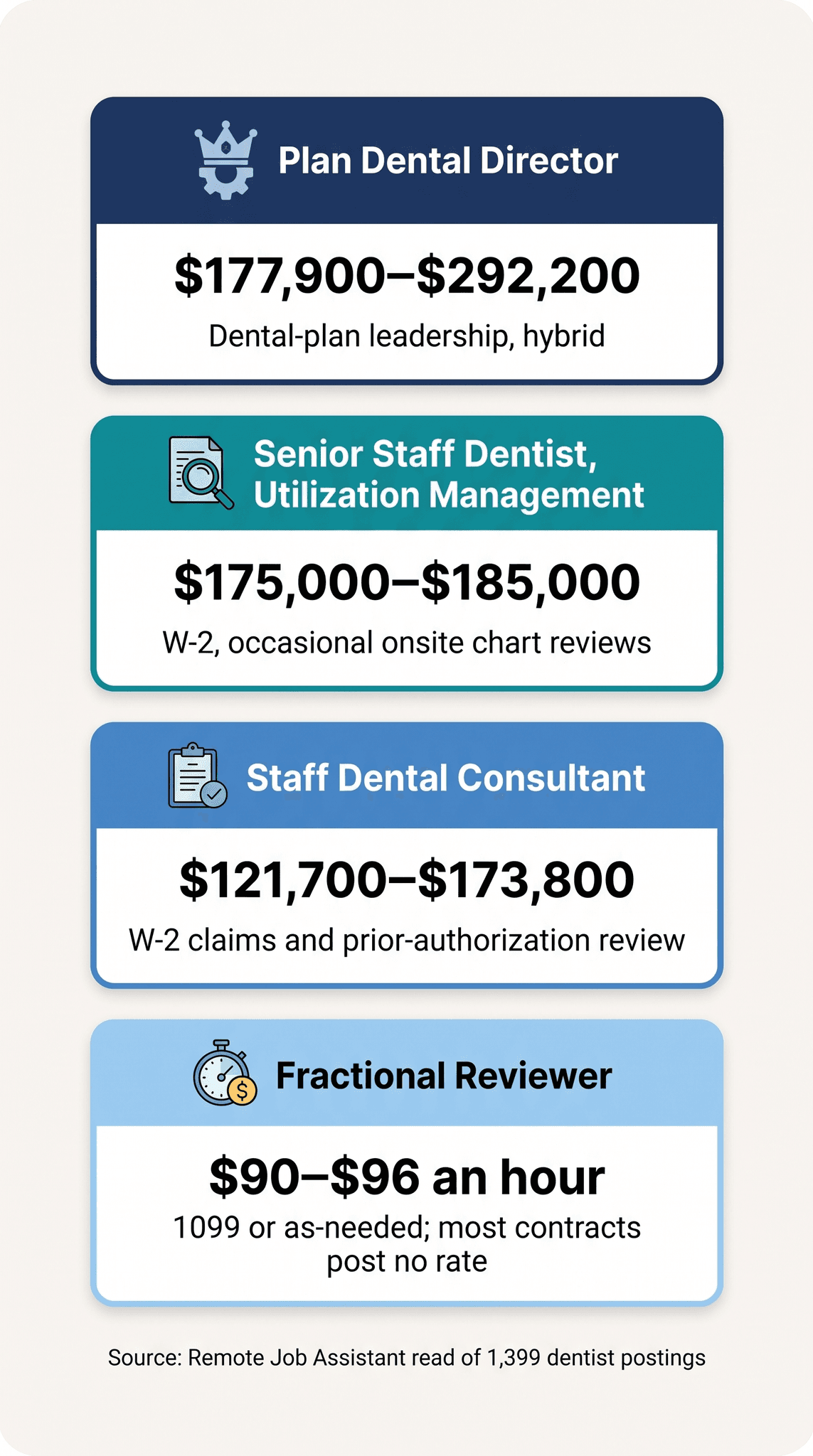
Now set that ladder next to the chair:
| Chairside benchmark | Pay | Source |
|---|---|---|
| General dentist median wage | $170,950 | BLS, May 2025 |
| Non-owner (associate or employee) general dentist, average | $160,448 | ADA Health Policy Institute, 2025 |
| Owner general dentist, average | $228,975 | ADA Health Policy Institute, 2025 |
| All private-practice general dentists, average net income | $215,320 | ADA Health Policy Institute, 2025 |
| Posted general and associate dentist ranges, our set (n=470) | Median $200,000–$300,000 | 255 of the 470 from Aspen Dental |
| Same, excluding Aspen (n=215) | Median about $187,000–$350,000 | Our read |
| Posted specialist ranges (n=40) | Median $205,000–$355,000 | Our read |
| Posted clinic dental director ranges (n=26) | Median about $186,000–$204,000 | Our read |
Read the two tables together and the trade is narrower than "remote pays less." The W-2 staff and senior review seats ($121,700–$185,000) sit around what the ADA says non-owner general dentists earn ($160,448) and below what DSOs advertise for associates. They're well under what owners take home ($228,975). A remote review seat doesn't cut your pay compared with being an associate. It cuts it compared with being an owner.
The reason is structural. A payer seat is salaried overhead at a dental plan or a state contractor. Nobody pays you a share of production, so a fast week earns nothing extra and a slow week costs you nothing. The 1099 rung hides its rate because it's paid by the case: Overjet's orthodontist contract at 5 to 10 hours a week and its general dentist contract at 30-plus hours can carry the same rate and produce very different incomes. Don't compare a 1099 offer to a salary until you have three numbers in writing: the rate per case, the cases you can expect each week, and any minimum hours. Without the second number, the first one tells you nothing.
Hours don't shrink, either. Gainwell's seat is a "Full-time, exempt salaried position (40 hours per week)," and Liberty's staff dentist works a "Structured schedule aligned with core business hours (not a flexible-hours role)." The ADA Health Policy Institute counted 35.6 hours a week in the office for the average dentist in 2025, 30.5 of them with patients. You're still measured. Liberty counts cases closed against turnaround times and scores your accuracy against other reviewers; it just doesn't count crowns.
One trend narrows the gap from the owner side: the ADA Health Policy Institute found that owner general dentists' inflation-adjusted income fell by $23,000 between 2011–2015 and 2021–2025, while non-owner income held essentially flat. If you're comparing against remote roles that pay $150K and up in other fields, the payer ladder is in that band from the staff rung upward.
Who Actually Hires Remote Dentists
All 10 seats sit on the payer side of dentistry, in six lanes:
- Dental plans' utilization management. Liberty Dental Plan's staff dentists review claims and prior authorizations across commercial, Marketplace, Medicare Advantage, and Medicaid business, and "Conduct peer-to-peer consultations with providers regarding clinical decisions and treatment alternatives."
- Medicaid fiscal agents. Gainwell Technologies' California consultants "review, approve, and/or deny dental treatment authorization requests and claims" under the state's Medi-Cal Dental policies, and the posting requires two years at an organization that provides Medi-Cal Dental services.
- Independent review organizations. Dane Street's dentist reviewers write opinions on records. The Hawaii posting says the role "involves advisory medical record reviews only and does not involve peer-to-peer discussions, calls, or direct patient care."
- AI claims-review vendors. Overjet sells dental AI to insurers and staffs "a nationwide network of dental consultants" who "Authorize or deny predeterminations and claims by reviewing radiographs and/or other supporting documentation" with the company's AI alongside.
- Medicaid appeal hearings. A Randstad posting for a "market leading insurance company" describes MassHealth Board of Hearing days: "3-4 working days per month, with up to 10 hearings per day."
- Plan leadership. Delta Dental of Washington's senior dental director runs provider network strategy and the member dentist advisory panel. Delta Dental of Michigan's associate dental director sits in its government-programs dental consulting and utilization management group.
If that list looks like the insurance industry's remote hiring with a dental license attached, that's exactly what it is. Nurses do the same work one rung over, which is why our guide to remote utilization review nurse jobs reads like a cousin of this one.
Where we expected remote seats and found none:
- Aspen Dental. Its "Remote Jobs" careers page ranks fifth on Google for "remote dentist jobs." Its Workday boards had 228 dentist and specialist requisitions on October 18. Zero were remote.
- The big medical insurers. Seven insurer career boards had no dentist titles posted that day. The payer seats we did find came from dental plans, a Medicaid contractor, review vendors, and one unnamed insurer hiring through Randstad.
- Teledentistry. Four postings mentioned it, all in-person clinic jobs using it as a tool: Marin Community Clinics, Waco Family Medicine, Greater Baden Medical Services, and a mobile-dentistry group in Ohio.
Teledentistry is not a remote career for dentists in 2026. It's a tool clinics use. Even Barton Associates' teledentistry jobs page, which ranks for that search, now says its "locum tenens dentist recruiting and staffing efforts have transitioned away from teledentistry to local, in-person staffing."
The industry side is real but doesn't need your license. GEHA's remote Dental Policy & Quality Manager seat accepts "RDH, DDS, or equivalent" and targets $93,873–$118,755. Solventum's remote Digital Dentistry Leader pays $187,600–$257,950 including variable pay, with 20% travel, but it requires 10-plus years in digital product management, MedTech, or health technology and lists dental experience only as something that could help. If industry is where you're headed, the degree gets you into the room; clinical research or medical writing experience is what gets the offer.
Stop Applying Manually
Our AI applies to hundreds of matching jobs while you sleep. Wake up to interviews, not more applications.
Why Almost Every Remote Seat Is Tied to One State
Seven of the 10 seats name a state, and it isn't recruiter habit. Four mechanisms put it there.
1. A dentist has to sign the "no." Delta Dental of Arkansas posted two clinical reviewer roles for registered dental hygienists that spell this out. The reviewer "may approve a claim when established requirements are met, but may not deny a claim," and anything that "may result in an adverse benefit determination" goes "to a Dental Consultant or other designated authority for final determination." The dentist seat exists for the denial.
2. The programs are state programs. Gainwell's consultants review Medi-Cal Dental requests under California policy and need an active California license. The MassHealth seat requires a Massachusetts license because you defend denials in Massachusetts hearings. Liberty's two New York seats name New York.
3. Teledentistry follows the patient, not the dentist. The ADA's teledentistry policy says dentists who deliver care that way "must be licensed or credentialed in accordance with the laws of the state in which the patient receives service." It adds that the ADA "opposes a single national federalized system of dental licensure for the purposes of teledentistry." A virtual practice that serves eight states needs eight licenses.
4. The interstate compact isn't open yet. The Dentist and Dental Hygienist Compact became active in April 2024, when Maine became the seventh member state, and Oklahoma made it 13 states in May 2026. The compact's own site says "compact privileges are not yet being issued." Physicians already have a working shortcut, which is why our remote physician guide treats a multi-state license portfolio as routine. Dentists don't have one yet. Even when privileges open, the compact covers only CODA-accredited DDS and DMD graduates, so foreign-trained dentists won't qualify, and states can still require their own specialty licenses. (Military-spouse portability is one of the compact's stated reasons, a theme in our remote jobs for military spouses guide.)
For remote work, the license that matters is the one in the state where the claim, the patient, or the hearing is, not the one where you live.
That makes timing the thing most dentists get wrong.
California's licensure-by-credential pathway asks for proof of active clinical practice for at least five years immediately preceding the application, plus a $525 fee and 50 units of continuing education from the prior two years. Its only nonclinical route is written for full-time work in public-health programs, and a commercial plan's review queue isn't obviously one. Leave the chair first and that five-year window starts closing. Get the second license while you still have chair years, and confirm the details with the board before you rely on them.
The Dental Board of California's clinical-practice pathway page lists the forms and the full requirement.
What the Work Looks Like After You're Hired
The postings describe the job more plainly than any recruiter will.
Liberty's staff dentist posting lays out the day: "You'll start your day by logging in, reviewing assigned cases, and managing your review queue while maintaining quality and turnaround expectations." You're expected to "Meet established productivity and quality benchmarks," "Complete interrater reliability assessments," and spend about 10% of your time in calibration sessions, spotting trends that include fraud, waste, and abuse. Interrater reliability means your calls on the same cases are compared with other reviewers' calls; the skill being graded is applying the plan's criteria the way everyone else does, which isn't the skill that made you good chairside. Then there are the peer-to-peer calls with treating dentists who disagree with you.
Gainwell's consultants work a shared queue of claims "referred by other members of the Claims Processing team," give each other second opinions on complex cases, including special-needs patients, and help train new consultants. Overjet's reviewers "Participate in training and calibration sessions and provide regular feedback to improve productivity and accuracy of claims review," with the company's AI looking at the same radiographs you are.
The hearing seat is the least remote of the remote jobs. You prepare "expert testimony from hearing packets," attend hearings "in-person or telephonic," and "defend the clinical rationale of adverse benefit determinations," up to 10 times in a day.
Here's the friction the job descriptions skip. For most of your career, you've been the dentist whose claim got denied. In this job, you're the one denying it, on the record, and then defending it on a peer-to-peer call or in a hearing room to a colleague who thinks you're wrong. If a denied claim of your own still ruins your afternoon, expect that feeling daily, because Liberty lists peer-to-peer calls as a standing duty and the MassHealth seat schedules up to 10 hearings in a day.
Be clear about whom the work serves, too. Liberty's senior posting puts "financial stewardship" in the same sentence as quality outcomes, and it asks you to "Identify potentially unnecessary services, inappropriate care settings, and emerging utilization trends." You're paid to protect the plan's spending as well as the patient's care, and on a peer-to-peer call you'll argue the plan's side. If you can't make that argument with a straight face, you'll fail the part of the job the postings grade.
What a Reviewer Actually Checks
Payer criteria are public, and they read like a checklist you've been on the other side of. California's Medi-Cal Dental Manual of Criteria, which Gainwell's consultants apply, includes these rules in its 2026 edition:
- Scaling and root planing (D4341, D4342): prior authorization with current periapical radiographs of the involved areas and bitewings; "Patients shall exhibit radiographic evidence of bone loss"; a benefit once per quadrant every 24 months. Only qualifying teeth count toward the four-tooth line between the two codes: a qualifying tooth "shall have bone loss, be restorable and have arch integrity," and teeth slated for extraction don't count.
- Laboratory crowns (D2710–D2792): arch and periapical radiographs; a benefit once in a five-year period; "not a benefit when the tooth can be restored with an amalgam or resin-based composite," and not when the prognosis is questionable "due to non-restorability or periodontal involvement."
- The 36-month rule: if the same provider placed an amalgam or composite on the tooth within 36 months, the crown request needs written justification and "A current periapical radiograph dated after the restoration."
Put a crown request through those rules and it becomes a three-question test, asked in order. Could an amalgam or composite restore the tooth? If yes, it's denied. Is there a supportable five-year prognosis, meaning the tooth is restorable and periodontally sound? If not, it's denied. Did the same office fill this tooth within 36 months? Then the request needs written justification and a periapical taken after that filling. A request that clears all three, with arch and periapical films attached, is the one you approve.
If you've written these requests as a provider, you already know half the job. The other half is applying the same rules to someone else's radiographs, 40 hours a week, with your name on the result.
How to Make the Move Without Closing Doors
The order you do things in matters more than which job you pick. Work through this before you apply anywhere.
Step 1: Do you hold a license in the state whose payer seats you want?
- No, and you're still practicing full-time: Apply for that license now, while your clinical years count. California's credential route looks at the five years immediately before you apply, charges $525, and wants 50 CE units from the past two years. New York, home to two of the 10 seats, endorses out-of-state dentists who didn't finish a year-long approved residency only if they've practiced two years full-time, with "8 months of such practice" in "the two years preceding your application," for a $377 fee (New York's license requirements). Then go to step 2.
- No, and you've already left the chair: Read that state's credential rules before you apply for anything there; California's nonclinical route is written for public-health programs. In the meantime, target the Portable seats that take any license, like the two Overjet contracts in our set.
- Yes: Go to step 2.
Step 2: Do you have two years of claims or utilization review?
- No: Take a fractional seat while you keep practicing, either a 1099 review contract or independent-review cases. Liberty's senior seat requires two years of review work, and Overjet strongly prefers two.
- Yes: Apply to W-2 staff seats in your license state ($121,700–$173,800 posted in our set) and senior utilization-management seats ($175,000–$185,000).
Step 3: Ten or more years in practice, and you want leadership?
- Plan dental director seats are the top of the ladder ($177,900–$292,200 at Delta Dental of Washington). Both we found were hybrid, so the license and the commute both have to work.
Two practical notes on finding the seats. In our pull, the searches that surfaced real ones were "dental utilization review," "dental reviewer," "dental consultant," "DDS DMD reviewer," and "dental director." Titles also mislead: Overjet's two contracts appeared only on Overjet's own job board, never on LinkedIn or SimplyHired, and the MassHealth hearing seat was posted by Randstad under the title "Orthodontist," so a search for "dental consultant" never finds it. For Medicaid fiscal-agent seats, check Gainwell's job board by state.
On your résumé, translate production into determinations. An illustrative before-and-after: "Associate dentist in a high-volume PPO practice" becomes "Prepared narratives and radiographs for prior authorizations and appeals across PPO and Medicaid plans; tracked denial reasons by CDT code." Reviewers work in CDT codes all day, and Overjet asks for "Proficiency with CDT codes and dental procedures" by name.
"Any license works." Ask whether that holds for every line of business; Delta Dental of Michigan's posting makes licensure "state-specific ... as required by the particular state, line of business, or client." "It's 1099." No weekly case volume in writing, no dropped clinical day. "We score accuracy." Ask what agreement rate is expected after training and what happens below it. "It's remote, with some onsite." Get the number of days and the city in writing; Gainwell's includes occasional days in Roseville.
The last problem is volume. Payer seats are few, and they don't sit open long: the median posting in our set was first listed September 28, three weeks before we pulled it. Most of what you see live was posted within the past month, so check daily and apply the day they post. Remote Job Assistant's auto-apply is built for that kind of search, where a handful of listings matter and timing decides who gets the screen.
Stop Applying Manually
Our AI applies to hundreds of matching jobs while you sleep. Wake up to interviews, not more applications.
Red Flags: When a "Remote Dentist" Listing Is Something Else
We set aside 19 postings that looked remote or hybrid to a keyword filter and weren't. Here's what they turned out to be:
| What you see | Example from our read | What it actually is |
|---|---|---|
| A "remote dentist" results page full of psychiatrists | 43 of the first 60 cards on LinkedIn's "Remote Dentist Jobs" page | Telepsychiatry ads matched on "remote" |
| "Work Location: Remote" on a dentist posting | ALIGNERCO, twice | A partnership asking your practice to take intraoral scans in your own office |
| A "paid partnership" for licensed dentists | Aligner32 | Content work: reviewing blogs and making "5 short educational videos per month" |
| A federal dentist job in remote results | Indian Health Service endodontist; VA dentist | The postings answer the "Telework eligible" and "Remote job" fields with "No," or print "Telework: Not Available" |
| "Remote-work options" on a state clinic job | State of Michigan, State of South Carolina | Statewide benefits boilerplate; the job is in a clinic |
| "Hybrid" in a clinic posting | Gundersen Health System, Dentologie, State of Hawaii | An "academic–private practice hybrid model," zirconia "hybrid options," a "Hybrid Plan" pension |
| A remote dental-benefits seat that doesn't need you | GEHA policy manager; Delta Dental of Arkansas clinical reviewers | Hygienist-eligible seats, real but not priced for a DDS |
The federal fields are the fastest tell. Any dentist posting with a structured "Telework eligible" or "Remote job" line answers the question in one word, so read that line before the job description. For broader searches, our list of the best remote job boards covers which boards filter remote honestly.
Frequently Asked Questions
How much do remote dental consultants make compared with practicing dentists?
Posted W-2 ranges for remote or mostly remote staff and senior review seats ran $121,700 to $185,000 in our October 2026 read, against a $160,448 average for non-owner general dentists and $228,975 for owners (ADA Health Policy Institute, 2025). The four 1099 reviewer contracts we found (n=4 of 10 seats) published no pay at all. Plan dental director seats run higher, $177,900 to $292,200 at Delta Dental of Washington, but both we found were hybrid.
Can a dentist actually work from home full-time?
Yes, but rarely, and not by treating patients. Of 1,399 dentist-credentialed postings first listed in 2026 that we read in full, 7 were remote and 3 were hybrid (0.7%). All 10 were claims review, utilization management, independent review, Medicaid hearings, or dental-plan leadership.
I'm a general dentist with five years in practice and one state license. What remote job can I get without getting licensed somewhere else?
Look for seats that accept any active, unrestricted license, like Overjet's 1099 claims-review contracts, and for payer seats in the state where you're already licensed. Two of the 10 seats we found accepted any U.S. license; seven named a single state. If your state runs a large Medicaid dental program, the plans and contractors that administer it are your best first target.
What does a License Tether score of 4 mean, and should I apply?
A 4 means the seat names a state license, wants six or more years in practice, and adds some office time, the way Gainwell's Medi-Cal Dental consultant (ten years, occasional onsite days in Roseville) and Liberty Dental Plan's senior staff dentist (occasional onsite chart reviews) do. Apply if you already hold that license and can live with the onsite days. Otherwise, treat it as a target a year out.
Do I need a license in every state to do teledentistry?
In practice, yes. The ADA's policy says dentists delivering care by teledentistry must be licensed in the state where the patient receives the service, and the ADA opposes a national license for teledentistry. The interstate compact meant to ease this has 13 member states but was not issuing privileges in October 2026, one reason 0 of the 4 postings in our set that mentioned teledentistry were remote.
Will leaving clinical practice for an insurance review job hurt my chances of getting licensed in another state later?
It can. California's licensure-by-credential pathway requires active clinical practice for the five years immediately before you apply, and its nonclinical route is written for public-health programs. If a second state is in your plans, get that license before you leave the chair, or keep a clinical day.
Are 1099 dental reviewer contracts worth it?
They're the easiest door to open and the least transparent. Four of the 10 seats we verified were 1099 contracts, at Overjet and Dane Street, and none published a rate. They're worth it as a way to build the two years of review experience that Liberty's senior seat requires and Overjet prefers, while you keep practicing.
Start Your Remote Dentist Career
Ten remote seats in 1,399 postings is a small market, but a readable one: every seat sat on the payer side, and seven named the state. Start with the seats your current license already qualifies you for, build two years of review experience before you need it, and add the next state while your chair years still count. Browse six-figure remote listings and policy and compliance roles for adjacent openings, compare notes with the license-bound paths in our remote pharmacist jobs guide, and let auto-apply handle the daily checking while you're still in the operatory.
The chair is where you earned the license. The remote job pays you to use it on paper.
Ready to Find Your Remote Job?
Browse thousands of curated remote jobs or let AI apply for you.
Browse Remote JobsRelated Job Guides
Remote Brand Manager Jobs: What 829 Postings Pay (2026)
Remote brand manager jobs: we analyzed 829 US postings. Classic CPG roles paid $125K and rarely went remote; software and health roles paid about $170K.
23 min read
Remote Project Coordinator Jobs That Actually Pay $75K+
Remote project coordinator jobs are quoted at $50K-$75K, but 1 in 5 postings we tracked clear $75K at the floor. Here's the signal that separates them.
24 min read
Remote UX Researcher Jobs: What 211 Postings Pay (2026)
Remote UX researcher jobs: we read 211 US postings. Remote seats paid $144K vs $176K hybrid; employer type, statistics and AI work set the $190K+ band.
38 min read