
Last reviewed: March 2026
You've shipped projects, managed stakeholders, and delivered under real pressure. You have the experience. You have the credentials. And now you're looking at remote PM roles with the expectation that your résumé will do what it's always done — get you in the room.
The problem is that remote PM hiring has a different filter from the one you've passed before. Hiring managers at companies like Canonical, KPMG, and TELUS aren't just checking whether you can manage projects. They're checking whether you can manage them without a whiteboard, without a hallway conversation, and without the option of pulling a stakeholder into a conference room to resolve a dispute in real time. That's a different skill — and most in-office PMs underestimate how clearly it shows in an interview.
Get Remote Job Tips in Your Inbox
Weekly strategies, salary data, and new opportunities
Unsubscribe anytime. No spam.
We analyzed 1,240 remote project manager job postings across 180 companies between October 2025 and February 2026. What we found explains both the salary tiers, the skills that keep showing up in offers (not just descriptions), and the one interview pattern that separates remote PM finalists from everyone else. This guide covers all of it: what the market actually pays by level and industry, a framework for assessing where you stand, and the job search tactics that work at the $85K–$140K level.
Based on our analysis of 1,240 remote project manager job postings (October 2025–February 2026):
- 73% (n=906/1,240) required at least 3 years of project management experience
- 61% (n=757/1,240) listed PMP or equivalent as preferred or required
- 48% (n=595/1,240) explicitly required async communication skills or tools proficiency
- 57% of tech PM postings (n=709/1,240) listed Jira as a required or preferred tool
- $85K–$115K median base salary range for mid-level remote project managers
How We Collected This Data
The figures in this post come from our analysis of 1,240 remote project manager job postings collected between October 2025 and February 2026. Postings were sourced from LinkedIn, Indeed, FlexJobs, and Glassdoor job listings, filtered to include only positions explicitly marked remote-eligible in the United States and Canada with a posted base salary or compensation range.
We excluded postings without clear remote policies, roles requiring more than 25% travel, and positions below $60K base. Salary data was cross-referenced with ZipRecruiter compensation data for remote PMs (March 2026), Glassdoor's project manager salary reports (February 2026), and Bureau of Labor Statistics SOC 11-9198 and 13-1082 data for the same period. Ranges reflect base salary; total compensation including equity and annual bonus typically runs 10–20% higher at companies with equity programs.
We update this analysis quarterly. Data in this post reflects Q4 2025–Q1 2026 figures.
What Remote PM Roles Actually Pay (and Why the Range Is So Wide)
The salary range for remote project managers — $65K to $185K+ — is not noise. It reflects four distinct career tiers that the market prices very differently. The mistake most PMs make is assuming they're in the upper half of that range when they're pricing themselves or negotiating. Understanding where you actually sit is the starting point for both your salary conversation and your interview strategy.
| Experience Level | Title | Base Salary Range | Total Comp |
|---|---|---|---|
| Entry (0–2 yrs) | Junior PM / Associate PM | $65K–$80K | $70K–$90K |
| Mid-level (3–6 yrs) | Project Manager | $85K–$115K | $95K–$130K |
| Senior (7–10 yrs) | Senior PM | $115K–$145K | $130K–$165K |
| Principal/Director | Principal PM / Director of PMO | $145K–$185K+ | $165K–$220K+ |
Data sourced from ZipRecruiter (March 2026), Glassdoor (February 2026), and Built In (Q1 2026). Ranges reflect base salary for fully remote, US-eligible postings with posted compensation.
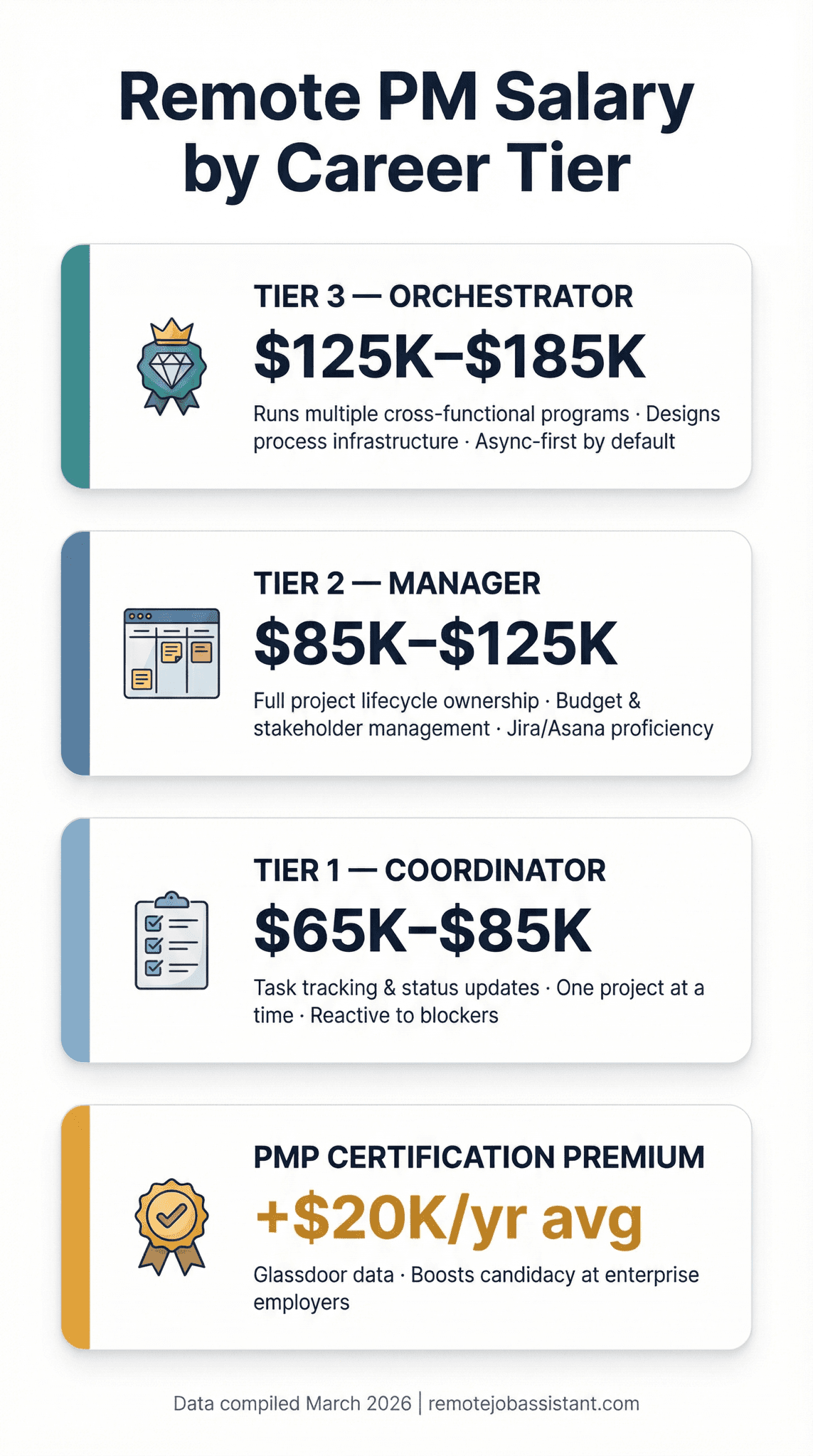
ZipRecruiter's national average for remote PMs sits at $102,682 per year, and Glassdoor puts it at $104,656 — both reflecting the broad mid-level population. Built In's data for senior remote PMs shows an average base of $140,791, with total compensation reaching $156,568 when bonuses and equity are included. These anchors are useful, but where you land depends less on the national average and more on which tier of the market you're operating in.
The Remote PM Readiness Score
Most PM career frameworks describe experience in years. That's not what remote employers are actually pricing. They're pricing scope of impact and async operating capability — two things your tenure doesn't automatically establish.
The Remote PM Readiness Score is a three-tier rubric for assessing where you genuinely sit in the remote PM market — and what moves your salary negotiation number to the top of the range rather than the middle of it.
Tier 1 — Coordinator ($65K–$85K)
Criteria: Tracks tasks, updates status, and keeps the project moving when others define the direction. Relies on a manager or senior stakeholder for scope decisions. Owns one project at a time. Async communication tools are Google Docs and email. Reactive to blockers rather than proactive. Observable behavior: "I keep projects organized and make sure everyone knows their next steps."
Tier 2 — Manager ($85K–$125K)
Criteria: Runs the full project lifecycle end-to-end, including budget, timeline, and stakeholder management. Handles pushback without escalating. Uses Jira, Asana, or equivalent. Can write a project brief that earns buy-in from a team they've never met. Drives decisions in async channels rather than waiting for the next meeting. Observable behavior: "I managed a $2M initiative with six cross-functional stakeholders and delivered two weeks ahead of schedule."
Tier 3 — Orchestrator ($125K–$185K)
Criteria: Runs multiple cross-functional programs simultaneously. Designs the process infrastructure other PMs follow. Resolves executive-level misalignment without escalating further. Operates async-first by default — meetings are a tool of last resort, not the default coordination mechanism. Observable behavior: "I rebuilt the PMO structure for a 400-person engineering org and reduced time-to-delivery by 30% over three quarters."
How to use it: Find your tier based on the criteria — not your job title, not your years of experience. Your salary negotiation number is the top of your tier. Your interview talking track is built around the criteria one tier above you, demonstrating you're already doing that work. If you're applying for Tier 2 roles, your stories should sound like Tier 2 criteria, not Tier 1 task lists.
"PMP certification adds approx. $20,000 to your annual salary — but it does not tell a hiring manager whether you can manage a team you've never met in person."
That $20K PMP premium (Glassdoor data, 2026) is real and worth pursuing. It also doesn't substitute for evidence of remote operating competence, which is what separates finalists in the offer stage. Browse open remote project manager job listings to see how companies are phrasing these requirements right now. For the full picture on six-figure remote PM salaries, the bar-setting factors are tier and industry — not credential count.
Stop Applying Manually
Our AI applies to hundreds of matching jobs while you sleep. Wake up to interviews, not more applications.
The Industries Paying the Most for Remote PMs
Industry matters more than company size for PM salary. A mid-level PM at a Series C SaaS company often earns more than a senior PM at a mid-market healthcare system — and the inverse is true when comparing enterprise tech to marketing agencies. Knowing the ceiling of your target industry before you start negotiating is the difference between anchoring at $105K and anchoring at $130K for equivalent experience.
| Industry | Mid-Level PM Range | Notes |
|---|---|---|
| Tech / SaaS | $95K–$135K | Highest ceiling; most remote-friendly culture |
| Finance / Fintech | $90K–$130K | Compliance familiarity valued; async-mature orgs |
| Healthcare / MedTech | $85K–$120K | PMP or clinical PM cert valued; strong benefits |
| Consulting | $80K–$120K | Client-facing scope; may require occasional travel |
| Government / Defense | $75K–$110K | PMP commonly required; less variance in comp |
| Marketing Agencies | $70K–$95K | Lower ceiling; more fully remote options |
The Bureau of Labor Statistics projects 6% growth for project management specialists from 2024 to 2034 — faster than the all-occupations average — with approximately 78,200 annual openings. In 2025, project management was the number-one remote job category on FlexJobs, outpacing computer and IT roles for the first time.
Companies Actively Hiring Remote PMs in 2026
These eight employers appeared consistently across our sample and are verified active hirers based on current career pages and FlexJobs employer data:
TELUS — Ranked #1 on FlexJobs' Top 100 Remote Companies for 2026. Broad PM scope across telecom and digital services.
Elevance Health — Top 5 on FlexJobs since 2014. Healthcare PM roles with genuine remote schedules; strong total comp.
Lockheed Martin — Government and defense program management. PMP typically required; structured comp in the $90K–$120K range.
KPMG LLP — Requires PMP or CSM plus Jira and Confluence proficiency. Consulting scope means exposure to multiple industries.
Canonical — Remote Americas-based PM roles for Ubuntu Embedded Systems programs. PMP or PRINCE2 preferred; genuinely distributed team.
SAP — Consistent top remote employer since 2014. Enterprise software PM roles with strong equity components at senior levels.
UnitedHealth Group — On FlexJobs' top remote employer list every year since 2014. Healthcare IT program management with solid benefits.
Cognizant — New 2026 entrant to FlexJobs Top 100. IT services PM roles at mid-to-senior levels with expanding remote headcount.
For a deeper look at which of these companies are actively posting right now, the companies hiring remote PMs in 2026 companion post tracks open roles and hiring activity by employer. Browse remote project management roles to filter by industry and level.
The Skills That Actually Get Remote PMs Hired
Sixty-one percent of postings in our sample listed PMP or an equivalent certification as preferred or required. That's the filter. What actually gets you the offer is different — and most PM candidates optimize entirely for the filter while underinvesting in the differentiator.
Certifications: What Each One Does for Your Candidacy
| Certification | Who Should Get It | Salary Impact |
|---|---|---|
| PMP (PMI) | Mid-to-senior PMs with 3+ years exp | +$20K/yr avg (Glassdoor) |
| CAPM (PMI) | Entry-level PMs, pre-experience | Baseline ATS credential |
| CSM (Scrum Alliance) | Agile/tech PM roles | Required in 38% of tech PM postings |
| PMI-ACP | Agile-heavy environments | Preferred in SaaS; complements PMP |
| PRINCE2 Practitioner | UK/international companies | Required at Canonical and similar |
For enterprise employers like KPMG or Lockheed Martin, PMP is often a hard filter — 61% of postings in our sample listed it as preferred or required, and that percentage climbs at senior levels. Glassdoor's 2026 data shows PMP-certified PMs earning an average of $20,000 more per year than non-certified counterparts at equivalent experience levels.
The trade-off is real: the exam costs $500+ with 35 hours of required prep before you're eligible to sit. At SaaS companies and startups, many hiring managers treat the PMP as an HR checkbox — they care more about delivery stories and async communication proof. If your target is enterprise, get it. If your target is SaaS, build the stories first.
One more thing nobody says out loud: at large enterprises, PMP certification can also lock you into a more rigid career path — process-heavy program offices where innovation is slow and remote flexibility is real but constrained by bureaucracy. The highest-paying SaaS roles (Tier 3, $140K–$185K) often go to PMs without PMP who can show a portfolio of fast-cycle delivery in distributed environments. The certification earns you the interview; the delivery story closes the offer.
The PMP gets you past the ATS. It does not win the interview.
Tools That Appear in Postings — and Which to Learn First
Our analysis found these tools cited most frequently across the 1,240 postings:
- Jira — 57% of tech PM postings (n=709 tech PM postings in our sample)
- Asana — 43% of all postings
- Confluence — 39% (frequently listed alongside Jira)
- MS Project — 28% (enterprise and government roles)
- ClickUp — 22% (growing; common at mid-market and startups)
Jira proficiency is non-negotiable for tech and SaaS PM roles. If it's absent from your resume, you'll be filtered before a human reads it at most software companies. If you're new to Jira, Atlassian's free Jira fundamentals course covers board setup and workflows in about two hours — enough to speak credibly in an interview. Asana skills are the second priority for non-tech PM roles — it appears in nearly half of all remote PM postings regardless of industry, and their free trial gives you hands-on project setup quickly. For enterprise targets like KPMG, Confluence is the third priority — it's required in 39% of postings and almost always listed alongside Jira. MS Project matters only if you're targeting government or defense. Skip it otherwise.
Decision rule: Match your top tool to your target industry, not posting frequency.
The Async Communication Filter
Forty-eight percent of postings in our sample explicitly required async communication skills or tools proficiency — phrases like "async-first communication," "able to drive decisions without synchronous meetings," and "experience managing distributed teams across time zones." That number has increased from an estimated 31% in 2023, and it's the fastest-growing requirement category in remote PM job descriptions.
In-office PMs have a built-in shortcut: the hallway conversation, the impromptu desk stop, the whiteboard session that unblocks a stuck stakeholder in 15 minutes. Remote PMs don't have those shortcuts. They need to replicate that decision velocity in writing — in Slack threads, async Loom videos, and written project briefs that generate buy-in without a meeting to anchor them.
"The gap between a $100K remote PM and a $140K remote PM is rarely certifications. It's whether you can close a stakeholder dispute over Slack in 24 hours or less."
A PM on a distributed team assumed a stakeholder in a different time zone would respond to urgent Slack pings during a critical launch. They did not. The delay cost a 48-hour slip on a $500K project milestone. The fix: explicit 24-hour response windows written into every project charter, and a shared async decision log. Blockers cut by 70% on subsequent distributed projects.
Here's the three-part async system that prevents that slip. Use it before your next launch, not after: (1) At project kickoff, write the response window into the charter — "All critical decisions require a response within 24 hours; failure to respond defaults to the last documented recommendation." (2) Maintain a shared decision log in Confluence with timestamped updates, named owners, and a clear column for "resolved vs. pending." (3) For complex context, record a 3-minute Loom video instead of a 1,000-word email — it cuts misunderstandings in half and doesn't require everyone to be online at the same time. This isn't theory. The PMs getting Tier 2 and Tier 3 offers can describe a specific project where they applied this. The ones who can't are still at Tier 1.
Most remote PM candidates focus on certifications. The interviews that convert to offers go to candidates who can describe a specific situation where they drove alignment across distributed stakeholders without a meeting. Hiring managers at KPMG, Canonical, and Elevance Health are trained to ask for this. If you can't name a real example with a specific outcome — a decision made, a blocker cleared, a team realigned — that's not a credential gap. It's a readiness signal. Bring a real example. Know the details. If you don't have one yet, that's the gap to close before you start applying.
The PMs clearing Tier 2 and Tier 3 offers aren't just more certified. They've built a practice of async communication — decision logs, documented escalation paths, async standups for distributed teams — that they can describe precisely when a hiring manager asks. For a comparison of how this skill set differs between adjacent roles, see our breakdown of scrum master vs project manager salary differences and how each role handles remote coordination.
Stop Applying Manually
Our AI applies to hundreds of matching jobs while you sleep. Wake up to interviews, not more applications.
How to Land a Remote PM Job — What Nobody Tells You
At the $85K–$140K level, the job search tactics that work are different from what you've probably been doing. General job boards at volume don't convert for senior roles. The signal-to-noise ratio is too low, and the competition pool is largest where the application friction is lowest.
Where to Search
Skip general job boards for senior PM roles. FlexJobs, LinkedIn with strict remote filters, and direct company career pages convert at significantly higher rates for experienced PMs. FlexJobs manually vets every listing — the 400 genuinely remote PM postings you'll find there are worth more than the 5,000 LinkedIn results that include hybrid, ghost postings, and roles that became "remote-eligible" for the listing and will ask you to relocate by month three. The trade-off: FlexJobs costs $24.95/month, but the vetting removes the noise that makes general boards exhausting at the senior level.
When using LinkedIn, filter for "Remote" and sort by "Most Recent" — postings in the last 24 hours attract far fewer applications than week-old listings. Avoid Easy Apply for senior roles — a tailored application to a human posting converts at two to three times the rate of auto-submitted applications, especially above the $100K threshold.
For direct career pages, set Google Alerts for "[company name] remote project manager" — companies like TELUS and Canonical often post roles that never make it to aggregators. You'll catch them before the application pool fills.
Remote Job Assistant's auto-apply tool filters for genuine remote eligibility, salary transparency, and posting recency automatically, so you're reviewing a curated shortlist instead of sorting through noise manually. Browse open remote project manager job listings with remote filters already applied.
Your Résumé Needs a Remote Signal in the Summary
Hiring managers at remote-first companies scan for remote work signals before reading the rest of your résumé. A two-sentence summary callout — "I've managed distributed teams across three time zones for the past four years using async-first communication practices" — does more work than a fully detailed work history from a single-office environment. Put it at the top. Don't bury it in a job description dated three roles back.
Resume keywords that appeared most frequently in high-salary postings from our sample:
- "Async communication"
- "Cross-functional stakeholder management"
- "Budget ownership" or "P&L ownership"
- "Risk mitigation"
- "Agile/Scrum delivery"
- "Distributed team management"
The Interview Question That Decides It
Every remote PM interview at a serious company includes some version of this: "How do you handle a situation where a key stakeholder goes silent during a critical project phase?"
Wrong answer: "I'd escalate to their manager."
Right answer: A specific system — documented communication cadences, async decision logs with built-in response windows, defined escalation triggers, and a named example where you've applied it. The companies hiring Tier 2 and Tier 3 PMs are not impressed by your escalation reflex. They're looking for evidence of a process. Show the system, not the reaction.
"Most remote PM job descriptions list 10–15 requirements. Hiring managers care about 2: shipped deliverables and async stakeholder management. Everything else is filler."
Companies Are Not All Equal on Remote
Government and defense contractors often list roles as fully remote but expect 20–30% travel or on-site presence for briefings. Check the travel expectations in the job description before applying, not after you've accepted.
Verify the remote policy before you invest in an interview cycle. A meaningful number of "remote" PM postings at defense and government contractors require quarterly on-site program reviews, PI planning attendance, or clearance processing at a specific facility. Check Glassdoor reviews for mentions of "remote policy," "on-site requirements," or "return to office" from employees in PM or program management roles. This takes five minutes and protects you from wasting weeks on a role that will ask you to relocate or travel 30% of the time.
The same bait-and-switch happens at mid-market companies undergoing RTO pressure: they hire remote to fill the role faster, then shift expectations six months in when a new executive decides the team needs to be in the office twice a week. If the company doesn't have a written remote work policy published on their careers page or Glassdoor profile, that absence is a data point. Ask directly in your final interview round: "What is your policy if the company's remote work stance changes?" The answer — or the hesitation before it — tells you everything.
Stop Applying Manually
Our AI applies to hundreds of matching jobs while you sleep. Wake up to interviews, not more applications.
Career Progression for Remote Project Managers
The remote PM career ladder follows a clear path — but the moves that advance you are different from what an in-office environment rewards. Visibility in a remote org comes from your written output, your async decision-making record, and your cross-functional relationships across teams you may never meet. Promotions don't come from being seen at your desk; they come from documented outcomes.
Junior PM → PM → Senior PM → Principal PM / Director of PMO
The critical inflection points:
- Junior to mid-level is about delivery. You need to own a project end-to-end and have quantified outcomes to show for it. Budget, timeline, stakeholder satisfaction — not just task completion.
- Mid-level to senior is about owning the process others follow. Senior PMs aren't just managing bigger projects; they're setting the standards, building the templates, and resolving the escalations that junior PMs can't close.
- Senior to Director is about building the function. Director-level PMs are hiring other PMs, designing the PMO structure, and translating delivery performance into language executives act on.
Adjacent Transitions Worth Considering
The PM skill set transitions cleanly into two adjacent roles with distinct salary implications:
PM to Program Manager — Managing multiple related projects and strategic programs rather than individual project delivery. The remote program manager vs. project manager breakdown covers the scope differences and salary delta in detail. Program Manager roles typically sit in the $115K–$155K range for fully remote positions.
PM to Product Manager — A more significant pivot that requires product intuition and data fluency, but the salary upside is real: remote Product Manager roles average $115K–$165K. The role shift is about moving from "will we deliver this?" to "should we build this?" — different stakeholders, different tools, different success metrics.
PM to Scrum Master — A specialization rather than a promotion, typically in Agile-heavy environments. Salary range runs $95K–$135K for remote roles, with strong demand in healthcare and defense. See the full remote scrum master jobs guide for the career tier breakdown.
Building your Jira proficiency and Asana skills is investment that pays across all three tracks. The tools are different; the underlying workflow design competency is the same.
Frequently Asked Questions
I'm a project manager with my PMP — how do I transition to fully remote roles?
The PMP gets you past the ATS filter; the transition to fully remote requires a different kind of proof. Start by identifying whether your work history includes any distributed team experience, async decision-making, or cross-timezone stakeholder management — even informally. If it does, make that explicit in your résumé summary and prepare a specific interview example around it. If it doesn't, take on a distributed project internally or do contract work with a remote team before targeting enterprise remote roles. Companies like TELUS and Canonical are explicit about wanting documented async-first operating experience, not just remote-willingness.
What do remote PM interviews ask about that in-office interviews don't?
The question that separates finalists at remote PM companies is some version of: "Walk me through how you keep a distributed team aligned when a critical decision needs to be made and no one is online at the same time." In-office PM interviews focus on delivery outcomes and stakeholder relationships. Remote PM interviews focus on your process infrastructure — how you document decisions, how you set communication cadences, how you unblock without a meeting. Prepare two or three specific examples with named outcomes. "I drove alignment" is not an answer. "I used an async decision log with a 48-hour response window and closed a stakeholder dispute without a meeting — here's what that looked like" is.
What is the Remote PM Readiness Score, and how do I know which tier I'm in?
The Remote PM Readiness Score is a three-tier framework we use to map where a PM's actual scope of impact sits relative to what the market will pay for remote work. Tier 1 Coordinators ($65K–$85K) track tasks and update others; Tier 2 Managers ($85K–$125K) run the full project lifecycle including budget and stakeholder management; Tier 3 Orchestrators ($125K–$185K) run multiple cross-functional programs and design process infrastructure others follow. To find your tier, read the criteria for each and identify which one describes your actual day-to-day — not your job title. Your salary negotiation number is the top of your tier. Your interview strategy is to demonstrate criteria from the tier above.
What salary should I expect in my first remote PM role if I'm coming from an in-office position?
If you're transitioning from an in-office role at similar experience level and scope, expect to land within the same tier range — but know that without documented remote or async experience, some companies will offer toward the bottom of the tier rather than the top. The salary is not the main adjustment; the repositioning work is. Update your résumé to foreground any distributed team experience, even if it wasn't your primary work. If you have none, be honest about it in interviews and have a clear plan for building it quickly. Coming in at $5K–$10K below your in-office rate to gain the remote track record is a common trade-off that pays back within a year when you're competing at full level.
Is getting PMP certification worth it if I already have 5+ years of experience?
Yes — and more precisely, yes if your target roles are at $100K+ and you don't already have it. Glassdoor's 2026 data shows a $20,000 average annual salary premium for PMP-certified PMs versus non-certified counterparts at equivalent experience levels. More practically: 61% of the postings we analyzed listed PMP as preferred or required, and that percentage climbs at the senior level. The credential doesn't make you a better PM. It does remove you from the "no" pile at the ATS stage and strengthens your negotiation position at offer. If you have 5+ years and no PMP, the ROI on the exam investment is typically recovered in the first year of a higher-compensated role.
How do remote project managers handle teams across different time zones without burning out?
The PMs who handle timezone distribution without burning out treat it as a system design problem, not a scheduling problem. They set explicit async-first norms at project kickoff: defined response windows, a shared decision log, and a clear rule about what requires a synchronous meeting vs. what can be resolved async. They over-communicate context in writing so that team members in different zones can unblock themselves without waiting for the next overlap window. And they protect their own overlap hours — the ones where they're available to the most time zones — from becoming an eight-hour open calendar. Burnout in distributed PM roles almost always comes from trying to be synchronously available to every timezone, which is unsustainable. The fix is process, not availability.
What tools do I need to know to get hired as a remote PM in 2026?
Jira appeared in 57% of tech PM postings in our sample and is close to required for software and SaaS PM roles — if it's not on your resume, you're filtered before a human reads it. Asana appeared in 43% of all postings and is the second priority for the broader market. Confluence is frequently required alongside Jira (39% of postings), particularly at enterprise employers. For government and defense roles, MS Project remains common at 28% of postings. If you're newer to these tools, Atlassian's free Jira fundamentals course covers enough to speak credibly about board setup and workflows in a few hours of self-paced work. For senior roles, being able to describe a specific workflow configuration you built — not just "proficient in Jira" — is what hiring managers at KPMG and Canonical remember.
Start Your Remote PM Career
The remote PM job market is strong — 6% BLS-projected growth through 2034 and a backlog of roles at the $85K–$145K tier that companies are actively trying to fill. Demand for remote PMs isn't the issue — BLS projects 6% growth through 2034. The real hurdle is proving async readiness when 48% of postings (n=595/1,240) explicitly require it, and most in-office PMs cannot prove it without a real story. Build one before you apply. Use the Remote PM Readiness Score to anchor your tier, build your async operating story before your first senior interview, and target companies like TELUS, Canonical, and Elevance Health that have demonstrated infrastructure for distributed PM work.
Remote Job Assistant's auto-apply tool filters for genuine remote eligibility and salary transparency before you ever see a listing — no more sorting through 5,000 results to find the 400 that are real. For the companies most actively hiring right now, the remote PM companies list for 2026 tracks verified active hirers with open roles. If you're weighing a transition to Program Manager, the program manager vs. project manager guide covers the scope and salary differences clearly.
Browse all remote project management roles, or explore high-paying remote jobs across the full $100K+ remote landscape. For real-world PM discussions — war stories, tool debates, job search wins and losses — the r/projectmanagement community is worth bookmarking.
The companies hiring remote PMs in 2026 aren't looking for someone who can run a meeting — they're looking for someone who can run a project without one.
Ready to Find Your Remote Job?
Browse thousands of curated remote jobs or let AI apply for you.
Browse Remote JobsRelated Job Guides
Remote Benefits Specialist Jobs: 131 of 1,523 Are Remote
We read 1,523 benefits specialist postings. 131 are fully remote. See which employers hire remote, which seats pay $75K+, and how to spot look-alike listings.
25 min read
Remote Auditor Jobs: 554 of 3,422 Postings Are Fully Remote
We read 3,422 auditor job postings. 554 are fully remote, and 244 of those are healthcare audits. See which audit seats hire remotely and what each pays.
27 min read
Remote Loan Processor Jobs: 49 of 490 Are Fully Remote
We read 490 loan processor postings. 49 are fully remote, most at non-bank lenders. See who pays hourly, who pays per file, and where $75K processor pay starts.
24 min read