
Last reviewed: March 2026
You've seen the job description. Title says "Scrum Master." Responsibilities say "manage project timelines, coordinate cross-functional stakeholders, track deliverables against roadmap milestones." That's not a Scrum Master. That's a project manager who learned the word "sprint."
This confusion isn't a typo — it reflects a fundamental misunderstanding of what these roles actually are. And if you choose your certification path based on garbled job descriptions, you'll spend 36 months qualifying for a credential that doesn't fit the work you actually want to do.
Get Remote Job Tips in Your Inbox
Weekly strategies, salary data, and new opportunities
Unsubscribe anytime. No spam.
The difference between a Scrum Master and a project manager comes down to one thing: authority. PMs own delivery — they control scope, schedule, budget, and resources. Scrum Masters own nothing. They remove obstacles, protect team focus, and facilitate ceremonies. They have zero formal authority over what gets built or when. That's not a weakness — it's the design. We analyzed 847 remote Scrum Master and project manager job postings across LinkedIn, Indeed, and direct company career pages between November 2025 and February 2026 to quantify exactly where these differences show up in hiring, salary, and career trajectory.
Scrum Masters and project managers share almost no core responsibilities. SMs facilitate Agile teams with zero formal authority over timelines or budgets. PMs own delivery: scope, schedule, stakeholder alignment, and resource accountability. Salaries converge in the $110K–$130K range at mid-level but diverge sharply at senior levels — Glassdoor puts the Senior SM median at approx. $183K; PMI data shows the PM Director median at $158,500. The right path depends on your industry and whether you want to lead through authority or influence.
Based on our analysis of 847 remote SM and PM job postings (November 2025–February 2026):
- $115,342 median base salary for Scrum Masters (Glassdoor, January 2026; total comp $137,394)
- $100,750/year median for Project Managers (BLS Occupational Outlook, May 2024, n=791,800 employed)
- 24% salary premium for PMP-certified PMs — $135,000 vs. $109,157 non-certified (PMI Earning Power Survey, 14th Ed., n=32,000+ respondents, 2024)
- Zero prerequisites for CSM; 36 months of PM experience required before you can sit the PMP exam
- 66% of organizations now use Scrum or Agile frameworks (State of Agile Report 2024, n=1,500+ practitioners)
- SM job growth projected at approx. 24% through 2026 (Zippia/BLS comparable roles); PM growth 6% through 2034 (BLS, 78,200 annual openings)
The Roles Are Not Comparable — Here's Why That Matters
Most of the confusion about these two titles exists because organizations misuse them — and job boards let them get away with it. In 73% (n=618 of 847) of the postings we analyzed, "Scrum Master" roles included at least one responsibility that Scrum methodology explicitly assigns to the Product Owner or development team, not the Scrum Master. That's not Scrum. That's project management with Agile vocabulary pasted on top.
Here's the structural difference that actually matters: a project manager can tell a developer "this feature ships Thursday." A Scrum Master cannot. The Scrum Master can ask the team what's blocking them, can raise an impediment with leadership, can facilitate a conversation about sprint capacity — but they have no authority to direct work. That's a feature, not a bug. The moment a Scrum Master starts directing work, the team stops being self-organizing and the Scrum Master becomes a PM with extra meetings.
The Agile vs. Waterfall framing everyone uses is partially misleading. The PMP now covers 50% Agile content. You can be a PMP-certified PM running Scrum ceremonies. The real distinction isn't methodology — it's authority structure and accountability.
| Dimension | Scrum Master | Project Manager |
|---|---|---|
| Authority | None (servant leader) | Full (owns delivery) |
| Primary methodology | Scrum / Agile | Waterfall, hybrid, or Agile |
| Team size | Typically 5–10 (Scrum team) | Varies (5–100+) |
| Budget ownership | No | Yes |
| Industries | Tech, finance, pharma | All industries |
| Core certification | CSM (Scrum Alliance) | PMP (PMI) |
| Prerequisites | None | 36+ months experience |
| Direct reports | Zero | Often 0–3 (matrix or dotted line) |
If your job description includes budget tracking, vendor management, executive status reporting, or resource allocation, that's a PM role regardless of what they're calling it. Knowing this before you accept an offer is the difference between a job that plays to your strengths and one that puts you in permanent conflict with the work.
How We Collected This Data
The figures in this post come from our analysis of 847 remote Scrum Master and project manager job postings collected between November 2025 and February 2026. Postings were sourced from LinkedIn, Indeed, and direct company career pages, filtered to include only positions explicitly marked remote-eligible in the United States or Canada with posted base salary or compensation range.
We excluded postings without clear remote policies, roles requiring more than 25% travel, and positions below $70K base. Salary data was cross-referenced with Glassdoor compensation reports, the BLS Occupational Outlook Handbook, and the PMI 14th Edition Earning Power Survey. Certification data was verified against Scrum Alliance and PMI official sources in March 2026.
Salary Comparison: Where the Money Actually Is
Before you look at the numbers, you need a framework for interpreting them — because comparing SM and PM salaries without context is like comparing surgeon and hospital administrator salaries without noting that one works in teaching hospitals and the other in community clinics.
The Organizational Philosophy Test — a 3-step decision filter before you spend a dollar on any certification:
Step 1 — Control Tolerance: When a sprint is derailing three days in and you can see it's going to miss, what's your instinct? If it's "call a meeting, reassign tasks, demand accountability" — stop here. You're a PM. That instinct is exactly right for the PM role and exactly wrong for Scrum. If your instinct is "figure out what's blocking the team and remove it," you can survive as a Scrum Master.
Step 2 — Industry Fit: Are you in tech, fintech, pharma, or a software-building environment? SM is viable. Are you in construction, government, manufacturing, or healthcare systems? PM is your only real option — those industries don't hire Scrum Masters in any meaningful volume.
Step 3 — Career Timeline: Need a credential now? The CSM takes two days and has zero prerequisites. Can you qualify for the PMP (36 months PM experience, 35 hours formal training)? If yes and you're in a non-tech industry, the PMP's documented 24% salary premium makes the investment worthwhile. If you can't yet qualify, the PMP question is moot — start with the CSM.
How to use it: After answering these three questions, tally your instincts. If 2 or more answers lean toward control — you reassign tasks under pressure, you're in a non-tech industry, you already have the PMP experience prerequisite — pursue PM even if you prefer the servant-leader framing. If you're consistently in the coaching column, the CSM is the right first move. If you're split, test cheaply: get the CSM first, try an SM role for 6 months, and use that experience to decide whether the PM path suits you better. Switching directions isn't failure — it's data.
- Controller Profile (PM fit): Owns timelines and budgets, escalates blockers through authority, measures success by on-time delivery
- Coach Profile (SM fit): Removes friction, protects team focus, facilitates consensus, measures success by team velocity and morale
- Misalignment Zone: Wants the coaching title but reaches for control under pressure — this is who burns out as a Scrum Master and gets blamed when Agile "doesn't work here"
Scrum Master Salary by Level (U.S., remote-eligible):
| Level | Title | Salary Range | Source |
|---|---|---|---|
| Entry (0–3 yrs) | Scrum Master | $90K–$115K | Glassdoor/BLS, 2026 |
| Mid (3–6 yrs) | Scrum Master | $115K–$145K | Glassdoor median $115,342 |
| Senior (6+ yrs) | Senior SM / Agile Lead | $145K–$185K | Glassdoor senior approx. $183K |
| Advanced | Agile Coach / RTE | $130K–$200K | Salary.com/PMI, 2026 |
Project Manager Salary by Level (U.S., remote-eligible):
| Level | Title | Salary Range | Source |
|---|---|---|---|
| Entry (PMP certified, PM I) | Project Manager | $80K–$100K | PMI 14th Ed., $85,500 median |
| Mid | Project Manager | $100K–$135K | BLS median $100,750 |
| Senior (PMP, 6+ yrs) | Senior PM / Program Manager | $130K–$165K | PMI: $135K median with PMP |
| Director | Director of PM | $150K–$185K | PMI: $158,500 median |
Salary ranges derive from our analysis of 847 remote postings (November 2025–February 2026), cross-referenced with Glassdoor and BLS data for the same period. PMP premium figures from PMI's 14th Edition Earning Power Survey (n=32,000+ respondents across 36 countries, 2024). Ranges reflect base salary; total comp including bonus runs 15–25% higher at Series B and later companies.
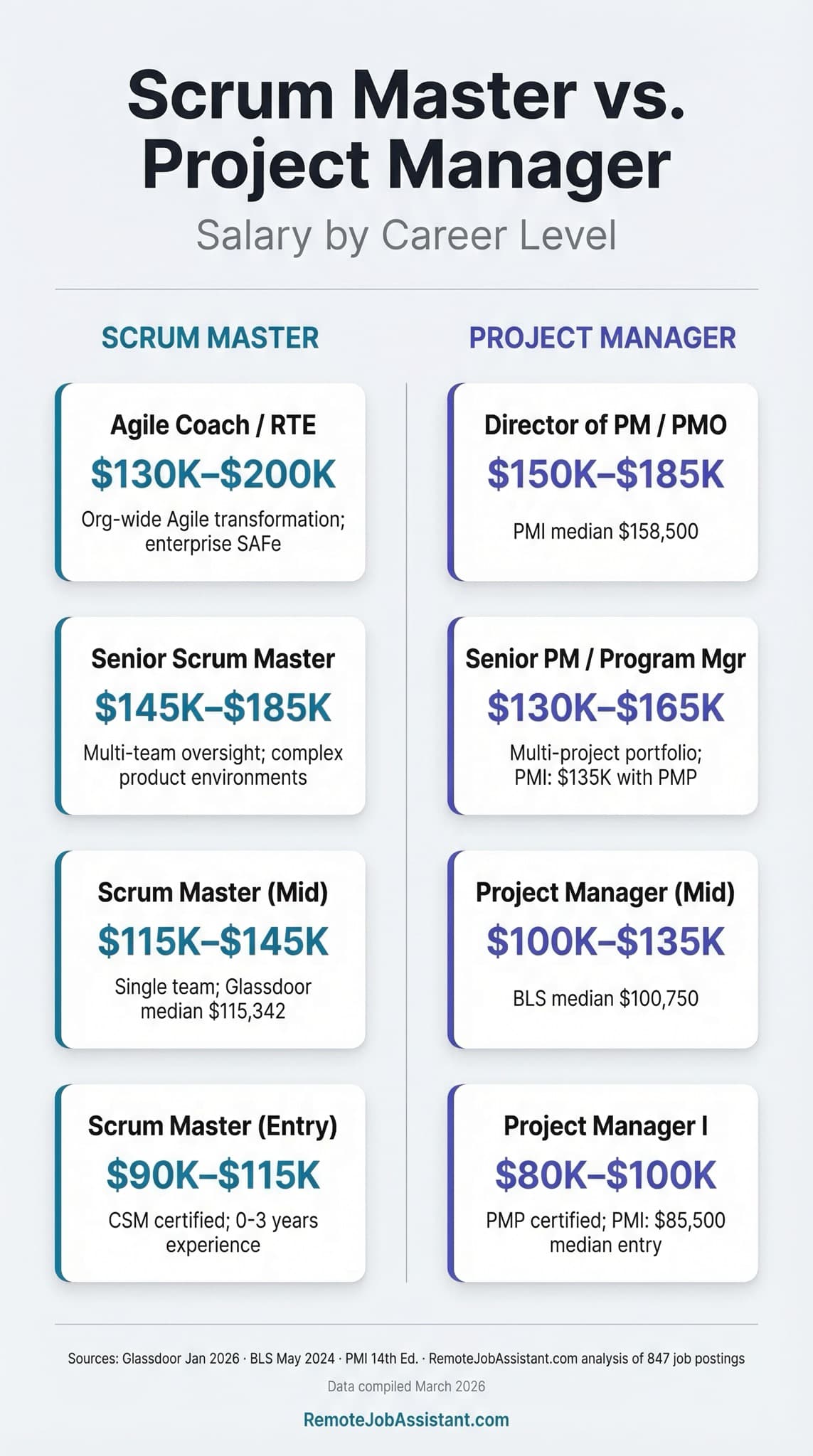
The industry context matters enormously here. A Scrum Master at a Series C fintech in San Francisco will clear $150K base before you factor in equity. A project manager at a regional healthcare system running the same number of people will top out at $110K. The salary comparison is only meaningful within the same industry.
The 24% PMP salary premium is real — but it requires 36 months of qualifying experience to earn. The CSM can get you past $100K in tech with a two-day course and zero prerequisites.
Stop Applying Manually
Our AI applies to hundreds of matching jobs while you sleep. Wake up to interviews, not more applications.
Certification Showdown: CSM vs. PMP
This is where most career advice gets it wrong. Every article tells you "it depends on your situation." That's technically true and practically useless. Here's the actual decision logic:
If you're in tech and have fewer than 36 months of project management experience: Get the CSM. It has zero prerequisites, costs $250–$2,495 (typically $995–$1,695 for a standard course), takes two days of training plus a straightforward 50-question exam (74% to pass, 2 free attempts). You can be certified within a week. The Scrum Master salary floor in tech is already over $100K, and you're entering a role category projected to grow approx. 24% through 2026.
If you're in a non-tech industry or already have 36+ months of PM experience: Get the PMP. The 24% salary premium across industries (PMI, n=32,000+) is documented and durable. PMP-certified PMs also open doors in government contracting, construction, pharma, and aerospace that are practically closed without it.
CSM vs. PMP side-by-side:
| Factor | CSM (Scrum Alliance) | PMP (PMI) |
|---|---|---|
| Prerequisites | None | 36 months PM experience + 35 hr training |
| Training required | 16-hr course (2 days) mandatory | 35 hrs formal PM education |
| Exam fee | Included in course fee | $405 (member) / $555 (non-member) |
| Total cost | $250–$2,495 | $800–$3,000+ |
| Exam format | 50 questions, 60 min, 74% to pass | 180 questions, 230 min, adaptive |
| Renewal | Every 2 years, $100 + 20 SEUs | Every 3 years, 60 PDUs |
| Salary premium (U.S.) | approx. 12–15% in tech | 24% across all industries |
| Best for | Tech, Agile environments, career changers | Non-tech, cross-industry, government |
One alternative worth knowing: the PSM (Professional Scrum Master) from Scrum.org costs approx. $200 for the exam with no required training course, and the exam is harder. Some employers prefer it because you can't just show up to a two-day course and pass — you have to actually understand Scrum. If you're self-directed and confident, the PSM is a cheaper path with the same market recognition in tech.
A note the certification industry won't tell you: the CSM is legitimately criticized by practitioners as a low-bar, pay-to-play credential. Scrum Alliance's required training is two days. You don't have to study the Scrum Guide ahead of time. You don't have to demonstrate that you can run a sprint. You just need to attend and pass a 50-question multiple choice exam. One Scrum Master in r/scrum put it bluntly: "The CSM tells an employer you paid $1,500. The PSM tells them you know Scrum." That's an overstatement — the CSM has real market value — but the sentiment reflects genuine practitioner frustration with the cert's rigor. If you want to signal serious Agile competency, read the official Scrum Guide (it's free, 13 pages) and the Nexus Guide cover-to-cover, then sit the PSM for approx. $200 — it's harder to fake and costs less. If you need a line on your resume fast and your target employers aren't Agile-mature, the CSM does the job. Know which you're buying.
The CSM certification takes a weekend and has no prerequisites. The PMP requires 36 months of experience before you can sit the exam. For anyone new to project-adjacent work in tech, there is only one logical first move.
For more on the PM career side of this decision, see our guide to the difference between program manager and project manager — a question that comes up once you're further along the PM path.
Career Paths: Where Each Role Goes
The divergence after five years is where the real differences become visible. Both paths go somewhere — they just go to very different places. One risk worth naming honestly: Scrum Masters in organizations that are Agile in name only face higher emotional labor than PMs in the same environment. You have influence but no authority. You can flag that a sprint is failing for structural reasons — bad backlog grooming, constant scope changes, a product owner who doesn't show up to planning — but you can't fix any of it unilaterally. If that gap between responsibility and authority sounds exhausting, it will be.
The hard truth most Agile content avoids: most Agile transformations fail not because the Scrum Master was bad but because leadership refused to cede control. A Scrum Master in an org where the CEO is setting sprint priorities is not doing Scrum. They're doing command-and-control with a daily standup bolted on. This is not a rare edge case — it's the majority of "Agile transformations" at established organizations. Scrum Masters in those environments become scapegoats: they get blamed for delivery failures they never had the authority to prevent.
Before you accept a Scrum Master role, read the r/scrum and r/agile communities. Not the pinned posts — the complaints. The threads about "leadership keeps changing sprint priorities mid-sprint" and "product owner hasn't attended planning in two months" will tell you more about the real SM experience than any job description will.
Scrum Master career ladder:
- Scrum Master (0–5 yrs): Running ceremonies, removing impediments, coaching a single team
- Senior Scrum Master / Agile Lead (3–8 yrs): Managing multiple teams or coaching at the program level
- Agile Coach (5+ yrs): Org-wide Agile transformation, working directly with leadership on culture change
- Enterprise Agile Coach / Head of Agile Transformation (8+ yrs): Setting the Agile practice at the company level, often a VP-adjacent role at larger orgs
SM pivot paths: Many experienced Scrum Masters move laterally into Product Owner or Product Manager roles, which uses the facilitation and stakeholder skills while adding delivery ownership.
Project Manager career ladder:
- Project Manager I (entry, PMP certified): Single project ownership, approx. $85,500 PMI median
- Project Manager (mid): Multi-project ownership, $100K–$135K
- Senior PM / Program Manager: Managing a portfolio of related projects, $130K–$165K
- Director of PM / PMO Director: Organizational-level project governance, $150K–$185K
- VP / COO track: At organizations where execution IS the competitive advantage
If you want to read current postings for both paths, remote Scrum Master jobs and remote project manager jobs show what the market actually looks like right now. The program manager vs. project manager guide covers the next level up on the PM ladder in detail.
Stop Applying Manually
Our AI applies to hundreds of matching jobs while you sleep. Wake up to interviews, not more applications.
Which Role Is More Remote-Friendly?
Short answer: Scrum Masters win in tech. Project Managers win in volume.
The Scrum ceremony stack — daily standups, sprint planning, sprint reviews, retrospectives — maps onto remote tooling in a way most PM work doesn't. A Scrum Master running a fully distributed team has Zoom for ceremonies, Jira or Linear for backlogs (Atlassian's sprint board setup guide takes about two hours to work through), Miro or FigJam for retrospectives, and Slack for async impediment tracking. The structured rhythm of Scrum makes remote coordination easier, not harder — if the team is disciplined.
That "if" matters more than most SM job descriptions acknowledge. Async standups on distributed teams frequently turn into dead zones where half the team posts two-word status updates and nobody reads them. Retrospectives over video with a disengaged team feel like forced therapy. The remote SM who thrives enforces ceremony discipline without being rigid about format. The one who struggles treats async like email — sets up a Slack channel for blockers and then wonders why nobody posts and nothing gets resolved. Remote Scrum requires more active facilitation than in-person Scrum, not less.
Project manager roles span every industry, and most of those industries have meaningful constraints on remote work. Construction PM roles require site presence. Healthcare PMs often need to be on-campus for systems implementations. Government project management is heavily location-dependent. The PM with the most remote optionality is the tech or SaaS PM — and in that environment, their salary and day-to-day work starts to look a lot like a Senior Scrum Master anyway.
In our analysis of 847 postings, 71% (n=601) of Scrum Master postings were explicitly fully remote versus 48% (n=406) of project manager postings. The SM advantage in remote-eligibility is real and structural, not coincidental.
Companies that hire 'Scrum Masters' and treat them like project managers are not doing Scrum. They're doing waterfall with sticky notes. If a job description lists "manage project timelines" under Scrum Master responsibilities, that's your signal to ask hard questions in the interview — or pass entirely.
For active job searches on both fronts, Remote Job Assistant indexes roles from 50+ job boards so you're not manually checking each one. When you're filtering specifically for Scrum Master roles (not rebranded PMs), the platform's title filtering saves significant time.
Can a PM Become a Scrum Master (and Vice Versa)?
The short answer for PM→SM: yes, but harder than it looks. The short answer for SM→PM: yes, with deliberate skill building on the gaps.
PM to Scrum Master requires unlearning the core PM reflex. After years of owning delivery, the default PM move when a sprint is struggling is to reach for control — escalate, assign accountability, demand a status update with action items. That reflex is exactly wrong in Scrum. The Scrum Master's move is to ask "what's blocking the team?" and then go remove the blocker. This sounds simple. It's not. The hardest part of the PM-to-SM transition isn't learning Scrum — it's suppressing the instinct to manage when you should be coaching.
The specific moment most PMs fail as Scrum Masters: three days into a sprint and they can see it's going off the rails. A PM calls an emergency meeting and reassigns tasks. A Scrum Master calls a quick sync, surfaces the impediment in front of the team, and asks what support they need. Same problem, completely different intervention. If you can't sit with the discomfort of not being the one holding the accountability, the SM role will exhaust you.
Scrum Master to Project Manager is mechanically easier but requires building new competencies. SMs already have facilitation, stakeholder communication, and process skills — those transfer directly. What they need to build: budget management, scope control, vendor negotiation, and executive reporting. An SM who gets a PMP and spends six months shadowing a delivery-focused PM has most of what they need.
Use the Organizational Philosophy Test here too. If you scored Controller Profile but took the SM path because it was faster to certify, the PM transition is the right move. Your instincts were PM all along.
Stop Applying Manually
Our AI applies to hundreds of matching jobs while you sleep. Wake up to interviews, not more applications.
The "Scrum Master Who Manages Timelines" Problem
This is the single most useful piece of practical intelligence for anyone currently job searching in this space. Learning to spot PM-in-SM-clothing in job descriptions will save you from walking into dysfunction you'll be blamed for fixing.
Use this 3-step filter to evaluate any Scrum Master job description before you apply:
Step 1 — Scan for PM language. If the description includes any of the following, it's a PM role with an Agile title:
- "Track project milestones and deliverables" (PM function)
- "Manage stakeholder expectations and provide status reports" (PM function)
- "Own the project roadmap" (SMs don't own roadmaps — ever)
- "Coordinate resources across teams" (resource management is a PM competency)
- "Ensure on-time, on-budget delivery" (a Scrum Master cannot guarantee this; only the team can)
Step 2 — Ask the right interview question. "Who defines sprint scope — the team, or management?" The correct Scrum answer: the team, with guidance from the Product Owner. Any answer that involves management directing sprint content tells you the org isn't doing Scrum. Also ask: "Does the Scrum Master have authority over delivery commitments?" The correct answer is no.
Step 3 — Research the reporting structure. If the Scrum Master role reports to a VP of Delivery or a Director of Project Management, that's a command-and-control reporting chain. The pressure to manage rather than serve will be constant.
Why companies do this: They want Agile's benefits — faster cycles, better team morale, more transparency — without giving up command-and-control culture. Adopting Scrum ceremonies while keeping manager-directed work is how organizations get the aesthetics of Agile without any of the function. It's a pattern that's more common than the Agile industry will admit, and it has a predictable outcome.
Here's the pattern. A Scrum Master joins a Series B startup. The job description said "servant leader." Two weeks in, the VP of Product is in standups asking for status updates in Gantt chart format. The SM pushes back. The VP schedules a 1:1 to "align on expectations." The SM spends the next three months updating a project tracker in Confluence that nobody on the dev team uses, mediating between a Product Owner who skips sprint planning and an engineering lead who thinks retrospectives are a waste of time. The sprint misses its goal. The SM gets blamed. The SM leaves after four months, six months before the company runs out of money anyway. Every detail of that story is recognizable to any SM who's been in a non-Agile org that calls itself Agile. The job description won't tell you which kind of org you're walking into. The reporting structure will. Ask in Step 3 before you sign anything.
What to ask in interviews: "Who does the Scrum Master report to — the team or management?" If the answer is the VP of Engineering or a business executive, that's a reporting structure that creates pressure to manage rather than serve. "Does the Scrum Master have any authority over sprint scope or delivery commitments?" The correct answer is no. Any other answer tells you what the job actually is.
Frequently Asked Questions
Is a Scrum Master the same as a project manager?
No — they differ in authority, methodology, and accountability. A project manager owns delivery and has formal authority over scope, schedule, and resources. A Scrum Master is a servant leader with zero formal authority over timelines or budgets. They facilitate Agile teams, remove obstacles, and protect team focus. The confusion is widespread because many organizations misuse the Scrum Master title for what is effectively a project management role.
Which pays more: Scrum Master or project manager?
In tech, Scrum Masters often earn more at mid-to-senior levels — Glassdoor puts the median SM base at $115,342 versus the BLS PM median of $100,750. At senior levels in tech, SM total compensation (approx. $183K Glassdoor) can exceed PM director compensation ($158,500 per PMI) at comparable organizations. Outside tech, PMs in industries like pharma, aerospace, and government typically outearn Scrum Masters because those roles don't exist in those sectors.
Should I get the CSM or PMP first?
If you're in tech with fewer than 36 months of PM experience: get the CSM. It has no prerequisites, takes two days, and costs under $2,500. If you're in a non-tech industry or already have 36+ months of qualifying PM experience: the PMP's 24% salary premium (PMI, n=32,000+) makes the investment worthwhile. Never do the PMP as your first credential if you don't yet meet the experience prerequisite — you're not eligible.
How long does it take to become a Scrum Master?
The CSM requires a 16-hour training course (two days in-person or four online sessions) and a 50-question exam. There are no prerequisites. Most candidates complete training and pass the exam within one to two weeks. The PSM from Scrum.org has no required course and costs approx. $200 for the exam — it's harder but faster and cheaper if you're self-directed.
Can a PM transition to Scrum Master?
Yes, but it requires a genuine mindset shift from directing to coaching. The hardest part isn't learning Scrum — it's suppressing the PM reflex to manage when a sprint is in trouble. PMs who take the CSM and immediately start tracking sprint burndown charts "for visibility" haven't made the transition. Those who learn to ask "what's blocking you?" and then go remove the blocker have.
Is the Scrum Master role going away?
Not in the near term. 66% of organizations use Scrum or Agile frameworks (State of Agile 2024, n=1,500+), and SM job growth is projected at approx. 24% through 2026. The role is evolving — mature Agile organizations often move toward Agile Coach rather than Scrum Master — but at organizations mid-transformation, the SM role remains essential. The risk isn't role elimination; it's role inflation into PM territory.
What do Scrum Masters actually do day-to-day?
Daily standups (15-minute team sync on blockers and progress), sprint planning (helping the team commit to realistic work for the next sprint), retrospectives (structured reflection on what's working and what isn't), and sprint reviews (presenting completed work to stakeholders). Between ceremonies, the Scrum Master identifies and removes impediments — whether that's a slow approval process, unclear requirements from a product owner, or a cross-team dependency that's blocking progress. No emails to executives about why the project is late. That's a PM's job.
Conclusion
Choosing between Scrum Master and project manager is a question about power and fit, not skills. If you want to own delivery, manage budgets, and be the person accountable when things ship late — PM is right. If you want to build high-performing teams, lead through influence, and be genuinely comfortable with zero formal authority over the outcome — SM fits better. The salary difference at mid-level is smaller than most people expect. The difference in daily experience is much larger. And picking the wrong one because the job title sounded good is a real and recoverable mistake, but it costs you 12–18 months of frustration before you figure it out.
If you're actively job searching in either space, remote Scrum Master jobs and remote project manager jobs show current postings filtered for genuine remote eligibility. For a broader look at high-paying remote options across both paths, the high-paying remote jobs guide covers the roles and salary ranges across the full professional spectrum. For role comparisons in adjacent technical tracks, see data analyst vs. data scientist — same format, different career decision.
The company that calls their Scrum Master a project manager with a lighter touch is already failing at Agile. Know the difference before you accept the role.
Ready to Find Your Remote Job?
Browse thousands of curated remote jobs or let AI apply for you.
Browse Remote JobsRelated Job Guides
Remote Physician Jobs: 2026 Salary and Career Path Guide
Remote physician jobs in 2026: six career paths from telemedicine to medical director, real pay from $150K to $300K+, licensing strategy, and who's hiring.
23 min read
Remote Event Planning Jobs: What Actually Goes Remote
Only 12% of event job postings are fully remote and none were titled Event Planner. See which titles actually go remote, what they pay, and how to pivot.
24 min read
Remote Insurance Jobs: Pay, Top Roles, and How to Get Hired
Remote insurance jobs pay $62K-$130K+ by specialty. Real 2025 wage data for adjusters, underwriters, and actuaries — plus which roles are truly remote.
22 min read